WEED SCIENCE
Effect of Glyphosate on Fruit Retention, Yield, and Fiber Quality of
Glyphosate Resistant Cotton
Wendy A. Pline-Srnic, Keith L. Edmisten*, John W. Wilcut, Randy Wells, and Judith. L. Thomas
W. A. Pline-Srnic, Syngenta, Jealott’s Hill International Research Centre, Bracknell, Berkshire RG42 6EY, United Kingdom; K. L. Edmisten, J. W. Wilcut, and R. Wells, Department of Crop Science, North Carolina State University, Raleigh, NC 27695-7620; and J. L. Thomas, Director, Southeastern Plant Environmental Laboratory Phytotron, North Carolina State University, 2003 Gardner Hall, Raleigh, NC 27695-7618
*Corresponding author: [email protected] ABSTRACT
Glyphosate-resistant cotton allows growers greater flexibility in timing herbicide applications, as well as a broader spectrum of weed control, than that offered by other herbicide systems. Despite overwhelming adoption of glyphosate-resistant cot-ton, concern for reproductive tolerance to glypho-sate in glyphoglypho-sate-resistant cotton has been raised. Field and greenhouse studies were conducted to investigate the effect of labeled and off-label glypho-sate treatments on fruiting patterns, abnormal boll abscission, and yield of glyphosate-resistant cotton. Two separate field studies were conducted in 2000 and 2001 in Greene County, and Clayton, NC. In Greene County, NC, fruit reductions of first position sympodial bolls on node 1 through 10 were evident in 2000 and 2001 at the cutout and mid-bloom stages, respectively, when glyphosate was applied postemergence after the 4-leaf stage. These same treatments reduced seed cotton by 160 kg ha-1 compared with plants treated within
label guidelines. In Clayton, NC (2000), and in a controlled environment greenhouse, reductions in total, first position, and sympodial bolls located on nodes 1 through 10 occurred when glyphosate was applied at the 4-leaf stage postemergence and at the 8-leaf stage postemergence-directed compared with the non-treated control. Abnormal boll abscission, when a deceased boll remains attached to plant, was increased with off-labeled glyphosate treatments in Greene County, NC. Overall, differences in fruit retention due to glyphosate applications were not evident in all locations, environments, or years.
T
he herbicide glyphosate was registered for use in glyphosate-resistant cotton in the United States in 1997. A naturally occurring gene for production of 5-enolpyruvylshikimate 3-phosphatesynthase [E.C. 2.5.1.19], which was identified from Agrobacterium sp. strain CP4 and provides resistant to glyphosate (Barry et al., 1992), was cloned and expressed in several crop plants including cotton(Nida et al., 1996).Certain restrictions are specified in the registra-tion of glyphosate for glyphosate-resistant cotton (Roundup Ultra supplemental label, Monsanto Inc., St. Louis, MO, 2001). Producers may make foliar postemergence applications to cotton through the 4-leaf stage of crop development. After this stage of crop growth, producers are restricted to poste-mergence-directed spray applications to minimize glyphosate contact with leaf tissue. Producers may apply a maximum of two postemergence and two postemergence-directed applications of 1.12 kg ha-1 each growing season. Sequential glyphosate
ap-plications must be at least 10 days apart and cotton must have at least two nodes of incremental growth between applications. These label restrictions appear related to the potential for fruit loss following ap-plications during reproductive development.
Since its commercial availability, there have been performance and yield loss complaints on glypho-sate-resistant cotton in several southeastern states due to a wide-spread, but not rigorously documented, increase in lower fruiting branch boll abortions and misshapen bolls (Ferreira et al., 1998; Vargas et al., 1998). These symptoms typically occur on the first and second fruiting positions of the lower fruiting branches of glyphosate-treated cotton. Yields are often not affected by early-season fruit losses be-cause cotton compensates by relocating the boll load higher and to fruit positions further out on the plant (Jones et al., 1996). This late-season compensation may delay harvest and cause yield loss if the season is not long enough for compensatory growth (Jones and Snipes, 1999).
removal of late-season fruit was associated with increased micronaire (Jones et al., 1996). The effect of glyphosate-induced fruit loss on the fiber quality of harvested bolls from glyphosate-treated plants has not been investigated.
Because of the wide spread acceptance of glyphosate-resistant cotton, and a concern by grow-ers of perceived glyphosate-induced increases in boll abscission and pollination problems, research was initiated with two main objectives. The first objec-tive was to determine whether timing and application method of glyphosate to glyphosate-resistant cotton affects fruit retention, location of fruit on the plant, and abnormal boll abscission in glyphosate-resistant cotton grown in the field or greenhouse. The second objective was to determine whether timing and ap-plication method of glyphosate affects yield and fiber quality in field-grown glyphosate-resistant cotton.
MATERIALS AND METHODS
Field evaluations. Field studies were conducted in Greene County and in Clayton, NC, in 2000 and 2001. The tests in Greene County were conducted on farms with a previous history of high boll abscission in glyphosate-resistant cotton. The tests in Clayton were conducted at the Central Crops Research Sta-tion near Clayton, NC.
Treatments in the studies at Greene County in-cluded a non-treated control, three glyphosate treat-ments within label restrictions (a 4-leaf postemer-gence treatment, a 4-leaf postemerpostemer-gence treatment followed by (fb) a 7-leaf postemergence-directed treatment, and a 7-leaf postemergence-directed treat-ment), and three glyphosate treatments outside of label restrictions (a 7-leaf postemergence treatment, a 7-leaf postemergence fb a 12-leaf postemergence-directed treatment only in 2001 only, and a 4-leaf postemergence treatment fb a 7-leaf postemergence treatment). The cultivar used both years was Deltap-ine 5415 Roundup Ready (DP 5415RR; Delta PDeltap-ine and Land Co., Scott, MS). All glyphosate (Roundup Ultra 4.0; Monsanto, Inc., St. Louis, MO) treatments consisted of 1.12 kg ai ha-1 glyphosate and were
applied using a CO2 backpack sprayer (XR11003
spray tips). All plots received a preemergence treatment of pendemethalin (Prowl 3.3EC; BASF, Research Triangle Park, NC) at 0.84 kg ai ha-1 and
one treatment of mepiquat-chloride (Pix-Plus; BASF, Research Triangle Park, NC) at 0.84 kg ai ha-1 at the
12-leaf stage to regulate vegetative growth of cotton
according to extension recommendations for North Carolina (Edmisten, 2001). Plots were kept weed-free through the duration of the study by weeding by hand, as necessary. In 2000, plots consisted of four rows, 12.2 m long on a 0.8-m spacing. In 2001, plots consisted of twelve rows, 45.8 mlong on a 0.8-m spacing. Treatments were arranged in a randomized complete block design with four replications in 2000 and three replications in 2001.
Treatments in the studies at Clayton included the non-treated conventional cultivar Deltapine 5415 (DP5415; Delta Pine and Land Co., Scott, MS), a non-treated DP 5415RR cultivar, and two glyphosate (Roundup Ultra) treatments of 1.12 kg ai ha-1, applied
within label restrictions (a 4-leaf postemergence treatment, and a 4-leaf postemergence treatment fb an 8-leaf postemergence-directed treatment) to DP 5415RR cotton. All plots received a preemergence treatment of pendemethalin (Prowl 3.3EC) at 0.84 kg ai ha-1, a late postemergence-directed treatment
of fluometuron (Cotoran 4L; Griffin Co., Valdosta, GA) at 1.12 kg ai ha-1, and clethodim (Select 2EC;
Valent USA, Walnut Creek, CA) at 0.14 kg ai ha-1
as needed, and one treatment of mepiquat-chloride (Pix-Plus). Plots were kept weed-free with hand weeding. Plots in both years consisted of four rows, 7.6 m long on a 1.0-m spacing. Treatments in both years were arranged in a randomized complete block design with four replications.
Ten plants per plot from both field studies were plant mapped at the mid-bloom stage (2 wk after first bloom) and at reproductive cut-out (<5 nodes above white bloom) to document fruit retention and location. Seed cotton yield was determined by machine harvesting the entire plot at Greene County in 2001, or from the center two rows of the plot at Greene County in 2000 and Clayton in 2000 and 2001. Approximately 0.5 to 1.0 kg of seed cotton was separated from each plot to determine lint percentage after ginning, and for subsequent HVI fiber analysis. HVI fiber analysis of all lint samples was conducted by Cotton Incorporated (Cary, NC).
data from both years were combined. Treatment means were separated by Fisher’s Protected LSD test. Yield and quality component data were subjected to analysis of variance, and since year by treatment interactions were not significant, data from both years were combined. Data were further subjected to either single degree of freedom orthogonal contrasts (Greene County, NC) or to the Fisher’s Protected LSD means separation procedure (Clayton, NC).
Greenhouse evaluations. Cotton plants were grown in a climate-controlled greenhouse at the Southeastern Plant Environmental Laboratory with a 26/22° C day/night temperature regime. Seeds of Delta and Pine Land cultivars DP 50, DP 90, DP 5415, DP5415 RR and DP 458B/RR (Delta Pine and Land, Co., Scott, MS) were planted in 25-cm diameter pots containing a gravel-metro mix com-bination soil. DP 50 and DP 90 are parental lines for DP 5415. DP 5415 is the back cross parent for DP 5415RR and DP 458B/RR. DP 5415RR contains a gene encoding for a glyphosate-resistant 5-enolpyr-uvylshikimate 3-phosphate synthase enzyme (Nida et al., 1996), and DP 458 B/RR shares the same backcross parent as DP 5415RR (DP 5415) and an additional gene encoding an insecticidal Bacillus thurengensis var. kurstaki protein CryIA(c) (Sims et al., 1996). Plants were thinned to one per pot and were watered twice daily with a standard Phytotron nutrient mixture (Downs and Thomas, 1991). Appli-cations of 1.12 kg ai ha-1 glyphosate (Roundup Ultra)
were made to some glyphosate-resistant cotton plants as previously described. Conventional and other glyphosate-resistant plants remained non-treated. The growth regulator mepiquat-chloride (Pix-Plus) was applied to upper leaves of all plants at the rate of 0.84 kg ha-1 at the 10-leaf stage to control vegetative
growth. Treatments were arranged in a randomized complete block design with four replications, and the experiment was repeated twice. All plants were mapped during the fifth week of flowering as previ-ously described.
Statistical analysis was conducted on all data using SAS (version 8.0, SAS Institute, Cary, NC). Analysis of variance was conducted using the general linear model procedure in SAS. When the experimental trial by treatment interactions were significant (P ≤ 0.05), data were further analyzed and presented separately for 2000 and 2001. When experimental trial by treatment interactions were not significant (P > 0.05), data from both experiments were combined. Treatment means were separated by Fisher’s Protected LSD test.
RESULTS AND DISCUSSION
Field evaluations. In general, glyphosate treat-ments had a greater affect on fruit retention and boll placement on the plant in 2000 than in 2001 at both the Greene County and Clayton locations (Tables 1 through 3). At the Greene County location, the
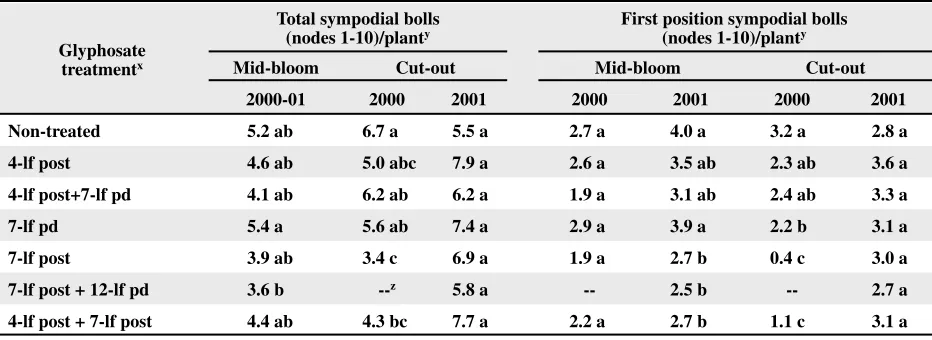
num-Table 1. Effect of glyphosate application and timing on the number of sympodial and first position sympodial bolls per plant on nodes 1 through 10 in Greene County, North Carolina, in 2000 and 2001
Glyphosate treatmentx
Total sympodial bolls
(nodes 1-10)/planty First position sympodial bolls (nodes 1-10)/planty
Mid-bloom Cut-out Mid-bloom Cut-out
2000-01 2000 2001 2000 2001 2000 2001
Non-treated 5.2 ab 6.7 a 5.5 a 2.7 a 4.0 a 3.2 a 2.8 a
4-lf post 4.6 ab 5.0 abc 7.9 a 2.6 a 3.5 ab 2.3 ab 3.6 a
4-lf post+7-lf pd 4.1 ab 6.2 ab 6.2 a 1.9 a 3.1 ab 2.4 ab 3.3 a
7-lf pd 5.4 a 5.6 ab 7.4 a 2.9 a 3.9 a 2.2 b 3.1 a
7-lf post 3.9 ab 3.4 c 6.9 a 1.9 a 2.7 b 0.4 c 3.0 a
7-lf post + 12-lf pd 3.6 b --z 5.8 a -- 2.5 b -- 2.7 a
4-lf post + 7-lf post 4.4 ab 4.3 bc 7.7 a 2.2 a 2.7 b 1.1 c 3.1 a
xPost = postemergence treatment; pd = postemergence-directed treatment.
yTen plants per plot were mapped for fruit retention and location at the mid-bloom (3rd week of flowering) and cut-out (<5
nodes above white flower) growth stages. Means within a column followed by the same letter are not significantly differ-ent according to Fisher’s Protected LSD test (P=0.05).
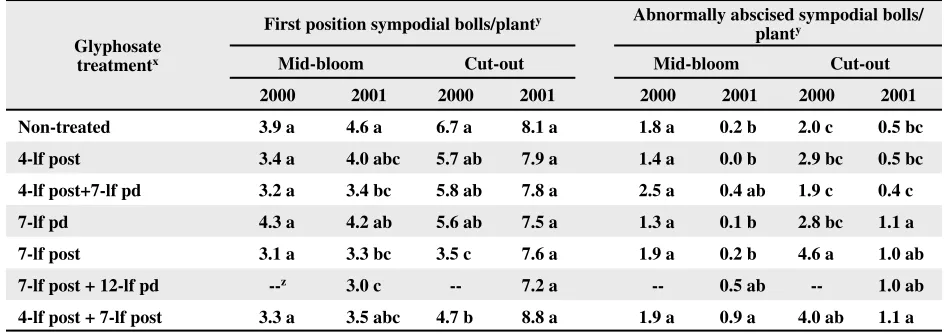
ber of sympodial bolls on nodes 1-10 was not dif-ferent from the non-treated check at the mid-bloom stage for combined data for 2000 and 2001, or at the cut-out stage in 2001 (Table 1). At cut-out in 2000, boll numbers were significantly reduced on nodes 1 through 10 by glyphosate treatments that included a 7-leaf postemergence application compared with the non-treated control (Table 1). The number of total first position sympodial bolls was not significantly affected by any glyphosate treatments at mid-bloom in 2000 or at cutout in 2001 (Table 2). The 4-leaf postemergence + 7-leaf postemergence-directed, 7-leaf postemergence, and the 7-leaf postemergence + 12-leaf postemergence-directed treatments had significantly fewer total first position sympodial bolls per plant compared with the non-treated control at mid-bloom in 2001 (Table 2). At cutout in 2000, the 7-leaf postemergence and the 4-leaf postemergence + 7-leaf postemergence treatments of glyphosate had significantly fewer total first position sympodial bolls than the non-treated control (Table 2). Glypho-sate had no effect on the number of bolls on nodes 11 and higher at Greene County (data not shown). Glyphosate treatments did not affect the number of abnormally abscised sympodial bolls at mid-bloom in 2000, but in 2001 the 4-leaf postemergence + 7-leaf postemergence glyphosate treatment had sig-nificantly more abnormally abscised bolls than the non-treated control (Table 2). In both years at cutout, the 4-leaf postemergence + 7-leaf postemergence
treatment had more abnormally abscised sympodial bolls per plant (Table 2). Additionally, in 2000 and 2001, the 7-leaf postemergence glyphosate treatment and the 7-leaf postemergence-directed treatment, respectively, had more abnormally abscised bolls than the non-treated cotton (Table 2).
Overall, except for the 7-leaf postemergence-directed glyphosate treatment, the only treatments associated with increased fruit loss compared with the non-treated control were those that included an off-label 7-leaf postemergence treatment. This observation is in general agreement with other researchers who reported an increase in fruit loss when glyphosate treatments were made poste-mergence beyond the 4-leaf stage (Ferreira et al., 1998; Kalaher and Coble, 1998; Vargas et al., 1998; Jones and Snipes, 1999). The increase in abnormal boll abscission in off-label glyphosate-treated plots at cutout in 2000 and 2001 (Table 2) is in contrast with a report by Carey et al. (2000). In their studies, the incidence of abnormal boll abscission (referred to as cavitation) was similar in glyphosate-treated and non-treated glyphosate-re-sistant cotton, as well as conventional cotton, and they concluded that it was not due to glyphosate treatment (Carey et al., 2000). Our data indicate that abnormal boll abscission can be increased by glyphosate treatments in cultivars, such as DP 5415RR, which have a tendency towards abnormal boll abscission (Lege´ and Kerby, 2001).
Table 2. Effect of glyphosate treatment and application timing on the number of first position sympodial bolls and abnormally abscised sympodial bolls per plant in Greene County, North Carolina, in 2000 and 2001
Glyphosate treatmentx
First position sympodial bolls/planty Abnormally abscised sympodial bolls/
planty
Mid-bloom Cut-out Mid-bloom Cut-out
2000 2001 2000 2001 2000 2001 2000 2001
Non-treated 3.9 a 4.6 a 6.7 a 8.1 a 1.8 a 0.2 b 2.0 c 0.5 bc
4-lf post 3.4 a 4.0 abc 5.7 ab 7.9 a 1.4 a 0.0 b 2.9 bc 0.5 bc
4-lf post+7-lf pd 3.2 a 3.4 bc 5.8 ab 7.8 a 2.5 a 0.4 ab 1.9 c 0.4 c
7-lf pd 4.3 a 4.2 ab 5.6 ab 7.5 a 1.3 a 0.1 b 2.8 bc 1.1 a
7-lf post 3.1 a 3.3 bc 3.5 c 7.6 a 1.9 a 0.2 b 4.6 a 1.0 ab
7-lf post + 12-lf pd --z 3.0 c -- 7.2 a -- 0.5 ab -- 1.0 ab
4-lf post + 7-lf post 3.3 a 3.5 abc 4.7 b 8.8 a 1.9 a 0.9 a 4.0 ab 1.1 a
xPost = postemergence treatment; pd = postemergence-directed treatment.
yTen plants per plot were mapped for fruit retention and location at the midbloom (3rd week of flowering) and cutout (<5
nodes above white flower) growth stages. Means within a column followed by the same letter are not significantly differ-ent according to Fisher’s Protected LSD test (P = 0.05).
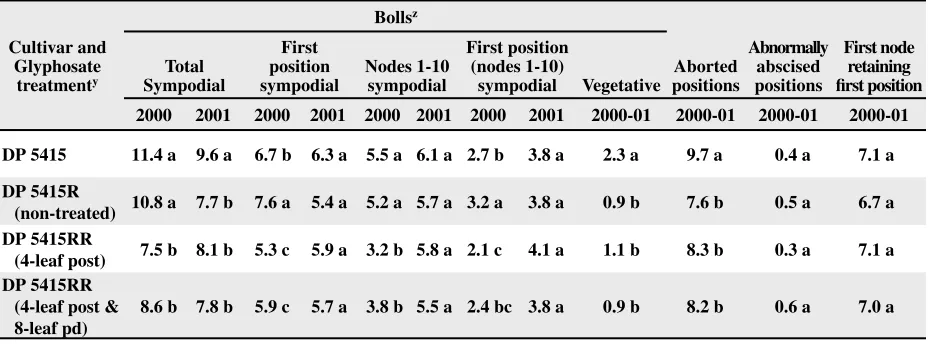
Table 3. Effect of glyphosate treatment and application timing on the number of sympodial bolls, first position sympodial bolls, sympodial and first position bolls on nodes 1 through 10, vegetative bolls, aborted positions, abnormally abscised positions, and the first node that retained a first position boll per plant in Clayton, North Carolina, in 2000 and 2001
Cultivar and Glyphosate treatmenty
Bollsz
Total Sympodial
First position
sympodial Nodes 1-10 sympodial
First position (nodes 1-10)
sympodial Vegetative positionsAborted
Abnormally abscised positions
First node retaining first position
2000 2001 2000 2001 2000 2001 2000 2001 2000-01 2000-01 2000-01 2000-01
DP 5415 11.4 a 9.6 a 6.7 b 6.3 a 5.5 a 6.1 a 2.7 b 3.8 a 2.3 a 9.7 a 0.4 a 7.1 a
DP 5415R
(non-treated) 10.8 a 7.7 b 7.6 a 5.4 a 5.2 a 5.7 a 3.2 a 3.8 a 0.9 b 7.6 b 0.5 a 6.7 a
DP 5415RR
(4-leaf post) 7.5 b 8.1 b 5.3 c 5.9 a 3.2 b 5.8 a 2.1 c 4.1 a 1.1 b 8.3 b 0.3 a 7.1 a
DP 5415RR (4-leaf post &
8-leaf pd) 8.6 b 7.8 b 5.9 c 5.7 a 3.8 b 5.5 a 2.4 bc 3.8 a 0.9 b 8.2 b 0.6 a 7.0 a
yPost = postemergence treatment; pd = postemergence-directed treatment.
z Ten plants per plot were mapped for fruit retention and location at cutout (<5 nodes above white flower) growth stages.
Means within a column followed by the same letter are not significantly different at according to Fisher’s Protected LSD test (P = 0.05).
At cutout in Clayton, plants treated with the 4-leaf postemergence or the 4-4-leaf postemergence + 8-leaf postemergence-directed glyphosate treatments had a reduced number of total sympodial bolls, first position sympodial bolls, sympodial bolls on nodes 1 through 10, and first position sympodial bolls on nodes 1 through 10 compared with the non-treated DP 5415RR control in 2000, but not in 2001 (Table 3). At the Clayton location, glyphosate treatments did not significantly affect the number of vegeta-tive bolls, aborted positions, abnormally abscised fruit, or node of fertility (node of first sympodial branch to retain a first position boll) compared with the non-treated DP 5415RR control for combined data from 2000 and 2001 (Table 3). Differences in fruiting characteristics between the conventional DP 5415 cultivar and the transgenic sister line DP 5415RR were evident in many cases. These dif-ferences may be attributed to difdif-ferences in stand establishment between the two cultivars. DP 5415 averaged about two plants less per 30 cm than DP 5415RR (data not shown). To compensate for gaps in the stand, DP 5415 likely had a different fruiting architecture than DP 5415RR. Glyphosate applied within the label guidelines affected fruiting charac-teristics much more in 2000 than in 2001, although no explanation for this is readily available. Most previous studies have not shown any significant fruit loss when glyphosate treatments are applied within label guidelines (Ferreira et al., 1998; Kalaher and
Coble, 1998; Vargas et al., 1998; Jones and Snipes, 1999). The data from this study shows that glypho-sate treatments applied within label guidelines may unpredictably impact fruit retention in certain years or conditions.
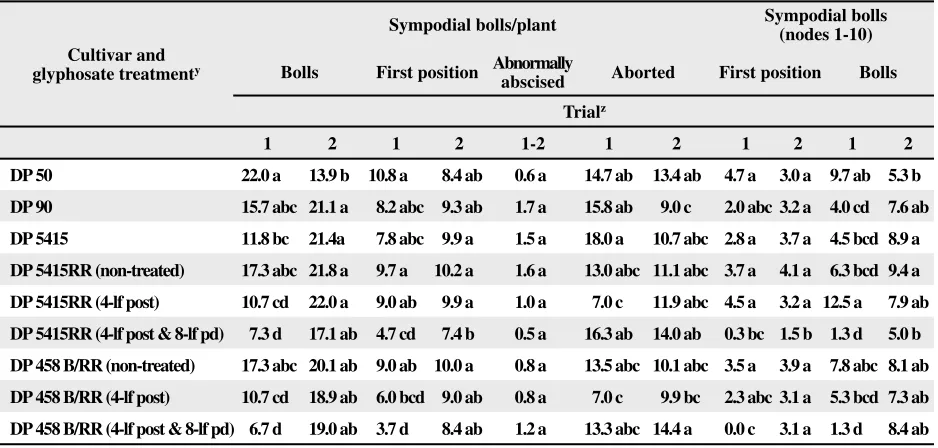
significantly different than the number in non-treated glyphosate-resistant plants in both trials and in both cultivars (Table 4). Overall, the effect of glyphosate on fruit retention was more severe in the first trial of the greenhouse study, which was conducted during the fall-winter, compared with the second trial, which was conducted in the spring-summer. Because the greenhouse only receives ambient daylight, shorter days during the first trial may have increased glypho-sate related fruit loss.
Because significant decreases in total first position sympodial bolls in the second trial and in first position bolls on nodes 1 through 10 in both trials are evident in 4-leaf postemergence + 8-leaf postemergence-directed glyphosate applications to DP 5415RR compared with the non-treated DP 5415RR, light intensity alone does not explain these differences. Reduced light levels may interact with glyphosate applications to exacerbate glyphosate-related fruit loss. Differences in severity of fruit loss between glyphosate-treated glyphosate-resis-tant plants grown in the greenhouse compared with the field, or in different seasons in the greenhouse, may be due to differences in glyphosate absorption. The foliar absorption of glyphosate is generally increased by any factor which increases the water potential of the plant (Duke, 1988). Plants grown in
environments with high soil moisture, lack of water stress, high relative humidity, and low light intensity generally absorb and translocate a greater amount of glyphosate than plants that are grown in a more stressful environment (Duke, 1988). Additionally, Wills (1978) reported that glyphosate toxicity to cotton was 21 to 40% greater at 25° C than at 35° C. Because the greenhouse conditions in which the glyphosate-resistant cotton plants were grown was likely more conducive to enhanced glyphosate absorption and translocation than field conditions, the resulting glyphosate-induced symptoms of fruit loss may have been magnified in greenhouse studies compared with the field (Tables 1 through 4).
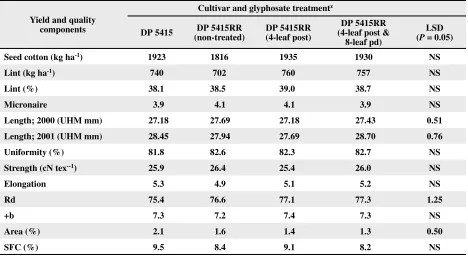
Yield and fiber quality. There were few differ-ences in yield and fiber quality among glyphosate treatments. In both 2000 and 2001 at the Greene County location, there were no differences in lint yield (Table 5). The only fiber quality component that was significantly affected by the 7-leaf postemer-gence treatment was the fiber radiance (HVI color Rd), which was greater in plots receiving a 7-leaf postemergence treatment than those which did not receive a 7-leaf postemergence glyphosate treatment (Table 5). At the Clayton location, seed cotton and lint yield was not affected by glyphosate treatments (Table 6). Fiber length (UHM) was the only fiber
Table 4. Fruit retention and location on conventional, nontreated resistant, or treated glyphosate-resistant cotton measured at the fifth week of flowering from plants grown in the Southeastern Plant Environmental Laboratory Phytotron Greenhouse
Cultivar and glyphosate treatmenty
Sympodial bolls/plant Sympodial bolls (nodes 1-10)
Bolls First position Abnormally abscised Aborted First position Bolls
Trialz
1 2 1 2 1-2 1 2 1 2 1 2
DP 50 22.0 a 13.9 b 10.8 a 8.4 ab 0.6 a 14.7 ab 13.4 ab 4.7 a 3.0 a 9.7 ab 5.3 b
DP 90 15.7 abc 21.1 a 8.2 abc 9.3 ab 1.7 a 15.8 ab 9.0 c 2.0 abc 3.2 a 4.0 cd 7.6 ab
DP 5415 11.8 bc 21.4a 7.8 abc 9.9 a 1.5 a 18.0 a 10.7 abc 2.8 a 3.7 a 4.5 bcd 8.9 a
DP 5415RR (non-treated) 17.3 abc 21.8 a 9.7 a 10.2 a 1.6 a 13.0 abc 11.1 abc 3.7 a 4.1 a 6.3 bcd 9.4 a
DP 5415RR (4-lf post) 10.7 cd 22.0 a 9.0 ab 9.9 a 1.0 a 7.0 c 11.9 abc 4.5 a 3.2 a 12.5 a 7.9 ab
DP 5415RR (4-lf post & 8-lf pd) 7.3 d 17.1 ab 4.7 cd 7.4 b 0.5 a 16.3 ab 14.0 ab 0.3 bc 1.5 b 1.3 d 5.0 b DP 458 B/RR (non-treated) 17.3 abc 20.1 ab 9.0 ab 10.0 a 0.8 a 13.5 abc 10.1 abc 3.5 a 3.9 a 7.8 abc 8.1 ab DP 458 B/RR (4-lf post) 10.7 cd 18.9 ab 6.0 bcd 9.0 ab 0.8 a 7.0 c 9.9 bc 2.3 abc 3.1 a 5.3 bcd 7.3 ab DP 458 B/RR (4-lf post & 8-lf pd) 6.7 d 19.0 ab 3.7 d 8.4 ab 1.2 a 13.3 abc 14.4 a 0.0 c 3.1 a 1.3 d 8.4 ab
yPost = postemergence treatment; pd = postemergence-directed treatment.
zMeans within a column followed by the same letter are not significantly different according to Fisher’s Protected LSD
quality component affected by glyphosate treatment at the Clayton location. Fibers were significantly longer in 2001 in plots treated with a 4-leaf
poste-mergence + 8-leaf posteposte-mergence-directed treatment than non-treated DP 5415RR plots (Table 6). These data show that although glyphosate may cause a
re-Table 5. Effect of 7-leaf postemergence glyphosate treatment on cotton yield and quality components from Greene County, North Carolina, in 2000 and 2001
Yield and quality
components Without 7-leaf postemergencex With 7-leaf postemergency P-value of contrastz
Seed cotton (kg ha-1) 2546.0 2392.0 0.05
Lint (kg ha-1) 962.3 915.7 NS
Lint (%) 37.7 38.1 NS
Micronaire 3.46 3.36 NS
Length (UHM mm) 27.69 27.69 NS
Uniformity (%) 80.7 80.4 NS
Strength (cN tex-1) 26.9 26.5 NS
Elongation 6.8 6.0 NS
Rd 75.2 76.3 0.03
+b 7.4 7.5 NS
Area (%) 2.2 2.0 NS
SFC (%) 9.8 10.1 NS
xTreatments in the without 7-leaf postemergence variable included 4-leaf postemergence, 4-leaf postemergence + 7-leaf
postemergence-directed, and 7-leaf postemergence-directed.
yTreatments in the with 7-leaf postemergence variable included 7-leaf postemergence , 4-leaf postemergence + 7-leaf
pos-temergence, and 7-leaf postemergence + 12-leaf postemergence-directed.
zSingle degree of freedom orthogonal contrasts were conducted comparing with 7-leaf postemergence and without7-leaf
postemergence glyphosate treatments. P-values greater than 0.05 indicate the means are not significantly different and are designated NS.
Table 6. Glyphosate treatment or variety on cotton yield and quality components from Clayton, North Carolina, in 2000 and 2001
Yield and quality components
Cultivar and glyphosate treatmentz
DP 5415 (non-treated)DP 5415RR (4-leaf post)DP 5415RR (4-leaf post &DP 5415RR 8-leaf pd)
LSD (P = 0.05)
Seed cotton (kg ha-1) 1923 1816 1935 1930 NS
Lint (kg ha-1) 740 702 760 757 NS
Lint (%) 38.1 38.5 39.0 38.7 NS
Micronaire 3.9 4.1 4.1 3.9 NS
Length; 2000 (UHM mm) 27.18 27.69 27.18 27.43 0.51
Length; 2001 (UHM mm) 28.45 27.94 27.69 28.70 0.76
Uniformity (%) 81.8 82.6 82.3 82.7 NS
Strength (cN tex--1) 25.9 26.4 25.4 26.0 NS
Elongation 5.3 4.9 5.1 5.2 NS
Rd 75.4 76.6 77.1 77.3 1.25
+b 7.3 7.2 7.4 7.3 NS
Area (%) 2.1 1.6 1.4 1.3 0.50
SFC (%) 9.5 8.4 9.1 8.2 NS
duction in bolls, this reduction does not necessarily translate into yield reduction (Tables 1 through 3). Jones et al. (1996) reported that yields are often not affected by early-season fruit losses because cotton compensates by relocating the boll load higher and to further fruiting positions on the plant. Late com-pensation may delay harvest and cause yield loss if the season is not long enough for compensatory growth (Jones and Snipes, 1999). Previous work that studied the effect of fruit removal on fiber quality reported that removal of squares early in the season decreased fiber micronaire, maturity, and cell wall thickness (Pettigrew et al., 1992); however, removal of late-season fruit was associated with increased micronaire (Jones et al., 1996). Data from the current study show that glyphosate treatments have little ef-fect on fiber quality (Tables 5 and 6). Although plants generally compensate for early season fruit loss as shown by yield data (Tables 5 and 6), differences in fiber quality components are not associated with this compensation.
CONCLUSION
Increases in fruit loss can be associated with glyphosate treatments, particularly glyphosate treat-ments that are outside of the label recommendations. The occurrence and severity of these losses seem to vary by environment and year. Growing conditions that favor greater glyphosate absorption tend to show more severe effects. Although glyphosate effects on fruit retention, yield, and abnormal boll abscission were sporadic and often unpredictable, these effects were generally greater with glyphosate treatments applied later in reproductive development than treatments applied during early vegetative growth. Growers may wish to limit glyphosate contact with glyphosate-resistant cotton when plants begin repro-ductive development.
ACKNOWLEDGEMENT
Supported by the North Carolina Cotton Grow-ers and Cotton Incorporated. Appreciation is also extended to Louie Johnson, North Carolina Coopera-tive Extension Service; the staff of the Southeastern Plant Environmental Laboratory Phytotron; Edward Straughn, Scott Clewis, and Joel Faircloth, Crop Science Department; and Isabelle Leroy, ENSAIA, Nancy, France.
REFERENCES
Barry, G., G. Kishore, S. Padgette, M. Taylor, K. Kolacz, M. Weldon, D. Re, D. Eichholtz, K. Fincher, and L. Hallas. 1992. Inhibitors of amino acid biosynthesis: Strategies for imparting glyphosate tolerance to crop plants. p. 139-145. In B.K. Singh, H. Flores, and J. C. Shannon (eds.) Biosynthesis and Molecular Regulation of Amino Acids in Plants. Am. Soc. Plant Physiologists, Rockville, MD. Carey, J. B., D. C. Heering, and K. L. Ferreira. 2000. Review
of Roundup Ultra (glyphosate) effects on fruit retention, yield, and maturity in Roundup Ready (glyphosate-re-sistant) cotton. p. 1479. In Proc. Beltwide Cotton Res. Conf., San Antonio, TX. 4-8 Jan. 2000. Natl. Cotton Counc. Am., Memphis, TN.
Downs, R. J. and J. F. Thomas. 1991. Phytotron Procedural Manual for Controlled Environment Research at the Southeastern Plant Environmental Laboratory. Technical Bull. 244 (Revised). North Carolina State University and North Carolina Agric. Res. Serv., Raleigh, NC.
Duke, S. O. 1988. Glyphosate. p. 1-70 In P.C. Kearney and D.D. Kaufman. (eds.) Herbicides; Chemistry, Degrada-tion and Mode of AcDegrada-tion. Marcel Dekker, Inc., New York.
Edmisten, K. L. 2001. Suggestions for Pix use. p. 52-59. In K. L. Edmisten et al. (eds.) 2001 Cotton Information. Publ. AG-147. North Carolina Coop. Ext. Serv., Raleigh, NC. Ferreira, K. L., D. J. Jost, G. A. Dixon, and D. W. Albers.
1998. Roundup Ready cotton fruiting pattern response to over the top applications of Roundup Ultra after the 4-leaf stage. p.848. In Proc. Beltwide Cotton Res. Conf., San Diego, CA. 5-9 Jan. 1998. Natl. Cotton Counc. Am., Memphis TN.
Jones, M. A., R. Wells, and D. S. Guthrie. 1996. Cotton response to seasonal patterns of flower removal: I. Yield and fiber quality. Crop Sci. 36:633-638.
Jones, M. A. and C. E. Snipes. 1999. Tolerance of transgenic cotton to topical application of glyphosate. J. Cotton Sci. 3:19-26 [On-line]. Available at http://www.journal.cot-ton.org/1999/issue01/weed/art01/article.pdf.
Kalaher, C. J. and H. D. Coble. 1998. Fruit abscission and yield response of Roundup-Ready cotton to topical appli-cations of glyphosate. p. 849. In Proc. Beltwide Cotton Res. Conf., San Diego, CA. 5-9 Jan. 1998. Natl. Cotton Counc. Am., Memphis TN.
Nida, D. L., K. H. Kolacz, R. E. Buehler, W. R. Deaton, W. R. Shuler, T. A. Armstrong, M. L. Taylor, C. C. Ebert, G. J. Rogan, S. R. Padgette, and R. L. Fuchs. 1996. Glypho-sate-tolerant cotton: Genetic characterization and protein expression. J. Agric. Food Chem. 44:1960-1966. Pettigrew, W. T., J. J. Heitholt, and W. R. Meredith, Jr. 1992.
Early season floral bud removal and cotton growth, yield, and fiber quality. Agron. J. 84:209-214.
Sims, S. R., S. A. Berberich, D. L. Nida, L. L. Segalini, J. N. Leach, C. C. Ebert, and R. L. Fuchs. 1996. Analysis of expressed proteins in fiber fractions from insect-pro-tected and glyphosate-tolerant cotton varieties. Crop Sci. 36:1212-1216.
Vargas, R. N., S. Wright, and T. M. Martin-Duvall. 1998. Tolerance of Roundup Ready cotton to Roundup Ultra applied at various growth stages. p. 847-848. In Proc. Beltwide Cotton Res. Conf., San Diego, CA. 5-9 Jan. 1998. Natl. Cotton Counc. Am., Memphis TN.