warwick.ac.uk/lib-publications
Original citation:
Zhao, Nan, Oozeerally, Ryan, Degirmenci, Volkan, Wagner, Zdeněk, Bendová, Magdalena and Jacquemin, Johan. (2016) New method based on the UNIFAC–VISCO model for the
estimation of ionic liquids viscosity using the experimental data recommended by mathematical gnostics. Journal of Chemical & Engineering Data, 61 (11). pp. 3908-3921.
Permanent WRAP URL:
http://wrap.warwick.ac.uk/98233
Copyright and reuse:
The Warwick Research Archive Portal (WRAP) makes this work of researchers of the University of Warwick available open access under the following conditions.
This article is made available under the Attribution-NonCommercial-NoDerivatives 4.0 (CC BY-NC-ND 4.0) license and may be reused according to the conditions of the license. For more details see: http://creativecommons.org/licenses/by-nc-nd/4.0/
A note on versions:
The version presented in WRAP is the published version, or, version of record, and may be cited as it appears here.
New Method Based on the UNIFAC
−
VISCO Model for the Estimation
of Ionic Liquids Viscosity Using the Experimental Data
Recommended by Mathematical Gnostics
Nan Zhao,
†Ryan Oozeerally,
‡Volkan Degirmenci,
*
,‡Zdene
̌
k Wagner,
*
,§Magdalena Bendova
,
́
§and
Johan Jacquemin
*
,†,∥†School of Chemistry and Chemical Engineering, Queen’s University Belfast, Belfast, BT9 5AG, U.K. ‡School of Engineering, University of Warwick, Coventry, CV4 7AL, U.K.
§E. Hála Laboratory of Separation Processes, Institute of Chemical Process Fundamentals of the CAS, v. v. i., Rozvojová135,
165 02 Prague 6−Suchdol, Czech Republic
∥UniversitéFrançois Rabelais, Laboratoire PCM2E, Parc de Grandmont 37200 Tours, France
*
S Supporting InformationABSTRACT: The viscosity of ionic liquids (ILs) has been modeled as a function of temperature and at atmospheric pressure using a new method based on the UNIFAC−VISCO method. This model extends the calculations previously reported by our group (see Zhao et al. J. Chem. Eng. Data
2016, 61, 2160−2169) which used 154 experimental viscosity data points of 25 ionic liquids for regression of a set of binary interaction parameters and ion Vogel−Fulcher−Tammann (VFT) parameters. Discrepancies in the experimental data of the same IL affect the quality of the correlation and thus the development of the predictive method. In this work, mathe-matical gnostics was used to analyze the experimental data from different sources and recommend one set of reliable data for each IL. These recommended data (totally 819 data points) for
70 ILs were correlated using this model to obtain an extended set of binary interaction parameters and ion VFT parameters, with a regression accuracy of 1.4%. In addition, 966 experimental viscosity data points for 11 binary mixtures of ILs were collected from literature to establish this model. All the binary data consist of 128 training data points used for the optimization of binary interaction parameters and 838 test data points used for the comparison of the pure evaluated values. The relative average absolute deviation (RAAD) for training and test is 2.9% and 3.9%, respectively.
1. INTRODUCTION
Recently, ionic liquids (ILs) have received significant attention due to their unique properties, such as nonvolatility, high chemical stability, and easy operation at the liquid state, and thus have become promising alternatives to traditional liquid solvents.1−7 However, the viscosities of ILs are relatively high compared to those of traditional solvents and water.8 Accordingly, the viscosity of ILs is a very important parameter in assessing various aspects of chemical processes; high viscosity can negatively affect mass transfer and power requirements for mixing in liquid−liquid systems. A low viscosity IL is desirable as a solvent in order to minimize pumping costs and increase mass transfer rates; while higher viscosity ILs could be favorable for other applications, such as lubrication, membranes,9etc.
To develop new ILs with a tailored viscosity, the conven-tional experimental trial-and-error method is not practical due to the large quantity of potential cation−anion combinations. Therefore, a variety of methods have been reported for the
correlation/evaluation/prediction of IL viscosity.9−29Methods based on the different correlation equations which provide the correlation for viscosity usually describe the exponential behavior of the temperature dependency; such as the Vogel− Fulcher−Tamman (VFT) equation,10−12 fluidity equation,12 Litovitz equation,12,13 Arrhenius equation,12,14 power law equation,15and the Daubert and Danner correlation.14
Predictive methods for the viscosity can be categorized as (i) group contribution method (GCM)9,16−19and (ii) quantitative structure−property relationship (QSPR).20−27 Gardas et al.9 and Daniel et al.17developed the group contribution method based on the Orrick−Erbar model30 to predict IL viscosity. However, the Orrick−Erbar model also requires density data for the prediction of the viscosity. To overcome this limitation
Received: July 30, 2016 Accepted: September 29, 2016 Published: October 10, 2016
Article
pubs.acs.org/jced
and to attempt the development of an improved viscosity model with lower deviations in estimated viscosities, Gardas et al.19proposed a new group contribution method based on the Vogel−Fulcher−Tammann (VFT) equation. Gharagheizi et al.18employed a total of 46 substructures in addition to the temperature to predict IL viscosity. Lazzús and Pulgar− Villarroel16 estimated the viscosity of a number of ILs using an improved Andrade-type approach that is a linear combi-nation of the contribution of groups in the cation and the anion. Other approaches reported in the literature to describe the IL viscosity are based on the statistical association fluid theory (SAFT) equation of state (EoS).28,29 Polishuk28modeled the viscosity of ILs using SAFT-cubic equation of state coupled with two models, free volume theory (FVT) and modified Yarranton−Satyro (MYS) correlation. Despite unsatisfactory results of free volume theory, the modified Yarranton−Satyro correlation predicted the viscosity of two families of imidazolium-based ILs ([Cnmim][PF6] and [Cnmim][BF4]) with appropriate accuracy. Furthermore, Abolala et al.29modeled the viscosity of pure imidazolium-based ILs ([Cnmim][PF6], [Cnmim][BF4], and [Cnmim][NTf2]) using the SAFT-VR-Mie equation of state coupled with three models, namely frictional theory (FT), free-volume theory (FVT), and modified Yarranton−Satyro (MYS) correlation. The result showed that the MYS model calculated the viscosity more precisely than the FVT and FT models. A comparative result from the SAFT-cubic EoS proposed by Polishuk28 showed that the performance of SAFT-VR-Mie EoS was better than the SAFT-cubic EoS. All the equations mentioned are semiempirical, regardless of the basis of their development.
Viscosity measurement is highly sensitive to the presence of impurities (water and halides),31the temperature control,32and the different experimental techniques,33 such as the Anton Paar automated microviscometer (AMVn) and the Ubbelohde viscometers, for example. In other words, experimental data of ILs reported in the literature were obtained using different techniques and samples with different impurity levels. Thus, discrepancies in the experimental data occur and affect the quality of the correlation and thus the development of the predictive method. Therefore, one of the main purposes of this work is to do a critical analysis of the viscosity data and to recommend a data set for each IL.
In the present work, we present an extension of the pre-viously developed method33 based on the UNIFAC−VISCO model to evaluate the viscosity of 70 pure ILs and 11 binary ionic liquid mixtures. Herein, the mathematical gnostics was
first employed for the data analysis and data set recommen-dation. One recommended data set for each IL was used to calculate the binary interaction parameters and ion VFT parameters.
2. DATA ANALYSIS
The impurities (such as halides, water, and metals) in the ionic liquids and the different measurement techniques have a significant effect on the accuracy of the measured viscosity, as discussed elsewhere33 and above. Discrepancies in the experimental data of the same IL affect the quality of the correlation and thus the development of the predictive method. Therefore, in the present work, mathematical gnostics34,35was used to analyze the experimental data, and a data set for each IL is recommended.
Mathematical gnostics is a novel paradigm of uncertainty.34 This axiomatic theory is built upon the theory of measurement
and based on the fundamental laws of nature such as the special theory of relativity and thermodynamics. The properties of each individual measurement are analyzed and properties of a data sample are obtained by their aggregation. The results are thus valid even for small data samples because, unlike in statistics, the extrapolation from an infinite to afinite data sample is not used. In addition, the data are allowed to speak for themselves; there is no prior assumption on the distribution function of errors, but it is estimated during data analysis. It is possible to describe both unimodal and multimodal distributions using the same approach. In this work, nonlinear regression along with an influence function is utilized. This stems from the methodology of robust statistics36in which the data errors are assumed to have normal distribution with zero mean but the sample is contaminated by a few values having a gross error. Knowing a distribution function of these gross errors, an influence function is derived. During regressions, the influence function is used for iterative reweighting of the residuals. The procedure is stopped when the values of residuals do not change. The influence function derived from mathematical gnostics does not require any assumption on the distribution function of measurement errors, both the precise data and outliers can be described by the same distribution function estimated during regression. In addition, thesea posteriori weights obtained by application of the influence function are directly related to the distribution density where the weight equal to one coincides with the location of its maximum, that is, the most probable value. Owing to these properties the values of thea posterioriweights together with results of marginal analysis of residuals can successfully be applied to a critical evaluation of the scattered data.
For example, several authors8,37−44 have reported visco-sity values of the IL 1-ethyl-3-methylimidazolium triflate, [C2mim][OTf]. The temperature range, number of data points, purity, and measurement techniques in each reference are summarized inTable 1.
Figure 1 shows the weight of experimental viscosities for [C2mim][OTf]. Only two data points39,41 were measured at 278.15 K. The weight of one point is close to zero and the other one is close to one. However, it could not be concluded that the viscosity measured by Freire et al.39at 278.15 K causes a large difference from the estimated location. Only a qual-itative judgment can be made by comparison between the data weights at the same temperature. It is seen fromFigure 1that the viscosity data reported by Freire et al.39manifests a better performance than other data at each reported temperature, with the exception of at 278.15 K.
The comparison between the estimated locations and the experimental values is demonstrated inFigure 2. As shown in
of the data set reported by Freire et al.39is−0.7% compared with the estimated locations, lower than−4.1% of ARD from Seddon et al.8 and −4.5% of ARD from Rodriguez et al.́ 41
While the ARD is up to 9.7% for the data set measured by Yusoff et al.42 in a comparison from the estimated loations. Therefore, in general we recommend the data set published by Freire et al.39to be used for the optimization of the UNIFAC− VISCOfitting parameters.
∑
μ μμ
× =
−
= M
100 ARD 100
i M
0
exp o
o (1)
whereMis the number of data points in the data set;μexpis the experimental viscosity; andμois the estimated location of the maximum distribution density.
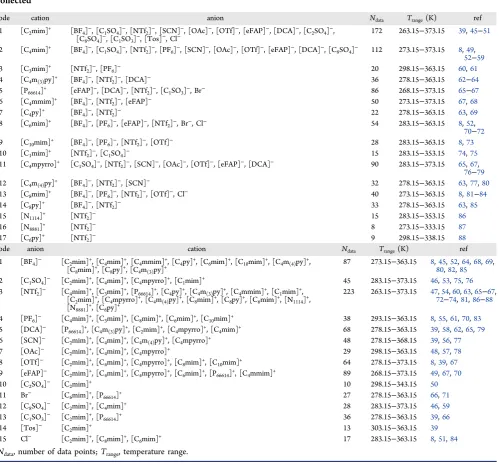
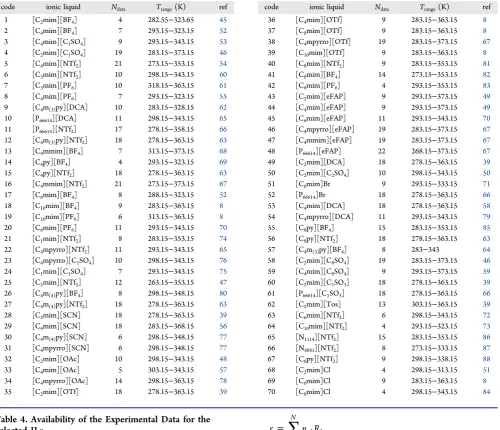
Following this methodology, we recommended then one data set for each selected ionic liquid. The gnostic analysis of experimental data for each ionic liquid is illustrated in Figures S1−S86 of the Supporting Information. The cations and anions used are among the most commonly studied struc-tures. The cations used include imidazolium, ammonium, phos-phonium, pyridinium, and pyrrolidinium. Fifteen different anions are used including the tetrafluoroborate ([BF4]−), methyl-sulfate ([C1SO4]−), and thiocyanate ([SCN]−), for example. Selected cations and anions are listed inTable 2along with the number of data points containing this ion, temperature range, and the references from which the experimental viscosity data were taken. The selected 70 different ILs, the number of data points in the recommended reference, and the temperature range are summarized in Table 3. For some ILs, such as [C6mim]Br, only one viscosity data set is available in the liter-ature, to date. Recommended data could thus not be obtained by the gnostic analysis and the given set was then considered as the recommended data set.
3. UNIFAC−VISCO BASED METHOD FOR PREDICTION OF VISCOSITY OF IONIC LIQUIDS
3.1. Calculation of Ionic Liquid Viscosity by the UNIFAC−VISCO Method. A new method for the prediction of viscosities of pure and mixtures of ionic liquids has been recently developed by our group.33For the calculation of pure IL viscosity based on the UNIFAC−VISCO model, the cation and anion, constituting the ionic liquid, are regarded as indi-vidual components and each component is made up of a single group. Below is the summary of the calculations using this method. Full details of the UNIFAC−VISCO model have been described previously.33
[image:4.625.67.566.97.228.2]The UNFAC−VISCO model is a group contribution model developed by Chevalier et al.89,90to predict the viscosities of
Figure 2. Deviations of the literature values from the estimated locations for [C2mim][OTf]:△, Abbott et al.;37■, François et al.;38
[image:4.625.59.302.237.424.2]□, Rodriguez et al.;́ 41×, Freire et al.;39○, Yusoffet al.;42●, Seddon et al.;8+, Morgan et al.;40▲, Tsamba et al.;43▽, Vuksanovic et al.44
Table 1. Information for Experimental Viscosities of 1-Ethyl-3-methylimidazolium Triflate [C2mim][OTf] Collected from
Corresponding Referencesa
ref Ndata Trange(K) source purity water (ppm) chloride (ppm) experimental technique
37 1 293 synthesized NA NA NA NA
38 1 298.15 Fluka 98% NA NA HP3DCE
41 8 278.15−348.15 synthesized NA 96 NA cone−plate rheometer
39 18 278.15−363.15 Iolitec 99% 20 NA Stabinger viscometer
42 5 303.15−363.15 Sigma-Aldrich 98% NA NA concentric cylinders viscometry
8 9 283.15−363.15 NA NA 237 1300 cone−plate viscometer
40 1 303.15 EMD Chemicals NA NA <2000 cone−plate viscometer
43 5 298.15−343.15 solvionic 99.5% 50−100 NA Anton Paar viscosimeter
44 4 288.15−318.15 Iolitec 99% 130 NA Stabinger viscometer
total 52 278.15−363.15
aNdata, number of data points;Trange, temperature range.
Figure 1. Data weight of the literature values for [C2mim][OTf]:
△, Abbott et al.;37■, François et al.;38□, Rodriguez et al.;́ 41×, Freire et al.;39 ○, Yusoff et al.;42 ●, Seddon et al.;8 +, Morgan et al.;40
[image:4.625.61.303.481.661.2]liquid mixtures. The main equation of the UNIFAC−VISCO model is
∑
μ = μ· + −
=
⎛ ⎝
⎜ ⎞
⎠ ⎟
x V
V g
T g
T
ln( ) ln
i C
i i i
1 m
c E
r E
9 9 (2)
Herein, μ is the viscosity of the ionic liquid; subscript i represents the component in the ionic liquid (i.e., the cation and anion);Cis the number of components in the ionic liquid (C = 2); xi is the mole fraction of the cation/anion in the ionic liquid, which is equal to 0.5;μiis the effective viscosity of the ion and represented by the Vogel−Fulcher−Tamman (VFT) equation (eq 3);Viis the effective molar volume of the ion and calculated using the volumetric parameters (eq 4), which were developed based on a group contribution method developed by our group previously;91,92 Vm is the molar volume of the ionic liquid, and is calculated based on the assumption that the molar volume of the ionic liquid is
the sum of the effective molar volumes of the cation and anion.91,92
μ = ·
−
⎡ ⎣
⎢ ⎤
⎦ ⎥
A B
T T
exp ion
0 (3)
∑
* * = · *
=
V (T ,p ) ( (a T ) )
i
i ip
ion ref 0 2
ref
(4)
where T* = T − 298.15, pref = 0.1 MPa, and ai is the volumetric parameters as described by Jacquemin et al.91,92 The values of the volumetric parameters used in this paper are given in Table S1 of theSupporting Information.
The residual term and the combinatorial term in eq 2 are defined as follows:
∑
∑
γ γ= −
= =
g
RT i x[ n (ln ln )]
C i
m N
m i m m i
r E
1 1
, ,
[image:5.625.67.567.84.549.2](5)
Table 2. Selected Cations and Anions Constituting the Selected ILs, and References from Which Experimental Data Were Collected
code cation anion Ndata Trange(K) ref
1 [C2mim]+ [BF
4]−, [C1SO4]−, [NTf2]−, [SCN]−, [OAc]−, [OTf]−, [eFAP]−, [DCA]−, [C2SO4]−, [C8SO4]−, [C1SO3]−, [Tos]−, Cl−
172 263.15−373.15 39,45−51
2 [C4mim]+ [BF4]−, [C1SO4]−, [NTf2]−, [PF6]−, [SCN]−, [OAc]−, [OTf]−, [eFAP]−, [DCA]−, [C8SO4]− 112 273.15−373.15 8,49,
52−59
3 [C3mim]+ [NTf2]−, [PF6]− 20 298.15−363.15 60,61
4 [C4m(3)py]+ [BF4]−, [NTf2]−, [DCA]− 36 278.15−363.15 62−64
5 [P66614]+ [eFAP]−, [DCA]−, [NTf2]−, [C1SO3]−, Br− 86 268.15−373.15 65−67
6 [C4mmim]+ [BF4]−, [NTf2]−, [eFAP]− 50 273.15−373.15 67,68
7 [C4py]+ [BF4]−, [NTf2]− 22 278.15−363.15 63,69
8 [C6mim]+ [BF4]−, [PF6]−, [eFAP]−, [NTf2]−, Br−, Cl− 54 283.15−363.15 8,52,
70−72
9 [C10mim]+ [BF4]−, [PF6]−, [NTf2]−, [OTf]− 28 283.15−363.15 8,73
10 [C1mim]+ [NTf2]−, [C1SO4]− 15 283.15−353.15 74,75
11 [C4mpyrro]+ [C1SO4]−, [NTf2]−, [SCN]−, [OAc]−, [OTf]−, [eFAP]−, [DCA]− 90 283.15−373.15 65,67,
76−79
12 [C4m(4)py]+ [BF4]−, [NTf2]−, [SCN]− 32 278.15−363.15 63,77,80
13 [C8mim]+ [BF4]−, [PF6]−, [NTf2]−, [OTf]−, Cl− 40 273.15−363.15 8,81−84
14 [C8py]+ [BF4]−, [NTf2]− 33 278.15−363.15 63,85
15 [N1114]+ [NTf2]− 15 283.15−353.15 86
16 [N8881]+ [NTf2]− 8 273.15−333.15 87
17 [C6py]+ [NTf2]− 9 298.15−338.15 88
code anion cation Ndata Trange(K) ref
1 [BF4]− [C2mim]+, [C4mim]+, [C4mmim]+, [C4py]+, [C6mim]+, [C10mim]+, [C4m(4)py]+, [C8mim]+, [C8py]+, [C4m(3)py]+
87 273.15−363.15 8,45,52,64,68,69,
80,82,85
2 [C1SO4]− [C2mim]+, [C4mim]+, [C4mpyrro]+, [C1mim]+ 45 283.15−373.15 46,53,75,76
3 [NTf2]− [C4mim]+, [C3mim]+, [P66614]+, [C4py]+, [C4m(3)py]+, [C4mmim]+, [C1mim]+, [C2mim]+, [C4mpyrro]+, [C4m(4)py]+, [C8mim]+, [C8py]+, [C6mim]+, [N1114]+, [N8881]+, [C6py]+
223 263.15−373.15 47,54,60,63,65−67,
72−74,81,86−88
4 [PF6]− [C4mim]+, [C3mim]+, [C8mim]+, [C6mim]+, [C10mim]+ 38 293.15−363.15 8,55,61,70,83
5 [DCA]− [P66614]+, [C
4m(3)py]+, [C2mim]+, [C4mpyrro]+, [C4mim]+ 68 278.15−363.15 39,58,62,65,79
6 [SCN]− [C2mim]+, [C4mim]+, [C4m(4)py]+, [C4mpyrro]+ 48 278.15−368.15 39,56,77
7 [OAc]− [C2mim]+, [C4mim]+, [C4mpyrro]+ 29 298.15−363.15 48,57,78
8 [OTf]− [C2mim]+, [C4mim]+, [C4mpyrro]+, [C8mim]+, [C10mim]+ 64 278.15−373.15 8,39,67
9 [eFAP]− [C2mim]+, [C4mim]+, [C4mpyrro]+, [C6mim]+, [P66614]+, [C4mmim]+ 89 268.15−373.15 49,67,70
10 [C2SO4]− [C2mim]+ 10 298.15−343.15 50
11 Br− [C6mim]+, [P66614]+ 27 278.15−363.15 66,71
12 [C8SO4]− [C2mim]+, [C4mim]+ 28 283.15−373.15 46,59
13 [C1SO3]− [C2mim]+, [P66614]+ 36 278.15−363.15 39,66
14 [Tos]− [C2mim]+ 13 303.15−363.15 39
15 Cl− [C2mim]+, [C8mim]+, [C6mim]+ 17 283.15−363.15 8,51,84
aN
∑
ϕ∑
θ ϕ= +
g
RT x x
z x q
ln
2 ln
i i
i
i i i i i i
c E
(6)
wherezis a coordinate value equal to 10, and
θ =
∑
x q
x q
i i i
j j j (7)
ϕ = ∑
x r x r
i i i
j j j (8)
∑
=
= qi n Q
k N
i k k
1 ,
(9)
∑
=
= ri n R
k N
i k k
1 ,
(10)
Herein, the volume Rand surface area Q parameters of ions used were obtained by using the COSMOthermX software (version C30_1601) following the methodology previously described by our group93 and are given in Table S2 of the
Supporting Information. R and Q values reported herein are higher but in good agreement (i.e., RAAD close to 7.3% and 12% for R and Q values, respectively) with values reported in the case of the [Cnmim][BF4] with n = 2, 4, 6 or 8, [Cnmim][PF6] with n= 2 or 4, [Cnmim][OTf] withn= 4 or 6, and [C8mim]Cl by Santiago et al.94 using a DFT-PCM computational approach, for example. Similarly, good agree-ments are observed between our set ofR and Q values with data determined by Banerjee et al.95using a DFT-PCM com-putational approach. However, by using the empirical method-ology proposed originally by Domańska,96 we observed that calculated R and Q values of investigated ionic liquids are systematically lower than values reported herein and in the literature with RAAD close to (52% and 48%) with this work, (41% and 29%) and (82% and 33%) with data reported by Santiago et al.94 and by Banerjee et al.,95 respectively.
Table 3. Ionic Liquids of the Recommended References Including Number of Data Points and Temperature Ranges (see Figures S1−S86 of the Supporting Information)
code ionic liquid Ndata Trange(K) ref
1 [C2mim][BF4] 4 282.55−323.65 45
2 [C4mim][BF4] 7 293.15−323.15 52
3 [C4mim][C1SO4] 9 293.15−343.15 53
4 [C2mim][C1SO4] 19 283.15−373.15 46
5 [C4mim][NTf2] 21 273.15−353.15 54
6 [C3mim][NTf2] 10 298.15−343.15 60
7 [C3mim][PF6] 10 318.15−363.15 61
8 [C4mim][PF6] 7 293.15−323.15 55
9 [C4m(3)py][DCA] 10 283.15−328.15 62
10 [P66614][DCA] 11 298.15−343.15 65
11 [P66614][NTf2] 17 278.15−358.15 66
12 [C4m(3)py][NTf2] 18 278.15−363.15 63
13 [C4mmim][BF4] 7 313.15−373.15 68
14 [C4py][BF4] 4 293.15−323.15 69
15 [C4py][NTf2] 18 278.15−363.15 63
16 [C4mmim][NTf2] 21 273.15−373.15 67
17 [C6mim][BF4] 8 288.15−323.15 52
18 [C10mim][BF4] 9 283.15−363.15 8
19 [C10mim][PF6] 6 313.15−363.15 8
20 [C6mim][PF6] 11 293.15−343.15 70
21 [C1mim][NTf2] 8 283.15−353.15 74
22 [C4mpyrro][NTf2] 11 293.15−343.15 65
23 [C4mpyrro][C1SO4] 10 298.15−343.15 76
24 [C1mim][C1SO4] 7 293.15−343.15 75
25 [C2mim][NTf2] 12 263.15−353.15 47
26 [C4m(4)py][BF4] 8 298.15−348.15 80
27 [C4m(4)py][NTf2] 18 278.15−363.15 63
28 [C2mim][SCN] 18 278.15−363.15 39
29 [C4mim][SCN] 18 283.15−368.15 56
30 [C4m(4)py][SCN] 6 298.15−348.15 77
31 [C4mpyrro][SCN] 6 298.15−348.15 77
32 [C2mim][OAc] 10 298.15−343.15 48
33 [C4mim][OAc] 5 303.15−343.15 57
34 [C4mpyrro][OAc] 14 298.15−363.15 78
35 [C2mim][OTf] 18 278.15−363.15 39
code ionic liquid Ndata Trange(K) ref
36 [C4mim][OTf] 9 283.15−363.15 8
37 [C8mim][OTf] 9 283.15−363.15 8
38 [C4mpyrro][OTf] 19 283.15−373.15 67
39 [C10mim][OTf] 9 283.15−363.15 8
40 [C8mim][NTf2] 9 283.15−353.15 81
41 [C8mim][BF4] 14 273.15−353.15 82
42 [C8mim][PF6] 4 293.15−353.15 83
43 [C2mim][eFAP] 9 293.15−373.15 49
44 [C4mim][eFAP] 9 293.15−373.15 49
45 [C6mim][eFAP] 11 293.15−343.15 70
46 [C4mpyrro][eFAP] 19 283.15−373.15 67
47 [C4mmim][eFAP] 19 283.15−373.15 67
48 [P66614][eFAP] 22 268.15−373.15 67
49 [C2mim][DCA] 18 278.15−363.15 39
50 [C2mim][C2SO4] 10 298.15−343.15 50
51 [C6mim]Br 9 293.15−333.15 71
52 [P66614]Br 18 278.15−363.15 66
53 [C4mim][DCA] 18 278.15−363.15 58
54 [C4mpyrro][DCA] 11 293.15−343.15 79
55 [C8py][BF4] 15 283.15−353.15 85
56 [C8py][NTf2] 18 278.15−363.15 63
57 [C4m(3)py][BF4] 8 283−343 64
58 [C2mim][C8SO4] 19 283.15−373.15 46
59 [C4mim][C8SO4] 9 293.15−373.15 59
60 [C2mim][C1SO3] 18 278.15−363.15 39
61 [P66614][C1SO3] 18 278.15−363.15 66
62 [C2mim][Tos] 13 303.15−363.15 39
63 [C6mim][NTf2] 6 298.15−343.15 72
64 [C10mim][NTf2] 4 293.15−323.15 73
65 [N1114][NTf2] 15 283.15−353.15 86
66 [N8881][NTf2] 8 273.15−333.15 87
67 [C6py][NTf2] 9 298.15−338.15 88
68 [C2mim]Cl 4 298.15−313.15 51
69 [C6mim]Cl 9 283.15−363.15 8
[image:6.625.66.567.92.522.2]70 [C8mim]Cl 4 298.15−343.15 84
Table 4. Availability of the Experimental Data for the Selected ILs
combination [BF4]− [SCN]− [NTf2]−
[C2mim]+ √ √ √
[C4mim]+ √ √ √
[C4m(4)py]+ √ √ √
For example, in the case of the [C4mim][PF6],RandQvalues have been reported in the literature as close to (R= 8.5506 and Q= 6.5172 using Bondi method and ionic radii),97(R= 8.4606 and Q = 6.808 determined by using a DFT-PCM computa-tional approach)94 and (R = 11.034 and Q = 6.958 using a DFT-PCM computational approach)95such values match very well with those determined during this work (R= 9.2940 and Q= 7.8352) while a large difference is observed in each case by using the empirical methodology proposed originally by Domańska96(R= 6.0582 andQ= 5.2466) and in fact param-eters reported in Table S2 of theSupporting Informationcan be considered as representative.
Then, ln γm, the residual activity coefficient in the residual term (eq 5), is obtained by usingeq 11:
∑
∑
γ = − Θ Ψ − Θ Ψ
∑ Θ Ψ
= = = ⎡ ⎣ ⎢ ⎢ ⎤ ⎦ ⎥ ⎥ Q
ln m m 1 ln( )
i N
i i m i
N
i m i
j N
j j i
1 ,
1
,
1 , (11)
where:
Θ =
∑= =
x Q
X Q , m 1, 2, 3, ...,N
m m m i N i i 1 (12)
where the subscripts represent the defined groups, and
α
Ψ = ⎜⎛− ⎟
⎝ ⎞ ⎠ exp 298.15 mn mn (13)
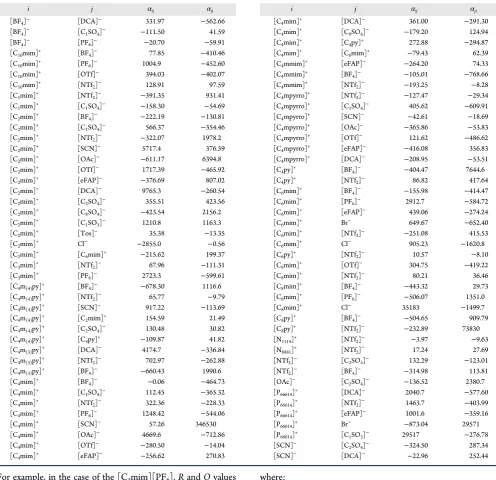
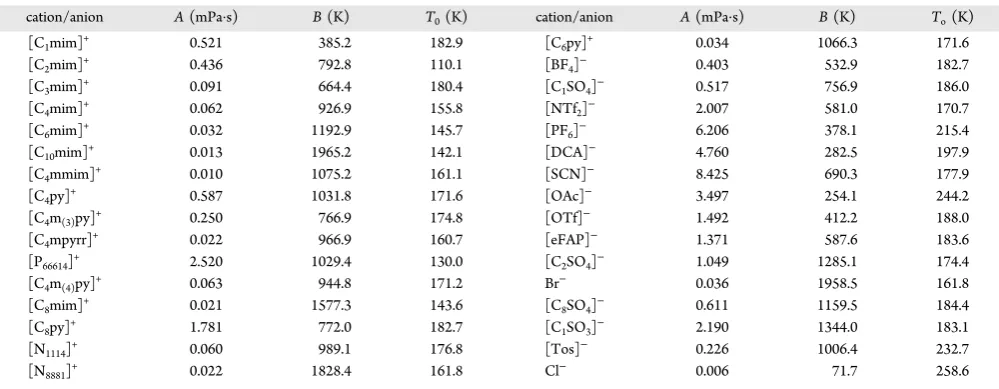
The unknown parameters, binary interaction parameters (αmn andαnm) and ion VFTfitting parameters (A,B, andT0) were estimated by minimizing the objective function (eq 14) using the Marquardt98optimization technique:
∑
μ μμ = − → = ⎛ ⎝ ⎜⎜ ⎞⎠⎟⎟ M
OF 1 min
i M 1 exp cal exp 2 (14)
[image:7.625.64.561.79.559.2]where M is the number of data points; μexp and μcal are the experimental and calculated viscosity data, respectively.
Table 5. Calculated Binary Interaction Parameters of the Selected Cations and Anions
i j αij αji
[BF4]− [DCA]− 331.97 −562.66
[BF4]− [C1SO4]− −111.50 41.59
[BF4]− [PF6]− −20.70 −59.91
[C10mim]+ [BF4]− 77.85 −410.46
[C10mim]+ [PF6]− 1004.9 −452.60
[C10mim]+ [OTf]− 394.03 −402.07
[C10mim]+ [NTf2]− 128.91 97.59
[C1mim]+ [NTf2]− −391.35 931.41
[C1mim]+ [C1SO4]− −158.30 −54.69
[C2mim]+ [BF4]− −222.19 −130.81
[C2mim]+ [C1SO4]− 566.37 −354.46
[C2mim]+ [NTf2]− −322.07 1978.2
[C2mim]+ [SCN]− 5717.4 376.59
[C2mim]+ [OAc]− −611.17 6394.8
[C2mim]+ [OTf]− 1717.39 −465.92
[C2mim]+ [eFAP]− −376.69 807.02
[C2mim]+ [DCA]− 9765.3 −260.54
[C2mim]+ [C2SO4]− 355.51 423.56
[C2mim]+ [C8SO4]− −423.54 2156.2
[C2mim]+ [C1SO3]− 1210.8 1163.3
[C2mim]+ [Tos]− 35.38 −13.35
[C2mim]+ Cl− −2855.0 −0.56
[C2mim]+ [C6mim]+ −215.62 199.37
[C3mim]+ [NTf2]− 67.96 −111.31
[C3mim]+ [PF6]− 2723.3 −599.61
[C4m(4)py]+ [BF4]− −678.30 1116.6
[C4m(4)py]+ [NTf2]− 65.77 −9.79
[C4m(4)py]+ [SCN]− 917.22 −113.69
[C4m(4)py]+ [C2mim]+ 154.59 21.49
[C4m(4)py]+ [C2SO4]− 130.48 30.82
[C4m(4)py]+ [C4py]+ −109.87 41.82
[C4m(3)py]+ [DCA]− 4174.7 −336.84
[C4m(3)py]+ [NTf2]− 702.97 −262.88
[C4m(3)py]+ [BF4]− −660.43 1990.6
[C4mim]+ [BF4]− −0.06 −464.73
[C4mim]+ [C1SO4]− 112.45 −365.32
[C4mim]+ [NTf2]− 322.36 −228.33
[C4mim]+ [PF6]− 1248.42 −544.06
[C4mim]+ [SCN]− 57.26 346530
[C4mim]+ [OAc]− 4669.6 −712.86
[C4mim]+ [OTf]− −280.50 −14.04
[C4mim]+ [eFAP]− −256.62 270.83
i j αij αji
[C4mim]+ [DCA]− 361.00 −291.30
[C4mim]+ [C8SO4]− −179.20 124.94
[C4mim]+ [C4py]+ 272.88 −294.87
[C4mim]+ [C6mim]+ −79.43 62.39
[C4mmim]+ [eFAP]− −264.20 74.33
[C4mmim]+ [BF4]− −105.01 −768.66
[C4mmim]+ [NTf2]− −193.25 −8.28
[C4mpyrro]+ [NTf2]− −127.47 −29.34
[C4mpyrro]+ [C1SO4]− 405.62 −609.91
[C4mpyrro]+ [SCN]− −42.61 −18.69
[C4mpyrro]+ [OAc]− −365.86 −53.83
[C4mpyrro]+ [OTf]− 121.62 −486.62
[C4mpyrro]+ [eFAP]− −416.08 356.83
[C4mpyrro]+ [DCA]− −208.95 −53.51
[C4py]+ [BF4]− −404.47 7644.6
[C4py]+ [NTf2]− 86.82 417.64
[C6mim]+ [BF4]− −155.98 −414.47
[C6mim]+ [PF6]− 2912.7 −584.72
[C6mim]+ [eFAP]− 439.06 −274.24
[C6mim]+ Br− 649.67 −652.40
[C6mim]+ [NTf2]− −251.08 415.53
[C6mim]+ Cl− 905.23 −1620.8
[C6py]+ [NTf2]− 10.57 −8.10
[C8mim]+ [OTf]− 304.75 −419.22
[C8mim]+ [NTf2]− 80.21 36.46
[C8mim]+ [BF4]− −443.32 29.73
[C8mim]+ [PF6]− −506.07 1351.0
[C8mim]+ Cl− 35183 −1499.7
[C8py]+ [BF4]− −504.65 909.79
[C8py]+ [NTf2]− −232.89 73830
[N1114]+ [NTf2]− −3.97 −9.63
[N8881]+ [NTf2]− 17.24 27.69
[NTf2]− [C2SO4]− 132.29 −123.01
[NTf2]− [BF4]− −314.98 113.81
[OAc]− [C2SO4]− −136.52 2380.7
[P66614]+ [DCA]− 2040.7 −577.60 [P66614]+ [NTf2]− 1463.7 −403.99 [P66614]+ [eFAP]− 1001.6 −359.16 [P66614]+ Br− −873.04 29571 [P66614]+ [C1SO3]− 29517 −276.78
[SCN]− [C2SO4]− −324.50 287.34
This method is faster than the regression along with an influence function used earlier in the paper. It is worth men-tioning that the estimators derived from mathematical gnostics converge to the ordinary least-squares method if the errors are sufficiently small as can be proven by a Taylor series expansion. In this stage, regression was applied to the recommended data sets only which ensures that errors are small enough and a faster algorithm can be utilized.
3.2. Extension of the UNIFAC−VISCO Method. In our previous study,33154 experimental data of the selected 25 ILs were used during the overall regression. In this work, these data were substituted by the recommended ones to estimate the corresponding binary interaction parameters and the VFT parameters of previously selected ions. Then based on the updated parameters, the unknown parameters of other 45 ionic liquids were optimized using their corresponding recommen-ded data sets.
Table 4shows the availability of the experimental data in the literature for different combinations of cations ([C2mim]+, [C4mim]+, [C4m(4)py]+, and [C4mpyrro]+) and anions ([BF4]−, [SCN]−, and [NTf2]−). It can be observed that the experimental data of [SCN]−-based ionic liquids are only reported in the literature for [C2mim][SCN],
39
[C4 mim]-[SCN],56 [C4m(4)py][SCN],77 and [C4mpyrro][SCN].77 The experimental data of [C4m(4)py]+-based ionic liquids are only available in the literature for [C4m(4)py][BF4],80 [C4m(4) py]-[SCN],77 and [C4m(4)py][NTf2].63 In other words, the experimental data of the ionic liquids consisting of each ion denoted with bold letters (seeTable 4) having been reported in literature are all listed inTable 4. For the other ions the VFT
fitting parameters have been obtained from the regression analysis of the first 25 ILs. Therefore, the VFT parameters of only [C4m(4)py]+, and [SCN]− are unknown. The VFT parameters of [C4m(4)py]+ only depend on the available experimental values of [C4m(4)py][BF4], [C4m(4)py][SCN], and [C4m(4)py][NTf2]. The VFT parameters of [SCN]−only depend on the available experimental values of [C2mim][SCN], [C4mim][SCN], [C4m(4)py][SCN], and [C4mpyrro][SCN]. Herein, the experimental data of these six ionic liquids were regressed together to get the proper VFTfitting parameters of [C4m(4)py]+, and [SCN]−, and the binary interaction param-eters of these six ionic liquids as well. Following this method-ology and based on these parameters having been obtained,
more binary interaction parameters and VFT parameters for other ILs were optimized.
The regression procedure was completed by developing scripts in MATLAB. MATLAB program (available in the
Supporting Information; filename: Calculation_Single_Ion-ic_Liquid) contains all parameters (binary interaction and VFT parameters) estimated during this study. This program can read experimental data of pure ionic liquids from‘ Recom-mended data sets.xlsx’, determine the evaluated viscosity data of selected ionic liquids, and calculate the relative average absolute deviation (RAAD) between the calculated and the experimental viscosity data for each ionic liquid, for each series of ionic liquids (like imidazolium, pyridinium, and ammonium-based ionic liquids), and for all the 70 ionic liquids. Plotting for the comparison between the predicted values and the experimental data can be shown as well.
The MATLAB program (Filename: Calculation_Binary_Ion-ic_Liquids) contains all parameters for the binary mixtures of ionic liquids estimated during this study. The program can read experimental data of binary mixtures from ‘Binary data.xlsx’, determine the evaluated viscosity of selected mixtures, and calculate the RAAD between the calculated and the experi-mental viscosity data for each binary system, and also for the 11 types of binary mixtures. Plotting for the comparison can be shown as well.
4. RESULTS AND DISCUSSION
Binary interaction parameters (seeTable 5) for 70 pure ILs and VFT parameters (seeTable 6) for 17 cations and 15 anions were estimated by following the regression analysis (eq 14) of 819 experimental data points.
The quality of the regression was then determined by calcu-lating the relative average absolute deviations (RAAD, eq 15) between the calculated and the experimental viscosity data:
∑
μ μμ
= × −
M
RAAD 100 1
i M
exp cal
exp (15)
[image:8.625.64.564.571.765.2]The RAAD values for the regression of each pure IL are presented inTable 7. The model results show a global relative average absolute deviation of 1.4% from the 819 experimental data, which demonstrate an excellent correlation ability of this
Table 6. VFT Fitting Parameters of the Selected Cations and Anions
cation/anion A(mPa·s) B(K) T0(K) cation/anion A(mPa·s) B(K) To(K)
[C1mim]+ 0.521 385.2 182.9 [C6py]+ 0.034 1066.3 171.6
[C2mim]+ 0.436 792.8 110.1 [BF4]− 0.403 532.9 182.7
[C3mim]+ 0.091 664.4 180.4 [C1SO4]− 0.517 756.9 186.0
[C4mim]+ 0.062 926.9 155.8 [NTf2]− 2.007 581.0 170.7
[C6mim]+ 0.032 1192.9 145.7 [PF
6]− 6.206 378.1 215.4
[C10mim]+ 0.013 1965.2 142.1 [DCA]− 4.760 282.5 197.9
[C4mmim]+ 0.010 1075.2 161.1 [SCN]− 8.425 690.3 177.9
[C4py]+ 0.587 1031.8 171.6 [OAc]− 3.497 254.1 244.2
[C4m(3)py]+ 0.250 766.9 174.8 [OTf]− 1.492 412.2 188.0
[C4mpyrr]+ 0.022 966.9 160.7 [eFAP]− 1.371 587.6 183.6
[P66614]+ 2.520 1029.4 130.0 [C2SO4]− 1.049 1285.1 174.4
[C4m(4)py]+ 0.063 944.8 171.2 Br− 0.036 1958.5 161.8
[C8mim]+ 0.021 1577.3 143.6 [C8SO4]− 0.611 1159.5 184.4
[C8py]+ 1.781 772.0 182.7 [C1SO3]− 2.190 1344.0 183.1
[N1114]+ 0.060 989.1 176.8 [Tos]− 0.226 1006.4 232.7
model, except in the case of the [C6mim]Br (RAAD = 12.3%) and [C10mim][NTf2] (RAAD = 14.7%).
The evaluated viscosities in comparison with the experimental values are presented in Figure 3. In addition, the relative deviation of the model in comparison with the experimental data is shown inFigure 4. The distribution of absolute relative deviations from experimental data is shown inFigure 5. For this
figure, it appears that 94.9% of the viscosities are evaluated within 0−5%; 2.7% within 5−10%; 2.0% within 10−20%; and the deviations of only four data points beyond 20%. The four points with larger deviation are from [C6mim]Br and [C10mim][NTf2]. However, due to a large range of viscosity values from bromide-based ILs, it was difficult to regress and obtain the optimal parameters of all ILs combined all together.
Tables 8and9show the results for different cation series of ILs and different anion types of ILs, respectively. This deviation for the estimation follows the order for (1) cations as ammonium < pyridinium < phosphonium < imidazolium < pyrrolidinium, and for (2) anions as [C2SO4]−< [Tos]−< [C1SO4]−< [PF6]−< [SCN]−< [OTf]−< [NTf2]−< [eFAP]−< [BF4]−< [C8SO4]−< [DCA]−< [C1SO3]−< [OAc]−< Br−< Cl−.
[image:9.625.324.565.61.255.2]By using the group interaction potential energy and VFT parameters of ions obtained by the regression of the viscosity data of pure ILs and by following the same methodology, the
Table 7. Relative Absolute Average Deviation (RAAD) of the Calculated Viscosity from the Experimental Viscosity Data for Selected ILs
IL RAAD (%) IL RAAD (%)
[C2mim][BF4] 1.71 [C4mim][OTf] 1.09
[C4mim][BF4] 0.25 [C8mim][OTf] 1.00
[C4mim][C1SO4] 0.17 [C4mpyrro][OTf] 0.72
[C2mim][C1SO4] 0.16 [C10mim][OTf] 0.99
[C4mim][NTf2] 0.38 [C8mim][NTf2] 0.88
[C3mim][NTf2] 0.13 [C8mim][BF4] 0.53
[C3mim][PF6] 0.11 [C8mim][PF6] 0.88
[C4mim][PF6] 0.29 [C2mim][eFAP] 0.39
[C4m(3)py][DCA] 0.23 [C4mim][eFAP] 1.45
[P66614][DCA] 0.42 [C6mim][eFAP] 0.48 [P66614][NTf2] 0.22 [C4mpyrro][eFAP] 1.60
[C4m(3)py][NTf2] 0.12 [C4mmim][eFAP] 2.16
[C4mmim][BF4] 1.63 [P66614][eFAP] 1.23
[C4py][BF4] 3.46 [C2mim][DCA] 2.31
[C4py][NTf2] 0.83 [C2mim][C2SO4] 0.14
[C4mmim][NTf2] 1.84 [C6mim]Br 12.33
[C6mim][BF4] 0.45 [P66614]Br 1.44
[C10mim][BF4] 1.73 [C4mim][DCA] 0.40
[C10mim][PF6] 0.57 [C4mpyrro][DCA] 7.19
[C6mim][PF6] 0.54 [C8py][BF4] 1.12
[C1mim][NTf2] 0.73 [C8py][NTf2] 0.24
[C4mpyrro][NTf2] 0.32 [C4m(3)py][BF4] 1.48
[C4mpyrro][C1SO4] 0.66 [C2mim][C8SO4] 0.80
[C1mim][C1SO4] 0.45 [C4mim][C8SO4] 3.37
[C2mim][NTf2] 1.78 [C2mim][C1SO3] 2.71
[C4m(4)py][BF4] 3.32 [P66614][C1SO3] 2.60
[C4m(4)py][NTf2] 0.20 [C2mim][Tos] 0.25
[C2mim][SCN] 0.15 [C6mim][NTf2] 0.23
[C4mim][SCN] 0.68 [C10mim][NTf2] 14.72
[C4m(4)py][SCN] 0.57 [N1114][NTf2] 0.04
[C4mpyrro][SCN] 2.20 [N8881][NTf2] 0.75
[C2mim][OAc] 7.72 [C6py][NTf2] 0.34
[C4mim][OAc] 0.62 [C2mim]Cl 9.84
[C4mpyrro][OAc] 4.31 [C6mim]Cl 3.46
[image:9.625.63.299.110.707.2][C2mim][OTf] 0.09 [C8mim]Cl 3.99
Figure 3.Comparison of experimental (μexp) and evaluated viscosity
[image:9.625.323.565.290.475.2](μcal) data for pure ionic liquids.
Figure 4. Relative deviation of evaluated viscosity values versus experimental data.
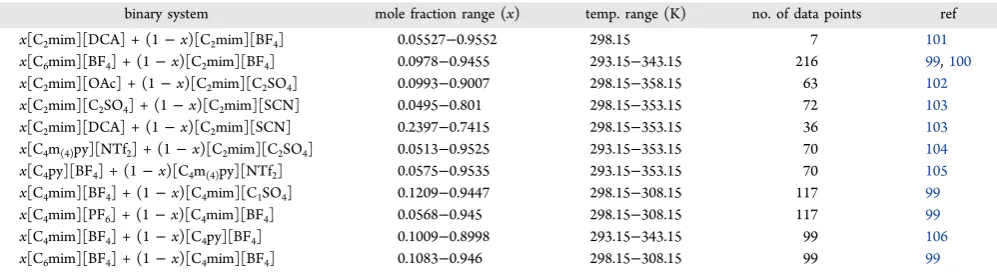
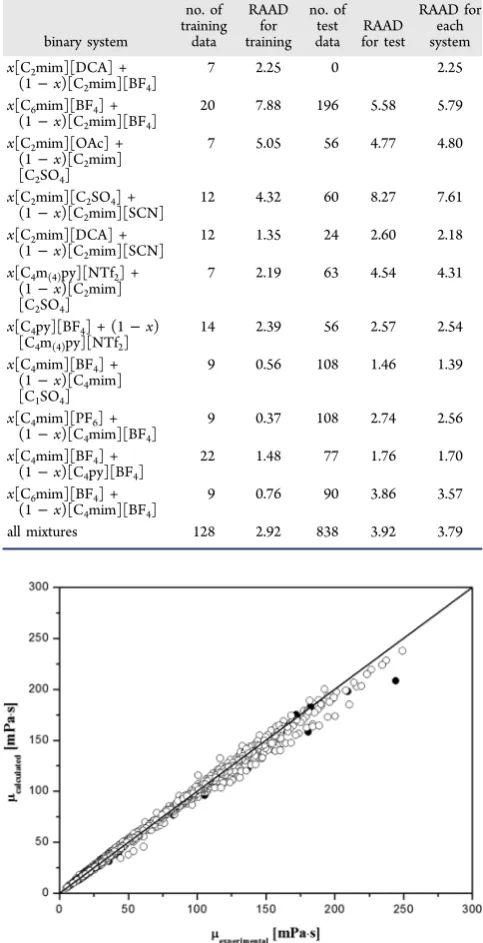
viscosity of binary mixtures of ILs were then correlated to obtain missing interaction parameters between cation−cation and/or anion−anion. The viscosity data of 11 binary mixtures of ILs reported in eight references were used. The compositions of the mixtures, temperature range, number of data points, and references are summarized inTable 10. Herein, only one set of data for each binary mixture was used as the training set to determine missing group interaction potential energy param-eters. The other data available were then used to evaluate the accuracy of the UNIFAC−VISCO model as the function of temperature and composition for each ILs mixture. The prediction result is highlighted by the RAAD values, presented in Table 11, which is 3.8% for all collected binary data. In addition, the parity plot given in Figure 6shows good agree-ment between the experiagree-mental data and calculated viscos-ities by using the model. In the case of the ([C2mim][BF4] + [C6mim][BF4]) binary mixture, two viscosity data sets are available in the literature,99,100and discrepancies between these series of measurements, which were performed in two different laboratories for different compositions and temperatures within an uncertainty close to 1.0%99 and 4.0%,100 do in fact exist.
As a consequence, for this particular binary mixture, a training data point, and some predicted data, shown as afilled and empty circles inFigure 6, respectively, seem to be underestimated.
5. CONCLUSIONS
A critical analysis of IL viscosity data has been made for the selection of available data sets for 70 ILs. An extension of a previously reported method based on the UNIFAC−VISCO model has been made using 819 experimental data of 70 ILs in a temperature range from 263.15 to 373.15 K at 0.1 MPa. The binary interaction parameters and the ion VFT parameters were obtained by a regression analysis of experimental viscosity data. The deviation of 1.4% from experimental data shows a good correlation quality of this model. The viscosity of binary mixtures of ionic liquids was then predicted by using this method, with a relative average absolute deviation lower than 3.8%. This proves that the UNIFAC−VISCO-based model can be used to correlate and then evaluate the viscosities of pure ionic liquids with different functionalities (i.e., branched or not alkyl chain shape, for example) thanks to the 3D structure of their ions (effective molar volume, effective viscosity,RandQ
Table 8. RAAD for Different Cation Types of ILs
cation type no. of structures no. of data temp. range (K) experimental viscosity range (mPa·s) RAAD (%)
pyridinium 11 132 278.15−363.15 7.673−640.14 0.78
pyrrolidinium 7 90 283.15−373.15 8.98−593.7 2.30
phosphonium 5 86 268.15−373.15 17.567−16955 1.26
imidazolium 45 488 263.15−373.15 4.229−63100 1.53
[image:10.625.59.565.91.362.2]ammonium 2 23 273.15−353.15 14.7−3729.6 0.29
Table 9. RAAD for Different Anion Types of ILs
anion type no. of structures no. of data temp. range (K) experimental viscosity range (mPa·s) RAAD (%)
[PF6]− 5 38 293.15−363.15 17.77−1052 0.42
[C1SO4]− 4 45 283.15−373.15 9−467.5 0.32
Cl− 3 17 283.15−363.15 33.2−63100 5.09
[C1SO3]− 2 36 278.15−363.15 13.33−7526.5 2.65
[NTf2]− 17 223 263.15−373.15 7.673−3729.6 0.83
[BF4]− 10 84 273.15−373.15 18.4−2291 1.38
[DCA]− 5 68 278.15−363.15 4.229−562.45 1.99
[SCN]− 4 48 278.15−368.15 5.485−112.41 0.66
[eFAP]− 6 89 268.15−373.15 7.45−3067.3 1.35
[OAc]− 3 29 298.15−363.15 8.98−288.8 4.85
[C2SO4]− 1 10 298.15−343.15 18.72−97.6 0.14
[C8SO4]− 2 28 283.15−373.15 23.3−1879 1.62
Br− 2 27 278.15−363.15 85.436−16955 5.07
[Tos]− 1 13 303.15−363.15 33.22−1417 0.25
[image:10.625.65.564.385.523.2][OTf]− 5 64 278.15−373.15 8.169−2059 0.67
Table 10. Experimental Viscosity Data of Binary Mixtures of ILs Collected from Literature
binary system mole fraction range (x) temp. range (K) no. of data points ref
x[C2mim][DCA] + (1−x)[C2mim][BF4] 0.05527−0.9552 298.15 7 101
x[C6mim][BF4] + (1−x)[C2mim][BF4] 0.0978−0.9455 293.15−343.15 216 99,100
x[C2mim][OAc] + (1−x)[C2mim][C2SO4] 0.0993−0.9007 298.15−358.15 63 102
x[C2mim][C2SO4] + (1−x)[C2mim][SCN] 0.0495−0.801 298.15−353.15 72 103
x[C2mim][DCA] + (1−x)[C2mim][SCN] 0.2397−0.7415 298.15−353.15 36 103
x[C4m(4)py][NTf2] + (1−x)[C2mim][C2SO4] 0.0513−0.9525 293.15−353.15 70 104
x[C4py][BF4] + (1−x)[C4m(4)py][NTf2] 0.0575−0.9535 293.15−353.15 70 105
x[C4mim][BF4] + (1−x)[C4mim][C1SO4] 0.1209−0.9447 298.15−308.15 117 99
x[C4mim][PF6] + (1−x)[C4mim][BF4] 0.0568−0.945 298.15−308.15 117 99
x[C4mim][BF4] + (1−x)[C4py][BF4] 0.1009−0.8998 293.15−343.15 99 106
values) and their interaction in solution (binary interaction parameters), as well as mixtures of ionic liquids, including elec-trolyte blends with great accuracy.
■
ASSOCIATED CONTENT*
S Supporting InformationThe Supporting Information is available free of charge on the
ACS Publications websiteat DOI:10.1021/acs.jced.6b00689. All the volumetric parameters,RandQvalues for each ion estimated in this work are presented in Tables S1−S2. The gnostic analysisfigures for all the other ionic liquids were illustrated in Figures S1−S86 (PDF)
Matlab files for the calculation of pure IL and binary mixtures (ZIP)
■
AUTHOR INFORMATIONCorresponding Authors
*E-mail: [email protected].
*E-mail: [email protected].
*E-mail: [email protected] [email protected].
Funding
N.Z. and J.J. acknowledge gratefully the CEA le Ripault (Grant No 4600261677/P6E31) and the Engineering and Physical Sciences Research Council (EPSRC) for supporting this work
financially (EPSRC First Grant Scheme, Grant No EP/ M021785/1).
Notes
The authors declare no competingfinancial interest.
■
ABBREVIATIONSCations:
[C1mim]+ 1,3-dimethylimidazolium [C2mim]+ 1-ethyl-3-methylimidazolium [C3mim]+ 1-propyl-3-methylimidazolium [C4mim]+ 1-butyl-3-methylimidazolium [C6mim]+ 1-hexyl-3-methylimidazolium [C8mim]+ 1-octyl-3-methylimidazolium [C10mim]+ 1-decyl-3-methylimidazolium [C4mmim]+ 1-butyl-2,3-dimethylimidazolium [C4py]+ 1-butylpyridinium
[C6py]+ 1-hexylpyridinium [C8py]+ 1-octylpyridinium
[C4m(3)py]+ 1-butyl-3-methylpyridinium [C4m(4)py]+ 1-butyl-4-methylpyridinium [C4mpyrro]+ 1-butyl-1-methylpyrrolidinium [N1114]+ butyl-trimethylammonium [N8881]+ methyl-trioctyl-ammonium [P66614]+ trihexyl(tetradecyl)phosphonium
Anions:
[BF4]− tetrafluoroborate
[NTf2]− bis(trifluoromethylsulfonyl)imide [C1SO4]− methylsulfate
[C2SO4]− ethylsulfate [C8SO4]− octylsulfate [C1SO3]− methanesulfonate [PF6]− hexafluorophosphate [DCA]− dicyanamide [SCN]− thiocyanate [OAc]− acetate [OTf]− triflate
[eFAP]− tris(pentafluoroethyl)trifluorophosphate [Tos]− tosylate
Br− bromide
Cl− chloride
Nomenclature Roman Letters:
ai volumetric parameter A VFT equation parameter B VFT equation parameter
C total number of components in UNIFAC−VISCO method gcE combinatorial contribution term in UNIFAC−VISCO
method
[image:11.625.60.299.96.588.2]grE residual contribution term in UNIFAC−VISCO method
Table 11. RAADs of Training Data, Test Data, and Experimental Data for Each Binary Mixture of ILs
binary system
no. of training
data
RAAD for training
no. of test data
RAAD for test
RAAD for each system
x[C2mim][DCA] +
(1−x)[C2mim][BF4]
7 2.25 0 2.25
x[C6mim][BF4] + (1−x)[C2mim][BF4]
20 7.88 196 5.58 5.79
x[C2mim][OAc] +
(1−x)[C2mim]
[C2SO4]
7 5.05 56 4.77 4.80
x[C2mim][C2SO4] +
(1−x)[C2mim][SCN]
12 4.32 60 8.27 7.61
x[C2mim][DCA] +
(1−x)[C2mim][SCN]
12 1.35 24 2.60 2.18
x[C4m(4)py][NTf2] +
(1−x)[C2mim]
[C2SO4]
7 2.19 63 4.54 4.31
x[C4py][BF4] + (1−x) [C4m(4)py][NTf2]
14 2.39 56 2.57 2.54
x[C4mim][BF4] +
(1−x)[C4mim]
[C1SO4]
9 0.56 108 1.46 1.39
x[C4mim][PF6] + (1−x)[C4mim][BF4]
9 0.37 108 2.74 2.56
x[C4mim][BF4] + (1−x)[C4py][BF4]
22 1.48 77 1.76 1.70
x[C6mim][BF4] + (1−x)[C4mim][BF4]
9 0.76 90 3.86 3.57
all mixtures 128 2.92 838 3.92 3.79
Figure 6.Comparison of experimental (μexp) and evaluated viscosity
(μcal) data for binary ionic liquids mixtures where data used for
[image:11.625.59.301.97.569.2]ni,k total number ofkthgroup present in componenti
M number of data points N total number of groups pref reference pressure (0.1 MPa)
qi van der Waals’surface area of component i Qk group surface area parameter
ri van der Waals’volume of componenti Rk group volume parameter
9 gas constant (J/mol·K) T temperature (K) T0 VFT equation parameter
Vi pure-component molar volume (m3/kmol) Vm mixture molar volume (m3/kmol)
xi mole fraction of the componenti
z coordinate value in UNIFAC−VISCO method
Greek Letters:
αmn group interaction potential energy parameter between groups mandn
γm residual activity coefficient
θi molecular surface area fraction of componenti
Θi area fraction for groupi μ viscosity of mixture (mPa·s) μi viscosity of component i
μexp viscosity experimentally measured
μcal viscosity calculated by our method
μo viscosity value with the maximum distribution density μion effective viscosity of ion
ϕi molecular volume fraction of componenti
Ψm,i group interaction parameter ω gnostic a posteriori weight
■
REFERENCES(1) Welton, T. Room-Temperature Ionic Liquids. Solvents for Synthesis and Catalysis.Chem. Rev.1999,99, 2071−2084.
(2) Marsh, K. N.; Boxall, J. A.; Lichtenthaler, R. Room Temperature Ionic Liquids and Their Mixturesa Review. Fluid Phase Equilib. 2004,219, 93−98.
(3) Dong, Q.; Muzny, C. D.; Kazakov, A.; Diky, V.; Magee, J. W.; Widegren, J. A.; Chirico, R. D.; Marsh, K. N.; Frenkel, M. ILThermo: A Free-Access Web Database for Thermodynamic Properties of Ionic Liquids.J. Chem. Eng. Data2007,52, 1151−1159.
(4) Diedenhofen, M.; Klamt, A. COSMO-RS as a Tool for Property Prediction of IL Mixtures-A Review.Fluid Phase Equilib. 2010,294, 31−38.
(5) Lei, Z.; Chen, B.; Li, C.; Liu, H. Predictive Molecular Thermodynamic Models for Liquid Solvents, Solid Salts, Polymers, and Ionic Liquids.Chem. Rev.2008,108, 1419−1455.
(6) Seiler, M.; Jork, C.; Kavarnou, A.; Arlt, W.; Hirsch, R. Separation of Azeotropic Mixtures Using Hyperbranched Polymers or Ionic Liquids.AIChE J.2004,50, 2439−2454.
(7) Marciniak, A. Influence of Cation and Anion Structure of the Ionic Liquid on Extraction Processes Based on Activity Coefficients at Infinite Dilution. A Review.Fluid Phase Equilib.2010,294, 213−233. (8) Seddon, K. R.; Stark, A.; Torres, M. J. Viscosity and Density of 1-Alkyl-3-Methylimidazolium Ionic Liquids. In Clean Solvents: Alternative Media for Chemical Reactions and Processiong; ACS Symposium Series; Abraham, M. A., Moens, L., Eds.; American Chemical Society: Washington, USA, 2002; Vol.819, pp 34−49.
(9) Gardas, R. L.; Coutinho, J. A. P. A Group Contribution Method for Viscosity Estimation of Ionic Liquids.Fluid Phase Equilib.2008,
266, 195−201.
(10) Meindersma, W. G. W.; van Acker, T.; de Haan, A. B. Physical Properties of 3-Methyl-N-Butylpyridinium Tricyanomethanide and Ternary LLE Data with an Aromatic and an Aliphatic Hydrocarbon at T = (303.2 and 328.2)K and p = 0.1 MPa.Fluid Phase Equilib.2011,
307, 30−38.
(11) Galán Sanchez, L. M.; Meindersma, G. W.; de Haan, A. B.́ Solvent Properties of Functionalized Ionic Liquids for CO2 Absorption.Chem. Eng. Res. Des.2007,85, 31−39.
(12) Ghatee, M. H.; Bahrami, M.; Khanjari, N. Measurement and Study of Density, Surface Tension, and Viscosity of Quaternary Ammonium-Based Ionic Liquids ([N222(n)]Tf2N). J. Chem. Thermodyn.2013,65, 42−52.
(13) Gaciño, F. M.; Paredes, X.; Comuñas, M. J. P.; Fernández, J. Pressure Dependence on the Viscosities of 1-Butyl-2,3-Dimethylimi-dazolium Bis(trifluoromethylsulfonyl)imide and Two Tris-(pentafluoroethyl)trifluorophosphate Based Ionic Liquids: New Measurements and Modelling.J. Chem. Thermodyn.2013,62, 162− 169.
(14) Haghbakhsh, R.; Raeissi, S. Two Simple Correlations to Predict Viscosities of Pure and Aqueous Solutions of Ionic Liquids.J. Mol. Liq. 2015,211, 948−956.
(15) Ghatee, M. H.; Zare, M. Power-Law Behavior in the Viscosity of Ionic Liquids: Existing a Similarity in the Power Law and a New Proposed Viscosity Equation.Fluid Phase Equilib.2011,311, 76−82.
(16) Lazzús, J. A.; Pulgar-Villarroel, G. A Group Contribution Method to Estimate the Viscosity of Ionic Liquids at Different Temperatures.J. Mol. Liq.2015,209, 161−168.
(17) Daniel, C. I.; Albo, J.; Santos, E.; Portugal, C. A. M.; Crespo, J. G.; Irabien, A. A Group Contribution Method for the Influence of the Temperature in the Viscosity of Magnetic Ionic Liquids.Fluid Phase Equilib.2013,360, 29−35.
(18) Gharagheizi, F.; Ilani-Kashkouli, P.; Mohammadi, A. H.; Ramjugernath, D.; Richon, D. Development of a Group Contribution Method for Determination of Viscosity of Ionic Liquids at Atmospheric Pressure.Chem. Eng. Sci.2012,80, 326−333.
(19) Gardas, R. L.; Coutinho, J. A. P. Group Contribution Methods for the Prediction of Thermophysical and Transport Properties of Ionic Liquids.AIChE J.2009,55, 1274−1290.
(20) Bini, R.; Malvaldi, M.; Pitner, W. R.; Chiappe, C. QSPR Correlation for Conductivities and Viscosities of Low-Temperature Melting Ionic Liquids.J. Phys. Org. Chem.2008,21, 622−629.
(21) Yu, G.; Wen, L.; Zhao, D.; Asumana, C.; Chen, X. QSPR Study on the Viscosity of Bis(trifluoromethylsulfonyl)imide-Based Ionic Liquids.J. Mol. Liq.2013,184, 51−59.
(22) Chen, B.-K.; Liang, M.-J.; Wu, T.-Y.; Wang, H. P. A High Correlate and Simplified QSPR for Viscosity of Imidazolium-Based Ionic Liquids.Fluid Phase Equilib.2013,350, 37−42.
(23) Han, C.; Yu, G.; Wen, L.; Zhao, D.; Asumana, C.; Chen, X. Data and QSPR Study for Viscosity of Imidazolium-Based Ionic Liquids.
Fluid Phase Equilib.2011,300, 95−104.
(24) Matsuda, H.; Yamamoto, H.; Kurihara, K.; Tochigi, K. Computer-Aided Reverse Design for Ionic Liquids by QSPR Using Descriptors of Group Contribution Type for Ionic Conductivities and Viscosities.Fluid Phase Equilib.2007,261, 434−443.
(25) Matsuda, H.; Yamamoto, H.; Kurihara, K.; Tochigi, K. Prediction of The Ionic Conductivity and Viscosity of Ionic Liquids by QSPR Using Descriptors of Group Contribution Type.J. Comput. Aided Chem.2007,8, 114−127.
(26) Tochigi, K.; Yamamoto, H. Estimation of Ionic Conductivity and Viscosity of Ionic Liquids Using a QSPR Model.J. Phys. Chem. C 2007,111, 15989−15994.
(27) Mirkhani, S. A.; Gharagheizi, F. Predictive Quantitative Structure−Property Relationship Model for the Estimation of Ionic Liquid Viscosity.Ind. Eng. Chem. Res.2012,51, 2470−2477.
(28) Polishuk, I. Modeling of Viscosities in Extended Pressure Range Using SAFT + Cubic EoS and Modified Yarranton-Satyro Correlation.
Ind. Eng. Chem. Res.2012,51, 13527−13537.
(29) Abolala, M.; Peyvandi, K.; Varaminian, F. Modeling the Viscosity of Pure Imidazolium-Based Ionic Liquids Using SAFT-VR-Mie EoS.Fluid Phase Equilib.2015,394, 61−70.
(31) Seddon, K. R.; Stark, A.; Torres, M.-J. Influence of Chloride, Water, and Organic Solvents on the Physical Properties of Ionic Liquids.Pure Appl. Chem.2000,72, 2275−2287.
(32) Jacquemin, J.; Husson, P.; Padua, A. A. H.; Majer, V. Density and Viscosity of Several Pure and Water-Saturated Ionic Liquids.Green Chem.2006,8, 172−180.
(33) Zhao, N.; Jacquemin, J.; Oozeerally, R.; Degirmenci, V. New Method for the Estimation of Viscosity of Pure and Mixtures of Ionic Liquids Based on the UNIFAC−VISCO Model. J. Chem. Eng. Data 2016,61, 2160−2169.
(34) Kovanic, P.; Humber, M. B. The Economics of Information-Mathematical Gnostics for Data Analysis(available only online);http://
www.math-gnostics.com/books(accessed Jan 5, 2016).
(35) Kovanic, P.Guide to Gnostic Analysis of Uncertain Data(available only online);http://www.math-gnostics.eu/software/ (accessed May 1, 2016).
(36) Heiberger, R. M.; Becker, R. A. Design of anS Function for Robust Regression Using Iteratively Reweighted Least Squares. J. Comput. Graph. Stat.1992,1, 181−196.
(37) Abbott, A. P.; McKenzie, K. J. Application of Ionic Liquids to the Electrodeposition of Metals. Phys. Chem. Chem. Phys. 2006, 8, 4265−4279.
(38) Francois, Y.; Zhang, K.; Varenne, A.; Gareil, P. New Integrateḑ Measurement Protocol Using Capillary Electrophoresis Instrumenta-tion for the DeterminaInstrumenta-tion of Viscosity, Conductivity and Absorbance of Ionic Liquid-Molecular Solvent Mixtures.Anal. Chim. Acta 2006,
562, 164−170.
(39) Freire, M. G.; Teles, A. R. R.; Rocha, M. A. A.; Schröder, B.; Neves, C. M. S. S.; Carvalho, P. J.; Evtuguin, D. V.; Santos, L. M. N. B. F.; Coutinho, J. A. P. Thermophysical Characterization of Ionic Liquids Able to Dissolve Biomass.J. Chem. Eng. Data2011,56, 4813− 4822.
(40) Morgan, D.; Ferguson, L.; Scovazzo, P. Diffusivities of Gases in Room-Temperature Ionic Liquids: Data and Correlations Obtained Using a Lag-Time Technique.Ind. Eng. Chem. Res.2005,44, 4815− 4823.
(41) Rodríguez, H.; Brennecke, J. Temperature and Composition Dependence of the Density and Viscosity of Binary Mixtures of Water + Ionic Liquid.J. Chem. Eng. Data2006,51, 2145−2155.
(42) Yusoff, R.; Aroua, M. K.; Shamiri, A.; Ahmady, A.; Jusoh, N. S.; Asmuni, N. F.; Bong, L. C.; Thee, S. H. Density and Viscosity of Aqueous Mixtures of N -Methyldiethanolamines (MDEA) and Ionic Liquids.J. Chem. Eng. Data2013,58, 240−247.
(43) Mbondo Tsamba, B. E.; Sarraute, S.; Traïkia, M.; Husson, P. Transport Properties and Ionic Association in Pure Imidazolium-Based Ionic Liquids as a Function of Temperature.J. Chem. Eng. Data2014,
59, 1747−1754.
(44) Vuksanovic, J. M.; Calado, M. S.; Ivanis, G. R.; Kijevcanin, M. L.; Serbanovic, S. P.; Visak, Z. P. Environmentally Friendly Solutions of Liquid Poly(ethylene Glycol) and Imidazolium Based Ionic Liquids with Bistriflamide and Triflate Anions: Volumetric and Viscosity Studies.Fluid Phase Equilib.2013,352, 100−109.
(45) Sanmamed, Y. A.; Gonzalez-Salgado, D.; Troncoso, J.; Romani,́ L.; Baylaucq, A.; Boned, C. Experimental Methodology for Precise Determination of Density of RTILs as a Function of Temperature and Pressure Using Vibrating Tube Densimeters. J. Chem. Thermodyn. 2010,42, 553−563.
(46) Costa, A. J. L.; Esperança, J. M. S. S.; Marrucho, I. M.; Rebelo, L. P. N. Densities and Viscosities of 1-Ethyl-3-Methylimidazolium N-Alkyl Sulfates.J. Chem. Eng. Data2011,56, 3433−3441.
(47) Schreiner, C.; Zugmann, S.; Hartl, R.; Gores, H. J. Fractional Walden Rule for Ionic Liquids: Examples from Recent Measurements and a Critique of the so-Called Ideal KCl Line for the Walden Plot.J. Chem. Eng. Data2010,55, 1784−1788.
(48) Quijada-Maldonado, E.; van der Boogaart, S.; Lijbers, J. H.; Meindersma, G. W.; de Haan, A. B. Experimental Densities, Dynamic Viscosities and Surface Tensions of the Ionic Liquids Series 1-Ethyl-3-Methylimidazolium Acetate and Dicyanamide and Their Binary and
Ternary Mixtures with Water and Ethanol at T = (298.15 to 343.15K).
J. Chem. Thermodyn.2012,51, 51−58.
(49) Almantariotis, D.; Stevanovic, S.; Fandiño, O.; Pensado, A. S.; Padua, A. A. H.; Coxam, J.-Y.; Costa Gomes, M. F. Absorption of Carbon Dioxide, Nitrous Oxide, Ethane and Nitrogen by 1-Alkyl-3-Methylimidazolium (C(n)mim, N = 2,4,6) Tris(pentafluoroethyl)-trifluorophosphate Ionic Liquids (eFAP).J. Phys. Chem. B2012,116, 7728−7738.
(50) Gómez, E.; Gonzalez, B.; Calvar, N.; Tojo, E.; Domínguez, Á ́. Physical Properties of Pure 1-Ethyl-3-Methylimidazolium Ethylsulfate and Its Binary Mixtures with Ethanol and Water at Several Temperatures.J. Chem. Eng. Data2006,51, 2096−2102.
(51) Kavitha, T.; Vasantha, T.; Venkatesu, P.; Rama Devi, R. S.; Hofman, T. Thermophysical Properties for the Mixed Solvents of N-Methyl-2-Pyrrolidone with Some of the Imidazolium-Based Ionic Liquids.J. Mol. Liq.2014,198, 11−20.
(52) Sanmamed, Y. A.; Gonzalez-Salgado, D.; Troncoso, J.;́ Cerdeiriña, C. A.; Romaní, L. Viscosity-Induced Errors in the Density Determination of Room Temperature Ionic Liquids Using Vibrating Tube Densitometry.Fluid Phase Equilib.2007,252, 96−102.
(53) Pereiro, A. B.; Verdía, P.; Tojo, E.; Rodríguez, A. Physical Properties of 1-Butyl-3-Methylimidazolium Methyl Sulfate as a Function of Temperature.J. Chem. Eng. Data2007,52, 377−380.
(54) Harris, K. R.; Kanakubo, M.; Woolf, L. A. Temperature and Pressure Dependence of the Viscosity of the Ionic Liquids 1-Hexyl-3-Methylimidazolium Hexafluorophosphate and 1-Butyl-3-Methylimida-zolium Bis(trifluoromethylsulfonyl)imide.J. Chem. Eng. Data2007,52, 1080−1085.
(55) Pereiro, A. B.; Legido, J. L.; Rodríguez, A. Physical Properties of Ionic Liquids Based on 1-Alkyl-3-Methylimidazolium Cation and Hexafluorophosphate as Anion and Temperature Dependence. J. Chem. Thermodyn.2007,39, 1168−1175.
(56) Vakili-Nezhaad, G.; Vatani, M.; Asghari, M.; Ashour, I. Effect of Temperature on the Physical Properties of 1-Butyl-3-Methylimidazo-lium Based Ionic Liquids with Thiocyanate and Tetrafluoroborate Anions, and 1-Hexyl-3-Methylimidazolium with Tetrafluoroborate and Hexafluorophosphate Anions. J. Chem. Thermodyn. 2012, 54, 148− 154.
(57) Xu, A.; Zhang, Y.; Li, Z.; Wang, J. Viscosities and Conductivities of 1-Butyl-3-Methylimidazolium Carboxylates Ionic Liquids at Differ-ent Temperatures.J. Chem. Eng. Data2012,57, 3102−3108.
(58) Carvalho, P. J.; Regueira, T.; Santos, L. M. N. B. F.; Fernandez, J.; Coutinho, J. A. P. Effect of Water on the Viscosities and Densities of 1-Butyl-3-Methylimidazolium Dicyanamide and 1-Butyl-3-Methylimi-dazolium Tricyanomethane at Atmospheric Pressure. J. Chem. Eng. Data2010,55, 645−652.
(59) Wasserscheid, P.; Hal, R.; Bösmann, A. 1-N-Butyl-3-Methylimidazolium ([Bmim]) Octylsulfate-an Even ‘Greener’ Ionic Liquid.Green Chem.2002,4, 400−404.
(60) Gómez, E.; Calvar, N.; Macedo, E. A.; Domínguez, Á. Effect of the Temperature on the Physical Properties of Pure 1-Propyl 3-Methylimidazolium Bis(trifluoromethylsulfonyl)imide and Charac-terization of Its Binary Mixtures with Alcohols.J. Chem. Thermodyn. 2012,45, 9−15.
(61) Neves, C. M. S. S.; Batista, M. L. S.; Cláudio, A. F. M.; Santos, L. M. N. B. F.; Marrucho, I. M.; Freire, M. G.; Coutinho, J. A. P. Thermophysical Properties and Water Saturation of [PF6]-Based Ionic Liquids.J. Chem. Eng. Data2010,55, 5065−5073.
(62) Bandres, I.; Giner, B.; Gascó ́n, I.; Castro, M.; Lafuente, C. Physicochemical Characterization of N-Butyl-3-Methylpyridinium Dicyanamide Ionic Liquid.J. Phys. Chem. B2008,112, 12461−12467. (63) Oliveira, F. S.; Freire, M. G.; Carvalho, P. J.; Coutinho, J. A. P.; Lopes, J. N. C.; Rebelo, L. P. N.; Marrucho, I. M. Structural and Positional Isomerism Influence in the Physical Properties of Pyridinium NTf2-Based Ionic Liquids: Pure and Water-Saturated Mixtures.J. Chem. Eng. Data2010,55, 4514−4520.
Heat Capacities and Viscosities of Pyridinium Ionic Liquids.J. Chem. Thermodyn.2005,37, 559−568.
(65) Pereiro, A. B.; Veiga, H. I. M.; Esperanca, J. M. S. S.; Rodríguez,̧ A. Effect of Temperature on the Physical Properties of Two Ionic Liquids.J. Chem. Thermodyn.2009,41, 1419−1423.
(66) Neves, C. M. S. S.; Carvalho, P. J.; Freire, M. G.; Coutinho, J. A. P. Thermophysical Properties of Pure and Water-Saturated Tetradecyltrihexylphosphonium-Based Ionic Liquids. J. Chem. Ther-modyn.2011,43, 948−957.
(67) Gaciño, F. M.; Regueira, T.; Lugo, L.; Comuñas, M. J. P.; Fernandez, J. Influence of Molecular Structure on Densities and́ Viscosities of Several Ionic Liquids. J. Chem. Eng. Data 2011, 56, 4984−4999.
(68) Okoturo, O. O.; VanderNoot, T. J. Temperature Dependence of Viscosity for Room Temperature Ionic Liquids.J. Electroanal. Chem. 2004,568, 167−181.
(69) García-Mardones, M.; Gascón, I.; López, M. C.; Royo, F. M.; Lafuente, C. Viscosimetric Study of Binary Mixtures Containing Pyridinium-Based Ionic Liquids and Alkanols. J. Chem. Eng. Data 2012,57, 3549−3556.
(70) Li, J.-G.; Hu, Y.-F.; Ling, S.; Zhang, J.-Z. Physicochemical Properties of [C6mim][PF6] and [C6mim][(C2F5)3PF3] Ionic Liquids.J. Chem. Eng. Data2011,56, 3068−3072.
(71) Li, J.-G.; Hu, Y.-F.; Sun, S.-F.; Liu, Y.-S.; Liu, Z.-C. Densities and Dynamic Viscosities of the Binary System (water+1-Hexyl-3-Methylimidazolium Bromide) at Different Temperatures. J. Chem. Thermodyn.2010,42, 904−908.
(72) Santos, F. J. V.; Nieto de Castro, C. A.; Mota, P. J. F.; Ribeiro, A. P. C. Electrical Conductivity and Viscosity of 1-Hexyl-3-Methylimi-dazolium Bis(trifluorosulfonyl)imide, [C6mim] [(CF3SO2)2N].Int. J. Thermophys.2010,31, 1869−1879.
(73) Gan, Q.; Xue, M.; Rooney, D. A Study of Fluid Properties and Microfiltration Characteristics of Room Temperature Ionic Liquids [C10-min][NTf2] and N8881[NTf2] and Their Polar Solvent Mixtures.Sep. Purif. Technol.2006,51, 185−192.
(74) Tokuda, H.; Hayamizu, K.; Ishii, K.; Susan, M. A. B. H.; Watanabe, M. Physicochemical Properties and Structures of Room Temperature Ionic Liquids. 2. Variation of Alkyl Chain Length in Imidazolium Cation.J. Phys. Chem. B2005,109, 6103−6110.
(75) Pereiro, A. B.; Santamarta, F.; Tojo, E.; Rodríguez, A.; Tojo, J. Temperature Dependence of Physical Properties of Ionic Liquid 1,3-Dimethylimidazolium Methyl Sulfate. J. Chem. Eng. Data 2006,51, 952−954.
(76) Gonzalez, B.; Gó mez, E.; Domínguez, A.; Vilas, M.; Tojo, E.́ Physicochemical Characterization of New Sulfate Ionic Liquids. J. Chem. Eng. Data2011,56, 14−20.
(77) Domańska, U.; Królikowska, M. Density and Viscosity of Binary Mixtures of Thiocyanate Ionic Liquids + Water as a Function of Temperature.J. Solution Chem.2012,41, 1422−1445.
(78) Almeida, H. F. D.; Passos, H.; Lopes-da-Silva, J. A.; Fernandes, A. M.; Freire, M. G.; Coutinho, J. A. P. Thermophysical Properties of Five Acetate-Based Ionic Liquids.J. Chem. Eng. Data2012,57, 3005− 3013.
(79) Gonzalez, E. J.; Gonzá lez, B.; Macedo, E. A. Thermophysicaĺ Properties of the Pure Ionic Liquid 1-Butyl-1-Methylpyrrolidinium Dicyanamide and Its Binary Mixtures with Alcohols. J. Chem. Eng. Data2013,58, 1440−1448.
(80) Sánchez, L. G.; Espel, J. R.; Onink, F.; Meindersma, G. W.; Haan, A. B. de. Density, Viscosity, and Surface Tension of Synthesis Grade Imidazolium, Pyridinium, and Pyrrolidinium Based Room Temperature Ionic Liquids.J. Chem. Eng. Data2009,54, 2803−2812. (81) Tokuda, H.; Tsuzuki, S.; Susan, M. A. B. H.; Hayamizu, K.; Watanabe, M. How Ionic Are Room-Temperature Ionic Liquids? An Indicator of the Physicochemical Properties. J. Phys. Chem. B 2006,
110, 19593−19600.
(82) Harris, K. R.; Kanakubo, M.; Woolf, L. A. Temperature and Pressure Dependence of the Viscosity of the Ionic Liquids 1-Methyl-3-Octylimidazolium Hexafluorophosphate and 1-Methyl-3-Octylimida-zolium Tetrafluoroborate.J. Chem. Eng. Data2006,51, 1161−1167.
(83) Tomida, D.; Kumagai, A.; Kenmochi, S.; Qiao, K.; Yokoyama, C. Viscosity of 1-Hexyl-3-Methylimidazolium Hexafluorophosphate and 1-Octyl-3-Methylimidazolium Hexafluorophosphate at High Pressure.
J. Chem. Eng. Data2007,52, 577−579.
(84) Gómez, E.; Gonzalez, B.; Domínguez, Á ́.; Tojo, E.; Tojo, J. Dynamic Viscosities of a Series of 1-Alkyl-3-Methylimidazolium Chloride Ionic Liquids and Their Binary Mixtures with Water at Several Temperatures.J. Chem. Eng. Data2006,51, 696−701.
(85) Mokhtarani, B.; Sharifi, A.; Mortaheb, H. R.; Mirzaei, M.; Mafi, M.; Sadeghian, F. Density and Viscosity of Pyridinium-Based Ionic Liquids and Their Binary Mixtures with Water at Several Temper-atures.J. Chem. Thermodyn.2009,41, 323−329.
(86) Bhattacharjee, A.; Luís, A.; Lopes-da-Silva, J. A.; Freire, M. G.; Carvalho, P. J.; Coutinho, J. A. P. Thermophysical Properties of Sulfonium- and Ammonium-Based Ionic Liquids.Fluid Phase Equilib. 2014,381, 36−45.
(87) Fröba, A. P.; Kremer, H.; Leipertz, A. Density, Refractive Index, Interfacial Tension, and Viscosity of Ionic Liquids [EMIM][EtSO4], [EMIM][NTf2], [EMIM][N(CN)2], and [OMA][NTf2] in Depend-ence on Temperature at Atmospheric Pressure.J. Phys. Chem. B2008,
112, 12420−12430.
(88) Liu, Q.-S.; Yang, M.; Li, P.-P.; Sun, S.-S.; Welz-Biermann, U.; Tan, Z.-C.; Zhang, Q.-G. Physicochemical Properties of Ionic Liquids [C3py][NTf2] and [C6py][NTf2]. J. Chem. Eng. Data 2011, 56, 4094−4101.
(89) Gaston-Bonhomme, Y.; Petrino, P.; Chevalier, J. L. UNIFAC VISCO Group Contribution Method for Predicting Kinematic Viscosity: Extension and Temperature Dependence. Chem. Eng. Sci. 1994,49, 1799−1806.
(90) Chevalier, J. L.; Petrino, P.; Gaston-Bonhomme, Y. Estimation Method for the Kinematic Viscosity of a Liquid-Phase Mixture.Chem. Eng. Sci.1988,43, 1303−1309.
(91) Jacquemin, J.; Ge, R.; Nancarrow, P.; Rooney, D. W.; Costa Gomes, M. F.; Pádua, A. A. H.; Hardacre, C. Prediction of Ionic Liquid Properties. I. Volumetric Properties as a Function of Temperature at 0.1 MPa.J. Chem. Eng. Data2008,53, 716−726.
(92) Jacquemin, J.; Nancarrow, P.; Rooney, D. W.; Costa Gomes, M. F.; Husson, P.; Majer, V.; Padua, A. a. H.; Hardacre, C. Prediction of́ Ionic Liquid Properties. II. Volumetric Properties as a Function of Temperature and Pressure.J. Chem. Eng. Data2008,53, 2133−2143. (93) Wang, Y.; Hao, W.; Jacquemin, J.; Goodrich, P.; Atilhan, M.; Khraisheh, M.; Rooney, D.; Thompson, J. Enhancing Liquid-Phase Olefin-Paraffin Separations Using Novel Silver-Based Ionic Liquids.J. Chem. Eng. Data2015,60, 28−36.
(94) Santiago, R. S.; Santos, G. R.; Aznar, M. UNIQUAC Correlation of Liquid−liquid Equilibrium in Systems Involving Ionic Liquids: The DFT−PCM Approach.Fluid Phase Equilib.2009,278, 54−61.
(95) Banerjee, T.; Singh, M. K.; Sahoo, R. K.; Khanna, A. Volume, Surface and UNIQUAC Interaction Parameters for Imidazolium Based Ionic Liquids via Polarizable Continuum Model.Fluid Phase Equilib. 2005,234, 64−76.
(96) Domańska, U. Solubility of N-Alkanols (C16,C18,C20) in Binary Solvent Mixtures.Fluid Phase Equilib.1989,46, 223−248.
(97) Sahandzhieva, K.; Tuma, D.; Breyer, S.; Pérez-Salado Kamps, Á.; Maurer, G. Liquid−Liquid Equilibrium in Mixtures of the Ionic Liquid 1- N -Butyl-3-Methylimidazolium Hexafluorophosphate and an Alkanol.J. Chem. Eng. Data2006,51, 1516−1525.
(98) Marquardt, D. W. An Algorithm for Least-Squares Estimation of Nonlinear Parameters.J. Soc. Ind. Appl. Math.1963,11, 431−441.
(99) Navia, P.; Troncoso, J.; Romaní, L. Viscosities for Ionic Liquid Binary Mixtures with a Common Ion.J. Solution Chem.2008,37, 677− 688.
(100) Song, D.; Chen, J. Density and Viscosity Data for Mixtures of Ionic Liquids with a Common Anion.J. Chem. Eng. Data2014,59, 257−262.
(102) Pinto, A. M.; Rodríguez, H.; Arce, A.; Soto, A. Combined Physical and Chemical Absorption of Carbon Dioxide in a Mixture of Ionic Liquids.J. Chem. Thermodyn.2014,77, 197−205.
(103) Bastos, P. D. A.; Oliveira, F. S.; Rebelo, L. P. N.; Pereiro, A. B.; Marrucho, I. M. Separation of Azeotropic Mixtures Using High Ionicity Ionic Liquids Based on 1-Ethyl-3-Methylimidazolium Thiocyanate.Fluid Phase Equilib.2015,389, 48−54.
(104) Larriba, M.; Navarro, P.; Beigbeder, J.-B.; García, J.; Rodríguez, F. Mixing and Decomposition Behavior of {[4bmpy][Tf2N]+[emim]-[EtSO4]} and {[4bmpy][Tf2N]+[emim][TFES]} Ionic Liquid Mixtures.J. Chem. Thermodyn.2015,82, 58−75.
(105) Larriba, M.; García, S.; Navarro, P.; García, J.; Rodríguez, F. Physical Characterization of an Aromatic Extraction Solvent Formed by [bpy][BF4] and [4bmpy][Tf2N] Mixed Ionic Liquids. J. Chem. Eng. Data2013,58, 1496−1504.
![Table 1. Information for Experimental Viscosities of 1-Ethyl-3-methylimidazolium TriflCorresponding Referencesate [C2mim][OTf] Collected froma](https://thumb-us.123doks.com/thumbv2/123dok_us/9485084.454664/4.625.61.303.481.661/table-information-experimental-viscosities-methylimidazolium-tricorresponding-referencesate-collected.webp)