RESEARCH ARTICLE
Developing of Persian version of the BKB sentences and content
validity assessment
Abdollah Moossavi1, Saeideh Mehrkian2, Farahnaz Karami2*, Akbar Biglarian3, Behrooz Mahmoodi Bakhtiari4
1- Department of Otolaryngology, School of Medicine, Iran University of Medical Sciences, Tehran, Iran 2- Department of Audiology, University of Social Welfare and Rehabilitation Sciences, Tehran, Iran 3
- Department of Biostatistics, University of Social Welfare and Rehabilitation Sciences, Tehran, Iran
4- Department of Performing, School of Performing Arts and Music, University of Tehran, Tehran, Iran
Received: 23 Sep 2016, Revised: 30 Oct 2016, Accepted: 8 Nov 2016, Published: 15 Jan 2017
Abstract
Background and Aim: With regard to the shor-tage of proper materials in Persian for the eva-luation of speech perception in children, this study aimed to develop the Persian version of the BKB sentence test, and determine its content validity in normal Persian speaking children aged 6-12 years.
Methods: This study was an applied research. The study procedure comprised sentence cons-truction, determining their content validity, and degree of difficulty when presenting to 15 nor-mal children with noise background. The selec-ted sentences were short with high redundancy, a simple structure, and containing words appro-priate to vocabulary of grade one and two chil-dren. Content validity of the sentences was determined by Lawshe method through presen-ting them to 10 experts. Sentences were pre-sented in different signal to noise ratios (SNRs) to 15 children aged 6-12 years. The average SNR for each sentence was determined. The upper and lower limit to select the final sentences were determined by calculating the
average and standard deviation of SNR to per-ceive the sentences.
Results: According to experts’ opinions, out of 220 selected sentences, 200 sentences obtained acceptable level of content validity (CVR˃0.62). In addition, analyzing the data from the average SNR for sentence perception revealed that 43 sentences were harder or easier than the acceptable range that were removed from the sentence package. The remaining 157 sentences were categorized into 10 equivalent lists.
Conclusion: The findings indicate that the Persian version of the BKB sentence test has good content validity and is applicable in resea-rch and clinical studies.
Keywords: BKB sentence; validity; Persian; signal to noise ratio
Introduction
Generally, audiometric tests evaluate speech perception of people in quiet using one-syllable words. The results of speech recognition in a quiet environment and the use of only single-syllable words cannot determine a person’s hearing ability in a real environment. This is because many variables, including individual (such as proficiency in vocabulary, linguistic
* Corresponding author: Department of Audiology,
competence, motivation and internal situation) and environmental (such as signal-to-noise ratio, types of noises and gap), dynamically interact in this process. Some people with normal hearing thresholds and a high score in word recognition test in quiet show weakness in speech perception in noise. Thus, the per-formance of individuals in noise cannot be pre-dicted merely by conventional pure tone assess-ments and recognition of words in quiet [1]. Although the use of one-syllable and two-syllable words makes the test time shorter and facilitates its implementation, the limited num-ber of items in tests with words can produce a learning effect on consecutive performances. In addition, the validity of speech reception thre-shold (SRT) test using words is accompanied by restrictions due to the heterogeneous difficulty of words. The use of sentences as target incen-tives increases the availability of textual signs to audiences, compared with the use of one-syllable words. Richer context makes listeners rely less on acoustic signals. Moreover, the target word is also affected by the syntactic context of the sentence [2]. The use of sentences instead of separated words provides a more reliable index of assessing a child's behavior in a normal relationship with others [3]. Senten-ces are longer than words and more likely activates mechanisms of dynamic signal proce-ssing (including proceproce-ssing density) in users with hearing aid and cochlear implants. They also provide higher accuracy and a natural way to assess speech perception [4]. However, evaluation of speech recognition in quiet is the most commonly used test (92%) in hearing cli-nics. It is followed by the assessment of single-syllable word recognition in noise (35%) and tests with sentence content (6%) to assess speech perception in clinics. The lack of daily assessments of speech perception in noise in hearing clinics is due to the lack of appropriate materials or efficient and reliable tools in diffe-rent languages [4].
Procurement and construction of appropriate materials for tools and necessary tests to assess speech perception, especially understanding speech in noise (SIN), are of considerable
importance. This topic is impressive, especially in children. Due to the lack of maturation of auditory brain structures until the age of 15 years and limited hearing and linguistic experi-ence compared with adults, children need a higher signal-to-noise ratio (SNR) [5]. The evaluation of speech perception, especially among school children and in noisy environ-ments, is important because receiving detailed information and its understanding in the class-room is essential for their academic achieve-ment [6].
Bamford-Kowal-Bench (BKB) sentences were introduced to assess speech understanding in children with hearing impairment or cochlear implants. Later, these sentences were widely used and employed in many speech perception tests in noise, including BKB speech-in-noise (SIN) test. These sentences are also used as materials for many studies in the auditory processing field [7-10]. The vocabulary levels of these sentences are consistent with the first and second-grade school children's vocabulary. These very short sentences with high redun-dancy and rich semantic and syntactic context lead to better speech recognition performance [3,11,12]. In addition to using acoustic and syntactic signals, this improved performance is due to access to semantic cues, which increase the probability of choosing the correct target word out of the active competitive group of words [2].
Methods
The current study is an applied research and inc-ludes the preparation of complex sentences, verification of their content validity, and determination of their difficulty in noise. For preparing sentences according to the principles observed in the English version, the sentences that were appropriate for the first-grade reading level were used. For this purpose, about 450 famous story books for the age groups of A and B levels published by the intellectual develop-pment of children and young adults institute were studied and investigated. Short sentences, with familiar words, high redundancy and simple grammar were selected for the children. Every sentence had three or four key words. Key words of each sentence varied from one-syllable to multiple-one-syllable words in any part of speech, including subject, object, verb, or predicate. Also, the appropriate words for this age group were extracted from the basic vocabulary of Persian books for Iranian children according to the Persian language that were phonetically balanced and used in the const-ruction of sentences [3,13]. According to the target criteria in the selection of sentences and the linguist’ opinions, 220 sentences were finally selected out of 350 primary sentences, which grammatically possessed object-verb, adverb-object-verb, object-verb, subject-preposition verb, and genitive phrase-verb constructions.
To determine the content validity of the selected sentences, they were put at the disposal of 10 audiologist experts and speech and language pathologists for review. They were asked to evaluate the sentences according to the criteria of making sentences and based on Lawshe’s questionnaires of three options, including: 1) It is appropriate, 2) It is appropriate to some extent but can be used, and 3) it is not appropriate. Accordingly, the content validity ratio (CVR) was calculated for each sentence. Expert opi-nions were also applied with regard to changing some words or grammar points in sentences. Based on the number of experts, the least accep-table CVR was 0.62, and there were 200 sen-tences with the least acceptable CVR.
The selected sentences were recorded in a broadcasting center studio by an announcer fluent in phonetic topics and having an expre-ssive and familiar voice. In order to determine the amount of difficulty in understanding sen-tences in noise, speech babble noise was used. This type of noise is more realistic and difficult. According to the results of previous studies, 4 speaker babble noises are appropriate for the evaluation of children speech perception [12]. So to make noise, short stories suitable for children were played and recorded in the studio by trained speakers (3 women and 1 man). Using the software sound forge 10, silent intervals between words were removed for all stories, and they were made appropriate in terms of intensity and root mean square (RMS). Eventually, four stories were combined. To add noise ratios to sentences, MATLAB software was used. The start and end time of noises were set fully coordinated for each sentence. Prior to the combination of noises with sentences, each sentence was separately made appropriate with noise in terms of intensity and RMS. The sentences were administered with SNR of -6, -3, 0, +3, and +6 dB on 15 children aged 6 to 12 years speaking Persian language. They were selected from different schools in District 5 Tehran with the same age range and from both genders by available random sampling method. The inclusion criteria for the children were as follows: having normal hearing threshold (pure tone threshold average than 25 dB); normal tympanic membrane; being monolingual; spea-king Persian language; no history of neuro-logical diseases, epilepsy or head trauma; and signed informed consent forms of children and parents to participate in the evaluation. If child-ren or pachild-rents refused to continue participation in any stage of this research, they were excluded from the study.
to children with the SNR of -6, -3, 0, +3, and +6 dB. The results showed that in -6 dB SNR, none of the children were able to repeat the sentences due to the high difficulty of the task. Thus, sentences with -6 dB SNR were excluded. Each of the 200 sentences was presented to the children in 4 SNR levels of -3, 0, +3, and +6 dB (maximum 800 stimuli). Sentences were presented with 4-second intervals. Due to the prolonged time of assessment, children were allowed to rest. In each sentence, the pre-sentation was started from SNR of -3 and ended at the level at which the child could correctly repeat the two key words in the sentence. In other words, the SNR in which 50% of key-words were correctly repeated in a sentence was considered as the threshold of under-standing for children in each sentence in noise. The mean and standard deviation for under-standing threshold for all 200 sentences were separately calculated. The level of difficulty of each sentence was calculated using the mean of the means for recorded levels and by using the formula: Mean ± 1.96 * (SD). The upper and lower limits for selecting sentences were also determined. Eventually, the sentences within the acceptable limit were chosen, and they were placed in the appropriate categories based on the mean SNR. This method of
classification was used for ordering lists of sentences with the mean balanced difficulty. Finally, 10 lists of 16 sentences were prepared based on the average difficulty of sentences. After selecting and ordering lists, the average difficulty of each list was calculated. To make up for three missing sentences at the end of the list, the sentences that had the nearest mean to the acceptable range were used.
Data analysis was performed using SPSS 21. To select the appropriate sentences according to the average difficulty of sentences, mean and standard deviation, were used. We used normal distribution curve for evaluation of the normality of the data. Validity was assessed with Lawshe method. All ethical considerations were approved by letter No. 1394.269 from the University of Welfare and Rehabilitation Sciences.
Results
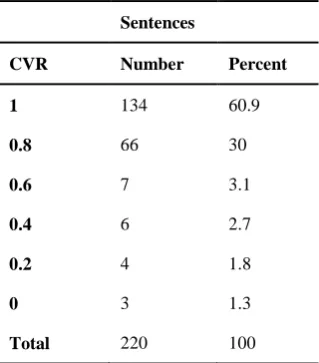
In this research, the relative coefficient content validity for 220 selected sentences was calcu-lated according to linguist and target criteria (Table 1). As it is evident, eventually 200 sentences (90.9%) obtained the least acceptable CVR.
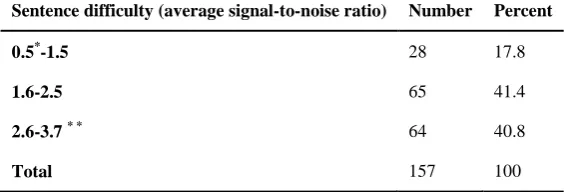
Each of the sentences was combined with diffe-rent SNRs (-3, 0, +3, and +6 dB) and presented for 15 children of 6 to 12 years. The average SNR, which is required to recognize two key words in every sentence, was determined. The minimum and maximum mean of SNR in sen-tences were -3 and + 5.4 dB, respectively. The mean SNR for all sentences was 2.13 dB with a standard deviation of 0.8. The upper and lower limits to select sentences with the monotonous level of difficulty were obtained as 3.7 and 0.5, respectively in 18 (9%) sentences, the average SNR to detect at least two key words in the sentence was higher than the acceptable level, and in 25 (12.5%) sentences, that was less than the acceptable level (Table 2). Eventually, 157 (78.5%) sentences were in the acceptable range in terms of difficulty. The finally selected sen-tences were divided into three categories in terms of mean SNR. The difficulty of nearly 65 (82%) sentences was in the SNR range of 1.6 to Table 1. Content validity ratio of the
sentences
Sentences
CVR Number Percent
1 134 60.9
0.8 66 30
0.6 7 3.1
0.4 6 2.7
0.2 4 1.8
0 3 1.3
Total 220 100
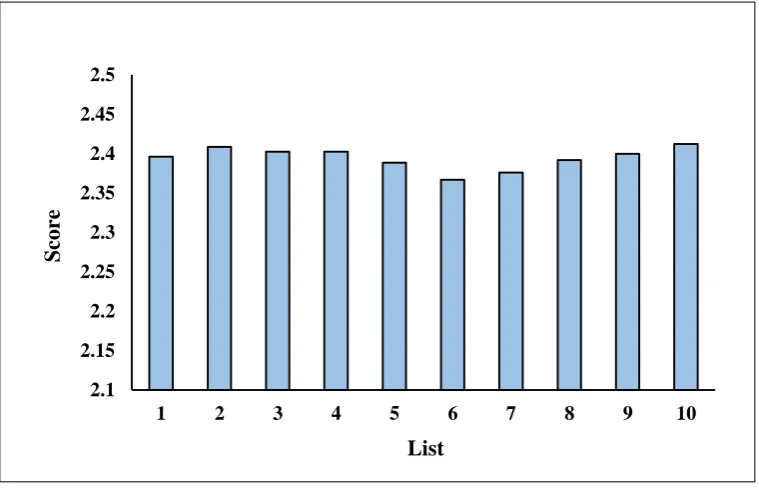
3.7 dB (Table 3). Fig. 1 shows the average difficulty for each list separately. There was no significant difference between the means for the difficulty level of lists (p>0.05).
Discussion
The current study was conducted to prepare the Persian version of the BKB sentences and deter-mine their validity in assessing speech per-ception of children with hearing impairment, hearing aid, or cochlear implants. It is also intended to use these sentences in develop and perception speech in noise tests, especially the BKB-SIN test. Various tests of SIN in terms of materials used examine different levels of auditory processing. Tests that include syllables, numbers, and words target lower levels of processing in the central auditory system, and tests with sentences are applicable at higher levels of processing, including memory and abi-lity to understand. So, the performance of indi-viduals in the SIN tests is influenced by many factors, including speech materials (phrases,
sentences, words syllabic, single-syllable words, numbers, etc.) and the type of background noise (white noise, pseudo-noise, babble noise, etc.). Regarding the assessment of children’s speech understanding, sentences provide higher accuracy and more natural way for speech perception due to contextual and linguistic cues. In addition, they provide a more credible index of children's behavior and management in normal relationships with others when com-pared to using separate words [3]. Therefore, sentences form materials of many common speech perception in noise in children. Some of the most popular tests are hearing in noise test-children (HINT-C), listening in spatialized noise-sentences (LiSN-S), pediatric speech intelligibility (PSI), and BKB-SIN. The HINT-C test uses sentence materials in the presence of noise with speech format. This type of noise, when compared to babble noise, provides no challenging condition for the child. Despite the high sensitivity and credit, the LiSN-S test is only designed for children with Table 2. Distribution of sentences by the level of difficulty
Sentence difficulty (based on average signal-to-noise ratio) Number Percent
Above the upper limit 18 9
Acceptable range 157 78.5
Below the lower limit 25 12.5
Total 200 100
Table 3. Distribution of the final selected sentences by the level of difficulty
Sentence difficulty (average signal-to-noise ratio) Number Percent
0.5*-1.5 28 17.8
1.6-2.5 65 41.4
2.6-3.7 * * 64 40.8
Total 157 100
*Lower limit **
auditory processing disorder. The PSI test uses one speaker competitive noise that does not seem to create enough challenge for chi-ldren. BKB sentences can be used for different populations of children (hearing loss, auditory processing disorder, and learning disability) in primary school. When used along with 4-person babble noise, BKN sentences can be more sensitive in differentiating people with disorders from normal people because of more natural fluctuations in amplitude [14]. In the Persian language, the only existing materials for chil-dren are monosyllabic words designed in two separate versions of word in noise (WIN) test. In the study of Emami, the white competitive noise was used with the ratios of +5 and +10 [15]. In Lotfi et al. research two lists containing 36 one-syllable words were used in the presence of babble noise at SNR of +24 to 0 [16]. In this study, to provide appropriate sentence materials for Persian spea-king children, BKB sentence maspea-king pattern was considered. An extensive field study was performed to provide appropriate sentences for children in the first and second-grade and according to its English version criteria (short
sentences, high redundancy, familiar and frequ-ently used words, maintaining Persian phono-logical balance, and simple grammar). Out of the 220 selected sentences and according to the linguists’ opinions, 134 sentences obtained the content validity index of 1. In other words, all experts considered them absolutely suitable. Also, 66 sentences obtained a validity of 0.8 and remainned in the sentences package, having reliability higher than 62%. Due to the diffe-rences in the syntax of Persian and English languages, the rules for making Persian senten-ces were not similar to the rules for making English sentences. English sentences had ect-verb-object, subject-verb-adverb, and subj-ect-verb structures while Persian sentences had subject-object-verb, subject-verb, subject-prepo-sitional phrase-verb, and genitive phrase-verb structures. Moreover, the English sentences had up to 7 syllables while in the Persian language, the number of syllables reached up to 11.
In this research to provide a package of sen-tences with balanced difficulty in equal lists, the sentences with different SNRs were pre-sented to children. The calculation of the ave-rage threshold speech recognition of sentences Fig. 1. Average sentence difficulties in each list.
2.1 2.15 2.2 2.25 2.3 2.35 2.4 2.45 2.5
1 2 3 4 5 6 7 8 9 10
Score
in noise (detecting 50% of key words in each sentence) showed that some sentences needed a higher SNR to understand at least two key words. In other words, they were considered difficult sentences. On the other hand, some sentences were very simple and easily under-stood at low SNR. Therefore, very difficult and very easy sentences were removed from the package. Eventually, 157 sentences remained in the package in terms of average level of dif-ficulty in 10 lists of 16 sentences. The original English version of BKB sentences has 336 sentences, which are set in 21 lists of 16 sen-tences [3]. Nevertheless, other arrangements of the list are also available with more sentences.
Conclusion
In addition to providing the appropriate mate-rials for assessment of speech perception in diff-erent populations of children (impaired hearing, auditory processing disorders, and learning dis-order), Persian version sentences of BKB can be used for speech recognition research in children and adults with impaired hearing.
Acknowledgments
We would like to appreciate all participated children and their respected parents, respected officials of Tehran education administration, District 5 education office, and principals of District 5 schools (Bahman 5 girl’s and Shahid Hasheminejad boys’ schools) for their coope-ration in this research.
REFERENCES
1. Wilson RH, McArdle R. Speech signals used to evaluate functional status of the auditory system. J Rehabil Res Dev. 2005;42(4 Suppl 2):79-94.
2. Wilson RH, McArdle RA, Smith SL. An evaluation of the BKB-SIN, HINT, Quick SIN, and WIN materials on listeners with normal hearing and
listeners with hearing loss. J Speech Lang Hear Res. 2007;50(4):844-56.
3. Bench J, Kowal A, Bamford J. The BKB (Bamford-Kowal-Bench) sentence lists for partially-hearing children. Br J Audiol. 1979;13(3):108-12.
4. Mueller HG. Speech audiometry and hearing aid fittings: going steady or casual acquaintances? Hear J. 2001;54(10):19-29.
5. Flexer C. The impact of classroom acoustics: lis-tening, learning, and literacy. Semin Hear. 2004;25(2):131-40.
6. Crandell CC, Smaldino JJ. Classroom acoustics for children with normal hearing and with hearing impair-ment. Lang Speech Hear Serv Sch. 2000;31(4):362-70.
7. Sarant JZ, Blamey PJ, Dowell RC, Clark GM, Gibson WP. Variation in speech perception scores among children with cochlear implants. Ear Hear. 2001;22(1):18-28.
8. Narain C, Scott SK, Wise RJ, Rosen S, Leff A, Iversen SD, et al. Defining a left-lateralized response specific to intelligible speech using fMRI. Cereb Cortex. 2003;13(12):1362-8.
9. Meekings S, Evans S, Lavan N, Boebinger D, Krieger-Redwood K, Cooke M, et al. Distinct neural systems recruited when speech production is modulated by different masking sounds. J Acoust Soc Am. 2016;140(1):8.
10. Oreinos C, Buchholz JM. Evaluation of loudspeaker-based virtual sound environments for testing directional hearing aids. J Am Acad Audiol. 2016;27(7):541-56.
11. Etymotic Research: Bamford-Kowal-Bench Speech-in-Noise Test (Version 1.03 Audio CD) Elk Grove Village, Etymotic Research. 2005
12. Schafer EC. Speech perception in noise measures for children: a critical review and case studies. J Educ Audiol. 2010;16:4-15.
13. Nematzadeh S. Identification of Iranian primary school students core vocabulary: a brief report of a national project. Journal of Curriculum Studies. 2008;3(9):8-17.
14. Smits C, Houtgast T. Recognition of digits in different types of noise by normal-hearing and hearing-impaired listeners. Int J Audiol. 2007;46(3):134-44. 15. Emami SF. Word recognition score in white noise
test in healthy listeners. Sch J App Med Sci. 2015;3(1A):29-33.