* k. A. Abd El-Gwwad
Email Address: [email protected] 10.22068/ijae.9.2.2942
Evaluation of Gasoline Engine Piston with Various Coating Materials Using Finite
Element Method
Nouby M. Ghazaly 1, k. A. Abd El-Gwwad2
1
Mechanical Engineering Dept., Faculty of Engineering, South Valley University, Qena-83521, Egypt
2Automotive and Tractor Eng. Dept., College of Engineering, Minia University, El-Minia – 61111, Egypt
ARTICLE INFO A B S T R A C T
Article history:
Received : 13 March 2019
Accepted: 10 May 2019
Published: 01 June 2019
The purpose of this paper is to examine the piston stress distribution using several thicknesses of the coating materials to achieve higher gasoline engine performance. First of all, finite element structure analysis is used to uncoated petrol piston made of aluminum alloy. Then, steel and cast iron piston materials are conducted and compared with the aluminum piston. After that, investigation of four coating materials namely, Yttria-stabilized Zirconia, Magnesia-stabilized zirconia, alumina, and mullite are studied for each piston materials. Next, influence of various thickness coating layers on the structure stresses of the top surfaces are examined. Comparison between simulated results for aluminum, steel and cast iron materials are reported. Moreover, the influences of different coating thickness on the Von Mises stresses of four coating materials are investigated. From the simulation results, it can report that the maximum Von Mises stresses and deformations for the piston materials are decreasing with increasing the coating thickness for Magnesia-stabilized zirconia, Yttria-stabilized Zirconia, Mullite and Alumina coated materials.
Keywords: structure analysis, aluminum piston, MgZrO3, YTZ,
Mullite and Alumina
International Journal of Automotive Engineering
Journal Homepage: ijae.iust.ac.ir
S
N:
2
0
0
8
-9
8
9
9
International Journal of Automotive Engineering (IJAE) 2943
1
Introduction
In an automobile industry, piston is the most significant part of the engine which is subjected to high stresses due to converting the heat and pressure energy released by fuel combustion into mechanical works. The function of the piston is bearing the gas pressure and making the crankshaft rotation through the piston pin. Therefore, it is must be designed to resist damage that induced by the extreme heat and pressure of process.
Shete et al. 2012 [1] analyzed stresses of a piston due to combustion gas load using two dimensional photo elastic technique and FEA. They observed that reducing the piston weight lead to increase the power output of engine. Also, they concluded that stress is compressive at all the boundaries except at the back of crown, where stresses are tensile, the tensile stresses are smaller than compressive stresses. Rajam et al. 2013 [2] analyzed the stress distribution in the piston to know the stresses due to the gas pressure and thermal variations using Ansys. They found that the volume of the piston was reduced by 24%, the thickness of barrel was reduced by 31%, width of other ring lands of the piston was reduced by 25%, Von Mises stress was increased by 16% and deflection was increased after optimization. But all the parameters are well with in design consideration. Ghodake and Patil, 2013 [3] evaluated total deflection occurred during working condition considering gas pressure and material properties of piston as parameter for the simulation. Their CAE results showed that Von Mises stress was 338.41 N/mm2 for 180 bar cylinder pressure in case of SI engine. Their CAE results found the stresses occurred in piston was within the permissible limit of the piston material and deflection is well with the tolerance limit as provided with IS standard. P.C. Mishra et al 2015 [4] used finite element method to analyze the coating strength of a compression ring at compression and power stroke transition. The deformation, von Misses stress and strain in the core and coating interface are discussed. It was found that the maximum von-Misses stress developed at the highest combustion chamber pressure is 128 MPa.
Shinde et al. 2016 [5] investigated structural analysis on conventional piston made of Al alloy A2618. They performed analysis on piston made of Al-GHY1250 and Al-GHS1300. They studied a particular piston design and its capability for maximum gas pressure. They acted high combustion gas pressures as a mechanical load and causes major stresses in the critical region of the piston. They concluded that stress occurred by using Al-GHS1300 is lower than the permissible stress value. Patil Amit 2016 [6] performed structural analysis using finite element method for single cylinder diesel engine for design the piston with different materials such as aluminum alloy A 413 and cast iron FG 200. CATIV V5 R20 software and structural analysis in Ansys workbench 14.5 were used. Their study revels about stress distribution, critical regions and deformation in the piston materials for applied pressure load. They concluded that the cast iron and aluminum piston stress values were less than permissible values. For cast iron piston stress was maximum at inner side of piston pin hole and for aluminum piston stress was maximum at top side of crown and minimum at pin hole.
Cerit, M. ,2011 [7] investigated temperature and thermal stress field of the ceramic coated piston of diesel engine. He observed that the temperature of coating surface was increased with increases in the thickness in a decreasing rate. Sivakumar and Senthil Kumar 2014 [8] carried out experimental investigation under different loading conditions in a three cylinder diesel engine with its piston crown coated with Yttria Stabilized Zirconia. It was concluded that the heat loss to the cooling water is reduced up to 5–10% and the thermal efficiency is increased by 3–5% with reduction of brake specific fuel consumption by up to 28.29%. M. Gamal Fouad et al 2017 [9] carried out a 3-D finite element thermal analysis on spark ignition engine piston for investigating thermal behavior of uncoated and coated piston using commercial software called Ansys. They found that the temperature developed at the top surface of coated region is higher than that of the uncoated piston surface. Also, they observed that the substrate temperature is decreasing with increase the thickness of coating and the maximum surface temperature of Yttria-stabilized Zirconia,
2944 International Journal of Automotive Engineering (IJAE) MgZrO3, Alumina and Mullite coating is
increases by 117.47%, 144.76 %, 15.014 and 44.86 % respectively for 1.6 mm thick coating. As may be seen from the literature, most of the studies have been concerned with thermal modelling of piston. The current paper is concerned with structure analysis to analyze the stresses under the effect of mechanical load. a finite element method is used to analyze the stresses of aluminum alloy piston crown coated with different ceramic coatings namely; Yttria-stabilized Zirconia, MgZrO3, Alumina and Mullite to reduce the cold start HC emission at
idle and to improve the performance
characteristics at the wide open throttle conditions. Also, the stresses and deformation distribution of the piston with various thicknesses ranged from 0.1mm to 1.6 mm for each ceramic coating material is examined. Comparison between the coatings materials and uncoated piston stresses and deformation distribution are reported.
2
Numerical Approach
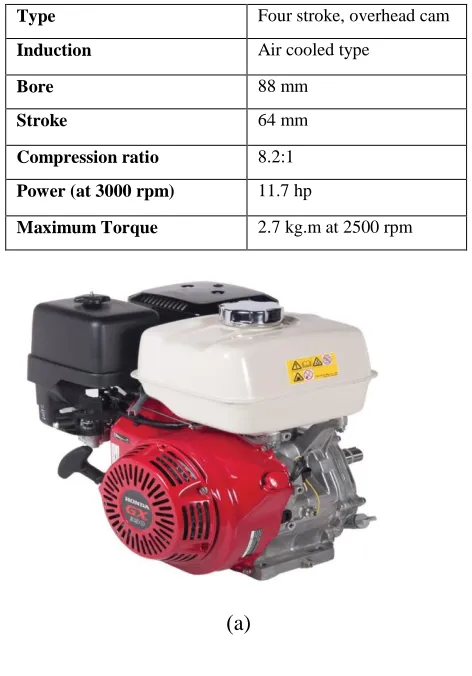
During working process of internal combustion engines, the piston affected by the high-pressure gas pressure, the inertia force caused by high-speed reciprocating motions and friction forces. This is lead to create a lot of stresses on the piston. Structural analysis is required to determine the effects of loads on the actual piston. In this study, structural analyses are carried out to investigate the effect of coating materials on stresses and strains distributions for the gasoline piston. 3D structural analyses are performed using ANSYS code. Effects of different coating thicknesses on the piston are investigated to determine the optimum coating thickness that could minimize the surface stresses. An air cooled SI engine piston is taken as the basis in the simulation, as shown in Figure 1a . The specifications of the test engine are tabulated in Table 2. A geometrical model of the piston is developed based on geometry of the actual object and modelled using Solidworks software, as shown in Figure 1b. The loads set in this case during compression stroke are at a crank location of highest gas pressure of 5 MPa. The total number of nodes and elements of the FE model is equal to 36 824 and 190 600, respectively, as shown in Figure 1c. Mechanical
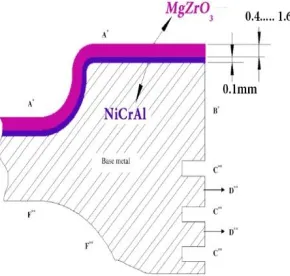
properties of the aluminum alloy piston are 485 MPa, 450 MPa for ultimate, yield strength respectively and of cast iron piston are 448 MPa, 310 Mpa for ultimate yield respectively and for steel piston are 448 MPa 531Mpa for ultimate and yield respectively. The piston is coated with different thickness of Yttria-stabilized Zirconia, MgZrO3, Alumina and Mullite over a 1 mm thickness of NiCrAl bond coat as shown schematically in Figure 2. Material properties of the piston made of aluminum alloy and the selected TBC materials namely; Yttria-stabilized Zirconia, MgZrO3, Alumina and Mullite are listed in Table 2.
Table 1. Table 1: The engine specifications.
Type Four stroke, overhead cam
Induction Air cooled type
Bore 88 mm
Stroke 64 mm
Compression ratio 8.2:1
Power (at 3000 rpm) 11.7 hp
Maximum Torque 2.7 kg.m at 2500 rpm
)a)
International Journal of Automotive Engineering (IJAE) 2945
(b)
(c)
The piston used in the FE analyses: a) gasoline Figure 1.
engine b) the piston, c) meshing of the FE model.
partially coated piston. Figure 2.
Table 2. Materials properties of the piston, bond coat and ceramic topcoat.
3
RESULTS AND DISCUSSIONS
In this study, the evaluation of common materials which are used for manufacturing of the spark engine piston namely; aluminum, cast iron and steel are listed and discussed. Mechanical stress on the piston without coating material is examined. After that, the coating material is added to the piston crown with several thickness using four different coating materials namely; (MgZrO3 , Alumina, mullite and YSZ) in order to investigate the mechanical stresses for coated piston.
The results of von Mises distribution and total deformation on piston for three types of materials namely; aluminum, cast iron and steel are evaluated. Counter-plots of the stress distribution and deformation of aluminum, cast
Material
Modul us of elastic ity [GPa]
Poisso n’s ratio [m/m]
Therm al Condu ctivity [W/m °C]
Therm al expans ion 10 -6 [1/°C]
Densi ty [kg/m 3]
Speci fic heat [J/kg °C]
Piston (aluminum alloy)
90 0.33 155 21 2700 910
Piston (steel) 200 0.30 79 12.2 7200 7870 Piston (Cast
iron)
105 0.33 50 0.1280
000
7100 963
Bond coat (NiCrAl)
90 0.27 16.1 12 7870 764
Ceramic coating (MgZrO3)
46 0.20 0.8 8 5600 650
Ceramic coating (Alumina)
300 0.21 18 7.3 3690 880
Ceramic coating (Mullite)
3000 0.33 50 12.8 2800 963
Ceramic coating (YSZ)
11.25 0.22 1.4 10 5650 640
Rings (cast iron)
200 0.30 16 12 7200 460
2946 International Journal of Automotive Engineering (IJAE) iron and steel for the uncoated pistons are shown
in Figure 3 and Figure 4. It is found that the maximum stress distributions of the piston made of aluminum, cast iron and steel piston are 373.64 Mpa, 373.64 Mpa and 374.67 Mpa, respectively. Also, it is found that the deformation distributions of the piston made of aluminum; cast iron and steel piston are 0.10201 mm, 0.083463 mm and 0.045617 mm, respectively as shown in piston contours.
Stress distribution of uncoated piston: a) Figure 3.
Aluminum b) cast iron c) Steel.
Total deformation of uncoated piston: a) Figure 4.
Aluminum b) cast iron c) Steel.
3.1 Effect of Coating Materials on
Aluminum Piston
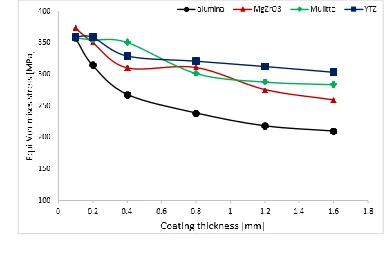
Nowadays, various engineered coatings have been applied to improve durability. In this section, the effect of different coating materials namely MgZrO3, alumina, mullite and YSZ with various coating thickness from 0.1 to 1.6 mm of the aluminum piston are examined. The simulation results of maximum equivalent Von Mises stresses and maximum deformations of the aluminum piston considering coated materials are plotted, as shown in Figure 5 and Figure 6. It is observed that the values of the maximum stresses are reduced by increasing the coating thickness for all coated materials. Also, it is found that the alumin coated material is reduced the stress and the deformation of the
aluminum piston more than MgZrO3, YSZ and mullite coated materials. Moreover, it is found that the YTZ coating material has less influence on stress and deformation of the aluminum piston.
Maximum Von Mises stress of different coating Figure 5.
for aluminum piston
Maximum deformation of different coating for Figure 6.
aluminum piston
3.2 Effect of coating materials on cast
iron piston
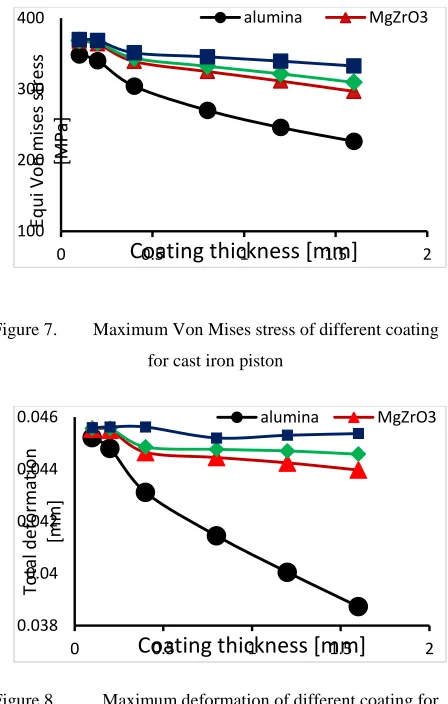
In this section, the effect of MgZrO3, alumina, mullite and YSZ with various coating thickness from 0.1 to 1.6mm of the cast iron piston are examined. The simulation results of maximum equivalent Von Mises stresses and maximum deformations of the cast iron piston considering coated materials are plotted, as shown in Figure 7 and Figure 8. It is observed that the values of the maximum stresses are reduced by increasing the coating thickness for all coated materials. Also, it is found that the alumina coated material is reduced the stress on the cast iron piston more than other coated
0 0.05 0.1 0.15
0 0.5 1 1.5 2
To
ta
l d
ef
o
rm
at
ion
[
m
m
]
Coating thickness [mm]
alumina MgZrO3
International Journal of Automotive Engineering (IJAE) 2947
materials. In additions, the alumina coated material is reduced the deformation of the cast iron piston more than MgZrO3, YTZ, Mullite coated materials. Moreover, it is found that the YTZ coating material has less influence on stress and deformation of the cast iron piston.
Maximum Von Mises stress of different coating Figure 7.
for cast iron piston
Maximum deformation of different coating for Figure 8.
cast iron piston
3.3 Effect of coating materials on Steel
piston
In this section, the effect of different coating materials namely MgZrO3, Alumina, Mullite and YSZ with various coating thickness from 0.1 to 1.6mm of the Steel piston are examined. The simulation results of maximum equivalent Von Mises stresses and maximum deformations of the Steel piston considering different coating materials are plotted, as shown in Figure 9 and Figure 10. It is observed that the values of the maximum stresses are reduced by increasing the
coating thickness for all coated materials. Also, it is found that the Alumina coated material is reduced the stress on the Steel piston more than other coated materials. In additions, the Alumina coated material is reduced the deformation of the Steel piston more than MgZrO3, YTZ, Mullite coated materials. Moreover, it is found that the YTZ coating material has less influence on stress and deformation of the cast iron piston.
Maximum Von Mises stress of different coating Figure 9.
for steel piston
Maximum deformation of different coating for Figure 10.
steel piston
4
Conclusion
Test runs are carried out for the piston of four-stroke gasoline engine. The simulation results of stresses are compared with the mechanical properties of the aluminum, steel and cast iron alloy, it is observed that stresses values are lower than the allowable stress values of all materials. Also, it is clearly shown that the maximum deformations of the piston made of aluminum, cast iron and steel piston are 0.10201 mm, 0.083463 mm and 0.045617 mm,
100 200 300 400
0 0.5 1 1.5 2
Eq
u
i Von
mis
es
s
tres
s
[MPa
]
Coating thickness [mm]
alumina MgZrO3
0.038 0.04 0.042 0.044 0.046
0 0.5 1 1.5 2
To
ta
l d
ef
o
rm
at
ion
[m
m
]
Coating thickness [mm]
alumina MgZrO3
100 200 300 400
0 0.5 1 1.5 2
Eq
u
i Von
mis
es
s
tres
s
[MPa
]
Coating thickness [mm]
alumina MgZrO3
0.02 0.03 0.04 0.05
0 0.5 1 1.5 2
To
ta
l d
ef
o
rm
at
ion
[
m
m
]
Coating thickness [mm]
alumina MgZrO3
2948 International Journal of Automotive Engineering (IJAE) respectively. For all the coating thicknesses, It is
observed that the values of the maximum stresses are reduced by increasing the coating thickness for all coated materials Also, it is found that the Alumina coated material is reduced the stress and deformations on the piston more than MgZrO3, YTZ, Mullite coated materials. Moreover, it is quite obvious that the YTZ coating material has less influence on stress and deformation of the cast iron piston.
REFERENCES
[1] H. Shete, R. Pasale, and E. Eitawade,
"Photoelastic Stress Analysis & Finite Element Analysis of an Internal Combustion Engine Piston."
[2] C. V. Rajam, P. Murthy, M. M. Krishna, and
G. P. Rao, "Design Analysis and
Optimization of Piston using CATIA and
ANSYS," International Journal of
Innovative Research in Engineering & Science ISSN, pp. 2319-566, 2013.
[3] G. AP and K. Patil, "Piston Design and
Analysis by CAE Tools."
[4] P.C. Mishra, Prakhardeep, S. Bhattacharya,
P. Pandey “Finite Element Analysis for Coating Strength of a Piston Compression Ring in Contact with Cylinder Liner: A Tribodynamic Analysis” Tribology in Industry Vol. 37, No. 1 (2015) 42-54.
[5] M. B. Shinde, T. Sakore, and V. Katkam,
"Design Analysis of Piston for Four Stroke Single Cylinder Engine Using ANSYS," 2016.
[6] A. Patil, "Analysis of Single Cylinder Diesel
Engine Piston Using Finite Element
Method," Imperial Journal of
Interdisciplinary Research, vol. 2, no. 11, 2016.
[7] M. Cerit, "Thermo mechanical analysis of a
partially ceramic coated piston used in an SI engine," Surface and coatings Technology, vol. 205, no. 11, pp. 3499-3505, 2011.
[8] G. Sivakumar and S. S. Kumar,
"Investigation on effect of Yttria Stabilized
Zirconia coated piston crown on
performance and emission characteristics of a diesel engine," Alexandria engineering journal, vol. 53, no. 4, pp. 787-794, 2014.
[9] M. Gamal Fouad, Nouby M. Ghazaly, Ali
M. Abd-Tawwab and k. A. Abd El-Gwwad “Finite Element Thermal Analysis of A Ceramic Coated Si Engine Piston Considering Coating Thickness” American Journal of Engineering Research, 2017, Volume-6, Issue-2, pp-109-113