M E T H O D O L O G Y
Open Access
Identifying mislabeled and contaminated
DNA methylation microarray data: an
extended quality control toolset with
examples from GEO
Jonathan A. Heiss
*and Allan C. Just
Abstract
Background: Mislabeled, contaminated or poorly performing samples can threaten power in methylation microarray analyses or even result in spurious associations. We describe a set of quality checks for the popular Illumina 450K and EPIC microarrays to identify problematic samples and demonstrate their application in publicly available datasets. Methods: Quality checks implemented here include 17 control metrics defined by the manufacturer, a sex check to detect mislabeled sex-discordant samples, and both an identity check for fingerprinting sample donors and a measure of sample contamination based on probes querying high-frequency SNPs. These checks were tested on 80 datasets comprising 8327 samples run on the 450K microarray from the GEO repository.
Results: Nine hundred forty samples were flagged by at least one control metric and 133 samples from 20 datasets were assigned the wrong sex. In a dataset in which a subset of samples appear contaminated with a single source of DNA, we demonstrate that our measure based on outliers among SNP probes was strongly correlated (> 0.95) with another independent measure of contamination.
Conclusions: A more complete examination of samples that may be mislabeled, contaminated, or have poor performance due to technical problems will improve downstream analyses and replication of findings. We
demonstrate that quality control problems are prevalent in a public repository of DNA methylation data. We advocate for a more thorough quality control workflow in epigenome-wide association studies and provide a software package to perform the checks described in this work. Reproducible code and supplementary material are available athttps:// doi.org/10.5281/zenodo.1172730.
Keywords: DNA methylation, Epigenomics, Infinium, 450K, EPIC, Quality control, Contamination, Mislabeling, Data cleaning
Background
The number of epigenome-wide association studies in epigenetic epidemiology is growing rapidly, facilitated by popular microarray platforms like the Infinium 450K and EPIC chips, which offer broad coverage and precise quan-tification of DNA methylation. Whereas the literature about preprocessing and statistical analysis of microar-ray data is extensive [1,2], the need for upstream quality
*Correspondence:[email protected]
Department of Environmental Medicine and Public Health, Icahn School of Medicine at Mount Sinai, One Gustave L. Levy Place, Box 1057, New York, NY 10029, USA
control (QC) to ensure robust and reproducible results has received much less attention. Epigenome-wide asso-ciation studies usually start with a quality control step, often involving discarding individual probes or entire samples with too many high detectionpvalues (resulting from a low signal-to-noise ratio of fluorescence intensi-ties), probes with too few beads, or discarding subsets of probes that are considered unreliable based on design fea-tures (e.g., those being cross-reactive or close to SNPs). However, there is a lot of heterogeneity in which checks are undertaken and how criteria are applied, as seen in the methods reported across a large consortium of
birth cohort studies [3]. Furthermore, quality checks that go beyond to catch other types of problematic samples are not yet standard procedure. There are many reasons microarray experiments might fail: starting with low-quality DNA input, an incomplete bisulfite conversion, or a failure of the other experimental steps in the Infinium assay. These issues can result in distorted methylation pat-terns, which may be sometimes more or less apparent. Another common source of errors is sample mislabeling, especially in large multi-center studies where the chain of custody of the sample collection process is long and mistakes can happen at every step. Mislabeling creates mismatches between epi- and phenotype, thereby obfus-cating genuine associations or even producing spurious ones. The prevalence of mislabeling was recently demon-strated in 70 publicly available gene expression datasets hosted in the Gene Expression Omnibus (GEO) reposi-tory: Toker et al. used genes known to be differentially expressed between sexes to infer the sex of the sample donors and to compare it to the recorded metadata. They found that 32 of the datasets contained discrepancies in a subset of the samples [4]. Finally, sample contamination with foreign DNA may arise accidentally in the laboratory or from complex sampling procedures (e.g., contamina-tion of cord blood or placental tissue with maternal blood [5]) and analytic methods are needed to identify and quantify contamination.
Having found mislabeled and contaminated samples in our own DNA methylation datasets, we developed a soft-ware package for the R programming language named ewastoolsaiming to facilitate quality control and sta-tistical analysis of datasets generated from the Illumina Infinium BeadChip platforms (both 450K and the newer EPIC). In order to test the package functionality, we decided to apply it to a range of datasets from the public Gene Expression Omnibus (GEO) repository. The results show that low-quality samples, mislabeling, and contami-nation of samples are widespread issues. It is our hope that theewastoolspackage will help researchers to extend and improve the quality control workflow in epigenome-wide association studies.
Methods
Datasets
The search for DNA methylation datasets was limited to the popular Gene Expression Omnibus repository. We selected datasets meeting the following criteria: they had to be submitted before January 2018; samples had to be run on the Illumina Infinium HumanMethylation450 BeadChip (GEO Accession GPL13534); the sex of the sample donors had to be provided in the metadata; and raw data had to be provided in the form of .idat files. Datasets containing only preprocessed data were not included as they may no longer contain QC probes and
the lack of a standard format makes their analysis diffi-cult to automate. While ourewastoolspackage offers the same functionality for the EPIC chip, our selection was limited to the predecessor 450K chip as the two plat-forms differ in the number of SNP probes which are essential for the checks described below. Datasets meeting these criteria were identified using the Entrez Program-ming Utilities (http://eutils.ncbi.nlm.nih.gov/). From this list we manually excluded datasets based on the descrip-tion and metadata provided in GEO: we dropped datasets involving samples from tumor tissue or cultivated cell lines because tumor cells can show extensive epigenetic mutations related to defects in the DNA methylation maintenance apparatus [6], whereas for the latter it is unclear to what degree methylation profiles reflect the natural/in vivo state of the cell types rather than an epigenome of manipulation [7]; we dropped placenta sam-ples because they could either be of maternal or fetal origin, as well as sperm samples as the cells are haploid; we dropped FFPE (formalin-fixed, paraffin-embedded) samples as their preparation follows a different proce-dure than for fresh tissue samples and the DNA is often of lower quality; lastly, we excluded datasets measuring 5-hydroxymethyl-cytosine. Eventually, a total of 80 datasets comprising 8327 samples remained, representing a broad range of tissues and cell lines (peripheral blood, cord blood, saliva, liver, muscle, cartilage, etc.).
Quantification of methylation levels
Treating DNA with sodium bisulfite converts cytosine to thymine except for 5-methylcytosine, which is protected by the added methyl-group. In combination with sub-sequent whole-genome amplification, the proportion of unmethylated to methylated DNA strands in the DNA input is translated into differences in abundance of dis-tinct PCR (polymerase chain reaction) products, which, for the sake of simplicity, are here still referred to as (un)methylated. The 450K chip employs 50 base pairs long probes complimentary to the targeted loci. Unmethy-lated and methyUnmethy-lated strands are targeted by separate probes or color channels. Their abundance is quanti-fied by hybridization with the corresponding probes, a subsequent single-base extension step with dye-linked nucleotides and measurement of the resulting fluores-cence intensity. Thus, two data points are available for each CpG sitei, the intensity for unmethylated and methy-lated strands, Ui and Mi, respectively. Here, intensities were corrected for dye bias using RELIC [8], but not nor-malized. The proportion of methylated strands was then estimated as Mi
Mi+Ui, commonly referred to as theβ-value.
Quality checks
monitoring the various experimental steps such as bisul-fite conversion or staining; a sex check comparing the actual sex of the sample donors to the records; an identity check for fingerprinting sample donors; and detection of contaminated samples using outliers among the 65 probes querying high-frequency SNPs.
The first check, implemented by the function control_metrics, evaluates 17 control metrics calcu-lated from dedicated control probes placed on each assay. A description of these metrics, together with default thresholds to flag problematic samples, is provided in the BeadArray Controls Reporter Software Guide available from the Illumina support website. Similar functions to evaluate the control probes visually are provided in the minfi[9], RnBeads[10] andshinyMethyl[11] R packages. Not all flagged samples necessarily failed nor do these metrics indicate potential upstream issues, e.g. whether the DNA quality was low to begin with. All 8327 samples were screened in this first check.
There are 65 probes placed on the 450K chip query-ing high-frequency SNPs (with 59 of these on the EPIC chip; their probe identifiers start with “rs”). Just as for CpG sites, a β-value is calculated for each SNP locus, based on fluorescence intensities from two probes tar-geting either the wild type or the common mutant variant. Theseβ-values usually fall into one of three dis-junct clusters, corresponding to the heterozygous and the two homozygous genotypes (AB, AA, or BB). The specific combination of SNPs across these 65 probes serves as a genetic fingerprint: fingerprints of samples from the same donor match but differ between individu-als – with the exception of monozygotic twins – thereby enabling one to check for discrepancies with the meta-data. Genotype calling is handled bycall_genotypes. This function poolsβ-values of all 65 SNP probes across samples to train a mixture model with four compo-nents: three Beta distributions, each representing one genotype, and one uniform distribution representing out-liers. Subsequently, posterior probabilities are computed and forwarded to check_snp_agreement. Using the posterior probabilities as soft classification, pairwise agreement of fingerprints is assessed by counting the number of SNP probes for which two samples possess the same genotype, divided by the total number of SNP probes after those classified as outliers were excluded (consistent with the soft genotype calling, a SNP might be partially classified as outlier and therefore be only partially excluded). Mislabeling constitutes either as unex-pected disagreement between samples that are supposed to come from the same individual, or unexpected agree-ment between samples supposed to come from different individuals. A list of such instances, here termed con-flicts, is returned bycheck_snp_agreement. This sec-ond quality check was applied to a dataset comprised
of 150 pairs of monozygotic twins (in total 300 samples and 10 technical replicates resulting in 47,895 pairwise comparisons).
The total intensityTi = Ui +Mi has been shown to be sensitive to copy number aberrations [12]. By exploit-ing the natural difference in allosomal copy number, this can be used to detect sex-mismatches. There are 11,232 and 413 probes on the 450K chip targeting the X and Y chromosome, respectively. The function check_sex computes for each sample n the average total intensi-ties of all probes targeting either chromosome, T¯nX and
¯
TnY, respectively. In order to account for differences in post-amplification DNA concentration, T¯nX and T¯nY are normalized by the average total intensity across all auto-somal probes which leads to more compact clusters in visualizations. Thresholds to discriminate between both sexes are determined by the Hodges-Lehmann estima-tor (median of all pairwise male/female averages) for
¯
TnX and T¯nY separately. This robust approach was cho-sen over other sex determination functions provided in the minfi [9], RnBeads [10] and shinyMethyl [11] packages exactly because of the potential of sex-mismatches and allosomal outliers being present in the dataset. All 8327 samples were screened in this third check.
When exploring the data, one dataset in particular, here referred to as dataset E, caught our attention. Plotting
¯
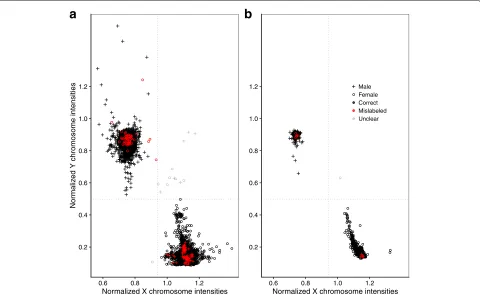
TnX against T¯nY, most samples—aside from a few misla-beled ones—clustered as expected, but a subset of samples from female donors were protruding from the cluster cen-ter in the direction of the male cluscen-ter cencen-ter (Fig. 3b): such a pattern is indicative of sample contamination and more specifically, it is compatible with the hypoth-esis of the foreign DNA coming from a male source. This does not imply that only female samples were affected: in the case of a male/male DNA mix, both allosomes would still show a methylation profile typi-cal for males, only in the case of a female/male mix would both allosomes show methylation profiles atypi-cal for either males or females. With increasing degree of contamination, such samples would be further away from the female cluster center and closer to the male cluster center.
with the following likelihood function Nn=165j=1βnj ∼
N(1−γ )·μknj+γn·cj,(1−γn)·σknj
and parameters n ∈[1,N] (sample index),j ∈[1, 65] (SNP probe index), k ∈ {AA, AB, BB} (the three possible genotypes), knj (genotype of samplenfor probej),βnj(methylation level of samplenfor SNP probej),σk (standard deviation for
β-values from genotypek),cj (methylation level of SNP probej in foreign DNA), andγn (degree of contamina-tion of samplen). The parameters were estimated using the Metropolis algorithm implemented in the Julia pro-gramming language (code is provided the supplement). Comparingγn(degree of contamination) toT¯nYfor female samples allowed us to test if both agreed on ranking sam-ples from least to most contaminated. This check was applied only to datasetE.
Our precise quantification of sample contamination in datasetErequired the assumption that the foreign DNA came from a single source, which may be an unusual sce-nario. A simpler and more general test of sample contam-ination that can be applied to any dataset is implemented in the function snp_outliers. This function, again using the output ofcall_genotypes, computesOn, the average log odds from the 65 posterior probabilities from the outlier component from the mixture model described above. Thus,Oncaptures how irregular the SNPβ-values of samplenare, i.e., how much they deviate from the ideal trimodal distribution.Onwas compared toγnin datasetE in order to confirm that it did indeed capture sample con-tamination. Subsequently, all 8327 samples were screened in this fourth check.
Results
Figure 1 shows the distribution of the “Bisulfite Con-version II” control metric, used to monitor successful
bisulfite conversion, across the 80 datasets. Three hun-dred seventy-seven samples from 17 datasets fell below the default threshold specified by Illumina. Overall, 940 samples (11%) from 41 datasets (51%) were flagged by at least one of the 17 metrics incontrol_metrics, leav-ing 7387 samples that passed this first check. A summary is provided in Table1. Many of these problematic sam-ples would be overlooked when filtering out only samsam-ples with too many undetected probes or low overall fluo-rescence intensity, two popular criteria. Out of the 940 flagged samples, 432 had>1% of probes with a detection pvalue above 0.01 and 217 were flagged by the getQC function from theminfipackage, and 541 samples when considering both criteria.
Figure 2 shows the result of the identity check in the dataset comprising 150 monozygotic twins. Pairwise agreement of SNP fingerprints between samples ranged from 0.96 to 1.00 for the 187 twin pairs (number is larger than 150 because of the technical replicates) and from 0.22 to 0.66 for the 47,708 non-twin pairs, thereby perfectly segregating both groups. For comparison, geno-type calling by k-means clustering, as implemented in the wateRmelonpackage [13], produced non-identical fin-gerprints in 11 out of the 187 twin pairs, with one twin pair showing as many as 9 discordant SNPs.
The function check_sex estimated that 133 of the 8327 samples had been assigned the wrong sex yield-ing an error rate of 1.6%, with 13 cases beyield-ing unclear, as the inferred sex was discordant between T¯X
n and
¯
TY
n (Fig. 3a). Of the 80 datasets, 20 (25%) contained these sex-mismatched samples. These were unevenly dis-tributed: the three highest error rates per study were 55% (#mistakes 38/#total sample size 69), 45% (5/11), and 34% (15/44). Excluding all samples that failed the control_metrics check and might have technical
+ + + ++ ++ + + ++ + + + + ++++ ++++ + +++++++++++ + ++++++ ++++ ++++++++++++++++++++++++++++ ++++++++ + + ++ + +++++ ++ ++++ + +++ + ++++++++++ +++++ + + ++ +++ +++++ +++++ +++ +++++++++++++++ ++++++++ ++ +++++++++++++++++++++++++++++++++++++++++++++++++++++ ++ + + ++ ++++++ ++++++++ + + +++++++++ ++++++++ + +++ +++ + +++++++++++ ++++++ +++ ++ + +++ + +++ +++++ +++++++++++++++++++ + ++ + + + + ++++++ ++++ ++++++ +++++++++ + +++ +++++++ ++++ ++++++++++++ ++ +++++++++++++++ +++++++++ +++ ++++ ++++++++++++ + +++++ +++++++++++++++++ ++++ ++++++++ ++++++++++ ++++++++++++++++ + +++++++++ ++ +++ + + + + + +++++++++ ++ ++ ++++++ + ++ + + ++++ + + + ++++++++ ++ + +++ + +++++++++++++ +++++++ +++++ ++++ + ++++++ + +++++ +++ + + ++++++++++++++++++++++++++ +++ ++ + +++++++ + + + ++++++++++ ++++++++++ ++++++++++++++ +++++ ++ +++ + ++ ++++ + ++++++ ++ ++ + + + + + + + + + + + + ++ + ++ + + + + + ++++ +++ + ++ ++ + + +++ +++++++++++ +++ ++ ++ +++ + ++ ++++ + + ++ + ++++++++ +++ +++++ +++ + + ++ + ++++++ ++++++++++++ ++++ ++++++ ++++++ + ++ + + + ++ + ++ + ++ ++ + ++++++++++++++ ++++++ ++ ++++++++++ + ++++++++ ++ + +++ + ++++ +++ ++ +++ + ++ +++ + ++ ++ + + + ++ + + + + + +++++ +++ + ++++ + + + + + + + + ++ + ++++++++ +++++++++ ++++++++ +++++++++ +++++++ +++++++++++++++ ++++ + + + ++++ +++++ +++ ++ + +++ ++++++ + ++ + + ++ + + ++ + + + ++ + ++++ ++ +++ + ++ +++ + ++ + +++ + ++ + +++++ + ++ +++ +++++ ++ ++++ ++ +++ + + + + + + + ++++ ++++ ++ +++++++++ + +++++ +++ + + +++ + +++ ++ ++ + ++++ + + + + + + + + + + + + ++ +++++++++ ++++++++++++++++++++++++ ++++++++ +++++ +++++++++++ +++ +++++++++++++++++++++ + + + ++++ ++++++++++++++++++++++++ + +++ + ++++++ ++++ +++++ + ++++ + ++ + + + + + + + +++ + ++ + ++++ ++ ++++ +++++++++++ ++++ ++++ ++ +++ ++ +++ ++ + + + ++ + + + +++++++++ ++++++++ ++++++ + +++++++++++++ ++++ +++++++ + + + + +++++ + ++++ +++ + +++ ++ + + + + + ++ ++ +++++++++ +++++ +++++ ++++++++ ++ ++ +++ ++++ + + ++++++ +++++ ++ + ++ +++++++++++++++ ++++++++ ++ +++++++++ + +++++++++++ + + +++++ + ++++++++ +++++++ + ++ ++ + ++ ++++ +++++ ++++++++ ++++++++ + +++++++++++++ ++ ++ ++ +++ + + + +++++ ++++++ +++++++ ++++++++++++++++++++++++++++++++++ +++++++++++++++ ++++++ ++ ++++++++ + ++++++++ ++ +++ +++ +++ ++ +++++ ++ ++ ++++++ ++++++++++ ++++++++++++ ++++++++ +++ ++ ++ +++ + ++++ + ++ ++++ ++++ +++++++++ +++++ +++++++++ ++ +++++++ ++ ++ + + + + +++ + + + + + + + + + +++++++++++++++++++++++++++++++ ++++++++++++++++++ ++++++++++++++++++++++++++++++++++++++++++++ ++ ++++++++++++++++++++++++++++++++ + ++++++++++++ ++++++ ++++++++++ ++++++++++++++++++++++++ +++++++++++++++++ ++++ ++++++++++ +++++++ +++++ ++++++ ++++ +++ ++ ++++++++ +++++++++ +++++++ ++++++ ++ ++++++ ++ +++++++++ +++++ +++++ ++ +++++ ++ +++++ ++++++ ++++++++ ++++++++++ ++++++++++ ++++++++++ + +++ + ++ ++ ++ +++ +++++ + + ++++++++++++ ++++ ++++++++++++++++++++++ +++++++++++++++++++++ +++++++++++++++++++++++++ +++++++++++++++++++++++++++++++ +++ ++++++++++++++++++++++++++++++++++++++++ +++++++++++++++++++++++++++++++++++++++++++++ ++++++++++++++++++++++++ +++++++++++++++++++++++++++++++++ +++ +++++++++++ +++ ++++++ +++++ +++++++++ ++ + + + + + + ++ + +++ ++++ ++++++ +++ +++ + ++ ++ + + + + + + ++++++++++++++++++++ +++++++ ++++++++++ ++++++++++++++++++++++++++++++++++++++++++++++++++++++++++++++++++ ++++++++++++++++++++++ ++++++++++++++++++++++++++++++++++++++++++++++++++++ +++++++++++++++++++++++++++++++++++++++++++++++++++ + +++++++++++ ++++++++++ +++++++++++++++++++++++++++++ +++ ++++++++++ +++++ +++++++++++++++++++ +++++++ +++ ++ ++++ ++++++ ++++ +++++++++ + +++++ ++++ + ++++++++++++++++ ++++++++ ++ ++ +++ +++ ++ + + + + + + +++++++++++++++++++ +++++++++ +++++++++++++++++++ + +++++++++++++++++++++++++++++++ ++++++++++++++++++ ++ +++++++++++++++++++++++++++++++++++ +++ ++++++++++++++++++ +++++++++++++++++++++++++++++++++++++++++++++++++++++++++++ ++++++++++++++++++++++++++++++++++ ++++++++++++++++++ +++++++++++++++++++++++++++++++++++++++++++++++++++++ ++++++++++++++++++++++++++ +++++ ++ +++++++++++++ ++++++++ ++++++++ +++++++++++++++++++++++++++++++++++++++++++++++++++++ ++++ ++++++++++++++ ++++++++++++++++++++++++++++++++++++++ ++++++++++++++++++++++++++++++++++++++++++++++++++++++++++++++++++ +++++++++++++++++++++++++++ +++++++++++++++++++ +++++++++++++ +++++ ++++++++++++++++++ +++++++++++++++++++++++++++++++++++++++++++++++++++++++++++++++++++++++++++++++++ +++++++++++++++++++++++++++++++++++++++++++++++++++++++++++++++++++++++++++++++++++++++++++++++ +++++++++++++ +++++++++ ++++++++++++++++ ++++++++++ + ++++++++++++ ++++++++++++++++++++++ +++++++++++++++ +++++++++++++++++ ++++++++++ +++ + + ++ ++++ ++++++ ++ ++++++ +++++++ +++++++++++++ +++++ +++ +++++ ++++++ + + +++ + +++++ + ++++ ++++++++ ++ ++++ + +++++++++ ++++++++++++ +++++++++++++++++++++++ +++++++++++++++++++++++++++++++ ++++++++++++ ++++++++++++++ ++++++++++++++++++++++++++++++ +++++++++++++++++++++++++++++ +++ ++++++ +++++++++++++++++++++++++++++++++++++++++++++++++++++++++++++++++++++++++++++++++++ ++++++++++++++++++++++++++++++++++++++++++++++++ +++++++++++++++++++++++++++++++++++++ ++++++++++++ ++++++++++++++++++++++++ +++ ++++++++++++ +++ ++++++++++++++++++++++++++++++++++++++++++++++++++++++++++++ +++++++++++++++++++ +++++++++++++++++++ ++++++++++++++ ++++++++++++++++++++++++++++++++++++++++++++++++ + +++++++++++++++++++++++++++++++++++++++++++++++++++++++ ++++++ ++++++++++++++++++++++++++++++++++++++++++++++++ ++++++++++++++++++++++ +++++++ +++++++ ++++++ ++++++ +++++ +++++++ +++ ++++ ++++++++++ +++++ ++ ++++++++ ++++++++++++++++++++++++++++++++++++++++++++++++++++++++++++++++++++++++++++++++++++++++++++++++++++++++++++++++++++++++++++++++++++++++++ ++++++++++++++++++++++++++++++++++++++++++++++++++++++++++++ +++++++++++++++++++++++++++++++++++++++++++++++++++++++++++++++++++++++++++++++++++++++++++++++++++++++++++++++++++++++ ++ ++++++++++++ +++ ++++++++++++++++++++++++++++++++++++++++++++ +++++++++++++++++++++++++++++++++++++++++++++++++++++++++++++++++++++++++++++++++++++++++++++++++++++++++++++++++++++++++++++++++++++++++++++++++++++++++++++++++++++++++++++++++++++ ++++++++++++ ++++++++++++++++++ ++++++++++++++++++++++++++++++++++++++++++++++++++++++++++++++++++++++++++++++++++++++++++++++++++++++++++++++++++++++++++++++++++++++++++++++++++++++++++++++++++ +++++++++++++++++++++++++++++++++++++++++++++++++++++++++++++++++++++++++++++++++++++++++++++++++++++++++++++++++++++++++++++++++++++++++++++++++++++++++++++++++++++++++++++++++++++++++++++++++++++++++++++++++++++++++++++++++++++++++++++++++++++++++++++++++++++++++++++++++++++++++++++++++++++++++++++++++++++++++++++++++++++++ +++++++++++++++++++++++++++++ ++++++++ + +++++++++++++++++++++++++++++++++++++++++++ ++++ ++++++++++++++++++++ +++++ +++++++++++++ ++++++++++++++++++++++++++++++++++++++++++++ ++++++ +++ ++++++++++++++++++++++ ++++ +++++++++++++ ++++++++ +++++++++++++++++++++++++++ +++++++++++++ ++++++++++ ++++++++++++ ++++ +++++++++++++++++++++++++++++++++ ++++++++++++++++++++++++++++++++++++++++++++++++++++++++++++++++++++++++++++++++ +++++++++++++++++++++++++++++++++++++++++++++++++++++++++++++++++++++++++++++++++++++++++++++++++++++++++++++++++++++++++++++++++++++++++++++++++++ +++ +++ +++++++++++++++++ ++++++ +++++++ ++++++ ++++++++++++++++++++++++++++++++++++++++++++++++++++++++++++++++++++++++++++++++++++++++++++++++++++++++++++++++++++++++++++++++++++++++++++++++++++++++++++++++++++++++++++++++++++++++++++++++++++++++++++++++++++++++++++++++++++++++++++++++++++++++++++++++++++++++++++++++++++++++++++++++++++++++++++++++++++++++++++++++++++++++++++++++++++++++++++++++++++++++++++++++++++++++++++++++ ++++++++++++++++++++++++++++++++++++++++++++++++++++++++++++++++++ ++++ ++++++++ ++++ ++++ ++++++++++ ++++++++++++++++++++++++++++++++++++++++++++++++++++++++++++++++++++++++++++++++++++++++++++++++++++++++++++++++++++++++++++++++++++++++++++++++++++++++++++++++++++++++ +++++++++++++++++++++++++++++++++++++++++++++++++++++++++++++++++++++++++++++++++++++++++ ++++++++++++++++++++++++++++++++++++++++++++++++++++++++++++++++++++++++++++++++++++++++++++++++++++++++++++++++++++++++++++++++++++++++++++++++++++++++++++++++++++++++++++++++++++++++++++++++++++++++++++++++++++++++++++++++++++++++++++++++++++++++++ +++++++++++++++++++++++++++++++++++ ++ +++++++++++++++++++++++++++++++++++++++++++++++++++++++ ++++++++++++++++++++++++++++++++++++++++++++++++++++++++++++++++++++++++++++++++++++++++++++++++ +++++++++++++ +++++ ++++++++++++++++++++++++++++++++++++++++++++++++++++++++++++++++++++++++++++++++++++++++++++++++++++++++++++++++++++++++++++++ ++++++++++++++++++++++++ ++++++++++++++++++++++++++++++++++++++++++++++++++++++++++++++++++++++++++++++++++++++++++++ +++++++++++++++++++++++++++++++++++++++++++++++++++++++++++++++++++++++++++++++++++++++++++++++++++++++++++++++++++++++++++++++++++++++++++++++++++++++++++++++++++++++++++++++++++++++++++++++++++++++++++++++++++++++++++++++++++++++++++++++++++++++++++++++++++++++++++++++++++++++++++++++++++++++++++++++++++++++++++++++++++++++++++++++ +++++++++++++++ +++++++++++++++++++++++++++++++++++++++++++++++++++++++++++++++++++++++++ +++++++++++++++++++++++++++++++++++++++++++++++++++++++++++++++++++++++++++++++++++++++++++++++++++++++++++++++++++++++++++++++++++++ +++++++++++++++++++++++++++++++++++++++++++++++++++++++++++++++++++ +++++++++ +++++++++++++++++++++++ +++++++++++++++++++++++++++++++ +++++++++++++++++++++++++++++++ +++++++++++++++++++++++++++++++++++++++++++++++++++++++++ + + 0.1 0.5 1.0 5.0 10.0 20.0 #17 #80
GEO datasets sorted by minimum bisulfite conversion ratio
Bisulfite Con
v
ersion II (unitless r
atio)
Table 1Summary of the number of samples flagged by each of the 17 control metrics outlined in the BeadArray controls reporter software guide. n.a.—not available
Metric Passed Flagged n.a.
Restoration 8326 0 1
Staining green 7885 10 432
Staining red 7764 14 549
Extension green 8324 3 0
Extension red 8326 1 0
Hybridization high/medium 8326 1 0
Hybridization medium/low 8327 0 0
Target removal 1 8327 0 0
Target removal 2 8327 0 0
Bisulfite conversion I green 8317 10 0
Bisulfite conversion I red 8208 119 0
Bisulfite conversion II 7950 377 0
Specificity I green 8323 4 0
Specificity I red 8279 48 0
Specificity II 8326 1 0
Non-polymorphic green 7677 558 92
Non-polymorphic red 7917 318 92
Any of the above 7387 940 –
errors in measurement did not change sex-mismatched error rates substantially: out of the 7387 samples, 122 (1.7%) had been assigned the wrong sex with 10 unclear cases. Comparing with the predictions provided from minfi, there were, apart from the 13 unclear cases men-tioned above, 66 female (according to metadata) sam-ples from six datasets that were correctly classified by ewastoolsbut misclassified byminfi.
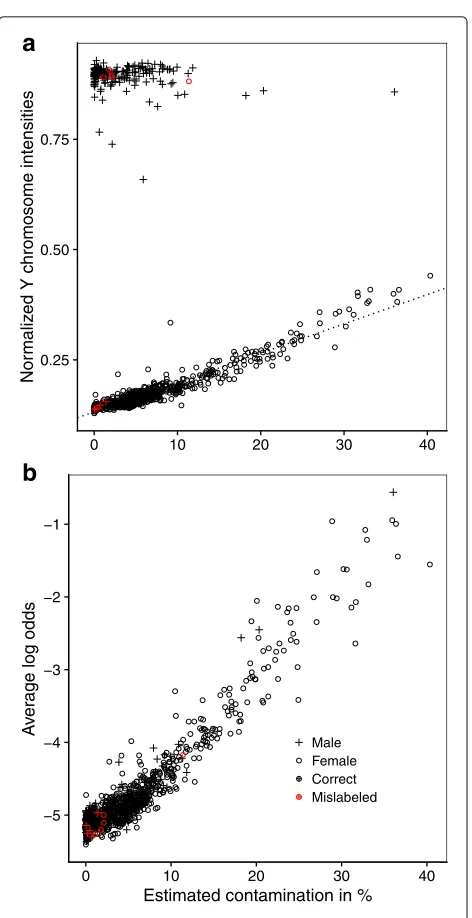
Estimating the degree of contaminationγnfor each sam-ple in datasetE, we found thatγn andT¯nY were strongly correlated among females (Pearson’s correlation coeffi-cient 0.953, 95% bootstrapped CI 0.934,0.965; Fig. 4a), confirming that both metrics agreed on ranking samples
Twins Unrelated
0.00 0.25 0.50 0.75 1.00
Agreement score
Fig. 2Pairwise agreement scores of genetic fingerprints in a dataset of monozygotic twins. There is a perfect segregation between twin and non-twin pairs
from least to most contaminated. Correlation was weaker forT¯nX(−0.828, 95% CI−0.898,−0.748), suggesting that
¯
TnY was the more sensitive metric of contamination in this situation. Males were not included in the calcula-tion of these correlacalcula-tion coefficients because contamina-tion would not affect T¯nY nor T¯nX if our hypothesis of contamination coming from a single male source were correct. Even though γn was non-zero for most sam-ples, we assume that only a subset of the samples were indeed contaminated, as those with the largestγntended to be allocated next to each other on the 450K chips (not shown).γn andOnfor the same set of samples were strongly correlated as well (Pearson’s correlation coeffi-cient 0.958, 95% bootstrapped CI 0.948,0.966), even when including males (0.954, 95% CI 0.944,0.961; Fig.4b), sug-gesting that in this dataset On, the average log odds of SNP probes being outliers, was a proxy for sample con-tamination not contingent on the sex of the sample donor or source of contamination (with the exception of con-taminating DNA coming from another tissue of the same donor).
While the importance of a metric monitoring critical laboratory steps such as bisulfite conversion is obvious, the relevance of Illumina provided default thresholds for other metrics is less clear. Figure 5 shows the dis-tribution of On among all samples that were flagged by the control_metrics checks versus the remain-der that passed. We use On here as a measure of poor technical performance, rather than a measure of sam-ple contamination, as the former would also contribute to a deviation of the SNP probes from the ideal tri-modal distribution. Flagged samples had in general higher values of On, indicating that such samples are indeed of concern.
Discussion
0.2 0.4 0.6 0.8 1.0 1.2
0.6 0.8 1.0 1.2
Normalized X chromosome intensities
Nor
maliz
ed Y chromosome intensities
a
Male Female Correct Mislabeled Unclear
0.2 0.4 0.6 0.8 1.0 1.2
0.6 0.8 1.0 1.2
Normalized X chromosome intensities
b
Fig. 3Average fluorescence intensities of probes targeting the X chromosome (x-axis) or targeting the Y chromosome (y-axis), each normalized versus the average fluorescence of autosomal probe intensities per sample. Dotted lines represent the Hodges-Lehmann estimators separating the male and female cluster centers. Samples that are discordant for sex relative to their metadata annotation are considered mislabeled and shown in red. Samples falling in the lower left or upper right quadrant are considered “unclear”.aAll 8327 samples from all 80 datasets.bA single dataset (datasetE) with a spread in the female cluster indicating varying degrees of contamination with male DNA
epigenome-wide association study. We conducted a sur-vey of publicly available DNA methylation datasets to see whether they suffer from the same quality issues that have been reported for gene expression datasets. Assuming that all samples included in datasets uploaded to the GEO repository were used in associated analyses, our results indicate that the current practice of quality control fails to detect many problematic samples that have the potential to severely bias findings.
Eleven percent of samples were flagged by at least one of the 17 control metrics defined by the microarray man-ufacturer. This does not mean that every flagged sample features inaccurate methylation levels and it is unclear how Illumina’s default thresholds were set and whether the resulting dichotomization is appropriate for flagging samples in all conditions. However, samples flagged by one or more criteria incontrol_metricshad substan-tially more outliers among the normally well-behaved SNP probes, an indication of low data quality, and therefore these samples require closer attention. In the specific case of monitoring bisulfite conversion, Zhou et al. suggested a more robust alternative to using the dedicated control probes [17].
0.25 0.50 0.75
0 10 20 30 40
Nor
maliz
ed Y chromosome intensities
a
Male Female Correct Mislabeled −5
−4 −3 −2 −1
0 10 20 30 40
Estimated contamination in %
A
v
er
age log odds
b
Fig. 4Evidence of contamination in datasetE.aγn, the estimated
degree of contamination, andT¯Y
nare strongly correlated among
females with a Pearson’s correlation coefficientr=0.953.bγnand
On, the average log odds of SNP probes being outliers, are strongly
correlated as well (r=0.954), including both males and females
In contrast, check_sexcan be applied regardless of the number of samples available for each person. In our survey 1.6% of samples coming from 25% of the datasets were assigned the wrong sex. The actual rate of mis-labeled samples is likely higher because sample swaps between donors of the same sex would have gone unde-tected. Assuming a balanced sex ratio and random mis-labeling, only half of the potential mistakes would be captured by this test alone. If applicable, more compre-hensive checks testing for correct tissue types and other
6619 1 14 48 4 377 8 10 484 119 n = 301
Passed Specificity II Staining Red Specificity I Red Specificity I Green Bisulfite Conversion II Staining Green Bisulfite Conversion I Green Non−polymorphic Green Bisulfite Conversion I Red Non−polymorphic Red
−4 −2 0 2
Average log odds
Fig. 5Boxplots ofOn(average log odds of being an outlier across the
65 SNP probes) as a measure of low technical performance for samples flagged by any of the 17 Illumina control metrics and samples passing all of them. Metrics are ordered by medianOnwith
the number of samples in each non-exclusive category indicated on the right. Flagged samples have in general higher values ofOnthan
samples that passed all checks, indicating that flagged samples are more likely to have poor performance characteristics
features should be conducted. Regarding the few unclear cases in which the sex of the sample donors could not conclusively be inferred, we suspect that most of these samples suffer from other, possibly upstream issues and should be excluded. A few, however, might represent chro-mosomal disorders, e.g. Klinefelter syndrome, which has an reported incidence around 1 per 576 [18]. Because of their XXY genotype, individuals with Klinefelter syn-drome, who are phenotypically male, would in Fig.3be located in the center of the upper right quadrant (forT¯X n on par with females, forT¯Y
n on par with males).
caused by other issues, as evident when comparing sam-ples passing and failing thecontrol_metricscheck. This does however not diminish the value of On as an overall sample quality indicator. This metric is easy to compute using our mixture modeling approach and can be applied regardless of the sex of the sample donors. Unlike a recently proposed metric of contamination of cord blood with maternal blood based on methylation probes [5], our measuresnp_outliers is not depen-dent on the tissue type of the sample and contaminat-ing DNA. Because the proportion of the 65 SNP probes expected to differ in a contaminated sample is a func-tion of both the relative proporfunc-tion of contaminafunc-tion and the number of SNPs for which the contaminating sample differs in genotype, it was not possible to deter-mine a single cutoff forOn above which samples should be classified as contaminated and excluded from fur-ther analysis. Judging by Fig. 4b however, we inter-pret that removing samples with an average log2 odds of −4 represents a reasonable choice. Other authors have suggested to use the SNP probes as quality indi-cator before: Pidsley et al. proposed a metric quanti-fying the standard deviation of SNP probes in order to benchmark normalization methods for 450K datasets [13], but did not evaluate the quality of individual samples.
There are some limitations of our work. We did not check the associated publications for whether the authors of the original studies mentioned flagging or exclusion from downstream analyses of any samples from their datasets uploaded to the GEO repository. We advocate the inclusion of a simple tag in the meta-data on GEO to indicate samples excluded in qual-ity control steps, although no such indication was seen in the metadata of the studies we reviewed. Fur-thermore, our analysis is demonstrated exclusively on the Illumina Infinium HumanMethylation450 BeadChip, although the functions in ourewastoolspackage work equally well on the newer Illumina Infinium Methyla-tionEPIC BeadChip (commonly called 850K chip) for which far fewer datasets are currently available on GEO. While we excluded certain types of tissues in order to get a handle on the heterogeneity of datasets, this does not mean that these QC checks cannot be applied to those tissues, such as checking maternal con-tamination of fetal placenta. The selection of datasets was also restricted to those for which raw data were available, as this was needed to automate our QC test-ing, and this subset may not be representative of the entirety of >1000 Illumina 450K methylation datasets on GEO. Nonetheless, we feel that our results indi-cate the need for additional QC checks as data quality issues appear prevalent in publicly available methylation datasets.
Conclusion
Beyond the obvious measurement of methylation, a multitude of information can be inferred from high-dimensional DNA methylation data, information that can be checked for agreement with recorded covari-ates. This includes the use of principal component analysis to create lower-dimensional representations for discriminating between tissue types; comparing chrono-logical and epigenetic age [19]; the estimation of cell proportions for blood samples, which can be as pre-cise as actual blood cell counts [20]; or any other checks that might apply to the specific dataset at hand. We demonstrated in this work the high prevalence of failed and mislabeled samples in DNA methylation datasets and recommend that epigenome-wide associa-tion studies should start with comprehensive quality con-trol. With ewastools, we provide a software package for the popular R programming language to conduct the quality checks described here. Existing R scripts do not have to be changed in order to incorporate these tests into existing analytic workflows. In addition, we recommend that researchers seeking to make their DNA methylation data available should also upload raw data in the form of .idat files. Taken together these steps will improve the reproducibility of epigenome-wide association studies.
Abbreviations
450K: Illumina Infinium HumanMethylation450 BeadChip; CI: Confidence interval; EPIC: Illumina Infinium MethylationEPIC BeadChip; GEO: Gene expression omnibus; QC: Quality control; SNP: Single nucleotide polymorphism
Acknowledgements
We would like to thank Elena Colicino and Stefanie Busgang for their feedback on the manuscript and Brook Frye for code review.
Funding
This work was supported by NIH grants R00ES023450 and P30ES023515.
Availability of data and materials
R and Julia code to reproduce all analyses and results presented here, including retrieval of public methylation datasets, as well as other supplementary material, are available athttps://doi.org/10.5281/zenodo.1172730. The ewastools R package can be found athttps://github.com/hhhh5/ewastools.
Authors’ contributions
JAH performed analyses and wrote the manuscript. ACJ conceived and supervised the project and contributed to the manuscript. Both authors read and approved the final manuscript.
Ethics approval and consent to participate
Not applicable.
Competing interests
The authors declare that they have no competing interests.
Publisher’s Note
Springer Nature remains neutral with regard to jurisdictional claims in published maps and institutional affiliations.
References
1. Dedeurwaerder S, Defrance M, Bizet M, Calonne E, Bontempi G, Fuks F. A comprehensive overview of Infinium HumanMethylation450 data processing. Brief Bioinform. 2014;15(6):929–41.
2. Morris TJ, Beck S. Analysis pipelines and packages for Infinium HumanMethylation450 BeadChip (450k) data. Methods. 2015;72:3–8. 3. Felix JF, Joubert BR, Baccarelli AA, Sharp GC, Almqvist C,
Annesi-Maesano I, et al. Cohort profile: pregnancy and childhood epigenetics (PACE) Consortium. Int J Epidemiol. 2017;47(1):22–23u. 4. Toker L, Feng M, Pavlidis P. Whose sample is it anyway? Widespread
misannotation of samples in transcriptomics studies. F1000Res. 2016;5:2103.
5. Morin AM, Gatev E, McEwen LM, MacIsaac JL, Lin DTS, Koen N, et al. Maternal blood contamination of collected cord blood can be identified using DNA methylation at three CpGs. Clin Epigenet. 2017;9:75. 6. Dawson MA. The cancer epigenome: Concepts, challenges, and therapeutic opportunities. Science. 2017;355(6330):1147–52. 7. Nestor CE, Ottaviano R, Reinhardt D, Cruickshanks HA, Mjoseng HK,
McPherson RC, et al. Rapid reprogramming of epigenetic and transcriptional profiles in mammalian culture systems. Genome Biol. 2015;16:11.
8. Xu Z, Langie SA, De Boever P, Taylor JA, Niu L. RELIC: a novel dye-bias correction method for Illumina Methylation BeadChip. BMC Genomics. 2017;18(1):4.
9. Aryee MJ, Jaffe AE, Corrada-Bravo H, Ladd-Acosta C, Feinberg AP, Hansen KD, et al. Minfi: a flexible and comprehensive Bioconductor package for the analysis of Infinium DNA methylation microarrays. Bioinformatics. 2014;30(10):1363–9.
10. Assenov Y, Muller F, Lutsik P, Walter J, Lengauer T, Bock C.
Comprehensive analysis of DNA methylation data with RnBeads [Journal Article]. Nat Methods. 2014;11(11):1138–40. Available from:https://www. ncbi.nlm.nih.gov/pubmed/25262207.
11. Fortin JP, Fertig E, Hansen K. shinyMethyl: interactive quality control of Illumina 450k DNA methylation arrays in R. F1000Res. 2014;3:175. 12. Feber A, Guilhamon P, Lechner M, Fenton T, Wilson GA, Thirlwell C,
et al. Using high-density DNA methylation arrays to profile copy number alterations. Genome Biol. 2014;15(2):R30.
13. Pidsley R, CC YW, Volta M, Lunnon K, Mill J, Schalkwyk LC. A data-driven approach to preprocessing Illumina 450K methylation array data. BMC Genomics. 2013;14:293.
14. Zhang X, Mu W, Zhang W. On the analysis of the Illumina 450k array data: probes ambiguously mapped to the human genome. Front Genet. 2012;3:73.
15. Chen YA, Lemire M, Choufani S, Butcher DT, Grafodatskaya D, Zanke BW, et al. Discovery of cross-reactive probes and polymorphic CpGs in the Illumina Infinium HumanMethylation450 microarray. Epigenetics. 2013;8(2):203–9.
16. Lehne B, Drong AW, Loh M, Zhang W, Scott WR, Tan ST, et al. A coherent approach for analysis of the Illumina HumanMethylation450 BeadChip improves data quality and performance in epigenome-wide association studies. Genome Biol. 2015;16:37.
17. Zhou W, Laird PW, Shen H. Comprehensive characterization, annotation and innovative use of Infinium DNA methylation BeadChip probes. Nucleic Acids Res. 2017;45(4):e22. Available from:https://www.ncbi.nlm. nih.gov/pubmed/27924034.
18. Nielsen J, Wohlert M. Chromosome abnormalities found among 34,910 newborn children: results from a 13-year incidence study in Arhus, Denmark. Hum Genet. 1991;87(1):81–3.
19. Horvath S. DNA methylation age of human tissues and cell types. Genome Biol. 2013;14(10):R115.