R E S E A R C H
Open Access
A real-time comparison between direct control,
sequential pattern recognition control and
simultaneous pattern recognition control using a
Fitts
’
law style assessment procedure
Sophie M Wurth
1*and Levi J Hargrove
2,3Abstract
Background:Pattern recognition (PR) based strategies for the control of myoelectric upper limb prostheses are generally evaluated through offline classification accuracy, which is an admittedly useful metric, but insufficient to discuss functional performance in real time. Existing functional tests are extensive to set up and most fail to provide a challenging, objective framework to assess the strategy performance in real time.
Methods:Nine able-bodied and two amputee subjects gave informed consent and participated in the local Institutional Review Board approved study. We designed a two-dimensional target acquisition task, based on the principles of Fitts’ law for human motor control. Subjects were prompted to steer a cursor from the screen center of into a series of subsequently appearing targets of different difficulties. Three cursor control systems were tested, corresponding to three electromyography-based prosthetic control strategies: 1) amplitude-based direct control (the clinical standard of care), 2) sequential PR control, and 3) simultaneous PR control, allowing for a concurrent activation of two degrees of freedom (DOF). We computed throughput (bits/second), path efficiency (%), reaction time (second), and overshoot (%)) and used general linear models to assess significant differences between the strategies for each metric.
Results:We validated the proposed methodology by achieving very high coefficients of determination for Fitts’law. Both PR strategies significantly outperformed direct control in two-DOF targets and were more intuitive to operate. In one-DOF targets, the simultaneous approach was the least precise. The direct control was efficient in one-DOF targets but cumbersome to operate in two-DOF targets through a switch-depended sequential cursor control.
Conclusions:We designed a test, capable of comprehensively describing prosthetic control strategies in real time. When implemented on control subjects, the test was able to capture statistically significant differences (p < 0.05) in control strategies when considering throughputs, path efficiencies and reaction times. Of particular note, we found statistically significant (p < 0.01) improvements in throughputs and path efficiencies with simultaneous PR when compared to direct control or sequential PR. Amputees could readily achieve the task; however a limited number of subjects was tested and a statistical analysis was not performed with that population.
Keywords:Functional performance assessment, Fitts’law, Myoelectric control, Upper limb prostheses, Pattern recognition
* Correspondence:[email protected]
1
Institute of Bioengineering, Swiss Federal Institute of Technology (EPFL), Lausanne CH-1015, Switzerland
Full list of author information is available at the end of the article
Background
The field of myoelectric upper limb prosthetics has been characterized by great advances in both the development of multi-articulate advanced arm systems [1] and robust and efficient control strategies [2,3] for the operation of those devices.
The current clinical standard of care in myoelectric control strategies is an amplitude-based dual site con-trol. In this approach, commonly referred to as direct control (DC), the mean absolute value (MAV) of the electromyography (EMG) signal amplitude is recorded over an agonist–antagonist pair of residual muscles to control two directions of one prosthetic degree of free-dom (DOF) [4,5]. DC is configured to provide a 1:1 mapping of the EMG signal amplitude to the speed of prosthesis movement. Because the number of independ-ent muscle sites in amputee subjects is limited, mode-switching (e.g., through co-contraction of the muscle pair) must be implemented to operate additional DOFs [6]. Thus in DC, operation of more than one DOF re-quires mode switching and use of control sites that are physiologically unrelated to the intended movement, which makes control cumbersome and unintuitive. Further, as DC relies on isolated muscle contractions, EMG cross-talk and muscle co-activation may decrease the sensitivity and efficiency of this strategy.
An alternative control strategy relies on algorithms that recognize features in the complex EMG signal terns derived from several electrode locations. Such pat-tern recognition (PR) control systems decipher user intent by classifying feature sets and assigning them to a given motion class, based on the assumption that each pattern describes a state of muscle activation that is con-sistent and distinct from other states of muscle activa-tions [7]. As such, PR systems separate complex patterns into a discrete number of classes. PR–based control pro-vides a substantial advantage over DC because inde-pendent muscle pairs are not required, which potentially enables control of more DOFs. Many different PR imple-mentations have been investigated with different classi-fiers, feature sets, signal conditioning, or post-processing techniques; a comprehensive overview can be found in [2,8,9]. PR–based systems have been proposed for the control of the next generation of multifunctional upper limb prostheses [10,11].
Many activities of daily living involve simultaneous movement of several DOFs. Both DC and current PR control systems provide only sequential control outputs, preventing users from performing coordinated tasks in a natural way. Currently, simultaneous activation of sev-eral DOFs can be clinically achieved with DC, but only in individuals who have undergone a surgical technique called Targeted Muscle Reinnervation (TMR) [12]. Dur-ing TMR, the residual nerves of the amputated limb are
transferred to available muscles in the residual limb, thereby artificially creating additional independent con-trol sites. After TMR, mode switching is no longer re-quired, EMG cross talk is decreased, and simultaneous control of two DOFs is possible. However, even though TMR is growing in popularity, only a small subset of prosthetic users has had TMR surgery. Moreover, TMR has not yet been performed on transradial subjects, who may benefit from being able to combine wrist and hand motions.
importance of evaluating control strategy performances in real-time, functional tasks. In 2014, Young et al. dem-onstrated the feasibility of providing real-time simultan-eous control of 2 DOFs with surface EMG PR control, by configuring simultaneous motions as additional classes on TMR subjects [20]. The authors showed that the simul-taneous strategy outperformed conventional control strat-egies in a real-time virtual hand positioning task and that subjects preferred to use a simultaneous class 78% of the time during positioning tasks requiring 2 DOFs instead of positioning the hand in two sequential operations.
Myoelectric control strategies are generally evaluated in controlled laboratory environments. Under such con-ditions, PR–based systems have achieved classification accuracies higher than 96% with no significant difference between the different classifiers investigated [2,21]. Des-pite their high potential for the control of multi-DOF upper limb prostheses and an increasing interest in the scientific community, translation of PR systems from fundamental research to clinical application has not yet occurred, although initial clinical trials are ongoing. This delay is due in part to the standard practice of evaluating PR control strategies by determining classification accur-acies or errors in an offline evaluation during a discon-nected state on previously collected data (and not on data collected in real time during an experiment). While useful, these metrics are not sufficient to comprehen-sively determine the real time clinical usability of PR sys-tems. Furthermore, classification accuracies do not allow for adequate comparison between different approaches to PR control. Identifying the most promising PR strat-egy for clinical implementation requires a shift from offline error evaluation to functional performance mea-sures. However, current control algorithms are intended for multifunctional and multi-articulate advanced hand and arm systems, which are not always available to re-searchers. Existing functional tests are not adequate for objective, pre-clinical performance evaluation of such con-trol systems.
To bypass the need for an actual prosthesis, virtual environments have been developed to evaluate the real time functional performance of myoelectric control strategies. Kuiken et al. developed the Motion Test [3], a relatively simple test that prompts subjects to move a virtual prosthesis through its full range of motion for a given DOF, with the virtual limb moving at a constant speed. Simon et al. developed the more challenging Target Achievement Control (TAC) test [22], which re-quires positioning of a multifunctional virtual limb from an initial target position back into a neutral pos-ition. In the TAC test, the speed of virtual limb move-ment is proportional to the intensity of the muscle contraction. Test difficulty is modified by changing end-point tolerance, and test complexity level is modified by
changing the number of DOFs required to position the limb. While the test can only evaluate one difficulty level at a time, it provides a set of informative performance metrics that allow characterization of control strategies beyond classification accuracies. A limitation of the TAC test is the visual aspect of the task; task completion may be delayed due to difficulty in using visual cues to identify which DOF to operate to achieve the required position. Furthermore the TAC test contains proprietary informa-tion and is not generally available.
Lack of pre-clinical functional assessment methods for control strategies hinders the comparison of different approaches across laboratories. A challenging, objective, real time assessment is needed to identify the most promising control strategies for efficient translation of PR into clinical application. The TAC test is a close ana-logy to a so-called Fitts’ law style test. In 1954, Fitts first quantified human motor performance in a series of discrete pointing movements using a center-out tar-get acquisition test [23]. For rapid, tartar-geted move-ments, Fitts’ law models the trade-off between speed and accuracy by relating the time taken for a pointing movement to the difficulty of the target (eq. (1)).
MT¼aþbID ð1Þ
The aim of the present work was to design and imple-ment an objective and challenging test, based on the paradigm of Fitts’law, to assess functional performance of EMG-based control strategies in real time. A two-dimensional Fitts’ law style target acquisition task test (FTAT test) with a comprehensive set of performance metrics was used to evaluate three control strategies: the clinical standard of care (DC); a conventional, sequential PR (seqPR) strategy; and a simultaneous PR (simPR) strategy. The FTAT test was used with both able-bodied and amputee subjects to identify which strategy had the highest potential for controlling next generation of multifunctional prostheses.
Methodology Subjects
Nine able-bodied subjects and two amputee subjects gave informed consent and participated in this study, which was approved by the Northwestern University In-stitutional Review Board. Each subject participated in three experimental sessions on three different days to perform the proposed FTAT test with each control strategy. Subjects’demographic information is shown in Table 1.
Control strategies, setup, and configuration
The source signal for each control strategy was surface EMG. The signals were amplified using a Texas Instru-ments TI-ADS1299 analog front end system and sam-pled at a frequency of 1 kHz. The signal was filtered with a 3rd order Butterworth filter with a 20 Hz cut-off to reduce motion artifact.Direct control (DC): For able-bodied and the TR subject (S10), pre-gelled adhesive bi-polar Ag-AgCl electrodes (BioMedical Instruments, Inc.) were placed on the wrist flexors and wrist extensors. Muscles were identified by palpation of the proximal forearm. The TH amputee subject (S11) had previously undergone TMR surgery and had four independent con-trol sites on the upper arm (Table 1). For this subject we used four bipolar electrodes, and no switching method was required. The MAV of the EMG signal was ex-tracted over a 200 ms sliding window and was directly mapped to the operation of one DOF. We prompted subjects to perform contractions of flexors and extensors at a medium level and adjusted gains to enable them to achieve the full range of motion. Thresholds for signal detection were manually set to reduce muscle crosstalk. Sequential operation of two DOFs was implemented by
configuring additional thresholds on both channels such that a short co-contraction of flexors and extensors allowed the user to switch between DOFs. The speed of the control output was proportional to the intensity of the muscle contraction [22]. A single reference elec-trode, serving as a ground for the acquired EMG signal was placed on the styloid process for able-bodied sub-jects and on the acromioclavicular joint for amputee subjects.
Conventional sequential pattern recognition control (seqPR)
For able-bodied subjects, six bipolar electrodes were placed in a ring, equidistantly spaced around the prox-imal forearm at approximately one third of the arm length from the elbow. For amputee subjects, the elec-trodes were placed around the residual muscle bulge on the distal residual limb. Precise electrode placement for all subjects was not required as the PR technique ex-tracts feature patterns from all EMG signals rather than isolated amplitudes from independent muscle contrac-tions [27]. A LDA classifier was trained using EMG data acquired during a supervised data collection session: EMG signals were collected during four sets of two rep-etitions of each motion class, during which subjects were shown pictures of the required movements. For able-bodied and the TR subject, the motion classes were hand open, hand close, wrist flexion, wrist extension, and no motion. The TH subject performed elbow flexion and extension instead of wrist flexion and extension, as this DOF was more intuitive to control and is more import-ant at this level of amputation (Table 2). Subjects were instructed to perform contractions corresponding to the indicated motion class for three seconds, starting from no or a very low level of contraction and gradually in-creasing contraction intensity to a comfortable, self-selected level, corresponding to the intensity of a firm hand shake. The LDA classifier was trained to recognize the EMG signal patterns in four commonly used time domain features (Mean Absolute Value, Number of Zero Crossings, Slope Sign Changes, and Waveform Length [28]) and six autoregressive coefficients (the first 6 pa-rameters ai from the autoregressive model of the EMG activity [29]) that were extracted in analysis windows of 250 ms with an overlap of 200 ms. Using analysis win-dows of up to 250 ms has been shown to produce an acceptable trade-off between controller delay and classifi-cation accuracy [30]. Proportional control was derived in
Table 1 Subject demographics
Subject Age (years) Amputation Recording site TMR surgery?
S1–S9 22–30 Able-bodied Right proximal forearm n/a
S10 65 Transradial (TR) Residual forearm N
each window to provide an output speed to the corre-sponding class [31]. Post-processing of the signal included a decision-based velocity ramp that was shown to reduce the effect of misclassification on the controllability of the system [32]. The LDA classifier was trained using all the data collected during the supervised image-guided sessions.
Simultaneous pattern recognition control (simPR)
Simultaneous pattern recognition control was implemented using a similar approach to a parallel classification strategy proposed by Young et al. [16]. In this approach, one LDA classifier is built for each DOF, allowing for independent classification for each DOF and therefore parallel operation of both DOFs. Six bipolar electrodes were placed as de-scribed for seqPR, and signal processing (i.e., filtering, fea-ture extraction, classifier training) was identical to that described for seqPR. In the image-guided data collection sessions, subjects performed discrete and combined mo-tions in four sets of two repetimo-tions each. Proportional con-trol and post-processing was configured in the same way as for seqPR. Each classifier was built with all data from com-bined motions, discrete motions, and the no-motion class. Motion classes were as for seqPR: hand open/close, with wrist flexion/extension (for able-bodied and the TR sub-ject), or elbow flexion/extension (for the TH subject) (Table 2).
Fitts’target acquisition task (FTAT)
A two-dimensional center-out target acquisition task test was created following the principles of Fitts’ law testing for rapid aimed movements. The goal of the test was to control a cursor in two-dimensional Cartesian space and to steer it from the center of the screen to a circular tar-get that appeared with a given radius at a given location. Figure 1A shows the graphical user interface (GUI), pro-grammed in MATLAB (The MathWorks Inc., Natick, MA), in which subjects controlled the cursor. Figure 1B shows all possible target locations with the two types of targets: on-axis, requiring the operation of one single DOF, and off-axis, requiring the operation of two DOFs. The cursor was controlled using one of the three strat-egies described above. The mapping of limb motion to cursor movement is shown in Table 2.
A trial began with of the appearance of a target circle on the test space. Subjects were instructed to move the cursor as fast as possible from its initial position in the circle in the center of the space into the target circle and to dwell inside the target for a full second to complete target acquisition. A trial failure was determined by (i) a time-out, (i.e., when target acquisition took longer than 15 seconds); (ii) by excessive overshooting (i.e., when the cursor moved into and immediately out of the target more than 4 times; such targets were considered too dif-ficult), or (iii) when cursor movement was uncontrolled and the cursor bumped into the borders of the test Table 2 Mapping of limb motion to cursor control
Subject Cursor left Cursor right Cursor up Cursor down
Able-bodied & TR (S10) Wrist flexion Wrist extension Hand open Hand closed
TH-TMR (S11) Hand closed Hand open Elbow flexion Elbow extension
Hand open
Wrist flexion
Wrist extension
Hand closed
A
B
space. Upon trial completion (or failure), the cursor returned to the initial position and the next trial was ini-tiated by the appearance of a new target.
The Fitts’law test was characterized by a series of tar-get acquisition tasks, each of which was assigned a level of difficulty expressed as the target’s index of difficulty (ID) in bits (eq. (2)).
ID¼ log2 1þ D=W ð2Þ
where D is the target’s distance from the center and W is the target’s width as defined by diameter; both D and W are expressed in GUI distance units. The main output metric of the Fitts’law test is a metric called throughput (TP) in bits/s that describes the information transfer rate of the system (i.e., the control strategy) (eq. (3)):
TP¼ IDe=MT ð3Þ
where IDe is the ID adjusted for accuracy according to the recommendations of Soukoreff et al. [24], which ac-counts for the endpoint scatter within each target’s toler-ance, as defined by the target width W, of the targeted movements for each condition and subject (eq. (4)).
IDe¼ log2 1þ D=We ð4Þ
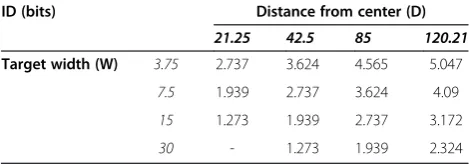
where We = 4.133 σ, and σ is the standard deviation of the endpoint positions for a given difficulty condition. As such, the metric throughput incorporates the results from all trials over a wide range of difficulties into one single performance index. It is important to evaluate a strategy over a wide enough range of IDs for an object-ive evaluation [24]. In [25], Williams and Kirsch used an ID range of 1.58 - 5 bits, while Scheme et al. chose a range of 1.59 - 3.46 bits, showing that higher IDs re-sulted in higher failure rates [26]. In pilot work, we found that evaluation of control strategies at higher IDs was important for assessing precision control in tasks that required the activation of one or two DOFs [33]. The IDs used with the corresponding target distances (D) and widths (W) are presented in Table 3 and range from 1.273 to 5.047 bits.
Experimental protocol
After configuration of the control strategy, subjects were first allowed to familiarize themselves with the control strategy by controlling a virtual prosthesis. Subjects were prompted to go through every DOF at low or high speed to verify good control. Further, practice sessions were carried out during each testing session to ensure that subjects had enough time to (1) achieve control of the cursor by mapping muscle contraction to cursor motion on the screen, and (2) reach a plateau in performance. The number of practice trials per session as well as the number of practice sessions was proportional to the complexity of the control strategy and task complexity (i.e. 1 DOF vs. 2 DOFs) (Table 4).
The experimental protocol consisted of six sessions per control strategy. Sessions were separated by rest pe-riods of two or three minutes, depending on muscle fa-tigue. In every session, 45 targets that required use of either 1 or 2 DOFs were presented to evaluate subjects’ ability to perform both task types with the given control strategy.
Performance metrics
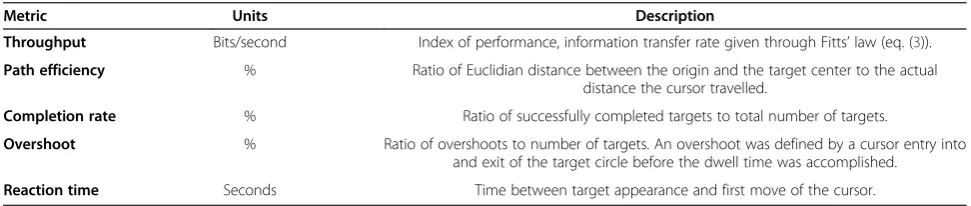
To comprehensively evaluate each control strategy, we generated a set of five quantitative performance metrics (Table 5).
Questionnaires
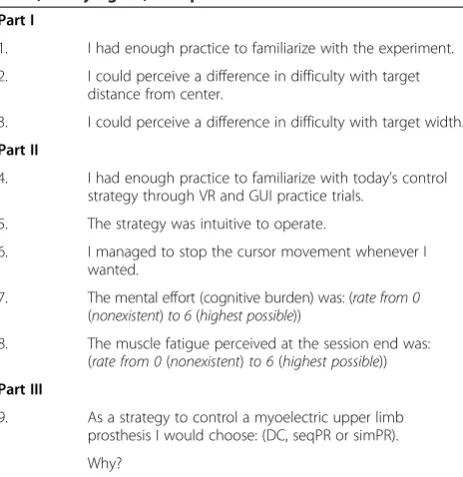
Qualitative evaluation of the control strategies was ob-tained through a three-part questionnaire (Table 6). Sub-jects completed a questionnaire after using each control strategy and after evaluating all three strategies. Part I of the questionnaire comprised questions concerning the experimental setup and the test and was administered after the first experimental session. Part II comprised questions about control strategy and was administered after testing each control strategy. Subjects were prompted to answer a last question (part III) after com-pletion of all experiments.
Statistical analysis
We assessed the significance of the results for each per-formance metric with general linear models (GLMs). We built one GLM for each of the five dependent variables (throughput; path efficiency; overshoot; completion rate; and reaction time) and tested for possible interactions between all variables. Session number (one to six); task type (1 or 2 DOFs); and control strategy (DC, seqPR, or simPR) were used as fixed factors and subject was used as a random factor. To further analyze differences be-tween significant effects and interactions, we conducted post-hoc comparisons with a Bonferroni correction fac-tor whenever required. Amputee subject data were ana-lyzed as case studies.
Table 3 Range of IDs (bits) through combination of distances D and widths W (GUI distance units) ID (bits) Distance from center (D)
21.25 42.5 85 120.21
Target width (W) 3.75 2.737 3.624 4.565 5.047
7.5 1.939 2.737 3.624 4.09
15 1.273 1.939 2.737 3.172
Results
Compliance with Fitts’law
We obtained a strong linear relationship between move-ment time MT (s) and index of difficulty ID (bits) across subjects, indicating high conformity of the data to Fitts’ law. The high coefficients of determination R2for both able-bodied and amputee subjects with each control strategy and in each task type (Figure 2) support the val-idity of the proposed test for EMG-based control strat-egies. Able-bodied subjects achieved a R2of 0.994 ± 0.004 across control strategies for 1 DOF tasks (Figure 2A; thin lines) and a R2 of 0.981 ± 0.003 across control strategies for 2 DOF tasks (Figure 2A; thick lines). Amputee subjects achieved R2= 0.988 ± 0.02 (Figure 2B; thin lines) for 1 DOF targets and R2= 0.9658 ± 0.01 for 2 DOF targets (Figure 2B; thick lines).
Control strategy performance Cursor trajectories
The goal of the test was to reach the targets as fast as possible using the assigned control strategy. Subjects ex-hibited a stereotypical cursor profile with each strategy that was consistent across subjects with the exception of the TH subject using DC, where the setup for DC was different due to the additional control sites from prior TMR surgery. Figure 3 shows those profiles for one rep-resentative able-bodied subject (3A) and for both ampu-tee subjects (3B and 3C).
Completion rate
Both able-bodied and amputee subjects had very high completion rates (above 96%) with each control strategy. The GLM for able-bodied subjects yielded target type as a significant factor (p = 0.02); subjects completed signifi-cantly less 2 DOF targets (combined motions) than 1
DOF targets (discrete motions). For amputee subjects, there was no difference in completion rates between control strategies or target types.
Performance metrics Able-bodied subjects
The performance metrics characterizing the control strategies for able-bodied subjects in the proposed test are summarized in Figure 4. The GLM for each per-formance metric yielded ‘session number’ as a non-significant main effect.‘Task type’was a significant main event for throughput and path efficiency (p < 0.001) and overshoot (p = 0.003). Furthermore‘control strategy’was a significant main effect in every metric (p < 0.001 for throughput; p = 0.005 for path efficiency; p = 0.023 for overshoot; and p = 0.013 for reaction time).
In 1 DOF targets, able-bodied subjects achieved a similar throughput with DC and seqPR; however, the throughput achieved with simPR was significantly lower (Figure 4A). In 2 DOF targets, throughput was signifi-cantly higher using simPR than using seqPR or DC.
Path efficiency for 1 DOF targets, in which target acqui-sition required only a one-directional cursor motion, showed no substantial difference between the three control strategies (Figure 4B). In combined motions, subjects achieved significantly higher path efficiency with simPR, in which paths exhibited a diagonal motion profile (Figure 3A) whereas there was no significant difference between DC and seqPR, both of which were characterized by sequential, boxy motion profiles (Figure 3A).
There was no difference in reaction time between task types (Figure 4C). For both task types, seqPR exhibited the lowest reaction time. Subjects exhibited no statistical difference in reaction time between DC and simPR in both task types.
Table 4 Practice session protocol
Practice trials Direct control Conventional PR Simultaneous PR
Discrete targets (1 DOF, on axes) sessions 1 1 1
targets/session 11 22 22
Combined targets (2 DOFs, off-axes) sessions 6 6 12
targets/session 15 30 30
Table 5 Description of performance metrics
Metric Units Description
Throughput Bits/second Index of performance, information transfer rate given through Fitts’law (eq. (3)).
Path efficiency % Ratio of Euclidian distance between the origin and the target center to the actual distance the cursor travelled.
Completion rate % Ratio of successfully completed targets to total number of targets.
Overshoot % Ratio of overshoots to number of targets. An overshoot was defined by a cursor entry into and exit of the target circle before the dwell time was accomplished.
For overshoot, the trend across control strategies within each task type was conserved even though subjects com-pleted 2 DOF targets with substantially more overshoots that 1 DOF trials (Figure 4D). Subjects achieved the high-est overshoot with seqPR, whereas they overshot signifi-cantly less in both task types with DC and simPR.
Amputee subjects
Data for both amputee subjects is presented separately due to the inherently different characteristics of their re-spective amputation.
For 1 DOF targets, both amputee subjects had the high-est throughput using seqPR (Table 7A), which was sub-stantially higher than the throughput obtained with simPR. While for S11, the throughput obtained with seqPR was also substantially higher than with DC, there was no not-able difference between DC and seqPR for S10. For 2 DOF targets, S10 performed with a considerably lower through-put using DC than with either seqPR or simPR; there was no difference between the two PR strategies. S11 exhibited the highest throughput with simPR in 2 DOF targets.
Path efficiency (Table 7B) was generally high for both amputee subjects in discrete targets. S10 had notably lower path efficiency with simPR than with both other control strategies and S11 had considerably lower path efficiency with DC than with both others. For 2 DOF targets, both amputee subjects achieved the highest path efficiency with simPR while for both, the two sequential control strategies (DC and seqPR) had similar path efficiencies.
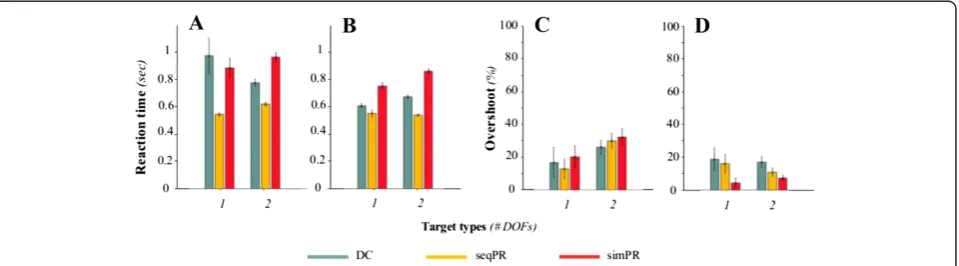
Both amputee subjects had fastest reaction times with seqPR (Figure 5A for S10, Figure 5B for S11). For both subjects there was no substantial difference in reaction time between DC and simPR.
Both amputee subjects had high variability in terms of overshoots (Figure 5). For S10, there was no substantial difference between control strategies within each task type. S10 overshot more in 2 DOF targets than in discrete targets (Figure 5C). There was no difference be-tween task types for S11; however, this subject overshot considerably less with simPR than with both other con-trol strategies (Figure 5D).
Questionnaire
Subjects rated the design of the experiment in part I of the questionnaire and strongly agreed that the FTAT test Table 6 Three-part questionnaire: Subjects were
prompted to answer by rating from 1 (totally disagree) to 7 (totally agree) except where otherwise indicated
Part I
1. I had enough practice to familiarize with the experiment.
2. I could perceive a difference in difficulty with target distance from center.
3. I could perceive a difference in difficulty with target width.
Part II
4. I had enough practice to familiarize with today’s control strategy through VR and GUI practice trials.
5. The strategy was intuitive to operate.
6. I managed to stop the cursor movement whenever I wanted.
7. The mental effort (cognitive burden) was: (rate from 0 (nonexistent)to 6(highest possible))
8. The muscle fatigue perceived at the session end was: (rate from 0(nonexistent)to 6(highest possible))
Part III
9. As a strategy to control a myoelectric upper limb prosthesis I would choose: (DC, seqPR or simPR).
Why?
was easy to familiarize with (Q1) and that they could per-ceive a difference in difficulty with target width (Q3). Sub-jects did less agree with perceiving a difference in difficulty with target distance from center (Q3) (Figure 6A). Part II concerned the comparison of the three control strategies throughout the FTAT test (Figure 6B). Subjects familiar-ized equally well with each strategy (Q4) and found that simPR was slightly more intuitive to operate than seqPR or DC (Q5). Subjects reported more difficulties in stopping the cursor on command with seqPR (Q6). Finally, subjects reported highest mental (Q7) and physical (Q8) efforts with DC. Part III of the questionnaire concerned each subject’s preferred strategy for daily use with prosthet-ics (Figure 6C). Only one subject chose DC, while the others (including both amputee subjects S10 and S11) chose either seqPR or simPR for reasons such as intui-tiveness of the control, higher functionality and less physical efforts.
Discussion
The last two decades have seen extensive efforts in the development of PR control solutions for myoelectric upper limb prostheses. Many strategies have emerged that achieve classification accuracies of more than 96% for sequential control of several DOFs. Despite this suc-cess, most of these strategies have not yet achieved clin-ical application. The delay in implementation is in part due to uncertainty in how to relate offline classification accuracy to real time functionality. Offline performance evaluation is not sufficient to indicate usability, and the lack of appropriate functional tests impedes comparison of different approaches to PR control. Furthermore, few have attempted to compare proposed new strategies to direct control, which is the current clinical standard of care for myoelectric prosthesis control.
We designed and implemented a two-dimensional tar-get acquisition task, based on the principles of Fitts’law A B C
DC
seqPR
simPR
Target types (# DOFs)
1 2 1 2 1 2
Figure 3Cursor trajectories with the three control strategies (DC in green, seqPR in yellow and simPR in red) for (A) one representative able-bodied subject (B) the TR subject (S10), and (C) the TH-TMR subject (S11).For(A),(B), and(C), the left column represents all cursor trajectories for 1 DOF targets (discrete motions) and the right column represents all cursor trajectories for 2 DOF targets (combined motions).
for human motor control, and evaluated it in a clinical study on 9 able-bodied and 2 amputee subjects. To evaluate the capacity of the proposed task to identify promising strategies for the control of the next gener-ation multi-functional prostheses, subjects performed the task using three different EMG-based control strat-egies. We characterized the interactions between sub-jects and control strategies through a broad set of performance metrics during two types of task: (i) discrete targets requiring use of one DOF and (ii) combined tar-gets requiring two DOFs. The ability to perform both types of task is extremely important for a natural, robust control of a prosthesis.
We assessed the validity of our methodology by evalu-ating the conformity of our data to Fitts’ law. Figure 2 shows the extremely high correlation of movement time to index of difficulty across task types and control strat-egies for both able-bodied (Figure 2A) and amputee sub-jects (Figure 2B). Our work thus supports the growing use of tests based on the paradigms of Fitts’ law to evaluate EMG-based control strategies in real time [25,26,31]. The different slopes and offsets of the regres-sion lines indicate the differences between the control
strategies in terms of both speed and accuracy, which are reflected in the throughput metric (Figure 4A). As a control strategy performance descriptor, the throughput of a system describes information transfer capacity and thus is the average rate of successful message delivery over a communication channel.
DC, the current clinical standard of care for myoelec-tric control, was characterized by high performance in discrete (1 DOF) tasks across able-bodied subjects and both amputee subjects. For these tasks, user intent was efficiently translated into action: cursor movements were both fast and efficient. In combined tasks, subjects had to activate 2 DOFs to acquire the target. For able-bodied subjects and the TR subject, this required a sequential activation of the DOFs that was interrupted by a com-pulsory co-contraction to switch between modes. This was perceived as both a high mental burden and a cause for increased muscle fatigue, which was efficiently reflected in weaker throughput and lower path efficiencies. S11 (TH-TMR subject) was able to activate each DOF at the same time using DC (because TMR enabled 4 inde-pendent control sites); as such S11 was able to move the cursor in diagonal mode, allowing for a higher Table 7 (A) Throughput (bits/s) (Mean ± Std err.) and (B) Path efficiency (%) (Mean ± Std err.) for amputee subjects S10 (TR) and S11 (TH-TMR)
(A) Throughput (bits/s) DC seqPR simPR
Discrete targets (1 DOF) S10(TR) 2.75 ± 0.17 3.12 ± 0.21 1.36 ± 0.13
S11(TH–TMR) 2.64 ± 0.24 3.67 ± 0.23 2.11 ± 0.18
Combined targets (2 DOFs) S10(TR) 0.62 ± 0.01 1.07 ± 0.33 1.08 ± 0.04
S11(TH-TMR) 1.24 ± 0.04 1.32 ± 0.03 1.63 ± 0.05
(B) Path efficiency (%) DC seqPR simPR
Discrete targets (1 DOF) S10(TR) 93.7 ± 2.12 94.9 ± 1.72 83.7 ± 2.31
S11(TH-TMR) 90.1 ± 0.23 97.0 ± 0.96 96.3 ± 1.12
Combined targets (2 DOFs) S10(TR) 63.9 ± 0.81 65.4 ± 0.33 73.7 ± 1.35
S11(TH-TMR) 71.3 ± 0.8 71.6 ± 0.76 87.7 ± 0.7
throughput (i.e., 2 DOF targets were reached faster). Path efficiency for 2 DOF targets was not substantially higher as uncontrolled muscle co-activation hindered pre-cise steering of the cursor into the target (Figure 3C). Des-pite this difficulty, S11 was able to precisely maneuver the cursor for 1 DOF targets.
For both able-bodied and amputee subjects, seqPR outperformed (or was equal to) DC in nearly every per-formance metric in both task types. The intuitive nature of seqPR control is reflected in shorter reaction times as well as higher throughput and path efficiency through the possibility to perform seamless sequential control, which is not possible in DC because of the need to switch between modes. Using seqPR, both amputee sub-jects achieved extremely high throughput in 1 DOF tasks when compared to able-bodied subjects, which is an en-couraging result for the clinical implementation of pat-tern recognition techniques.
Able-bodied and amputee subjects showed very promis-ing results with simPR through the capacity of simultan-eously and proportionally activating two DOFs. While this was highly beneficial in 2 DOF tasks, it might have hin-dered precise activation of one DOF at a time as shown by very low throughputs in 1 DOF tasks. However, although subjects were slower in executing a one-directional mo-tion, they were equally efficient at doing so. A possible so-lution to the reduced velocity in 1 DOF tasks might be to add gains whenever only one of the parallel classifiers is
activated in order to achieve a higher velocity in discrete 1 DOF tasks with low contractions. We noted that subjects needed a lot of practice to learn how to make repeatable and precise contractions. Even though all subjects had reached a plateau in their learning curve before testing, this plateau may be temporary. To obtain the full benefits of simPR, it is possible that a higher mastery level is re-quired, which could be achieved with more practice. The results for simPR suggest great potential for improving control of combined motions, although this strategy re-quires focused attention during classifier training and an extensive amount of practice. Although performance of discrete motions was not reliable, subjects reported that this strategy was highly intuitive.
The FTAT test was able to identify substantial differences between control strategies and to reveal advantages and shortcomings in performing different task types. Research efforts need to focus on implementing promising strategies and show good control over new generation multiarticulate prostheses. Such devices will enable more than two DOFs to be operable at the same time. While the potential of seqPR and especially simPR (or a different approach to simultaneous pattern recognition control) is clear, the limi-tations of DC also become apparent: switching through more than two DOFs would be too cumbersome, too un-natural, and impose too high of a cognitive burden.
The FTAT test used is highly modular in terms of diffi-culty level (e.g. target widths or locations are modifiable), 0
2 4 6 8
Q1 Q2 Q3 0 2 4 6 8
Q4 Q5 Q6 Q7 Q8 DC seqPR simPR
0 1 2 3 4 5 6 7
DC seqPR simPR
A B
C
is adaptable to different inputs (e.g., intramuscular EMG, electroencephalography (EEG)), and has as the potential to serve various goals, including comparing different control strategies. Our implementation provides a simple method for direct comparison of PR-based strategies currently be-ing developed with the current clinical standard of care (DC). The setup is very simple and does not contain pro-prietary information, thus it could easily be implemented to allow direct comparison between different PR control strategies across research laboratories. This work thus con-tributes to future research efforts on translating pattern recognition into clinical application.
Conclusion
We were able to use an objective and challenging func-tional evaluation test to allow comparison of myoelectric control strategies in able-bodied and amputee subjects in a pre-clinical setting. We directly compared in real time, between DC, the current clinical standard of care, and pattern recognition–based control strategies cur-rently being developed to control multi-articulate myoelec-tric upper limb prostheses. The functional performance evaluation task generates a broad set of performance met-rics. The appropriateness of this methodology was vali-dated by finding high conformity of the data with Fitts’law through high coefficients of determination. The FTAT test allowed us to comprehensively compare functional per-formance metrics of three control strategies (including throughput (bits/second), path efficiency (%), overshoot (%), and reaction time (seconds)) and revealed significant differences between control strategies. We found that both pattern recognition control strategies outperformed the amplitude-based DC control in coordinated (2 DOF) tasks but that the advantage of a concurrent activation of two DOFs provided by simultaneous PR was offset by a re-duced reliability in discrete (1 DOF) motions. Sequential pattern recognition strategy was precise and robust for tar-gets requiring 1 DOF, but depended on a seamless sequen-tial operation to achieve a coordinated task. Both PR strategies were perceived as highly intuitive by subjects whereas DC control was perceived as unnatural and cum-bersome to operate, even though efficient for discrete tasks. Our findings will contribute to a convergence of fu-ture research efforts to enable translation of PR-based con-trol strategies into the clinic.
Competing interests
Dr. Hargrove has an ownership interest in a Coapt, LLC, a company working to develop control strategies to control myoelectric limbs. This work was performed prior to the formation of the Company.
Authors’contributions
SMW helped in conceiving the study design and experimental protocol, programming the graphical user interface, acquiring, analyzing, and interpreting the data, and drafting the manuscript. LJH helped in conceiving the study design, drafting the manuscript, revising for important intellectual
concept, and supervising the study. Both authors read and approved the final manuscript.
Acknowledgements
The authors would like to acknowledge Dr. Todd Kuiken for his intellectual support and general advice during this study. They would also like to acknowledge Ann Barlow for critically revising the drafted manuscript. This work was supported by DARPA RE-NET Program administered through the Space and Naval Warfare Systems Center contract number N66001-12-1-4029.
Author details
1Institute of Bioengineering, Swiss Federal Institute of Technology (EPFL), Lausanne CH-1015, Switzerland.2Center for Bionic Medicine, Rehabilitation Institute of Chicago, Chicago, IL 60611, USA.3Department of Physical Medicine and Rehabilitation, Northwestern University, Chicago, IL 60611, USA.
Received: 5 February 2014 Accepted: 22 May 2014 Published: 30 May 2014
References
1. Belter JT, Segil JL, Dollar AM, Weir RF:Mechanical design and performance specifications of anthropomorphic prosthetic hands: A review.J Rehabil Res Dev2013,50:599–618.
2. Scheme E, Englehart K:Electromyogram pattern recognition for control of powered upper-limb prostheses: state of the art and challenges for clinical use.J Rehabil Res Dev2011,48:643–659.
3. Kuiken TA, Li G, Lock BA, Lipschutz RD, Miller LA, Stubblefield KA, Englehart KB: Targeted muscle reinnervation for real-time myoelectric control of multifunction artificial arms.JAMA2009,301:619–628.
4. Parker PA, Scott R:Myoelectric control of prostheses.Crit Rev Biomed Eng
1985,13:283–310.
5. Williams TW III:Practical methods for controlling powered upper-extremity prostheses.Assist Technol1990,2:3–18.
6. Dorcas D, Scott R:A three-state myo-electric control.Med Biol Eng1966, 4:367–370.
7. Graupe D, Salahi J, Kohn KH:Multifunctional prosthesis and orthosis control via microcomputer identification of temporal pattern differences in single-site myoelectric signals.J Biomed Eng1982,4:17–22.
8. Zecca M, Micera S, Carrozza M, Dario P:Control of multifunctional prosthetic hands by processing the electromyographic signal.Crit Rev™ in Biomed Eng2002,30:459–485.
9. Parker P, Englehart K, Hudgins B:Myoelectric signal processing for control of powered limb prostheses.J Electromyogr Kinesiol2006,16:541–548. 10. Englehart K, Hudgins B:A robust, real-time control scheme for multifunction
myoelectric control.Biomed Eng, IEEE Trans on2003,50:848–854. 11. Ajiboye AB, Weir RF:A heuristic fuzzy logic approach to EMG pattern
recognition for multifunctional prosthesis control.Neural Syst Rehabil Eng, IEEE Trans on2005,13:280–291.
12. Kuiken T, Dumanian G, Lipschutz R, Miller L, Stubblefield K:The use of targeted muscle reinnervation for improved myoelectric prosthesis control in a bilateral shoulder disarticulation amputee.Prosthetics Orthot Int2004,28:245–253.
13. Kamavuako EN, Englehart KB, Jensen W, Farina D:Simultaneous and proportional force estimation in multiple degrees of freedom from intramuscular EMG.Biomedl Eng, IEEE Trans on2012,59:1804–1807. 14. Muceli S, Farina D:Simultaneous and proportional estimation of hand
kinematics from EMG during mirrored movements at multiple degrees-of-freedom.Neural Sys Rehabil Eng, IEEE Trans on2012,20:371–378. 15. Cipriani C, Antfolk C, Controzzi M, Lundborg G, Rosén B, Carrozza MC,
Sebelius F:Online myoelectric control of a dexterous hand prosthesis by transradial amputees.Neural Syst Rehabil Eng, IEEE Trans on2011, 19:260–270.
16. Young AJ, Smith LH, Rouse EJ, Hargrove LJ:Classification of simultaneous movements using surface EMG pattern recognition.Biomed Eng, IEEE Trans on2013,60:1250–1258.
17. Baker JJ, Scheme E, Englehart K, Hutchinson DT, Greger B:Continuous detection and decoding of dexterous finger flexions with implantable myoelectric sensors.Neural Syst Rehabil Eng, IEEE Trans on2010,18:424–432. 18. Jiang N, Rehbaum H, Vujaklija I, Graimann B, Farina D:Intuitive, Online,
freedom in upper limb amputees.Neural Syst Rehabil Eng, IEEE Trans on
2013,22:501–510.
19. Jiang N, Vujaklija I, Rehbaum H, Graimann B, Farina D:Is Accurate Mapping of EMG Signals on Kinematics Needed for Precise Online Myoelectric Control?Neural Syst Rehabil Eng, IEEE Trans on2013,22:549–558. 20. Young AJ, Smith LH, Rouse EJ, Hargrove LJ:A comparison of the real-time
controllability of pattern recognition to conventional myoelectric control for discrete and simultaneous movements.J Neuroeng Rehabil2014,11:34–44. 21. Hargrove LJ, Englehart K, Hudgins B:A comparison of surface and
intramuscular myoelectric signal classification.Biomed Eng, IEEE Trans on
2007,54:847–853.
22. Simon AM, Hargrove LJ, Lock BA, Kuiken TA:Target Achievement Control Test: evaluating real-time myoelectric pattern-recognition control of multifunctional upper-limb prostheses.J Rehabil Res Dev2011,48:619–627. 23. Fitts PM:The information capacity of the human motor system in
controlling the amplitude of movement.J Exp Psychol1954,47:381–391. 24. Soukoreff RW, MacKenzie IS:Towards a standard for pointing device
evaluation, perspectives on 27 years of Fitts’law research in HCI.Int J Human-Computer Studies2004,61:751–789.
25. Williams MR, Kirsch RF:Evaluation of head orientation and neck muscle EMG signals as command inputs to a human–computer interface for individuals with high tetraplegia.Neural Syst Rehabil Eng, IEEE Trans on
2008,16:485–496.
26. Scheme EJ, Englehart KB:Validation of a selective ensemble-based classification scheme for myoelectric control using a three-dimensional Fitts’law test.Neural Syst Rehabil Eng, IEEE Trans on2013,21:616–623. 27. Young AJ, Hargrove LJ, Kuiken TA:Improving myoelectric pattern recognition
robustness to electrode shift by changing interelectrode distance and electrode configuration.Biomed Eng, IEEE Trans on2012,59:645–652. 28. Hudgins B, Parker P, Scott RN:A new strategy for multifunction
myoelectric control.Biomed Eng, IEEE Trans on1993,40:82–94. 29. Graupe D, Salahi J, Zhang D:Stochastic analysis of myoelectric temporal
signatures for multifunctional single-site activation of prostheses and orthoses.J Biomed Eng1985,7:18–29.
30. Smith LH, Hargrove LJ, Lock BA, Kuiken TA:Determining the optimal window length for pattern recognition-based myoelectric control: Balancing the competing effects of classification error and controller delay.Neural Syst Rehabil Eng, IEEE Trans on2011,19:186–192.
31. Scheme E, Lock B, Hargrove L, Hill W, Kuraganti U, Englehart K:Motion Normalized Proportional Control for Improved Pattern Recognition Based Myoelectric Control.Neural Syst Rehabil Eng, IEEE Trans on2013,22:149–157. 32. Simon AM, Hargrove LJ, Lock BA, Kuiken TA:A decision-based velocity
ramp for minimizing the effect of misclassifications during real-time pattern recognition control.Biomed Eng, IEEE Trans on2011,58:2360–2368. 33. Wurth SM, Hargrove LJ:Real-time comparison of conventional direct control and pattern recognition myoelectric control in a two-dimensional Fitts’law style test.In Eng Med Biol Soc (EMBC), 2013 35th Annual Int Conf the IEEE
2013,:3630–3633.
doi:10.1186/1743-0003-11-91
Cite this article as:Wurth and Hargrove:A real-time comparison between direct control, sequential pattern recognition control and simultaneous pattern recognition control using a Fitts’law style assessment procedure.
Journal of NeuroEngineering and Rehabilitation201411:91.
Submit your next manuscript to BioMed Central and take full advantage of:
• Convenient online submission
• Thorough peer review
• No space constraints or color figure charges
• Immediate publication on acceptance
• Inclusion in PubMed, CAS, Scopus and Google Scholar
• Research which is freely available for redistribution