S H O R T R E P O R T
Open Access
Activation of FXR pathway does not alter
glial cell function
Stefanie Albrecht
1†, Ann-Katrin Fleck
2†, Ina Kirchberg
1, Stephanie Hucke
2, Marie Liebmann
2, Luisa Klotz
2*†and Tanja Kuhlmann
1*†Abstract
Background:The nuclear receptor farnesoid-X-receptor (FXR; NR1H4) is expressed not only in the liver, gut, kidney and adipose tissue but also in the immune cells. FXR has been shown to confer protection in several animal models of inflammation, including experimental autoimmune encephalomyelitis (EAE), an animal model of multiple sclerosis (MS). FXR agonists are currently tested in clinical trials for treatment of human metabolic diseases. The beneficial effect of FXR agonists in EAE suggests that FXR might represent a potential target in inflammatory-demyelinating CNS diseases, such as MS. In MS, oligodendrocytes not only undergo cell death but also contribute to remyelination. This repair mechanism is impaired due to a differentiation block of oligodendroglial progenitor cells. Activation of other nuclear receptors that heterodimerize with FXR promote oligodendroglial differentiation. Therefore, we wanted to address the functional relevance of FXR for glial cells, especially for oligodendroglial differentiation.
Methods:We isolated primary murine oligodendrocytes from FXR-deficient (FXR Ko) and wild-type (WT) mice and determined the effect of FXR deficiency and activation on oligodendroglial differentiation by analysing markers of oligodendroglial progenitor cells (OPCs) and mature oligodendrocytes (OLs) using qRT-PCR and immunocytochemistry. Additionally, we determined whether FXR activation modulates the pro-inflammatory profile of astrocytes or microglia and whether this may subsequently modulate oligodendroglial differentiation. These in vitro studies were complemented by histological analyses of oligodendrocytes in FXR Ko mice.
Results:FXR is expressed by OPCs and mature oligodendrocytes. However, lack of FXR did not affect oligodendroglial differentiation in vitro or in vivo. Furthermore, activation of FXR using the synthetic agonist GW4064 did not affect oligodendroglial differentiation, remyelination in an ex vivo model or the expression of pro-inflammatory molecules in astrocytes or microglia. Concordantly, no effects of supernatants from macrophages cultured in the presence of GW4064 were observed regarding a possible indirect impact on oligodendroglial differentiation.
Conclusions:Our data suggest that FXR is dispensable for oligodendroglial differentiation and that FXR agonists, such as GW4064, represent a potential therapeutic approach for MS which specifically targets peripheral immune cells including macrophages but not brain-resident cells, such as oligodendrocytes, astrocytes or microglia.
Keywords:FXR, Nuclear receptors, Oligodendrocytes, Microglia, Astrocytes, GW4064
* Correspondence:[email protected]; [email protected]
Stefanie Albrecht and Ann-Katrin Fleck are co-first authors who equally contributed to this paper.
Luisa Klotz and Tanja Kuhlmann are co-last authors who equally contributed to this paper.
†Equal contributors
2Department of Neurology, University of Münster, 48149 Münster, Germany 1Institute of Neuropathology, University Hospital Münster, 48149 Münster,
Germany
Background
Nuclear receptors are a large group of transcription fac-tors that comprises 49 family members which enable the organism to quickly adapt to environmental changes by inducing the appropriate gene program [1]. Nuclear re-ceptors are activated by lipophilic ligands including hor-mones, fatty acids, bile acids and oxysterols, homo- and heterodimerize upon activation and regulate the metab-olism of glucose, fatty acids, triglycerides and lipopro-teins [1]. Besides these metabolic effects, numerous immune-modulatory effects by nuclear receptors have been described, including modulation of central nervous system (CNS) autoimmunity [2–4].
Interestingly, several members of the nuclear receptor family are also involved in molecular mechanisms regu-lating oligodendroglial differentiation. Downregulation of retinoid X receptor gamma (RXRγ) expression or ap-plication of RXRγ antagonists significantly impaired oligodendroglial differentiation. Similarly, mice lacking RXRγ showed delayed remyelination after induction of demyelination in vivo [5]. In oligodendrocytes, RXRγ heterodimerizes with the vitamin D receptor (VDR) to induce oligodendroglial differentiation, and accordingly, vitamin D-induced activation accelerates oligodendroglial differentiation [6]. Other nuclear receptors, such as thy-roid receptors (TR) and liver X receptors (LXR), are well expressed in oligodendroglial lineage cells and modulate oligodendroglial differentiation and myelination. Patients with congenital hypoparathyroidism typically develop a hypomyelinating phenotype, and triiodothyronine (T3) is required for the maturation of oligodendroglial progenitor cells into mature myelinating oligodendrocytes (for review see [7]). Mice lacking both LXRαand LXRβdisplay thin-ner myelin sheaths and reduced expression levels of mye-lin genes in the cerebellum. Furthermore, addition of pharmacological activators of LXRs to mixed glial cell cul-tures promotes oligodendroglial differentiation [8].
The nuclear receptor farnesoid-X-receptor (FXR; NR1H4) is expressed not only in the liver, gut, kidney and adipose tissue, but also in the immune cells [9, 10]. FXR heterodimerizes with other nuclear receptors, such as RXRs [11, 12]. The best-characterized endogenous FXR ligands are lipophilic bile acids, namely cholic acid and chenodeoxycholic acid. In addition, the synthetic compound GW4064 serves as an agonist with high re-ceptor specificity and efficacy [11, 13, 14]. In accordance with its expression pattern, FXR activation has been shown to confer protection in several animal models of innate intestinal and hepatic inflammation [11]. In ex-perimental autoimmune encephalomyelitis (EAE), an animal model of multiple sclerosis (MS), pharmaco-logical activation of FXR significantly ameliorated the disease course by induction of anti-inflammatory macro-phages [15, 25]. Interestingly, FXR agonists are currently
tested in clinical trials for treatment of alcoholic hepa-titis, type 2 diabetes mellitus and primary biliary cirrho-sis, demonstrating that FXR already represents an attractive pharmacological target in human metabolic diseases. The beneficial effect of FXR agonists in EAE suggests that FXR might represent a potential target in inflammatory-demyelinating CNS diseases, such as MS. Oligodendroglial lineage cells are not only a primary tar-get in MS but also a prerequisite for remyelination, an endogenous repair mechanism. However, especially in chronic MS lesions, remyelination is limited at least partly due to a differentiation block inhibiting the differ-entiation of oligodendroglial progenitor cells (OPCs) into myelinating oligodendrocytes [16–18]. Importantly, remyelination failure contributes to axonal damage and worsening of clinical signs in demyelinating animal models [19, 20].
Given its recently illustrated relevance in macrophage-mediated protection from CNS autoimmunity and the functional role of several nuclear receptors for oligo-dendroglial differentiation, we addressed the functional relevance of FXR in different brain-resident cells, espe-cially focusing on oligodendrocytes. Here, we show that FXR is expressed in murine oligodendrocytes. However, lack or activation of FXR did not influence oligodendro-glial differentiation in vitro or in vivo. Furthermore, FXR activation did not affect key immune functions of astro-cytes and microglial cells. These data demonstrate that, in contrast to other nuclear receptors, FXR is dispensable for oligodendroglial differentiation as well as for brain-resident astrocytes and microglia and hence suggest that pharmacological activation of FXR to downregulate CNS inflammation does not interfere with repair mechanisms, such as remyelination.
Materials and methods
Animals
FXR Ko mice [21] were purchased from Jackson Labora-tory and C57Bl/6 wild-type control mice from the animal facility in Münster, Germany. Animal handling and experi-ments were conducted according to the German Animal Welfare Act and approved by the responsible governmen-tal authorities (LANUV Nordrhein-Westfalen; AZ-8.84.-02.05.20.12.286, 84.-02.04.2013.A029, AZ 84-02.04.2014. A221, AZ 84-02.04.2013.A374).
Primary oligodendroglial culture and treatment
marrow-derived macrophage (BMM) supernatant, oligo-dendrocytes were incubated with 50% supernatant in culture medium for 48 h.
Cerebellar slice cultures and treatment
Sagittal, cerebellar slices from P1 mice were dissected as described earlier [23]. After 12 days in culture, demyelin-ation was induced by 16-h incubdemyelin-ation with 0.5 mg/ml ly-solecithin. During subsequent remyelination, the brain slices were incubated with 10 or 20 μM GW4064 for 14 days. The ex vivo slices were fixed and stained with neurofilament 70 kDa (NFL; Dako, 1:500) and anti-MBP (Abcam, ab7349, 1:200). Confocalz-stacks of whole slices were acquired with a Zeiss LSM 700 confocal micro-scope, and images were analysed using NIH ImageJ. The extent of myelination was quantified by determining the ratio between MBP and NFL staining. Two independent experiments were performed, and in each experiment, six brain slices and three z-stacks from six brain slices were analysed for each concentration of GW4064 or DMSO.
Macrophage and microglia culture and treatment
Preparation of bone marrow-derived macrophages and generation of primary astrocyte cultures via mixed glial culture preparation were performed as described previ-ously [2]. The murine embryonic stem cell-derived micro-glial precursor cells (ESdMs) were provided by Harald Neumann (University of Bonn) and cultured according to their publication [2, 24]. Depending on the individual cell type, cells were treated with different concentrations of the synthetic FXR agonist GW4064 (Tocris, 2473); con-centrations depended on individual cell type. Control groups were treated with the equivalent volume of solvent, i.e. DMSO. ESdMs and primary astrocytes were incubated for 24 h with the BMM-conditioned supernatant, before stimulation with LPS and IFNγ.
Generation of BMM supernatant
To produce BMM-conditioned supernatant, BMMs were treated with 15μM GW4064 or DMSO and cultured for 72 h [25].
Detection of TNFαand nitric oxide
TNFα in cell culture supernatants was quantified using ELISA Ready-SET-Go!® (murine TNFα; eBioscience) ac-cording to the manufacturer’s recommendations. Nitrite concentrations were measured in the supernatants using the Griess Reagent Kit (Invitrogen) according to the manufacturer’s instructions.
RT2Profiler™PCR Array
Treated ESdMs and astrocytes were stimulated with LPS and INFγ for 6 h. RNA isolation was performed with RNeasy Mini Kit (Qiagen) combined with the
RNase-Free DNase Set (Qiagen) to digest DNA. For transcrip-tion to complementary DNA (cDNA), the RT2 First-Strand Kit (Qiagen) was utilized. Afterwards, the RT2 Profiler™ PCR Array Inflammatory Response & Auto-immunity (#PAMM-077Z; Qiagen) was performed with RT2Real-Time SYBR Green PCR Master Mix (SuperArray Bioscience) according to the manufacturer’s protocol. For normalization, the housekeeping gene Hsp90ab1 was taken as internal control. Analysis was performed at the RT2 Profiler PCR Array Data Analysis Web portal (pro-vided from Qiagen).
RNA isolation and qRT-PCR
Total RNA from cells was isolated using peqGOLD Total RNA Kit (12-6634, PeqLab Biotechnologie GmbH). Mes-senger RNA (mRNA) was transcribed into cDNA by reverse transcription reaction (High Capacity cDNA Tran-scription Kit, Applied Biosystems), and cDNA was diluted to a final concentration of 0.75 ng/μl. qRT-PCR was performed using Power SYBR® Green PCR Master Mix (Applied Biosystems) and StepOne Plus real-time cycler (Applied Biosystems). The following primers were used:
Fxr fw: GCCACAGATTTCCTCCTCGT,Fxr rev: CAGT
CTCTCCCTGGTACCCA, Mbp fw: GTACAAGGACTC
ACACACGAGA, Mbp rev: GTTCGAGGTGTCACAA
TGTTCT, RPLP0 fw: CGACCTGGAAGTCCAACTAC
and RPLP0 rev: ATCTGCTGCATCTGCTTG, and data
were normalized usingRPLP0as internal control.
Immunocytochemistry (ICC)
OPCs were fixed directly after seeding or differentiated and fixed after 48 h as mature oligodendrocytes. Cells were permeabilised for 10 min in 0.5% Triton X-100 in PBS and blocked using 5% FCS/PBS for 30 min. The pri-mary antibodies were rat anti-MBP (Abcam, ab7349, 1:200), rabbit anti-PDGFRα(Santa Cruz, SSC338, 1:300), rabbit-FXR NR1H4 (Abcam, ab28676, 1:200; or Santa Cruz sc-13063, 1:100) and mouse anti-Olig2 (Medac, 387M-16, 1:200). Incubation was performed at 4 °C over night. Secondary antibody staining was performed using Cy™3 Anti-Rat (1:500) (Jackson, 112-165-167) and anti-Rabbit Alexa Fluor® 488 conjugate (1:500) (Jackson, 111-545-144) for 2 h at RT before embedding with Roti®-Mount FluorCare DAPI (Carl Roth, HP20.1). Images were taken using the laser scanning microscope (LSM 700, Zeiss Jena). At least 200 cells were quantified, and the numbers of MBP+ and PDGFRα+ cells were assessed as percentage of total DAPI+ cells.
Immunohistochemistry (IHC)
citrate buffer (pH 6) and stained using an automated immunostainer (AutostainerLink 48, Dako). Primary antibodies were specific to FXR (NR1H4, rabbit, Abcam ab28676 1:200; or Santa Cruz sc-13063, 1:50), NogoA (mouse, 11c7, a generous gift from M.E. Schwab, Brain Research Institute, University of Zürich and Department of Biology, Swiss Federal Institute of Technology Zürich, Switzerland, 1:15,000) and Olig2 (rabbit, 18953, IBL, 1:150 and mouse, 387M-16, Medac, 1:200). Numbers of oligodendroglial cells were quantified in a blinded fash-ion in the corpus callosum, cerebellum and spinal cord in standardized microscopic fields of 10,000 μm2 each defined by an ocular morphometric grid.
Statistics
All cell culture experiments were performed in tripli-cates and replicated at least three times. All statistical analyses were performed using GraphPad Prism 5.03 (GraphPad Software Inc., San Diego, CA). In text and figures, results are provided as mean ± SEM. Multiple comparisons in the same data set were analysed by the Bonferroni-corrected (for selected groups) one-way ANOVA tests. Single comparisons to control were made
using two-tailed Student’s t test. p values <0.05 were considered significant.
Results
FXR is expressed in oligodendrocytes
Histological analysis of brain sections from adult mice revealed expression of FXR in oligodendroglial lineage cells, which were identified by their typical linear ar-rangement within the corpus callosum (Fig. 1a (arrows)) and by coexpression with OLIG2 (Fig. 1b). Additionally, we analysed expression of FXR in oligodendrocytes in vitro. Before induction of differentiation using CNTF and NT3 [22], almost 100% of the oligodendroglial lineage cells express PDGFRα, a marker specifically expressed by OPCs. After 24 h of differentiation, ap-proximately 15% of the cells express MBP, a marker of mature oligodendrocytes; this percentage increases to 35% after 48 h, whereas PDGFRα+ OPCs account for approximately 10% of the cells. FXR protein expression was detected in OPCs and mature oligodendrocytes using immunocytochemistry (Fig. 1c). Quantification of Fxr gene expression demonstrated an increase in Fxr
Fig. 1FXR is expressed by oligodendroglial cells in vivo and in vitro. Immunohistochemical analysis revealed oligodendroglial cells in the corpus
mRNA expression during oligodendroglial differentiation (Fig. 1d).
Lack of FXR does not impair oligodendroglial differentiation in vivo or in vitro
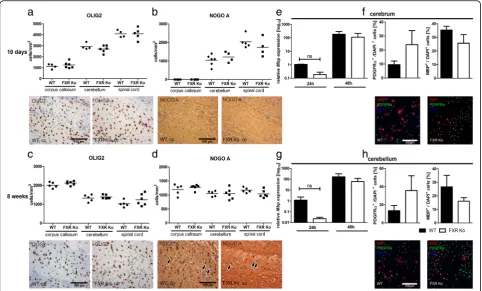
Utilizing FXR Ko mice, we determined the impact of FXR loss on the numbers of oligodendrocytes 10 days and 8 weeks after birth. To determine the numbers of OPCs and mature oligodendrocytes, we used OLIG2, a transcription factor that is expressed in both cell popula-tions. Quantification of OLIG2+ cells in the corpus cal-losum, cerebellum and spinal cord of FXR Ko and WT mice did not reveal differences between the two geno-types (Fig. 2a, c). Additionally, the number of mature NogoA positive oligodendrocytes was not affected by loss of FXR in any of the analysed CNS regions (Fig. 2b, d). The differentiation of FXR Ko or WT oligodendrocytes isolated from either cerebrum or cerebellum was ex-amined in vitro (Fig. 2e–h). After 24 h of differenti-ation, Mbp expression levels were slightly reduced in FXR Ko cells; however, no significant alteration in gene expression could be observed in either cerebral
or cerebellar oligodendrocytes (Fig. 2e, g). In addition, no difference in the amount of PDGFRα+ OPCs or MBP+ mature oligodendrocytes could be detected comparing FXR Ko and WT cells (Fig. 2f, h). In sum-mary, lack of FXR had no major effect on the numbers of oligodendrocytes or oligodendroglial differentiation, nei-ther in vivo nor in vitro.
Activation of FXR does not affect oligodendroglial differentiation
OPCs isolated either from the cerebrum or from the cere-bellum were treated with 1 or 10 μM of the
pharmaco-logical FXR agonist GW4064 after induction of
differentiation for up to 48 h. GW4064 treatment did not affect the viability of the oligodendroglial cells (data not shown). mRNA expression levels of the myelin-associated gene Mbp increased over time, but no differences in the relative expression levels were detected between GW4064-treated and control-GW4064-treated oligodendrocytes (Fig. 3a). Using immunocytochemistry, we determined the num-ber of PDGFRα+ OPCs and MBP+ mature oligodendro-cytes after 48 h of GW4064 treatment. The addition of
Fig. 2Loss of FXR does not impact oligodendroglial differentiation in vitro and in vivo. Immunohistochemical staining of WT and FXR Ko mice,
either 10 days or 8 weeks old, display no differences in the number of OLIG2+ oligodendroglial cells in the corpus callosum (cc), cerebellum or spinal cord (a,c). In addition, the proportion of mature NOGO A+ oligodendrocytes (b,d) is not altered in FXR Ko mice compared to WT mice. In vitro cultured, primary oligodendrocytes isolated either from the cerebrum (e,f) or cerebellum (g,h) display no significant difference in theMbp gene expression (e,g) after 24 and 48 h of differentiation or the percentage of PDGFRα+ OPCs or mature MBP+ oligodendrocytes (f,h) after 48 h of differentiation. In vivo: number of cells/mm2was determined using an ocular grit,n= 4–6 animals, two-tailed Student’sttest; in vitro:n= 3,
GW4064 to oligodendroglial cell cultures did not result in a significant change in the percentage of PDGFRα+ OPCs or MBP+ mature oligodendrocytes (Fig. 3b, c). Additionally, we analysed the impact of GW4064 appli-cation to oligodendroglial cells isolated from the cere-bellum; however, no alterations inMbpgene expression or changes in the percentage of PDGFRα+ OPCs and MBP+ mature oligodendrocytes compared to controls were observed (Additional file 1: Figure S1a–c). These data show that direct activation of FXR has no impact on oligodendroglial differentiation.
Remyelination following toxic-induced demyelination in cerebellar brain cultures is not impacted by activation of FXR
To analyse a potential impact of FXR activation on the process of remyelination, we made use of cerebellar slice cultures that were demyelinated by lysolecithin. We ap-plied two different concentrations of GW4064 to demye-linated cerebellar slice cultures during 14 days of remyelination. Evaluation of the amount of MBP+ and NFL+ axons revealed no influence of GW4064 treatment on the remyeliation capacity of oligodendrocytes after toxic demyelination in this ex vivo model (Additional file 1: Figure S1g, h).
No indirect effect of FXR-activated macrophages on oligodendroglial differentiation
Since peripheral macrophages migrate into the CNS dur-ing MS pathogenesis and then modulate the inflamma-tory activity of brain-resident cells and given the strong immune-modulatory properties of FXR in macrophages [25], we next addressed whether FXR might indirectly affect oligodendrocytes via FXR-modulated macro-phages. To this end, bone marrow-derived macrophages (BMM) were cultured and treated with 10μM GW4064 to activate FXR [25]. Subsequently, OPCs isolated from the cerebrum were cultured in the presence of superna-tants from GW4064-exposed BMMs to analyse the effect on oligodendroglial differentiation. Controls included oligodendroglial lineage cells cultured either in the presence of supernatants from BMM without GW4064 exposure or without any BMM supernatants. After 48 h of differentiation,Mbpexpression levels and numbers of mature MBP+ oligodendrocytes were significantly reduced in cerebral oligodendrocytes exposed to BMM supernatants; however, this was independent of GW4064 treatment (Fig. 3d–f ). No significant differences in the numbers of PDGFRα+ OPCs were observed in cul-tures exposed to BMM-conditioned medium with or without GW4064 or controls (Fig. 3e, f ). Cerebellar
Fig. 3Cerebral oligodendroglial differentiation is not affected by direct FXR activation or supernatant of FXR-activated BMMs. Cerebral oligodendrocytes
oligodendrocytes showed no significant alteration of Mbp gene expression, but a significant decrease in MBP+ mature oligodendrocytes after addition of BMM supernatants compared to controls without BMM supernatants; however, conditioning with GW4064 had no additional effect on oligodendroglial differentiation (Additional file 1: Figure S1d–f ). Furthermore, no sig-nificant differences in the numbers of PDGFRα+ OPCs were observed (Additional file 1: Figure S1e, f ).
FXR activation does not affect immune functions of brain-resident astrocytes and microglia
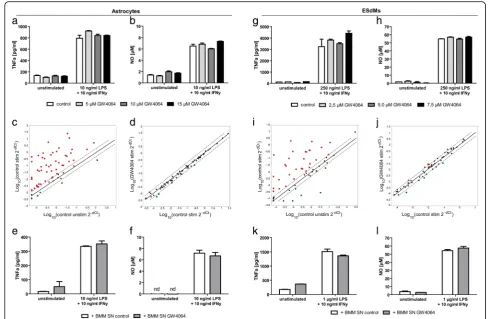
In light of the described anti-inflammatory properties of FXR on macrophages [25], we wondered whether pharmacological FXR activation might suppress inflam-matory activity of brain-resident astrocytes or microglia, which could also indirectly influence oligodendrocyte differentiation and function in local inflammatory pro-cesses during CNS autoimmunity. However, FXR activa-tion in primary astrocytes by different concentraactiva-tions of GW4064 did not affect the production of key pro-inflammatory molecules TNFα(Fig. 4a) and NO (Fig. 4b). In this line, also activation of FXR in embryonic stem cell-derived microglial cells (ESdMs; [24]) did not sup-press TNFα(Fig. 4g) and NO (Fig. 4h) production. Fur-thermore, no differences in the expression of 84 genes involved in inflammatory immune responses, such as genes of cytokines, interleukins and chemokines, were observed in DMSO-treated cells compared to GW4064-treated astrocytes (Fig. 4c, d) and ESdMs (Fig. 4i, j), respectively.
Supernatant of GW4064-treated BMMs does not affect astrocytic and microglial immune functions
We next investigated the influence of conditioned super-natant from FXR-activated BMMs on astrocytes and microglial cells. However, there was no modulation of TNFα(Fig. 4e, k) or NO (Fig. 4f, l) production detectable in astrocytes as well as in microglial cells upon incubation with conditioned supernatants. In conclusion, these data indicate that FXR does not play a major role in controlling pro-inflammatory activities of brain-resident cells, neither directly nor indirectly by modulating inflammatory macro-phage activity.
Discussion
Here, we demonstrate that FXR is expressed by OPCs and mature oligodendrocytes, like microglia and astrocytes [25]. However, lack of FXR did not affect oligodendroglial differentiation in vitro or in vivo. Furthermore, activation of FXR using the synthetic agonist GW4064 did not affect oligodendroglial differentiation, ex vivo remyelination or pro-inflammatory activation of astrocytes or microglia.
Several nuclear receptors, such as RXRα, RXRβ, RXRγ, VDR, TR, LXRα and LXRβ, are expressed by oligoden-drocytes and have been shown to affect oligodendroglial function [5, 6, 8, 26]. Lack of TR or LXRα/LXRβresults in delayed oligodendroglial differentiation or hypomyeli-nation in the cerebellum, respectively [8, 26]. Similarly, blocking and/or downregulation of VDR, TRs or RXRγ impaired oligodendroglial differentiation [5, 27]. In contrast, our results provide no indication that lack of FXR delays oligodendroglial differentiation in vitro or in vivo. FXR forms a heterodimer with RXR to induce expression of target genes, but FXR can also function as a repressor by suppressing gene expression [13]. Our results suggest that, at least in oligodendrocytes, the function of FXR is re-dundant to or is compensated by other nuclear receptors.
Activation of several nuclear receptors such as RXRγ, TR, VDR and LXRα/LXRβ promotes oligodendroglial differentiation [3, 5–8]. This is in contrast to our results, which show that activation of FXR by the synthetic agonist GW4064 had no effect on the number of MBP+ mature oligodendrocytes or expression levels of MBP. Oligodendrocytes display a region-dependent heterogen-eity within the CNS [28], and interestingly, lack of LXRα/βis associated with hypomyelination in the cere-bellum [8]. To determine whether FXR might play a more prominent role in the differentiation of cerebellar oligodendrocytes, we repeated our in vitro experiments using oligodendrocytes isolated specifically from the cerebellum. However, neither lack nor activation of FXR modulated the differentiation of cerebellar oligodendro-cytes. Likewise, addition of FXR agonists to demyeli-nated cerebellar slice cultures did not exhibit an effect on remyelination in this ex vivo model in which exclu-sively CNS-resident cells are present.
The anti-inflammatory phenotype induced by GW4064-mediated activation of FXR in peripheral myeloid cells, such as BMMs, is well documented [15, 25]. However, ex-pression of FXR is not limited to myeloid cells, but is also present in microglia as well as astrocytes [25]. Interest-ingly, FXR activation in microglia using GW4064 did not result in downregulation of pro-inflammatory key mole-cules, such as TNFα and NO, or altered expression of pro- and anti-inflammatory genes encoding for cytokines, interleukins or chemokines as well as their receptors. These data illustrate that activation of FXR via GW4064 has no influence on the immune responses of microglia and astrocytes. This contrasts with the activation of other nuclear receptors such as LXR, RXR and PPARα[31, 32]. Considering previously published data [25], our results suggest that FXR plays a pivotal role in downregulation of
pro-inflammatory molecules in peripheral myeloid cells, but not in CNS-resident microglia suggesting heterogen-eity between the two cell populations despite overlapping functions. This may be due to a considerable diversity of gene expression patterns between tissue macrophages from different mouse organs [33] and could further ex-plain the recent observation that blood-derived monocytes might mainly initiate demyelination in EAE whereas microglia potentially primarily clear myelin debris [34].
Conclusion
In summary, we demonstrated that activation of FXR by GW4064 does not modulate oligodendroglial differenti-ation directly or indirectly via FXR activdifferenti-ation in macro-phages. Furthermore, there is no indication that GW4064 directly or indirectly influences the
pro-Fig. 4Immune functions of brain-resident astrocytes and microglia are not affected by direct FXR activation or supernatant of FXR-activated
inflammatory profiles of CNS-resident astrocytes or microglia. These data suggest that FXR agonists, such as GW4064, represent a potential therapeutic approach for MS which specifically targets peripheral immune cells including macrophages, but not brain-resident cells, such as oligodendrocytes, astrocytes or microglia.
Additional file
Additional file 1: Figure S1. Cerebellar oligodendroglial differentiation
is not affected by direct FXR activation or supernatant of FXR-activated BMMs. Addition of GW4064 during the differentiation of cerebellar oligodendrocytes over 24 and 48 h does not influenceMbpexpression levels (a) or the percentages of PDGFRα+ OPCs or MBP+ oligodendrocytes (b, c). Oligodendrocytes of cerebellar origin exhibit no significant difference in theirMbpexpression level when incubated with supernatants from BMM cultured either in the presence or absence of GW4064 (d). The percentage of OPCs is unchanged after incubation with BMM-conditioned medium; the percentage of MBP+ oligodendrocytes is reduced independent of additional GW4064 treatment (e, f). Activation of FXR cultures using 10 and 20μM GW4064 during 14 days of remyelination in cerebellar slice after toxic demyelination does not alter the ratio of MBP+ and NFL+ axonal fibres (g). Remyelinated fibres are exemplarily highlighted (arrows). Note that a high amount of MBP+ debris is still present after 14 days of remyelination (h). In vitro: n= 3, 1way ANOVA with Bonferroni’s correction, 200 cells per condition were evaluated, *p< 0.05; ex vivo: n= 2, 1way ANOVA with Bonferroni`s correction, 6 slices with 3 images each per condition and preparation; all images are representative. (TIF 5564 kb)
Abbreviations
ANOVA:Analysis of variance; BMM: Bone marrow-derived macrophage; CNS: Central nervous system; CNTF: Ciliary neurotrophic factor; DAPI: 4′ ,6-Diamidin-2-phenylindol; DMSO: Dimethylsulfoxid; EAE: Experimental autoimmune encephalomyelitis; ELISA: Enzyme-linked immunosorbent assay; ESdMs: Embryonic stem cell-derived microglial precursor cells; fw: Forward; FXR: Farnesoid-X-receptor; Hsp90ab1: Heat shock protein 90 kDa alpha family class B member 1; ICC: Immunocytochemistry; ICH: Immunohistochemistry; IFNγ: Interferon gamma; Ko: Knock out; LPS: Lipopolysaccharide; LSM: Laser scanning microscope; LXR: Liver X receptor; MBP: Myelin basic protein; mRNA: Messenger RNA; MS: Multiple sclerosis; NFL: Neurofilament 70 kDa; NO: Nitric oxide; NogoA: Neurite outgrowth inhibitor A; NR1H4: Farnesoid -X-receptor; NT3: Neurotrophin-3; OL: Mature oligodendrocyte;
Olig2: Oligodendrocyte transcription factor; OPC: Oligodendroglial progenitor cell; PDGF: Platelet-derived growth factor; PDGFRα: Platelet-derived growth factor receptor alpha; PFA: Paraformaldehyde; PPAR: Peroxisome proliferator-activated receptor; qRT-PCR: Quantitative real-time polymerase chain reac-tion; rev: Reverse;RPLP0: 60S acidic ribosomal protein P0; RXR: Retinoid X receptor; SEM: Standard error of the mean; T3: Triiodothyronine; TNFα: Tumor necrosis factor alpha; TR: Thyroid receptor; VDR: Vitamin D receptor; WT: Wild type
Acknowledgements
The authors thank Harald Neumann (University of Bonn) for providing the murine embryonic stem cell-derived microglial precursor cells (ESdMs). Additionally, the authors thank Elke Hoffmann and Claudia Kemming for excellent technical assistance.
Funding
This study was supported by the German Research Foundation (CRC 128 A8 and SFB1009 A03 to LK, CRC 128 B7 and KU1477 6-1 to TK) and the Interdisciplinary Clinical Research Center, Münster (Kl2/015/14 to LK and KuT3/012/15).
Availability of data and materials
The datasets supporting the conclusions of this article are included within the article.
Authors’contributions
LK and TK designed the study. SA, AKF, SH, IK and ML performed the in vitro and ex vivo experiments. TK analysed mouse tissue samples. SA, AKF, IK and
ML analysed the data. SA, AKF, LK and TK wrote the manuscript. All authors read and approved the final manuscript.
Competing interests
The authors declare that they have no competing interests.
Consent for publication Not applicable.
Ethics approval Not applicable.
Publisher’s Note
Springer Nature remains neutral with regard to jurisdictional claims in published maps and institutional affiliations.
Received: 26 October 2016 Accepted: 6 March 2017
References
1. Francis GA, Fayard E, Picard F, Auwerx J. Nuclear receptors and the control of metabolism. Annu Rev Physiol. 2003;65:261–311.
2. Hucke S, Flossdorf J, Grutzke B, Dunay IR, Frenzel K, Jungverdorben J, Linnartz B, Mack M, Peitz M, Brustle O, et al. Licensing of myeloid cells promotes central nervous system autoimmunity and is controlled by peroxisome proliferator-activated receptor gamma. Brain. 2012;135:1586–605.
3. Chandraratna RA, Noelle RJ, Nowak EC. Treatment with retinoid X receptor agonist IRX4204 ameliorates experimental autoimmune encephalomyelitis. Am J Transl Res. 2016;8:1016–26.
4. Diab A, Hussain RZ, Lovett-Racke AE, Chavis JA, Drew PD, Racke MK. Ligands for the peroxisome proliferator-activated receptor-gamma and the retinoid X receptor exert additive anti-inflammatory effects on experimental autoimmune encephalomyelitis. J Neuroimmunol. 2004;148:116–26. 5. Huang JK, Jarjour AA, Nait Oumesmar B, Kerninon C, Williams A, Krezel W,
Kagechika H, Bauer J, Zhao C, Baron-Van Evercooren A, et al. Retinoid X receptor gamma signaling accelerates CNS remyelination. Nat Neurosci. 2011;14:45–53.
6. de la Fuente AG, Errea O, van Wijngaarden P, Gonzalez GA, Kerninon C, Jarjour AA, Lewis HJ, Jones CA, Nait-Oumesmar B, Zhao C, et al. Vitamin D receptor-retinoid X receptor heterodimer signaling regulates oligodendrocyte progenitor cell differentiation. J Cell Biol. 2015;211:975–85.
7. Lee JY, Petratos S. Thyroid hormone signaling in oligodendrocytes: from extracellular transport to intracellular signal. Mol Neurobiol. 2016;53:6568-83.
8. Meffre D, Shackleford G, Hichor M, Gorgievski V, Tzavara ET, Trousson A, Ghoumari AM, Deboux C, Nait Oumesmar B, Liere P, et al. Liver X receptors alpha and beta promote myelination and remyelination in the cerebellum. Proc Natl Acad Sci U S A. 2015;112:7587–92.
9. Lefebvre P, Cariou B, Lien F, Kuipers F, Staels B. Role of bile acids and bile acid receptors in metabolic regulation. Physiol Rev. 2009;89:147–91. 10. Schote AB, Turner JD, Schiltz J, Muller CP. Nuclear receptors in human
immune cells: expression and correlations. Mol Immunol. 2007;44:1436–45. 11. Modica S, Gadaleta RM, Moschetta A. Deciphering the nuclear bile acid
receptor FXR paradigm. Nucl Recept Signal. 2010;8, e005.
12. Calkin AC, Tontonoz P. Transcriptional integration of metabolism by the nuclear sterol-activated receptors LXR and FXR. Nat Rev Mol Cell Biol. 2012; 13:213–24.
13. Goodwin B, Jones SA, Price RR, Watson MA, McKee DD, Moore LB, Galardi C, Wilson JG, Lewis MC, Roth ME, et al. A regulatory cascade of the nuclear receptors FXR, SHP-1, and LRH-1 represses bile acid biosynthesis. Mol Cell. 2000;6:517–26.
14. Serbina NV, Pamer EG. Monocyte emigration from bone marrow during bacterial infection requires signals mediated by chemokine receptor CCR2. Nat Immunol. 2006;7:311–7.
15. Ho PP, Steinman L. Obeticholic acid, a synthetic bile acid agonist of the farnesoid X receptor, attenuates experimental autoimmune encephalomyelitis. Proc Natl Acad Sci U S A. 2016;113:1600–5.
17. Wolswijk G. Chronic stage multiple sclerosis lesions contain a relatively quiescent population of oligodendrocyte precursor cells. J Neurosci. 1998; 18:601–9.
18. Kuhlmann T, Miron V, Cui Q, Wegner C, Antel J, Brück W. Differentiation block of oligodendroglial progenitor cells as a cause for remyelination failure in chronic multiple sclerosis. Brain. 2008;131:1749–58.
19. Irvine KA, Blakemore WF. Remyelination protects axons from demyelination-associated axon degeneration. Brain. 2008;131:1464–77.
20. Duncan ID, Brower A, Kondo Y, Curlee Jr JF, Schultz RD. Extensive remyelination of the CNS leads to functional recovery. Proc Natl Acad Sci U S A. 2009;106:6832–6.
21. Sinal CJ, Tohkin M, Miyata M, Ward JM, Lambert G, Gonzalez FJ. Targeted disruption of the nuclear receptor FXR/BAR impairs bile acid and lipid homeostasis. Cell. 2000;102:731–44.
22. Watkins TA, Emery B, Mulinyawe S, Barres BA. Distinct stages of myelination regulated byγ-secretase and astrocytes in a rapidly myelinating CNS coculture system. Neuron. 2009;60:555–69.
23. Preisner A, Albrecht S, Cui Q-L, Hucke S, Ghelman J, Hartmann C, Taketo MM, Antel J, Klotz L, Kuhlmann T. Non-steroidal anti-inflammatory drug indometacin enhances endogenous remyelination. Acta Neuropathol. 2015; 130:247-61.
24. Beutner C, Roy K, Linnartz B, Napoli I, Neumann H. Generation of microglial cells from mouse embryonic stem cells. Nat Protoc. 2010;5:1481–94. 25. Hucke S, Herold M, Liebmann M, Freise N, Lindner M, Fleck AK, Zenker S,
Thiebes S, Fernandez-Orth J, Buck D, et al. The farnesoid-X-receptor in myeloid cells controls CNS autoimmunity in an IL-10-dependent fashion. Acta Neuropathol. 2016;132:413–31.
26. Billon N, Jolicoeur C, Tokumoto Y, Vennstrom B, Raff M. Normal timing of oligodendrocyte development depends on thyroid hormone receptor alpha 1 (TRalpha1). EMBO J. 2002;21:6452–60.
27. Huang C, Sakry D, Menzel L, Dangel L, Sebastiani A, Kramer T, Karram K, Engelhard K, Trotter J, Schafer MK. Lack of NG2 exacerbates neurological outcome and modulates glial responses after traumatic brain injury. Glia. 2016;64:507–23.
28. Marques S, Zeisel A, Codeluppi S, van Bruggen D, Mendanha Falcao A, Xiao L, Li H, Haring M, Hochgerner H, Romanov RA, et al. Oligodendrocyte heterogeneity in the mouse juvenile and adult central nervous system. Science. 2016;352:1326–9.
29. Miron VE, Boyd A, Zhao JW, Yuen TJ, Ruckh JM, Shadrach JL, van Wijngaarden P, Wagers AJ, Williams A, Franklin RJ, Ffrench-Constant C. M2 microglia and macrophages drive oligodendrocyte differentiation during CNS remyelination. Nat Neurosci. 2013;16:1211–8.
30. Natrajan MS, de la Fuente AG, Crawford AH, Linehan E, Nunez V, Johnson KR, Wu T, Fitzgerald DC, Ricote M, Bielekova B, Franklin RJ. Retinoid X receptor activation reverses age-related deficiencies in myelin debris phagocytosis and remyelination. Brain. 2015;138:3581–97.
31. Zhang-Gandhi CX, Drew PD. Liver X receptor and retinoid X receptor agonists inhibit inflammatory responses of microglia and astrocytes. J Neuroimmunol. 2007;183:50–9.
32. Xu J, Storer PD, Chavis JA, Racke MK, Drew PD. Agonists for the peroxisome proliferator-activated receptor-alpha and the retinoid X receptor inhibit inflammatory responses of microglia. J Neurosci Res. 2005;81:403–11. 33. Gautier EL, Shay T, Miller J, Greter M, Jakubzick C, Ivanov S, Helft J, Chow A,
Elpek KG, Gordonov S, et al. Gene-expression profiles and transcriptional regulatory pathways that underlie the identity and diversity of mouse tissue macrophages. Nat Immunol. 2012;13:1118–28.
34. Yamasaki R, Lu H, Butovsky O, Ohno N, Rietsch AM, Cialic R, Wu PM, Doykan CE, Lin J, Cotleur AC, et al. Differential roles of microglia and monocytes in the inflamed central nervous system. J Exp Med. 2014;211:1533–49.
• We accept pre-submission inquiries
• Our selector tool helps you to find the most relevant journal
• We provide round the clock customer support
• Convenient online submission
• Thorough peer review
• Inclusion in PubMed and all major indexing services • Maximum visibility for your research
Submit your manuscript at www.biomedcentral.com/submit