R E S E A R C H
Open Access
A real-time, practical sensor fault-tolerant module
for robust EMG pattern recognition
Xiaorong Zhang
1and He Huang
2,3*Abstract
Background:Unreliability of surface EMG recordings over time is a challenge for applying the EMG pattern recognition (PR)-controlled prostheses in clinical practice. Our previous study proposed a sensor fault-tolerant module (SFTM) by utilizing redundant information in multiple EMG signals. The SFTM consists of multiple sensor fault detectors and a self-recovery mechanism that can identify anomaly in EMG signals and remove the recordings of the disturbed signals from the input of the pattern classifier to recover the PR performance. While the proposed SFTM has shown great promise, the previous design is impractical. A practical SFTM has to be fast enough, lightweight, automatic, and robust under different conditions with or without disturbances.
Methods:This paper presented a real-time, practical SFTM towards robust EMG PR. A novel fast LDA retraining algorithm and a fully automatic sensor fault detector based on outlier detection were developed, which allowed the SFTM to promptly detect disturbances and recover the PR performance immediately. These components of SFTM were then integrated with the EMG PR module and tested on five able-bodied subjects and a transradial amputee in real-time for classifying multiple hand and wrist motions under different conditions with different disturbance types and levels.
Results:The proposed fast LDA retraining algorithm significantly shortened the retraining time from nearly 1 s to less than 4 ms when tested on the embedded system prototype, which demonstrated the feasibility of a nearly “zero-delay”SFTM that is imperceptible to the users. The results of the real-time tests suggested that the SFTM was able to handle different types of disturbances investigated in this study and significantly improve the classification performance when one or multiple EMG signals were disturbed. In addition, the SFTM could also maintain the system’s classification performance when there was no disturbance.
Conclusions:This paper presented a real-time, lightweight, and automatic SFTM, which paved the way for reliable and robust EMG PR for prosthesis control.
Keywords:Sensor fault-tolerant, EMG pattern recognition, Real-time, Signal disturbance, Practical, Robust, Outlier detection, Self-recovery
Background
Electromyographic signal (EMG) pattern recognition (PR) is a widely used method for classifying user intent for neural control of artificial limbs [1-6]. However, unreliabil-ity of surface EMG recordings over time is a challenge for applying the EMG PR-controlled prostheses in clinical
practice. Disturbances in EMG recordings are generally unpredictable in time, type, and level. Movement artifacts, environmental noises, electrode location shifts, loose electrode-skin contacts, user fatigue, and other conditions may all cause changes in the EMG characteristics and thus lead to inaccurate identification of user intent and threaten the prosthesis control reliability [7-11].
In order to make EMG PR clinically viable for control of artificial limbs, several strategies have been developed to address the challenge of unreliability in EMG recordings. Hargrove et al. [12], Young et al. [13,14], and Muceli [15] suggested several methods for making EMG PR-controlled * Correspondence:[email protected]
2NCSU/UNC Rehabilitation Engineering Center (REC), NCSU/UNC Department of Biomedical Engineering, North Carolina State University, 4402C
Engineering Building III, Raleigh, NC, USA 3
University of North Carolina at Chapel Hill, 150A MacNider Hall, Chapel Hill, NC, USA
Full list of author information is available at the end of the article
systems more robust to electrode shift, including employ-ing a new EMG PR trainemploy-ing method [12], investigatemploy-ing the effects of electrode size and orientation [13], changing interelectrode distance and electrode configuration [14], and extracting control signals by linear factorization of multi-channel EMG recordings [15]. Sensinger et al. [9], Tommasi et al. [16], and Chen et al. [17] developed adap-tive learning schemes to deal with variations in EMG sig-nals for reliable EMG pattern classification. Lopez et al. [18] proposed a robust EMG sensing system by fusing re-dundant information of EMG signals to reduce the sensi-tivity of the control system relative to electrode failures. Tkach et al. [19] suggested several time-domain features that were resilient to EMG signal change caused by muscle fatigue and exerted force levels. Hahne et al. [20] employed a spatial filter in high-density EMG signal processing to obtain robustness to sensor noise. Geng et al. [21] devel-oped a two-stage cascade classifier with the first classifier for limb position identification and the second for limb motion classification to reduce the effect of limb position variation on classification performance. Simon et al. [22] implemented a decision-based velocity ramp as a postpro-cessing step for the EMG PR algorithm to diminish the ef-fect of misclassifications on the prosthesis movement. Amsuss et al. [23] proposed a self-correcting EMG PR-controlled system by adding a postprocessing algorithm to the existing EMG PR algorithm to detect and remove mis-classifications of the system.
Our previous study also proposed a robust EMG PR interface for locomotion modes recognition based on the concept of sensor fault tolerance [24]. The proposed sensor fault-tolerant module (SFTM) consists of multiple sensor fault detectors and a self-recovery mechanism. The signals recorded from redundant EMG sensors are monitored by sensor fault detectors. The self-recovery mechanism will remove the EMG signals detected as abnormal recordings from the input of the pattern clas-sifier. The simulation results showed that the SFTM maintained classification performance when one out of ten signals recorded from gluteal and thigh muscles was distorted and recovered about 20% of classification accur-acy when four signals were distorted simultaneously.
While our previous study has demonstrated a promis-ing concept of our design, the SFTM was evaluated off-line on simulated constant disturbances. In order to implement this concept in real-time and apply the devel-oped system in practice, three major requirements must be satisfied.
First, the self-recovery strategy may require frequent retraining of the pattern classifier. The previous training procedure is computationally demanding, which involves reorganization of the feature matrices extracted from the original training data, computation of the new parame-ters for the retrained classifier, and reorganization of the
input data that is to be sent to the new classifier for mo-tion classificamo-tion. Whether or not this retraining pro-cedure can be completed sufficiently fast in real time, especially when frequent retraining occurs, is the key to the success of applying SFTM to improve the robustness of EMG PR.
Second, the previous designs of the sensor fault detector are impractical [24-26]. They either require the models of EMG signals under different types of disturbances, which are difficult to establish because the disturbances could be diverse and hard to predict in the real world [24], or need manual parameter adjustment to handle various disturb-ance types [25,26]. A practical sensor fault detector is re-quired in the proposed SFTM, which should be adaptive to various potential disturbances and is practical to build. Prompt detection is necessary in order for the distur-bances to be addressed before they impair the perform-ance of EMG PR. In addition, since disturbperform-ances do not always exist in the real world, the sensor fault detection should not harm the performance of EMG PR when there is no disturbance.
Last, to apply the designed robust EMG PR interface in practice, the SFTM needs to be seamlessly integrated with the PR module as a real-time system. The SFTM has to be lightweight in terms of computation and mem-ory overhead, especially when implemented on embed-ded systems for prosthesis control, because embedembed-ded computers are usually resource constrained and typically have processors with relatively slow system clock and limited memory.
practical SFTM for robust and reliable EMG PR for artificial arm control.
Methods
Architecture of the robust EMG PR interface
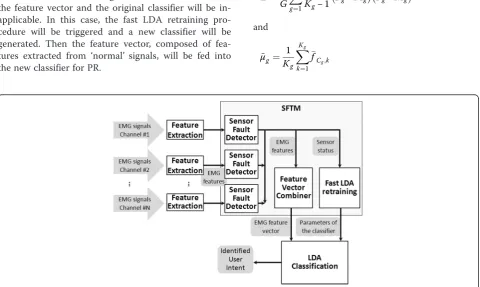
Figure 1 shows the overall structure of the robust EMG PR interface, which seamlessly integrates the EMG PR module with the SFTM. The system inputs are multiple channels of EMG signals. The input signals are preprocessed and seg-mented by overlapped sliding analysis windows. In every window, four time-domain (TD) features (mean absolute value, number of zero crossings, waveform length, and num-ber of slope sign changes [1]) of the EMG signals are ex-tracted from each input channel and then fed into the self-recovery module. The SFTM mainly consists of three components: multiplesensor fault detectors, a fea-ture vector combiner, and a fast LDA retraining pro-cedure. The sensor fault detectors closely monitor the features of individual EMG signals to detect various disturbances. Based on the detection results, the feature vector combiner concatenates the EMG features ex-tracted from ‘normal’channels into a feature vector as the input for pattern classification. If no disturbance is detected, the feature vector will be directly sent to the classifier generated from the original training data. If one or more signals are determined as ‘abnormal’, the features of the distorted signals will not be included in the feature vector and the original classifier will be in-applicable. In this case, the fast LDA retraining pro-cedure will be triggered and a new classifier will be generated. Then the feature vector, composed of fea-tures extracted from ‘normal’ signals, will be fed into the new classifier for PR.
Fast LDA-based retraining algorithm
The response time of the retraining algorithm is very critical to the design of the real-time SFTM. Linear dis-criminant analysis (LDA) is a widely used method for EMG PR because of its comparable classification accur-acy to more complex classifiers and the computational efficiency for real-time processing [1,3,25]. After examin-ing the details of the LDA algorithm, we developed a fast and memory efficient LDA retraining algorithm by mak-ing the most efficient use of existmak-ing information.
The principle of the LDA-based PR strategy is to find a linear combination of features which separates multiple clas-sesCg(g∈[1,G]). HereGdenotes the total number of
stud-ied classes. Suppose f is the feature vector of one analysis window, μgis the mean vector of class Cgand every class
shares a common covariance matrix∑, the linear discrimin-ant function is defined as
dCg ¼f
T
Σ−1μ
g−
1 2μg
TΣ−1μ
g:
During the training procedure,∑ andμgare estimated
based on the feature matrix calculated from the training data. The estimations of∑andμgare expressed as
~
Σ¼ 1 G
XG
g¼1
1
Kg−1 Fg−Mg
Fg−Mg
T
and
~ μg ¼
1
Kg XKg
k¼1
fCg;k
where Kg is the number of analysis windows in class
Cg; fCg;k is the kth observed feature vector in class Cg;
Fg ¼ fCg;1;fCg;2;…;fCg;k;…;fCg;Kg
h i
is the feature
mat-rix of class Cg; fCg;1;fCg;2;…;fCg;k;…;fCg;Kg is the mean
matrix which has the same dimension asFg. In a feature
vectorfCg;k ¼f1T;f2T;…;fnT;…;fNTT;N is the total
number of EMG input channels andfndenotes the four
EMG features extracted from thenthchannel.
In the previous retraining strategy [24], after the initial training process is done, the original EMG feature ma-trices Fg (g∈[1,G]) are stored in the memory for later
use in the retraining process. During the retraining pro-cedure, for each class, a new EMG feature matrix Fg' is
reorganized by removing the feature rows corresponding
to the disturbed channels from Fg. The mean vector of
each class ~μg0 and the new common covariance matrix
~
Σ0 are then recalculated based on F
g'. Our experimental
analysis has shown that the calculation ofΣ~0 is the most computational intensive task in the retraining procedure, which accounts for more than 90% of the total process-ing time. This is because for each class, a large amount of analysis windows are collected as the training data.
The number of columns in Fg' may vary from several
hundreds to a few thousands, which leads to intensive numerical operations in calculatingΣ~0.
In our new fast retraining strategy, the calculation of ~
Σ0and~μ
g0can be skillfully avoided. The trick is, instead of the large feature matrices Fg, only the mean vector ~
μg and the common covariance matrix Σ~ are stored in
the memory after the initial training process is finished. Figure 2 shows an example of retrieving Σ~0 and μ~g0 fromΣ~ and~μg when totally 6 EMG channels are in the
system and a single EMG channel Ch3 is identified as
‘abnormal’. The white blocks represent the elements
as-sociated with the disturbed channel. ~μg0 can be
ob-tained by taking off the elements that are associated with the disturbed EMG channel fromμ~g.Σ~0is constructed by
removing the corresponding rows and columns associated
with the disturbed channel from Σ~ and then merging
the remaining four small matrices (B1,B2, B3, and B4
in Figure 2). If multiple EMG signals are disturbed, Σ~0 andμ~g0can be obtained by doing the retrieving process repeatedly. Compared with the previous retraining al-gorithm which requires intensive numerical operations and a large memory space, the new strategy dramatic-ally accelerates the retraining speed and is much more memory efficient.
Sensor fault detector
In this study, a simple, fully automatic outlier detection method based on Mahalanobis distance analysis [28] was designed for EMG sensor fault detection because of several reasons. First, the detector is built only from normal training data and can detect new types of intru-sions [29], which is more practical than those who need prior knowledge of both normal data and all disturb-ance types. Second, the detector parameters can be cal-culated in the training procedure automatically. No more tuning step is required in the testing phase. Last, the detection algorithm is computationally efficient for real-time implementation. Mahalanobis distance ana-lysis is closely related to LDA, thus some calculation re-sults from the LDA classification can be directly reused in the outlier detection.
We assume that various types of disturbances are qualitatively different from EMG signals during normal motion activities. Since normal EMG signals of each mo-tion class are already collected in the training session, for each class, a normal EMG model is established from the training data. If a new piece of testing data has a large deviation from all the normal EMG models, it will be flagged as a disturbance. In our proposed system, each individual EMG signal is monitored by an outlier detector. In every analysis window, the 4 × 1 feature vec-torfnextracted from thenthEMG signal is processed as
a new instance. The Mahalanobis metric [28] is used to
estimate the distances of the new instance from the nor-mal model of each class. The instance is identified as
(
abnormal; if min
g∈½1;G fn−μ~g;n TX~ −1
nn
fn−μ~g;n
>τn
normal; if min
g∈½1;G fn−~μg;n TX~ −1
nn
fn−μ~g;n
≤τn
where for a specific channel n;μ~g;n is the estimated
mean vector of class Cg ðg∈½1;GÞ;Σ~nn is the estimated
4 × 4 common covariance matrix for all classes. μ~g;n and
~
Σnn are calculated in the training phase, and can be
eas-ily extracted from the corresponding positions in~μg and
~
Σ;respectively. fn−μ~g;nTΣ~−1
nn fn−μ~g;n
calculates the
estimated squared Mahalanobis distance from the new
instance fn to the normal model of class Cg;τn is the
outlier threshold. The value ofτnis chosen to reflect the
sensitivity of the outlier detector. Choosing a smaller
value of τn will result in a higher detection rate as well
as a higher false alarm rate. While a higher detection rate allows the SFTM to identify abnormal signals and recover classification decisions more efficiently, a higher false alarm rate might result in more incorrect removals of important good EMG channels from the PR system and thus might lead to classification errors. In the real world, the occurring time, duration, and type of ance cannot always be well predicted. Because disturb-ance does not always occur, it is essential for the SFTM not to significantly harm the PR performance when there is no disturbance. Since all training data are
con-sidered as‘normal’, in our designed sensor fault detector,
the value ofτnis automatically estimated in the training
phase by specifying the value of tolerable classification accuracy degradation (TCAD). TCAD is defined as the allowed maximum accuracy degradation of EMG PR when the SFTM is applied on normal signals. In our ex-periments, the value of TCAD was set to be 0.2%.
Participants
This study was conducted with Institutional Review Board (IRB) approval and informed consent of all subjects. Five able-bodied subjects (four males and one female; subjects AB1-AB5), free from orthopedic or neurological patho-logies, and a congenital transradial (TR) amputee (male; subject TR1) were recruited. The average age of subjects AB1-AB5 is 28.6 ± 2.7 years. Subject TR1 is 31 years old and the length of his deficient left forearm is 9 cm from the lateral epicondyle to the distal end of bone. The sub-ject has been using a two-site myoelectric prosthetic hand in his daily life.
EMG data collection
For each able-bodied subject, seven different classes of motion (3 degrees of freedom and a rest class) were re-quired to complete the test. These motions were no movement, wrist supination, wrist pronation, hand close, hand open, wrist flexion, and wrist extension. Six EMG signals were recorded from muscles on the subject’s do-minant forearm. The monitored muscles included the flexor carpi ulnaris (FCU), flexor carpi radialis (FCR), extensor carpi ulnaris (ECU), extensor carpi radialis (ECR),extensor pollicis longus(EPL), and palmaris longus (PL). The EMG electrodes were placed over the anatom-ical locations described in [30].
For the subject with the congenital limb deficiency (subject TR1), the motions chosen to elicit EMG signals were no movement, wrist supination, wrist pronation, hand close, and hand open, as determined by the ability of the subject. Six EMG electrodes were placed around his deficient forearm. Since PR control does not require independent muscle control sites [8,31], the electrode sites were determined by palpation while the subject performed the appropriate contractions. Wrist flexion and wrist extension were investigated on subject TR1 originally but were observed to be frequently mixed up with other motions. The subject was not able to consist-ently perform more than five distinct motions; therefore only five motion classes (2 degrees of freedom and a rest class) were chosen for subject TR1.
Electrode placement was prepared by shaving any excessive body hair in the site regions, and applying an alcohol prep pad. Disposable self-adhesive bipolar sur-face EMG electrodes (Norotrode, Myotronics Inc.) were used in this study. Each Norotrode was connected to an EMG pre-amplifier (MA-420-002, Motion Lab System Inc.), which band-pass filtered the EMG signals between 10 Hz and 3,500 Hz with a pass-band gain of 20. A single ground electrode was placed on the back of the elbow for all the subjects. All data were collected by a 16-channel EMG system (MA-300-16, Motion Lab System Inc), digi-tized by a data acquisition system with 16-channel 16-bit analog-to-digital converters (USB-1616HS, Measurement Computing Corporation), and sampled at 1000 Hz per channel. The sampled data were segmented into over-lapped analysis windows with 160 ms length and 20 ms increment, resulting in a new decision every 20 ms [32].
Disturbance types
used to demonstrate the feasibility of the SFTM. The following subsections briefly describe the data collection procedure of each type of disturbances.
Contact Artifact (CA)
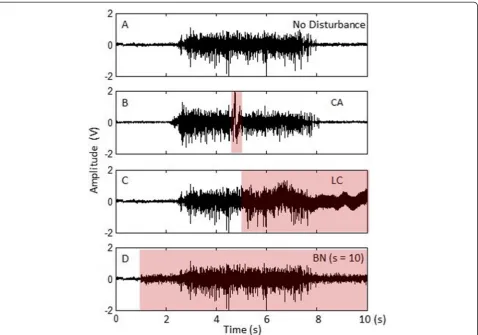
This is a common low-frequency noise that may lead to large drifts in EMG magnitude from baseline and is very difficult to totally remove [10]. Contact artifacts can be generated in many different situations in practice. In our experiments, we manually added contact artifacts to normal EMG signals by tapping one or multiple EMG electrodes during the subject’s normal motion activities because it is a simple yet controllable way of generating the disturbances in the lab environment [10]. Figure 3B shows an example of adding contact artifacts into a normal EMG signal.
Loose Contact (LC)
Loose electrode-skin contacts or contact lost can cause variations of electrode-skin impedance over time and
thus lead to low-quality signals [33]. To evaluate our system’s ability to handle this type of disturbance in real-time experiments, it is impractical to abruptly loo-sen or peel off the electrodes from skin during the sub-ject’s normal motion activities because it may interfere
with the subject’s performance and even damage the
electrodes. Instead, we simulated this situation by two steps: 1) we first gently peeled off the bipolar electrodes when the subject was in the rest state such that the electrodes were still partially attached to the skin. The signals of loose contacts from each channel were then collected and stored. 2) The collected disturbance data were fused with normal EMG signals in a way to mimic the randomness of real conditions where the disturbed channel, the timing, and duration of the disturbances are unpredictable. Assume in a testing trial, the number of disturbance segments to be added into a single EMG
channel is Iand the total number of EMG signals isN.
The testing data (i.e. normal EMG with disturbances) was constructed as
(
Enð Þ þt Dn;ið Þ;t t–startn;i<t<t–endn;i
Enð Þ;t otherwise ;
1≤i≤I; 1≤n≤N
ð Þ;ð1≤i≤I; 1≤n≤NÞ;
ð2Þ
where En(t) denotes the normal EMG signal from the
nth channel; Dn,i(t) denotes the data of the ith
disturb-ance segment to be added to the channel; t_startn,i
andt_endn,i are the start and the end time of Dn,i; t_
endn,i−t_startn,i represents the length of the
distur-bance. The testing data construction was performed
online to simulate the real-time conditions. Figure 3C
displays an example of an EMG signal with the loose-contact condition.
Baseline Noise (BN)
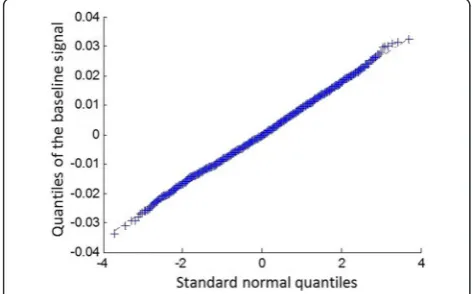
The baseline noise is composed of the thermal noise and the electrode-skin interface originated noise [10,18,34]. It can severely impair the resolution of signal recordings from surface electrodes. To generate the baseline noise, one trial of the baseline signal was first collected by ask-ing the subject to completely relax the muscles for 20 s. To analyze the distribution of the baseline noise, the Quantile-Quantile (Q-Q) plot [35] of the quantiles of the collected baseline signal versus the quantiles of a standard normal distribution was investigated (Figure 4). The Q-Q plot approximately lies on a line as shown in Figure 4, indicating that the distribution of the baseline noise and the Gaussian distribution are linearly related, so we assume the baseline noise is white Gaussian noise with different scales. To simulate different levels of line noise, the standard deviation of the collected base-line signalσ was first estimated, and then the simulated
baseline noise was generated by creating white Gaussian noise with a standard deviation ass⋅σ, wherescould be used to adjust the scale of the baseline noise. The simu-lated baseline noise and the EMG signal were then fused in a similar way as described in (2). An example of an EMG signal with additional baseline noise (s = 10) is shown in Figure 3D.
SFTM implementation on embedded system
To demonstrate the feasibility of realizing the proposed system on a real-time embedded system, a preliminary prototype of the robust EMG PR interface was im-plemented on the Gumstix Overo Air computer-on-module (COM), which contains a Texas Instruments OMAP3503 600 MHz processor based on the ARM Cortex-A8 architecture.
Classifier retraining used to be the most computational intensive part in the robust EMG PR interface. In this study, we compared two prototypes of the PR interface implemented on the Overo Air COM, one with the pro-posed fast LDA retraining algorithm, the other with the previous retraining strategy. By processing the same dataset, the computational time and the memory con-sumption of the two strategies were compared and dis-cussed in the result section.
Real-time experiments of the robust EMG PR interface on PC
The real-time experiments were conducted on a Matlab based implementation running on a laptop PC. The PC used was running 64-bit Windows 7 with processor at 3.1 GHz (Intel i5) and 4GB of RAM.
The experiments consisted of two sessions: training and testing. The training session was conducted first to collect training data for two purposes. One is to create the original motion classifier. The other is to build the sensor fault detector for each EMG channel. For each able-bodied subject, two trials of training data were col-lected. Each trial consisted of two repetitions of the fol-lowing seven types of motion classes: no movement, wrist supination/pronation, hand close/open, and wrist flexion/extension. The subjects were not restrained in any way during data collection. All contractions were performed at a speed and strength determined by the subject, and they were encouraged to contract at a level that they felt comfortable to repeat for the duration of the experiment. Before the training trial started, the sub-jects were instructed to perform each motion task mul-tiple times while the raw signals were viewed in real-time. The experimenter ensured that the signal quality of each EMG channel was good and that the gains of the ampli-fiers were appropriately set to avoid signal saturation. A Matlab implemented software GUI was developed to in-struct the subject to elicit and relax contractions. During Figure 4The Q-Q plot of the quantiles of the baseline signal
the training data collection, upon seeing a command of a motion class, the subject began the instructed contraction, and held the final position until seeing a command instructing them to relax the contraction. The duration of each motion was 4 s, and the rest periods were 8 s be-tween successive contractions. There was a 3 s countdown display to cue the subject before switching to the next motion.
For the subject with the congenital limb deficiency, nine training trials were conducted, including two trials for each motion class (wrist supination, wrist pronation, hand close, and hand open), and one trial for the no movement class. Each data collection trial consisted of two repetitions of a single motion class (4 s duration) separated by the rest periods (8 s duration). The subject was instructed to simultaneously perform the same mo-tion with his contra-lateral limb in order to aid him in visualizing the task. Sufficient rest time was allowed be-tween successive trials to avoid muscle fatigue.
The collected training data were then processed in two pathways. First, the motion classifier was created by processing the data set using the LDA method. After the training process was done, the parameters of the gene-rated classifier, the mean vector of each classμ~g and the
common covariance matrixΣ~ were saved in the memory
for later use in the real-time testing session. Second, the same dataset was used to build the sensor fault detector for each EMG channel.
In the real-time testing session, each subject was re-quired to perform the contractions under four different conditions with or without additional disturbances: 1) no disturbance (ND), 2) contact artifacts (CA), 3) loose contacts (LC), and 4) baseline noise (BN). For the BN
disturbance, three different scales were tested with s
configured as 5, 10, and 20, respectively. Each testing trial contains one repetition of all the investigated mo-tion classes. The subjects performed all the contracmo-tions in a random order by following the instructions dis-played on the software GUI. The duration of each con-traction was 4 s and the rest period between successive contractions was 8 s. The disturbances were either ma-nually introduced by the experimenter (CA) or fused with the collected EMG signals by software (LC and BN) in real-time. In the CA trials, the experimenter tapped 1–3 electrode(s) at a time during each contraction for
2–4 times. The experimenter was instructed to tap all
the electrodes as evenly as possible during the testing trials so that each electrode could have nearly the same chance to be disturbed. For the LC and BN trials, one disturbance segment was added into each EMG channel for each contraction at a random start time. The dur-ation of each disturbance was a random value within the range of 100–400 ms. For each subject, totally 30 testing
trials were collected, 5 for each condition. To better evaluate the performance of the proposed self-recovery strategy, two types of classification decisions with and without the self-recovery module were compared in every analysis window. The software GUI displayed the status of each EMG sensor and the classification deci-sions in real-time. All the experiments were documented and videotaped for later analysis.
Performance measurement
To evaluate the performance of the sensor fault detector, the detection rate (DR) and the false alarm rate (FAR) were computed. The metrics can be quantified as
DR¼
XN
n¼1
T Pn
XN
n¼1
T PnþFNn
ð Þ
100%;
and
FAR¼ XN
n¼1
FPn
ð Þ
XN
n¼1
FPnþT Nn
ð Þ
100%;
where N is the total number of EMG channels. For a
single channel n,TPn,FNn,FPn,TNn are the numbers of
true positives, false negatives, false positives, and true
negatives of the detector, respectively; TPn+FNn is the
total number of disturbed observations, and FPn+TNn
is the total number of normal observations. Note that for the testing trials disturbed by contact artifacts, the ground truth of the analysis windows was estimated ac-cording to the plots of the signals and the information recorded in the experiment documentations and videos, because tapping an electrode may affect multiple succes-sive analysis windows and the exact starting times and durations of the disturbances were unknown.
corrected by false alarms and the total number of ana-lysis windows affected by false alarms (CEFAR).
To evaluate the performance of the self-recovery stra-tegy, the analysis windows in the testing trials were di-vided into four categories according to the total number of disturbed EMG channels (categorized as 0, 1, 2, and 3). The average classification accuracy (CA) of each category was calculated as
CA¼ Number of correct classfication decisions in the category
Total number of classification decisions in the category
100%:
In addition, the classification accuracies of the system with and without the self-recovery module were both calculated and compared.
Results
Fast retraining algorithm vs. previous retraining algorithm Tables 1 and 2 summarize the performance comparison between the proposed fast LDA retraining algorithm and the previous retraining algorithm running on the
embed-ded system described in the section“SFTM
Implementa-tion on Embedded System”. Table 1 shows the processing time of the retraining algorithm when one, two, or three EMG channel(s) was/were disturbed. Table 2 compares the major memory consumption between our fast LDA retraining algorithm and the previous retraining algo-rithm. The original training data set contained EMG sig-nals collected from six channels and seven classes (772 analysis windows for each class) for subjects AB1–AB5, and six channels and five classes (772 analysis windows for each class) for subject TR1. It is shown that the new retraining algorithm was two orders of magnitude faster than the previous retraining strategy and meanwhile only consumed less than 1% of the memory usage of the old strategy. Furthermore, our proposed algorithm only took less than 4 ms to create the new classifier while the old strategy needed nearly 1 s, which is inadequate for real-time implementation. This result makes it possible for the new system to seamlessly extract EMG features, detect signal disturbances, retrain the classifier, perform PR, and
produce the recovered classification decision in a se-quence within the duration of one window increment (i.e. 20 ms in our experiments).
Real-time performance of the SFTM
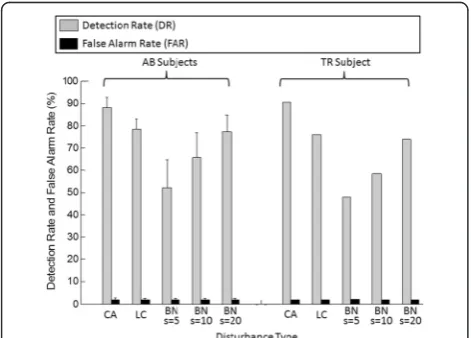
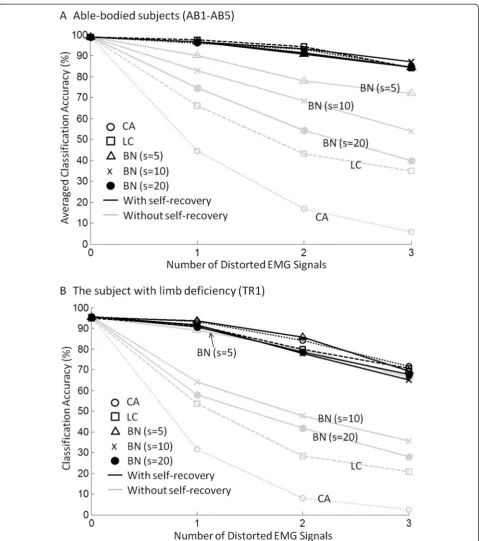
Figure 5 shows the detection rate (DR) and the false alarm rate (FAR) of the sensor fault detector for different types of disturbances. Figure 6 plots the motion classi-fication accuracies of the EMG PR system with (black lines) and without (grey lines) the SFTM. More detailed results of the averaged classification accuracy (mean ± standard deviation) across the five able-bodied subjects and the results of statistical analysis are presented in Table 3. As shown in the gray lines in Figure 6, different disturbance types had different damage levels to the sys-tem performance. According to the damage level, the five investigated disturbance types can be ranked as CA,
LC, BN(s = 20), BN(s = 10), and BN(s = 5), where the
CA disturbances caused the largest performance
reduc-tion while the BN(s = 5) only had slight impact on the
classification performance. As shown in Figure 5, the DR of the sensor fault detector increased as the damage level of the disturbance increased. Although the DR had large variation among disturbance types (DR ranged
from 52% (BNs = 5) to 88% (CA) for AB subjects, and
from 48% (BNs = 5) to 91% (CA) for TR1), the resulted
recovered classification accuracies for different types of disturbances were quite similar. A one-way ANOVA test on the five able-bodied subjects suggested that the clas-sification accuracies derived from the system with the SFTM were not significantly different across different disturbance types and levels (p > 0.08).
As shown in Table 3, classification accuracy of the EMG PR system was significantly improved by the SFTM when disturbance occurred (pairedt-test, p < 0.02 for all cells in Table 3). For both the AB subjects and the TR subject, the classification performance of the system deteriorated as the number of distorted signals increased, whether or not the SFTM was employed. Having more distorted channels means it will be more challenging for the sensor fault de-tector to identify all the disturbances correctly. Mean-while, the PR system will lose more information if more
Table 1 Processing time comparison between the new retraining method and the previous retraining method
New fast retraining Previous retraining Speedup
AB subjects (one channel removed) 3.78 ± 0.58 ms* 986.89 ± 49.71 ms* 267 ± 49
AB subjects (two channels removed) 2.93 ± 0.39 ms* 752.03 ± 25.71 ms* 260 ± 32
AB subjects (three channels removed) 2.21 ± 0.36 ms* 486.97 ± 21.11 ms* 242 ± 30
TR1 subject (one channel removed) 3.56 ms 711.21 ms 200
TR1 subject (two channels removed) 2.80 ms 476.56 ms 170
TR1 subject (three channels removed) 1.95 ms 307.02 ms 157
distorted channels are removed from the system. How-ever, the performance of the system with the SFTM dete-riorated much more slowly than the system without the module. The boosts of classification accuracies generally increased with the number of distorted channels. This indicates that the benefit of the SFTM became more obvious when multiple sensors were disturbed at the same time.
It was observed that the redundant information corded from able-bodied subjects was more than that re-corded from the amputee subject. Although the sensor fault detector provided similar DRs for subject TR1 in comparison with the able-bodied subjects, the recovered classification accuracies for TR1 deteriorated faster than those for the able-bodied subjects as shown in Figure 6. This is because the amount of extractable neural
in-formation from EMG signals from the TR patient’s
de-ficient forearm was limited. A similar observation was demonstrated in the previous study [24] in which the re-dundant information recorded from the gluteal and thigh muscles from five able-bodied subjects was found to be more than that recorded from a subject with a long transfemoral amputation.
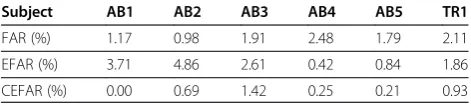
The FAR of the sensor fault detector for all subjects ranged from around 1% to 2.5% as shown in Figure 5 and Table 4. Overall, the false alarms had very slight ef-fects on the classification decisions as shown in Table 4, which was expected because in the training phase the TCAD caused by false alarms was set to be a small value of 0.2%. When the SFTM was employed, among all sub-jects and all types of tests, about 0.5% to 5% of the deci-sions affected by false alarms resulted in classification errors; meanwhile, around 0% to 1.5% of the decisions affected by false alarms were originally erroneous with-out the SFTM, and then got corrected after the SFTM was employed. Over 90% of the false alarms had no ef-fect to the system performance.
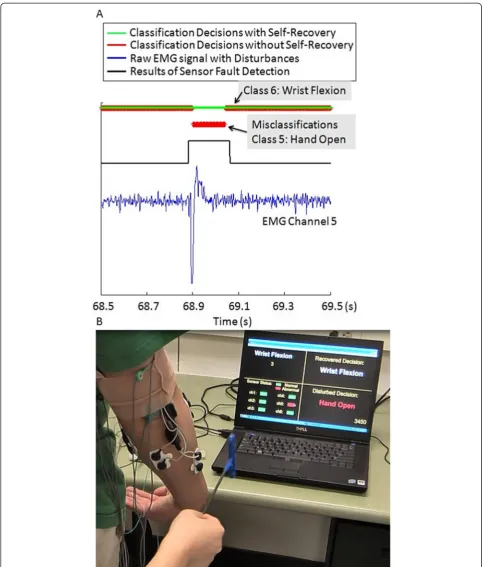
Figure 7 plots the real-time system performance of a segment of a representative CA trial. In this segment, a CA disturbance was introduced to Channel 5 (extensor pollicis longus) when the subject was performing wrist flexion. The blue line displays the raw EMG signals with the CA disturbance. The black line in the middle rep-resents the results of the sensor fault detection. A high signal means the EMG signal was identified as abnormal, and a low signal means normal. Without the self-recovery module, the wrist flexion motion was misclassified as hand open as displayed in the red line. By employing the SFTM, we can see the disturbance was detected imme-diately and the classification errors were successfully eli-minated in real-time as displayed in the green line. A screenshot from the recorded video of this CA trial is shown in Figure 7. In the screenshot, the experimenter just tapped the electrode of Channel 5. We can see in the software GUI, Channel 5 was identified as abnormal. The classification decisions with and without the SFTM were displayed as wrist flexion and hand open, respectively.
Discussion
In order to be a useful addition to the existing EMG PR interface for reliable and robust prosthesis control, a practical SFTM has to be fast enough, lightweight, auto-matic, and most importantly, robust under different con-ditions with or without disturbances. The experimental results presented in the previous section have demon-strated the feasibility of such an SFTM.
Table 2 Major memory usage comparison between the new retraining method and the previous retraining method
New fast retraining Previous retraining
AB subjects (772 windows for each class, 7 classes, 6 channels, 4 features per channel)
~
μg:(6 × 4) × 4 bytes = 96 bytes; Total size of the feature matrix: ~
Σ: (6 × 4) × (6 × 4) × 4 bytes = 2304 bytes; (6 4) × 772 × 7 × 4 bytes = 518784 bytes Total: 96 × 7 + 2304 = 2976 bytes = 2.9 Kbytes = 506.6 Kbytes
TR1 subject (772 windows for each class, 5 classes, 6 channels, 4 features per channel)
~
μg:(6 × 4) × 4 bytes = 96 bytes; Total size of the feature matrix: ~
Σ: (6 × 4) × (6 × 4) × 4 bytes =2304 bytes; (6 × 4) × 772 × 5 × 4 bytes = 370560 bytes Total: 96 × 5 + 2304 = 2784 bytes = 2.7 Kbytes = 361.9 Kbytes
First, the proposed fast LDA retraining algorithm sig-nificantly shortened the retraining time from up to 1 s to less than 4 ms when tested on the embedded system prototype, which successfully addressed the most critical
performance, which is apparently impractical, especially given the fact that some disturbances such as contact artifacts only last for a few hundred milliseconds. That means the disturbance cannot be recovered at all be-cause when the SFTM is ready for recovery, the disturb-ance is already gone. Shortening the retraining time to less than 4 ms allows the SFTM to complete sensor fault detection, classifier retraining, and pattern classification with the new classifier seamlessly in a sequence within the current analysis window. This clearly demonstrates the feasibility of a nearly“zero-delay” SFTM that is truly imperceptible to users.
Second, the developed SFTM is lightweight in terms of computation and memory overhead, which is a big advantage in applying the SFTM in practice, especially for future embedded system implementation. The fast retraining algorithm and the sensor fault detection algo-rithm were both smartly designed to efficiently utilize existing information calculated by the EMG PR algo-rithm, and thus to minimize the computation and mem-ory overhead. The same set of training data used to train the classifier was also used to build the sensor fault de-tectors so that additional data collection and memory consumption can be avoided.
Third, the outlier threshold of the sensor fault detector was automatically estimated by specifying the value of TCAD in the training phase. This strategy guarantees that an optimized outlier threshold can be determined
for most sensitive sensor fault detection under the con-dition that the SFTM will not significantly harm the EMG PR performance when there is no disturbance. This is also an important factor for applying the SFTM in practice because disturbances do not always exist in the real world. Outlier detection has been a widely used method in anomaly detection for biomedical data [33,36,37], but most existing studies have focused on the detection performance itself. The outlier thresholds are usually determined by specifying the false alarm rate [29]. In our study, we care more about the effect of the selection of outlier threshold on the PR perform-ance rather than that on the detection rate and false alarm rate. Using this threshold tuning strategy, the false alarms generated by the sensor fault detectors only had slight effect on the PR performance, which means the proposed robust EMG PR interface can still main-tain its classification performance when there is no disturbance.
The experimental results demonstrated the efficacy of the SFTM for handling the three types of disturbances investigated in this study. Although the sensor fault de-tection rate had a large variation among different types of disturbances, the recovered classification accuracies derived from testing trials under different conditions were quite similar. This is because low-level disturbances, though difficult to detect, had only small impacts on pattern classification, while high-level disturbances were more easily detected and the potential damage to the sys-tem could be effectively eliminated. The benefit of the SFTM generally became more significant as the number of distorted EMG signals increased and as the damage level of disturbance increased. The classification recovery performance for the TR subject deteriorated faster than that for the able-bodied subjects, which indicated that the redundant information recorded from the TR subjects was less than that recorded from the able-bodied subjects. As information redundancy in multiple EMG signals is essen-tial for the success of the SFTM, this might be a challenge to apply the designed SFTM to patients with amputations Table 4 The effects of false alarms on the classification
decisions
Subject AB1 AB2 AB3 AB4 AB5 TR1
FAR (%) 1.17 0.98 1.91 2.48 1.79 2.11
EFAR (%) 3.71 4.86 2.61 0.42 0.84 1.86
CEFAR (%) 0.00 0.69 1.42 0.25 0.21 0.93
FAR = false alarm rate.
EFAR = the ratio between the number of classification errors caused by false alarms and the total number of analysis windows affected by false alarms. CEFAR = the ratio between the number of classification errors corrected by false alarms and the total number of analysis windows affected by false alarms.
Table 3 The classification accuracy of the EMG PR system averaged across five able-bodied subjects (AB1-AB5)
CA LC BN BN BN
s= 5 s= 10 s= 20
No disturbance (w/o SFTM) 98.88 ± 0.73 98.84 ± 0.51 98.85 ± 0.53 98.90 ± 0.59 98.88 ± 0.57
No disturbance (w/ SFTM) 98.88 ± 073 98.84 ± 0.51 98.82 ± 0.53 98.90 ± 0.36 98.85 ± 0.57
1 channel disturbed (w/o SFTM) 44.50* ±10.50 66.22* ± 10.24 90.10* ± 2.94 82.93* ± 3.07 74.60* ± 2.38
1 channel disturbed (w/ SFTM) 96.00* ± 3.00 97.44* ± 2.23 96.70* ± 2.94 96.71* ± 1.31 96.58* ± 0.60
2 channels disturbed (w/o SFTM) 16.85* ± 12.74 43.05* ± 11.90 77.95* ± 8.30 68.36* ± 13.50 54.42* ± 12.56
2 channels disturbance (w/ SFTM) 92.81* ± 4.64 94.18* ± 5.22 90.80* ± 8.30 93.38* ± 2.63 91.31* ± 4.33
3 channels disturbed (w/o SFTM) 5.88* ± 5.50 35.06* ± 3.62 72.08* ± 5.17 54.02* ± 7.70 39.72* ±14.10
3 channels disturbed (w/ SFTM) 84.47* ± 6.17 84.20* ± 3.91 87.50* ± 5.17 87.19* ± 8.17 84.37* ± 7.34
because they usually have limited EMG recording sites for neural information extraction. As suggested in [24], the advanced surgical technique targeted muscle rein-nervation (TMR) [5] is a promising method for solving this problem. The TMR surgery could enhance the in-formation redundancy in recorded EMG signals by trans-ferring the residual nerves that originally commanded the muscles in the missing limb to alternative residual mus-cles. In addition, in recent years as the MEMS (micro-electro-mechanical systems) technology advances, high-density, micro-electrode EMG arrays have been developed [33,38,39]. These surface EMG arrays allow neural infor-mation extraction from both the temporal and the spatial domain, and can provide better-quality neural information than single channel EMG electrodes. Using high-density electrode arrays will result in much more redundant infor-mation in the EMG recordings. Furthermore, recording with many electrodes simultaneously often implies dis-turbances such as bad-contacts [33]. As the high-density EMG arrays become the trend, the SFTM will be more important in the future myoelectric prosthetic technology. Our proposed SFTM required user-specific training on individual subject for building the motion classifier and the sensor fault detector. In recent years, user-independent motion classification has become a promising approach for eliminating training phase on individual users and has po-tential for providing more user-friendly and more broadly accessible EMG PR-controlled applications. Ison et al. [40] provides a good review on user-independent EMG PR con-trol approaches. While some recent studies have shown great advances in this field [41-43], there has been no user-independent classification method being validated on am-putee subjects in real-time yet. For EMG PR-controlled prostheses, currently user-specific classification is still the dominant approach.
The performance measurement of this study was mainly focused on evaluating the SFTM’s ability of recovering er-roneous classifications caused by disturbances and the feasibility of implementing a lightweight, automatic, and robust SFTM in real-time. To apply the SFTM in clinical practice, in recent years, additional functional perform-ance metrics have been considered important to evaluate the usability of real-time PR control systems. Such metrics include completion time, completion percentage, and path efficiency of targeted tasks [5,44,45]. These functional metrics will be evaluated in our future work to inves-tigate how the SFTM will affect the usability of PR con-trol schemes. The three representative disturbances types were chosen for this study because on one hand, they are common and critical disturbances of EMG recordings [10,33], and on the other hand, they are more controllable and relatively easier to simulate and quantify in real-time experiments compared with some other common distur-bances such as fatigue, electrode shift, and limb motions.
In our future work, more types of practical disturbances will be investigated, including not only more individual disturbance types in the real world such as fatigue, elec-trode shift, and limb motions, but also coupling of these disturbances according to the realistic situation (e.g. CA and LC often come together). The occurring timing and duration of disturbances is also an important factor for further exploration. Instead of introducing disturbances randomly with random duration, for each type of disturb-ance, we will study when it typically occurs and how long it usually lasts practically, and consider this information in our experiments. Another future work will be integrating the EMG sensor interface into the embedded prototype of the robust EMG PR interface to be able to sample and digitize EMG signals and conduct real-time tests on a self-contained embedded system. In addition, more amputee subjects will be recruited for further testing of the robust EMG PR interface.
Conclusions
This paper presented a real-time, practical SFTM for ro-bust EMG PR. A fast LDA retraining algorithm and a fully automatic sensor fault detector based on outlier de-tection were developed, which allowed the SFTM to promptly detect various disturbances and recover the PR performance with nearly zero delay. In addition, no prior knowledge of disturbance type was required in building the sensor fault detector, and a new method for auto-matically tuning the outlier threshold in the training phase was developed. The SFTM was skillfully designed to make the most efficient use of existing information calculated by the EMG PR algorithm, and thus added lit-tle computation and memory overhead to the EMG PR interface. An integrated working prototype of the SFTM was then built for evaluation of the system validity, sen-sitivity, reliability, and robustness in real-time. The ex-perimental evaluation on five able-bodied subjects and one TR amputee subject showed that the PR interface with the SFTM could obtain significantly improved clas-sification accuracy in comparison with the interface with-out the SFTM when different types of disturbances were introduced. These results have demonstrated the feasibil-ity of a clinically viable and robust EMG PR interface for multifunctional prosthetic arm control.
Abbreviations
PR:Pattern recognition; SFTM: Sensor fault-tolerant module; LDA: Linear discriminant analysis; TD: Time-domain; TCAD: Tolerable classification accuracy degradation; TR: Transradial; CA: Contact artifact; LC: Loose contact; BN: Baseline noise; COM: Computer-on-module; DR: Detection rate; FAR: False alarm rate; TMR: Targeted muscle reinnervation.
Competing interests
Authors’contributions
XZ conceived of the study, designed and implemented the methods, carried out experiments under the supervision of HH, analyzed the data, and drafted the manuscript. HH conceived of the study, commented on the
interpretation of the results, and critically revised the manuscript. Both authors read and approved the submitted manuscript.
Acknowledgements
This work was partly supported by the National Institute on Disability and Rehabilitation Research (NIDRR #H133G130308) and NSF #1361549 & 1406750.
Author details 1
School of Engineering, San Francisco State University, 1600 Holloway Ave, San Francisco, CA, USA.2NCSU/UNC Rehabilitation Engineering Center (REC), NCSU/UNC Department of Biomedical Engineering, North Carolina State University, 4402C Engineering Building III, Raleigh, NC, USA.3University of North Carolina at Chapel Hill, 150A MacNider Hall, Chapel Hill, NC, USA.
Received: 5 August 2014 Accepted: 6 February 2015
References
1. Hudgins B, Parker P, Scott RN. A new strategy for multifunction myoelectric control. IEEE Trans Biomed Eng. 1993;40:82–94.
2. Englehart K, Hudgins B, Parker PA, Stevenson M. Classification of the myoelectric signal using time-frequency based representations. Med Eng Phys. 1999;21:431–8.
3. Englehart K, Hudgins B. A robust, real-time control scheme for multifunction myoelectric control. IEEE Trans Biomed Eng. 2003;50:848–54.
4. Ajiboye AB, Weir RF. A heuristic fuzzy logic approach to EMG pattern recognition for multifunctional prosthesis control. IEEE Trans Neural Syst Rehabil Eng. 2005;13:280–91.
5. Kuiken TA, Li G, Lock BA, Lipschutz RD, Miller LA, Stubblefield KA, et al. Targeted muscle reinnervation for real-time myoelectric control of multifunction artificial arms. J Am Med Assoc. 2009;301:619–28. 6. Huang H, Kuiken TA, Lipschutz RD. A strategy for identifying locomotion
modes using surface electromyography. IEEE Trans Biomed Eng. 2009;56:65–73.
7. Parker P, Englehart K, Hudgins B. Myoelectric signal processing for control of powered limb prostheses. J Eectromyography Kinesiol. 2006;16:541–610. 8. Hargrove LJ, Englehart K, Hudgins B. A comparison of surface and
intramuscular myoelectric signal classification. IEEE Trans Biomed Eng. 2007;54:847–53.
9. Sensinger JW, Lock BA, Kuiken TA. Adaptive pattern recognition of myoelectric signals: exploration of conceptual framework and practical algorithms. IEEE Trans Neural Syst Rehabil Eng. 2009;17:270–8. 10. De Luca CJ, Donald Gilmore L, Kuznetsov M, Roy SH. Filtering the surface
EMG signal: movement artifact and baseline noise contamination. J Biomech. 2010;43:1573–9.
11. Chowdhury RH, Reaz MB, Ali MABM, Bakar AA, Chellappan K, Chang TG. Surface electromyography signal processing and classification techniques. Sensors. 2013;13:12431–66.
12. Hargrove L, Englehart K, Hudgins B. A training strategy to reduce classification degradation due to electrode displacements in pattern recognition based myoelectric control. Biomed Signal Process Control. 2008;3:175–80.
13. Young AJ, Hargrove LJ, Kuiken TA. The effects of electrode size and orientation on the sensitivity of myoelectric pattern recognition systems to electrode shift. IEEE Trans Biomed Eng. 2011;58:2537–44.
14. Young AJ, Hargrove LJ, Kuiken TA. Improving myoelectric pattern recognition robustness to electrode shift by changing interelectrode distance and electrode configuration. IEEE Trans Biomed Eng. 2012;59:645–52.
15. Muceli S, Jiang N, Farina D. Extracting signals robust to electrode number and shift for online simultaneous and proportional myoelectric control by factorization algorithms. IEEE Trans Neural Syst Rehabil Eng. 2013;22:623–33. 16. Tommasi T, Orabona F, Castellini C, Caputo B. Improving control of
dexterous hand prostheses using adaptive learning. IEEE Trans Robotics. 2013;29:207–19.
17. Chen X, Zhang D, Zhu X. Application of a self-enhancing classification method to electromyography pattern recognition for multifunctional prosthesis control. J Neuroeng Rehabil. 2013;10:44.
18. López NM, di Sciascio F, Soria CM, Valentinuzzi ME. Robust EMG sensing system based on data fusion for myoelectric control of a robotic arm. Biomed Eng Online. 2009;8:5.
19. Tkach D, Huang H, Kuiken TA. Study of stability of time-domain features for electromyographic pattern recognition. J Neuroeng Rehabil. 2010;7:21. 20. Hahne JM, Graimann B, Muller K. Spatial filtering for robust myoelectric
control. IEEE Trans Biomed Eng. 2012;59:1436–43.
21. Geng Y, Zhou P, Li G. Toward attenuating the impact of arm positions on electromyography pattern-recognition based motion classification in transradial amputees. J Neuroeng Rehabil. 2012;9:74.
22. Simon AM, Hargrove LJ, Lock BA, Kuiken TA. A decision-based velocity ramp for minimizing the effect of misclassifications during real-time pattern recognition control. IEEE Trans Biomed Eng. 2011;58:2360–8.
23. Amsuss S, Gobel P, Jiang N, Graimann B, Paredes L, Farina D. Self-correcting pattern recognition system of surface EMG signals for upper limb prosthesis control. IEEE Trans Biomed Eng. 2014;61:1167–76.
24. Huang H, Zhang F, Sun YL, He H. Design of a robust EMG sensing interface for pattern classification. J Neural Eng. 2010;7:056005.
25. Zhang X, Liu Y, Zhang F, Ren J, Sun YL, Yang Q, et al. On design and implementation of neural-machine interface for artificial legs. IEEE Trans Ind Inform. 2012;8:418–29.
26. Liu Y, Zhang F, Sun Y, Huang H. Trust sensor interface for improving reliability of EMG-based user intent recognition. In: Proceedings of the 33rd Annual International Conference of the IEEE EMBS: August 30 - September 3, 2011; Boston. 2011. p. 7516–20.
27. Zhang X, Huang H, Yang Q. Real-time implementation of a self-recovery EMG pattern recognition interface for artificial arms. In: Proceedings of the 35th Annual International Conference of the IEEE EMBS: July 3–7, 2013; Osaka. 2013. p. 5926–9.
28. Mahalanobis PC. On the generalized distance in statistics. In: Proceedings of the National Institute of Sciences: April 16, 1936; Calcutta, vol. 2. 1936. p. 49–55.
29. Shyu M-L, Chen S-C, Sarinnapakorn K, Chang L. A novel anomaly detection scheme based on principal component classifier. In: Proceedings of the IEEE Foundations and New Directions of Data Mining Workshop, in conjunction with ICDM’03: November 19–22, 2003; Melbourne. 2003. p. 171–9. 30. Perotto A, Delagi EF. Anatomical guide for the electromyographer: the
limbs and trunk. Springfield, IL: Charles C Thomas Publisher; 2005. 31. Farrell TR, Weir RF. A comparison of the effects of electrode implantation
and targeting on pattern classification accuracy for prosthesis control. IEEE Trans Biomed Eng. 2008;55:2198–211.
32. Smith LH, Hargrove LJ, Lock BA, Kuiken TA. Determining the optimal window length for pattern recognition-based myoelectric control: balancing the competing effects of classification error and controller delay. IEEE Trans Neural Syst Rehab Eng. 2011;19:186–92.
33. Marateb HR, Rojas-Martínez M, Mansourian M, Merletti R, Villanueva MAM. Outlier detection in high-density surface electromyographic signals. Med Biol Eng Comput. 2012;50:79–89.
34. Phinyomark A, Limsakul C, Phukpattaranont P. A novel feature extraction for robust EMG pattern recognition. J Comput. 2009;1:71–80.
35. Wilk MB, Gnanadesikan R. Probability plotting methods for the analysis for the analysis of data. Biometrika. 1968;55:1–17.
36. Stålberg E, Bischoff C, Falck B. Outliers, a way to detect abnormality in quantitative EMG. Muscle Nerve. 1994;17:392–9.
37. Laurikkala J, Juhola M, Kentala E, Lavrac N, Miksch S, Kavsek B. Informal identification of outliers in medical data. In: The 5th International Workshop on Intelligent Data Analysis in Medicine and Pharmacology, August, 2000; Berlin. 2000. p. 20–4.
38. Yamagiwa S, Sawahata H, Ishida M, Kawano T. Micro-electrode arrays for multi-channel motor unit EMG recording. In: Proceedings of the IEEE 27th International Conference on Micro Electro Mechanical Systems: January 26–20, 2014; San Francisco. 2014. p. 857–60.
39. Someya T, Sekitani T. Bionic skins using flexible organic devices. In: Proceedings of the IEEE 27th International Conference on Micro Electro Mechanical Systems: January 26–20, 2014; San Francisco. 2014. p. 68–71. 40. Ison M, Artemiadis P. The role of muscle synergies in myoelectric control:
41. Matsubara T, Morimoto J. Bilinear modeling of EMG signals to extract user-independent features for multiuser myoelectric interface. IEEE Trans Biomed Eng. 2013;60:2205–13.
42. Khushaba RN. Correlation Analysis of Electromyogram (EMG) signals for multi-user myoelectric interfaces. IEEE Trans Neural Syst Rehab Eng. 2014;22:745–55.
43. Gibson AE, Ison MR, Artemiadis P. User-independent hand motion classification with electromyography. In: Proceedings of the ASME 2013 Dynamic Systems and Control Conference: October 21–23, 2013; Palo Alto. 2013. p. DSCC2013-3832.
44. Simon AM, Hargrove LJ, Lock BA, Kuiken T. Target achievement control test: evaluating real-time myoelectric pattern-recognition control of multifunctional upper-limb prostheses. J Rehab Res Dev. 2011;48:619–28.
45. Hargrove LJ, Simon AM, Lipschutz RD, Finucane SB, Kuiken TA. Real-time myoelectric control of knee and ankle motions for transfemoral amputees. J Am Med Assoc. 2011;305:1542–4.
Submit your next manuscript to BioMed Central and take full advantage of:
• Convenient online submission
• Thorough peer review
• No space constraints or color figure charges
• Immediate publication on acceptance
• Inclusion in PubMed, CAS, Scopus and Google Scholar
• Research which is freely available for redistribution