R E S E A R C H A R T I C L E
Open Access
Quality of cause-of-death reporting using
ICD-10 drowning codes: a descriptive study
of 69 countries
Tsung-Hsueh Lu
1, Philippe Lunetta
2, Sue Walker
3*Abstract
Background:The systematic collection of high-quality mortality data is a prerequisite in designing relevant drowning prevention programmes. This descriptive study aimed to assess the quality (i.e., level of specificity) of cause-of-death reporting using ICD-10 drowning codes across 69 countries.
Methods:World Health Organization (WHO) mortality data were extracted for analysis. The proportion of
unintentional drowning deaths coded as unspecified at the 3-character level (ICD-10 code W74) and for which the place of occurrence was unspecified at the 4thcharacter (.9) were calculated for each country as indicators of the quality of cause-of-death reporting.
Results:In 32 of the 69 countries studied, the percentage of cases of unintentional drowning coded as
unspecified at the 3-character level exceeded 50%, and in 19 countries, this percentage exceeded 80%; in contrast, the percentage was lower than 10% in only 10 countries. In 21 of the 56 countries that report 4-character codes, the percentage of unintentional drowning deaths for which the place of occurrence was unspecified at the 4th character exceeded 50%, and in 15 countries, exceeded 90%; in only 14 countries was this percentage lower than 10%.
Conclusion:Despite the introduction of more specific subcategories for drowning in the ICD-10, many countries were found to be failing to report sufficiently specific codes in drowning mortality data submitted to the WHO.
Background
Drowning is an important but neglected global health issue [1-4]. The systematic collection of high-quality mortality data about the environmental events and cir-cumstances leading to a case of drowning is a prerequi-site to designing relevant drowning prevention programmes [5,6]. Almost all countries collect, classify and tabulate cause-of-death data according to the same standard procedure (i.e., using theInternational Statisti-cal Classification of Diseases and Related Health
Pro-blems (ICD) published by the World Health
Organization (WHO)) [7]. The update from theNinth
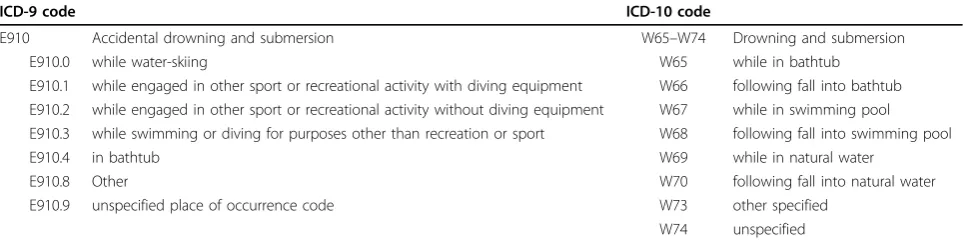
Revision(ICD-9) to theTenth Revision(ICD-10) entailed significant changes in the classification of unintentional drowning [8]: the ICD-9 emphasised details regarding
the nature of the recreational activity undertaken at the time of the event; in contrast, the ICD-10 highlights details about the nature of the body of water (e.g., bath-tub, swimming pool or natural water) and the mechan-ism of drowning (e.g., while in water versusfollowing a fall into water) (Table 1).
Despite the innovative expansion of the classification scheme in the ICD-10 for unintentional drowning, little is known about the current quality of cause-of-death reporting using ICD-10 codes in most countries. As noted in theWorld Report on Child Injury, even in rela-tively advanced countries, information regarding the place in which drowning occurs is poorly documented on death certificates [[9], p.61]. A recent study also indi-cates that of the 52 countries in the WHO European region, only 23 use 4th-character subdivisions and only 3 countries had high-quality data on the place of occur-rence of injuries [10]. This present study aimed to assess the quality (i.e., level of specificity) of cause-of-death * Correspondence: [email protected]
3
National Centre for Health Information Research and Training, School of Public Health, Queensland University of Technology, Victoria Park Road, Kelvin Grove, Australia
reporting using ICD-10 drowning codes across countries.
Methods
Data were extracted from the WHO mortality database for analysis [11]. As of August 2009, 146 countries sub-mitted mortality data to the WHO, of which 17 used only 3-character ICD-10 codes and 84 used 4-character ICD-10 codes. The ICD-10 codes for unintentional drowning are W65-W74 (Table 1). We excluded suicide by drowning (ICD-10 code X71), homicide by drowning (ICD-10 code X92), and cases of drowning of undeter-mined intent (ICD-10 code Y21), because no specific sub-categories exist for these codes in the ICD-10.
To ensure statistical stability in the calculation of per-centages, we included only those countries with more than 20 reported unintentional drowning deaths; thus, a total of 69 countries were included in the final analysis. To illustrate the magnitude of the mortality rates of unintentional drowning for each country, we first com-puted the age-adjusted drowning death rate (deaths per 100 000 people) for each country using the WHO stan-dard population structure. The age groups used for computing age-adjusted death rates were 0-14, 15-24, 25-44, 45-64 and 65+ years of age. Of the 69 countries included in the analysis, only 43 countries had popula-tion data from which the death rate could be calculated.
We then calculated two indicators of the quality (i.e., level of specificity) of cause-of-death reporting using ICD-10 codes for cases of unintentional drowning. The first indicator was the proportion of unintentional
drowning deaths (ICD-10 codes W65-W74) coded as unspecified at the 3-character level (ICD-10 code W74) (Table 1); the second was the proportion of uninten-tional drowning deaths in which the place of occurrence was unspecified at the 4thcharacter (.9) (Table 1). In other words, the higher the percentage of cases in which an unspecified code is reported, the poorer the quality of cause-of-death reporting.
Results
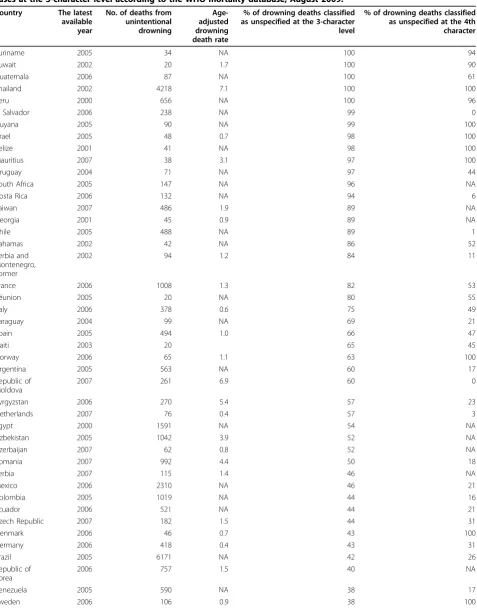
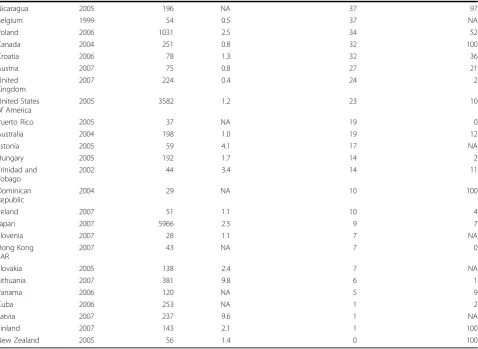
Of the 43 countries with population data available for the calculation of age-adjusted death rates, five coun-tries had a drowning death rate higher than 5 per 100 000: 9.8 in Lithuania, 9.6 in Latvia, 7.1 in Thailand, 6.9 in the Republic of Moldova, and 5.4 in Kyrgyzstan (Table 2). In 32 of the 69 countries studied in total, the percentage of cases of unintentional drowning coded as unspecified at the 3-character level exceeded 50%, and in 19 countries, this percentage exceeded 80%; in con-trast, this proportion was lower than 10% in only 10 countries. In 21 of the 56 countries that report 4-char-acter codes, the proportion of unintentional drowning deaths in which the place of occurrence was unspecified at the fourth character exceeded 50%, and in 15 coun-tries, the percentage exceeded 90%; in only 14 countries was this percentage lower than 10%. We found a large discrepancy between countries with regard to the unspecified codes at the 3-character level and the 4th character code; for example 99% vs. 0% respectively in El Salvador, and, in contrast, 0% versus 100% in New Zealand.
Table 1 Sub-categories of ICD-9 and ICD-10 codes for unintentional drowning (online ICD-10 codes can be accessed at http://apps.who.int/classifications/apps/icd/icd10online).
ICD-9 code ICD-10 code
E910 Accidental drowning and submersion W65–W74 Drowning and submersion
E910.0 while water-skiing W65 while in bathtub
E910.1 while engaged in other sport or recreational activity with diving equipment W66 following fall into bathtub E910.2 while engaged in other sport or recreational activity without diving equipment W67 while in swimming pool E910.3 while swimming or diving for purposes other than recreation or sport W68 following fall into swimming pool
E910.4 in bathtub W69 while in natural water
E910.8 Other W70 following fall into natural water
E910.9 unspecified place of occurrence code W73 other specified
W74 unspecified
In the ICD-10, the following fourth-character sub-divisions serve to identify the place of occurrence of the external cause where relevant: .0 Home
.1 Residential institution
.2 School, other institution, or public administrative area .3 Sports and athletics area
Table 2 Number and age-adjusted death rate (per 100 000 people) of unintentional drowning deaths and the proportion of drowning deaths coded as‘unspecified’in each country, ranked by the percentage of‘unspecified’ cases at the 3-character level according to the WHO mortality database, August 2009.
Country The latest available year
No. of deaths from unintentional drowning
Age-adjusted drowning death rate
% of drowning deaths classified as unspecified at the 3-character level
% of drowning deaths classified as unspecified at the 4th character
Suriname 2005 34 NA 100 94
Kuwait 2002 20 1.7 100 90
Guatemala 2006 87 NA 100 61
Thailand 2002 4218 7.1 100 100
Peru 2000 656 NA 100 96
El Salvador 2006 238 NA 99 0
Guyana 2005 90 NA 99 100
Israel 2005 48 0.7 98 100
Belize 2001 41 NA 98 100
Mauritius 2007 38 3.1 97 100
Uruguay 2004 71 NA 97 44
South Africa 2005 147 NA 96 NA
Costa Rica 2006 132 NA 94 6
Taiwan 2007 486 1.9 89 NA
Georgia 2001 45 0.9 89 NA
Chile 2005 488 NA 89 1
Bahamas 2002 42 NA 86 52
Serbia and Montenegro, Former
2002 94 1.2 84 11
France 2006 1008 1.3 82 53
Réunion 2005 20 NA 80 55
Italy 2006 378 0.6 75 49
Paraguay 2004 99 NA 69 21
Spain 2005 494 1.0 66 47
Haiti 2003 20 65 45
Norway 2006 65 1.1 63 100
Argentina 2005 563 NA 60 17
Republic of Moldova
2007 261 6.9 60 0
Kyrgyzstan 2006 270 5.4 57 23
Netherlands 2007 76 0.4 57 3
Egypt 2000 1591 NA 54 NA
Uzbekistan 2005 1042 3.9 52 NA
Azerbaijan 2007 62 0.8 52 NA
Romania 2007 992 4.4 50 18
Serbia 2007 115 1.4 46 NA
Mexico 2006 2310 NA 46 21
Colombia 2005 1019 NA 44 16
Ecuador 2006 521 NA 44 21
Czech Republic 2007 182 1.5 44 31
Denmark 2006 46 0.7 43 100
Germany 2006 418 0.4 43 31
Brazil 2005 6171 NA 42 26
Republic of Korea
2006 757 1.5 40 NA
Venezuela 2005 590 NA 38 17
Discussion
Using the percentage of cases coded as unspecified as an indicator of the quality of cause-of-death reporting for unintentional drowning deaths using ICD-10 codes, our findings indicate that in one in seven of the countries studied the quality of cause-of-death reporting was less than acceptable. Factors associated with the coding of unintentional drowning deaths as unspecified may result from different factors, such as a lack of specific informa-tion regarding the circumstances that led to the drown-ing, the inadequate collection of primary data owing to insufficient police and medico-legal investigation, and incompleteness or errors during the death certification and coding process. In addition, countries may focus on different aspects of drowning for their prevention pro-grammes and therefore require differing levels of specifi-city in the ICD-10 codes. For example, El Salvador may require more details about the place of occurrence of the drowning at the 4thcharacter code level and place less emphasis on the body of water, whereas in New
Zealand the focus may be more on coding information about the body of water involved and less on the place of occurrence. Additionally, the use of a national modifi-cation of the ICD-10 in New Zealand may have had an effect on reporting of place of occurrence, as the modifi-cation utilizes different codes compared with the inter-national version of the ICD-10.
An international comparison study indicated that the main reason for which injury-related deaths are coded as unspecified is that medical certifiers (including medi-cal examiners and coroners) fail to report sufficiently detailed information on the death certificates to allow coders to assign specific codes [12]. Another study also indicated that despite the legal requirement that all unnatural deaths be subjected to forensic investigation by a physician in Thailand, the cause of death is usually described in terms of symptoms rather than attributed to a specific underlying cause, because physicians are reluctant to provide specifics and risk involvement in legal proceedings [13]. Parish also suggests that a lack of
Table 2: Number and age-adjusted death rate (per 100 000 people) of unintentional drowning deaths and the propor-tion of drowning deaths coded as‘unspecified’in each country, ranked by the percentage of ‘unspecified’ cases at the 3-character level according to the WHO mortality database, August 2009.(Continued)
Nicaragua 2005 196 NA 37 97
Belgium 1999 54 0.5 37 NA
Poland 2006 1031 2.5 34 52
Canada 2004 251 0.8 32 100
Croatia 2006 78 1.3 32 36
Austria 2007 75 0.8 27 21
United Kingdom
2007 224 0.4 24 2
United States of America
2005 3582 1.2 23 10
Puerto Rico 2005 37 NA 19 0
Australia 2004 198 1.0 19 12
Estonia 2005 59 4.1 17 NA
Hungary 2005 192 1.7 14 2
Trinidad and Tobago
2002 44 3.4 14 11
Dominican Republic
2004 29 NA 10 100
Ireland 2007 51 1.1 10 4
Japan 2007 5966 2.5 9 7
Slovenia 2007 28 1.1 7 NA
Hong Kong SAR
2007 43 NA 7 0
Slovakia 2005 138 2.4 7 NA
Lithuania 2007 381 9.8 6 1
Panama 2006 120 NA 5 9
Cuba 2006 253 NA 1 2
Latvia 2007 237 9.6 1 NA
Finland 2007 143 2.1 1 100
standardised methods and inadequate training for certi-fiers, medical examiners and coroners in addition to a lack of adequate resources for conducting investigations of deaths results in variations in the quality of mortality data for injury surveillance [14]. More efforts should focus on training medical certifiers to report specific information relevant to injury prevention on death certificates.
The circumstances and environments that result in drowning deaths differ between countries according to the reported ICD codes. The differentiation of mechan-isms of drowning deaths into‘while in water’from‘ fol-lowing a fall into water’is one of the important changes in the ICD-10. The two circumstances have different implications for injury prevention. For instance, drown-ing while in water would mandate the promotion of
per-sonal flotation devices and ensuring adequate
supervision, whereas drowning following a fall into water would underscore the value of effective barriers. A percentage of drowning deaths coded as unspecified that was high and skewed to one particular mechanism of drowning would bias comparisons of mortality between the two mechanisms. We recommend caution in inter-preting the possible effects of unspecified coding on the comparison of international drowning mortality data by sub-category.
One of the limitations of this study was our use of secondary mortality data from the WHO, which lacks metadata about how each country collects information concerning circumstances resulting in and the mechan-isms of unintentional drowning as well as the process of death certification and coding. The second limitation was that many countries do not yet use the ICD-10, and some countries had no available population data; having such data available would have contributed to a more complete picture of the global status. The third limita-tion was the difficulty in defining‘high quality’ accord-ing to the percentage of cases coded as unspecified; in this study, we used a cut-off of 10%. There is no inter-nationally recognized standard to calculate the quality of coded data. This study is simply an initial assessment of the global status of the provision of specific information in cases of death due to unintentional drowning, and further studies are needed to explore the exact reasons for the high number of cases of unintentional drowning coded as unspecified in various countries.
Conclusion
In conclusion, despite the introduction of more specific subcategories for drowning in the ICD-10, which would provide better information for the design of prevention programmes, the findings of this study illustrate that
many countries fail to report sufficiently specific codes in drowning mortality data submitted to the WHO.
Acknowledgements
The WHO provided the mortality and population data. The analyses, interpretations, and conclusions of this study are solely those of the authors; the WHO is responsible only for the provision of the original data. This study was supported by grants from the National Science Council of Taiwan (NSC-95-2314-B-006-093) and the Department of Health of Taiwan (DOH96-TD-M113-049).
Author details
1NCKU Research Center of Health Data and Institute of Public Health,
College of Medicine, National Cheng Kung University, No. 1, Dah Hsueh Road, Tainan, Taiwan.2Hjelt Institute, Department of Forensic Medicine,
University of Helsinki, and National Institute for Health and Welfare, Injury Prevention Unit, 00300 Helsinki, Finland.3National Centre for Health
Information Research and Training, School of Public Health, Queensland University of Technology, Victoria Park Road, Kelvin Grove, Australia.
Authors’contributions
THL initiated this study and conducted the primary data analyses. THL, PL and SW participated equally in the interpretation of the results and critically commented upon and drafted the manuscript. All the authors have read and approved the final version of the manuscript.
Competing interests
The authors declare that they have no competing interests.
Received: 27 October 2009 Accepted: 8 April 2010 Published: 8 April 2010
References
1. Brenner RA:Childhood drowning is a global concern.BMJ2002,
324:1049-1050.
2. Peden MM, McGee K:The epidemiology of drowning worldwide.Inj Control Saf Promot2003,10:195-199.
3. Rahman A, Giashuddin SM, Svanström L, Rahman F:Drowning - a major but neglected child health problem in rural Bangladesh: implications for low income countries.Int J Inj Contr Saf Promot2006,13:101-105. 4. Branche C, van Beeck E:The epidemiology of drowning.Handbook on
DrowningBerlin Heidelberg, Germany: SpringerBierens JJLM 2006, 41-75. 5. Salmomez F, Vincent JL:Drowning: a review of epidemiology,
pathophysiology, treatment and prevention.Resuscitation2004,
63:261-268.
6. Quan L, Bennett EE, Branche CM:Interventions to prevent drowning.
Handbook of Injury and Violence PreventionNew York: SpringerDoll LS, Bonzo SE, Mercy JA, Sleet DA 2007, 81-96.
7. World Health Organization:International Statistical Classification of Diseases and Related Health Problems, Tenth Revision.Geneva: World Health Organization 1992.
8. Langley JD, Chalmers DJ:Coding the circumstances of injury: ICD-10 a step forward or backwards?Inj Prev1999,5:247-253.
9. Taneja G, van Beeck E, Brenner R:Drowning.World Report on Child Injury PreventionGeneva, Switzerland: World Health Organization PressPeden M, Oyegbite K, Ozanne-Smith J, Hyder AA, Branche C, Rahman AKMF, Rivara F, Bartolomeos K 2008,Chapter 3:59-78.
10. Suarez-Garcia I, Sethi D, Hutchings A:Mortality due to injuries by place of occurrence in the European region: analysis of data quality in the WHO mortality database.Inj Prev2009,15:275-277.
11. World Health Organization:Download the detailed data files of the WHO Mortality Database.[http://www.who.int/whosis/mort/download/en/index. html], August 15, 2009.
13. Tangcharoensathien V, Faramnuayphol P, Teokul W, Bundhamcharoen K, Wibulpholprasert S:A critical assessment of mortality statistics in Thailand: potential for improvements.Bull World Health Organ2006,
84:233-238.
14. Parrish G:Assessing and improving the quality of data from medical examiners and coroners.Proceedings of International Collaborative Effort on Automating Mortality Statistics, Volume I. Papers presented at the International Symposium on Injury Statistics, May 18-24, 1994Bethesda, Maryland: National Center for Health Statistics 1995,25:1-10.
Pre-publication history
The pre-publication history for this paper can be accessed here:http://www. biomedcentral.com/1471-2288/10/30/prepub
doi:10.1186/1471-2288-10-30
Cite this article as:Luet al.:Quality of cause-of-death reporting using ICD-10 drowning codes: a descriptive study of 69 countries.BMC Medical Research Methodology201010:30.
Submit your next manuscript to BioMed Central and take full advantage of:
• Convenient online submission
• Thorough peer review
• No space constraints or color figure charges
• Immediate publication on acceptance
• Inclusion in PubMed, CAS, Scopus and Google Scholar • Research which is freely available for redistribution