R E S E A R C H A R T I C L E
Open Access
Attempting rigour and replicability in
thematic analysis of qualitative research
data; a case study of codebook
development
Kate Roberts
1*, Anthony Dowell
2and Jing-Bao Nie
3Abstract
Background:Navigating the world of qualitative thematic analysis can be challenging. This is compounded by the fact that detailed descriptions of methods are often omitted from qualitative discussions. While qualitative research methodologies are now mature, there often remains a lack of fine detail in their description both at submitted peer reviewed article level and in textbooks. As one of research’s aims is to determine the relationship between
knowledge and practice through the demonstration of rigour, more detailed descriptions of methods could prove useful. Rigour in quantitative research is often determined through detailed explanation allowing replication, but the ability to replicate is often not considered appropriate in qualitative research. However, a well described qualitative methodology could demonstrate and ensure the same effect.
Methods:This article details the codebook development which contributed to thematic analysis of qualitative data. This analysis formed part of a mixed methods multiphase design research project, with both qualitative and quantitative inquiry and involving the convergence of data and analyses. This design consisted of three distinct phases: quantitative, qualitative and implementation phases.
Results and conclusions:This article is aimed at researchers and doctoral students new to thematic analysis by describing a framework to assist their processes. The detailed description of the methods used supports attempts to utilise the thematic analysis process and to determine rigour to support the establishment of credibility. This process will assist practitioners to be confident that the knowledge and claims contained within research are transferable to their practice. The approach described within this article builds on, and enhances, current accepted models.
Keywords:Thematic analysis, Rigour, Qualitative research, Codebook, Coding
Background
Navigating the world of thematic qualitative analysis can be challenging. Thematic analysis is a straightforward way of conducting hermeneutic content analysis which is from a group of analyses that are designed for non-numerical data. It is a form of pattern recognition used in content analysis whereby themes (or codes) that emerge from the data become the categories for analysis. These forms of analysis state that the material as a whole
is understood by studying the parts, but the parts cannot be understood except in relation to the whole [1]. The process involves the identification of themes with rele-vance specific to the research focus, the research ques-tion, the research context and the theoretical framework. This approach allows data to be both described and interpreted for meaning.
In qualitative research replication of thematic analysis methods can be challenging given that many articles omit a detailed overview of qualitative process; this makes it difficult for a novice researcher to effectively mirror analysis strategies and processes and for experi-enced researchers to fully understand the rigour of the
© The Author(s). 2019Open AccessThis article is distributed under the terms of the Creative Commons Attribution 4.0 International License (http://creativecommons.org/licenses/by/4.0/), which permits unrestricted use, distribution, and reproduction in any medium, provided you give appropriate credit to the original author(s) and the source, provide a link to the Creative Commons license, and indicate if changes were made. The Creative Commons Public Domain Dedication waiver (http://creativecommons.org/publicdomain/zero/1.0/) applies to the data made available in this article, unless otherwise stated.
* Correspondence:[email protected]
1Department of Primary Health Care & General Practice, University of Otago,
Wellington, New Zealand
study. Even though descriptions of code book develop-ment exists in the literature [2, 3] there continues to be significant debate about what constitutes reliability and rigor in relation to qualitative coding [1]. In fact, the idea of demonstration of rigour and reliability is often overlooked or only briefly discussed creating difficulties for replication.
Research aims to determine the relationship between knowledge and practice through the demonstration of rigour, validity and reliability. This combination helps termine the trustworthiness of a project. This is often de-termined through detailed explanations of methods allowing replication and thus the application of findings, but the ability to replicate is often not considered appro-priate in qualitative research. However, general consensus states that all research should be open to critique, which includes the integrity of the assumptions and conclusions reached [4]. That considered, a well described qualitative methodology utilising some components of quantitative frameworks could potentially have the same effect.
When research is aimed at informing clinical practice, determining trustworthiness is as an important step to ensure applicability and utility [5]. It is suggested that validity, one component of trustworthiness in qualitative research, can be established by investigating three main aspects: content (sampling frame and instrument devel-opment description); criterion-related (comparison and testing of the instrument and analysis tools between re-searchers, e.g. inter-rater or inter-coder testing); and, construct validity (appropriateness of data-led inferences to the research question using reflexive techniques) [4]. It would thus seem then that determining the validity, or ‘trustworthiness’, can be best achieved by a detailed and reflexive account of procedures and methods, allowing the readers to see how the lines of inquiry have led to particular conclusions [6].
Whilst the development of a codebook is not consid-ered a time efficient mode for analysis [2], it enables a discussion and possibility of replication within qualita-tive methods utilising what could be considered a quan-titative tool. It also allows reliability testing to be more easily applied. The codebook development discussed in this article formed part of a mixed methods multiphase design research project (mentioned throughout as the “case study”) with the overarching aims of identifying barriers and enhancing facilitators to communication be-tween two health provider groups. The discussion of demonstration of codebook development will include ex-amples from the PhD research project, and whilst a full discussion of the project is not within the scope of this article some background will assist in a grounding of the discussion.
This research project was a mixed methods multiphase design project, with both qualitative and quantitative
inquiry and involving the convergence of data and ana-lyses. This design consisted of three distinct phases: quantitative, qualitative and implementation phases. This project’s qualitative thematic analysis utilised the dualistic technique of inductive and deductive thematic
analysis informed by the work of Fereday and
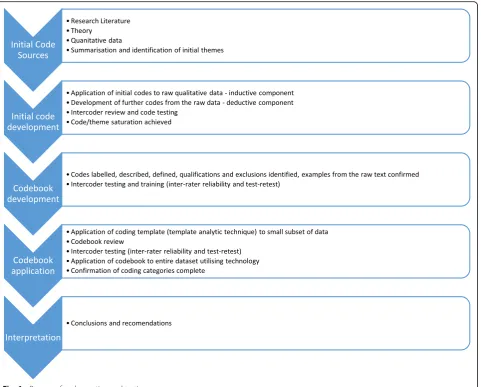
Muir-Cochrane which included the development and de-scription of an analytical codebook [7]. (See Fig. 1 for the process followed in the coding process) The deduct-ive component involved the creation of a preliminary codebook to help guide the analysis. This was based on the research question being asked, the initial analysis of the literature, the quantitative survey undertaken as part of the project and a preliminary scan of the raw inter-view data [8]. Additionally, the inductive approach followed the creation of the codebook. This allowed for any unexpected themes to develop during the coding process [9]. Deductive approaches are based on the as-sumption that there are ‘laws’or principles that can be applied to the phenomenon. Insight was thus derived from the application of the deductive model to the set of information and searching for consistencies and anomal-ies. Conversely, inductive approaches searched for pat-terns from the ‘facts’ or raw data [9]. This allowed for any unexpected themes with the potential to provide further useful analysis of the data to develop during the coding process. Combining these approaches allowed the development of patterns from the unknown parts that may fall outside the predictive codes of deductive reasoning and allowed for a more complete analysis.
This combined inductive/deductive approach fits well with both a mixed methods style of methodology and a pragmatic epistemology underpinning, whereby the methods are chosen by the researcher to be best able to answer the research questions. A critical realism onto-logical approach also meant that while the deductive ap-proach provided an initial sound grounding, the creator of the codebook needed to include an inductive process to allow the reality of others to be clearly represented in the data analysis.
description of the coding and reliability testing used in this analysis will assist replication and will support re-searchers and doctoral students hoping to demonstrate rigour in similar studies.
This case study was a project investigating the devel-opment of effective communication and collaboration tools between acupuncturists and general practitioners (GPs). A GP (sometimes known as a family doctor or family practice physician) is a medical physician whose practice is not orientated to a specific medical speciality but covers a variety of medical problems in patients of all ages [10]. The rationale for this project was the fact that the landscape for patient treatment is changing, and rather than rely solely on their GP’s advice, patients are making their own decisions about choice of treatment. Increasing numbers of patients are using complementary and alternative medicine (CAM) either as an adjunct, or as an alternative to standard mainstream care [11].
There are multiple reasons for the increase in CAM use cited in the literature including dissatisfaction with the biomedical model, increased perceived efficacy of CAM and an increase in training and practice of CAM therapies including biomedical appropriation of CAM skills [12]. Increasingly patients believe a combined ap-proach of CAM and conventional medicine is better than either on its own, and more and more patients have the desire to discuss CAM with well-informed GPs [13].
Patient’s extensive use of CAM has the potential to im-pact doctor-patient communication. Even with the in-crease in CAM use and a desire to discuss this, up to 77% of patients do not disclose their CAM use to their general practitioners, and GPs tend to underestimate patients use of CAM and may not ask about it [14]. When CAM is dis-cussed, GPs are being asked about the safety and effective-ness of CAM either on its own or as an adjunct, and additionally many patients have an expectation that their
GP will be able to discuss and/or refer to a CAM practi-tioner [15].
Communication gaps identified in both the research and evidenced in clinical practice formed the basis of this research questions. The specific questions asked were:
1. What is the current communication and collaboration between general practitioners and acupuncturists or CAM?
2. What are the barriers to communication between General Practice and Acupuncture or CAM? 3. How can communication be improved between
General Practice and Acupuncture or CAM? 4. Does communication and collaboration differ in the
landscape of mental health? And if so, why?
Methods
The mixed methods project utilised both survey and interview techniques to extrapolate data from the two participant groups (acupuncturists and general practi-tioners). The research aimed to evaluate and define current practice in order to develop effective strategies to connect the two groups. The tools and strategies allow clinical utility and transferability to other similar clinical groups. Ethics approval for this study was ob-tained from the The University of Otago Ethics
Commit-tee, and additionally the Ngai Tahu Research
Consultation Committee approved the research and con-sidered it of importance to Maori health.
The case study example within this article was part of a mixed method project which contained a qualitative ap-proach to interpreting interview data using thematic ana-lysis. It is the analysis of the qualitative component of this study that forms the basis of the discussion contained here-with. These types of qualitative analyses posit that reality consists of people’s subjective experiences or interpretations of the world. Therefore, there is no singular correct path-way to knowledge. This mode of analysis suggests a path-way to understand meaning or try to make sense out of textual data which may be somewhat unclear. Knowledge is de-rived from the field through a semi-structured examination of the phenomenon being explored. Thus there is no ob-jective knowledge which is independent of thinking [16].
The case example utilised a codebook as part of the thematic analysis. A codebook is a tool to assist analysis of large qualitative data sets. It defines codes and themes by giving detailed descriptions and restrictions on what can be included within a code, and provides concrete ex-amples of each code. A code is often a word or short phrase that symbolically assigns a summative, salient, essence-capturing, or attribute for a portion of data [17]. The use of a codebook was deemed appropriate to allow for the testing of interpretations of the data, and to allow for demonstration of rigour within the project.
Study population
The study population consisted of GPs in current prac-tice registered with the Royal New Zealand College of General Practitioners, and Acupuncturists in current practice registered with either the New Zealand Register of Acupuncturists or the New Zealand Acupuncture Standards Authority. Written informed consent was ob-tained from all participants.
Sample size
The recommendation for sampling size when investigating the phenomena surrounding experience is six participants [18]. However Guest suggests that thematic saturation is more likely to occur with a sample of twelve [19]. There-fore a group of 27 (14 GPs and 13 acupuncturists) were invited to participate in the semi structured interviews.
Maximum variation purposeful sampling was used for participant recruitment to allow for the exploration of the common and unique manifestations of the target phenomenon and demographically varied cases [20]. Demographic norms were mirrored where possible in the sampling technique with regard to sex, age, ethnicity and type and location of practice. This type of sampling is non-random and is based on the researcher’s
view-point that the participants selected will provide
insightful and penetrating information regarding the re-search question. Participants initially self-selected by in-dicating a willingness to be interviewed during the survey phase of this project, and further participants were targeted to meet demographic subsets.
Rationale of choice of methods
Semi-structured interviews, utilised in this case study, draw on aspects of descriptive research which allow a comprehensive summary of events in everyday terms, and allow for in-depth exploration of a specific phenomenon. The aim is to understand phenomena through meanings that people assign to them [21]. Through the ability to investigate this descriptive data, new perspectives, concepts and themes may be uncov-ered. During analysis researchers stay close to the data and there is no ability to prove causal effects. Although the inquiry may be value-bound, the researcher aims through the adoption of their ontological and epistemo-logical lens to identify a range of beliefs without introdu-cing bias from their own world view.
Developing the codebook and stages of data coding and testing
The development, use and testing of codebooks is not often reported in qualitative research reports, and rarely in enough detail for replication of the process. The decision to use and test a codebook was important in the demonstra-tion of rigour in this project, as it allowed a clear trail of evidence for the validity of the study and also allowed ease of inter-rater reliability testing of the data. The combination of the inductive/deductive approach described earlier to codebook development meant that the codebook, in this instance, was deduced a priori from the initial search of the literature, the quantitative survey and the initial read of the raw interview data. The preliminary codebook underwent many iterations through the inductive process before the final version was agreed upon by the researchers. (The process of the codebook development is represented in Fig. 1). The utilisation of a codebook allowed a more refined, fo-cused and efficient analysis of the raw data in subsequent reads [8]. The testing of reliability of codes was complex in the context of qualitative research as it could be seen as borrowing a concept from quantitative research and apply-ing it to qualitative research. Yet when adoptapply-ing the critical realist lens, it is acknowledged that interpretation would be difficult to infer to a wider group without establishing some line of reliability between testers. As this project was aimed directly at practical utility of its findings, the testing ap-proach seemed appropriate.
Results
Summarising the data and identifying initial themes
Following the literature review and suggestion of themes for inclusion in the early codebook a priori, the first read of a sample of the raw data was undertaken. The first read of the data involved highlighting text or ‘codable’ units that the researcher considered may become a‘ cod-able’moment. Comments were inserted into the margins with initial thoughts and ideas.
This was then done again using the literature informed codes as a guide to determine whether more codable units fitted within the early codebook, or whether further codes needed to be added to the analytical framework.
Examples of each theme, subtheme and code contin-ued to be reviewed and moved until agreement between the coders as to what determined sufficient demonstra-tion of a true representademonstra-tion of a theme became evident. This involved reading and re reading the subset of tran-scripts multiple times until theme saturation was achieved. Reoccurring themes were identified, but not necessarily given credence over stand out single com-ments that really embodied a theme.
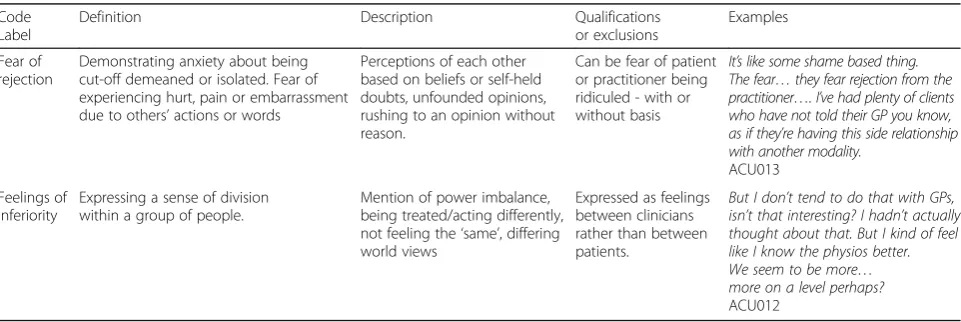
Codes were written following the guidelines of Boyatzis [9] and were classified with the following: label, definition, description, qualifications or exclusions and examples from the raw data. An example of code labels from this research is outlined in Table1below.
Applying a template of codes and additional coding
Once the codebook was in a draft form it was applied to a larger data set. This was repeated in an iterative way using the early codebook as a guide to determine whether most codable units fitted within the code guide or whether further codes needed to be added to the ana-lytical framework. Once this was done multiple times with no new codes emerging the codebook was assumed as a valid representation of the data.
Utilising technology: connecting the codes and identifying themes
At this stage the raw data was then transferred into Nvivo software program [22] to allow for a systematic coding approach with the identified codes being added as nodes, and the coded text being matched to the nodes in a systematic way. This allowed for sorting, clustering and comparison of codes between and within subgroups.
Table 1Example of a code definition form the code book
Code Label
Definition Description Qualifications
or exclusions
Examples
Fear of rejection
Demonstrating anxiety about being cut-off demeaned or isolated. Fear of experiencing hurt, pain or embarrassment due to others’actions or words
Perceptions of each other based on beliefs or self-held doubts, unfounded opinions, rushing to an opinion without reason.
Can be fear of patient or practitioner being ridiculed - with or without basis
It’s like some shame based thing. The fear…they fear rejection from the practitioner…. I’ve had plenty of clients who have not told their GP you know, as if they’re having this side relationship with another modality.
ACU013
Feelings of inferiority
Expressing a sense of division within a group of people.
Mention of power imbalance, being treated/acting differently, not feeling the‘same’, differing world views
Expressed as feelings between clinicians rather than between patients.
But I don’t tend to do that with GPs, isn’t that interesting? I hadn’t actually thought about that. But I kind of feel like I know the physios better.
We seem to be more…
more on a level perhaps?
Corroborating and legitimating coded themes
Approaches used for codebook structure analysis were chunkinganddisplaying[8]. Chunking refers to examin-ing chunks of text that are interrelated and are used for analysis in relation to the research questions and hy-potheses. Displaying data is another technique for dis-covering connections using maps and matrices to contextualise relationships between categories and con-cepts. Both these approaches allowed for legitimising analysis and to assist in the process of interpretation.
Testing the reliability of the code
Although inter-rater code testing and discussion occurred throughout the codebook development stage, the final codebook continued to be tested for inter-rater reliability before the data reached the interpretation stage. Reliability can be described as the consistency of judgement that protects against or lessens the contamination of projection [9]. Reliability was tested in this project in two ways:
1. Consistency of judgment over absence and presence (test-retest reliability); and
2. Consistency of judgement across various viewers (inter-rater reliability).
Both tests were checked for reliability using this for-mula suggested by Miles and Huberman [23]:
Reliability¼number of agreements=number of agreements þdisagreements
This calculation is a much cruder tool than Choen’s kappa, but gives a simple measure of agreement as a
percentage value and is able to be applied to small data sets with a high number of variables. As a rule of thumb, the minimum percentage to demonstrate adequate levels of agreement is 75% [17]. Less than this indicates an in-adequate level of agreement.
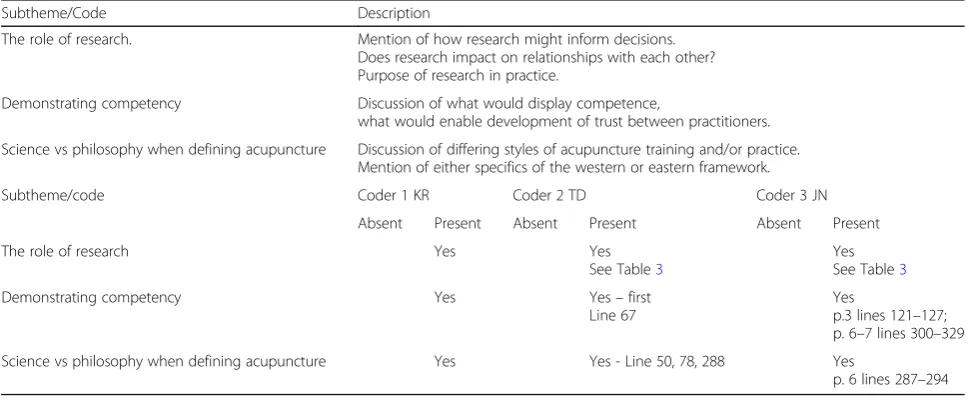
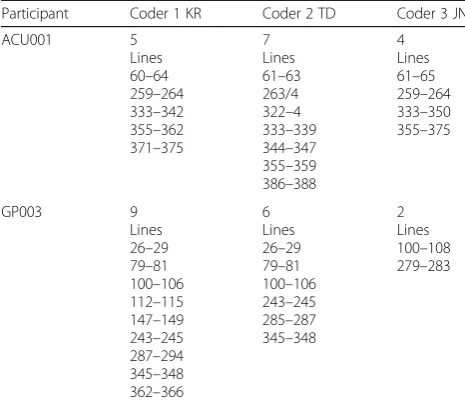
Inter-rater reliability was tested initially using nominal comparisons of absence or presence of a set of themes and frequency of observation of a single theme (see Table 2). This detailed approach to testing of agreement between coders is not always carried out and/or reported whereas it is suggested here as a necessary step. This con-tinued to be tested, with disagreements being recorded, but minimal changes to the codebook were made at this stage unless it was deemed absolutely necessary as the codebook was now deemed to be in its final version. This was in keeping with the critical realism philosophy that states that various realities are possible, and the pragmatic approach which states that there is no one correct way to code a data set. When all coders were in agreement, these sections of data were determined to be key representations of the code. Where more than one, but not a unanimous agreement was made, this section of data would be dis-cussed between coders. When only one coder applied a section of data to a specific code, this was assumed not to be a clear representation of the code.
Examples of how reliability testing was undertaken can be found in Tables2 and3. Once inter-rater testing had been analysed the coding of the data set was seen as complete and key themes and codes were identified and formed the basis for the discussion in relation to the re-search questions posed. While absolute agreement was not reached, discussion of coding differences continued to inform the codebook development until all coders
Table 2Example of table used for absence/presence reliability
Subtheme/Code Description
The role of research. Mention of how research might inform decisions. Does research impact on relationships with each other? Purpose of research in practice.
Demonstrating competency Discussion of what would display competence,
what would enable development of trust between practitioners.
Science vs philosophy when defining acupuncture Discussion of differing styles of acupuncture training and/or practice. Mention of either specifics of the western or eastern framework.
Subtheme/code Coder 1 KR Coder 2 TD Coder 3 JN
Absent Present Absent Present Absent Present
The role of research Yes Yes
See Table3
Yes See Table3
Demonstrating competency Yes Yes–first
Line 67
Yes
p.3 lines 121–127; p. 6–7 lines 300–329
Science vs philosophy when defining acupuncture Yes Yes - Line 50, 78, 288 Yes
p. 6 lines 287–294
Reliability = 6/6 + 0 = 1 High agreement
agreed that the results were reflective of the data. Of interest here, is that even with this detailed and reflexive process undertaken, the final inter-rater calculations still fell below adequate rates of agreement. However, this clear transparency of the process informed the interpre-tations and from this, conclusions and recommendations were drawn in relation to the research.
Discussion
Limitations of this method
A key limitation of codebook development is the extensive time required to establish the codebook itself and to train coders in the use of the codebook. Utilisation of a code-book often requires many revisions and iterations during the code development process before coder agreement can be reached. Even then, and as demonstrated by this project, full inter-coder reliability is unlikely to be achieved. Additionally, application of statistical testing, such as kappa coefficients, would require large volumes of data and analysis is unlikely to be undertaken within most qualitative projects. As was the case with this project, as the code number increases the percentage of agreement decreases during calculation. It is therefore unclear whether this form of analysis would reach a different end point to that of other forms of content analysis. To effect-ively establish this, a comparison of analysis of the same data using different techniques is recommended for future research projects. However, clear guidelines of qualitative
methodological processes will strengthen interpretability and applicability of results.
There are also considerable limitations to the utilisation of the percentage agreement calculation of coders. Fre-quently one category or code is clearer than others. Thus there is likely to be considerable agreement between the two coders about data in this category. Another problem is that the procedure does not take into account that they are expected to agree solely by chance. A correction for this problem is to use a Kappa statistic to measure the agreement between coders. However, as previously men-tioned, the more variables and the larger the data set the more problematic this calculation becomes.
Projection is another limitation of this thematic analysis approach. The stronger a researcher’s ideology the more tempted they will be to project. Projection can be reduced through the development of an explicit code and enabling consistency of judgement through inter-rater reliability. It is also necessary to remain close to the raw information during the development of themes and codes [9]. How-ever, due to the likelihood of different ideologies of coders, it is likely that this will have an impact of the ability to achieve adequate reliability.
Another limitation in thematic analysis can be sam-pling and the limited scope provided through the use of convenience sampling. In this study the random sample accessed for the quantitative survey did not yield enough voluntary participants for the in-depth interviews hence the sampling framework was modified to purposive con-venience sampling. Demographic data was collected to allow for comparison to the larger sample of survey par-ticipants and also to the census and workforce survey data carried out nationwide [24,25]. These demographic comparisons need to be explicitly transparent. In this type of study, the sampling will need to always be a con-venience sample. This is because a true random sample is unlikely to be feasible as it is necessary for the inter-viewee to be willing to participate and this usually in-volves an interest in the subject or in research itself. This may give a somewhat skewed view within the re-sults which must be taken into account in the analysis.
Conclusions
This article has provided a detailed and honest account of the difficulties in demonstrating rigour in thematic analysis of qualitative data. However, the researchers in-volved in this project found the development and utilisa-tion of a codebook, and the applicautilisa-tion by a team of researchers of the codebook to the data to be advanta-geous albeit time consuming. It was thought that the codebook improved the potential for inter-coder agree-ment and reliability testing and ensured an accurate de-scription of analyses. The approach was consistent with the ontological and epistemological framework which Table 3Example of table used for inter-rater reliability
Participant Coder 1 KR Coder 2 TD Coder 3 JN
ACU001 5
Lines 60–64 259–264 333–342 355–362 371–375
7 Lines 61–63 263/4 322–4 333–339 344–347 355–359 386–388
4 Lines 61–65 259–264 333–350 355–375
GP003 9
Lines 26–29 79–81 100–106 112–115 147–149 243–245 287–294 345–348 362–366
6 Lines 26–29 79–81 100–106 243–245 285–287 345–348
2 Lines 100–108 279–283
Reliability = 23/23 + 10 = .7–Inadequate agreement reached
Testing frequency of observation of theme‘research versus relationships’ –
informed the study and allowed the unique perspectives highlighted whilst maintaining integrity of analysis. Whilst the creation of the codebook was time intensive, there is the assurance of a demonstration of rigour and reliability within the process. This article has outlined the steps involved in the process of thematic analysis used in this project and helps to describe the rigour demonstrated within the qualitative component of this mixed methods study. This article does not attempt to present an analysis of the data in relation to the research question, but rather provides a clear description of the process undertaken in a qualitative data analysis frame-work. This article explains and explores the use of Fere-day and Muir-Cochranes’ hybrid approach to analysis which combines deductive and inductive coding whilst embedding it in a differing philosophical standpoint [7]. The clear description of the coding and reliability testing processes used in this analysis can be replicated and will support researchers wishing to demonstrate rigour in similar studies. We recommend that others embarking on qualitative analysis as a team embrace and enhance the concept of codebook development to guide complex analytical processes.
Abbreviations
CAM:Complementary and alternative medicine; GP: General practitioner
Acknowledgements Not applicable.
Funding
no funding received as part of this study.
Availability of data and materials
The datasets used and/or analysed during the current study are available from the corresponding author on reasonable request.
Authors’contributions
Conception or design of the work KR, TD, JN. Data collection KR. Data analysis and interpretation KR Drafting the article KR. Critical revision of the article KR, TD, JN. Final approval of the version to be published KR, TD, JN.
Ethics approval and consent to participate
The University of Otago Ethics Committee approved the survey and interviews for this study, and additionally the Ngai Tahu Research Consultation Committee approved the research and considered it of importance to Maori health.
Consent for publication Not applicable.
Competing interests
The authors declare that they have no competing interests.
Publisher’s Note
Springer Nature remains neutral with regard to jurisdictional claims in published maps and institutional affiliations.
Author details
1
Department of Primary Health Care & General Practice, University of Otago, Wellington, New Zealand.2Department of Primary Health Care & General Practice, University of Otago, Wellington, New Zealand.3Bioethics Centre, University of Otago, Dunedin, New Zealand.
Received: 27 August 2018 Accepted: 11 March 2019
References
1. Tashakkori A, Teddlie C, editors. Sage handbook of mixed methods in Social & Behavioral Research. 2nd ed: SAGE publications; 2010.
2. Decuir-Gunby JT, Marshall PL, Mcculloch AW. Developing and using a codebook for the analysis of interview data: an example from a professional development research project. Field methods. 2011;23:136–55.https://doi. org/10.1177/1525822X10388468.
3. Fonteyn ME, Vettese M, Lancaster DR, Bauer-Wu S. Developing a codebook to guide content analysis of expressive writing transcripts. Appl Nurs Res. 2008;21:165–8.https://doi.org/10.1016/j.apnr.2006.08.005.
4. Long T, Johnson M. Rigour, reliability and validity in qualitative research. Clin Eff Nurs. 2000;4:30–7.https://doi.org/10.1054/cein.2000.0106. 5. Porter S, Dipn BP. Validity, trustworthiness and rigour: reasserting realism in
qualitative research. J Adv Nurs. 2007;60:79–86.https://doi.org/10.1111/j. 1365-2648.2007.04360.x.
6. Seale C. The quality of qualitative research; 1999.https://doi.org/10.4135/ 9780857020093.
7. Fereday J, Muir-Cochrane E. Demonstrating rigor using thematic analysis: a hybrid approach of inductive and deductive coding and theme development. Int J Qual Methods. 2006;5:80–92.
8. Crabtree BF, Miller WL (William L. Doing qualitative research. Sage Publications; 1999.
9. Boyatzis RE. Transforming qualitative information : thematic analysis and code development. Thousand oaks CA: SAGE Publications; 1998.
10. general practitioner. (n.d.). Medical Dictionary for the Health Professions and Nursing. 2012.https://medical-dictionary.thefreedictionary.com/general +practitioner. Accessed 13 Jan 2019.
11. Harris PE, Cooper KL, Relton C, Thomas KJ. Prevalence of complementary and alternative medicine (CAM) use by the general population: a systematic review and update. Int J Clin Pract. 2012;66:924–39.
12. Hollenberg D. Uncharted ground: patterns of professional interaction among complementary/alternative and biomedical practitioners in integrative health care settings. Soc Sci Med. 2006;62:731–44.https://doi. org/10.1016/j.socscimed.2005.06.030.
13. Jong MC, van de Vijver L, Busch M, Fritsma J, Seldenrijk R. Integration of complementary and alternative medicine in primary care: what do patients want? Patient Educ Couns. 2012;89:417–22.https://doi.org/10.1016/j.pec. 2012.08.013.
14. Ben-Arye E, Frenkel M. Referring to complementary and alternative medicine--a possible tool for implementation. Complement Ther Med. 2008; 16:325–30.https://doi.org/10.1016/j.ctim.2008.02.008.
15. Roberts K, Nie JB, Dowell T. From knowing silence to curious engagement: the role of general practitioners to discuss and refer to complementary and alternative medicine. J Interprofessional Educ Pract. 2017;9:104–7. 16. Gephart R. Paradigms and Research Methods Researh Methods Forum.
Summer. 2012;4(1999):1–8.
17. Saldaña J. The coding manual for qualitative researchers. Thousand Oaks, CA: Sage Publications Ltd; 2009.
18. Morse JM. Determining sample size. Qual Health Res. 2000;10:3–5.https:// doi.org/10.1177/104973200129118183.
19. Guest G. How many interviews are enough?: an experiment with data saturation and variability. Field methods. 2006;18:59–82.https://doi.org/10. 1177/1525822X05279903.
20. Sandelowski M. Sample size in qualitative research. Res Nurs Health. 1995;18: 179–83.https://doi.org/10.1002/nur.4770180211.
21. Deetz S. Crossroads—describing differences in approaches to organization science: rethinking Burrell and Morgan and Their legacy. Organ Sci. 1996;7: 191–207.https://doi.org/10.1287/orsc.7.2.191.
22. QSR International Pty Ltd. NVivo qualitative data analysis software. 2015. 23. Miles MB, Huberman AM. Qualitative data analysis: an expanded
sourcebook. 2nd ed. Thousand Oaks: Sage Publications; 1994.
24. Statistics New Zealand. New Zealand Census of Population and Dwellings. 2013. 25. The Royal New Zealand College of General Practitioners. GP Workforce