R E S E A R C H A R T I C L E
Open Access
Improving the normalization of complex
interventions: part 2 - validation of the
NoMAD instrument for assessing
implementation work based on
normalization process theory (NPT)
Tracy L. Finch
1*, Melissa Girling
2, Carl R. May
3, Frances S. Mair
4, Elizabeth Murray
5, Shaun Treweek
6,
Elaine McColl
2, Ian Nicholas Steen
2, Clare Cook
7, Christopher R. Vernazza
8, Nicola Mackintosh
9, Samridh Sharma
8,
Gaery Barbery
10, Jimmy Steele
8and Tim Rapley
11Abstract
Introduction:Successful implementation and embedding of new health care practices relies on co-ordinated, collective behaviour of individuals working within the constraints of health care settings. Normalization Process Theory (NPT) provides a theory of implementation that emphasises collective action in explaining, and shaping, the embedding of new practices. To extend the practical utility of NPT for improving implementation success, an instrument (NoMAD) was developed and validated.
Methods:Descriptive analysis and psychometric testing of an instrument developed by the authors, through an iterative process that included item generation, consensus methods, item appraisal, and cognitive testing. A 46 item questionnaire was tested in 6 sites implementing health related interventions, using paper and online completion. Participants were staff directly involved in working with the interventions. Descriptive analysis and consensus methods were used to remove redundancy, reducing the final tool to 23 items. Data were subject to confirmatory factor analysis which sought to confirm the theoretical structure within the sample.
Results:We obtained 831 completed questionnaires, an average response rate of 39% (range: 22–77%). Full completion of items was 50% (n= 413). The confirmatory factor analysis showed the model achieved acceptable fit (CFI = 0.95, TLI = 0.93, RMSEA = 0.08, SRMR = 0.03). Construct validity of the four theoretical constructs of NPT was supported, and internal consistency (Cronbach’s alpha) were as follows: Coherence (4 items,α= 0.71); Collective Action (7 items,α= 0.78); Cognitive Participation (4 items,α= 0.81); Reflexive Monitoring (5 items,α= 0.65). The normalisation scale overall, was highly reliable (20 items,α= 0.89).
Conclusions:The NoMAD instrument has good face validity, construct validity and internal consistency, for assessing staff perceptions of factors relevant to embedding interventions that change their work practices. Uses in evaluating and guiding implementation are proposed.
Keywords:Normalization process theory, NPT, NoMAD, Implementation process, Questionnaire, Instrument development, Complex interventions
* Correspondence:[email protected]
1Department of Nursing, Midwifery and Health, Northumbria University,
Coach Lane, Newcastle-upon-Tyne NE7 7XA, UK
Full list of author information is available at the end of the article
© The Author(s). 2018Open AccessThis article is distributed under the terms of the Creative Commons Attribution 4.0
International License (http://creativecommons.org/licenses/by/4.0/), which permits unrestricted use, distribution, and
Introduction
Understanding implementation processes is key to ensuring that complex interventions in healthcare are taken up in practice and thus maximize intended benefits for service
provision and (ultimately) care to patients [1].
Normalization Process Theory (NPT) [2] provides a
frame-work for understanding how a new intervention becomes part of normal practice. This study aimed to develop and validate an adaptable survey instrument derived from NPT, to be used to improve the implementation of complex healthcare interventions within organisational settings.
We know already that innovations in healthcare are
themselves complex [3], and changing practice is
diffi-cult. There is a vast literature on implementation in this context and of the need for improvement in how change
is implemented [4,5], however the gap between research
evidence and practice remains wide [6, 7]. It is now
recognised that improved clinical and health outcomes for healthcare interventions are associated with success-ful implementation outcomes [1,8].
Advancements in the measurement of implementation activity have been made recently [9], particularly in rela-tion to the concept of organisarela-tional readiness [10–14].
Cook and colleagues [15, 16] have developed a set of
measures based on Greenhalgh et al’s model of
determi-nants of diffusion of service innovations [4]. A measure-ment model based on the Consolidated Framework for
Implementation Research (CFIR, [17]) has also been
of-fered, by Liang and colleagues [18]. Hodge and
col-leagues [19] have recently developed and tested an
implementation sustainability measure, and work is also progressing to test a measure of implementation climate
[13,20]. Although these measures show some
common-ality in the representation of a range of factors affecting implementation success, they differ in their methods of development, and in the extent to which they are based
on theoretical underpinnings [21]. Although these
ad-vances are promising, improvements in the development and testing of valid and reliable measures for assessing
implementation process and outcomes [22] are called
for and offer the potential to make important advances in implementation science [21].
This study extends Normalization Process Theory
(NPT) [2, 23] towards improving implementation
out-comes in the healthcare setting through the use of prac-tical tools to aid implementation ‘work’. NPT provides a framework for understanding how a new intervention be-comes part of normal practice, by emphasising the ways in which work must be reconfigured both individually and collectively by multiple stakeholders involved in the work of implementation. The potential for NPT to have far-reaching impact on academic and applied activity to improve the development of complex interventions that are well-placed to become effectively normalized in
practice is evident, as demonstrated by the increasing vol-ume of published research that has utilized NPT as a framework for evaluation studies. However, achieving this impact also requires more sophisticated (but simply ad-ministered) assessment measures to be developed, tested, and made available to user groups.
To date, few studies have developed quantitative approaches to using NPT (May et al., Review of NPT stud-ies, in preparation). The 16-statement interactive ‘toolkit’ developed in our previous work [24] (available atwww.nor
malizationprocess.org) is presented as a tool to guide
ser-vice planners, implementers and evaluators in thinking through their implementation problems. However, it is not developed as a research instrument, and nor was it vali-dated for purposes of measuring aspects of implementation activity over time and across settings, as is often the object-ive of structured assessment in implementation research.
The objectives of NoMAD were thus to: (1) develop a structured instrument for assessing activity related to the normalisation of complex interventions based on NPT, and (2) undertake initial psychometric testing of the instrument in terms of reliability and validity, across a sample of staff involved in the implementation of a range of interventions in different settings. We have re-ported the development methods and results in detail
previously [25]. In this paper, we present the methods
and results of the validation phase of the study, and the final NoMAD survey instrument. Guidance on applica-tion and adaptaapplica-tion of the instrument for different re-search and practice activities in provided.
Methods
A mixed methods approach was undertaken to develop, test and refine the NoMAD instrument using an itera-tive process. As the development methods are described in detail elsewhere [25], these will be briefly summarised here before detailing the methods used in the main sur-vey validation phase of the project. First, the theoretical foundations for this work are described.
Theoretical underpinning
NPT [2] is concerned with the generative processes that
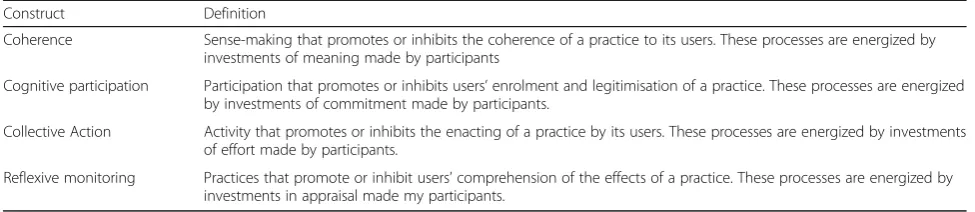
underpin three core problems: implementation (bringing a practice or practices into action); embedding (when a practice or practices may be routinely incorporated in everyday work of individuals and groups); and integra-tion (when a practice or practices are reproduced and sustained in the social matrices of an organization or in-stitution). There are four generative processes and asso-ciated investments (see Table1).
Item generation and instrument development
four constructs of NPT (coherence, cognitive participa-tion, collective action and reflexive monitoring). An itera-tive process of instrument development was undertaken using the following methods: theoretical elaboration, item generation and item reduction (team workshops); item ap-praisal (QAS-99); cognitive testing with complex interven-tion teams; theory re-validainterven-tion with NPT experts; and
pilot testing of instrument [25]. An overview of the
process is presented in Additional file1.
The NPT construct items utilised a 5 point scale of agreement for response (strongly agree; agree; neither agree nor disagree; disagree; strongly disagree) (Option
A response). A set of ‘not relevant’ response options
(not relevant to my role; not relevant at this stage; not
relevant to [name of intervention]), termed‘Option B
re-sponses’, were included following analysis of cognitive
interview data to reflect reasons why participants may be unable to provide a genuine response on the Option A response scale on some items. This was important for validation of the NoMAD tool, in understanding how participants respond to the items.
Three general ‘normalisation’ assessment items were
also developed, through a combination of review of exist-ing instruments, workshops, and consensus methods within the research team:
When you use [intervention],how familiardoes it
feel?
Do you feel that [intervention] iscurrentlya normal
part of your work?
Do you feel that [intervention]will becomea normal
part of your work?
These normalisation assessment items were rated on an 11 point scale (0–10, with appropriate descriptive an-chors at 0, 5 and 10). The items were added to the NPT construct items to comprise 46 items for a version of NoMAD that was tested in the main validation study.
NoMAD validation study
Study participants
We sought to recruit at least 300 participants for
reli-ability analysis [26]. A maximum variation approach to
sampling of implementation projects was undertaken, seeking diversity in terms of the kinds of interventions being implemented, implementation timelines, and the professionals involved in implementation activity. Inclu-sion of a site in the project was conditional on sufficient numbers of staff participants to merit a survey approach
(minimum ofn= 20), and access to participants through
an appropriate key contact within the site, who could support instrument administration. We sought a mini-mum of six implementation projects for inclusion.
Data collection
Participants in individual sites were identified and accessed through key contacts employed in the sites and invited to participate via email. At each site, instruments were administered either electronically (via SurveyMon-key Inc) or on paper, as advised by site contacts to allow
the best chance of maximizing response rates [27]. As
most data collection was conducted anonymously and using online methods, written consent was not deemed necessary for this study. As such, consent to participate was provided by individuals on choosing to complete the survey, as explained in the ethical committee approved participant information sheet explaining this procedure for consent, which accompanied all participation invita-tions. These procedures were approved by the Newcastle University Ethics Committee (Reference number 00555/ 2012; approval granted 1/09/2012). Site contacts worked with us to adapt the instrument appropriately to their intervention/setting, and issued invitations and re-minders of behalf of the NoMAD team. At each site, at least one reminder was issued to all invited participants, within 2 weeks of the initial invitation.
Instrument refinement
Exploratory analysis was conducted on the full dataset to inform the retention of items for psychometric test-ing. Firstly, patterns of item responding were explored through descriptive statistics and frequencies, including checks for floor/ceiling effects, and through correlations amongst the full set of items. These descriptive analyses were combined with consensus methods within the re-search team, to agree the items retained for the final
Table 1NPT Construct definitions
Construct Definition
Coherence Sense-making that promotes or inhibits the coherence of a practice to its users. These processes are energized by investments of meaning made by participants
Cognitive participation Participation that promotes or inhibits users’enrolment and legitimisation of a practice. These processes are energized by investments of commitment made by participants.
Collective Action Activity that promotes or inhibits the enacting of a practice by its users. These processes are energized by investments of effort made by participants.
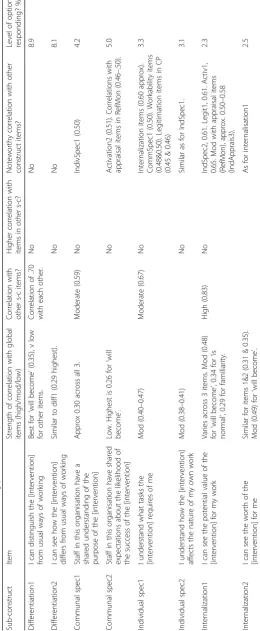
NoMAD instrument. Item retention was approached by considering each of the 16 sub-constructs as a set, aim-ing to retain at least one item per sub-construct. A sum-mary table was produced to include descriptive data for each item in terms of:
1. Relative strength of correlations with each other item within the sub-construct
2. Whether the item correlated more highly withother
sub-constructs within the main construct, than with items within its own sub-construct
3. Whether there were notable correlations between the item and items outside the main construct 4. The strength of correlation with the 3 general
normalisation assessment items, and
5. The level of‘not relevant’(option B) responding for the item
Table 2 provides an example for the construct of ‘
co-herence’. Two steps were undertaken towards team
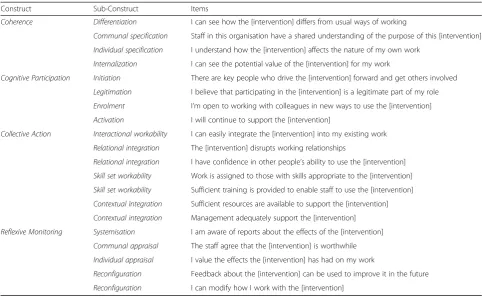
con-sensus regarding retention of items for the final NoMAD survey. Firstly, four team members (TF, TR, MG & CM) independently made item retention selec-tions on the basis of the summary data, with brief justifi-cations for selection and a rating of the difficulty of the decision (0–5, from ‘easy’ to ‘difficult’). Secondly, these judgements were collated and distributed to wider team members for discussion in a full team consensus meet-ing (to include also EM, FM, ST), where consensus was achieved on the final set of items to be retained. The de-cision difficulty ratings were used to prioritise the con-sensus discussions, maximising the input from the wider team. The full set of retained items categorised by the 16
NPT sub-construct domains [2] is presented in Table3.
Psychometric analysis
Psychometric analysis was conducted on the pooled data-set. Construct validity was explored through examination of the bivariate correlations between all possible pairs of construct items. We would expect items from the same construct to be more highly correlated with each other than with items measuring different constructs. Internal
consistency was assessed using Cronbach’s alpha. A value
of > = 0.7 is usually taken as indicative of adequate internal consistency.
Data were subject to confirmatory factor analysis (CFA) which sought to investigate if the theoretically derived model approximated to the data. Since variables were judged to be unidimensional, parcelling was undertaken in order to maximise reliability [28] communality [29] and the value of the fit statistics [30] and to transform the or-dinal data into a closer approximation to continuous data [31]. To create the parcels, the item-to-construct balance parcelling methodology was used [32].
Model fit was assessed by consulting the Tucker Lewis Index (TLI), Comparative Fit Index (CFI), Root Mean Square Error of Approximation (RMSEA) and the Stan-dardised Root Mean Square Residual (SRMR). The pri-mary aim was to achieve fit across all relevant indices. Specifically, we ideally sought a TLI and CFI of at least
0.90 and ideally 0.95 [33], an RMSEA below 0.07 [34]
and an SRMR below 0.08. However in line with Hu and
Bentler’s [35] guidelines a model acceptably
approxi-mates the data if a TLI or CFI of around 0.95 or an RMSEA up to around to 0.06 is observed alongside an
SRMR up to around 0.08 [35]. The confirmatory factor
analysis was undertaken withinMplus.
Ethics
Ethical approval for this study was granted by the Uni-versity of Newcastle Ethics Committee (Reference num-ber 00555/2012; approval granted 1/09/2012).
Results
Response
Six implementation projects contributed data for instru-ment validation, representing a variety of professional roles in relation to the interventions that were being im-plemented (for example, clinical, administrative, man-agerial, and other professionals in non-health contexts).
Across these interventions, a total of 831 surveys were submitted. An overall response rate cannot be calculated as the denominator cannot be determined for one site (S6). Excluding S6, the response rate is 35% (495/1423). A breakdown of response data by site is provided in Table4. Out of 831, 522 participants (63%) responded to one or more of the 43 NoMAD construct items, with 413 partici-pants (50% of total sample) responding to all items. Ex-cluding‘Option B’(‘not relevant’) responses, a total of 248 participants provided a likert scale (5 pt) response for all 43 construct items. Response rates were variable across items. Non-response at the individual item level ranged
from 0.6% (n= 3) to 12% (n= 61). Response rates to
op-tion A (item deemed relevant for a likert rating) ranged from 75% (n= 389) to 97% (n= 508) across items.
Participant characteristics
Information about participants’professional roles is pro-vided in Tables5and6.
Relationships amongst NPT constructs
expected pattern of relationships [available from authors on request].
Bivariate correlations between the NPT construct
mea-sures are shown in Table7revealing a moderate level of
correlation for summated scores within the construct domains. This suggests that Coherence and Cognitive Participation are the most highly correlated (r= .68), and
Reflexive Monitoring and Collective Action (r= .49) are
the two constructs that are least correlated.
Correlations between the construct measures scores and the overall normalisation score, with the general
as-sessment items are shown in Table 8. Correlations were
low to moderate. Of the three general assessment items, the construct measures appear to relate most strongly to perceptions that a new intervention will become a nor-mal part of work.
Factor structure
The NoMad items were entered into a CFA to repli-cate the theoretical model. This item level CFA was run using the Weighted Least Squares Means and Variances (WLSMV) estimator which was considered appropriate given that the data were technically
ordinal [36, 37]. The model showed reasonable fit
Table 3Retained items by NPT sub-construct domains
Construct Sub-Construct Items
Coherence Differentiation I can see how the [intervention] differs from usual ways of working
Communal specification Staff in this organisation have a shared understanding of the purpose of this [intervention]
Individual specification I understand how the [intervention] affects the nature of my own work
Internalization I can see the potential value of the [intervention] for my work
Cognitive Participation Initiation There are key people who drive the [intervention] forward and get others involved
Legitimation I believe that participating in the [intervention] is a legitimate part of my role
Enrolment I’m open to working with colleagues in new ways to use the [intervention]
Activation I will continue to support the [intervention]
Collective Action Interactional workability I can easily integrate the [intervention] into my existing work
Relational integration The [intervention] disrupts working relationships
Relational integration I have confidence in other people’s ability to use the [intervention]
Skill set workability Work is assigned to those with skills appropriate to the [intervention]
Skill set workability Sufficient training is provided to enable staff to use the [intervention]
Contextual Integration Sufficient resources are available to support the [intervention]
Contextual integration Management adequately support the [intervention]
Reflexive Monitoring Systemisation I am aware of reports about the effects of the [intervention]
Communal appraisal The staff agree that the [intervention] is worthwhile
Individual appraisal I value the effects the [intervention] has had on my work
Reconfiguration Feedback about the [intervention] can be used to improve it in the future
Reconfiguration I can modify how I work with the [intervention]
Table 4Response rates and item completion
Dataset Mode of administration Invited Responded RR
Total N/ Invited
Number of items completed Total completing 1–43 items 1–42 items All 43 items
S1: Digital Health Electronic + paper 231 67 29% 16 37 53
S2: Smoking cessation Paper 100 21 21% 3 18 21
S3: Patient self-management Electronic 400 91 23% 26 51 77
S4: Oral Health Risk Assessement
Paper with personal approach
Electronic (5th years)
297 229 77% 26 194 220
S5: System level IT Electronic 395 87 22% 14 53 67
S6: Sports programme Electronic–not targeted Unknown 336 Unknown 24 60 84
Total/ Overall >1423a 831 35%a 109 413 522
a
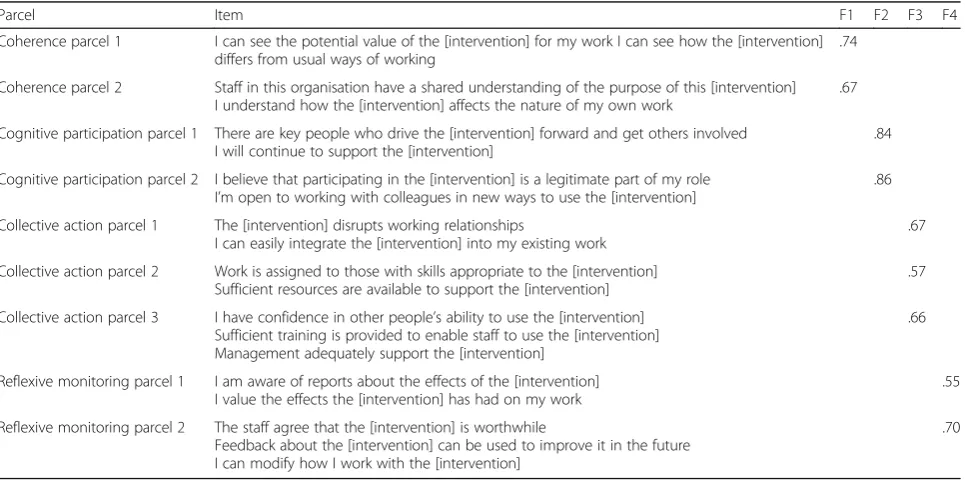
(CFI = 0.91, TLI = 0.90, RMSEA = 0.09). Based on the factor loadings, the items were parcelled using the
item-to-construct balance technique (see Table 9 for
parcel composition). The CFA was then rerun using the ML estimator since the parcelled data more closely approximated continuous data. The resultant model showed a level of fit (CFI = 0.93, TLI = 0.89, RMSEA = 0.11, SRMR = 0.05) just short of acceptable
[35]. The modification indices were therefore
con-sulted and on this basis two correlated errors were modelled. The resultant model achieved acceptable fit (CFI = 0.95, TLI = 0.93, RMSEA = 0.08, SRMR =
0.03). Table 9 presents the standardized factor
loadings.
Internal consistency of NPT construct subscales
Cronbach’s alpha was calculated for each of the four
NPT construct groupings. Coherence consists of four
items (α= 0.71); cognitive participation includes four
items (α= 0.81); collective action comprises seven items
(α= 0.78); and reflexive monitoring contains five items
(α= 0.65). The normalisation scale overall (comprising
items across all four constructs), was highly reliable (20
items, α= 0.89). Further information about item-total
statistics is available from the authors.
Discussion
This paper presents NoMAD as a theoretically derived instrument for assessing implementation processes from
Table 7Correlations between construct measures
Coherence Cognitive Participation Collective Action
Coherence 1
Cognitive Participation .68(n= 512) 1
Collective Action .55(n= 454) .54(n= 456) 1
Reflexive Monitoring .60(n= 427) .59(n= 428) .49(n= 423)
Pearson Correlation, all sig. (2 tailed) < .000
Table 6Site 4 Oral health risk assessment (Students and clinicians) descriptives
Site 4: Oral health risk assessment Student dentists (N= 189)
Site 4: Oral health risk assessment Clinicians (N= 31)
Year of study Professional Role
3rd Year 40 (77) Clinical Fellow 13 (4)
4th Year 41 (77) Senior lecturer 7 (2)
5th Year 20 (37) Professor 10 (3)
Associate Clinical Lecturer 55 (17)
Clinical Trainer 7 (2)
StR/SpR 7 (2)
Missing 3 (1)
Main role in relation to the intervention Main role in relation to the intervention
I oversee others delivering [risk assessment] scores
Yes: 84 (26) No: 3 (1) DA: 13 (4)
I directly deliver the [risk assessment] scores to patients
Yes: 94 (177) No: 6 (12)
I directly deliver [risk assessment] scores to patients
Yes: 42 (13) No: 42 (13) DA: 16 (5)
I use and deliver [risk assessment] scores in another setting
Yes: 6 (12 No: 74 (139) DA: 20 (38)
I use and deliver [risk assessment] scores in another setting
Yes: 23 (7) No: 58 (18) DA: 19 (6)
Years worked in the [Dental Hospital]
< 1 year 10 (3)
1–2 years 10 (3)
3–5 years 19 (6)
6–10 years 16 (5)
11–15 years 13 (4)
the perspective of individuals involved in implementa-tion activity. This further advances emerging work on
the measurement of implementation processes [20–22,
36–40], by offering a theory-based measurement tool
underpinned by Normalization Process Theory (NPT). To our knowledge, NoMAD represents the first sys-tematic development and validation of a structured as-sessment tool based on the theoretical constructs of
NPT [41]. NPT proposes that the embedding of new
practices requires participants involved in the process to engage in work across four construct domains of coher-ence, cognitive participation, collective action and reflex-ive monitoring. The Confirmatory Factor Analysis (CFA) of the items we retained using descriptive data and con-sensus methods, supported this proposed theoretical structure. Tests of internal consistency supported the
use of these items either as an overall measure of ‘
nor-malisation’ (20 items, α= 0.89), or as four construct
measures (ranging from α= 0.65–0.81). Except for
re-flexive monitoring, all constructs achieved the desired
threshold of≥0.07. Together with the moderate
correla-tions between the four construct measures, the data
supports the proposition that these are related but con-ceptually distinct domains within the theory. NoMAD has good face validity, and construct validity. NoMAD compares favourably against reviews of other implemen-tation and research utilization measures, which generally rate the psychometric properties of instruments as poor
to modest [22, 40], and show few (if any) measures to
meet the full range of psychometric criteria being assessed.
As a structured instrument, NoMAD offers scope to better understand the theoretical mechanisms of NPT by exploring, statistically, the relative importance of the NPT constructs in achieving sustained practice changes. NPT does not currently ascribe relative weightings to the importance of different construct domains for achieving the normalisation of a new practice, and the growing body of qualitative research framed by NPT
[42] would suggest that the importance of the construct
domains will vary according to the unique combination of intervention, context and human factors involved in the target practice change. A study by Jacobs and
col-leagues [20] to test a measure of Implementation
Table 8Correlations between construct measures and general assessment items
How familiar? Normal part of your work? Will it become normal?
Coherence .35(n= 448) .43(n= 447) .54(n= 443)
Cognitive Participation .25(n= 431) .30(n= 430) .47(n= 426)
Collective Action .41(n= 409) .48(n= 408) .45(n= 404)
Reflexive Monitoring .26(n= 388) .28(n= 387) .40(n= 383)
Normalisation score .41(n= 417) .48(n= 416) .58(n= 412)
Pearson Correlation, all sig. (2 tailed) < .0
Table 9Confirmatory Factor Analysis (CFA) Parcel composition & Standardised indicator loadings
Parcel Item F1 F2 F3 F4
Coherence parcel 1 I can see the potential value of the [intervention] for my work I can see how the [intervention] differs from usual ways of working
.74
Coherence parcel 2 Staff in this organisation have a shared understanding of the purpose of this [intervention] I understand how the [intervention] affects the nature of my own work
.67
Cognitive participation parcel 1 There are key people who drive the [intervention] forward and get others involved I will continue to support the [intervention]
.84
Cognitive participation parcel 2 I believe that participating in the [intervention] is a legitimate part of my role I’m open to working with colleagues in new ways to use the [intervention]
.86
Collective action parcel 1 The [intervention] disrupts working relationships
I can easily integrate the [intervention] into my existing work
.67
Collective action parcel 2 Work is assigned to those with skills appropriate to the [intervention] Sufficient resources are available to support the [intervention]
.57
Collective action parcel 3 I have confidence in other people’s ability to use the [intervention] Sufficient training is provided to enable staff to use the [intervention] Management adequately support the [intervention]
.66
Reflexive monitoring parcel 1 I am aware of reports about the effects of the [intervention] I value the effects the [intervention] has had on my work
.55
Reflexive monitoring parcel 2 The staff agree that the [intervention] is worthwhile
Feedback about the [intervention] can be used to improve it in the future I can modify how I work with the [intervention]
Climate [13] found that although a common factor structure was supported in different organisational set-tings that was consistent with the theoretical specifica-tion (subscales on whether use of an innovaspecifica-tion is
rewarded, supported or expected within their organisa-tion), the relevant strength of factor loadings of individ-ual items varied across the settings. In their study, the settings differed in the extent to which participants worked primarily independently versus collaboratively, in ways that made sense in relation to the relative
con-texts. They concluded that indeed ‘context matters’ in
measuring implementation climate, and argued that CFA models can still advance theory and knowledge of imple-mentation even if they cannot be reasonably expected to
fit other studies or contexts [20]. As authors of NoMAD,
we wish to see further validation of the instrument in different settings, but caution that interpretation of re-sults of different applications of NoMAD will need to be informed by understanding of important contextual fea-tures of the study context, often derived from qualitative work.
We suggest therefore that NoMAD should be viewed as a‘pragmatic measure’of implementation [43] and en-courage users to apply it flexibly to their implementation research and practice needs. Consistent with Glasgow and Riley’s [43] call for ‘pragmatic measures’ that bal-ance psychometric considerations against the require-ments of implementation in real life contexts, we believe that developing NoMAD with equal emphasis on (theor-etical) content and face validity, and respondent usability (through cognitive interviews) has resulted in a measure that meets their required criteria of being important to stakeholders, low burden to respondents, and actionable (in that it can point to problems that can be further in-vestigated or addressed in practice). Further, NoMAD also meets the recommended criteria of being broadly applicable (to a range of settings), unlikely to cause harm, related to theory, and psychometrically strong. A further required criterion of ‘sensitivity to change’(often termed ‘responsiveness’[39]) will be assessed in further validation work where multiple time point measures can be taken and compared. A review of implementation measures for community and public health settings found that all measures tested for responsiveness (7/51 measures reviewed), showed a minimum of moderate ef-fect size (criterion of 0.5), suggesting the capacity of such measures to be responsive to change.
In practical terms then, we offer NoMAD as an
adapt-able ‘bank of items’ that may be used flexibly by
re-searchers or implementers [Additional file 2]. We
anticipate that some will wish to use NoMAD as a complete instrument as presented here, with minimal adaptation besides adjustments for appropriate context-ualisation of the survey to the target practice change.
For these purposes, the validation data provided in this paper is important for the scientific endeavour of their work, as will other authors’validation studies be import-ant for further development of our work with NoMAD and with NPT. However in other applications of NoMAD, it may be that only certain items (or sets of items) may be relevant for use, and/or at particular stages of an implementation process. For example some items may be less useful in the very early stages of im-plementation, when no one has actually worked with the intervention or the intervention is not fully developed. The wording of the items may need to be altered, for ex-ample, for more anticipatory assessments. The extent to which the validation data reported in this paper can be expected to apply to future uses of NoMAD will there-fore vary with the level of adaption made to the items,
and will be a matter of the users’ own judgement. The
NPT website (http://www.normalizationprocess.org)
pro-vides advice for how NoMAD may be used and adapted, but this is merely guidance.
Consistent with this position, it is not possible to pre-scribe a formulaic process for scoring or combining items, or for the interpretation of the results that NoMAD generates, for all settings. In its simplest, most descriptive form, the underlying assumption of NoMAD is that more positive ratings by respondents of the im-plementation processes represented in each of the items are suggestive of higher potential for the practice to nor-malise. However this remains open to further assess-ment, and interpretation of results from the items used will always need to be undertaken in context. For
ex-ample, whether an intervention‘differs from usual ways
of working’ may be of benefit to the implementation
process in some contexts, but more problematic in others. For this reason, we present NoMAD as four sets of construct items, with reliability and validity data, and do not offer specific instructions for scoring or creating construct measures. Where assessments at the level of the construct are merited, items within the construct
may be averaged to create‘scores’that may be compared
amongst constructs, or between groups, or sites, if ap-propriate to the objective of the investigation.
Further validation of NoMAD is required to assess how the NoMAD constructs relate to measures that are both theoretically similar (convergent validity) and conceptually distinct (discriminant validity). Appropriate measures for these purposes were not available at the time NoMAD was being developed, but a diverse range of implementation success indicators are now rapidly emerging and subject to critical review [39]. Existing implementation measures vary greatly but include tools that emphasise behavioural
di-mensions (eg. Theoretical Domains Framework) [44–46],
constructs such as ‘implementation leadership’ [48]. It is likely that other measures more closely aligned with the focus of NPT will follow. Although defining and measuring concepts relating to implementation outcomes, or‘success’ still remains complex [22,49] due to the variety of theories and frameworks, studies that incorporate testing of sets of multiple measures will enhance our understanding of im-plementation process and outcomes. NoMAD should also be tested for criterion-related validity, to assess whether the construct measures are associated with implementation outcomes as proposed by NPT. These assessments can be undertaken in well designed longitudinal studies, that
in-clude robust implementation outcome measures [22]. We
are currently undertaking such work in a range of contexts,
including the ImpleMentAll study (http://www.implemen
tall.eu/), which will use measures including NoMAD
items,1 to assess the outcome of tailored implementation
interventions in various settings across eight countries. This study provides support for NoMAD as an adapt-able set of construct measures based on NPT. Key strengths include the underlying theoretical basis, and the iterative approach to item development and reten-tion that prioritised construct validity, and usability from the perspective of a range of professionals involved in implementing complex interventions, in healthcare and other settings (education and sport). Current limitations however include validation work that is not yet under-taken, in terms of test-retest reliability, and convergent, discriminant and criterion-related validity. NoMAD is also limited to the frame of reference that NPT itself
of-fers –a focus on the work that people undertake when
implementing changes in practice, from the perspective of those involved in this work. Like any theory, or de-rivative instrument, its application must be appropriate to its frame of focus. NPT asks us to observe and under-stand social action, at an individual and collective level. As a self-report measure of individual’s perceptions of these processes, a fuller understanding of the embedding of a practice in any given setting is likely to require a combin-ation of approaches that include quantitative and qualitative investigations. However, where larger scale implementation
studies aim to compare implementation progress across
multiple sitesinvolved in an implementation project, and/ or activityover time, NoMAD offers an appropriate tool to assess this. In some settings, NoMAD may be used as a diagnostic instrument, enabling data collection for local adaptation and improvement.
Conclusion
NoMAD provides a tool based on Normalization Process Theory (NPT), for the structured assessment of the work of implementation from the perspective of staff involved in implementing changes in practice. The key result of this study is the NoMAD instrument, along
with validation data concerning statistical properties and other information that can be used to guide the application of the measures across different settings and for different purposes (designing, monitoring, and for trouble-shooting interventions and their implementation). As such, NoMAD
should be viewed as a further tool in the NPT ‘toolkit’
(http://www.normalizationprocess.org), alongside the
inter-active 16 item tool [24] that was designed specifically for academic and non-academic users of NPT to think through
their implementation problems, more as a ‘sensitizing’
device than as a validated tool for measuring implementa-tion process and outcomes. We anticipate that although NoMAD is itself an important product of the study, the generation (and dissemination) of experience and know-ledge in the application of these measures to real problems of implementation of complex health interventions in diverse settings will be the key to improving the design and implementation of interventions that are ultimately intended to benefit recipients of health care services.
Endnotes 1
The factor structure of NoMAD items from an exist-ing dataset on e-mental health will be used to develop a version of NoMAD appropriate for the analysis of the ImpleMentAll study dataset.
Additional files
Additional file 1:Overview of instrument development process. Provides
process map of methods and data collected to develop and refine the NoMAD instrument. (DOCX 119 kb)
Additional file 2:Full NoMAD survey with adaptation guidance. Provides
a copy of the full NoMAD survey instrument with guidance for adaptation. (DOCX 187 kb)
Abbreviations
CFA:Confirmatory Factor Analysis; CFI: Comparative Fit Index; CFIR: Consolidated Framework for Implementation Research; NoMAD: Normalisation Measure Development (study name); NPT: Normalization Process Theory; QAS-99: Question Appraisal System; RMSEA: Root Mean Square Error of Approximation; SRMR: Standardised Root Mean Square Residual; TLI: Tucker Lewis Index
Acknowledgements
We wish to thank all who participated in completing questionnaires for the study. We wish to acknowledged the support of Claire Scally, Jane Banks, Hilary Hall, Aileen Mcvinish, and Janice Nichol, all of whom facilitated data collection in study sites; and Christiaan Vis and Jeroen Ruwaard for comments on early data analysis methods and results.
Funding
Availability of data and materials
The datasets generated and/or analysed during the current study are deposited on UK Datashare (record 852,387). Further information is available from the corresponding author on reasonable request.
Authors’contributions
TF led the design and conduct of the study with TR. TF, TR, MG, CM, FM, EM, ST, EMcC & INS contributed to study design and instrument development. TF, MG & TR coordinated survey data collection and interpretation of descriptive analysis. INS designed and conducted the primary analysis. CC designed and conducted the Confirmatory Factor Analysis. INS & CC guided data interpretation. CV, NM, SS, GB & JS undertook site specific survey adaptation, and data collection. CV & NM provided site-specific descriptive analysis and interpretation and critical comment on findings. TF, TR & MG drafted the manuscript, with comments from other authors. All authors read and approved the final manuscript.
Ethics approval and consent to participate
Participants provided consent by choosing to complete the survey. This process of providing consent was explained in the ethical committee approved participant information sheet that accompanied all participation invitations. As most data collection was conducted anonymously and using online methods, written consent was not deemed necessary or practical for this study. These procedures were approved by the Newcastle University Ethics Committee (Reference number 00555/2012; approval granted 1/09/ 2012).
Consent for publication Not applicable.
Competing interests
All authors declare that they have no competing interests.
Publisher’s Note
Springer Nature remains neutral with regard to jurisdictional claims in published maps and institutional affiliations.
Author details
1Department of Nursing, Midwifery and Health, Northumbria University,
Coach Lane, Newcastle-upon-Tyne NE7 7XA, UK.2Institute of Health & Society, Newcastle University, Baddiley-Clark Building, Richardson Road, Newcastle-upon-Tyne NE2 4AX, UK.3Faculty of Public Health and Policy,
London School of Hygiene and Tropical Medicine, 15-17 Tavistock Place, London WC1H 9SH, UK.4General Practice and Primary Care, Institute of Health and Wellbeing, University of Glasgow, 1 Horselethill Road, Glasgow G12 9LX, UK.5Research Department of Primary Care and Population Health,
University College London, Upper Floor 3, Royal Free Hospital, Rowland Hill Street, London NW3 2PF, UK.6Health Services Research Unit, University of Aberdeen, 3rd Floor, Health Sciences Building, Foresterhill, Aberdeen AB25 2ZD, UK.7School of Law and Business, University of Northumbria, City
Campus East 1, Newcastle upon Tyne NE1 8ST, UK.8Centre for Oral Health
Research, Newcastle University, Framlington Place, Newcastle upon Tyne NE2 4BW, UK.9Department of Health Sciences, College of Medicine, Biological
Sciences and Psychology, University of Leicester, Centre for Medicine, University Road, Leicester LE1 7RH, UK.10International Business and Asian
Studies, Griffith University, QLD, Gold Coast 4222, Australia.11Department of Social Work, Education and Community Wellbeing, Northumbria University, Coach Lane, Newcastle-upon-Tyne NE7 7XA, UK.
Received: 8 December 2017 Accepted: 29 October 2018
References
1. Durlak JA, DuPre EP. Implementation matters: a review of research on the influence of implementation on program outcomes and the factors affecting implementation. Am J Community Psychol. 2008;41(3):327. 2. May C, Finch T. Implementing, embedding, and integrating practices: an
outline of normalization process theory. Sociology. 2009;43(3):535–54. 3. Craig P, Dieppe P, Macintyre S, Michie S, Nazareth I, Petticrew M.
Developing and evaluating complex interventions: the new Medical Research Council guidance. BMJ. 2008;337:a1655.
4. Greenhalgh T, Robert G, Macfarlane F, Bate P, Kyriakidou O. Diffusion of innovations in service organizations: systematic review and
recommendations. Milbank Q. 2004;82(4):581–629.
5. Linton JD. Implementation research: state of the art and future directions. Technovation. 2002;22(2):65–79.
6. Lau R, Stevenson F, Ong BN, Dziedzic K, Treweek S, Eldridge S, Everitt H, Kennedy A, Qureshi N, Rogers A, et al. Achieving change in primary care—causes of the evidence to practice gap: systematic reviews of reviews. Implement Sci. 2016;11(1):1–39.
7. Grimshaw JM, Eccles MP, Lavis JN, Hill SJ, Squires JE. Knowledge translation of research findings. Implement Sci. 2012;7(1):50.
8. Proctor E, Silmere H, Raghavan R, Hovmand P, Aarons G, Bunger A, Griffey R, Hensley M. Outcomes for implementation research: conceptual distinctions, measurement challenges, and research agenda. Admin Pol Ment Health. 2011;38(2):65–76.
9. Rabin BA, Purcell P, Naveed S, Moser RP, Henton MD, Proctor EK, Brownson RC, Glasgow RE. Advancing the application, quality and harmonization of implementation science measures. Implement Sci. 2012;7(1):119. 10. Shea CM, Jacobs SR, Esserman DA, Bruce K, Weiner BJ. Organizational
readiness for implementing change: a psychometric assessment of a new measure. Implement Sci. 2014;9(1):7.
11. Weiner B. A theory of organizational readiness for change. Implement Sci. 2009;4:67.
12. Weiner BJ, Amick H, Lee S-YD. Review: conceptualization and measurement of organizational readiness for change: a review of the literature in health services research and other fields. Med Care Res Rev. 2008;65(4):379–436. 13. Weiner BJ, Belden CM, Bergmire DM, Johnston M. The meaning and
measurement of implementation climate. Implement Sci. 2011;6(1):78. 14. Gagnon M-P, Attieh R, Ghandour EK, Légaré F, Ouimet M, Estabrooks CA,
Grimshaw J. A systematic review of instruments to assess organizational readiness for knowledge translation in health care. PLoS One. 2014;9(12):e114338. 15. Cook JM, Dinnen S, Thompson R, Ruzek J, Coyne JC, Schnurr PP. A
quantitative test of an implementation framework in 38 VA residential PTSD programs. Adm Policy Ment Health Ment Health Serv Res. 2015;42(4):462–73. 16. Cook JM, O’Donnell C, Dinnen S, Coyne JC, Ruzek JI, Schnurr PP.
Measurement of a model of implementation for health care: toward a testable theory. Implement Sci. 2012;7(1):59.
17. Damschroder L, Aron D, Keith R, Kirsh S, Alexander J, Lowery J. Fostering implementation of health services research findings into practice: a consolidated framework for advancing implementation science. Implement Sci. 2009;4(1):50.
18. Liang S, Kegler M, Carvalho M, Fernandez M, Weiner B, Jacobs S, Williams R, Risendal B, Coombs L, Friedman D, et al. Measuring constructs from the consolidated framework for implementation research in the context of increasing colorectal cancer screening at community health centers. Implement Sci. 2015;10(1):A10.
19. Hodge LM, Turner KMT, Sanders MR, Filus A. Sustained implementation support scale: validation of a measure of program characteristics and workplace functioning for sustained program implementation. J Behav Health Serv Res. 2016;44(3):1–23.
20. Jacobs SR, Weiner BJ, Bunger AC. Context matters: measuring implementation climate among individuals and groups. Implement Sci. 2014;9(1):46.
21. Martinez RG, Lewis CC, Weiner BJ. Instrumentation issues in implementation science. Implement Sci. 2014;9(1):118.
22. Lewis CC, Fischer S, Weiner BJ, Stanick C, Kim M, Martinez RG. Outcomes for implementation science: an enhanced systematic review of instruments using evidence-based rating criteria. Implement Sci. 2015;10(1):155. 23. May C, Mair FS, Finch T, MacFarlane A, Dowrick C, Treweek S, Rapley T,
Ballini L, Ong BN, Rogers A, et al. Development of a theory of
implementation and integration: normalization process theory. Implement Sci. 2009;4:29.
24. May C, Finch T, Ballini L, MacFarlane A, Mair F, Murray E, Treweek S, Rapley T. Evaluating complex interventions and health technologies using normalization process theory: development of a simplified approach and web-enabled toolkit. BMC Health Serv Res. 2011;11(1):245.
25. Rapley T, Finch TL et al. Improving the normalization of complex interventions: part 1 - development of the NoMAD survey tool for assessing implementation work based on normalization process theory (NPT) Pending resubmission to BMC Medical Research Methodology in October 2018 2018.
26. Nunnally JC. Pyschometric Theory. 2nd ed. New York: McGraw-Hill; 1978. 27. Edwards PJ, Roberts I, Clarke MJ, DiGuiseppi C, Wentz R, Kwan I, Cooper R,
Felix LM, Pratap S. Methods to increase response to postal and electronic questionnaires. ochrane Database Syst Rev. 2009;(3). Art. No.: MR000008.
https://doi.org/10.1002/14651858.MR000008.pub4.
28. Kishton JM, Widaman KF. Unidimensional versus domain representative parceling of questionnaire items: an empirical example. Educ Psychol Meas. 1994;54:757–65.
29. Little TD, Cunningham WA, Shahar G, Widaman KF. To parcel or not to parcel: exploring the question and weighing the merits. Struct Equ Model. 2002;9:151–73.
30. Williams LJ, Holahan P. Parsimony based fit indices for multiple indicator models: do they work? Struct Equ Model Multidiscip J. 1994;2:161–89. 31. Bagozzi RP, Heatherton TF. A general approach to representing multifaceted
personality constructs: application to state self-esteem. Struct Equ Model. 1994;1:35–67.
32. Landis RS, Beal BJ, Tesluk PE. A comparison of approaches to forming composite measures in structural equation models. Organ Res Methods. 2000;3:186–207.
33. Bentler PM, Bonett DG. Significance tests and goodness-of-fit in the analysis of covariance structures. Psychol Bull. 1980;88:588–600.
34. Steiger JH. Understanding the limitations of global fit assessment in structural equation modeling. Personal Individ Differ. 2007;42:893–8. 35. Hu LT, Bentler PM. Cut-off criteria for fit indexes in covariance structure
analysis: conventional criteria versus new alternatives. Struct Equ Model. 1999;6:1–55.
36. Jamieson S. Likert scales: how to (ab)use them. Med Educ, 2004;38(12): 1217–18.
37. Wirth RJ, Edwards MC. Item factor analysis: Current approaches and future directions. Psychol Methods. 2007;12(1):58–79.
38. Rabin BA, Purcell P, Naveed S, Moser RP, Henton MD, Proctor EK. Advancing the application, quality and harmonization of implementation science measures. Implement Sci. 2012;7:119.
39. Clinton-McHarg T, Yoong SL, Tzelepis F, Regan T, Fielding A, Skelton E, Kingsland M, Ooi JY, Wolfenden L. Psychometric properties of implementation measures for public health and community settings and mapping of constructs against the consolidated framework for implementation research: a systematic review. Implement Sci. 2016;11(1):148. 40. Squires JE, Estabrooks CA, O'Rourke HM, Gustavsson P, Newburn-Cook CV,
Wallin L. A systematic review of the psychometric properties of self-report research utilization measures used in healthcare. Implement Sci. 2011;6(1):83. 41. Finch T, Rapley T, Girling M, Mair F, Murray E, Treweek S, McColl E, Steen I, May C. Improving the normalization of complex interventions: measure development based on normalization process theory (NoMAD): study protocol. Implement Sci. 2013;8(1):43.
42. McEvoy R, Ballini L, Maltoni S, O'Donnell C, Mair F, MacFarlane A. A qualitative systematic review of studies using the normalization process theory to research implementation processes. Implement Sci. 2014;9(1):2. 43. Glasgow RE, Riley WT. Pragmatic measures: what they are and why we
need them. Am J Prev Med. 2013;45(2):237–43.
44. Huijg JM, Gebhardt WA, Crone MR, Dusseldorp E, Presseau J. Discriminant content validity of a theoretical domains framework questionnaire for use in implementation research. Implement Sci. 2014;9:11.
45. Huijg JM, Gebhardt WA, Dusseldorp E, Verheijden MW, van der Zouwe N, Middelkoop BJC, Crone MR. Measuring determinants of implementation behavior: psychometric properties of a questionnaire based on the theoretical domains framework. Implement Sci. 2014;9(1):33.
46. Dyson J, Lawton R, Jackson C, Cheater F. Development of a theory-based instrument to identify barriers and levers to best hand hygiene practice among healthcare practitioners. Implement Sci. 2013;8(1):111.
47. Stamatakis KA, McQueen A, Filler C, Boland E, Dreisinger M, Brownson RC, Luke DA. Measurement properties of a novel survey to assess stages of organizational readiness for evidence-based interventions in community chronic disease prevention settings. Implement Sci. 2012;7(1):65. 48. Aarons GA, Ehrhart MG, Farahnak LR. The implementation leadership scale
(ILS): development of a brief measure of unit level implementation leadership. Implement Sci. 2014;9(1):45.