R E S E A R C H A R T I C L E
Open Access
Evolution of a unique predatory feeding
apparatus: functional anatomy, development and
a genetic locus for jaw laterality in Lake
Tanganyika scale-eating cichlids
Thomas A Stewart, R Craig Albertson
*Abstract
Background:While bilaterality is a defining characteristic of triploblastic animals, several assemblages have managed to break this symmetry in order to exploit the adaptive peaks garnered through the lateralization of behaviour or morphology. One striking example of an evolved asymmetry in vertebrates comes from a group of scale-eating cichlid fishes from Lake Tanganyika. Members of the Perissodini tribe of cichlid fishes have evolved dental and craniofacial asymmetries in order to more effectively remove scales from the left or right flanks of prey. Here we examine the evolution and development of craniofacial morphology and laterality among Lake
Tanganyika scale-eating cichlids.
Results:Using both geometric and traditional morphometric methods we found that the craniofacial evolution in the Perissodini involved discrete shifts in skeletal anatomy that reflect differences in habitat preference and predation strategies. Further, we show that the evolutionary history of the Perissodini is characterized by an accentuation of craniofacial laterality such that certain taxa show elaborate sided differences in craniofacial shape consistent with the sub-partitioning of function between sides of the head during attacks. Craniofacial laterality in the scale-eating specialistPerissodus microlepiswas found to be evident early in development and exhibited a unimodal distribution, which is contrary to the adult condition where jaw laterality has been described as a discrete, bimodal antisymmetry. Finally, using linkage and association analyses we identified a conserved locus for jaw handedness that segregates among East African cichlids.
Conclusions:We suggest that, during the evolution of the Perissodini, selection has accentuated a latent,
genetically determined handedness of the craniofacial skeleton, enabling the evolution of jaw asymmetries in order to increase predation success. Continued work on the developmental genetic basis of laterality in the Perissodini will facilitate a better understanding of the evolution of this unique group of fishes, as well as of left-right axis determination among vertebrates in general.
Background
Most multicellular animals exhibit one of two forms of symmetry: radial, in which multiple planes of symmetry can be drawn across an organism; or bilateral, where a single plane of symmetry, the sagittal plane, bisects an organism into mirrored halves [1]. Bilateral symmetry is a synapomorphy of the bilateria, a taxonomic group that
encompasses most animal phyla. Despite its utility as a diagnostic character, however, symmetry is not ubiqui-tous across all organ systems. For example, there is marked asymmetry in the patterning of the brain, heart and visceral organs in vertebrates and the genes that regulate the asymmetric morphogenesis of these
struc-tures (for example, nodal, lft1, pitx2) are well known
[2]. Likewise, a myriad of asymmetries have evolved in normally paired structures among various vertebrate lineages. Owls have evolved asymmetrical ears, which differ in size and placement on the skull, making them * Correspondence: [email protected]
Department of Biology, Syracuse University, 130 College Place, Syracuse, NY, 13244, USA
more effective auditory predators [3]. The eyes of flatfish migrate over the midline of the body during develop-ment and the oral jaws develop asymmetrically such that adults can lie on the benthic substrate and ambush prey [4]. Conspicuous craniofacial asymmetries are also evident in narwals [5], fruit bats [6] and a group of snail-eating snakes [7]. The prevalence of laterality in nature suggests that bilateral symmetry may, in fact, be more superficial than originally thought and, while much is known about the developmental genetic basis for normal asymmetric development of the visceral organs and brain, comparatively little is known about the genetic basis of laterality in normally paired structures.
Asymmetries are typically differentiated according to their causal origin and tend to be grouped into three classes. The first is fluctuating asymmetry, where the breaking of symmetry is a consequence of developmen-tal‘noise’and lacks a strict genetic basis. Asymmetries of this type are normally distributed around a mean symmetrical form [8]. The second type of asymmetry is antisymmetry, where the nature of the asymmetry (that is, which traits are affected) is genetically determined, but the side in which the trait manifests itself is pur-ported to be environmentally determined [9,10]. The random environmental determination of handedness results in an equal bimodal distribution on either side of a symmetrical mean [10]. The third category is direc-tional asymmetry, in which both the trait of interest and handedness are genetically determined. Directional asymmetries are found in populations as skewed unimo-dal distributions, with populations biased towards a par-ticular side. The evolution of directional asymmetries is thought to occur either directly from a symmetrical ancestor or as a progression from symmetry to antisym-metry to directional asymantisym-metry [9,11].
Scale-eating cichlids from Lake Tanganyika present a striking example of an evolved asymmetry in mouth direction. The Perissodini are a monophyletic cichlid tribe from Lake Tanganyika whose evolutionary history is marked by an ecological expansion from a deep-water generalized predator to shallow-water specialists that feed almost exclusively on scales (lepidophagy) [12].
Within the Perissodini, Perissodus species exhibit jaw
asymmetries that are dimorphic [13-18], with mixed populations of both‘lefty’individuals, that attack the left side of prey species with mouths angled off to the right, and‘righty’individuals, that correspondingly attack the right side with mouths bent to the left [19]. The nature of this asymmetry has been attributed to sided differ-ences in the length of the jaw joint (that is, the left-side is longer in lefty individuals) [15] but little more detail has been offered.
In P. microlepis lefty and righty morphs are main-tained through frequency-dependent selection, where the minority morph experiences a higher fitness than the majority morph as a consequence of a preferential prey avoidance of the more abundant morph [14]. The relative frequency of each morph fluctuates around a mean of 0.5 and the presence of both morphs appears to be an evolutionary stable state [14]. This system is a commonly cited example of antisymmetry, as jaw asym-metry is bimodal and there appears to be no species level bias in handedness [10]. Although the handedness of antisymmetric traits is generally assumed to be envir-onmentally determined, a genetic basis has been sug-gested for jaw laterality in P. microlepis[14,19], as well
as for the freshwater gobyRhinogobius flumineus [20]
and the herbivorous cichlidNeolamprologus moorii[19], suggesting widespread heritable laterality in mouth direction among Perciformes. Jaw laterality, therefore, does not appear to fit neatly into any one category of asymmetry [10]. The bimodal distribution of mouth direction in P. microlepispopulations is what would be expected for an antisymmetric trait [13]. However, a genetic basis for jaw handedness is more consistent with a directional asymmetry [10]. This apparent paradox has led to some debate in the literature concerning the cau-sal origin of this trait [10].
Here we explore the evolution of craniofacial mor-phology and laterality among scale-eating cichlids. Using geometric and traditional morphometric techniques, we show that the evolution of the Perissodini involved dis-crete shifts in craniofacial shape that are correlated with foraging habitat and that sided differences in craniofacial anatomy are evident in certain species that feed exclu-sively on scales, consistent with the lateralization of
feeding mechanics. In P. microlepis, we observe jaw
laterality early in development and identify a conserved locus segregating with craniofacial handedness in East African cichlids. Our data are consistent with the hypothesis that jaw laterality evolved in Tanganyikan scale-eaters due to selection on a conserved locus for handedness and that, as species became increasingly specialized to feed on scales, selection favoured an ela-boration of this asymmetry through the evolution of sided differences in jaw shape.
Results and discussion
Shifts in craniofacial anatomy correspond to different foraging niches
accounted for 24% of shape variation and reflected dif-ferences in the rotation of the mouth (Figure 2B). Hap-lotaxodon microlepis has a dramatically up-turned mouth and is significantly different from all other spe-cies along RW2 (Figure 1G). A second relative warp analysis was performed excludingH. microlepisin order to better resolve shape variation among species in the genusPerissodus(Figure 2C). As with the previous ana-lysis, RW1 (now 51%) described shifts in skull length but RW2 (17%) characterized differences in eye size (Figure 2C).
These shifts in anatomy correspond to differences in
foraging niche. H. microlepis is a member of the
Perissodini tribe, and is a sister taxon to the Perissodus genus (Figure 2A). The only symmetrical species among those analysed, it is a shallow water predator with large eyes and an up-turned mouth. Much of its diet is com-posed of small, pelagicMysisshrimps and juvenile fishes [12,21]. Mysisshrimps are extremely light sensitive and tend to be nocturnal [22,23]. Large eyes, similar to those of deep-water species, would facilitate predation on this food source.H. microlepisalso feeds on schools of juve-nile fish that occupy the upper few centimetres of the water column and it has been proposed that its up-turned mouth allows it to exploit this resource by stalk-ing and attackstalk-ing prey from below [21]. Among the
Figure 1Representative individuals of Perissodini species included in shape analyses. (A)Perissodus straeleni; (B)P. microlepis; (C)P. paradoxus; (D)P. elaviae; (E)P. multidentatus; (F)P. hecqui; (G)Haplotaxodon microlepis. Both the left and right sides of the head were
Perissodus species, scale-eating evolved from a more generalized predation strategy in deep water carnivores [12], a trend that is reflected in the large eye size of Perissodus species that still forage at depth (Figures 1 and 2). Among thePerissodusspecies that forage in the shallows, a divergence in skull length is observed (Figure 2). The sister taxa, P. microlepis andP. straeleni, lay at opposite ends of this axis and exhibit pronounced differ-ences in head length (Figure 2), which probably reflect differences in predatory behaviour [16]. The short skull length and deep body ofP. straeleniallows it to attack from short distances, relying on manoeuverability to capture prey, while the longer skulls and shallow bodies ofP. microlepis facilitate attacks from greater distances, employing speed to successfully capture prey [16]. These strategies represent alternate adaptations for lepi-dophagy in shallow water with high visibility [16]. Scale eaters exhibit sided differences in craniofacial shape Asymmetries in the length of the jaw joint and mouth orientation were noted for allPerissodusspecies, consis-tent with previous descriptions [13-15,17,18]. Subtle, but consistent, asymmetries were also observed for a variety of traits, including the thickness of the maxilla and pre-maxilla and curvature of the nasal bone, underscoring the complexity of this phenotype. We next wanted to
test whetherPerissodus species exhibited quantitative
asymmetries in craniofacial shape. Using relative warp
analysis to compare the ‘towards’ (facing prey) and
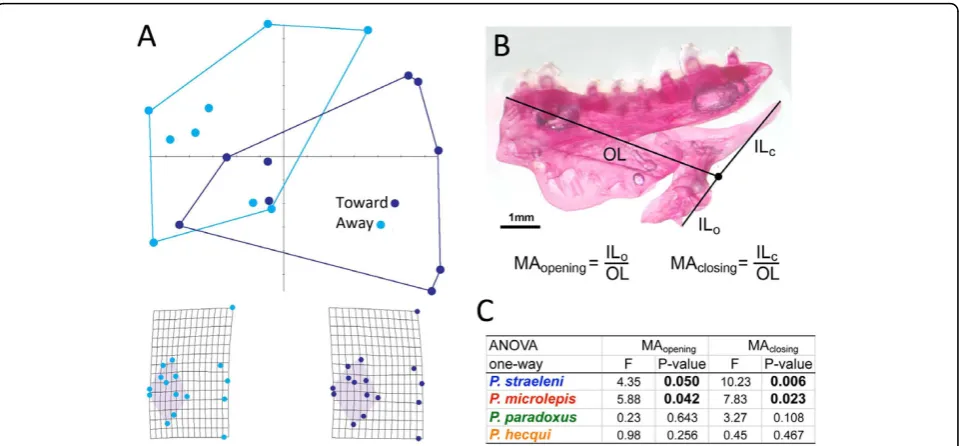
‘away’(opposite to prey) sides within species, we found that only P. straeleni, a shallow water scale-specialist, exhibited an asymmetry in overall head shape (Figure 3A). Sided differences in this species were characterized by variation in the length of the preorbital region of the skull (grids, Figure 3A). These data suggest an integra-tion of effects across broad regions of the head, with an overall elongation of the preorbital region of the skull noted for the side of the head facing prey during attacks.
Next, we tested whether Perissodusspecies exhibited
consistent asymmetries in specific functionally relevant characters of the jaw. In order to do this we modelled the mechanics of the lower jaw as a first order lever, where the fulcrum was taken as the jaw joint, the out-lever was measured as the distance between the fore-most tip of the jaw and the fulcrum, the opening in-lever was estimated as the distance from the tip of the retroarticular process of the lower jaw to the fulcrum and the closing in-lever was the distance from the end of the ascending arm of the lower jaw to the fulcrum [24] (Figure 3). From these lengths, mechanical advan-tage (MA) was calculated for jaw opening and closing as the ratio of in-lever to out-lever lengths, which can be used to estimate the relative speed and force of a lever [24]. A high MA is predictive of fish with powerful bites, while a low MA is predictive of fast, weaker bites
[25]. We found that bothP. straeleni andP. microlepis exhibited discrete sided differences in the MA of both the jaw opening and closing lever systems, predicting a lateralization in the speed and force of lower jaw rota-tion (Figure 3B and 3C). For both species, relatively lower MAs were estimated for the side of the fish that would be closest to the prey (toward the prey), consis-tent with a coordinated partitioning of force and speed between different sides of the jaw. No biases in MA
were detected in other Perissodusspecies, which
sug-gests that asymmetries have been elaborated in species adapted for shallow-water foraging strategies to include functionally significant sided differences in jaw shape. The exact nature and biological relevance of these func-tional asymmetries remain to be explored. One reason-able hypothesis is that, as the Perissodusforaging niche expanded from deep-water generalized predation to shallow-water specialization on scale-eating [12], selec-tion favoured modificaselec-tions of the feeding apparatus in order to increase foraging success, including the sub-partitioning of feeding mechanics between opposite sides of the jaw.
Jaw laterality is evident early in development and is not distributed as an antisymmetric trait
A brood of 141 larvalP. microlepis were collected from the mouth of a lefty female, and were staged to the late larval period [26]. Each animal retained a significant amount of yolk, indicating that they had not yet begun to feed for themselves, and the pharyngeal skeleton had
only just begun to mineralize. Nevertheless, conspicuous craniofacial asymmetries were observed in many of these larval samples (Figure 4A and 4B), consistent with a genetic basis for jaw handedness. Asymmetries were noted for jaw direction, hyoid length and curvature and pharyngeal jaw dentition. The degree of asymmetry var-ied widely among individuals and, while both lefty and righty individuals were clearly present, the distribution of jaw laterality was unimodal, suggesting that this text-book antisymmetric trait has a more complicated devel-opmental origin.
The distribution of larval jaw asymmetry was biased to the right-side (lefty). However, the family-level mean was not statistically different from zero (one-sample t-test,t = -0.87, P = 0.39) (Figure 4C). While a genetic basis for jaw laterality amongP. microlepis would make the most sense in the context of a directional asymme-try, it will require the analysis of additional individuals from multiple families to determine whether this early larval phenotype represents a fluctuating or directional asymmetry.
The observation of an early unimodal distribution of jaw asymmetry in scale eaters could provide a solution
to thePerissodus paradox. However, it would require a
population-level shift from a unimodal distribution in young fish to a discrete, bimodal antisymmetry in adults. Whether, and how, such a shift might occur would be a fruitful topic for future investigations. It is possible that the early asymmetry in jaw patterning could arise
through the co-option of the conserved asymmetric sig-nalling pathway used to define the left-right axis in ver-tebrates. Work on zebrafish has demonstrated that modulating distinct members of this signaling cassette not only disrupts normal asymmetric patterning, but also breaks symmetric patterning of paired structures, including the pharyngeal skeleton and somites [27-29]. Moreover, these mutational effects are of a directional (not fluctuating) nature, affecting one side of the body more often than the other, which suggests that they are
not the result of developmental noise. Once this unimo-dal asymmetry has been established in young fishes, the transition to antisymmetry could involve asymmetric growth and remodelling of the jaw [15], leading to a shift away from the mean and an accentuation of the tails of the distribution. Haploinsufficiency of zebrafish
fgf8 has been linked to asymmetric remodelling of the
craniofacial skeleton, offering a putative molecular mechanism for this phenomenon [28]. The lateralization of foraging behaviour might also influence the transition
to antisymmetry. Lateralizations in behaviour have been well studied in vertebrates and relationships between behavioural and morphological lateralization have been documented for many fish species. A behavioural later-ality in zebrafish swimming, for example, has been asso-ciated with sided differences in white and red muscle masses [30] and asymmetric foraging behaviours have been linked to mouth laterality in a number of species [13,14,20,31]. InP. microlepis, an early directional asym-metry might be accentuated and reinforced by latera-lized foraging behaviour and jaw plasticity through a positive feedback loop, wherein the behavioural asym-metry would lead to the asymmetric remodelling of the jaw (which would be most pronounced in near sym-metric larval fish). This would lead to a further func-tional lateralization and increased foraging success which, in turn, would reinforce the behavioural asym-metry, and so on. Finally, it is likely that selection has shaped the bimodal distribution of jaw handedness observed in adult P. microlepis. If symmetric, or nearly symmetric, fry were selected against and those with asymmetric jaws were selected for, this would lead to a population-level shift from a unimodal distribution in juveniles to a bimodal distribution in adults. In all likeli-hood, a confluence of factors underlie the development of jaw handedness in scale-eating cichlids, leaving many questions to be answered regarding (i) the genetic basis, (ii) ontogeny and (iii) plasticity of jaw laterality in the Perissodini.
Identification of a conserved locus for jaw handedness Previous studies have documented similar patterns of inheritance for jaw handedness in several groups of fishes [19,20] consistent with the hypothesis that cranio-facial laterality is regulated, at least in part, by an evolu-tionarily conserved locus. We reasoned that, if the evolution of craniofacial asymmetries in the Perissodini were the consequence of selection upon a latent and conserved locus for jaw handedness, it would also segre-gate in other East African cichlids. Taking advantage of a preexisting cross between two herbivorous Lake Malawi species, we looked for a genetic signature of handedness in different oral traits. Indices of asymmetry were generated for various jaw dimensions and we found significant variation in the index of asymmetry for the length of the retroarticular process of the lower jaw among F2hybrids. Handedness in this trait has been
used previously to describe jaw laterality in other cichlid species [19]. We next performed a mapping experiment using laterality (left versus right) as our trait of interest and found a narrow region on linkage group 10 that was significantly associated with handedness of the ret-roarticular process of the lower jaw: markers signifi-cantly associated with the direction of retroarticular asymmetry were GM294 and UNH2101 (Figure 5E).
In order to evaluate whether or not this locus
segre-gates with handedness in P. microlepis, larval samples
from a single family were typed as either lefty or righty and genotyped at both microsatellite loci. Only 93 (of 141) animals showed unambiguous jaw laterality. While individuals were invariant for GM294, they exhibited a size polymorphism for UNH2101. Two alleles where recovered from this family: ‘A’ - 150 bp, and‘B’- 158 bp. The mother was scored as heterozygous and, given that all three genotypic classes were recovered, we deduced that the sire was also heterozygous. Using three additional microsatellites, we found no evidence for multiple paternity. A departure from expected genotypic
frequencies was determined using aX2 goodness of fit
test for each morphotype and for the family as a whole. Association analysis showed a clear difference in genoty-pic frequencies among morphs with righties tending to be homozygous for the‘B’allele (X2 = 32.89, df = 2,P< 0.0001) and lefties exhibiting a disproportionate number
of heterozygous animals (X2 = 14.13, df = 2, P =
0.0009). These data are consistent with breeding experi-ments that have demonstrated dominance of the lefty allele over the righty [19]. Notably, we also observed a deficiency in the frequency of‘A’homozygous animals, which is also consistent with previously documented patterns of inheritance inP. microlepis, specifically, early lethality of animals homozygous for the dominant allele [14,19]. In fact, patterns of inheritance at UNH2101 were not different from what would be expected under
a model of a lefty (A/B) x lefty (A/B) cross with the
dominant allele being homozygous lethal (X2= 3.49, df
= 1,P = 0.062). The few A/A individuals in our family
appeared normal and were lefty or righty with equal frequency.
Conclusions
Figure 5Identification of a conserved locus for jaw laterality. A prominent feature of jaw laterality inPerissodus microlepisis a sided difference in the length of the retroarticular processes (ra) of the jaw (A, B). We found that a similar asymmetry segregates in the F2from an
those in Lake Tanganyika scale eaters [28]. Whilefgf8is not in the interval that segregates with jaw laterality in cichlids, it is still possible that it participates in the development of this trait as a member of a larger signal-ling network. Alternately, there could be several ways in which to lateralize the skull. Continued work in both laboratory models and natural populations should facili-tate a better understanding of the genes and signalling networks involved in the lateralization of the vertebrate body plan.
Methods
Morphometric analysis
Seven of the nine species in the Perissodini tribe were included in this analysis [Perissodus straeleni (n= 9), Perissodus microlepis(n = 9),Perissodus paradoxus(n= 5), Perissodus elaviae(n= 2),Perissodus multidentatus(n
= 2),Perissodus hecqui(n= 5) and Haplotaxodon
micro-lepis(n = 4)]. Given that many Perissodini species are rare, and that our morphometric method was somewhat destructive, we were only able to procure individuals from a subset of species. However, good phylogenetic coverage is obtained with these seven species (Figure 2A). Specimens came from the personal collection of RCA at Syracuse University, the University of Michigan at Ann Arbor, Cornell University and the Royal Museum for Central Africa in Belgium. The left and right sides of each specimen’s skull were dissected in order to remove skin and connective tissues, exposing a set of 16 landmarks, points that characterize the mechanics and geometry of the skull (Figure 1). Dis-sected specimens were photographed using an Olympus SP-570 and landmarks were digitized using the program tpsDig [32].
Lefty and righty individuals were grouped in this ana-lysis and tests of laterality focused on the differences between sides of the skull that would be facing (towards) or opposite (away) the prey. The sides of each
individual were characterized as either ‘towards’ or
‘away’ depending on whether, when photographed, the
specimen’s mouth was bending ‘towards’or‘away’from the camera. The mandibular symphysis for allPerissodus species was within 5° (or 4% of total head length) of the sagittal midline of the skull. The degree of error due to the bending out of the plan of focus of the camera should, therefore, be minimal. Using tpsRelw [33], RW analysis was performed as previously described [28] in order to identify major axes of shape variation among all samples. The set of landmarks and methods used to analyse the skull of Perissodini species were adapted from previously published work on damselfish craniofa-cial morphology [34].
MA was calculated for jaw opening and closing in four Perissodus species as the ratio of in-lever to out-lever
lengths [25]. In order to ensure the accurate planar orientation of the left and right sides of the jaw when photographed, we only used cleared and stained speci-mens for this analysis. Specispeci-mens of P. straeleni(n = 8), P. microlepis(n= 5),P. paradoxus(n= 6), and P. hecqui
(n = 4) were enzymatically cleared with trypsin and
bones were stained with Alizarin red using a method described by Potthoff [35]. These were the only species that we were able to obtain in sufficient numbers for this analysis but they provide good phylogenetic and ecological coverage (for example, deep- versus shallow-water predators) across the Perissodini. Photographs were taken of each side of the lower-jaw. Landmarks, pivot points and lever arms of the lower-jaw were placed using tpsDig [32] and MAs were calculated. Ana-lyses of variances were used to test for asymmetries in MAs within species.
LarvalP. microlepis
A brood of 141 P. microlepiswas collected from the
mouth of a wild-caught female and staged to the late larval period following [26]. The posterior half of each animal was taken for DNA isolation and genotypic ana-lysis, and the anterior half was cleared and stained according to the method described by Walker and Kim-mel [36] in order to visualize bone and cartilages. Skele-ton preparations were photographed in the dorsal and ventral views using a Zeiss Axiocam digital imaging sys-tem mounted to an M2 Bio stereomicroscope (Zeiss) and processed used Adobe Photoshop CS4.
Our method for quantifying asymmetric mouth direc-tion in these samples followed that of Hori et al.[19]. It involved measuring and comparing the angles formed by the lines between the left and right preorbital pro-cesses and from the preorbital propro-cesses to the symphy-sis of the upper jaw. A measure of laterality for each specimen was obtained by taking the difference between the left and right angles (L-R as in [19]).
Linkage analyses
A hybrid cross, that was originally generated in order to identify loci that segregate with jaw shape [37,38], was used to determine whether or not the handedness of the oral jaw is genetically determined in Lake
Malawi cichlids. The F2 mapping population (n= 173)
was generated by crossing two Lake Malawi cichlid
species, Labeotropheus fuelleborni and Metriaclima
Marker association analysis in wildP. microlepislarvae
Of the 141 P. microlepis larvae, 93 could be reliably
scored as either lefty or righty. A subset (n = 25) of
these animals was genotyped at microsatellite loci linked
to handedness. Primers were GM294F/R
GCTCGTCCTATCTTTAGAACA/AAACCAGCCCGC-TATT, and UNH2101F/R
CTGCAGGGT-CAAGTTTTCGT/GGCTGGGAGGAGAAAGAAAT. GM294 was found to be invariant but UNH2101 showed a size polymorphism. The remaining larvae were grouped by handedness and genotyped at UNH2101. AX2goodness of fit test was used to test for a departure from expected genotypic frequencies for each morphotype, and for the family as a whole.
Abbreviations
MA: mechanical advantage; RW: relative warp.
Acknowledgements
This work was supported by the Biology Department at Syracuse University, the Reneé Crown Honors Department and the McNair Undergraduate Post-Baccalaureate Achievement Program. We would like to thank J T Streelman and N Parnell for providing the most recent Malawi cichlid linkage map for use in this study. We would also like to thank S Renn and H Hofmann for providing the collection ofP. microlepisspecimens from the field. Finally, we thank four anonymous reviewers, as well as J T Streelman, T D Kocher, K A Parsons and W J Cooper, for reading and commenting on earlier drafts of this manuscript.
Authors’contributions
RCA designed the experiments. TAS performed the morphometric experiments. TAS and RCA performed the genetic mapping and association analysis. Both authors analysed and interpreted the results and wrote the manuscript.
Received: 15 September 2009
Accepted: 26 January 2010 Published: 26 January 2010
References
1. Carroll SB, Grenier JK, Weatherbee SD:From DNA to Diversity: Molecular Genetics and the Evolution of Animal Design.Malden: Blackwell Publishing, 2 2005.
2. Raya A, Belmonte JC:Left-right asymmetry in the vertebrate embryo: from early information to higher-level integration.Nat Rev Genet2006, 7(4):283-293.
3. Norberg RA:Occurrence and independent evolution of bilateral ear asymmetry in owls and the implications on owl taxonomy.Philosophical Transactions of the Royal Society of London1977,280(B):376-406. 4. Hubbs CL, Hubbs LC:Bilateral asymmetry and bilateral variation in fishes.
Papers from the Michigan Academy of Science, Arts and Letters1945, 30:229-311.
5. Ness AR:A measure of asymmetry of the skulls of odontocete whales.
Journal of Zoology, London1967,153:209-221.
6. Juste J, Ibanez C:An Asymmetric Dental Formula in a Mammal, the Sao-Tome Island Fruit BatMyonycteris brachycephala(Mammalia,
Megachiroptera).Canadian Journal of Zoology-Revue Canadienne De Zoologie1993,71(1):221-224.
7. Hoso M, Asami T, Hori M:Right-handed snakes: convergent evolution of asymmetry for functional specialization.Biology Letters2007,
3(2):169-U162.
8. Leary RF, Allendorf FW:Fluctuating Asymmetry as an Indicator of Stress -Implications for Conservation Biology.Trends in Ecology & Evolution1989, 4(7):214-217.
9. Palmer AR:From symmetry to asymmetry: phylogenetic patterns of asymmetry variation in animals and their evolutionary significance.Proc Natl Acad Sci USA1996,93(25):14279-14286.
10. Palmer AR:Antisymmetry.Variation: A central concept in biologyBurlington, MA: Elsevier IncHallgrimmson B, Hall BK 2005, 359-398.
11. Palmer AR:Symmetry breaking and the evolution of development.
Science2004,306(5697):828-833.
12. Takahashi R, Watanabe K, Nishida M, Hori M:Evolution of feeding specialization in Tanganyikan scale-eating cichlids: a molecular phylogenetic approach.BMC Evol Biol2007,7:195.
13. Hori M:Feeding relationships among cichlid fishes in Lake Tanganyika: effects of intra- and interspecific variation of feeding behavior on their coexistence.INTECOL Bulletin1991,19:89-102.
14. Hori M:Frequency-Dependent Natural Selection in the Handedness of Scale-Eating Cichlid Fish.Science1993,260(5105):216-219.
15. Liem KF, Stewart DJ:Evolution of scale-eating cichlid fishes of Lake Tanganyika: a generic revision with a description of a new species.
Bulletin for the Museum of Comparative Zoology1976,147(7):313-350. 16. Takahashi R, Moriqaki T, Hori M:Foraging behaviour and functional
morphology of two scale-eating cichlids from Lake Tanganyika.Journal of Fish Biology2007,70:1458-1469.
17. Takahashi S, Hori M:Unstable evolutionarily Stable Strategy and Oscillation - a Model of Lateral Asymmetry in Scale-Eating Cichlids.
American Naturalist1994,144(6):1001-1020.
18. Takahashi S, Hori M:Oscillation maintains polymorphisms - a model of lateral asymmetry in two competing scale-eating cichlids.J Theor Biol
1998,195(1):1-12.
19. Hori M, Ochi H, Kohda M:Inheritance pattern of lateral dimorphism in two cichlids (a scale eater,Perissodus microlepis, and an herbivore,
Neolamprologus moorii) in Lake Tanganyika.Zoological Science2007, 24(5):486-492.
20. Seki S, Kohda M, Hori M:Asymmetry of mouth morph of a freshwater goby,Rhinogobius flumineus.Zoological Science2000,17(9):1321-1325. 21. Konings A:Tanganyika cichlids in their natural habitat.Cichlid Press 1998. 22. Boscarino B, Rudstam LG, Loew ER, Mills EL:Predicting the vertical
distribution of the opossum shrimp,Mysis relicta, in Lake Ontario: a test of laboratory-based light preferences.Canadian Journal of Fisheries and Aquatic Sciences2009,66(1):101-113.
23. Juvonen P:Diel vertical migration of planktonic shrimps, jellyfish and copepods in Lake Tanganyika.Results of the 1999 LTR’s 20th multi-disciplinary cruiseBujumbura: FAO/FINNIDA Research for the Management of the Fisheries of Lake TanganyikaMölsä H, Salonen K, Sarvala J 1999. 24. Westneat MW:Feeding Mechanics of Teleost Fishes (Labridae,
Perciformes) - a Test of 4-Bar Linkage Models.Journal of Morphology
1990,205(3):269-295.
25. Westneat MW:A biomechanical model for analysis of muscle force, power output and lower jaw motion in fishes.Journal of Theoretical Biology2003,223(3):269-281.
26. Fujimura K, Okada N:Development of the embryo, larva and early juvenile of Nile tilapia Oreochromis niloticus (Pisces: Cichlidae). Developmental staging system.Dev Growth Differ2007,49(4):301-324. 27. Albertson RC, Yelick PC:Roles for fgf8 signaling in left-right patterning of
the visceral organs and craniofacial skeleton.Dev Biol2005, 283(2):310-321.
28. Albertson RC, Yelick PC:Fgf8 haploinsufficiency results in distinct craniofacial defects in adult zebrafish.Dev Biol2007,306(2):505-515. 29. Kawakami Y, Raya A, Raya RM, Rodriguez-Esteban C, Belmonte JC:Retinoic
acid signalling links left-right asymmetric patterning and bilaterally symmetric somitogenesis in the zebrafish embryo.Nature2005, 435(7039):165-171.
30. Heuts BA:Lateralization of trunk muscle volume, and lateralization of swimming turns of fish responding to external stimuli.Behavioural Processes1999,47(2):113-124.
31. Mboko SK, Kohda M, Hori M:Asymmetry of Mouth-Opening of a Small Herbivorous Cichlid Fish Telmatochromis temporalis in Lake Tanganyika.
Zoolog Sci1998,15(3):405-408.
32. tpsDig2.http://life.bio.sunysb.edu/morph/soft-tps.html. 33. tpsRelw.http://life.bio.sunysb.edu/morph/soft-tps.html.
35. Potthoff T:Clearing and staining techniques.Ontogeny and systematics of fishesLawrence: American Society of Ichtheologists and
HerpetologistsMoser HG 1984.
36. Walker MB, Kimmel CB:A two-color acid-free cartilage and bone stain for zebrafish larvae.Biotech Histochem2007,82(1):23-28.
37. Albertson RC, Streelman JT, Kocher TD:Directional selection has shaped the oral jaws of Lake Malawi cichlid fishes.Proceedings of the National Academy of Sciences of the United States of America2003,100(9):5252-5257. 38. Albertson RC, Streelman JT, Kocher TD, Yelick PC:Integration and
evolution of the cichlid mandible: the molecular basis of alternate feeding strategies.Proc Natl Acad Sci USA2005,102(45):16287-16292. 39. Van Ooijen JW, Voorrips RE:JoinMap 3.0.Plant Research International,
Wageningen, the Netherlands 2001, Software for the calculation of genetic linkage maps.
40. Van Ooijen JW, Boer MP, Jansen RC, Maliepaard C:QTLMap 4.0.Plant Research International, Wageningen, the Netherlands 2002, Software for the calculation of QTL positions on genetic maps.
41. Streelman JT, Albertson RC, Kocher TD:Genome mapping of the orange blotch colour pattern in cichlid fishes.Mol Ecol2003,12(9):2465-2471.
doi:10.1186/1741-7007-8-8
Cite this article as:Stewart and Albertson:Evolution of a unique predatory feeding apparatus: functional anatomy, development and a genetic locus for jaw laterality in Lake Tanganyika scale-eating cichlids. BMC Biology20108:8.
Submit your next manuscript to BioMed Central and take full advantage of:
• Convenient online submission
• Thorough peer review
• No space constraints or color figure charges
• Immediate publication on acceptance
• Inclusion in PubMed, CAS, Scopus and Google Scholar
• Research which is freely available for redistribution