Interference challenge to translation quality in multilingual legislation
Valentina V. Stepanova
DOI: 10.18355/XL.2019.12.04.01
Abstract
The current importance of the topic under study stems from the role of international treaties that establish security and protection of human rights. Moreover, within the UNO agenda 2030 for sustainable development, child rights are central. Thus, the task of quality translation comes to the forefront in multilingual communication that is often affected by language interference. The linguistic relevance of the research is supported by the fact that the works looking at interference of foreign language into native language in translation of legal domain are practically nonexistent. Due to the above, the paper aims at investigating this phenomenon in legal discourse on child rights. The leading approach to the study rests on the qualitative methodology and combines theoretical and empirical investigation. The latter integrates contextual analysis, comparative and contrastive methods allowing to identify the channels and nature of language transfer. A statistical method of analysis contributes to the quantitative assessment of interference. The research materials include the English and Russian versions of the Council of Europe Convention on Protection of Children against Sexual Exploitation and Sexual Abuse. The choice is determined by the fact that it is one of the major documents on child rights protection that has not been subject to language or translation analysis so far. The research findings describe channels and types of errors provoked by interference in multilingual communication on child rights. The results provide instruments to predict and avoid such errors in the course of drafting multilingual legislation and its interpretation within domestic language legal culture.
Key words: Multilingual discourse, language interference, semantic interference, grammatical interference, lexical interference, phraseological interference, syntactic interference, pragmatic interference, translation quality
Introduction
The dynamics of modern life expand economic, cultural, educational, and other types of cooperation among peoples. It, in turn, puts the tasks of clear, accurate and reliable translation within multilingual communication at the forefront of everyday activities. Specific emphasis is laid on the translation of international documents as this kind of activity produces a critical impact on the discourse on human rights and instruments for their protection. Among other topics, international communication focuses on child rights as their promotion is crucial for the youth generation safeguard in the future (Atabekova, 2019a; Atabekova, 2019b).
Therefore, the issues of the legal translation quality with regard to the multilingual production of international documents in general, and of those relative to the child rights, go beyond the translation field as per se, and refer to the humanitarian context; the latter relates to sustainability of human safety within global context (Atabekova, Gorbatenko, 2017).
Looking for the parallel terminology and trying to be most loyal to the source text (ST), translators often resort to literal rendering, which most often signals about certain difficulties in ensuring the text clear to the target audience.
The reasons may rest in fundamental differences of legal systems and languages involved. These differences often lead to the phenomenon of interference.
Language interference or transfer is widely explored (Newmark, 1988; Newmark, 1991; Hopkinson, 2007; Venuti, 1997), but there is no comprehensive and only one definition for this phenomenon. According to U. Weinreich (1953), there might be different types of interference. Most often interference as a language phenomenon is associated with learning a foreign language. This kind of interference is well studied. However, the present research understands language interference in a wider way, as the phenomenon that can be traced not only in foreign language communication but in legal translation as well. This angle of investigation has not got proper coverage so far, which confirms the research novelty.
The research hypothesis suggests that language interference is quite common in translation of the official multilingual discourse on child rights into the mother tongue; moreover, in many cases interference or language transfer produces inaccuracies at different levels of language system and leads to cognitive errors that hinder understanding of initial concepts as they do not fit the legal situation in the final text.
The research subject is the linguistic analysis of the Lanzarote Convention in terms of language interference of the source text (ST) into the target text (TT). The Convention texts are taken as an example of multilingual international instruments on the protection of child rights.
The research object covers all kinds of wrong translation as a result of direct rendering, borrowing, retaining English grammar and syntactic constructions, and semantic and pragmatic confusion reflected in the target text. Cases of mistranslation of the sense along with errors connected with polysemy that hinder understanding the final text are also in focus.
This research goal is to study the most typical errors connected with language interference or transfer in the legal domain. The material of the work represents the Lanzarote Convention and its translation into Russian for comparative analysis. To reach the goal, several tasks are to be fulfilled:
(1) to conduct the relevant literature review;
(2) to carry out the analysis of a multilingual international document on child rights in terms of source text transfer into the target text;
(3) to identify the channels and nature of transfer and
(4) to study the types of errors stemming from language interference.
The relevance of the work is determined by the worldwide multi-media communication, which puts the issues of clear and reliable translation of international instruments at the forefront of their further implementation activities. Translation in the legal sphere occupies a special place due to possible legal consequences in case of default rendering within international communication on human rights.
Literature Review
Verbal discourse is a functional aspect of language phenomenon, being a media of intercultural communication and contact. A potential manifestation of the contact of cultures and of their conflict and interaction can be realized in the language domain as a change in one/both/all of the languages involved and is often called by scholars linguistic interference (Abel et al., 2008).
between two language collectives or individuals (Weinreich, 1953) and is a deviation from the norm in L2 due to a violation of its rules (Rozencvejg, 1972). It is viewed as an influence of mother tongue onto the learner’s second language (Ellis, 1995), automatic transfer due to native language use habits (Dulay, Burt, Krashen, 1982) and/or as obvious errors in foreign language use (Lott, 1982).
Language interference or transfer is considered as one of the error sources (negative transfer), yet, where an appropriate feature of both languages is the same it results in positive transfer (Krashen, 1981).
The necessity of studying language interference was initiated over a century ago by the members of the Prague Linguistics Circle (PLC, 1929).
From the 1950s, interest in linguistic contacts and interference began to intensify and was manifested in works by U. Weinreich (1953), E. Haugen (1956), V. Strakova (1981) and others.
Generally, researchers demonstrate different approaches to the phenomenon of language interference and/or transfer. Some take it as strictly negative and call it an intervention from the source language. Others attribute to interference certain advantages and think that it is inevitable in translations from one language into another for the purposes of accuracy (Gao, 2013).
This research rests on a wide understanding of interference as penetration of one language element into another language system, causing certain damage to the final text. Such an approach allows extending the concept of interference from speaking and writing in a foreign language to translation, including into the mother tongue. The analysis of the material under study reveals numerous cases representing semantic, grammatical, lexical, phraseological, syntactic, and pragmatic types of language transfer.
Semantic interference “is caused by an overlap of meanings between the source lexical unit and the target lexical unit, which are only partial equivalents” (Thorovsky, 2009). Semantic borrowing implies the transfer of a sema or unity of meaning. The translator usually relies on the first meaning from a dictionary or his/her current knowledge and fails to consider the context that suggests another sense of the word with regard to another context (Cruse, 2004).
Grammatical interference occurs when the translator ignores the grammatical differences between two languages or possible impact of the source language norms. Typical manifestations of grammatical interference are violation of the word order accepted in the target language, untypical combination of words, violation of morphological forms and syntactic structures, and some others. Grammatical interference is more often associated with the poor quality of a target text than other kinds of transfer. Although grammatical interference does not often hinder understanding, it immediately reveals that the text is a translation. It is not so difficult to avoid this type of interference as the errors are easily spotted. Therefore it is essential to pay more attention to the final reading of translation.
Lexical interference occurs at the level of words. It comprises mainly cases created by incorrect or inappropriate direct translation of a concept. Researchers and scholars consider this type of interference as one of the most evident (Debyser, 1982; Thorovsky, 2009). Lexical interference is caused by a number of factors, including the phenomenon of false friends (Kussmaul, 1995; Malkiel, 2006), polysemy (Lennon, 2008), borrowings (Bloomfield, 1933; Humbley, 1974; Newmark, 1988), and other reasons, related to misunderstanding of a concept, and/or inadequate use of reference materials (Hopkinson, 2007).
previous study of the phenomenon. Briefly, there are two frameworks for consideration. The most far-reaching of them is the Code Copying Model (Johanson, 2002), which treats loan translations as a type of Selective Copying; it is explicitly classed with other types of structural copying, that is, taking elements from another language that is not overt. Overt elements are words and morphemes; taking them from another language is called ‘Global Copying.’
Another framework in which loan translations are featured in the Matrix Language Frame Model (Myers-Scotton, 2002). Loan translations suggest a change of meaning. However, phraseological borrowing is quite difficult to classify, and boundaries with other categories (lexical loan translation, syntactic borrowing, and pragmatic interference) are particularly fuzzy (Deroy, 1956; Humbley, 1974).
Syntactic interference comprises literal translation of a syntactic structure, either the whole sentence or a certain part of it. Syntactic interference is quite frequent in translations and is probably most difficult to be avoided. Translators have to disengage from the direct wording of the original, damaging the quality of TT, and to learn to reformulate the sentences according to the norms of the target language. It requires a lot of training and experience.
Pragmatic interference is problematic to define since both component parts of the term have been used with different meanings and/or with similar meanings but under different labels (Paradis, 1998). The pragmatic transfer is a projection of the speakers’ existing knowledge of the native language use and interaction patterns to similar communicative situations in the target language culture. In terms of legal translation, pragmatic interference is most damaging as it disorients the reader on the purpose and content of the delivered legal matter and disrupts legal communication (Odlin, 1989; Llórente, 1980; Kasper, 1992; Riley, 1989).
The above features of the interference concept have been taken into account in the course of methodology design and research implementation.
Methodology
Research materials include the English and Russian texts of the Lanzarote Convention.
The full name of the Convention is the Council of Europe Convention on the Protection of Children against Sexual Exploitation and Sexual Abuse. It was concluded and signed on 25 October 2007 in Lanzarote, Spain, and came into force on 1 July 2010 after ratification by five member states of the Council of Europe. Russia joined the Convention on 1 October 2012.
The English text bears the status of the original, and the Russian text is viewed as the target text. Both versions of the Convention are in open access on the internet and are placed on official sites of highly respected international and Russian organizations. However, the author of the translation into Russian is not known.
The choice of Convention as the material for the experimental part of the work is determined by the fact that it is one of the key documents that aims at child rights protection and prevention from sexual abuse and exploitation.
Methods of language interference analysis
The study rests on qualitative research principles and integrates theoretical analysis of the relevant academic sources and empirical investigation of cases when language interference leads to conceptual and other kinds of errors.
The continuous sampling method has been profiled to collect data for statistical analysis of the material under study.
For the purpose of improving translation skills, the work suggests the corrected/edited variant of translation to remove the damage caused by interference.
System of markers
In most cases, the identified channels of transfer do not give a good picture of the damage caused to the final text. That is why we follow the chain of effects that impact the final text as a result of other language interference.
For better classification of cross-linguistic influence, we have worked out the system of markers registered below:
Exc – excessive in the Russian text, can be omitted without any semantic loss Gr – grammatical interference
Gr→Meaning – grammatical interference contributing to semantic inaccuracy Gr→Style – grammatical interference resulted in stylistic clumsiness
Gr→Syntax – grammatical interference resulted in syntactic error/clumsiness Gr→Synt.Comp – grammatical interference resulted in syntactic complexity Legal Comm – cultural/legal communication failure
Lex.Borrowing – lexical borrowing
Lex.Borrowing→Style – lexical borrowing resulted in weird translation Lex.Collocation – lexical interference at the level of collocation
Lex.Doublet – translation of doublets into Russian (lexical interference) Lex.→Style – lexical interference resulted in style deviation
LT – loan translation/calque evident in the TT
LT→ Gr→Exc – loan translation resulted in nominalization and excessive word in the TT
LT→Legal Comm – loan translation resulted in legal communication failure LT→Pragm – loan translation resulted in the pragmatic error
LT→Sem – loan translation resulted in semantic incorrectness/error
LT→Style – loan translation affecting style/loan translation resulting in stylistic clumsiness
LT→Gr→Syntax – loan translation resulting in grammar violation and syntactic clumsiness
Negligence – human factor error
Pragmatics – pragmatic interference at the discourse level Sem.Context – contextual semantic error (wrong word) Sem.Polysemy – semantic interference of polysemic nature
Sem→Pragmatics – semantic interference resulting in a pragmatic deviation Sem.Synonimity – semantic interference caused by lexical synonymity Sem→Style – semantic interference resulting in a stylistic deviation Semantic – semantic confusion (sense) in the TL
Style – stylistic deviation Syntax – syntactic interference
Syntax→Meaning – syntactic interference which hinders understanding and affects pragmatics of the sentence
Syntax→Meaning→Legal Comm – syntactic interference with the impact on the meaning of the message and legal communication
Syntax→Style – syntactic interference/error resulting in a stylistic deviation
Results
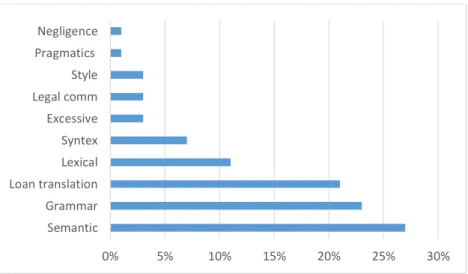
Analysis of the types of interference and their spread showed that the most frequent type of interference is of semantic nature (27%). The second most common type is grammatical interference comprising 23%. Loan interference is rated third with 21% frequency. It is followed by lexical and syntactic interferences with 11 and 7 percent, respectively. Interference resulting in excessive word in the TT, affecting legal communication and style of the TT comprise three percent each. Closing the chart is pragmatic interference at discourse level and interference resulting in an error due to negligence; they comprise 1% each.
The statistical data is visualized in Figure 1.
Figure 1: Types of interference
The examples below include the original English text of the Convention; the official translated text in Russian, and the author’s variant of the corrected/edited translation. Due to the tight format of the article we cannot give extended context of errors caused by language transfer; we can only outline their types.
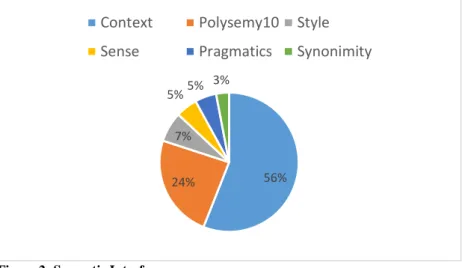
Semantic interference (41 cases) can be of six different types depending on the final effect on the TT:
1 contextual semantic error (wrong word)
Phenomenon of sexual exploitation - явление сексуальной эксплуатации - случаи сексуальной эксплуатации
2 semantic interference of polysemic nature
Specific monitoring mechanism – особый механизм мониторинга – специальный механизм мониторинга
Sexual activities – деятельность сексуального характера – действия сексуального характера)
3 semantic interference resulting in pragmatic deviation (wrong message, wrong discourse markers)
Where warranted – когда это оправдано – когда они (жертвы) имеют на это
право
Proceedings concerning the offences – уголовное разбирательство по поводу преступлений - уголовное разбирательство в отношении преступлений 4 semantic interference caused by lexical synonymity
Without any unjustified delay – без неоправданных задержек - без неоправданных
проволочек)
5 semantic interference resulting in stylistic deviation
0% 5% 10% 15% 20% 25% 30%
Semantic Grammar Loan translation Lexical Syntex Excessive Legal comm Style Pragmatics
To ensure that the information is provided in a manner adapted to their (victims’) age – чтобы информация предоставлялась в такой форме, которая учитывала бы их возраст – чтобы информация подавалась в такой форме, которая учитывала бы их возраст
6 semantic confusion (sense) in the TL
Covert operations (скрытные оперативно-следственные методы - скрытые оперативно-следственные методы)
The statistical data is visualized in Figure 2.
Figure 2: Semantic Interference
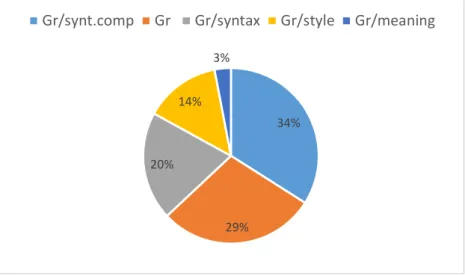
Grammatical interference (35 cases) represents five models of the damage caused to the TT. They are:
1 vague determiner + Noun, nominalization, comparative adjectives with abstract nouns, wrong prepositions and some others
Identification of anyproblems – выявление любыхпроблем - выявление проблем Allowing for the possibility of covert operations – допуская использование скрытных оперативно-следственных методов – обращаясь/прибегая к скрытым оперативно-следственным методам
A greater unity – большееединство – единство
For the purpose of –для целей мониторинга – с целью мониторинга 2 grammatical interference contributing to semantic inaccuracy
The status of parties to criminal proceedings – статус сторон уголовного разбирательства – Каждая Сторона обеспечивает жертвам доступ к бесплатной юридической помощи, когда возникает возможность получить статус стороны уголовного процесса.
3 grammatical interference resulting in stylistic clumsiness
The best interests of the child – высшие интересы ребенка – интересы ребенка Or … or (либо … или – или/либо … или/либо).
4 grammatical interference resulting in syntactic error/clumsiness
Each Party shall take measures to ensure that – каждая из Сторон принимает меры с целью обеспечить, чтобы –каждая из Сторон принимает меры для того, чтобы
5 grammatical interference resulting in syntactic complexity
Using a child … where – использование ребенка … когда – привлечение ребенка к
56% 24%
7% 5% 5% 3%
Context
Polysemy10
Style
The statistical data is visualized in Figure 3.
Figure 3: Grammatical Interference
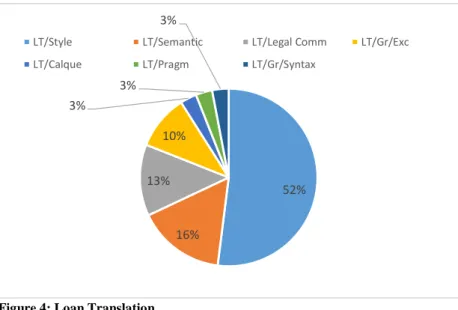
Loan translation (32 cases) manifested itself in seven types of interference; among them are:
1 loan translation affecting style
Taking due account – должным образом принимая во внимание - принимая во внимание
Offences of the same nature– совершение преступление такого же характера – совершение аналогичного преступления
2 loan translation resulting in semantic incorrectness/error
Support the setting up of information services – поддержка организации информационных служб – содействие в организации информационных служб Sexual activities – занятиедеятельностью сексуального характера – действия сексуального характера
3 loan translation resulting in legal communication failure
Final sentences – вступившие в окончательную силу приговоры – вступившие в силу приговоры
Supply evidence – представлять доказательства – выбирать способ дачи показаний
4 loan translation resulting in nominalization and excessive word in the TT
In order to ensure effective implementation – для обеспечения эффективного осуществления – для эффективного осуществления / С целью обеспечить эффективное осуществление ее положений (положений Конвенции)
5 loan translation/calque evident in the TT
Without any discrimination – без какой-либо дискриминации - без каких-либо исключений
6 loan translation resulting in pragmatic error
Are precluded from representing the child – не имеют возможности представлять ребенка – не наделены правом представлять ребенка
7 loan translation resulting in grammar violation and syntactic clumsiness Establish that – постановить, чтобы – ввести положение о том, чтобы The statistical data is visualized in Figure 4.
34%
29% 20%
14% 3%
Figure 4: Loan Translation
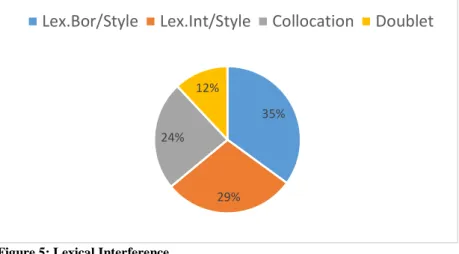
Lexical interference (17 cases) realized itself in four types, including:
1 Lexical borrowing (with or without change of grammatical category) resulting in weird translation
Minimising the risks– минимизация опасности - снижение рисков
Repeat victimisation – рецидивная виктимизация – повторное совершение преступления
2 Lexical interference resulting in style deviation
Offences concerning – преступления, касающиеся – преступления, связанные с
Through technologies– посредством технологий – c помощью технологий 3 Lexical interference at the level of collocation
Procedural law – процессуальное законодательство – процессуальное право Criminal proceedings – уголовное разбирательство – уголовный процесс 4 Translation of doublets into Russian
Encourage and support the setting up of information services – содействие и
поддержка организации информационных служб – содействие в организации информационных служб
The statistical data is visualized in Figure 5.
52%
16% 13%
10% 3%
3% 3%
LT/Style LT/Semantic LT/Legal Comm LT/Gr/Exc
Figure 5: Lexical Interference
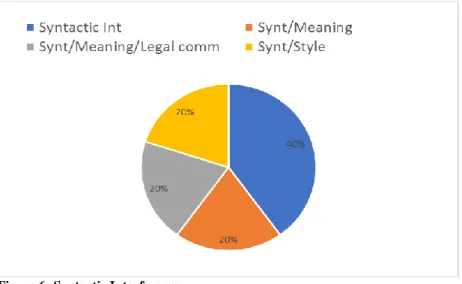
Syntactic interference (10 cases) can be identified in four types: 1 Syntactic interference evident in the TT
Engaging in sexual activities with a child where – занятие деятельностью сексуального характера, когда (используются) – занятие деятельностью сексуального характера с применением принуждения…, со злоупотреблением 1 Syntactic interference, which hinders understanding
Ensure that victims have access, as from their first contact with the competent authorities, to information on - обеспечивает доступ жертвам, с момента их первого контакта с компетентными органами, к информации, касающейся – обеспечивает доступ к информации, касающейся …, с момента их первого контакта с компетентными органами
3 Syntactic interference with the impact on the meaning and legal communication Each Party shall take the measures to ensure that the offences are punishable by sanctions, taking into account their seriousness – каждая Сторона принимает необходимые меры, обеспечивающие, чтобы преступления были наказуемы наложением санкций с учетом их тяжести – каждая Сторона принимает меры для того, чтобы наказания учитывали тяжесть совершенного преступления
4 Syntactic interference/error resulting in stylistic deviation
(Territory) for whose international relations it is responsible – территория, за ведение международных отношений которой она (Сторона) ответственна – территория, на которой она (Сторона) отвечает за международные отношения
The statistical data is visualized in Figure 6.
35%
29% 24%
12%
Figure 6: Syntactic Interference
Language interferenceresulting in excessive in the TT word that can be omitted without any semantic loss
Their special needs as witnesses - удовлетворение особых потребностей как свидетелей –удовлетворение их потребностей
Language interferenceresulting in cultural/legal communication failure
Such programmes or measures shall be accessible at any time during the proceedings, inside and outside prison - Такие программы или меры доступны в
любое время в течение разбирательств как в местах лишения свободы, так и за их пределами –такие программы или меры должны быть доступны в любое время (судебного) процесса, независимо от того, находится ли подозреваемый в следственном изоляторе или нет
Language interference resulting in stylistic deviation
Deposit of the instrument – сдача на хранение документа - депонирование документа
Pragmatic interference at discourse level
Established in accordance with this Convention – установленное согласно этой Конвенции – установленное данной Конвенцией
Mentioned – упомянутый – изложенный
Human factor error (negligence) can be revealed in the following example Amongpersons - от лиц – среди лиц
Discussion
Method of contextual analysis utilized in the survey proved feasibility of the hypothesis laid down in the opening part of this paper, namely, language interference or transfer is quite common in any situation of language contacts, including legal translation. Moreover, a source text can determine certain errors in the target text due to the complex mental processes of rendering from a foreign language into the native language.
features in the coherent text where meaning is looked at as synergy of all the elements.
Due to the reasons mentioned above, we experienced difficulties in identifying the type of interference in most of the cases. Though the erroneous translation is easy to trace, it is not easy to explain the reason for the error and/or its nature. Very often one and the same language unit understudy could be analyzed at different angles, and the error could be explained by different language factors or factors of other nature (for example, negligence).
Not surprising is the fact that semantic interference is dominating in the translated text. It reflects the importance of the meaning and/or sense in the legal message where ambiguity and incorrectness can result in serious legal implications.
The contextual analysis combined with comparative and contrastive methods of study revealed a number of cases which we described as contextual semantic error or wrong word. Those are the errors when chosen translation terms do not fit into the sense of the whole sentence and behave like aliens in the target language (ex., phenomenon of sexual exploitation – явление сексуальной эксплуатации - случаи сексуальной эксплуатации).
Errors connected with polysemy heavily prevail over errors stemmed from synonymity (ten against one). It can be attributed to the fact that polysemy refers to the source language difficulties whereas confusion of synonyms in translation is linked with the challenges of the target language (Polysemy: specific – особый –
специальный механизм мониторинга; sexual activities – деятельность сексуального характера – действия сексуального характера; synonymity: without any unjustified delay – без неоправданных задержек – без неоправданных
проволочек).
The errors stemmed from borrowing, collocations, and doublets from the foreign language formed another big group of lexical errors. This type of language transfer estimates translator’s skills, knowledge of the specifics of the legal discourse and translation experience.
Grammatical incorrectness realizes itself in translational English phrases of vague determiner + noun, nominalization (use of noun instead of verb forms) and grammar patterns violating the norms of the target language (measures toensure that – меры, обеспечивающие, чтобы – предпринять меры для того, чтобы).
The most damaging errors are those effecting legal communication in the target text. They are not numerous but can be very confusing, especially when translator interprets rules of the legal system other than in the target culture.
Forward literal translation, loan translation or calque gives rise to nine types of errors violating grammatical, semantic, stylistic and syntactical norms of the target language. Some of them hinder understanding and result in legal communication failure (Judicial winding-up order – судебное постановление о ликвидации – судебное постановление о ликвидации юридического лица).
Pragmatic borrowings result in erroneous following the discourse markers characteristic for legal English; this reduces the quality of the final text (mentioned – упомянутый – изложенный в пункте 1).
Identifying the error and classifying it was not enough in most cases, because it does not reveal the size of damage caused to the TT. That is why we have designed the system of markers explaining the channel, source, and consequences of language transfer (Gr→Meaning). Sometimes, the chain describing the final effect is lengthy (LT→Gr→Exc; LT→Gr→Syntax; Syntax→Meaning→Legal Comm).
The survey of interference of foreign language in legal translation into the mother tongue extends the general approach to language transfer as one of the core issues in translation quality.
errors that stick out of conventional legal situations in the target text. Therefore, such kind of language management regarding the above discourse seems to be timely.
Conclusion
The research showed that language interference is a multifaceted phenomenon inherent not only in acquiring a foreign language but in other situations of contact of native and foreign languages, including legal translation. Most often interference is associated with the contact-induced change in the foreign language as a result of transfer of various features of the native language. This research has asserted that interference can also be of adverse nature: a foreign language can predetermine deviations of conventional norms in the native language at translation. The damage to the TT can manifest itself at any level within the written discourse.
Anyway, language transfer can cause huge damage to the target text in terms of understanding, style, grammar, lexis, phraseology, and pragmatics conventionally accepted by the target language and culture. Legal discourse translation also reveals dramatically different legal domains in common law and continental law countries. Transfer of such domains into the final text without adapting and/or commenting can seriously hinder comprehending the message and be even more crucial in terms of legal consequences.
The research has identified channels and nature of transfer from English into Russian in the written translation of the legal text. They are lexical, semantic, grammatical, syntactical, stylistic and pragmatic.
We have also mapped out the most common types of transfer in legal translation, which are (given in decreasing value): semantic, grammatical, loan translation, lexical, syntactic, excessive word, violation of legal communication, stylistic, pragmatic, and the human factor.
The type of interference or language transfer is difficult to identify due to tight connections and interconnections of language levels. Thus, lexical and semantic levels, grammatical and syntactic levels, lexical and phraseological levels represent deep penetration into each other, hard to be separated and appropriated. Moreover, stylistic fluctuations can reflect changes at all language levels, being the final stage in a string of deviations.
We realize that the classification of interference types suggested in this work is conditional and far from being strict. However, the method of contextual analysis allows singling out the key source or channel of interference and explaining its nature in a particular case.
We have revealed that literal translation, loan translation, or calque is one of the most typical kinds of interference traced in translation of Lanzarote Convention into Russian. This can be attributed to the desire to render the text of the convention in the most loyal way.
The research findings make it possible to produce recommendations for translators. They should bear in mind that interference in legal translation does not only provoke serious mistakes but can lead to serious legal implications. To avoid incomprehensible translation, professionals need to apply a wide methodology, including formal and functional equivalence, descriptive equivalents, translation transformations, domestication, foreignization, and others. The main aim of translator should be fidelity to the legal sense of the ST rather than formal equivalence.
Acknowledgments
Bibliographic references
ABEL, S. DRESSEL, K. BITZER, R. KUMMERER, D. MADER, I. WEILLER, C. HUBER, W. 2008. The Separation of Processing Stages in a Lexical Interference Paradigm. In Magazine Elsevier. The Netherlands, Neuroimage, vol. 1, pp. 1113-1124. ISSN: 1053-8119.
ATABEKOVA, A. 2019a. Discourse Studies to Protect Minors Against Violence in Sport: Toward Discourse Studies Novelty. Proceedings of the 6th International Conference on Education and Social Sciences (INTCESS). UAE, Dubai, pp.1185-1189. ISBN: 978-605-82433-5-4.
ATABEKOVA, A.2019b. Do Discourse Studies Matter with Regard to Protect Minors Against Violence in Sports? Proceedings of the 6th International Conference on Education and Social Sciences (INTCESS). UAE, Dubai, pp.1190-1194. ISBN: 978-605-82433-5-4.
ATABEKOVA, A. GORBATENKO, R. 2017. Multilingual Community and Translation: Focus on Information Processing to Enhance Quality. In: Information, vol. 20, n. 7, pp. 4677-4692. ISSN: 1343-4500
BACKUS, AD. DORLEIJN, M. 2009. Loan Translations Versus Code-Switching. Cambridge: Cambridge University Press. ISBN: 1107605415.
BLOOMFIELD, L. 1933. Language. New York: Holt, Rinehart and Winston. ISBN: 0030558409.
CRUSE, A. 2004. Meaning in Language: An Introduction to Semantics and Pragmatics. Oxford: Oxford University Press. ISBN: 9780199559466.
DEROY, L. 1956. L'Emprunt Linguistique. París: Les Belles Lettres. ISSN: 2109-943X
DULAY, H. BURT, M. KRASHEN, S. 1982. Language Two. New York: Oxford University Press. ISBN: 0-19-502552-0.
ELLIS, R. 1995. The Study of Second Language Acquisition. New York: Oxford University Press. ISBN: 0194371891, 9780194371896
GEMAR, J.C. 1979. La Traduction Juridique et son Enseignement: Aspects Théoriques et Pratiques. In: Meta, vol. 24, n. 1, pp. 35-53. Canada, Montréal: Les Presses de l’Université. ISSN 1492-1421.
GAO, H. 2013. On Source Language Interference in Interpretation. In: Theory and Practice in Language Studies, Vol. 3, No. 7, pp. 1194-1199. Finland: Academy Publisher. ISSN: 1799-2591.
HAUGEN, E. 1956. The Analysis of Linguistic Borrowing. Linguistic Society of America: Language, vol. 26, pp. 210-231. ISSN: 0097-8507.
HOPKINSON, C. 2007. Factors in Linguistic Interference: A Case Study in Translation. In: Journal of Translation and Interpretation, vol. 2, no. 1, pp. 13-23. ISSN: 1336-7811.
HUMBLEY, J. 1974. Vers une Typologie de L'Emprunt Linguistique. France, Centre Nationale de la Recherche Scientifique. In: Cahiers de Lexicologie, vol. 25, pp. 46-70. ISSN: 2262-0346.
JOHANSON, L. 2002. Structural Factors in Turkic Language Contacts. London: Curzon. ISBN: 0-7007-1182-1.
KASPER, G. 1992. Pragmatic Transfer. In: Interlanguage Studies Bulletin, Vol. 8, Issue 3, pp. 203-231. The Netherlands: Utrecht Sage Publications Ltd. ISSN: 0267-6583.
KRASHEN, S.D. 1981. Bilingual Education and Second Language Acquisition Theory. In: Schooling and Language Minority Students: A Theoretical Framework. California: California State Department of Education. ISBN: 0-89755-011-0.
KUSSMAUL, P. 1995. Training the Translator. Amsterdam: John Benjamins Pub. Co. ISBN: 9789027216236.
LLORENTE, M.A. 1980. Consideraciones Sobre el Español Actual. In: Anuario de Letras, vol. 18, pp. 5-61. ISSN: 0185-1373.
LOTT, D. 1983. Analyzing and Counteracting Interference Errors. In: ELT Journal, vol. 37, no. 3 pp. 256-261. ISSN: 14774526, 09510893.
MALKIEL, B. 2006. The Effect of Translator Training on Interference and Difficulty. In: Target, vol. 18, no. 2, pp. 337-366. ISSN: 0924-1884.
MYERS-SCOTTON, C. 2002. Contact Linguistics: Bilingual Encounters and Grammatical Outcomes. New York: Oxford University Press: ISBN: 9780198299530. NEWMARK, P. 1981. Approaches to Translation. The UK, Oxford: Pergamon Press. ISBN: 0080246036.
NEWMARK, P. 1988. A Textbook of Translation. London: Prentice Hall Europe. ISBN 0-13-912593-0.
ODLIN, T. 1989. Language Transfer. Cambridge: Cambridge University Press. ISBN: 0521378095.
PARADIS, M. 1998. The Other Side of Language: Pragmatic Competence. Journal of Neurolinguistics, vol. 11, no. 1-2, pp. 1-10. ISSN: 09116044.
RILEY, P. 1989. 'Well don´t Blame me' On the Interpretation of Pragmatic Errors. In: W. Oleksy ed. Contrastive Pragmatics. Amsterdam: John Benjamins. ISBN: 9789027250094.
ROZENCVEJG, V. 1972. Language Contacts: Linguistic Issues. Leningrad: Nauka. ISBN 5-01-004654-7.
STRAKOVA, V. 1981. Zur Interferenz von Teilsystemen. Beitrag zur Akzentologischen Analyse der Russischen Sprache der Gegenwart. In: Folia Linguistica, vol. 15, pp. 437-442. ISSN: 01654004.
THOROVSKY, M. 2009. Lexical Linguistic Interference in Translations of Science-Fiction Literature from English into Czech. In: Ostrava Journal of English Philology, vol. 1, pp. 86–98. ISSN: 1803-8174.
VENUTI, L. 1997. The Translator’s Invisibility: A History of Translation. New York: Routledge. ISBN: 978-0-415-39453-6.
WEINREICH, U. 1953. Languages in Contact. Findings and Problems. New York: Publications of the Linguistic Circle of New York. ISBN 560569809.
Words: 5716
Characters: 40 481 (22,49 standard pages)
Valentina V. Stepanova, PhD in Linguistics, Department of Foreign Languages
Law Institute
RUDN University - Peoples’ Friendship University of Russia Miklukho-Maklay st, 6
117198, Moscow Russia