VOLUME 36, ARTICLE 8, PAGES 255
−
280
PUBLISHED 13 JANUARY 2017
http://www.demographic-research.org/Volumes/Vol36/8/ DOI: 10.4054/DemRes.2017.36.8
Research Article
Contribution of smoking-attributable mortality
to life expectancy differences by marital status
among Finnish men and women, 1971–2010
Riina Peltonen
Jessica Y. Ho
Irma T. Elo
Pekka Martikainen
©2017 Riina Peltonen et al.
1 Introduction 256
2 Data and methods 258
2.1 Data 258
2.2 Methods 258
3 Results 259
3.1 Differences in life expectancy by marital status in 1971–2010 259
3.2 The contribution of smoking among men 261
3.3 The contribution of smoking among women 263
4 Discussion 265
4.1 Summary of the main findings 265
4.2 Comparison to previous studies 266
4.3 Interpretation of the findings 267
4.3.1 All-cause mortality 267
4.3.2 The contribution of smoking 268
4.4 Methodological considerations 270
5 Conclusions 271
6 Acknowledgements 272
References 273
Contribution of smoking-attributable mortality to life expectancy
differences by marital status among Finnish men and women,
1971–2010
Riina Peltonen1 Jessica Y. Ho2
Irma T. Elo3 Pekka Martikainen4
Abstract
BACKGROUND
Smoking is known to vary by marital status, but little is known about its contribution to marital status differences in longevity. We examined the changing contribution of smoking to mortality differences between married and never married, divorced or widowed Finnish men and women aged 50 years and above in 1971–2010.
DATA AND METHODS
The data sets cover all persons permanently living in Finland in the census years 1970, 1975 through 2000 and 2005 with a five-year mortality follow-up. Smoking-attributable mortality was estimated using an indirect method that uses lung cancer mortality as an indicator for the impact of smoking on mortality from all other causes.
RESULTS
Life expectancy differences between the married and the other marital status groups increased rapidly over the 40-year study period because of the particularly rapid decline in mortality among married individuals. In 1971–1975 37–48% of life expectancy differences between married and divorced or widowed men were attributable to smoking, and this contribution declined to 11–18% by 2006–2010. Among women, in 1971–1975 up to 16% of life expectancy differences by marital status were due to
1
smoking, and the contribution of smoking increased over time to 10–29% in 2006– 2010.
CONCLUSIONS
In recent decades smoking has left large but decreasing imprints on marital status differences in longevity between married and previously married men, and small but increasing imprints on these differences among women. Over time the contribution of other factors, such as increasing material disadvantage or alcohol use, may have increased.
1. Introduction
Married individuals enjoy longer lives and better health than people in other marital status groups (Rendall 2011). Health behaviors, which have been shown to contribute to health disparities between married and unmarried groups, are one possible contributor to mortality differences by marital status (Dupre, Beck, and Meadows 2009; Molloy et al. 2009; Joung et al. 1995; Joung et al. 1997; Joutsenniemi et al. 2006). One of these behaviors, smoking, strongly affects mortality (Rogers et al. 2005) and it has also been shown to vary by marital status (Molloy et al. 2009; Nystedt 2006; Leinsalu, Tekkel, and Kunst 2007; Helmert and Shea 1998; Lindström 2010; Jones, Gulbis, and Baker 2010; Oh et al. 2010; Broms et al. 2004; Lee et al. 2005). The divorced are more likely to have smoked at some time than the married (Jones, Gulbis, and Baker 2010; Oh et al. 2010). Furthermore, both married men and women are least likely to be current smokers, whereas divorced men and women are most likely to be current smokers with the never married and the widowed falling in between (Molloy et al. 2009; Nystedt 2006; Helmert and Shea 1998; Lindström 2010). Differences between the married and the other marital status groups have also been found in smoking cessation among men, with married men having the highest rates of smoking cessation (Broms et al. 2004; Nystedt 2006).
Joutsenniemi et al. (2006) found that up to 33% of the differences in self-rated health was due to smoking, after controlling for education, in 1978–1980 and 2000–2001. Although previous population-based studies have made important contributions, studies based on self-reported smoking data from surveys are subject to problems related to accurately capturing lifetime smoking exposure in different marital states, due to factors such as misclassification of past and present smoking statuses, recall bias, and problems in taking into account different smoking intensities or changes in smoking status during follow-up (Ho and Elo 2013).
The mortality advantage of the married over the unmarried groups has also widened in recent decades in many high income countries, including Finland (Hu and Goldman 1990; Valkonen, Martikainen, and Blomgren 2004; Murphy, Grundy, and Kalogirou 2007; Martikainen et al. 2005; Liu 2009). Meanwhile, smoking behaviors
have changed markedly since the turn of the 20th century. In Finland, smoking
prevalence peaked among male cohorts born in 1911–1925; in those cohortsover 80% of men have ever smoked regularly (Martelin 1984). Among women, smoking
prevalence started to increase from the cohorts born at the beginning of the 20th century
and peaked at about 45% amongthe cohorts born in the 1950s (Helakorpi et al. 2004).
Accordingly, smoking has had a large but decreasing impact on longevity among men and a smaller but increasing impact on longevity among women (Martikainen et al. 2013), with parallel findings observed in many other high income countries (Preston, Glei, and Wilmoth 2011). While smoking behaviors have changed markedly during the 20th century, no estimates exist of the changing contribution of smoking to marital status differences in mortality.
2. Data and methods
2.1 Data
The data sets used are based on information drawn from the Finnish population censuses and administrative registers in 1970–2010. The data sets cover all persons permanently living in Finland at the end of the census years 1970, 1975 through 2000 and 2005 and include all person-years and deaths aggregated by Statistics Finland for each five-year period following each census (1971–1975, 1976–1980 through 2001– 2005, 2006–2010) stratified by age, gender and marital status. Individuals who emigrated during the five-year follow-up period were excluded. Marital status was measured in each census year, was fixed for the subsequent five-year follow-up period, and comprised four groups: married, never married, widowed and divorced. Person-years and deaths were allocated into age groups within each year on the basis of birthdates and further grouped into five-year categories. Analyses were restricted to people aged 50 and above since the majority of smoking-attributable deaths occur above age 50, and individuals were allowed to age into the follow-up (i.e., individuals who turn 50 in the five-year follow-up periods contribute person-years and deaths from their 50th birthday onwards).
2.2 Methods
non-smokers taken from the American Cancer Society’s Cancer Prevention Study II (CPS-II) (Thun et al. 1997). The model coefficients apply to the year 2003, and for the analyses in this study, they were modified to apply to each period using a time trend based on interactions between lung cancer mortality and year from the regression model described above (Preston, Glei, and Wilmoth 2011).
We used period life table methods (Preston, Heuveline, and Guillot 2001) and age-specific mortality rates in five-year age intervals to calculate life expectancies with and without smoking at age 50 by marital status, period, and gender. The contribution of smoking to the life expectancy differences was calculated by comparing the observed differences in life expectancies with those constructed assuming no exposure to smoking at all in the populations under study (i.e., in a scenario that would prevail if smoking were eliminated entirely). Because gender differences in the levels of and trends in smoking-attributable mortality have been significant over the study period (Martikainen et al. 2013), the analyses were conducted separately for men and women.
3. Results
3.1 Differences in life expectancy by marital status in 1971–2010
Table 1: Distribution of person-years by marital status (%, age-adjusted1) among Finnish men and women aged 50 and above in 1971–1975 and 2006–2010
Men Women
1971‒1975 2006‒2010 1971‒1975 2006‒2010
Married 78 66 50 55
Never married 9 14 15 11
Widowed 10 5 30 16
Divorced 3 14 5 17
All 100 100 100 100
Person-years
(in 1,000s) 2,432 4,627 3,463 5,486
1The age standard was the combined population of men and women during the whole study period.
Figure 1: Life expectancy at age 50 and above by period and marital status, Finnish men and women in 1971–2010
3.2 The contribution of smoking among men
Figure 2: Age-adjusted smoking-attributable mortality (/1,000 person-years) by period and marital status, Finnish men and women aged 50 and above in 1971–2010
Over the study period, smoking-attributable mortality at least halved in each marital status group among men (Figure 2). The relative decline was fastest among the married (68% decline), slowest among the never married (50% decline) and similar among the divorced and widowed men (about 61% decline). However, in absolute terms, the decline was most rapid among the divorced due to their very high level of smoking-attributable mortality in the beginning of the study period; over time their rate converged with that of the other unmarried groups. The absolute decline was also faster among widowers than among the married, whereas the pace of the decline did not differ between those never married and the married. Smoking-attributable mortality as a share of all-cause mortality declined in each marital status group, as the proportional decline in age-adjusted smoking-attributable mortality was more rapid than the proportional decline in other-cause mortality (results not shown here).
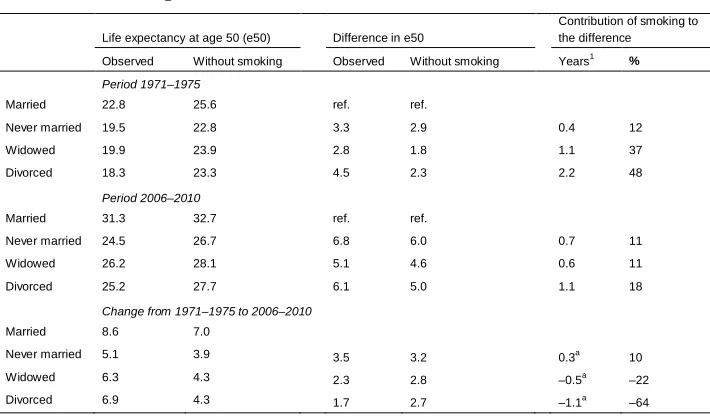
Due to the rapid decrease in smoking-attributable mortality across marital status groups, the contribution of smoking to the life expectancy differences among men diminished to less than a fifth by 2006–2010 (Table 2). By 2006–2010 the contribution of smoking-attributable mortality to the life expectancy difference between the divorced and the married had diminished to 18% (1.1 years) and between the widowed and the married to 11% (0.6 years). In absolute terms, the contribution of smoking to life-expectancy differences between never married and married men increased slightly, but as a percentage it remained stable and was 11% (0.7 years) in 2006–2010.
Table 2: Contribution of smoking-attributable mortality to life expectancy differences between the married and the unmarried groups, Finnish men aged 50 and above in 1971–1975 and 2006–2010
Life expectancy at age 50 (e50) Difference in e50
Contribution of smoking to the difference
Observed Without smoking Observed Without smoking Years1 %
Period 1971–1975
Married 22.8 25.6 ref. ref.
Never married 19.5 22.8 3.3 2.9 0.4 12
Widowed 19.9 23.9 2.8 1.8 1.1 37
Divorced 18.3 23.3 4.5 2.3 2.2 48
Period 2006–2010
Married 31.3 32.7 ref. ref.
Never married 24.5 26.7 6.8 6.0 0.7 11
Widowed 26.2 28.1 5.1 4.6 0.6 11
Divorced 25.2 27.7 6.1 5.0 1.1 18
Change from 1971–1975 to 2006–2010
Married 8.6 7.0
Never married 5.1 3.9 3.5 3.2 0.3a
10
Widowed 6.3 4.3 2.3 2.8 –0.5a –22
Divorced 6.9 4.3 1.7 2.7 –1.1a –64
1“Observed difference in life expectancy” minus “difference in life expectancy without smoking”
a
“Observed change in life expectancy difference” minus “change in life expectancy difference without smoking”
The rapid decrease in smoking-attributable mortality among the divorced and widowed men slowed down the increase of the life expectancy differentials. In the absence of smoking, the increase in the life expectancy difference between the divorced and married men would have been 64% larger (1.1 years) than the observed increase (Table 2). Similarly, the increase between widowed and married men would have been 22% larger (0.5 years) without smoking. In contrast, smoking accounted for 10% of the observed increase in the life expectancy difference between never married and married men.
life expectancy difference in this period (Table 3). After the early 1970s, age-adjusted smoking-attributable mortality began to increase in every marital status group, and the levels between groups diverged (Figure 2). Smoking-attributable mortality increased least among married women in both absolute and relative terms. Accordingly, by 2006– 2010 the contribution of smoking to the increased life expectancy differences had also grown, and it ranged from 10% (0.4 years) between the never married and the married to 29% (0.9 years) between the divorced and the married in 2006–2010 (Table 3).
Among women (Table 3), diverging and increasing rates of smoking-attributable mortality contributed to the increase in all-cause mortality differences between the married and each of the unmarried groups. In the absence of smoking-attributable deaths, the increase in life expectancy differences would have been 14%, 30% and 37% smaller than the observed increases between the married and the never married, widowed and divorced, respectively.
Table 3: Contribution of smoking-attributable mortality to life expectancy differences between the married and the unmarried groups, Finnish women aged 50 and above in 1971–1975 and 2006–2010
Life expectancy at age 50 (e50) Difference in e50
Contribution of smoking to the difference
Observed Without smoking Observed Without smoking Years1 %
Period 1971–1975
Married 28.6 28.7 ref.
Never married 27.6 27.6 1.1 1.1 0.0 0
Widowed 27.7 27.8 0.9 0.9 0.0 5
Divorced 27.5 27.8 1.1 0.9 0.2 16
Period 2006–2010
Married 36.0 36.3 ref.
Never married 32.2 32.9 3.8 3.4 0.4 10
Widowed 33.4 34.3 2.6 2.0 0.5 21
Divorced 33.0 34.2 3.0 2.1 0.9 29
Change from 1971–1975 to 2006–2010
Married 7.4 7.6
Never married 4.6 5.3 2.7 2.3 0.4a 14
Widowed 5.7 6.4 1.7 1.2 0.5a 30
Divorced 5.5 6.4 1.9 1.2 0.7a 37
1
“Observed difference in life expectancy” minus “difference in life expectancy without smoking”
4. Discussion
The aim of this study is to quantify the contribution of smoking to marital status differences in mortality in Finland from 1971 to 2010 and to assess how smoking has contributed to changes in these differences. Life expectancies were used to measure mortality differences, and the indirect PGW method was used to estimate the impact of smoking on mortality. Previous literature quantifying the contribution of smoking to marital status differences in mortality is scarce, and to the best of our knowledge, this study is the first to apply the PGW method to study the contribution of smoking to marital status differences in life expectancy and, in particular, is the first study to assess changes in the contribution of smoking to marital status differences over a 40-year period.
4.1 Summary of the main findings
We found that in the past 40 years marital status differences in life expectancy among those aged 50 years and above rapidly increased due to more rapid increases in the life expectancy of the married than the unmarried population. During this period, smoking-attributable mortality declined among men in all marital status groups, but particularly strongly among the divorced and widowed. These changes were significant drivers of trends in life expectancy differentials by marital status. In particular, in the absence of smoking, life expectancy differences between the married and divorced men would have increased by 64% more than they did (2.7 years as opposed to the observed increase of 1.7 years). However, smoking made a minor contribution to the increasing life expectancy differential between married and never married men, mainly because of relatively similar absolute trends in smoking-attributable mortality. At the end of the study period in 2006–2010, smoking-attributable mortality accounted for 11–18% of the life expectancy differences between married and unmarried men.
among men in the most recent period. However, as marital status differences have been larger among men, in absolute terms, the contribution remains larger among men.
4.2 Comparison to previous studies
In this study we focus on life expectancy and document an increase in the absolute differences in life expectancy between the married and each of the unmarried groups resulting from more rapid life expectancy increases in the married population among both men and women. These results are in line with a previous study by Martikainen et al. (2005) showing widening differences in relative mortality by marital status in the working aged and elderly Finnish population in recent decades, and with the observed widening of absolute differences in life expectancy between the married and the unmarried groups during the 1970s and 1980s among the Finnish elderly (Martelin 1994).
The finding that the divorced had the highest rates of smoking-attributable mortality is in line with previous literature showing that divorced men and women consistently have the highest smoking prevalence and lung cancer mortality rates in Finland (Martikainen et al. 2005; Martelin 1984) and in other high income countries (Molloy et al. 2009; Nystedt 2006; Helmert and Shea1998; Lindström 2010; Berntsen 2011; Joung et al. 1996; Kallan 1997; Ben-Shlomo et al. 1993). The lowest rates of lung cancer mortality and smoking prevalence are observed among the married in Finland (Martikainen et al. 2005; Martelin 1984). Similarly in our study population, smoking-attributable mortality was lowest among the married, followed by either the never married or the widowed (depending on the time period).
provide a fuller and more accurate estimate of the overall contribution of smoking to mortality differentials by marital status by using the PGW method, which captures all smoking-attributable mortality.
Few studies provide direct estimates of the contribution of smoking to mortality differences by marital status. We are aware of only one such cohort study based on a survey with mortality follow-up that shows no effect of smoking on marital status differences in mortality after controlling for self-rated health and functional ability (Lund et al. 2002). However, in the study by Lund et al. (2002), the measure for smoking included only two classes, differentiating those who have never smoked from those who have ever smoked, thus inaccurately estimating lifetime smoking exposure. Moreover, adjustment for self-rated health and functional ability prior to smoking adjustment may partially mask the true effects of smoking on mortality differentials, since smoking-related illness may lead to lower self-rated health and impaired functional ability. Overall, by using the PGW method, we avoided the problems related to accurately capturing lifetime smoking exposure that survey-based methods may suffer from, including recall bias, misclassification of past and present smoking statuses, and difficulties in taking into account different smoking intensities or changes in smoking status duringfollow-up (Ho and Elo 2013).
4.3 Interpretation of the findings 4.3.1 All-cause mortality
study population, and slowest among the never married men (Appendix, Figure A-1). If any strengthening of the contribution of education to life expectancy differences occurred over time, this has been most likely to have happened between never married and married men. In the study by Martikainen et al. (2005), increases in the relative differences could not be explained by changes in the distribution of socioeconomic position, nor household size, economic activity or number of children. However, because these characteristics were not taken into account in this study, the contribution of these factors to the results remains unclear.
First marriage rates have decreased for cohorts born since the late 1940s and divorce rates have increased in Finland (Pitkänen and Jalovaara 2007). These trends are presumably reflected in the increase in divorced men and women and never married men seen in this study (see Appendix, Figure A-2) and may indicate changes in the factors that contribute to marital status differences in mortality. For example, the decreasing trend of the first marriage rates may suggest strengthened positive selection into marriage, which may have improved the average health of the married. Meanwhile, the health of the divorced may have improved due to lessened negative selection as their relative size strongly increased during the study period from very small proportions. However, more detailed data would be needed to assess the possible changes in the causation-selection related mechanisms.
4.3.2 The contribution of smoking
Among men, the contribution of smoking to life expectancy differences by marital status has diminished over time, and increases in life expectancy differentials would have been even larger without smoking. Between the never married and married men, the contribution of smoking remained most persistent. The declining rates of smoking-attributable mortality in our study reflect the aging of the cohorts of men among whom smoking peaked, that is, male cohorts born around 1911–1925, of which about 80% ever smoked regularly (Martelin 1984), the replacement of these cohorts with successive younger cohorts among whom smoking initiation started to decline, and an overall increase in cessation over time (Laaksonen et al. 1999). Overall, increases in cessation and deterring initiation have been highly successful among Finnish men and have helped dampen increasing inequality in life expectancy. The success of addressing smoking is reflected in its disappearing contribution among men, which also appears to have opened the door for the contribution of other factors.
2006‒2010, was of similar magnitude in all the unmarried groups (11% to 18%), a finding consistent with Nystedt’s (2006) hypothesis about the importance of the presence of a spouse for men in success in quitting smoking. It may be more difficult for an unmarried person to quit because of the lack of, for instance, spousal support or control available for smoking reduction and cessation (Westmaas, Wild, and Ferrence 2002; Umberson 1992). Married individuals may also be in a better position to bear the stresses associated with quitting smoking, such as the withdrawal symptoms, due to the overall stress buffering effects that a stable marriage may bring, or they may have stronger incentives (Osler and Prescott 1998) to quit because of, for instance, parenting responsibilities. In addition, difficulties in smoking abstinence during the processes of losing a spouse may contribute to higher overall lifetime smoking exposure among divorced or widowed men (Nystedt 2006).
The contribution of smoking to the life expectancy difference between married and divorced men was especially pronounced in the beginning of the study period, and this contribution also showed the largest decrease over time. Besides cessation differences, differences in initiation may also partly account for these findings; the proportion of those who have ever smoked has been found to be consistently higher only among divorced men when compared with the married in the Finnish population (see Appendix, Figure A-3; Martelin 1984). Part of these differences may be related to marital conflict, i.e., marital frictions induce smoking initiation, but as smoking usually starts during adolescence or early adulthood (Khuder, Dayal, and Mutgi 1999; Chen and Millar 1998) and marriage usually occurs later (Pitkänen and Jalovaara 2007), it is also possible that processes related to marital selection (Fu and Goldman 2000) contribute to these initiation differences. The low proportion of the divorced and their high smoking-attributable mortality in the first study periods may also imply selection (Hu and Goldman 1990) based on characteristics related to both smoking and higher risk of divorce, for instance, heavy alcohol use (Laaksonen et al. 2002; Leonard, Smith, and Homish 2014; Torvik et al. 2013). As divorce became more common during the study period, it is possible that the divorced became more like the average in these respects, and selection on these factors became less relevant.
may have been the stronger driver here. Men who never married may have been the slowest to terminate the habit of smoking, and this may be related to their lifetime exclusion from relationships that may be, on average, important sources of support, control and enhanced incentive to preserve health.
In contrast to men, the contribution of smoking to life expectancy differences by marital status among women has increased over time, and smoking has contributed to increases in these differences. Rates of smoking-attributable mortality were lower than those among men and increasing because of the time lag between the genders at the start of the smoking epidemic (Lopez, Collishaw, and Piha 1994).These trends among women reflect the aging of the cohorts of women among whom the prevalence of
smoking started to increase, that is, the cohorts born in the beginning of the 20th century
(Martelin 1984). Besides increased smoking initiation in successive birth cohorts,
cessation has also increased among women across cohorts over time (Laaksonen et al. 1999). The slower increase in smoking-attributable mortality among the married seen in our study could then be due to slower increases in initiation in the successive birth cohorts of married women and higher levels of smoking cessation and possibly larger
increases in cessation over time among the married.Here women are experiencing the
typical story of an adverse risk factor being distributed in a way that favors the theoretically most advantaged group, married women.
In the literature on smoking behavior, systematically lower rates of cessation in comparison with married women have been found only among divorced women in Finland (Martelin 1984). Evidence on cessation differences from other countries also show that marital breakdown, especially that leading to divorce, is related to sustained smoking among women (Nystedt 2006). Smoking-attributable mortality was increased about twofold among divorced women in the 2000s when compared with the other unmarried groups in our study, which may partly reflect stresses related to marital conflict and dissolution hindering smoking cessation and abstinence. Comparable to our findings for men, initiation differences may also have contributed to the higher rates of smoking-attributable mortality among divorced women (see Appendix, Figure A-3; Martelin 1984; Oh et al. 2010).
4.4 Methodological considerations
solely on lung cancer mortality and survey-based cohort studies, as discussed in the previous sections.
However, this study also has its limitations. First, the indirect method assumes that the expected lung cancer death rates among non-smokers reported in the U.S. CPS-II study do not differ by marital status. This assumption would not hold if marital status was associated with factors other than smoking that increase lung cancer risk, such as exposure to asbestos or other carcinogens in occupational settings or in living environments. However, there is no strong reason to believe that differences in these exposures by marital status are large. It was also assumed that the association between lung cancer mortality and mortality from all other causes does not differ by marital status. This assumption would not hold if, for instance, similar levels of lung cancer mortality across marital status groups were associated with lower levels of mortality from all other causes among the married than among the unmarried groups. The unmarried may have higher mortality due to smoking-related causes other than lung cancer because of, for instance, higher co-morbidity and higher levels of other risk factors, such as heavy alcohol use.
Marital status was measured in each census year, and was not updated during the subsequent five-year follow-up period. At ages above 50, (re)marriage rates have been low in past decades but are increasing among the divorced and never married; 5% of the divorced and 1% of the never married in 1990 (re)married during 1991–1995 among men, while during 2006–2010 these figures were 8% for divorced and 4% for men who never married in 2005 (source: individual level data from Statistics Finland, TK-53-339-13). Among women, (re)marriage rates have been lower than among men but are also increasing. The proportion of married individuals at ages above 50 who recently lost their spouse through bereavement or divorce has been stable at about 6% from 1991–1995 to 2006–2010 among men and has decreased among women from about 13% to 11%. Taking these changes into account would probably lead to wider life expectancy differences than observed here, especially towards the end of the study period – and possibly larger estimates of the contribution of smoking to life expectancy differences. In this respect, the results presented in this study are likely to be conservative.
longevity between married and previously married men and small but increasing imprints on these differences among women. Smoking now accounts for a relatively larger proportion of life expectancy differences by marital status among women than among men, but its contribution in absolute terms still remains larger for men. Because changes in smoking-attributable mortality did not explain or explained only a part of the increases in life expectancy differences between the married and the three unmarried groups, over time the contribution of other factors, such as increasing material disadvantage or alcohol use, may have increased.
6. Acknowledgements
References
Ben-Shlomo, Y., Smith, G.D., Shipley, M., and Marmot, M.G. (1993). Magnitude and causes of mortality differences between married and unmarried men. Journal of
Epidemiology and Community Health 47(3): 200‒205.
doi:10.1136/jech.47.3.200.
Berntsen, K.N. (2011). Trends in total and cause-specific mortality by marital status
among elderly Norwegian men and women. BMC Public Health 11:537.
doi:10.1186/1471-2458-11-537.
Broms, U., Silventoinen, K., Lahelma, E., Koskenvuo, M., and Kaprio, J. (2004). Smoking cessation by socioeconomic status and marital status: The contribution of smoking behavior and family background. Nicotine & Tobacco Research
6(3): 447‒455.doi:10.1080/14622200410001696637.
Chen, J. and Millar, W.J. (1998). Age of smoking initiation: Implications for quitting. Health Reports. Statistics Canada 9(4): 39‒46.
Dupre, M.E., Beck, A.N., and Meadows, S.O. (2009). Marital trajectories and mortality
among US adults. American Journal of Epidemiology 170(5): 546‒555.
doi:10.1093/aje/kwp194.
Fu, H. and Goldman, N. (2000). The association between health-related behaviors and the risk of divorce in the USA. Journal of Biosocial Science 32(1): 63‒88. doi:10.1017/S0021932000000638.
Helakorpi, S., Martelin, T., Torppa, J., Patja, K., Vartiainen, E., and Uutela, A. (2004). Did Finland’s Tobacco Control Act of 1976 have an impact on ever smoking?
An examination based on male and female cohort trends. Journal of
Epidemiology and Community Health 58(8): 649‒654.
doi:10.1136/jech.2003.015925.
Helldán, A., Helakorpi, S., Virtanen, S., and Uutela, A. (2013). Health behavior and
health among the Finnish adult population [and earlier publications during
1987–2013]. Helsinki: National Institute for Health and Welfare. https://www.thl.fi/fi/web/thlfi-en/research-and-expertwork/population-studies/ health-behaviour-and-health-among-the-finnish-adult-population-avtk.
Helmert, U. and Shea, S. (1998). Family status and self-reported health in West
Hu, Y.R. and Goldman, N. (1990). Mortality differentials by marital status: An international comparison.Demography 27(2): 233‒250.doi:10.2307/2061451. Jones, A., Gulbis, A., and Baker, E.H. (2010). Differences in tobacco use between
Canada and the United States. International Journal of Public Health 55(3):
167‒175.doi:10.1007/s00038-009-0101-3.
Joung, I.M., Stronks, K., van de Mheen, H., and Mackenbach, J.P. (1995). Health behaviors explain part of the differences in self reported health associated with
partner/marital status in the Netherlands. Journal of Epidemiology and
Community Health 49(5): 482‒488.doi:10.1136/jech.49.5.482.
Joung I.M., Glerum J.J., van Poppel F.W., Kardaun J.W., and Mackenbach J.P. (1996). The contribution of specific causes of death to mortality differences by marital status in the Netherlands. European Journal of Public Health 6(2): 142‒149. doi:10.1093/eurpub/6.2.142.
Joung, I.M., Stronks, K., van de Mheen, H., van Poppel, F.W., van der Meer, J.B., and Mackenbach, J.P. (1997). The contribution of intermediary factors to marital status differences in self-reported health.Journal of Marriage and Family 59(2): 476‒490.doi:10.2307/353484.
Joutsenniemi, K.E., Martelin, T.P., Koskinen, S.V., Martikainen, P.T., Härkänen, T.T., Luoto, R.M., and Aromaa, A.J. (2006). Official marital status, cohabiting, and self-rated health – time trends in Finland, 1978‒2001. European Journal of
Public Health 16(5): 476‒483.doi:10.1093/eurpub/cki221.
Kallan, J. (1997). Effects of sociodemographic variables on adult mortality in the United States: Comparisons by sex, age, and cause of death. Social Biology
44(1‒2): 136‒147.doi:10.1080/19485565.1997.9988940.
Khuder, S.A., Dayal, H.H., and Mutgi, A.B. (1999). Age at smoking onset and its effect on smoking cessation.Addictive Behaviors 24(5): 673‒677. doi:10.1016/S0306-4603(98)00113-0.
Laaksonen, M., Uutela, A., Vartiainen, E., Jousilahti, P., Helakorpi, S., and Puska, P. (1999). Development of smoking by birth cohort in the adult population in
eastern Finland 1972–97. Tobacco Control 8(2): 161‒168.
doi:10.1136/tc.8.2.161.
Laaksonen, M., Luoto, R., Helakorpi, S., and Uutela, A. (2002). Associations between health-related behaviors: A 7-year follow-up of adults. Preventive Medicine
34(2): 162‒170.doi:10.1006/pmed.2001.0965.
women. International Journal of Epidemiology 34(1): 69‒78. doi:10.1093/ije/dyh258.
Leinsalu, M., Tekkel, M., and Kunst, A.E. (2007). Social determinants of ever initiating smoking differ from those of quitting: a cross-sectional study in Estonia.
European Journal of Public Health 17(6): 572‒578.
doi:10.1093/eurpub/ckm030.
Leonard, K.E., Smith, P.H., and Homish, G.G. (2014). Concordant and discordant alcohol, tobacco, and marijuana use as predictors of marital dissolution.
Psychology of Addictive Behaviors 28(3): 780‒789.doi:10.1037/a0034053.
Lindström, M. (2010). Social capital, economic conditions, marital status and daily
smoking: A population-based study. Public Health 124(2): 71‒77.
doi:10.1016/j.puhe.2010.01.003.
Liu, H. (2009). Till death do us part: Marital status and U.S. mortality trends, 1986– 2000. Journal of Marriage and Family 71(5): 1158‒1173.
doi:10.1111/j.1741-3737.2009.00661.x.
Lopez, A.D., Collishaw, N.E., and Piha, T. (1994). A descriptive model of the cigarette
epidemic in developed countries. Tobacco Control 3: 242‒247.
doi:10.1136/tc.3.3.242.
Lund, R., Due, P., Modvig, J., Holstein, B.E., Damsgaard, M.T., and Andersen, P.K. (2002). Cohabitation and marital status as predictors of mortality – an eight year
follow-up study. Social Science & Medicine 55(4): 673‒679.
doi:10.1016/S0277-9536(01)00219-2.
Martelin, T. (1984). Tupakointitapojen kehitys Suomessa haastattelu ja
kyselytutkimusten valossa [In Finnish only]. Helsinki: Lääkintöhallitus.
Martelin, T. (1994).Differential mortality at older ages. Sociodemographic mortality differences among the Finnish elderly. Helsinki: Finnish Demographic Society. Martikainen, P., Martelin, T., Nihtilä, E., Majamaa, K., and Koskinen, S. (2005).
Differences in mortality by marital status in Finland from 1976 to 2000: Analyses of changes in marital-status distributions, socio-demographic and household composition, and cause of death. Population Studies 59(1): 99‒115. doi:10.1080/0032472052000332737.
Mathers, C.D., Fat, D.M., Inoue, M., Rao, C., and Lopez, A.D. (2005). Counting the dead and what they died from: An assessment of the global status of cause of death data.Bulletin of the World Health Organization 83(3): 171‒177.
Molloy, G.J., Stamatakis, E., Randall, G., and Hamer, M. (2009). Marital status, gender and cardiovascular mortality: Behavioural, psychological distress and metabolic
explanations. Social Science & Medicine 69(2): 223‒228.
doi:10.1016/j.socscimed.2009.05.010.
Murphy, M., Grundy, E., and Kalogirou, S. (2007). The increase in marital status differences in mortality up to the oldest age in seven European countries, 1990–
99.Population Studies 61(3): 287‒298.doi:10.1080/00324720701524466.
Nystedt, P. (2006). Marital life course events and smoking behaviour in Sweden 1980–
2000. Social Science & Medicine 62(6): 1427‒1442.
doi:10.1016/j.socscimed.2005.08.009.
Oh, D.L., Heck, J.E., Dresler, C., Allwright, S., Haglund, M., Del Mazo, S.S., Kralikova, E., Stucker, I., Tamang, E., Gritz, E.R., and Hashibe, M. (2010). Determinants of smoking initiation among women in five European countries: A cross-sectional survey. BMC Public Health 10:74. doi:10.1186/1471-2458-10-74.
Osler, M. and Prescott, E. (1998). Psychosocial, behavioural, and health determinants of successful smoking cessation: A longitudinal study of Danish adults. Tobacco
Control 7(3): 262‒267.doi:10.1136/tc.7.3.262.
Pitkänen, K. and Jalovaara, M. (2007). Perheet ja perheenmuodostus. In Koskinen, S., Martelin, T., Notkola, I., Notkola, V., Pitkänen, K., Jalovaara, M., Mäenpää, E., Ruokolainen, A., Ryynänen, M., and Söderling, I. (eds.). Suomen väestö [In Finnish only]. Helsinki: Gaudeamus Helsinki University Press: 115‒167.
Preston, S., Heuveline, P., and Guillot, M. (2001). Demography: Measuring and
modeling population processes. Oxford: Wiley-Blackwell.
Preston, S.H., Glei, D.A., and Wilmoth, J.R. (2010). A new method for estimating smoking-attributable mortality in high-income countries. International Journal
of Epidemiology 39(2): 430‒438.doi:10.1093/ije/dyp360.
Preston, S.H., Glei, D.A., and Wilmoth, J.R. (2011). Contribution of smoking to international differences in life expectancy. In: Crimmins, E.M., Preston, S.H., and Cohen, B. (eds.). International differences in mortality at older ages:
Dimensions and sources. Washington, D.C.: The National Academies Press:
Rendall, M.S., Weden, M.M., Favreault, M.M., and Waldron, H. (2011). The protective effect of marriage for survival: a review and update. Demography 48(2): 481‒
506.doi:10.1007/s13524-011-0032-5.
Rogers, R.G., Hummer, R.A., Krueger, P.M., and Pampel, F.C. (2005). Mortality
attributable to cigarette smoking in the United States. Population and
Development Review 31(2): 259‒292.doi:10.1111/j.1728-4457.2005.00065.x.
Thun, M.J., Day-Lally, C., Myers, D.G., Calle, E.E., Flanders, W.D., Zhu, B.P., Namboodiri, M.M., and Heath, C.W. (1997). Trends in tobacco smoking and mortality from cigarette use in cancer prevention studies I (1959 through 1965) and II (1982 through 1988). In: Burns, D.M., Garfinkel, L. and Samet, J.M. (eds.). Changes in cigarette-related disease risks and their implications for
prevention and control. NIH publication no. 97–4213. Bethesda, MD: Cancer
Control and Population Sciences, National Cancer Institute, U.S. National Institutes of Health: 305‒382.
Tillgren, P., Haglund, B.J., Lundberg, M., and Romelsjö, A. (1996). The sociodemographic pattern of tobacco cessation in the 1980s: Results from a panel study of living condition surveys in Sweden.Journal of Epidemiology and
Community Health 50(6): 625‒630.doi:10.1136/jech.50.6.625.
Torvik, F.A., Røysamb, E., Gustavson, K., Idstad, M., and Tambs, K. (2013). Discordant and concordant alcohol use in spouses as predictors of marital dissolution in the general population: Results from the Hunt study. Alcoholism,
Clinical and Experimental Research 37(5): 877‒884.doi:10.1111/acer.12029.
Umberson, D. (1992). Gender, marital status and the social control of health behavior.
Social Science & Medicine 34(8): 907‒917.
doi:10.1016/0277-9536(92)90259-S.
Valkonen, T., Martikainen, P., and Blomgren, J. (2004). Increasing excess mortality
among non-married elderly people in developed countries. Demographic
Research Special Collection S2(12): 305‒330.doi:10.4054/DemRes.2004.S2.12.
Westmaas, J.L., Wild, T.C., and Ferrence, R. (2002). Effects of gender in social control of smoking cessation. Health Psychology 21(4): 368‒376. doi:10.1037/0278-6133.21.4.368.
Appendix
Figure A-1: The proportion (%) of the population with only basic education (up to nine years of schooling) by marital status, Finnish men and women aged 50 and above in 1971–2010
Figure A-2: The distribution of person-years by marital status (%, age-adjusted) among Finnish men and women aged 50 and above in 1971–2010
Figure A-3: The proportion of never smokers (three-year averages, %) in marital status groups, Finnish men and women aged 55–64 in 1987–2013
Calculated on the basis of: Helldán et al. (2013).
0
20
40
60
80
10
0
%
PERIOD
MEN
0
20
40
60
80
10
0
%
PERIOD Married
Never married Widowed Divorced