Volume 3, Issue 5, 2016 Available online at www.ijiere.com
International Journal of Innovative and Emerging
Research in Engineering
e-ISSN: 2394 – 3343 p-ISSN: 2394 – 5494
ENHANCED AUTHENTICATION TO VIDEO SEQUENCES
BY USING LPDC AND PN SEQUENCE WATERMARKING
1
S.JanardhanaRao,
2Dr O.NagaRaju
1Research Scholar, ANU, Guntur, AP, India, e-mail:[email protected]
2 Head, Dept. of Computer Science, Govt.College of Engineering, Macherla, Guntur, AP, India,
Abstract—
The main objective of the paper is to provide enhanced security videoconference.
.
For most video
conferencing applications, we believe that video over the open Internet with AES (128-bit, SSL) encryption
enabled is very secure. This is the same encryption used by financial institutions that offer online banking,
ecommerce and customer relationship management systems (CRM). CRM systems host an organization’s
complete customer and prospect database with access via the open Internet using 128-bit AES encryption.
The world’s largest financial institutions and retailers trust encryption for online transactions over the
Internet. A good example is Salesforce.com, the leading CRM system. Salesforce.com uses AES encryption
and serves customers such as Dell, Amazon and many others who certainly take their data very seriously.
The security can be enhanced by LDPC and PN sequences in vedio streams
Index Terms — LDPC, PN sequence, CRM, AES encryption , SSL.
I. INTRODUCTION
The need for including the LDPC codes can be described as; video watermarking technology tries to protect the ownerships right in which the watermark is regarded as transmitted message and the video frames as the channels or carriers for the pixels that are encountering attacks. So this can be treated as process of encoding and stochastically permutation as the source processing and the watermarking embedding as modulation and the extraction of the watermark in the receiver as demodulation. So before decoding there should be some error correcting codes to make the receiver to decode the watermark in a more appropriate way. In this thesis frame based watermarking in the transform domain with LDPC code is performed[1]
Access control has often been addressed by using encryption. Encryption is the process of scrambling data into an incomprehensible form. The original data is known as the plaintext and the scrambled data is known as the cipher text. The opposite procedure of obtaining the plaintext from the cipher text is known as decryption. Encryption provides confidentiality because a secret key is necessary for decryption. Traditionally, encryption has been used to ensure the confidentiality of sensitive information (such as electronic mail, military secrets, and financial information) transmitted through an insecure communications channel. For access control, video is encrypted and the decryption key is offered only after the access conditions have been satisfied. Obtaining the encrypted video alone (without the decryption key) does not allow the video to be projected. The significant limitation of encryption is that it offers no protection once the video is decrypted. This implies that encryption alone is not sufficient for content protection and another method is needed to protect the video after decryption. Watermarking has been proposed to provide more lasting protection.
This technique is based on the preserving zone notion which means that no modification is permissible in this area for data hiding procedure. Let s be the host signal in R and mϵ {0, 1} be the data to be concealed . Then the marked signal is attained as
𝑠̂ = {𝑀𝑚(𝑠), 𝑠 ∈ 𝐴𝑍𝑠, 𝑠 ∈ 𝐹𝑍 ……..…1
Where FZ is the prohibited zone and AZ is the allowable zone and Mm(s) is the mapping function which is articulated as
𝑀𝑚(𝑠) = {𝑠 + 𝑒𝑚(1 −
𝑟
Volume 3, Issue 5, 2016 The FZ can be knows from
𝐹𝑍𝑚= {𝑠|||𝑒𝑚|| ≤ 𝑟}
𝐴𝑍𝑚= {𝑠|||𝑒𝑚|| > 𝑟} ………..3
During the mining procedure minimum distance method has been measured
𝑚̂ = 𝑎𝑟𝑔𝑚𝑖𝑛 𝑑(𝑦, 𝑦𝑚) ………...4
Where y is the received signal and ym is equal to the FZ attained. The underneath figure shows the generalized block
diagram for the projected mechanism
Figure 1 Block Diagram of the Proposed Mechanism
a) Embedding Procedure
1.
For embedding Y-channel is used2.
Apply the transformation (DCT/DWT) and divide the low frequency components into 8x8 non overlapping blocks3.
In the choosy embedding process the data will be concealed only in definite block of the definite frames. So initially we are believed to choose the frames and the blocks.4.
Block selection: Energy of the mask area is computed for a specified block if this energy is higher than definite threshold (T1) then the block is processed or else left unaffected5.
Frame selection: Chosen number of blocks in the whole frame is counted .If the ration of the chosen blocks to the all bocks is above definite threshold (T0) the frame is processed or else it is left unaffected6.
Coefficient selection: Energy of each coefficient in the chosen block region is compared alongside a definite threshold T2.If the energy is higher than the threshold then it is used for data hiding or else left unaffectedFigure 2: Mask for considering frequency band
b) Extraction Procedure
The specified marked video sequence will be undergoing the initial three steps in the embedding process
1. At each frame, frame synchronization markers are decoded first. The message decoding is performed once the end of the group of frames is noticed.
2. Two frame indexes are stored present fcur and preceding fpre to decipher the message u
Encode Frame
Selection
Transformati on
Check Energy
Data Embedding
Inverse transform z
Host Video
Volume 3, Issue 5, 2016 3. If fcur >t then skip this frame
4. If fcur=fpre then skip this frame
5. If both the cases are not met then procedure the present frame. Put om values in the equivalent place of data
structure .Non chosen blocks re left as erasures.
Blind Watermarking with Parity Sequences in Transform Domain
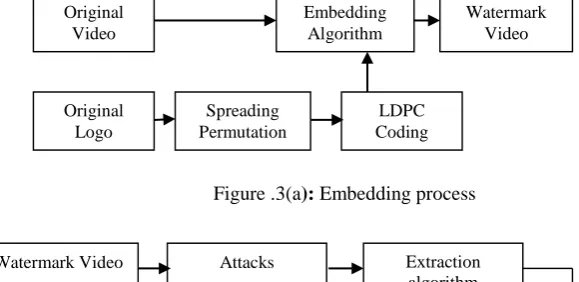
Figure .3(a): Embedding process
Figure .3 (b) Extraction Process
Figure 3: Block diagram of embedding and extraction process
Original Video: In this paper for the experimental analysis different videos available at[2] .The sample video frames are displayed below
Embedding Algorithm:
Consider a frame which is in true color RGB which is converted into Ycbcr.
Consider the Y component of the color transformed frame
Apply DCT (Discrete Cosine Transform)[11][12] and consider the middle frequency components for embedding line [32:32: MxN] where M & N are the x & y dimension of the frame.
Consider a logo to be embedded of size 32x32 and make the values to be as {-1, +1}.
Generate a random sequence of size [1 MxN] and consider the frequency position as stated in before point
Encode the message data with LDPC
The embedding process is
𝑉𝑖′= 𝑉𝑖+ 𝑎𝑖𝑏𝑘𝑝𝑘…… 5
Where ‘i’ is the ith DCT coefficient and ‘k’ is the middle frequency component , 𝑉
𝑖 is the unique DCT coefficient and 𝑉𝑖′ is the modified coefficient , 𝑝𝑘 ∈ {−1,1} is the spreading sequence .the value of 𝑎𝑖 is set as
If |𝑉𝑖|<2 then 𝑎𝑖= 2……6
If 2< |𝑉𝑖|<10 then 𝑎𝑖= 2.5 ……7
If 10< |𝑉𝑖|<20 then 𝑎𝑖= 3……8
If |𝑉𝑖|>20 then 𝑎𝑖= 5……9
Spreading sequences: In this paper three different types of spreading codes were used PN sequence [5].Gold Codes [6]and Walsh/Hadamard codes [7]
Extraction Process:
Watermark Video Attacks Extraction algorithm
LDPC decoding Spreading
permutation Extracted Logo
Original Video
Embedding Algorithm
Watermark Video
Original Logo
Spreading Permutation
Volume 3, Issue 5, 2016
The watermarked video frame is converted into Ycbcr from which the ‘Y’ component is selected for the process
Apply the DCT transform and convolve the middle frequency coefficients with spreading sequence. 𝐸𝑘= ∑(𝑘+1)𝑥𝑐𝑟−1𝑖=𝑘𝑥𝑐𝑟 𝑉𝑖′𝑝𝑖 …….. 10
𝐶𝑟 = 32
Consider the sign of the resultant coefficient value and perform LDPC decoding to extract the logo
PARITY CHECK CODES
Low-density parity-check (LDPC) codes are forward error-correction codes, first projected in the 1962 PhD thesis of Gallager at MIT[1]. At the time, their incredible potential remained undiscovered due to the computational demands of simulation in an era when vacuum tubes were only just being replaced by the first transistors. They remained mainly ignored for over 35 years. In the mean time the field of forward error correction was conquered by extremely ordered algebraic block and convolutional codes.
Parity Check Code:
A binary parity check code is a block code: i.e., a compilation of binary vectors of fixed length n. The signs in the code suit ‘r’ parity check equations of the form:
𝑋𝑎⊕ 𝑋𝑏⊕ 𝑋𝑐⊕ … … ⊕ 𝑋𝑧= 0……11
Where ⊕ 𝑚eans modulo 2 addition and Xa,Xb,Xc are the code symbols in the equation. Every codeword of length n can
include (n-r)=k information digits and ‘r ‘check digits.
Parity Check Matrix
A parity check matrix is an r-row by n-column binary matrix. Keep in mind k=n-r. The rows stand for the equations and the columns stand for the digits in the code word. There is a ‘1’ in the ith row and jth column if and only if the ith code
digit is enclosed in the jth equation
LDPC Code
The percentage of 1’sin the parity check matrix for a LDPC code is low.
A regular LDPC code has the feature that:
Every code digit is enclosed in the identical number of equations,
Every equation comprises of the identical number of code symbols.
An uneven LDPC code relaxes these constraints.
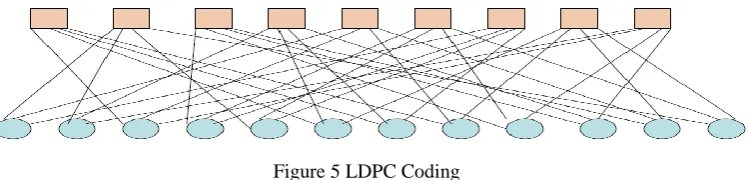
Decoding of LDPC codes is implied by a graphical portrayal.
The graph has two kinds of nodes: parity nodes and bit node. Every bit node depicts a code symbol and every parity node depicts a parity equation. There is a line drawn amid a bit node and a parity node if and only if that bit is caught up in that parity equation.
Volume 3, Issue 5, 2016 Figure 4 LDPC decoding
Squares represent parity equations, lines corresponds to 1st row and 1st column are represented Note that each bit node has
3 lines linking it to parity nodes and every parity node has 4 lines linking it to bit nodes.
Figure 5 LDPC Coding
Decoding is attained by passing messages along the lines of the graph. The messages on the lines that join to the i-th bit node, ci, are estimates of Pr[ci=1] (or certain corresponding information). At the nodes a variety of estimates are joined in a meticulous way.
Every bit node is furnished an early estimate of the likelihood it is a 1 from the soft output of the channel. The bit node broadcasts this early estimate to the parity nodes on the lines linked to that bit node. But every parity node ought to make novel estimates for the bits caught up in that parity equation and send these novel estimates (on the lines) back to the bit nodes.
Every parity node knows that there are an even number of 1’sin the bits linked to that node. But the parity node has attained estimates of the likelihood that each bit node linked to it is a 1. The parity node sends a novel estimate to the ith bit node
depending upon all the other probabilities given to it.
For instance, mull over the parity node equivalent to the equation
𝐶3⊕ 𝐶6⊕ 𝐶7⊕ 𝐶8= 0……..12
This parity node has the estimates p3, p6, p7, and p8 equivalent to the bit nodes c3, c6, c7, and c8, wherein pi is an estimate
for Pr[ci=1].
The novel estimate for the bit node c3 is
𝑝3′ = 𝑝6(1 − 𝑝7)(1 − 𝑝8) + 𝑝7(1 − 𝑝6)(1 − 𝑝8) + 𝑝8(1 − 𝑝6)(1 − 𝑝7) + 𝑝6𝑝7𝑝8
And likewise for other nodes
But the bit nodes are offered diverse estimates of Pr[c=1] by the channel and by every parity nodes linked to it.
It no longer broadcasts a solitary estimate but sends diverse estimates to every parity equation. The novel estimate sent to every parity node is attained by joining all other existing estimates. That is, in formulating the novel estimate sent to a parity node, it ignores the estimate established from that parity node.
If as an alternative to passing estimates of Pr[c=1] we pass estimates of log {Pr[c=1]/Pr[c=0]} wherein Pr[c=0] = 1 -Pr[c=1], we only needed to add the suitable terms. The channel estimate is forever used in all estimates passed to the parity node. The procedure now iterates: parity nodes passing messages to bit nodes and bit nodes passing messages to parity nodes. At the very last step, a concluding estimate is calculated at each bit node by calculating the normalized product of all of its estimates. Then a tough choice is made on each bit by comparing the concluding estimate with the threshold 0.5.
PN SEQUENCES
A pseudorandom noise (PN) sequence is a sequence of binary numbers, e.g. ±1, which appears to be arbitrary, but is in fact entirely deterministic. The sequence appears to be arbitrary in the sense that the binary values and groups or runs of the similar binary value take place in the sequence in the identical proportion, if the sequence were being produced depending on a fair "coin tossing" trial. In the trial, every head might lead to one binary value and a tail the other value. Pseudorandom sequences can be produced by using a Linear Feedback Shift Register (LFSR) circuit i.e. when a shift register has a non-zero early state and the output is fed back to the input, the unit acts as a periodic shift register
The third cells are tapped and modulo-2 added and fed back to the initial phase 𝑚1 = 𝑚2 ⊕ 𝑚3
The contents of the shift register are shifted with each clock pulse. The output of the LFSR is taken from the m3 stage. The outputs of the three shift registers in shown in the table under.
The output from the Linear Feedback Shift Register is a seven bit sequence
Volume 3, Issue 5, 2016 Table.1: Combinations of shift register
M1 M2 M3
1 1 1
0 1 1
0 0 1
1 0 0
0 1 0
1 0 1
1 1 0
1 1 1
N=2n-1, Where N is the period and n is the no of shift registers. If suitable feedback tap associations are completed, then
an n–bit shift register can generate a maximal length sequence using the above equation. The above sequence produced for a three feedback shift register phase is the highest length (M) sequence. The utmost length sequences are also identified as the pseudo noise or the PN sequences.
WATERMARKING USING PN SEQUENCES
Pseudo noise sequences are used for watermarking as their extremely high-quality correlation features, noise like distinctiveness and resistance to intrusion. Each data bit of the watermark is denoted by a large number of bits, out of which a major portion may be lost without losing the watermark methodically. This technique ensures the endurance of watermark because of redundancy. Pseudo noise sequences are a high-quality tool for watermarking due to the subsequent reasons[8]: PN generator generates periodic sequences that come out to be arbitrary. PN sequences are produced by an algorithm that uses a preliminary seed. The PN sequence produced is in fact not statically arbitrary but will pass numerous tests of randomness. Unless the algorithm and seed are identified, the sequence is not practical to forecast. A common technique that is followed for watermarking using PN sequences is embedding a PN sequences into the data wherein every PN sequence denotes one bit of watermarking information. For the watermark extraction the sequence of marked bits are connected with known PN sequence. To strongly embed one bit of watermark information with this technique the PN sequence length ought to be a great deal greater than the square of the highest data values [7]
The experiment was conducted with two dissimilar transformations like DCT (Discrete cosine transform) and DWT (Discrete wavelet transform) in which a block size 8x8 was used for block partitioning. A discerning number of coefficients were used as revealed in figure 8 from the low frequency bands. In the case of DWT; LL components were used with the same block size. The input video sequences were composed from of CIF format whose resolution is 352x288 in 4:0:0 YUV encoded stream .The trials were conducted with T0=0.3, T1=0.3 and T2=0.8 thresholds.
(a)
(b)
Volume 3, Issue 5, 2016
(a)
(b)
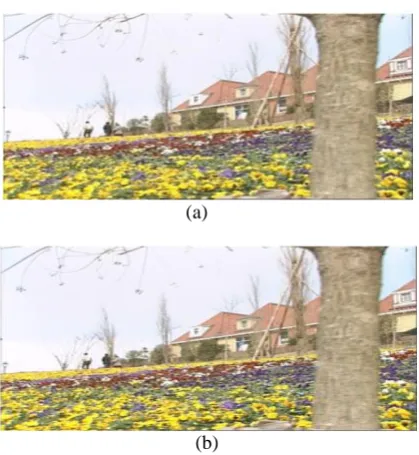
:Figure 7 (a) Original 2nd Frame of flower sequence (b) Marked frame with DWT, PSNR=28.25
Figure 8: Performance analysis of the planned scheme w r t diverse data rates and the likelihood of error
BLIND WATERMARKING WITH PARITY SEQUENCES IN TRANSFORM DOMAIN
(a)
(b)
Volume 3, Issue 5, 2016
(d)
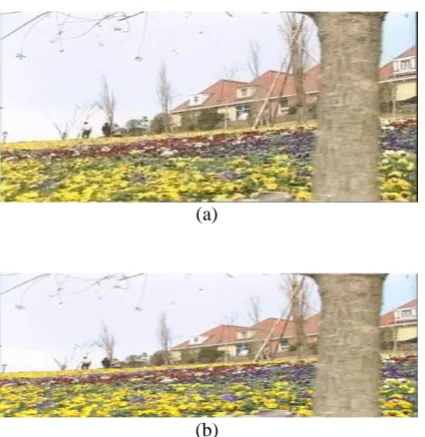
Figure 9 video frames from video samples considered for experiments (a) Flowers.avi (b) hall.avi (c) mobile.avi (d) suzie.avi
(a)
(b)
(c)
(d)
(e)
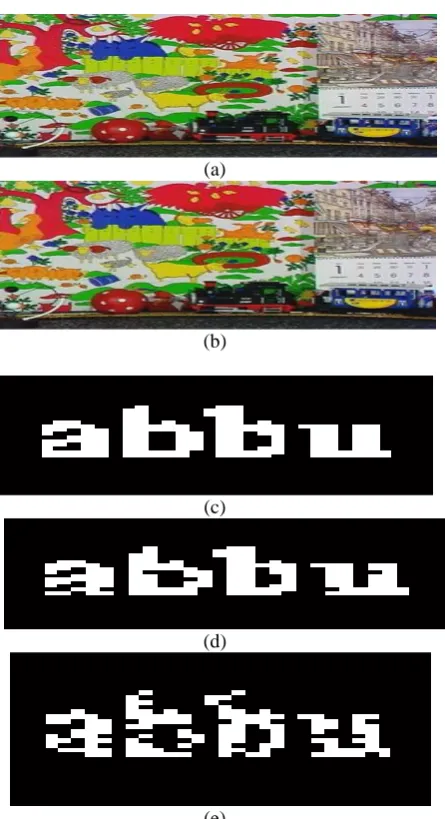
Figure 10: (a) Original Video frame (b) Watermarked frame (c) Original Logo (d) extracted with PN spreading sequence and LDPC coding (e) extracted Without LDPC coding
Table 2Analytical results with and without Pre coding
Parameter NO
PRE-CODING LDPC
BER 0.04 0.01
NC 0.99 0.99
Volume 3, Issue 5, 2016
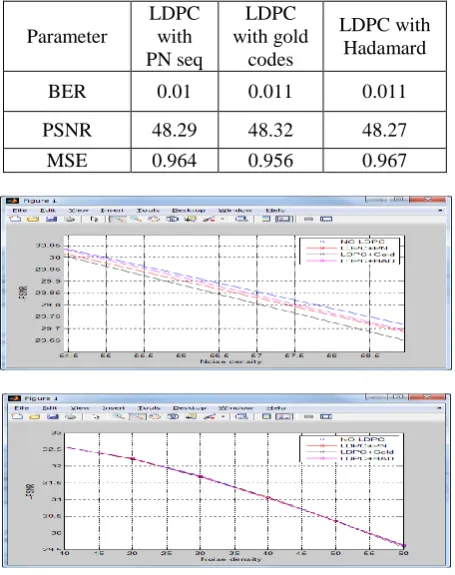
Table 3Analytical results for extraction with different preading sequences
Parameter
LDPC with PN seq
LDPC with gold
codes
LDPC with Hadamard
BER 0.01 0.011 0.011
PSNR 48.29 48.32 48.27
MSE 0.964 0.956 0.967
:
Figure 11 Performance analysis for mobile video sequence with proposed approach
Figure 12: Mean square Error Analysis of the proposed approach for the Mobile.avi video sequence
Volume 3, Issue 5, 2016
STEP BY STEP APPROACH
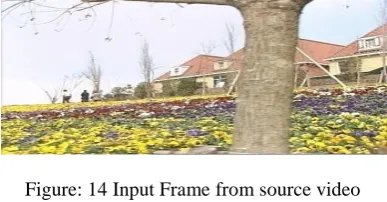
Figure: 14 Input Frame from source video
Figure: 15 Ycbcr Components of the frame
Input Message Length is 142560
T0=0.3; T2=0.8; Block size=8 Quantization matrix used
Q = [255 130 150 192 255 255 255 255 130 150 192 255 255 255 255 255 150 192 255 255 255 255 255 255 192 255 255 255 255 255 255 255 255 255 255 255 255 255 255 255 255 255 255 255 255 255 255 255 255 255 255 255 255 255 255 255 255 255 255 255 255 255 255 255];
Figure 16: Watermarked frame
Figure.17: Probability of Error
RESULT ANALYSIS
In this paper video data hiding mechanism in the selected regions is proposed, the experiments were conducted on different videos and of different block sizes. The scheme is implemented in two transformation domains discrete wavelet transform (DWT) and Non sub sampled Contourlet transform (NSCT). The Figures 14-17 shows the performance analysis of the proposed approach in two domains. difference of the error between these two transformations which depicts that there is a 0.06 (%) decrement in the error for NSCT when compared against DWT.
Volume 3, Issue 5, 2016
III Conclusion
FOR Selective zone based selective data embedding scheme is proposed in transform domain .The method out performs than the existing DCT based approach with and increment of about 0.2dB of PSNR on average with a probability of error 0.05 decrement. It is here by concluded that the current scheme may be utilized for better selective approach. This approach of blind video watermarking in transform domain with LDPC coding run faster than the conventional DCT based and also fits for the applications in the compressed video standards. When the perceptual quality is concerned, this approach preserved it and a slight variation (almost negligible) variation is observed and the watermark can be extracted blindly. The normalization coefficient between the embedded logo (message) and the extracted is very high and almost 1 which shows the efficiency of the algorithm
REFERENCES
[1]
Gallager, R.G., "Low-density parity-check codes," Information Theory, IRE Transactions on , vol.8, no.1,
pp.21,28, January 1962
[2]
K.R.Rao and J.J Hwang , ”Techniques and standards of Image, video and audio coding “, Prentice Hall
,1996
[3]
G. Do¨err and J.-L. Dugelay, “A guide tour of video watermarking,” Signal Processing: Image
Communication, vol. 18, no. 4, pp. 263–282, Apr. 2003.
[4]
I. Cox, M. Miller, and J. Bloom, Digital Watermarking. San Francisco, CA: Morgan Kaufmann, 2002
[5]
R. Wolfgang, C. Podilchuk, and E. Delp, “Perceptual watermarks for digital images and video,” Proceedings
of the IEEE, vol. 87, no. 7, pp. 1108–1126, July 1999.
[6]
Ingemar J. Cox, Joe Kilian, Tom Leighton and Talal Shamoon: A Secure, Robust Watermark for Multimedia.
Proceedings of the First International Workshop on Information Hiding, 1996
[7]
Frank Hartung and Bernd Girod: Watermarking of Uncompressed and Compressed Video. Signal
Processing ,1998.
[8]
Voigt, Z., “Watermarking 2D vector data for Geographical Information Systems”, proceedings of SPIE,
Security of Watermarking and Multimedia Content, San Jose, 2002.
[9]
F. Hartung and M .Kutter ,” Multi Media Watermarking Techniques “, Proceedings of the IEEE ,
87(7):1079-1107 , July 1999
[10]
C.I.Podilchuk and E.J.Delp. “Digital Watermarking: Algorithms and applications ” , IEEE signal Processing
Magazine, 18(4): 33-46, July 2001
[11]
A. M. Eskicioglu and E. J. Delp, “An overview of multimedia content protection in consumer electronics
devices,” Signal Processing: Image Communication, vol. 16, no. 7, pp. 681–699, Apr. 2001.
[12]
E. T. Lin, A. M. Eskicioglu, R. L. Lagendijk, and E. J. Delp, “Advances in digital video content protection,”
Proceedings of the IEEE: Special Issue on Advances in Video Coding and Delivery, vol. 93, no. 1, pp. 171–
183, Jan. 2005.
BIBLIOGRAPHY
1 Syamalapalli.Janardhanarao graduated his AMIE from Kolkota, INDIA Masters Degree in ECE from
Jawaharlal Nehru Technological University (JNTU) .AP. INDIA. He got another Master Degree in CSE from IETE Delhi, India. He is currently being Fellow of IETE, New Delhi. And working as an Associate Professor in the Department of electronics and communication Vardhaman college of engineering Shamshbad,Hyderabad, , India. He has served for 20 years in Indian Air force on different RADAR Systems. His main research fields include Digital Water Marking, Network security.