www.ijper.org
Studies on Development of Controlled Release
Matrix Tablets of Camptothecin-An Anticancer Drug
Buchi Naidu Nalluri*, Pavan Kumar Devineni, Maheswari Karna Male, Ashraf Sultana Shaik and
Chandra Teja Uppuluri
Department of Pharmaceutics, KVSR Siddhartha College of Pharmaceutical Sciences, Vijayawada-520010, AP, INDIA.
ABSTRACT
Objectives: The present investigation was carried out with an objective of formulating prototype controlled release (CR) matrix tablets of Camptothecin (CPT), an anti-cancer drug. Experimental: pH solubility profile studies of CPT and solubility of CPT in different surfactants were carried out. Controlled release tablets were prepared by direct compression method using hydroxyl propylmethyl cellulose (HPMC LVCR and HPMC K4M) as release retardants. The effect of different grades of microcrystalline cellulose (MCC) like Avicel PH 101 and Avicel PH 105 and solubilizing agents like cyclodextrins were included in the formulations and their effect on CPT release from tablets were studied. Results and Discussion: Solubility studies were conducted in order to select suitable dissolution medium for CPT. Based on the solubility studies, 0.1N HCl with 3% w/v SLS (pH1.2) was selected as dissolution medium. The FTIR and DSC results indicated that there was no in situ interaction between CPT and the selected excipients in the formualtions. Formulations containing 20% w/w of hydroxypropyl-β-cyclodextrin with Avicel PH105 as filler and HPMC k4M as release retardant gave superior CPT release of 98.40 ± 1.02% at the end of 12 h and fulfilled the regulatory requirements. The Higuchi square root model showed higher correlation coefficient values (0.949-0.990) indicating diffusion was the release mechanism for CPT from tablets. Conclusion: CPT can be formulated in to CR matrix tablets using HPMC K4M as release retardant and MCC as filler for better therapeutic efficacy.
Key words: Camptothecin, CR matrix tablets, Cyclodextrins, Dissolution studies, Solubility studies.
DOI: 10.5530/ijper.49.4.6 Correspondence Address
Dr. Buchi Naidu Nalluri
KVSR Siddhartha College of Pharmaceutical Sciences, Vijayawada - 520010, AP, INDIA.
E Mail: buchinalluri@yahoo. com
INTRODUCTION
Camptothecin (CPT) is a poorly water-solu-ble anti-cancer drug and used for the treat-ment of colorectal, breast, lung and ovarian cancers and according to the BCS system (Class-IV) its dissolution is the rate-limiting step for absorption.1,2 As a result, the use of
CPT is limited by its solubility issue in sev-eral clinical trials and research was carried out on development of water soluble ana-logues of CPT. The elimination half life of CPT is 58.7 mins.3 The dose of the CPT is
200 mg/day for individual weighing 70 kg.4
Since the elimination half life is short and its solubility is quite low, enhanced dissolution and sustained/controlled release character-istics are needed for CPT for better thera-peutic efficacy.
Submission Date : 18-12-2014
Revision Date : 05-02-2015
Accepted Date : 02-04-2015
To overcome hurdles like poor solubility and hydrolytic processes of CPT, development of adequate drug carriers is gaining increas-ing attention. Different approaches have been utilized to alleviate solubility and sta-bility issues of CPT.3-5 Most of the research
works were focused on the particulate deliv-ery of the CPT and its analogues especially as liposomes and nanoparticles.6-11 Very few
reports were published on the delivery of CPT and its analogues by oral matrix tablet technology.12,13
In the present study, we aim at developing prototype CR matrix tablets of CPT keep-ing in view of its shorter elimination half life.
carried out based on the solubility studies. CR matrix tablets of CPT were prepared using HPMC (LVCR100 and K4M) as release retardants and MCC (Avicel PH101
and Avicel PH105) as filler. Since, CPT is poorly water-soluble drug, its release from the CR matrix tablets is incomplete and therapeutically effective drug levels may not be achieved. Literature survey revealed that the solu-bility and stasolu-bility of CPT was successfully enhanced by inclusion complexation with cyclodextrins.3-5 Hence, in
this investigation solubilizing excipients like cyclodextrins (β-cyclodextrin and hydroxyl propyl-β-cyclodextrin) were included in the formulations and their effect on the CPT release was studied in order to achieve therapeutically effective levels of CPT CR from matrix tablets.
MATERIALS AND METHODS
Reagents and Chemicals
Camptothecin was obtained from Gamma Technol-ogy Development Co. Ltd. (Shenzhen, China). HPMC (LVCR100 and K4M grades) and MCC (Avicel PH101 and Avicel PH105 grades) were obtained from Color-con Asia Pvt.Ltd. Goa and FMC Biopolymers, USA, respectively. β-cyclodextrin and hydroxyl propyl-
β-cyclodextrin were obtained from Roquette Pharma, France. Tween 20 and Sodium lauryl sulphate were pur-chased from Lobachemie, Mumbai and Merck Pvt. Ltd., Mumbai respectively. Magnesium stearate and talc were
purchased from SD fine chemicals Ltd., Mumbai. All
Table 1: Formulae of CR matrix tablets of CPT
Ingredients
(mg/tab) F1 F2 F3 F4 F5 F6
CPT 50 50 50 50 50 50
HPMC
(LVCR100) - 22.5 22.5 - -
-HPMC (K4M) 22.5 - - 30 30 30
β-CD - - - - 30
-HP-β-CD - - - 30
MCC (AVICEL
PH101) - - 76 - -
-MCC (AVICEL
PH105) 76 76 - 68.5 38.5 38.5
Magnesium
Stearate 0.75 0.75 0.75 0.75 0.75 0.75
Talc 0.75 0.75 0.75 0.75 0.75 0.75
Total weight
(mg/tab) 150 150 150 150 150 150
β-Cyclodextrin Camptothecin
(CPT)
CPT CR Matrix Tablet
+
CPT release profiles from HPMC matrix (F4), with β-CD (F5) and
with HP-β-CD (F6)
other reagents were of analytical grade, and double dis-tilled water was used throughout. All solvents used in
HPLC analysis were of HPLC grade and filtered using a 0.45 µm nylon filter.
Analytical Method
Quantitative analysis of CPT was performed on a HPLC system (Shimadzu HPLC, class VP series) with two LC-20 AD pumps, SIL-20 A auto sampler, PDA detec-tor SPD-M20A VP, and Inertsil C18 column (250×4.6 mm dimensions and 5 µm particle size). The HPLC system was equipped with “LC-Solution” software to acquire and process the data. Mobile phase consist-ing of 15 mM ammonium acetate (pH 6.5): acetoni-trile (60:40) was used in isocratic mode and the mobile phase was filtered through nylon disc filter of 0.45 µm (Millipore) and sonicated for 3 min before use. The flow rate was 1 ml/min and the injection volume was 20 µl. PDA detection was performed at 254 nm and the separation was achieved at ambient temperature. Under these conditions the CPT was eluted at 6.8 min without any interference peaks.
Solubility Studies
Excess amounts of CPT (10 mg) was added to 15
ml of each fluid in a 25 ml stopper conical flask and
the mixtures were shaken for 48 hours at room tem-perature (37 ± 1°C) on orbital rotary shaker incubator
(Remi, India). During 48 hours of shaking 1ml aliquots
were withdrawn at different time intervals and filtered
immediately using a 0.45 µ nylon disc filter. The filtered
samples were diluted suitably and assayed for CPT by above HPLC method. Shaking was continued until three consecutive estimations were same. The solubility experiments were run in triplicate.
Characterization of CPT Tablet Powder Blends
Fourier Transmittance Infrared Spectroscopic (FT-IR) Studies
The FT-IR spectra of pure CPT and CPT with selected excipients like HPMC LVCR 100, HPMC K4M, Avi-cel PH 101, AviAvi-cel PH 105, β-CD, HP-β-CD, Magne-sium stearate and Talc was measured using ATR-FTIR spectrophotometer (Bruker, Germany). ATR spectra were measured over the wave number range of 4000-500 cm-1 at a resolution of 1.0 cm-1. The powder sample
is simply placed onto the ATR crystal and the sample spectrum is collected.
Differential Scanning Calorimetry (DSC) studies
Thermal analysis of pure CPT and CPT with selected excipients like HPMC LVCR 100, HPMC K4M, Avicel
PH 101, Avicel PH 105, β-CD, HP-β-CD, Magnesium
stearate and Talc was performed using DSC (Mettler Star SW 8.10). The sample was sealed in a crimped
aluminium pan by application of the minimum pos-sible pressure and heated at a rate of 10⁰C /min from 25-400⁰C in a nitrogen atmosphere. An empty alumin-ium pan was utilized as the reference pan.
Preparation of CPT CR Matrix Tablets
CPT CR matrix tablets were prepared by direct com-pression method, as per formulae given in Table 1. HPMC K4M and HPMC LVCR 100 were used as release retarding materials. Sufficient quantity of MCC (Avicel PH 101 and PH 105) was used to raise the bulk volume of the tablets to a weight of 150 mg each. Talc and magnesium stearate at 0.5% w/w levels were used as glidants/lubricants.
All the ingredients were passed through sieve # 80 before mixing. Initially drug and polymers were mixed thoroughly and then required quantities of fillers were added and finally the blend was mixed with talc and mixed thoroughly for 5 min in a poly bag and then required amount of magnesium stearate was added and mixed for another 5 min. Powder blends (for 50 tablets each) of all the above formulations were compressed on single punch tablet press (Cadmach, India) using 8 mm punches (round shape) at a hardness of 4-4.5 kg/cm2.
Evaluation of Flow Properties of powder blend
The powder blends were evaluated for parameters like bulk density, tapped density, Carr’s index, Angle of repose, and Hausner’s ratio.14
Evaluation of Post-Compression Parameters of CPT CR Matrix Tablets
The compressed CPT CR matrix tablets were evaluated for properties like drug content, uniformity of weight, friability, hardness and in vitro drug release studies.15
In vitro Drug Release Studies
In vitro drug release studies of CPT CR matrix tablet
formulations prepared were carried in 900 ml of 0.1N HCl with 3% w/v SLS as dissolution medium using USP XXI type II (Paddle method) Dissolution Rate Test Apparatus (LABINDIA, DS 8000, Mumbai, India) at 50/75/100 rpm. The temperature was maintained constant at 37 ± 0.5°C. 5 ml aliquots were withdrawn at different time intervals and filtered using a 0.45 µ nylon disc filter and replaced with 5 ml of fresh dissolu-tion medium. The filtered samples were diluted suitably and 10 µl conc. HCl was added and assayed for CPT by HPLC method. The dissolution experiments were con-ducted in triplicate.
Figure 2: FTIR Spectra of CPT - (A) CPT; (B) CPT-HPMC LVCR100; (C) CPT-HPMC K4M; (D) CPT-β-CD; (E) CPT-HP- β-CD; (F) Avicel PH101; (G) AvicelPH105;(H)
CPT-Magnesium Stearate; (I) CPT-Talc
Figure 3: DSC thermograms of CPT - (A) CPT; (B) CPT-HPMC LVCR100; (C) CPT-HPMC K4M; (D) CPT-β-CD; (E) CPT-HP- β-CD; (F) Avicel PH101; (G) AvicelPH105;(H)
Release Kinetics and Mechanisms
Different kinetic models i.e., Zero-order, First-order, Higuchi and release mechanism like Korsmeyer
Pep-pas were applied to interpret the release profile of CPT
from matrix systems.16-19
RESULTS AND DISCUSSION
Solubility Studies
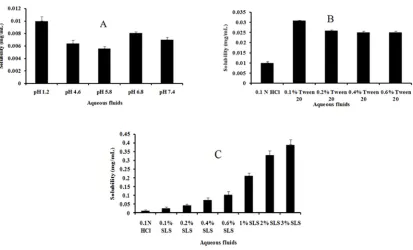
Solubility of CPT in 0.1N HCl was 0.01 mg/ml and found to be decreased with increase in pH of the aque-ous fluids as CPT it is weakly basic drug (Figure 1A). The solubility of CPT in aqueous fluids of pH 4.6-7.4 was almost same.
Since CPT is not official in any pharmacopoeia and no official dissolution medium was reported for CPT. Ideally, a dissolution medium should be able to provide sink con-ditions for the drug (i.e. at least 3 times the highest dose administered should be soluble in medium) and should have a be able to discriminate power i.e able to differenti-ate different degrees of product performance in terms of cumulative percent of drug released/dissolved. Hence in this investigation an attempt was made to develop a suitable dissolution medium for evaluation the CR matrix tablets of CPT with good discriminatory power based on the solubility studies. Hence, 0.1N HCl of pH 1.2 was selected for further development of dissolution medium as it afforded good solubility conditions and also keeping in view the fact that CPT exists in active lactone form in
pH 1.2 fluids. To enhance the sink conditions for CPT in 0.1N HCl, solubility studies were further carried out with surfactants like Tween 20 and SLS.
Solubility studies of CPT in 0.1N HCl with different per-centages of Tween 20 showed 2-3 fold increase in solu-bility and but sink conditions can’t be maintained (Figure 1B). Solubility studies of CPT revealed that perfect sink conditions were achieved with 0.1 NHCL with 3% SLS as dissolution medium (Figure 1B). A 39 fold increase in solubility of CPT with 0.1N HCl (pH 1.2 ) containing 3% w/v SLS was achieved, which equals to about 7 times the dose of the CPT in the 900ml of the dissolution medium (Figure 1C). Moreover, this medium also showed good discrimination between various formulae in terms of cumulative percent of drug released. Hence, 0.1N HCl (pH 1.2) with 3% w/v SLS was chosen as dissolution medium to develop CR matrix tablets of CPT.
Characterization of CPT Tablet Powder Blends
FTIR Studies
FTIR spectrum of CPT showed -OH stretching at 3,426.25 cm, C-C(=O)-O streching for cyclic ester (lac-tone) at 1,740.15 cm-1, C=C and C-C(=O)-O
stretch-ing for the pyridone at 1649.92 cm-1 and 1,151.42 cm-1,
C=C and C-N stretching for quinoline ring at 1,600.29, 1,572.28 and 1,437.40 cm-1. Peak at 771.33 cm-1 appears
to be a contribution of four adjacent hydrogen bonds on hetero-atomic nucleus. The characteristic absorp-tion bands of CPT were all retained in the FTIR spectra of 1:1 w/w physical mixtures of the CPT and selected
Figure 4: Comparative in vitro release profiles of CPT -(A) using HPMC K4M (F1) and HPMC LVCR100 (F2); (B) using AVICEL
excipients. These results indicated that there was no in situ interaction between CPT and the selected excipients in the formualtions (Figure 2).
DSC Studies
DSC thermograms of the pure CPT and CPT with the selected excipients are shown in Figure 3. The CPT showed a sharp endothermic peak at around 290ºC cor-responding to its melting point.20 The sharp
endother-mic melting peak of CPT at 290ºC was retained in all the thermograms of 1:1w/w physical mixtures of the CPT and selected excipients. These results indicated that the CPT was compatible with all the selected excipients in the formulations.
Evaluation of Flow Properties of Powder Blend
The powder blends of the formulations were evaluated for the flow properties. The results were in good agree -ment with specified values. These results indicated that the powder blends of all formulations were suitable to compress tablets by direct compression method. How-ever, flow properties of formulation blends containing Avicel PH 105 were superior when compared to Avicel PH 101.
Evaluation of Post-Compression Parameters of CPT CR Matrix Tablets
The compressed CPT CR matrix tablets were evaluated for properties like drug content, uniformity of weight, friability and hardness. The drug content of CPT CR matrix tablets was within 100 ± 1% of labeled claim. A good degree of uniformity in weight of tablets was achieved for all batches of tablet formulations prepared. The % deviation was within 3, which indicates excellent uniformity in weight of all batches of tablet formula-tions. The friability values of all batches of tablet for-mulations prepared were less than 1%. The hardness of all batches of tablet formulations compressed ranged between 4-4.5 kg/cm2.
In vitro Drug Release Studies
The CPT CR matrix tablets prepared by direct com-pression using HPMC (LVCR 100 and K4M) as release retardant and MCC (Avicel PH101 and Avicel PH105) as filler were evaluated in paddle type apparatus using 900ml of 0.1N HCl containing 3% w/v SLS as medium with agitation speed of 50/75/100 rpm.
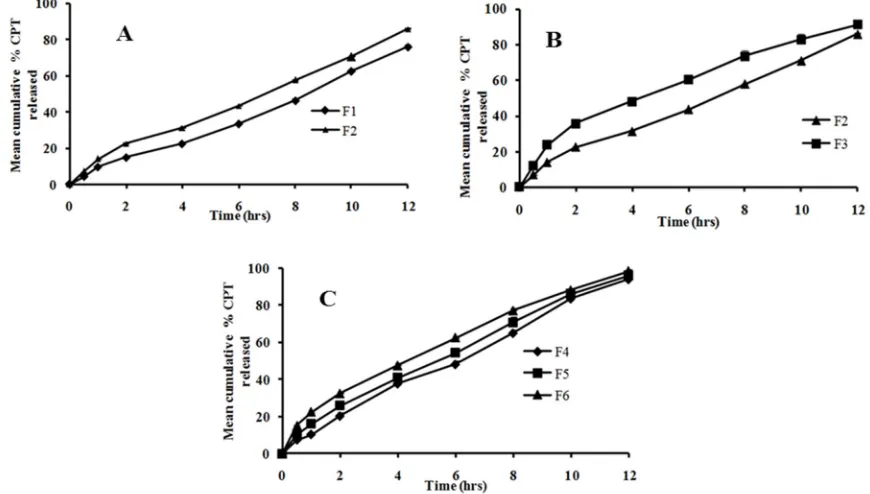
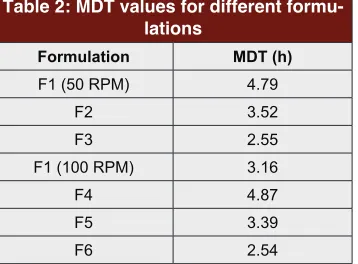
In the present study, initially the effect of different release retardant polymers on CPT release from CR matrix tablets was studied. F1 and F2 containing K4M and LVCR100 at a level of 15% w/w of total tablet weight with AVICEL PH105 as filler gave 76.13 ± 1.11 and 86.07 ± 0.62 percent CPT releases respectively at end of 12 h. Comparative in vitro dissolution profiles of F1 and F2 were shown in Figure 4A. The tablets in case of F2 eroded completely by the end of 8 h, whereas in case of F1, tablets remained intact for 10 h. Being a low viscosity grade (80-120 cp) HPMC polymer when com-pared to HPMC K4M (3000-5600 cps), the LVCR100 induced faster swelling of the tablet, leading to faster
Table 2: MDT values for different formu -lations
Formulation MDT (h)
F1 (50 RPM) 4.79
F2 3.52
F3 2.55
F1 (100 RPM) 3.16
F4 4.87
F5 3.39
F6 2.54
Figure 5: Comparative in vitro release profiles of CPT (F1)
with different agitation speeds
Figure 6: Comparative in vitro CPT release profiles using different concentrations of HPMC K4M - 15%w/w (F1) and
disruption and erosion of CR matrix tablets. The cal-culated MDT for F1 is 4.79 h, whereas it is 3.52 h for F2. Based on the MDT values (Table 2), it can be fur-ther confirmed that HPMC K4M showed slow swell -ing rate followed by slower erosion/disintegration of tablet compared with formulations containing HPMC LVCR100 and hence more retarding capacity. Hence, keeping in view of drug release profiles obtained with F1 and F2, HPMC K4M was selected as release retard-ing polymer.
Later the effect of AVICEL PH101 as a filler on CPT
release from CR matrix tablets was studied. F3 contain-ing LVCR100 at a level of 15% w/w of total tablet weight were developed 91.15 ± 2.49 percent of CPT at the end of 12 h. Comparative in vitro dissolution
profiles of F2 and F3 were shown in Figure 4B. Ini -tial burst release at 1 h was 14.02 ± 0.07 and 23.73 ± 2.32% respectively for F2 and F3.The tablets in case of F3 were completely eroded by the end of 7 h, whereas in case of F2, tablets eroded by the end of 8 h. Superior burst release was achieved with formulations containing
AVICEL PH101 as filler rather than formulations con
-taining AVICEL PH105 as filler, this could be due to
quicker swelling of tablets containing AVICEL PH101 compared to formulations containing AVICEL PH105. Therefore, based on dissolution data obtained with F2 and F3 and keeping in view of the results obtained from pre-compression studies and integrity of the tablets
dur-ing dissolution, AVICEL PH105 was selected as filler.
As CPT is poorly water soluble drug, the effect of agi-tation speed on drug release pattern from CR matrix tablets was studied. F1 containing 15 % w/w HPMC K4M of total tablet weight as release retarding polymer and AVICEL PH105 as filler was evaluated under 3 dif -ferent agitation speeds. Comparative in vitro dissolution, 50, 75 and 100 rpm was 76.13 ± 1.11, 97.58 ± 1.24 and 98.62 ± 0.949 respectively. These results showed clear discrimination that percent drug release increased with increase in agitation speed (Figure 5). Hence, keeping
in view of CPT release profiles obtained with differ -ent agitation speeds and to maintain hydrodynamics and sink conditions, 100 rpm was selected as agitation speed. Later effect of release retardant percentage on CPT release from CPT CR matrix tablets was studied. The cumulative percent CPT released at the end of 12h from F4 CPT CR matrix tablets containing 20% w/w of HPMC K4M was 94.16 ± 1.45. Whereas, F1 contain-ing 15% w/w HPMC K4M at 100 rpm gave 98.62 ± 0
.94 percent CPT release at end of 12 h, which is signifi -cantly higher. Comparative in vitro dissolution profiles of
F1 and F4 were shown in Figure 6. Initial burst release at 1 h was 27.26 ± 2.52 and 10.17 ± 0.39% respectively for F1 and F4. The MDT value (Table 2) for F1 (at 100 rpm) was 3.16 h and in the case of F4 it was 4.87 h. The tablets in case of F1 were completely eroded by the end of 10 h, whereas in case of F4, the integrity of the tab-lets was maintained throughout 12 h. Hence, keeping in
view of drug release profiles obtained with F1 and F4,
F4 with 20% w/w HPMC K4M was selected as core formulation.
Since CPT is poorly water soluble drug, its release from CR matrix tablet is incomplete and therapeutically effec-tive drug levels may not be achieved. Hence, in the
pres-ent investigation cyclodextrins like β-CD and HP-β-CD
at a level of 20% w/w of total tablet weight (F5 and F6) were included in the formulations and their effect on the CPT release was studied in order to achieve thera-peutically effective levels of CPT. A 96.23 ± 1.27% CPT release was observed at end of 12 h with F5
con-taining β-CD (20% w/w) and 98.4 ± 1.02% of CPT
release was observed at end of 12 h with F6 containing
HP-β-CD (20% w/w). The initial release of CPT at 1 h
was 10.17 ± 0.39, 15.98 ± 0.42 and 22.27 ± 0.92 respec-tively for F4, F5 and F6. The addition of cyclodextrins
significantly increased the initial burst release of CPT
from the formulations. The CPT release was more with
HP-β-CD when compared to β-CD. This is because of more hydrophilic nature of HP-β-CD than the β-CD.
Table 3: Release kinetic parameters of different formulations
Formulation release (12 Mean% h)
Zero order First order Higuchi Peppas
k0 (h-1) R2 k (h-1) R2 K
h (h-1/2) R2 n R2
F1 (50 RPM) 76.14 ± 1.11 6.06 0.991 0.10 0.934 21.54 0.912 0.734 0.980
F2 86.08 ± 0.62 6.73 0.992 0.14 0.926 24.41 0.951 0.650 0.989
F3 91.16 ± 2.49 7.10 0.950 0.18 0.976 26.92 0.995 0.504 0.996
F1 (75 RPM) 97.58 ± 1.24 7.954 0.927 0.29 0.978 30.45 0.989 0.514 0.996
F1 (100
RPM) 98.62 ± 0.94 7.906 0.897 0.33 0.978 30.73 0.988 0.664 1.0
F4 94.16 ± 1.45 7.813 0.995 0.20 0.901 28.26 0.949 0.874 0.992
F5 96.23 ± 1.27 7.81 0.990 0.23 0.896 28.66 0.970 0.688 0.999
Comparative in vitro dissolution profiles of F4, F5 and
F6 were shown in Figure 4C.
Among all the formulations, F6 containing 20% w/w HP-β-CD gave superior and required CPT release of 98.4 ± 1.02% at the end of 12 h and fulfilled the regula -tory requirements in terms of percent drug release. H2* Release Kinetics and Mechanisms
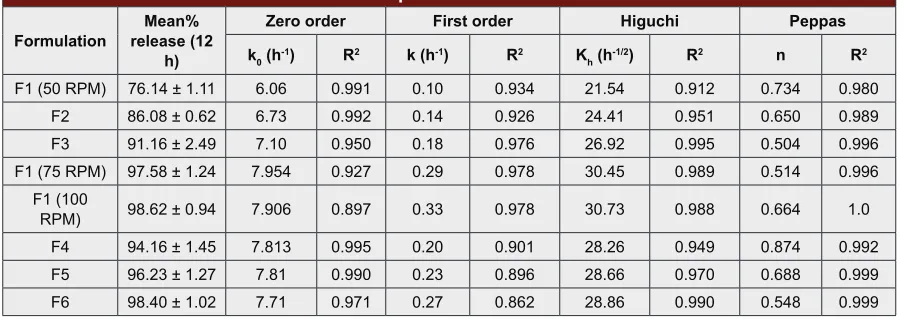
Formulations F1 (100 rpm), F4, F5 and F6 were evalu-ated for release kinetics and mechanisms. The R2 values
for F1 (100 rpm) obtained with First order plots were found to be superior when compared to R2 values of
Zero order plots. These results indicated that the CPT release from F1 (100 rpm) followed First order kinetics (Table 3). In case of F4, F5 and F6, R2 values obtained
from Zero order plots were found to be superior when compared to R2 values obtained from First order plots
indicating that CPT release from F4, F5 and F6 fol-lowed Zero order kinetics.
The Higuchi square root model showed higher correla-tion coefficient values (0.949-0.990) indicating diffusion was the release mechanism for CPT from F1 (100rpm), F4, F5 and F6. The graphs of log % QT versus log t showed a linear relationship with R2 values ranging
from 0.992-1.0 and ‘n’ values obtained by fitting initial 60 % cumulative CPT release data from F1 (100 rpm), F4, F5 and F6 in to Korsmeyer Peppas equation ranged between 0.548-0.874 indicating anomalous transport (both diffusion and erosion) as CPT release mechanism from CPT CR matrix tablets (Table 3).
CONCLUSION
CPT, a poorly water soluble drug can be formulated in to CR matrix tablets using HPMC K4M as release
retar-dant and MCC as filler for better therapeutic efficacy in
order to make this molecule to a successful anticancer drug. Addition of solubilising agents like HP-β-CD sig -nificantly increased the dissolution of CPT within tablet core and enhanced the release rate.
ACKNOWLEDGEMENTS
The authors are thankful to Dr. U Das, Undurti Life Sciences, USA for providing gift sample of Camptoth-ecin and to the Siddhartha Academy of General and Technical education, Vijayawada for providing facilities to carry out the research work.
Highlights of Paper
• Camptothecin (CPT) is a poorly water-soluble anti-cancer drug can be used for the treatment of colorectal, breast, lung and ovarian cancers.
• It has short half life and so, controlled release (CR) formulations are required for better therapeutic efficacy. • Cyclodextrins were added in the CR tablet formulations to enhance the CPT solubility in order to ensure
com-plete release of CPT from matrix tablets.
• Formulations containing 20%w/w of hydroxypropyl-β-cyclodextrin with microcrystalline cellulose as filler and HPMC K4M as release retardant gave superior CPT release (F6) and fulfilled the regulatory requirements.
Author Profile
REFERENCES
1. Wall ME, Wani MC. Camptothecin and Taxol: from discovery to clinic. Journal of Ethnopharmacol 1996; 51(1-3): 239-53.
2. Biswajit Basu, Kevin Garala, Ravi Bhalodia, Bhavik Joshi, Kuldeep Mehta. Solid lipid nanoparticles: A promising tool for drug delivery system. Journal of Pharmacy Research 2010; 3(1): 84-92.
3. Kang J, Kumar V, Yang D, Chowdhury PR, Hohl RJ. Cyclodextrin
complexation: Influence on the solubility, stability, cytotoxicity of
Camptothecin, an antineoplastic agent. European Journal of Pharmceutical Sciences2002; 15(2): 163-70.
4. Naveen K, Thakral AR, Daniel BS, Andre HE, Dipak KM. Soluplus-solubilized
citrated Camptothecin-A potential drug delivery strategy in colon cancer. AAPS Pharm Sci Tech. 2012; 13(1): 59-66.
5. Shankar Swaminathan, Linda Pastero, Loredana Serpe, Francesco Trotta, Pradeep Vavia, et al. Cyclodextrin-based nanosponges encapsulating camptothecin: physicochemical characterization, stability and cytotoxicity.
European Journal of Pharmaceutics and Biopharmaceutics2009; 74(2): 193-201.
6. Cortesi R, Esposito E, Maietti A, Menegatti E, Nastruzzi C. Formulation
study for the antitumor drug Camptothecin: liposomes, micellar solutions and a microemulsion. International Journal of Pharmaceutics 1997; 159(1): 95–103.
7. Daoud SS, Fetouh MI, Giovanella BC. Antitumor effect of liposomes-incorporated Camptothecin in human malignant xenografts. Anti-cancer drugs 1995; 6(1): 83-93.
8. Ann Mari S, Goril EF, Martin B. A method to determine the incorporation capacity of Camptothecin in liposomes. AAPS Pharm Sci Tech. 2004; 5(3): 30-7. 9. Ryotaro Kunii, Hiraku Onishi, Yoshiharu Machida. Preparation and
antitumor characteristics of PLA/PEG-PPG-PEG) nanoparticles loaded with Camptothecin. European Journal of Pharmaceutics and Biopharmaceutics 2007; 67(1): 9-17.
10. Shankar S, Linda P, Loredana S, Francesco T, Pradeep V, Dino A, et
al. Cyclodextrin-based nanosponges encapsulating Camptothecin:
Physicochemical characterization, stability and cytotoxicity. European
Journal of Pharmaceutics and Biopharmaceutics 2010; 74(2): 193-201. 11. Lei Yang, Fude Cui, Dongmei Cun, Anjin Tao, Kai Shi, Wenhui Lin.
Preparation, characterization and bio distribution of the lactone form of 10-hydroxycamptothecin (HCPT)- loaded bovine serum albumin (BSA)
nanoparticles. International of Journal of Pharmaceutics 2007; 340(1): 163-72. 12. Lev Bromberg T, Alan Hatton, Rafael Barreiro-Iglesias, Carmen Alvarez,
Angel Concheiro. Controlled release Camptothecin tablets based on pluronic and poly (acrylic acid) copolymer. Effect of fabrication technique on drug stability, tablet structure and release mode. Drug Development and Industrial
Pharmacy 2007; 33(6): 607-15.
13. Chen H, Jiang G, Ding F. Monolithic osmotic tablet containing solid dispersion
of 10-hydroxycamptothecin. Drug Development and Industrial Pharmacy 2009; 35(2): 131-7.
14. The United State Pharmacopoeia. USP30-NF-25, Asian edition. M Rockville, United States Pharmacopoeial Convention Inc; 2007; 643-5.
15. Lachman L, Herbert AL, Joseph LK. The Theory and Practice of Industrial
pharmacy. 3rd Edition. Varghese publishing house; 1987; 296-300.
16. Brazel CS, Peppas NA. Modeling of drug release from swellable polymers.
European Journal of Pharmaceutics and Biopharmaceutics 2000; 49(1): 47-58. 17. Lapidus H, Lordi NG. Drug release from compressed hydrophilic matrices.
Journal of Pharmaceutical Sciences 1966; 55(8): 840-3.
18. Higuchi T. Mechanism of sustained action medication, theoretical analysis of rate of release solid drugs dispersed in solid matrices. Journal of Pharmaceutical Sciences 1963; 52(12): 1145-8.
19. Korsmeyer RW, Gurny R, Doelker E, Buri P, Peppas NA. Mechanism of solute release from porous hydrophilic polymers. International Journal of Pharmaceutical Sciences 1983; 15(1): 25-35.
20. The Merck Index. edited 12th edition, Merck Research Laboratories, New