VOLUME 38, ARTICLE 34, PAGES 929
−
966
PUBLISHED 9 MARCH 2018
http://www.demographic-research.org/Volumes/Vol38/34/ DOI: 10.4054/DemRes.2018.38.34
Research Article
Interethnic marriage in Northeast China,
1866–1913
Bijia Chen
Cameron Campbell
Hao Dong
© 2018 Bijia Chen, Cameron Campbell & Hao Dong.
This open-access work is published under the terms of the Creative Commons Attribution 3.0 Germany (CC BY 3.0 DE), which permits use, reproduction, and distribution in any medium, provided the original author(s) and source are given credit.
1 Introduction 930
2 Background 932
2.1 The Eight Banners 932
2.2 Assortative mating 934
2.3 Interethnic marriage during the Qing 936
2.4 Shuangcheng 938
3 Data 940
4 Methods 944
4.1 Community, household, and individual influences on intermarriage 944
4.2 Assortative mating over time 948
5 Results 950
5.1 Descriptive results 950
5.2 Determinants of intermarriage 951
5.3 Time trends 953
6 Conclusion 957
7 Acknowledgments 959
References 960
Interethnic marriage in Northeast China, 1866–1913
Bijia Chen1
Cameron Campbell2
Hao Dong3
Abstract
BACKGROUND
There is considerable debate about whether Manchu and associated non-Han ethnic groups in China maintained a distinct identity in the late 19th century or were ‘sinicized’ and assimilated into the Han majority.
OBJECTIVE
We assess the boundaries between Han and non-Han groups by examining the determinants of interethnic marriage in China in the late 19th and early 20th centuries in a setting where Han, Manchu, and other non-Han were free to intermarry, without being subject to institutional restrictions that limited such marriages elsewhere in China.
METHODS
We make use of the China Multi-Generational Panel Dataset, Shuangcheng (CMGPD-SC), which consists of roughly 1.3 million observations of 107,890 Han, Manchu, Mongol, Xibo, and other individuals who lived in rural Northeast China between 1866 and 1913. We apply logistic regressions to examine the determinants of ethnic intermarriage and contingency table analysis to examine trends over time.
RESULTS
Marriage between Han and non-Han was not uncommon and increased over time. The chances of ethnic intermarriage were affected by village and family context by and individual characteristics.
1
CONCLUSIONS
In a setting where Han, Manchu, and other ethnicities were free to intermarry, they did so in large numbers, suggesting that by itself ethnicity was not a salient boundary when it came to marriage in Northeast China in the late 19th century.
CONTRIBUTION
This is one of the first quantitative studies of ethnic intermarriage in China before the 20th century and one of only a small number of such studies for historical non-Western populations.
1. Introduction
One of the most vigorous debates in the study of Qing history concerns whether the descendants of the Manchu conquerors maintained an identity distinct from that of their Han subjects or were ‘sinicized’ via a process of assimilation and integration (Crossley 1991, 1997, 1999; Elliott 2001; Ho 1967, 1998; Rawski 1996). On the one hand, Ho (1967) argued that, by the end of the Qing, the Manchus had lost their distinct identity and been assimilated into Han Chinese culture. Crossley (1991, 1997, 1999), Elliott (2001), Rhoads (2001), and others dispute the claim that the Manchus had been sinicized and suggest that they had a distinct identity well into the 19th century, although they differ in the details of their arguments and the implications. Understanding these processes during the Qing dynasty (1644–1911) is important because this was a key period in Chinese history: It was not only the last imperial dynasty, but also the crucible from which key features of 20th-century Chinese economy, politics, and society emerged (Ho 1967).
Sociologists routinely study the assimilation of ethnic groups by examining intermarriage. While assimilation is a complex process that cannot be reduced to a single indicator, intermarriage offers insights into one key dimension: whether ethnic identity is salient enough as a boundary to influence marriage decisions. For example, Pagnini and Morgan (1990) and Qian and Lichter (2007) examine intermarriage in the United States in the early and late 20th century respectively for insight into boundaries between immigrant groups and the native-born population. Low rates of intermarriage, like the levels observed between African Americans and whites in the United States, are suggestive of in-group preferences on the part of one or both groups. High rates, meanwhile, are indicative of relative indifference to the ethnicity of prospective spouses.
China regarding civilians and the Eight Banners, as detailed in the next section, would complicate the interpretation of results: Intermarriage between mostly Manchu bannermen and mostly Han civilians was forbidden or at least strongly discouraged (Zhang and Zhang 2005; Liu 2008). If Manchu–Han intermarriage was rare in the general population, it is unclear whether it reflected compliance with prohibitions against marriage between bannermen and civilians or deliberate avoidance based on ethnicity.
This paper explores the boundaries between Han and non-Han in the late Qing by studying intermarriage in an unusual population whose members were able to marry without regard to the prohibitions against marriages between bannermen and civilians that, as a by-product, prevented marriages between Manchu and Han elsewhere in China. The population we study were affiliated with the Eight Banners. Families should have been free to emphasize or ignore the ethnicity of prospective spouses for their son or daughter according to their own preferences or prejudices. High rates of intermarriage would indicate indifference to boundaries, while very low rates would indicate attentiveness to them.
Our analysis makes use of the China Multi-Generational Panel Dataset, Shuangcheng (CMGPD-SC). This records the population of a settlement in Shuangcheng County in what is now Heilongjiang Province on an annual basis between the middle of the 19th century and the beginning of the 20th. For our analysis, we use two measures of ethnicity to identify cases of intermarriage: the registered ethnicity of husbands recorded in the original data and the implied ethnicity as suggested by maiden names of their wives. The data also allows us to examine the relationship of intermarriage and socioeconomic status because they include household landholding and official positions held by males.
While this study is by no means intended to resolve the debate over sinicization, we hope that the results will offer a novel perspective on ethnic boundaries between Manchu and Han during the Qing by taking a very different approach than previous studies. Whereas much of the earlier work examines relations among elites or in major cities where there were banner garrisons, we study the routine behavior of residents of farming communities on the frontier. Their decisions regarding marriage provide insights into the practice of identity on the ground, reflecting their daily experiences and interactions.
integration, or, in the case of studies of black–white intermarriage in the United States, test Merton’s status exchange theory (1941). Studies of marriage between Chinese and neighboring peoples in the Qing and earlier dynasties, like studies of intermarriage between the residents of empires and neighboring peoples, have generally been qualitative and focused on the role of marriage in diplomacy. Similarly, studies of marriage for conquering peoples such as the Manchus, who founded the Qing dynasty, and the Mongols, who founded the Yuan dynasty (1271–1368), have generally focused on the strategies of elite families.
The rest of the paper is divided into five parts. In Section 2 we provide historical background on ethnicity and ethnic intermarriage during the Qing period, giving the institutional and historical context for the study site. In Section 3 we introduce the CMGPD-SC, which is the basis for our analysis, and provide background on Shuangcheng. We explain our approaches to the measurement of ethnicity. In Section 4 we describe our methods. We use tabulations to characterize patterns of ethnic assortative mating and then estimate logistic regressions to examine how community, household, and individual characteristics influenced the probability that a man would marry a woman of a different ethnicity. In Section 5 we present the results and interpret the main findings. We conclude in Section 6 with an assessment of the results for our understanding of Qing China.
2. Background
2.1 The Eight Banners
One of the most distinctive and widely noted features of Qing China was that it was founded by a conquering army organized by Manchus, who originated in what is now Northeast China, and then ruled by their descendants. As part of their effort to maintain control, the conquerors and their descendants sought to retain an identity distinct from that of their subject population. Toward this end they created a civil and military organization, the Eight Banners, membership of which was hereditary and defined by descent from the Manchu conquerors and their Mongol or other allies. Rules and regulations privileged bannermen (qiren) and governed their interactions with the nonbanner civilian population, made up mostly of Han Chinese. Outside Northeast China, bannermen lived separately from Han Chinese and other civilians in garrisons.
residents of the territory they conquered by their emphasis on martial skills, such as horseback riding, archery, and hunting. They continued to use their own written and oral language, dressed differently than the Han, chose recognizably different given names (Campbell, Lee, and Elliott 2002), and had different traditions for marriage, burial, and other ceremonies. While the Manchu adapted Confucian ideology to legitimate their rule, there is plenty of debate, as noted before, over the extent to which they actually assimilated to the majority Han culture (Crossley 1991, 1997, 1999; Elliott 2001; Ho 1967, 1998).
The Eight Banners were originally an institution of military management among the Jurchen tribes of Northeast China. They gradually developed into a more elaborate political and military institution as the Jurchen expanded southward from Northeast China and eventually completed their conquest of the country (Du 2008). When the Eight Banner system was first established in 1615, the bannermen consisted mainly of Manchus who were part of the conquering army, along with some Mongols and other ethnicities who lived in Northeast China. It also included some Han who had lived under the Jurchen. More Han were added to the banners later, either because they helped in the conquest or because they had other relationships with the Manchu. Subsequently, affiliation was hereditary.
The Eight Banners had an internal hierarchy (Xu 2008). The Upper Three Banners (shangsanqi) were of higher status. They included the Plain Yellow, Bordered Yellow, and Plain Blue. Membership was limited to the Manchu conquerors and their descendants only. The Lower Five Banners (xiasanqi) included the Plain Red, Bordered Red, Plain White, Bordered White, and Bordered Blue. In addition to Manchu, they included other ethnicities, such as Mongol, Xibo, and Han. These banners were of lower status on a number of levels (Ding 1992; Li 1992). Whereas in Shuangcheng the Han and other groups were mixed together with Manchu in the Lower Five Banners, in other contexts they were organized under separate formal structures. The Han who were part of the Eight Banners were mostly descended from Han who resided in areas that were conquered early on and were incorporated into the Han-martial Eight Banners (baqi hanjun). Another sign that Han bannermen had a distinct and somewhat lower status is that during the reign of Qianlong (1735–1796) they were allowed to choose whether they wanted to retain their status or become non-banner Han civilians (Sun 2005).
also investigated the question of Manchu and Han assimilation by studying the Han banners. He concluded that the resinicization of Han bannermen led to the overall sinicization of the Manchu banner population (Xie 2008). Wu and Zhao (2008) examined the Xibo garrison, focusing on its origins (Wu and Zhao 2008). Other Chinese researchers have looked into the ethnic identity of Han bannermen in Northeast China. Wu concluded that Han bannermen in Heilongjiang mostly assimilated into Manchu culture in terms of their language, customs, and ethnic identity, although there were some exceptions (Wu 2005). Qiu described the life of bannermen and their descendants who live in suburban areas of Beijing based on oral history interviews and by referring to other archives (Qiu 2014).
As discussed in the introduction, there is intense debate over whether the Manchu retained a distinct identity or had been assimilated by the Han by the end of the Qing. The case for sinicization was made most forcefully by Ho (1967, 1998). He argued that the Qing embraced Confucianism as a way of legitimating their rule and that, following the example of previous conquest dynasties, the Manchu and other groups that were part of the banners were eventually assimilated into Han Chinese society. In contrast, Crossley (1991, 1997, 1999), Elliott (2001), Rhoads (2001), and others have suggested that Manchus retained a distinct identity well into the 19th century. The specifics of their arguments differ. Elliot (2001: 14) explored Manchu identity formation and claimed that “the Manchus were never as a group assimilated into Chinese society in the Qing.” He said that the Manchu conquest group took measures to maintain boundaries that would distinguish them from the majority Han (Elliott 2001). Crossley (1991) claimed that not only were the Manchus not sinicized but their self-consciousness of their distinct ethnicity grew over time in response to changes in their own position and in Chinese attitudes toward them (Crossley 1991).
2.2 Assortative mating
One of the most influential theories about the relationship of race and ethnic intermarriage to broader social context is Merton’s (1941) original theory of status exchange. Initially developed to account for patterns of interracial marriage in the 20th -century United States, this theory suggests that, when marrying, individuals leverage high status on one level by seeking a spouse who may be low status on that level but high on another. Other theories of race and ethnic assortative mating focus on explaining ethnic homogamy (that is, the choice of a spouse from within the same group). Preferences for cultural similarity have been studied in the literature on personal attraction in psychology (Byrne 1971). Another hypothesis about within-group marriage is group identification (Hwang, Saenz, and Aguirre 1995), according to which more educated individuals may be more likely to intermarry because they are not as concerned about identifying as a member of their origin group.
Assortative mating by race and ethnicity is widespread, reflecting the salience of relevant social boundaries. In the most extreme cases, such boundaries are imposed by laws forbidding specific types of intermarriage. Even where laws do not forbid intermarriage, prejudice against specific racial or ethnic groups may lead to marriages with them being rare. Conversely, groups may discourage their members from marrying out in order to preserve the identity of the group and prevent assimilation. In other cases, low rates of intermarriage between groups result from the indirect effect of associations between group membership and other characteristics that play a role in spouse selection: for example, religion (Pagnini and Morgan 1990).
Racial and ethnic intermarriage is consequently widely studied for what it reveals about the formation, maintenance, and dissolution of boundaries between groups. The relevant literature is sizeable and here we provide examples of a few influential studies that use intermarriage to study assimilation. Intermarriage between racial and ethnic groups in the United States is the most frequently considered. Common topics include the determinants of interethnic marriage (Furtado and Trejo 2013), the linguistic distance (Chiswick and Houseworth 2011), trends of intermarriage over time (Qian and Lichter 2007), and immigration in relation to assimilation (Pagnini and Morgan 1990). Outside the United States, Monden and Smits (2005) studied marriages between Latvians and Russians before and after independence from the Soviet Union, and found that at least half of the increase in intermarriage following independence could be explained by what they refer to as “the integrative process.” In an analysis that preceded the civil war in Yugoslavia by several years, Botev (1994) examined ethnic intermarriage there and concluded that it was not increasing, and that there was little evidence that boundaries between groups were diminishing.
2000), published studies of ethnic intermarriage are rare and tend to focus on specific regions or provinces. For Taiwan, marriages between Taiwanese and mainlanders have been examined in the historical and political context of relationships between those two groups (Wu 2002; Liang 2009). In conjunction with a study of consanguinity (marriage with kin) in a Man (Manchu) population in a community in rural Liaoning, Wang, Qian, and Bittles (2002) reported rising levels of intermarriage between Manchu and Han in the 20th century. In a study using 1990 census data from Beijing and Xinjiang, Mamet, Jacobson, and Heaton (2005) found that Man were the most likely to intermarry and Uyghurs the least.
2.3 Interethnic marriage during the Qing
Even though the prohibition against marriage between bannermen and civilians was well enough known to be the basis of a common saying (“Qi min bu tonghun” – “Banner and civilians do not intermarry) and had the side effect of preventing intermarriage between Han and Manchus in much of China, we have not located any evidence of prohibitions against ethnic intermarriage within the Eight Banners during the Qing. The small number of published quantitative studies of ethnic intermarriage during the Qing rely on the ethnicity apparent in the maiden names of wives in genealogies from elite Manchu descent groups, such as the Imperial Lineage. The results tend to confirm that prohibitions against bannerman marrying Han populations (min) were respected, at least in the selection of primary wives (qi) (Lee, Wang, and Ruan 2001; Lee and Wang 2000). In elite families of the ruling class, primary wives were almost entirely Manchu, while qie (commonly translated as ‘concubines’) and other partners of lower status could be Han. Remaining studies of ethnic intermarriage in the Eight Banners are mostly qualitative, focusing on the institutional context, or reporting on case studies of specific locations based on archival documents or the results of fieldwork among contemporary descendants of Eight Banner populations.
In her study of women in the Eight Banners, Ding (1999: 323–356) summarizes much of what is known about intermarriage between Manchu and Han during the Qing. She emphasizes that what we refer to as the boundary between Manchu and Han during the Qing was in fact a boundary between the ruling banners and their civilian subjects, not necessarily between the two ethnic groups as they are presently defined. According to Ding, within the Eight Banners, Manchu, Han, and other ethnicities were free to intermarry (Ding 1999: 349), and this may have been a way the Manchu and Han within the banners integrated.
Han was encouraged in order to reduce tensions between the two groups. However, the policy did not work well and the Qing court quietly canceled the policy soon afterwards (Rawski 1991: 181–182). Subsequently, intermarriage between bannermen and civilians was prohibited during the early Qing, mainly to prevent Manchu women from marrying Han men. Starting during the reign of Kangxi (1661–1722), men in the Eight Banners were allowed to marry Han women under specific conditions. This practice became common during the Qianlong period (1736–1795). The prohibition against intermarriage between the banners and Han was revived in the Jiaqing period (1796– 1820) and then relaxed again in 1865. The rule that forbade daughters of bannermen from marrying Han civilian males was amended so that it applied only in Beijing (Ding 1999: 343–344).
A number of other studies examine intermarriage between bannermen and Han civilians (Zhang and Zhang 2005; Liu 2008). Formal or informal prohibitions against such intermarriages were most influential in the Upper Three Banners (Zhang and Zhang 2005). Bannermen also had an economic incentive not to intermarry. They enjoyed benefits and privileges, including legal protection of their real estate and other property, that they could lose if they married Han civilians (Liu 2008). In spite of these obstacles, at least one qualitative study relying on interviews with the living descendants of mixed marriages suggests that in Eight Banner garrisons bannermen married local non-banner Han civilians (Pan 2007). Liu (2008) also compared marriage practices across Eight Banner garrisons and found that while bannermen in northern garrisons, such as Xian and Suiyuan, avoided marrying civilians for more than 200 years, in other garrisons, such as Hangzhou, they did so frequently. Bannermen took civilian Han women as their wives, but banner women rarely married civilian Han men (Liu 2008).
2.4 Shuangcheng
The population of Shuangcheng that we study was descended from Manchu, Han, and other bannermen who lived in Beijing and other locations in areas that are now Hebei, Liaoning, and Jilin Provinces and migrated to Shuangcheng between 1815 and 1838 (Chen, Lee, and Campbell 2010; Chen 2009, 2017; Ding 1991). The original movement of the bannermen to Shuangcheng in the early 19th century was organized by the state (Chen 2017). That the settlement was carefully planned and regulated is evident in Figure 1, which shows the locations of settlement villages in Shuangcheng. The Qing government relocated 698 metropolitan banner families from Beijing to Shuangcheng in order to reduce the expense associated with supporting them in the capital. The relocated families were given land grants instead of monthly and annual allowances for their support. These were the jingqi, or metropolitan bannermen. To clear the land, construct 120 new villages, and otherwise help the metropolitan families adjust to rural life, the government also relocated 3,000 households of rural bannermen from areas that are now Hebei, Liaoning, and Jilin Provinces (Wang et al. 2013). These were the
tunding. Shuangcheng was otherwise closed to other legal migrants before the 1860s. Status as jingqi or tunding was hereditary, descending through the father.
The state privileged the jingqi in a number of ways. Most importantly, it gave them larger allocations of land. In Shuangcheng, each tunding household was allocated 18.33 shang, while each jingqi household was allocated nearly twice that amount: 35 shang (Chen 2017). 4 Detailed analysis of landholding data in Shuangcheng proved that the local government succeed in maintaining the inequality between metropolitan and rural bannermen: In 1876, about 58% of the rural banner households were in the bottom half of the overall landholding distribution, while only 13.5% of the metropolitan banner households were in the bottom half. The state also intervened in the land market to maintain these differentials (Chen 2017). Meanwhile, male tunding were required to serve as laborers. Tunding households without adult males had to hire laborers to fulfill the service requirement.
4Shang is a unit of land in historical China, especially in northern China. 35 shang correspond to about 64
Figure 1: Shuangcheng settlement, Heilongjiang, late 19th to early 20th century
Source: Wang et al. (2013).
3. Data
To study ethnic intermarriage in Shuangcheng during the Qing, we make use of 1.3 million records of over 100,000 individuals in the CMGPD-SC (Lee et al. 2013). Because this data and extensive documentation are publicly accessible for download at ICPSR (Wang et al. 2013), and are the basis of a book on stratification and demographic behavior which also provides extensive detail on local context (Chen 2017), here we only summarize specific details relevant to the analysis.5 The CMGPD-SC was constructed from population registers compiled annually in Shuangcheng from 1866 to 1913. Records included individual name, age, relationship to household head, demographic characteristics, and entrances and exits. Importantly for this analysis, the CMGPD-SC records the registered ethnicity of households. For males, registered ethnicity was hereditary and descended through the father. Other historical Chinese population sources, such as the China Multi-Generational Panel Dataset, Liaoning (CMGPD-LN), mostly do not record registered ethnicity, except in very specific circumstances.
The CMGPD-SC includes a number of measures of social, economic, and political status. The CMGPD-SC organizes individuals not only by household and village, but by banner, which, as noted earlier, was an important dimension of status because of its association with jingqi or tunding status (Chen 2017; Wang et al. 2013). The CMGPD-SC includes landholding recorded at six points in time: 1870, 1876, 1882, 1887, 1889, and 1906. Landholding reflected a mixture of state and market influences. The land allocation policy of the state differentiated between jingqi and tunding (Chen 2017).
Previous studies using the CMGPD-SC and CMGPD-LN establish these datasets as valuable source for studying social, economic, and demographic history (Chen 2017; Dong et al. 2015; Dong 2016; Lee and Campbell 1997). The suitability of the registers for studying marriage has already been demonstrated in studies of community and household influences on the chances of marrying or remarrying (Chen, Campbell, and Lee 2014; Campbell and Lee 2008a; Dong 2016). Other studies have used the CMGPD-SC and the related CMGPD-LN to examine stratification and demographic behavior (Campbell and Lee 2008b, 2011; Chen 2017; Chen, Lee, and Campbell 2010). Studies of Liaoning by Ding et al. (2004) and Lee and Campbell (1997) use only the CMGPD-LN but are relevant as background on regional and banner history and context.
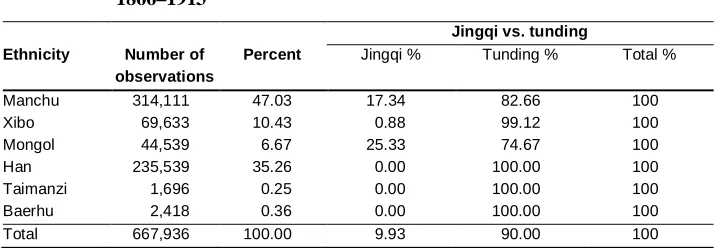
Our sample is based on records of jingqi and tunding in CMGPD-SC. Both the jingqi and tunding include a mixture of Manchu, Mongol, Han, Xibo, and other groups. The diversity is apparent in Table 1, which presents the registered ethnicity of males in the CMGPD-SC according to whether they were jingqi or tunding. The higher-status
5 The data and accompanying documentation may be downloaded at ICPSR: http://www.icpsr.umich.edu/
jingqi were composed mostly of Manchu, but included Mongol and Xibo. Importantly, the jingqi did not include any Han at all. The lower-status tunding included a substantial proportion who were Han, with the remainder distributed among the other non-Han groups (Chen 2017). Han accounted for 35% of males, making them a minority in Shuangcheng. Outside Northeast China, of course, Han Chinese accounted for the majority of the population. According to one estimate, non-Han in the Eight Banners accounted for only 2–4% of the population of China overall during the Qing (Elliott, Campbell, and Lee 2016).
Table 1: Registered ethnicity and population category of males, Shuangcheng, 1866–1913
Jingqi vs. tunding Ethnicity Number of
observations
Percent Jingqi % Tunding % Total %
Manchu 314,111 47.03 17.34 82.66 100
Xibo 69,633 10.43 0.88 99.12 100
Mongol 44,539 6.67 25.33 74.67 100
Han 235,539 35.26 0.00 100.00 100
Taimanzi 1,696 0.25 0.00 100.00 100
Baerhu 2,418 0.36 0.00 100.00 100
Total 667,936 100.00 9.93 90.00 100
Notes: Restricted to observations of males between 1 and 75sui. We exclude those observations whose registered ethnicity was not available in the data.
Source: CMGPD-SC, 1866–1913.
ethnicity being either Han or non-Han. We identified surnames that were exclusively or predominantly Han and non-Han by tabulating surnames against the registered ethnicity of men in our data. Then we flagged wives’ ethnicity based on whether their maiden name was one that the tabulations indicated was predominantly Han or predominantly non-Han, and retained the remainder in our sample as a third group classified as indeterminate.
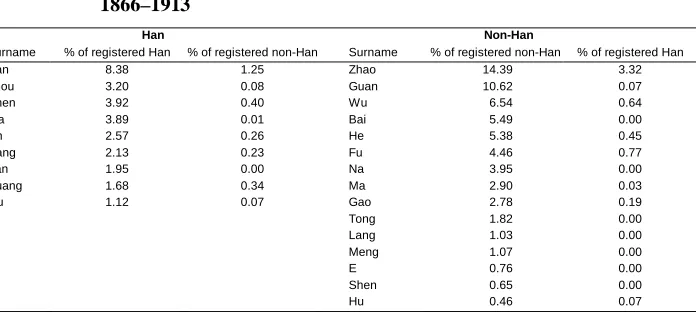
Tabulation of male surnames by registered ethnicity identifies a subset of surnames that have a clear association with ethnicity, in the sense that they are almost exclusively Han or non-Han. Table 2 presents the top 20 surnames according to whether the male’s household ethnicity is registered as Han or non-Han. Through a review of such tabulations, we identified a subset of surnames listed in Table 3 that appear almost exclusively in Han or non-Han households, and are therefore likely to be reliable indicators of the registered ethnicity of the wife’s household of origin. These are the basis for our flag variable. For a wife’s likely ethnicity we identified nine Han surnames (Han, Zhou, Jin, Chen, Xia, Jiang, Mu, Pan, Huang) that appeared primarily among men registered as Han and used these as the basis for inferring Han ethnicity among wives. For example, 8.46% of the Han population was surnamed Han, versus 1.8% of the non-Han population. The distinction is even clearer for the remaining Han surnames. Zhou accounts for 3.29% of the Han population, but 0.26% of the non-Han population. To identify non-Han wives, we also identified 15 surnames that in the Shuangcheng registers appear solely or primarily among non-Han men (Zhao, Guan, Wu, Bai, Fu, He, Gao, Na, Ma, Tong, Lang, Shen, Meng, E, Hu). While outside Northeast China some of these are primarily associated with Han Chinese, within Shuangcheng this is a coincidence, and the surnames don’t reflect kinship with Han Chinese lineages elsewhere in China that have the same surname.
Table 2: Top 20 male surnames by registered ethnicity, Shuangcheng, 1866–1913
Han surname % of Han population Non-Han surname % of non-Han population
1 Wang 15.21 Zhao 14.39
2 Liu 9.01 Guan 10.62
3 Han 8.38 Wu 6.54
4 Zhang 6.22 Bai 5.49
5 Li 4.43 He 5.38
6 Chen 3.92 Fu 4.46
7 Xia 3.89 Na 3.95
8 Zhao 3.32 Wang 3.24
9 Zhou 3.20 Xu 3.16
10 Jin 2.57 Liu 2.95
Table 2: (Continued)
Han surname % of Han population Non-Han surname % of non-Han population
12 Jiang 2.13 Li 2.81
13 Fan 2.11 Gao 2.78
14 Pan 1.95 Zhang 2.32
15 Yan 1.69 Tong 1.82
16 Huang 1.68 Wen 1.44
17 Yuan 1.50 Han 1.25
18 Su 1.47 Yu 1.10
19 Yu 1.47 Meng 1.07
20 Xu 1.42 Su 1.06
Other 22.17 Other 21.25
Total 100.00 100.00
Observations 7,401 12,396
Source: CMGPD-SC, 1866–1913. Restricted to tunding and jingqi.
Table 3: Surnames used to flag Han and non-Han wives, Shuangcheng, 1866–1913
Han Non-Han
Surname % of registered Han % of registered non-Han Surname % of registered non-Han % of registered Han
Han 8.38 1.25 Zhao 14.39 3.32
Zhou 3.20 0.08 Guan 10.62 0.07
Chen 3.92 0.40 Wu 6.54 0.64
Xia 3.89 0.01 Bai 5.49 0.00
Jin 2.57 0.26 He 5.38 0.45
Jiang 2.13 0.23 Fu 4.46 0.77
Pan 1.95 0.00 Na 3.95 0.00
Huang 1.68 0.34 Ma 2.90 0.03
Mu 1.12 0.07 Gao 2.78 0.19
Tong 1.82 0.00
Lang 1.03 0.00
Meng 1.07 0.00
E 0.76 0.00
Shen 0.65 0.00
Hu 0.46 0.07
Source: CMGPD-SC, 1866–1913. Restricted to tunding and jingqi.
other non-Han selected Chinese characters to represent their surnames, they did so on the basis of the pronunciation of their names in their native language. The Manchus began to adapt Chinese characters to represent their surnames only after they conquered China in the early 17th century, in part out of a desire to improve communication with their Han subjects (Gao 2001). This also explains why some of the surnames that appear mainly or solely among non-Han people in Shuangcheng seem to be the same as surnames associated with Han Chinese elsewhere in China.
The surnames in Table 3 that are predominantly Han or non-Han are roughly the same as the ones that other studies have identified as being strongly associated with being either Han or Manchu, Mongol, or other non-Han. Because these were adapted as transliterations, they don’t reflect common ancestry with Han Chinese with the same surnames elsewhere in China. Studies of Manchu surnames list the most common Chinese characters used to represent them during the Qing and trace the history of the practice of using Chinese characters for surnames back to the Liao, Jin, and Yuan periods (Gao 2001). For example, Guan and Bai are common Chinese surnames for people whose Manchu-language surname is Gua’erjia. Gao and He are common Chinese surnames for people whose Manchu-language surname is Hesheli. Overall, as many as one-third of the Chinese characters routinely used to represent Manchu surnames originated with the Jurchens during the Jin dynasty in the 12th century (Mu 2005).
4. Methods
4.1 Community, household, and individual influences on intermarriage
Right-hand-side variables listed in Table 4 measure characteristics of the newlywed husband, his household, and his village. We make use of information about the husband from when they were first recorded as married. When a right-hand-side variable is an indicator, for example, of whether the husband holds a non-Han name, the mean given in Table 2 represents the proportion of the population in that category. The coefficient that we estimate later will reflect the proportional difference in the odds of having a wife from another ethnicity, compared to the odds of having a wife from the other ethnicity for those males who do not have a non-Han name.
Table 4: Means of the right-hand-side variables, newlywed males, Shuangcheng, 1866–1913
Husband’s characteristics Han Non-Han
Father ever held a position 0.03 0.06
Father has a non-Han given name 0.08 0.22
Father not located in the data 0.16 0.17
Mother’s surname is non-Han (Han) 0.15 0.06
Mother not in the data 0.19 0.19
Husband has a non-Han given name 0.05 0.14
Husband is the eldest son 0.57 0.58
Village % Han 0.66 0.24
Landholding (ref: 0–15)
15–18.33 0.10 0.12
>18.33 0.33 0.37
Landholding missing 0.32 0.27
Husband’s age (ref: 11–20 sui)
21–30 sui 0.50 0.53
31–40 sui 0.17 0.19
Time period (ref: 1866–1879)
1880–1889 0.14 0.15
1890–1899 0.14 0.15
1900–1913 0.32 0.30
Population category (ref: jingqi)
Tunding 1.00 0.87
We include six sets of right-hand-side variables that measure different aspects of social and economic status at time of marriage at household and individual levels: (1) jingqi (metropolitan bannermen) or tunding (rural bannermen), (2) household landholding, (3) whether or not the husband’s father has ever held a government position, (4) an indicator for whether the husband’s father has a non-Han given name, (5) an indicator for whether the husband has a non-Han given name, (6) husband’s age at marriage, (7) an indicator for whether the husband’s mother’s maiden name was non-Han, and (8) an indicator for whether or not the husband was an eldest son.
Among the Manchu, we expect jingqi to be less likely than tunding to marry a Han wife. As noted earlier, the jingqi had the highest status in Shuangcheng (Chen 2017). They were all Manchu and Mongols, and descended from the bannermen who had been relocated from Beijing and Rehe. The state took active measures to maintain distinctions between them and the tunding, including granting them a variety of economic and social privileges. The tunding were descended from bannermen farmers in Liaoning and Jilin who were recruited by the state to help prepare the area for the jingqi. For jingqi, a Han wife would necessarily be tunding, and families indifferent to the ethnicity of their son’s wife may have had little incentive to recruit a wife from the lower-status tunding. By contrast, economically less successful non-Han tunding may have had an incentive to intermarry with economically successful Han tunding if it allowed them to exchange their higher ethnic status for a connection with an economically successful family (Merton 1941).
For our measure of landholding, we use a categorical variable. To construct it, we calculate the total amount of land held by each household, merge it to individual records, and then categorize the amount of land held as high, medium, or low. For years where no landholding information was available for an individual, we copied their information forward from the most recent available year. For those whose landholding information was still missing after attempting to copy forward, we created an indicator variable, thereby separating them into a different category.6
We expect men whose fathers held a position to have been more likely to intermarry if they were Han, but less likely to intermarry if they were non-Han. In historical China, a father’s socioeconomic status influenced adult male marriage chances (Chen, Campbell, and Lee 2014). Men with high-status fathers married earlier and were more likely to marry overall. In a largely rural society like Shuangcheng, holders of relatively mundane salaried government positions were among the local elite because they had a fixed nonagricultural income. Some positions also provided opportunities for additional income beyond the official salary. Han males whose fathers
6
held a salaried position may have been an attractive prospect for non-Han families with daughters, while similarly advantaged non-Han families may have had great incentive to consider daughters from Han families. We do not use the husband’s own official position because most men married before they were old enough to attain a position.
As a measure of expressed ethnic affiliation or aspiration, we use indicators of whether the husband or his father had a non-Han given name. When Han took non-Han given names, it was typically to express an affiliation with the ruling Manchus. For example, in Liaoning men often took Manchu given names upon acquiring an official position (Campbell, Lee, and Elliott 2002). Some of the bannermen in Shuangcheng who were registered as Han had Manchu given names, suggesting a desire to express affiliation with the non-Han banners. Among Han males in our population, having a non-Han given name may have reflected some status not otherwise measured that led them to express affiliation. Accordingly, we expect Han males who had non-Han given names or whose fathers had non-Han given names to have been more likely to marry non-Han women.
We include a categorical variable to control for age at time of marriage for the husband. In historical China, male age at marriage was strongly associated with socioeconomic status. Higher-status males married earlier. Lower-status males married later or not at all (Campbell and Lee 2008a). To the extent that earlier marriage reflected higher social or economic status, we expect Han men who married early also to be more likely to marry non-Han wives, and non-Han men who married early to be less likely to marry Han wives. The age of males in our regression models ranges from 11 to 40 sui, so we divided the observations into three age categories: 11–20, 21–30, and 31–40. We start at age 11 because previous studies of marriage in Northeast China reveal that men began to marry at around that age (Chen, Campbell, and Lee 2014). Overall, they were most likely to marry in their early or mid-twenties.
Han men who had a mother with a non-Han maiden name should be more likely to marry a non-Han wife. Although the registered ethnicity of these men was Han, they probably included some who were of mixed ancestry, in the sense that their mother may have been non-Han. For a Han male, the fact that their mother was non-Han may indicate that their father was himself of higher status than other Han males. Of course, having a non-Han mother may have increased the chances of marrying a non-Han woman in other ways. For example, the husband may already have had affinal kin who were non-Han who could assist in the search for a spouse by providing introductions to other non-Han families.
To the extent that families were also more strategic and selective when it came to evaluating prospective daughters-in-law for eldest sons, we expect Han males who were eldest sons to have been more likely to marry non-Han wives. Conversely, we expect non-Han males who were eldest sons to have been less likely to marry Han wives.
We include the percentage of the village population currently registered Han as a measure of the ethnic composition of the local marriage market. The share of Han or non-Han people within the village may affect the chances of intermarriage by shaping the composition of the marriage market. In historical China, families sought brides in the same village or a neighboring village. If people were completely indifferent to the ethnicity of their spouse, or more broadly if preferences were unchanging, an increase in the share of the local population that was of a particular ethnicity should increase the share of marriages involving that ethnicity. If the percentage of Han in the village was high, we would expect non-Han families seeking brides for their sons to have had more Han potential brides to choose from, and if they were indifferent to ethnicity or their preferences with respect to ethnicity did not vary across villages, the share of Han brides should still increase. Meanwhile, Han families should have had fewer non-Han brides from whom to choose. The measure we use in the logistic regression is not time-varying. Ethnic differences in marriage and reproduction were small and we doubt that composition within villages changed much over time, but we do address the possibility of changes over time in the population-level composition of the marriage market in the contingency table analysis.
We expect the chances of intermarriage to have changed during the period covered by our data, 1866–1913. As discussed above, regulations related to intermarriage focused more on maintaining boundaries between bannermen and civilians, and less on boundaries between ethnic groups, and they appear to have been relaxed starting in 1865. In the last few decades of the 19th century, China experienced political, social, and economic change. Attacks by foreign countries and unrest in other parts of the country weakened the Qing state and reduced the status of bannermen. We expect that these changes, especially the diminished status of Manchus, weakened boundaries between Han and non-Han. To control for changes over time in the chances that an individual intermarried, we include a categorical variable by dividing our data into four periods: 1866–1879, 1880–1889, 1890–1899, and 1900–1913.
4.2 Assortative mating over time
within-population differences in the propensity to intermarry but is less useful for producing a population-level measure of the tendency to intermarry or remain homogamous. While coefficients from the logistic regressions may reveal differences between men in the likelihood of intermarriage, by themselves they do not necessarily yield insight into the overall prevalence of intermarriage at the population level. That requires consideration of the distribution of couples according to the characteristics of both husband and wife.
We begin by computing the ratios of observed to expected marriages for different combinations of husband’s and wife’s ethnicity over the four periods specified earlier. We consider two categories for husband’s registered ethnicity (Han and non-Han) and three categories for wife’s inferred ethnicity (Han, indeterminate, non-Han). We restrict our observations to newly married couples. Expected numbers of marriages were calculated on the assumption that ethnicity played no role at all in partner choice, and numbers of marriages to spouses of a particular type were directly proportional to the overall share of spouses of that type. When the ratio of observed to expected marriages is high, this means that pairs with those characteristics form more often than would be expected if their matching was random. If the ratio is higher than one for spouses from the same ethnic background, this means that there is ethnic homogamy, in the sense that people are more likely to be married to people of the same ethnicity than can be accounted for by chance.
We then apply contingency table analysis to model the numbers of newly married couples with different combinations of ethnicity in time periods. Studies of assortative marriage across religious, ethnicities, and educational attainments routinely make use of such models (Kalmijn 1991; Mare 1991; Johnson 1980; Pagnini and Morgan 1990). To account for the influence of the numbers of husbands and wives of each ethnicity on the total numbers of couples of each combination, these models control for the distributions of husbands and wives by category, and estimate parameters that reflect how common or uncommon different types of pairings are relative to what would be expected if families were indifferent to the associated characteristics. Because they rely on records of new couples, these models account for changes across time periods in the ethnic composition of the newlyweds.
parameter estimates for ethnic homogamy. These parameters and their interaction with time periods measure the extent of ethnic homogamy and its changes over time.
logF =β +β +β +β +β β +β β +pδ +pδ β (1)
5. Results
5.1 Descriptive results
Ethnic intermarriage was not uncommon. According to a tabulation of a husband’s recorded ethnicity by ethnicity implied by his wife’s surname in Table 5, 7.90% of married non-Han men had wives who appear to be Han, in the sense that their maiden surname was observed primarily in households whose registered ethnicity was Han. Conversely, 21.35% of Han men have wives who appear based on their maiden names to be non-Han. These are conservative estimates based solely on a small number of surnames that had a very clear association with one ethnicity or the other. For both Han and non-Han men, some wives currently in the indeterminate category are certain to be of a different ethnicity than their husband. According to Table 6, among non-Han males intermarriage with Han was more common for the tunding than for the jingqi. The tunding were of lower status than the jingqi, so may have had more incentive to intermarry, if it allowed them to form connections with economically successful Han families.
Table 5: Percentages of Han and non-Han newlywed men married to Han or non-Han wives, Shuangcheng, 1866–1913
Husband’s registered ethnicity
Husband’s population category
Wife’s ethnicity as suggested by maiden name
Indeterminate observations
%
Han observations
%
Non-Han observations
%
Total
Non-Han Jingqi 810 77 734 1,621
49.97 4.75 45.28 100.00
Non-Han Tunding 5,449 914 4,565 10,928
49.86 8.36 41.77 100.00
Non-Han All 6,259 991 5,299 12,549
49.88 7.90 42.23 100.00
Han Tunding 4,586 1,306 1,599 7,491
61.22 17.43 21.35 100.00
Observations 10,845 2,297 6,898 20,040
By themselves, the percentages intermarrying presented in Table 5 do not yield insight into actual preferences because they are subject to the influence of the relative availability of Han and non-Han in the marriage market. According to Table 5, Han were a minority (7,491 out of 20,040) of the husbands in Shuangcheng: 37.4%. This is very close to the share of Han men in Shuangcheng in Table 1. Assuming the shares of Han women in the marriage market were similar, it would have been arithmetically difficult for a large share of non-Han to marry Han wives, even if their families all wanted them to. Similarly, large shares of Han men marrying non-Han wives may simply have reflected their relative abundance in the marriage market, not a specific preference. Making inferences about preference or avoidance requires comparison of observed marriages with the number that would be expected if families were indifferent to the ethnicity of their son- or daughter-in-law. Therefore, below we make use of contingency table analysis.
5.2 Determinants of intermarriage
Mother’s inferred ethnicity had strong effects on a man’s chances of intermarriage. Table 6 presents the results of logistic regressions in which the outcome is whether a man’s wife is of the opposite ethnicity; again, each observation represents a newlywed couple.7 In our logistic regression models, the estimated coefficients reveal the change in the odds of intermarriage associated with a one-unit change in the covariate, holding other covariates unchanged. According to Table 6, the tendency to intermarry was correlated across generations: Mother’s ethnicity, as reflected in her maiden name, has a significant effect on Han and non-Han males’ chances of marrying a woman of the other ethnicity. For Han men, having a mother with a non-Han maiden name raised the chances of marrying a non-Han woman by approximately 31%. For non-Han men, having a mother with a Han maiden name raised the chances of marrying a woman with a Han maiden name by 52%. The inclusion of a control for the ethnic composition of the village rules out the possibility that this solely reflects the availability of spouses in the marriage market. More likely, the inclination to intermarry was inherited, or mother’s kin played a role in helping locate prospective spouses and tended to refer families of their own ethnicity.
him may both have been strategies for Han banner families that sought to express an affiliation with the non-Han banner elites. Since father’s official position and household landholding are controlled for, this is net of any effects of the political or socioeconomic standing of the family.
The composition of the local marriage market was also an important determinant of the chances of ethnic intermarriage. Han people who lived in a village where the percentage of non-Han was higher had higher chances of marrying a non-Han wife. Conversely, for non-Han people, living in a village with a higher proportion of Han people increased the chances of marrying a Han wife. In both cases, a one percentage point increase in the share of Han in the village raised the chances of marrying a Han wife by approximately 1%. The strength and consistency of these associations suggest that marriage markets were very local.
Table 6: Determinants of interethnic marriage, newlywed males, Shuangcheng, 1866–1913
Wife’s surname non-Han, for registered Han husbands
Wife’s surname Han, for registered non-Han husbands Husband’s characteristics Coef. Odds ratio p Coef. Odds ratio p
Father ever held a position 0.51 0.99 0.96 –0.28 0.75 0.11
Father has a non-Han given name –0.41 1.17 0.15 –0.02 0.98 0.74
Father not in the data 0.03 1.24 0.24 0.14 1.16 0.15
Mother’s surname is non-Han (Han) 0.24 1.31 0.00 0.42 1.52 0.00
Mother not in the data –0.07 0.88 0.47 –0.29 0.75 0.19
Husband has a non-Han given name 0.22 1.34 0.02 0.16 1.17 0.13
Husband is the eldest son –0.29 0.91 0.12 –0.04 0.97 0.63
Village % Han –0.01 0.99 0.00 0.01 1.01 0.00
Landholding (ref: 0–15 shang)
15–18.33 0.00 1.01 0.99 –0.28 0.76 0.03
>18.33 –0.01 0.99 0.87 –0.02 0.98 0.83
Missing –0.22 0.80 0.02 –0.07 0.92 0.51
Husband’s age (ref: 11–20 sui)
21–30 0.09 1.10 0.17 –0.18 0.84 0.03
31–40 0.26 1.29 0.01 –0.13 0.88 0.26
Time period (ref:1866–1879)
1880–1889 –0.00 1.00 0.98 –0.13 0.88 0.33
1890–1899 0.07 1.08 0.51 0.05 1.06 0.66
1900–1913 0.19 1.21 0.02 0.15 1.16 0.15
Population category (ref: jingqi)
Tunding 0.67 1.96 0.00
Constant –0.66 0.52 0.00 –3.03 0.05 0.00
Log likelihood –3,714.01 –2,974.70
The results for the effects of jingqi and tunding status are consistent with the hypothesis that tunding non-Han had the most incentive to intermarry, because for at least some of them it may have offered an opportunity to trade their higher ethnic status for connections to economically well-off Han families (Merton 1941). Non-Han tunding were twice as likely to intermarry as non-Han jingqi. Since we have controlled for the percentage of Han in the village of residence, this is unlikely to reflect the effects of geographic segregation by banner on marriage markets. It seems more likely that, as a non-Han elite, the jingqi had less incentive to marry Han because doing so would also imply intermarriage with lower-status tunding.
The effects of other measures of social and economic status were inconsistent. The effects of father’s official position were not statistically significant. As for landholding, there were differences by category among non-Han men, but the pattern was U-shaped: Men in the middle of the distribution were less likely to intermarry than those at the bottom or top. While the effect of being in the lower category of landholding is consistent with the hypothesis that the least well-off non-Han had the strongest incentive to intermarry, the effect of being in the upper category is not.
The results also suggest that intermarriage became more common in the final decades of the Qing. According to Table 6, Han were approximately 20% (e0.19) more likely to marry non-Han wives in the period after 1900 than they were before 1880. While non-Han men were also more likely to intermarry during this period, the results are not statistically significant. Overall, there is some suggestion that in the final years of the dynasty already porous ethnic boundaries weakened even further. In particular, there is clear evidence that either Han were more accepting of non-Han daughters-in-law or non-Han were more willing to marry their daughters into Han families. As noted above, the Qing court began to relax restrictions on intermarriage between bannermen and civilians in 1865, and this may have been accompanied by a weakening of boundaries between ethnic groups within the banners. From the logistic regression alone, however, it is impossible to rule out the possibility that changes in the relative availability of different types of prospective spouses in the marriage market drove changes in the likelihood of intermarriage.
5.3 Time trends
specified combination of ethnicities was the same as would be expected if marriage ignored ethnicity. Ratios higher than 1 indicate that there are more couples of the specified combination than would be expected if people were indifferent to ethnicity. Ratios higher than 1 for couples of the same ethnicity are indicative of homogamy.
We observe a clear time trend of decreasing homogamy and increasing intermarriage in these ratios. The o/e ratios for homogamy were 1.61 for Han and 1.28 for non-Han in the first time period, 1866–1879. The ratios declined gradually and reached 1.32 for Han homogamous marriages and 1.20 for non-Han homogamous marriages in the time period 1900–1913. At the same time, the ratios for heterogamous pairings increased over time. The ratio for couples consisting of non-Han men and Han wives rose from 0.62 to 0.79. The ratio for couples consisting of Han men and non-Han wives rose from 0.54 to 0.69.
Table 7: Observed/expected ratios for ethnic homogamy and intermarriage across time, newlywed couples, Shuangcheng, 1866–1913
Husband’s registered Ethnicity of wife’s surname
ethnicity Indeterminate Han Non-Han Observations
1866–1879 Han 1.17 1.61 0.54 3,388
Non-Han 0.90 0.62 1.28 5,453
1880–1889 Han 1.12 1.67 0.60 1,145
Non-Han 0.93 0.59 1.25 1,861
1890–1899 Han 1.14 1.46 0.65 1,080
Non-Han 0.92 0.75 1.19 1,972
1900–1913 Han 1.12 1.32 0.69 2,492
Non-Han 0.92 0.79 1.20 3,765
Total Han 1.14 1.51 0.62 8,105
Non-Han 0.91 0.68 1.24 13,051
Observations 11,242 2,503 7,411 21,156
As an aside, we note that the ethnic composition of the population as a whole remained stable across the four periods. While this is most apparent in calculations for the whole population that are not shown here, it is evident in the stability shares of registered Han and non-Han men among husbands shown in Table 7. In the first period, 38.3% (3,388/8,841) of husbands were registered Han. In the final period, 39.8% (2,492/6,257) of husbands were registered Han. The population was closed, with almost no in- or out-migration, and differentials in marriage and reproduction according to ethnicity were mild, so there was limited scope for the ethnic composition of the population to change.
estimated models. Model A-1 is an independence model, including only marginal distributions of both husbands and wives, which assumes no association between the ethnicities of husbands and wives. Model A-2 includes a parameter that allows for homogamy to be more or less common than expected from the marginal distributions. Model A-3 allows for the numbers of couples to vary by time period, but doesn’t include a homogamy parameter. Model A-4 includes additive effects of time period and homogamy. Model A-5 includes an interaction between time period and homogamy. If the extent of homogamy changed over time, Model A-5 should be the best fit.
Table 8: Models of ethnic assortative mating
A-1: Marginals logF =β +β +β
A-2: A-1 + homogamy logF =β +β +β +pδ
A-3: A-2 + time logF =β +β +β +β
A-4: A-1× time + homogamy logF =β +β β +β β +pδ
A-5: A-2× time logF =β +β β +β β +pδ β
Notes: eβ is husband’s ethnicity,β is wife’s ethnicity,β is time period, p = 1 if i = j (p = 0 otherwise).
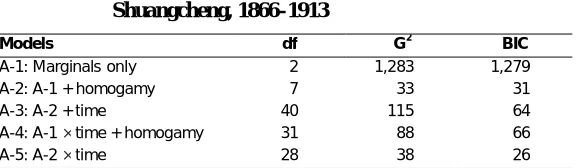
Table 9 presents the test statistics. While we present bothG and BIC for the models of ethnic assortative marriage, we will focus on BIC as our main criterion for goodness of fit. TheG statistic is the deviance for the model. As the fit of the model improves, the deviance will approach 0. The BIC statistics adjust the likelihood ratios L for sample size. The smaller the value of BIC, the better the fit of the model to the data (Raftery 1986). If this assumption is true, the deviance will approach 0. The degrees of freedom equal the number of cells in the table minus the number of model parameters (Agresti 2007).
Table 9: Goodness-of-fit tests for log-linear models of assortative marriage, Shuangcheng, 1866–1913
Models df G2 BIC
A-1: Marginals only 2 1,283 1,279
A-2: A-1 + homogamy 7 33 31
A-3: A-2 + time 40 115 64
A-4: A-1×time + homogamy 31 88 66
As might be expected from Table 10, homogamy was an important feature of marriage in Shuangcheng, and its intensity changed over time. Whereas the BIC for Model A-1 is very large (1,279), the BIC in Model A-2 is much smaller: 31. Model A-2 includes a parameter that allows for homogamous marriages to be more or less common than other pairings, and the reduction in BIC reproduces the patterns in the data better than Model A-1, even after accounting for the use of additional degrees of freedom. Model A-5, which allows for the extent of homogamy to change over time, has an even smaller BIC: 26. Overall, Model A-5 best fits the data.
Odds ratios computed from these models confirm that homogamy declined over time. Table 10 presents these odds ratios. In the first time period, 1866–1879, the odds of a homogamous marriage within either group were 2.6 those of the odds of a heterogamous marriage. This parameter declined to 2.46 and 1.97 in the next two periods and fell to 1.80 in 1900–1913. The result that intermarriage became more common over time and homogamy less common is consistent with the logistic regression results in Table 6, but the approach here rules out the possibility that the trend in Table 6 was caused by changes in the composition of the marriage market.
Table 10: Odds ratios: Homogamy vs. heterogamy among newlywed couples, Shuangcheng, 1866–1913
Time period Odds ratio
Homogamy/heterogamy
1866–1879 2.60
1880–1889 2.46
1890–1899 1.97
1900–1913 1.80
between 15 and 25 (Monden and Smits 2005: 335).8 In Yugoslavia, of the 64 odds ratios for homogamy computed for all the combinations of eight ethnic groups in eight different regions, only four were lower than 3 (Botev 1994: 473). The majority were much higher.
6. Conclusion
To our knowledge, this study is both one of the first quantitative analyses of ethnic intermarriage in a historical Chinese population and one of a relatively small number of studies of ethnic intermarriage for any Chinese population, historical or modern. It contributes to our understanding of ethnic boundaries in Qing China in an unusual setting where Han and non-Han could intermarry without regard to prohibitions against marriage between banners and civilians. If similar studies of intermarriage elsewhere in Qing China or among the peoples of other multiethnic agrarian empires become available, our study will hopefully act as a point of comparison that will yield new insight into interactions not only between ethnic groups in China but also in agrarian empires more generally.
The results inform ongoing debates about the nature of ethnic identities and boundaries during the Qing by showing that in a setting where Han, Manchus, and others were not affected by the prohibitions against marriage between banner and non-banner populations that largely prevented them from marrying elsewhere in China, there is little evidence of a strong aversion to ethnic intermarriage. Even though homogamy was somewhat more likely than intermarriage, the gap was not nearly as pronounced as in other historical populations widely noted for ethnic divisions that were reflected in low rates of intermarriage. In Shuangcheng during the late 19th century, ethnicity by itself was not so salient a boundary that when it came to decisions about marriage it led to patterns suggestive of racial and ethnic divides.
may be either that there was some assimilation or that behaviors and customs remained distinct but that these differences were simply not considered important. Second, we find some evidence that is consistent with the hypothesis based on status exchange theory that high-status non-Han were less likely to intermarry.
Finally, there were interactions between registered ethnicity and ethnic aspiration or affiliation expressed by choice of name or previous marriage choices. Ethnicity, in other words, was not solely the product of official registration, but also in some cases an expression of affiliation or aspiration that was aligned to registered ethnicity but not identical to it. Within groups defined by registered ethnicity, the tendency to intermarry varied according to whether there was a family history of intermarriage, suggesting persistent differences within groups in the definition of boundaries and the willingness to cross those boundaries. Men registered as Han with a mother whose surname was non-Han were themselves more likely to marry a non-Han wife. Conversely, men registered as non-Han whose mother had a Han maiden name were more likely to marry a Han wife. Among the Han, family ethnic aspiration or affiliation, as reflected in the choice of a non-Han given name, also influenced marriage choices. For Han men, having a Han given name was associated with elevated chances of marrying a non-Han wife.
7. Acknowledgments
Preparation and documentation of the CMGPD-SC for public release via ICPSR DSDR was supported by the National Institutes of Health, Eunice Kennedy Shriver National Institute of Child Health and Human Development (NICHD) Grant no. R01 HD070985 “Multi-generational Demographic and Landholding Data: CMGPD-SC Public Release.” Contents are solely the responsibility of the authors and do not necessarily represent the official views of the NICHD.
References
Agresti, A. (2007). Loglinear models for contingency tables. In: Agresti, A. (ed.). An introduction to categorical data analysis. Hoboken: Wiley: 204–232.
doi:10.1002/9780470114759.ch7.
Botev, N. (1994). Where East meets West: Ethnic intermarriage in the former
Yugoslavia, 1962–1989. American Sociological Review 59(3): 461–480.
doi:10.2307/2095944.
Byrne, D.E. (1971).The attraction paradigm. New York: Academic Press.
Campbell, C.D. and Lee, J.Z. (2008a). Economic conditions and male first marriage in Northeast China, 1749–1909.Sungkyun Journal of East Asian Studies 8(1): 17– 42.
Campbell, C.D. and Lee, J.Z. (2008b). Kin networks, marriage, and social mobility in
late imperial China. Social Science History 32(2): 175–214.
doi:10.1017/S0145553200010749.
Campbell, C.D. and Lee, J.Z. (2011). Kinship and the long-term persistence of inequality in Liaoning, China, 1749–2005. Chinese Sociological Review 44(1):
71–104.doi:10.2753/CSA2162-0555440105.
Campbell, C.D., Lee J.Z., and Elliott, M. (2002). Identity construction and reconstruction: Naming and Manchu ethnicity in Northeast China, 1749–1909.
Historical Methods 35(3): 101–116.doi:10.1080/01615440209601201.
Chen, S. (2009). Where urban migrants met rural settlers: State categories, social boundaries, and wealth stratification in Northeast China, 1815–1913 [PhD thesis]. Ann Arbor: University of Michigan, Department of History.
Chen, S. (2017). State-sponsored inequality: The Banner System and social
stratification in Northeast China. Stanford: Stanford University Press.
doi:10.11126/stanford/9780804799034.001.0001.
Chen, S., Campbell, C.D., and Lee, J.Z. (2014). Categorical inequality and gender difference: Marriage and remarriage in Northeast China, 1749–1913. In: Lundh, C. and Kurosu, S. (eds.).Similarity in difference: Marriage in Europe and Asia,
1700–1900. Cambridge: MIT Press: 393–438.
Chen, S., Lee J.Z., and Campbell, C.D. (2010). Wealth stratification and reproduction
in Northeast China. The History of the Family 15(4): 386–412.
doi:10.1016/j.hisfam.2010.10.001.
Chiswick, B.R. and Houseworth, C.A. (2011). Ethnic intermarriage among immigrants: Human capital and assortative mating.Review of Economics of the Household
9(2): 149–180.doi:10.1007/s11150-010-9099-9.
Crossley, P. (1991). Orphan warriors: Three Manchu generations and the end of the Qing world. Princeton: Princeton University Press.
Crossley, P. (1997).The Manchus. Hoboken: Wiley-Blackwell.
Crossley, P. (1999).A translucent mirror. Berkeley: University of California Press.
Ding, Y. (1991). Qingdai Beibu Bianjiang Baqi Zhufang Gaishu [An overview of Eight Banners garrison in Northern borders of the Qing dynasty].Zhongguo Bianjiang Shidi Yanjiu [China’s Borderland History and Geography Studies] 2: 23–31.
Ding, Y. (1992).Qingdai Baqi Zhufang Zhidu Yanjiu [The study of the Eight Banners garrison in Qing dynasty]. Tianjin: Tianjin Guji Chubanshe.
Ding, Y. (1999). Manzu de Funv Shenghuo yu Hunyin Zhidu Yanjiu [The study of
Manchu women’s life and the institution of marriag]. Peking: Peking University Press.
Ding, Y., Guo, S., Lee, J.Z., and Campbell, C.D. (2004). Liaodong Yimin zhong de Qiren Shehui [Banner society and the settlement of Liaodong]. Shanghai: Shanghai shehui kexue chubanshe.
Dong, H. (2016). Patriarchy, family system, and Kin effects on individual demographic behavior throughout the life course, East Asia, 1678–1945 [PhD thesis]. Hong Kong: Hong Kong University of Science and Technology, Division of Social Science.
Dong, H., Campbell, C.D., Kurosu, S., Yang, W., and Lee, J.Z. (2015). New sources for comparative social science: Historical population panel data from East Asia.
Demography 52(3): 1061–1088.doi:10.1007/s13524-015-0397-y.
Du, J. (2008).Baqi yu Qingchao Zhengzhi Lungao [Discussions of the Eight Banners and the Qing dynasty]. Beijing: People’s Publishing House.
Elliott, M., Campbell C.D., and Lee, J.Z. (2016). A demographic estimate of the population of the Qing Banners.Études chinoises 35(1): 9–40.
Furtado, D. and Trejo, S.J. (2013). Interethnic marriages and their economic effects. In: Constant, A.F. and Zimmermann, K.F. (eds.). Handbook on the economics of
migration. Cheltenham: Edward Elgar: 276–290.
doi:10.4337/9781782546078.00024.
Gao, Q. (2001). Chuyi Man Han Xingshi Qiyuan de Gongtong Tezheng [A preliminary discussion of the common features of Manchu and Han’s surnames of origin].
Manzu Yanjiu (Manchu Research) 4: 46–51.
Han, H. (2010). Trends in educational assortative marriage in China from 1970 to 2000.
Demographic Research 22(24): 733–770.doi:10.4054/DemRes.2010.22.24.
Ho, P. (1967). The significance of the Ch’ing period in Chinese history.The Journal of Asian Studies 26(2): 189–195.doi:10.2307/2051924.
Ho, P. (1998). In defense of sinicization: A rebuttal of Evelyn Rawski’s ‘Reenvisioning
the Qing.’ The Journal of Asian Studies 57(1): 123–155.
doi:10.1017/S0021911800022713.
Hwang, S., Saenz, R., and Aguirre, B. (1995). The SES selectivity of interracially
married Asians. International Migration Review 29(2): 469–491.
doi:10.2307/2546790.
Johnson, R.A. (1980).Religious assortative marriage in the United States. New York: Academic Press.doi:10.1016/B978-0-12-386580-9.50012-0.
Kalmijn, M. (1991). Shifting boundaries: Trends in religious and educational
homogamy. American Sociological Review 56(6): 786–800.
doi:10.2307/2096256.
Lee, J.Z. and Campbell, C.D. (1997). Fate and fortune in rural China: Social
organization and population behavior in Liaoning, 1714–1873. Cambridge: Cambridge University Press.doi:10.1017/CBO9780511563058.
Lee, J.Z., Chen, S., Campbell, C.D., and Wang, H. (2013).China Multi-Generational Panel Dataset – Shuangcheng (CMGPD-SC), 1866–1913. Ann Arbor: Inter-university Consortium for Political and Social Research.