RESEARCH
Fully digital data processing
during cardiovascular implantable electronic
device follow-up in a high-volume tertiary
center
Ingo Staudacher
1,2, Asha Roy Nalpathamkalam
1,2, Lorenz Uhlmann
3, Claudius Illg
1,2, Sebastian Seehausen
1,2,
Mohammadreza Akhavanpoor
1,2, Anke Buchauer
4, Nicolas Geis
1,2, Patrick Lugenbiel
1,2,
Patrick A. Schweizer
1,2,5,6, Panagiotis Xynogalos
1,2, Maura M. Zylla
1,2,5, Eberhard Scholz
1,2, Edgar Zitron
1,2,
Hugo A. Katus
1,2,5and Dierk Thomas
1,2,5*Abstract
Background: Increasing numbers of patients with cardiovascular implantable electronic devices (CIEDs) and limited follow-up capacities highlight unmet challenges in clinical electrophysiology. Integrated software (MediConnect®) enabling fully digital processing of device interrogation data has been commercially developed to facilitate follow-up visits. We sought to assess feasibility of fully digital data processing (FDDP) during ambulatory device follow-up in a high-volume tertiary hospital to provide guidance for future users of FDDP software.
Methods: A total of 391 patients (mean age, 70 years) presenting to the outpatient department for routine device follow-up were analyzed (pacemaker, 44%; implantable cardioverter defibrillator, 39%; cardiac resynchronization therapy device, 16%).
Results: Quality of data transfer and follow-up duration were compared between digital (n= 265) and manual pro-cessing of device data (n= 126). Digital data import was successful, complete and correct in 82% of cases when early software versions were used. When using the most recent software version the rate of successful digital data import increased to 100%. Software-based import of interrogation data was complete and without failure in 97% of cases. The mean duration of a follow-up visit did not differ between the two groups (digital 18.7 min vs. manual data transfer 18.2 min).
Conclusions: FDDP software was successfully implemented into the ambulatory follow-up of patients with implanted pacemakers and defibrillators. Digital data import into electronic patient management software was feasible and supported the physician’s workflow. The total duration of follow-up visits comprising technical device interrogation and clinical actions was not affected in the present tertiary center outpatient cohort.
Keywords: Ambulatory device follow-up, Cardiac pacemaker, Digital data processing, Implantable cardioverter defibrillator, Software
© The Author(s) 2017. This article is distributed under the terms of the Creative Commons Attribution 4.0 International License (http://creativecommons.org/licenses/by/4.0/), which permits unrestricted use, distribution, and reproduction in any medium, provided you give appropriate credit to the original author(s) and the source, provide a link to the Creative Commons license, and indicate if changes were made. The Creative Commons Public Domain Dedication waiver (http://creativecommons.org/ publicdomain/zero/1.0/) applies to the data made available in this article, unless otherwise stated.
Open Access
*Correspondence: [email protected]
1 Department of Cardiology, Medical University Hospital Heidelberg,
University of Heidelberg, Im Neuenheimer Feld 410, 69120 Heidelberg, Germany
Background
Cardiac pacemakers, implantable cardioverter defibrilla-tors (ICDs) and cardiac resynchronization therapy (CRT) devices are widely used in clinical electrophysiology [1– 4]. The number of cardiovascular implantable electronic devices (CIEDs) is increasing due to aging population and an extension of CIED implantation indications [5] resulting in a rising number of device interrogations. The logistics of monitoring these devices represent a substantial chal-lenge in cardiovascular patient care [6]. As further increase in physician work load cannot be expected in the future, increasing numbers of CIEDs require optimal technical strategies for device follow-up to facilitate device interroga-tion, data handling, and electronic documentation [7].
During conventional follow-up visits, device data obtained through the programmer are transferred manually into paper-based patient records or electronic patient management systems and device identifica-tion documents. To optimize quality and duraidentifica-tion of CIED follow-up visits, an integrated software package (MediConnect®) has been developed, enabling digital processing of device follow-up data. Fully digital transfer of interrogation data between the programmer and elec-tronic patient management systems is expected to result in increased efficiency with concurrent improvement in reporting quality. Furthermore, the low durability of thermo paper used to print CIED records poses limita-tion of paper-based follow-up with regard to data stor-age. Using fully digital solutions, parameters obtained during device interrogation are imported electronically in standardized fashion into the data management sys-tem. Written reports and device identification cards are generated automatically by the software. The normaliza-tion results in a uniform follow-up process for different devices and manufacturers which may improve work-flow productivity.
CIED follow-up in a tertiary center is characterized by high patient numbers, considerable complexity of indi-vidual cases, and significant comorbidities of outpatients presenting for routine interrogation. The aim of this work was to evaluate the feasibility of digital CIED data pro-cessing using MediConnect® software in a high-volume tertiary hospital.
Methods
Study design and patient population
Between November 2013 and November 2015, a total of 18,449 patients presented to the electrophysiology outpatient clinic at the department of cardiology, Medi-cal University Hospital Heidelberg (Germany). A sample cohort of 391 patients scheduled for routine follow-up of cardiac pacemakers, ICDs, or CRT devices were pro-spectively enrolled. Study patients underwent CIED interrogation, followed by either manual or digital trans-fer (MediConnect®; Fleischhacker, Schwerte, Germany) of device data into the electronic patient management system (i.s.h.med®, SAP, Walldorf, Germany) installed on Windows (Microsoft, Redmond, WA, USA)—based personal computer workstations. The decision between manual and digital data processing was left to the phy-sician’s discretion. Baseline characteristics and proce-dural data were analyzed. Total duration of the follow-up visit was measured from each study subject entering the examination room to the receipt of written medi-cal reports and updated device identification card by the respective patient.
CIED device interrogation and manual data transfer
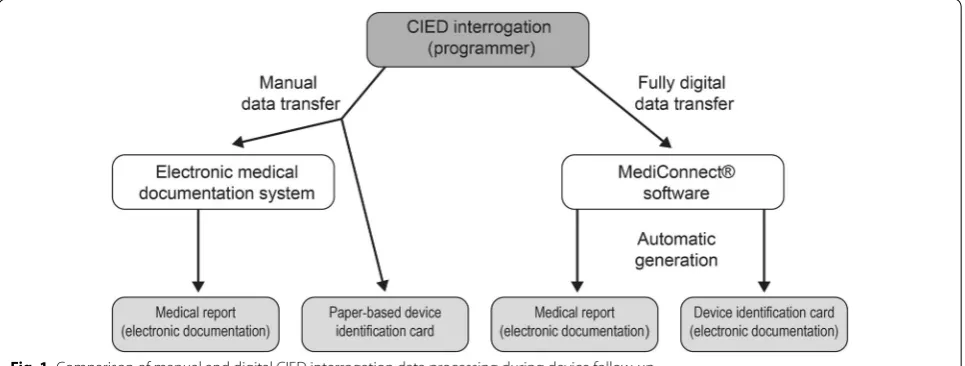
Device interrogation was performed through telemetry (Fig. 1). Specific programmers were used to retrieve pro-grammed parameters and data stored on pacemakers, ICDs and CRT devices from the following manufacturers:
Biotronik (Berlin, Germany), Boston Scientific (Marlbor-ough, MA, USA), LivaNova (London, UK), Medtronic (Minneapolis, MN, USA), St. Jude Medical (St. Paul, MN, USA), and Vitatron (Maastricht, the Netherlands). Oper-ating parameters of the devices were modified if required. Interrogation data were then transferred manually into a Microsoft Word-based file of the i.s.h.med® patient man-agement system, allowing for electronic documentation and generation of a medical report. Furthermore, the data were manually entered into a paper-based device identification card. Additional tasks were performed at the physician’s discretion (e.g., obtaining medical history or blood pressure, physical examination, auscultation).
Fully digital data processing (FDDP)
Following device interrogation via appropriate program-ming devices, MediConnect® software was employed for digital data transfer and for generation of medical documents. During the course of the study, five versions of the software were used owing to software updates: 2.6.0.130 (10/2013–3/2014), 2.6.0.138 (3/2014–8/2014), 2.7.0.10 (8/2014–10/2014), 2.7.0.20 (10/2014–7/2015), and 2.7.0.47 (7/2015–11/2015). Patients underwent CIED follow-up with the current software version at the time of follow-up. The update from 2.6.0.130 to 2.6.0.138 included minor modifications. More substantial changes were car-ried out during the following update to version 2.6.0.10, involving optimization of user interface and electrocar-diogram viewer. Subsequent updates 2.7.0.20 and 2.7.0.47 were performed to improve stability and performance. The list of programming devices and CIEDs recognized by the software was updated with each step. Interrogation data were stored on a permanently installed USB mass storage stick connected to the programming device. The follow-up data were then imported automatically via a switch box from different programmers employed in par-allel into MediConnect® software installed on a personal computer, allowing for standardized reading and storage of data retrieved from different devices (Fig. 1). Medical reports and CIED identification documents were auto-matically generated by the software package, printed, and stored electronically both in MediConnect® software and through import into the electronic patient manage-ment system (i.s.h.med®). Thus, the integrated approach allowed for facilitated handling of interrogation data from various manufacturers. Telemedical applications [8] were not included in this work.
Statistics
Statistical analyses were performed using Prism 6.0 (GraphPad, La Jolla, CA, USA) and Origin 8.0 (Origin-Lab Corporation, Northampton, MA, USA) software, as well as “R” software [9] (version 3.3.1) with the packages
“car” [10] (version 2.1-2) and “xtable” [11] (version 1.8-2). Continuous variables are expressed as mean ± SEM. For between-group comparisons, the unpaired Student’s t test (two-tailed test) was used, assuming that the data were approximately normally distributed. Categorical variables are described as count and percentage and were analyzed using the Chi-square test or Fisher’s exact test (two-tailed tests) where appropriate. Furthermore, a linear regres-sion model for the duration of follow-up visits was applied where study group (FDDP vs. conventional follow-up), age, gender, concomitant cardiac disease, device manufacturer, device type, and physician experience in clinical electro-physiology were included as predictors. Effect estimates, 95% confidence intervals (CI), and p values are provided in the results section. A p value < 0.05 was considered sta-tistically significant. Since this was an exploratory analysis, no adjustment for multiple testing was applied.
Results
Patient characteristics
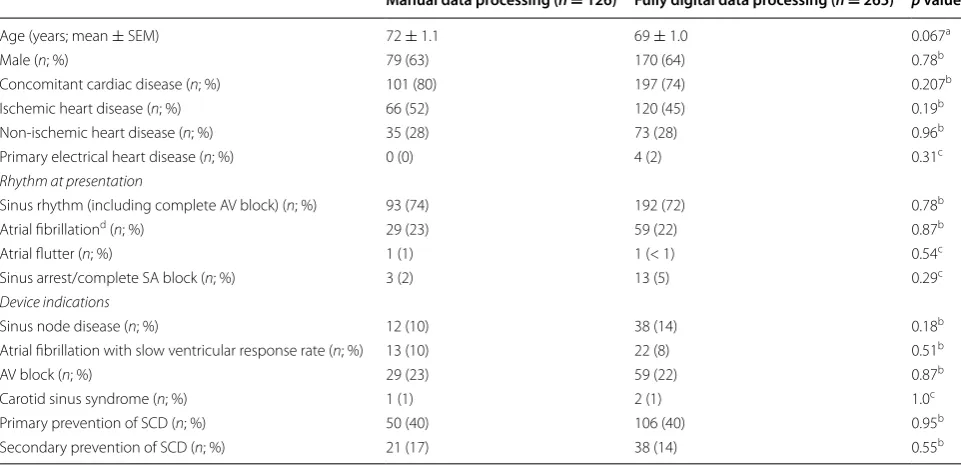
A total of 391 patients presenting for ambulatory follow-up of cardiac pacemakers (n = 173; 44%), ICDs (n = 154; 39%), or CRT devices (n = 64; 16%) were included (Tables 1 and 2). The mean age was 70.3 ± 0.7 years, and 249 study subjects were male (64%). Manual transfer of device inter-rogation data was employed in 126 cases (32%), whereas fully digital data processing (FDDP) using MediConnect® software was used in 265 patients (68%). The majority of patients exhibited concomitant cardiac disease (manual data transfer, 80%; FDDP, 74%), with ischemic heart disease being the most abundant (Table 1). Sinus rhythm was pre-sent in 74% (manual data transmission) and 72% of cases (FDDP). Twenty-three percent of all study subjects was presented in atrial fibrillation. Common CIED indications comprised primary and secondary preventions of sud-den cardiac death, higher degree atrioventricular block, and sinus node disease (Table 1). Baseline parameters were not significantly different between groups. Pacemak-ers and ICDs were equally distributed between the groups (Table 2). Finally, significant intergroup differences between device manufacturers were noted (Table 2).
of previous electrophysiological experience, whereas in the FDDP cohort, prior experience was lower (1.8 ± 0.1 years; p < 0.001).
Efficiency of digital data transfer
The accuracy of data transfer increased with subse-quent software updates (Table 3). Errors included Table 1 Baseline characteristics of study patients
AV atrioventricular node, SA sinoatrial node, SCD sudden cardiac death, SEM standard error of the mean a Unpaired Student’s t test (two-tailed test)
b Chi-square test (two-tailed test) c Fisher’s exact test (two-tailed test)
d Includes paroxysmal, persistent, and permanent atrial fibrillation
Manual data processing (n = 126) Fully digital data processing (n = 265) p value
Age (years; mean ± SEM) 72 ± 1.1 69 ± 1.0 0.067a
Male (n; %) 79 (63) 170 (64) 0.78b
Concomitant cardiac disease (n; %) 101 (80) 197 (74) 0.207b
Ischemic heart disease (n; %) 66 (52) 120 (45) 0.19b
Non-ischemic heart disease (n; %) 35 (28) 73 (28) 0.96b
Primary electrical heart disease (n; %) 0 (0) 4 (2) 0.31c
Rhythm at presentation
Sinus rhythm (including complete AV block) (n; %) 93 (74) 192 (72) 0.78b
Atrial fibrillationd (n; %) 29 (23) 59 (22) 0.87b
Atrial flutter (n; %) 1 (1) 1 (< 1) 0.54c
Sinus arrest/complete SA block (n; %) 3 (2) 13 (5) 0.29c
Device indications
Sinus node disease (n; %) 12 (10) 38 (14) 0.18b
Atrial fibrillation with slow ventricular response rate (n; %) 13 (10) 22 (8) 0.51b
AV block (n; %) 29 (23) 59 (22) 0.87b
Carotid sinus syndrome (n; %) 1 (1) 2 (1) 1.0c
Primary prevention of SCD (n; %) 50 (40) 106 (40) 0.95b
Secondary prevention of SCD (n; %) 21 (17) 38 (14) 0.55b
Table 2 Types and manufacturers of cardiac devices included in the study
Italic values indicate statistically significant associations
CRT cardiac resynchronization therapy device, D defibrillator, ICD implantable cardioverter defibrillator, P pacemaker a Chi-square test (two-tailed test)
b Fisher’s exact test (two-tailed test)
Manual data processing (n = 126) Fully digital data processing (n = 265) p value
Device type
Single chamber P (n; %) 8 (6) 27 (10) 0.21a
Dual chamber P (n; %) 43 (34) 95 (36) 0.74a
Single chamber ICD (n; %) 46 (37) 77 (29) 0.14a
Dual chamber ICD (n; %) 12 (10) 19 (7) 0.42a
CRT-P (n; %) 2 (2) 0 (0) 0.10b
CRT-D (n; %) 15 (12) 47 (18) 0.14a
Device manufacturer
Biotronik (n; %) 6 (5) 17 (6) 0.52a
Boston Scientific (n; %) 31 (25) 25 (9) < 0.0001a
LivaNova (Ela/Sorin) (n; %) 9 (7) 4 (2) 0.006b
Medtronic (n; %) 56 (44) 155 (58) 0.009a
St. Jude Medical (n; %) 22 (17) 63 (24) 0.16a
general failure to import interrogation data, incomplete import of single values, insufficient transfer of interro-gation values into documents created by the software, and import of incorrect values, respectively. Of note, no errors were observed with the final software update during the course of the study. MediConnect® software crashes occurred during four of 265 follow-up inves-tigations (1.5%). In these cases, a reboot of the system and a re-login were necessary, which required approxi-mately 2–3 min. Two additional system reboots (0.75%) were actively initiated at the physicians’ discretion when document printing failed. Written patient reports and device identification cards produced through MediConnect® software were free from errors in 98% of cases (Table 3). Incompletely transferred device interrogation data were manually completed prior to generation of medical documents, if required.
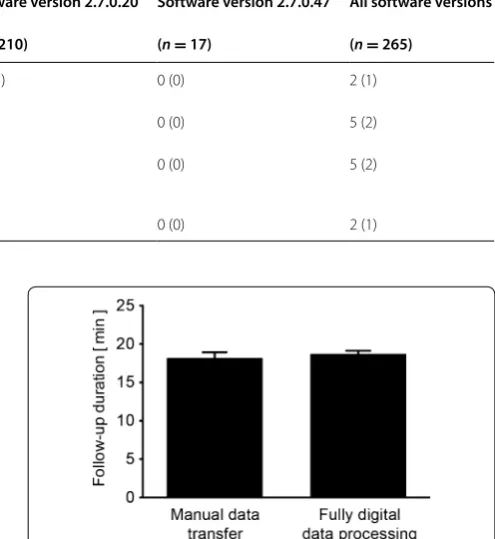
In the present sample cohort, the mean duration of follow-up visits using FDDP and automatic document production yielded 18.7 ± 0.4 min (n = 265) and was not
significantly different from patients subjected to manual transfer of interrogation data from the programmer into electronic documentation system and into paper-based device identification cards (18.2 ± 0.8 min; n = 126;
p = 0.49) (Fig. 2). While software updates improved
the quality of data transfer, mean follow-up duration did not change when comparing early software versions (16.4 ± 1.0 min; n = 38) with the most recent version
investigated in the present study (18.4 ± 2.2 min; n = 17;
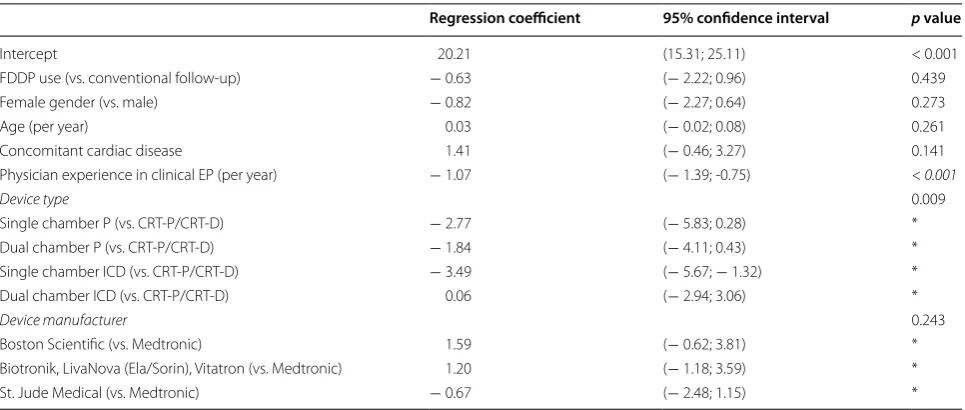
p = 0.37) (Table 4). Multivariate analysis revealed an
influence of physician’s experience and device type on device follow-up duration among potential determi-nants (i.e., age, gender, concomitant cardiac disease, device type and manufacturer, physician’s experience in clinical electrophysiology, and conventional vs. FDDP follow-up) (Table 5). The duration of ambulatory follow-up was shorter when performed by more experienced physicians.
Technical and clinical events observed during ambulatory follow‑up
In addition to device interrogation, the completion of reports and CIED identification cards, ambulatory CIED follow-up visits included further physician tasks contributing to the duration and complexity of device follow-up. Obtaining patient’s history, physical exami-nation, and consultation with other physicians were commonly performed without significant differences between study groups (Table 6). Furthermore, inter-rogation of cardiac pacemakers, ICDs, or CRT devices Table 3 Accuracy of data transfer using fully digital data processing, stratified by software versions
Software version 2.6.0.130–
2.7.0.10 Software version 2.7.0.20 Software version 2.7.0.47 All software versions (n = 38) (n = 210) (n = 17) (n = 265)
General failure of data import
(n; %) 1 (3) 1 (< 1) 0 (0) 2 (1)
Incomplete data import (one or
more values missing) (n; %) 2 (5) 3 (1) 0 (0) 5 (2)
Incomplete transfer of values into documents (one or more values missing) (n; %)
2 (5) 3 (1) 0 (0) 5 (2)
Import of incorrect values (n; %) 2 (5) 0 (0) 0 (0) 2 (1)
Fig. 2 Total duration of ambulatory device follow-up. Mean (± SEM) visit duration is compared between manual and digital data process-ing, respectively
Table 4 Duration of follow-up visits using FDDP software, stratified by software versions
Software ver‑ sion 2.6.0.130– 2.7.0.10
Software ver‑
sion 2.7.0.20 Software version 2.7.0.47 (n = 38) (n = 210) (n = 17)
Mean (± SEM) follow-up dura-tion (min)
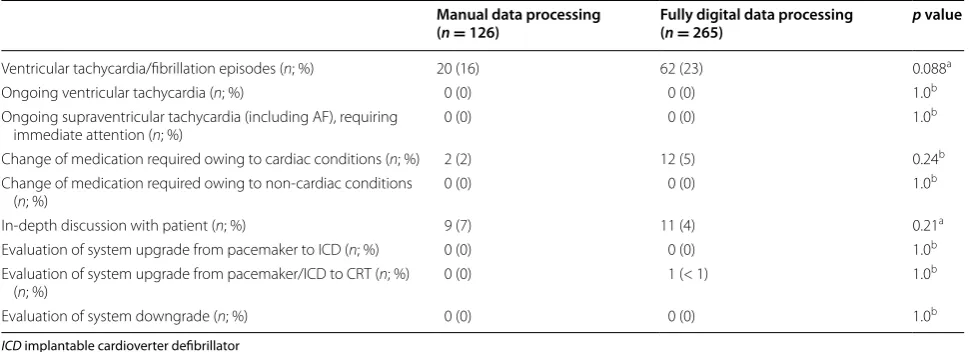
revealed technical issues such as low battery voltage and extended investigation of ICD leads under advisory in a minority of patients of both groups (Table 7). Finally, additional clinical aspects were addressed during device follow-up (Table 8). Ventricular tachycardia or fibril-lation episodes detected by defibrillator devices repre-sented the most frequent events and were encountered in 16% (manual data transfer group) and 23% of patients (FDDP; p = 0.088). In these cases, further evaluation was necessary and options for antiarrhythmic treat-ment optimization were discussed and initiated when appropriate.
Discussion
Feasibility of fully digital data processing in CIED follow‑up
We were able to demonstrate successful implementation of FDDP using MediConnect® software into the clinical CIED follow-up workflow at a university hospital. Fea-sibility of FDDP in routine application is indicated by a 82% rate of complete and correct data transfer with the first three software versions and a 100% rate of correct data transfer with the final software version which has been used at the end of the study. Software crashes were rare (1.5%). Furthermore, medical documents were pro-duced by the software with very few errors, and provided Table 5 Linear regression analysis of total follow-up
Linear regression was applied to adjust for intergroup differences in indicated parameters; * a single p value is provided for parameters “device type” and “device manufacturer”
Italic value indicates statistically significant associations
CRT cardiac resynchronization therapy device, D defibrillator, EP electrophysiology, ICD implantable cardioverter defibrillator, P pacemaker
Regression coefficient 95% confidence interval p value
Intercept 20.21 (15.31; 25.11) < 0.001
FDDP use (vs. conventional follow-up) − 0.63 (− 2.22; 0.96) 0.439
Female gender (vs. male) − 0.82 (− 2.27; 0.64) 0.273
Age (per year) 0.03 (− 0.02; 0.08) 0.261
Concomitant cardiac disease 1.41 (− 0.46; 3.27) 0.141
Physician experience in clinical EP (per year) − 1.07 (− 1.39; -0.75) <0.001
Device type 0.009
Single chamber P (vs. CRT-P/CRT-D) − 2.77 (− 5.83; 0.28) *
Dual chamber P (vs. CRT-P/CRT-D) − 1.84 (− 4.11; 0.43) *
Single chamber ICD (vs. CRT-P/CRT-D) − 3.49 (− 5.67; − 1.32) *
Dual chamber ICD (vs. CRT-P/CRT-D) 0.06 (− 2.94; 3.06) *
Device manufacturer 0.243
Boston Scientific (vs. Medtronic) 1.59 (− 0.62; 3.81) *
Biotronik, LivaNova (Ela/Sorin), Vitatron (vs. Medtronic) 1.20 (− 1.18; 3.59) *
St. Jude Medical (vs. Medtronic) − 0.67 (− 2.48; 1.15) *
Table 6 Tasks performed by the physician during ambulatory patient follow-up
Italic value indicates statistically significant associations
ICD implantable cardioverter defibrillator. No patient was directly admitted to the hospital a Chi-square test (two-tailed test)
b Fisher’s exact test (two-tailed test)
c In five cases, patients were instructed to keep a copy of the written report (including current device parameters) with their pacemaker identification card issued previously
Manual data processing (n = 126) Fully digital data processing (n = 265) p value
Device interrogation (n; %) 126 (100) 265 (100) 1.0b
Written report (n; %) 126 (100) 265 (100) 1.0b
Pacemaker/ICD identification card (n; %) 122 (97)c 265 (100) 0.01b
Brief medical history (n; %) 126 (100) 265 (100) 1.0b
Consultation with other physicians (n; %) 14 (11) 48 (18) 0.08a
the added benefit of electronic documentation of both patient reports and device identification cards, respec-tively, eliminating the use of hardcopy archiving. In addi-tion, removing the need for manual completion of device identification cards resulted in increased technical qual-ity of medical documentation. A low rate of physician complaints after an initial MediConnect® software instal-lation and adaptation phase indicated satisfaction with FDDP performance during the course of the study.
Comparison with manual data transfer
Optimized data transfer between the programming device and the electronic documentation system could reduce overall duration of follow-up visits. Mean fol-low-up duration was 19 min in the present study. Con-trary to expectations, there was no significant difference between the follow-up duration using FDDP and manual data transmission. Overall times of outpatient visits were determined by additional tasks that were carried out by Table 7 Device-related technical events identified during patient follow-up
ERI elective replacement indicator, ICD implantable cardioverter defibrillator a Chi-square test (two-tailed test)
b Fisher’s exact test (two-tailed test)
Manual data processing (n = 126) Fully digital data processing (n = 265) p value
Low battery voltage (n; %) 6 (5) 6 (2) 0.18a
Battery depletion (ERI) (n; %) 2 (2) 4 (2) 1.0b
Significant change in pacing threshold (n; %) 1 (1) 3 (1) 1.0b
Significant change in lead impedance (n; %) 1 (1) 0 (0) 0.32b
Significant change in sensing threshold (n; %) 1 (1) 1 (< 1) 0.54b
Extended tests owing to lead advisory (n; %) 6 (5) 15 (6) 0.71a
Lead dysfunction (n; %) 0 (0) 1 (< 1) 1.0b
Skeletal muscle/nerve stimulation (n; %) 0 (0) 0 (0) 1.0b
Device-related infection (n; %) 0 (0) 0 (0) 1.0b
T-wave oversensing (n; %) 0 (0) 1 (< 1) 1.0b
Pacemaker-mediated tachycardia (n; %) 0 (0) 0 (0) 1.0b
Cross talk (any type) (n; %) 0 (0) 0 (0) 1.0b
Electromagnetic interference (n; %) 0 (0) 1 (< 1) 1.0b
Table 8 Clinical events identified during patient follow-up
ICD implantable cardioverter defibrillator a Chi-square test (two-tailed test) b Fisher’s exact test (two-tailed test)
Manual data processing
(n = 126) Fully digital data processing (n = 265) p value
Ventricular tachycardia/fibrillation episodes (n; %) 20 (16) 62 (23) 0.088a
Ongoing ventricular tachycardia (n; %) 0 (0) 0 (0) 1.0b
Ongoing supraventricular tachycardia (including AF), requiring
immediate attention (n; %) 0 (0) 0 (0) 1.0
b
Change of medication required owing to cardiac conditions (n; %) 2 (2) 12 (5) 0.24b
Change of medication required owing to non-cardiac conditions
(n; %) 0 (0) 0 (0) 1.0
b
In-depth discussion with patient (n; %) 9 (7) 11 (4) 0.21a
Evaluation of system upgrade from pacemaker to ICD (n; %) 0 (0) 0 (0) 1.0b
Evaluation of system upgrade from pacemaker/ICD to CRT (n; %)
(n; %) 0 (0) 1 (< 1) 1.0
b
the physician in addition to device interrogation in the setting of a specialized Electrophysiology Outpatient Clinic, associated with referral of particularly demanding cases. These actions were not affected by the method of handling device-related data. Thus, the relative contri-bution of efficient data transfer to follow-up times may have been too low to show significant effects. Increased physician’s experience contributed to shorter follow-up duration among patients with manual data handling as well. Furthermore, there was a tendency towards more CRT devices in the FDDP group than in the manual data handling group (18% vs. 13%). As CRT follow-up can be more time-consuming and requires the investigation of more technical parameters compared to pacemakers or ICDs, this difference may potentially have outweighed the benefits of FDDP. Finally, the duration of MediConnect® software loading processes was noted during the course of the study as possible factor contributing to a lack of FDDP effects on total follow-up time. Future software improvements are expected to allow for exploitation of further benefits provided by FDDP use.
Limitations, benefits and future directions
This study has inherent limitations due to the non-ran-domized patient assignment to treatment groups. A low recruiting rate resulted in a relatively low number of patients included in the study. It is important to highlight that the subpopulation analyzed here represents only a small “snapshot” of the “real life” situation at the Electro-physiology Outpatient Clinic. In addition, the study was initiated early after new implementation of fully digital data transfer into the clinical workflow. Therefore, ben-efits of established, long-term FDDP use, expected to result in reduced follow-up duration as device records will be readily available from the database, could not be evaluated. Telemedical applications that may provide sig-nificant further improvements in CIED patient follow-up using MediConnect®-based digital data transfer were not included in this study. We recognize a potential bias as stratification of the results according to device manu-facturers or to the respective physicians performing the follow-up investigations was not statistically feasible in the present sample. However, the open study design and resulting uneven distribution of device manufactur-ers between manual data handling and FDDP groups at the physicians’ discretion, respectively, may offer further insights into FDDP use. It could be speculated that some manufacturers’ devices were more likely used by the established, manual process, while others were more fre-quently subjected to be interrogated using the new FDDP workflow algorithm. The hypothesis that FDDP may indeed be better suited for some systems, while other manufacturers’ devices may be associated with potential
problems or increased work load, could impact daily clin-ical routine and needs to be further addressed and evalu-ated in controlled studies in the future. Potential added benefits of digital data transfer using MediConnect® software were not assessed: Electronic storage of device interrogation and clinical data in the software pack-age facilitates the handling of safety information, device recalls or scientific investigations among CIED patients. While the present study confirms the feasibility of newly implemented digital CIED interrogation data transfer in a high-volume center, a prospective, randomized multi-center study is required to further elucidate characteris-tics of its long-term use in clinical application.
Conclusions
Replacing manual CIED data transfer by automatic, fully digital data transfer during routine follow-up is feasible. The overall duration of follow-up visits, including device interrogation, clinical actions, and case discussions, is similar compared with manual data transfer, but may decrease with increasing user experience and further software improvements. Digital data transfer software represents a technical solution to alleviate the growing demand in device follow-up caused by increasing num-bers of CIEDs and offers advantages over manual data transfer and paper-based patient records.
Authors’ contributions
IS and DT designed the study. IS, ARN, CI, MA, NG, PL, PAS, PX, MMZ, ES, EZ and DT acquired the data. IS, ARN, LU, CI, SS, AB and DT analyzed and interpreted the data. IS, ARN and DT wrote the manuscript. IS, ARN, LU, CI, SS, MA, AB, NG, PL, PAS, PX, MMZ, ES, EZ, HAK and DT revised the manuscript for important intellectual content. All authors read and approved the final manuscript.
Author details
1 Department of Cardiology, Medical University Hospital Heidelberg, University
of Heidelberg, Im Neuenheimer Feld 410, 69120 Heidelberg, Germany. 2 HCR
(Heidelberg Center for Heart Rhythm Disorders), Medical University Hospital Heidelberg, Heidelberg, Germany. 3 Institute of Medical Biometry and
Infor-matics, University Hospital Heidelberg, Heidelberg, Germany. 4 Center for
Infor-mation Technology and Medical Engineering, University Hospital Heidelberg, Heidelberg, Germany. 5 DZHK (German Centre for Cardiovascular Research),
partner site Heidelberg/Mannheim, Heidelberg, Germany. 6 Heidelberg
Research Center for Molecular Medicine (HRCMM), Heidelberg, Germany.
Acknowledgements
Not applicable.
Competing interests
The authors declare that they have no competing interests.
Availability of data and materials
The datasets used and/or analyzed during the current study are available from the corresponding author on reasonable request.
Consent for publication
Not applicable.
Ethics approval and consent to participate
• We accept pre-submission inquiries
• Our selector tool helps you to find the most relevant journal
• We provide round the clock customer support • Convenient online submission
• Thorough peer review
• Inclusion in PubMed and all major indexing services
• Maximum visibility for your research
Submit your manuscript at www.biomedcentral.com/submit
Submit your next manuscript to BioMed Central
and we will help you at every step:
board (Ethics Committee of Heidelberg University) waived the need for writ-ten informed consent from the participants.
Funding
This work was supported in part by research grants from the University of Hei-delberg, Faculty of Medicine (Physician Scientist Program to I.S., Postdoctoral Fellowship to P.L.), from the German Cardiac Society (Fellowships to I.S. and P.L.), and from the Joachim Siebeneicher Foundation (to D.T.). C.I. was sup-ported by the Cardiology Career Program of the Department of Cardiology, University of Heidelberg, and S.S. was holder of the Otto-Hess-Scholarship of the German Cardiac Society. P.A.S was supported by the Heidelberg Research Center for Molecular Medicine (Senior Career Fellowship). The funding sources had no involvement in study design, in the collection, analysis and interpreta-tion of the data, in the writing of the report, and in the decision to submit the article for publication.
Publisher’s Note
Springer Nature remains neutral with regard to jurisdictional claims in pub-lished maps and institutional affiliations.
Received: 5 July 2017 Accepted: 3 October 2017
References
1. Epstein AE, DiMarco JP, Ellenbogen KA, Estes NA 3rd, Freedman RA, Gettes LS, Gillinov AM, Gregoratos G, Hammill SC, Hayes DL, Hlatky MA, Newby LK, Page RL, Schoenfeld MH, Silka MJ, Stevenson LW, Sweeney MO, Smith SC Jr, Jacobs AK, Adams CD, Anderson JL, Buller CE, Creager MA, Ettinger SM, Faxon DP, Halperin JL, Hiratzka LF, Hunt SA, Krumholz HM, Kushner FG, Lytle BW, Nishimura RA, Ornato JP, Page RL, Riegel B, Tarkington LG, Yancy CW, American College of Cardiology/American Heart Association Task Force on Practice Guidelines (writing committee to revise the ACC/AHA/NASPE 2002 guideline update for implantation of cardiac pacemakers and antiarrhythmia devices); American Association for Thoracic Surgery; Society of Thoracic Surgeons. ACC/AHA/HRS guide-lines for device-based therapy of cardiac rhythm abnormalities: a report of the American College of Cardiology/American Heart Association task force on practice guidelines (writing committee to revise the ACC/AHA/ NASPE 2002 guideline update for implantation of cardiac pacemakers and antiarrhythmia devices): developed in collaboration with the Ameri-can Association for Thoracic Surgery and Society of Thoracic Surgeons. Circulation. 2008;2008(117):e350–408.
2. Epstein AE, DiMarco JP, Ellenbogen KA, Estes NA 3rd, Freedman RA, Gettes LS, Gillinov AM, Gregoratos G, Hammill SC, Hayes DL, Hlatky MA, Newby LK, Page RL, Schoenfeld MH, Silka MJ, Stevenson LW, Sweeney MO, American College of Cardiology Foundation; American Heart Association Task Force on Practice Guidelines; Heart Rhythm Society. ACCF/AHA/HRS focused update incorporated into the ACCF/AHA/HRS 2008 guidelines for device-based therapy of cardiac rhythm abnormalities: a report of the American College of Cardiology Foundation/American Heart Association task force on practice guidelines and the Heart Rhythm Society. Circula-tion. 2012;2013(127):e283–352.
3. Brignole M, Auricchio A, Baron-Esquivias G, Bordachar P, Boriani G, Breithardt OA, Cleland J, Deharo JC, Delgado V, Elliott PM, Gorenek B, Israel CW, Leclercq C, Linde C, Mont L, Padeletti L, Sutton R, Vardas PE, ESC Committee for Practice Guidelines (CPG), Zamorano JL, Achenbach S, Baumgartner H, Bax JJ, Bueno H, Dean V, Deaton C, Erol C, Fagard R, Ferrari R, Hasdai D, Hoes AW, Kirchhof P, Knuuti J, Kolh P, Lancellotti P, Linhart A, Nihoyannopoulos P, Piepoli MF, Ponikowski P, Sirnes PA, Tamargo JL, Tendera M, Torbicki A, Wijns W, Windecker S, Document Reviewers, Kirchhof P, Blomstrom-Lundqvist C, Badano LP, Aliyev F, Bänsch D, Baumgartner H, Bsata W, Buser P, Charron P, Daubert JC, Dobreanu D, Faerestrand S, Hasdai D, Hoes AW, Le He JY, Mavrakis H, McDonagh T, Merino JL, Nawar MM, Nielsen JC, Pieske B, Poposka L, Ruschitzka F, Ten-dera M, Van Gelder IC, Wilson CM. ESC guidelines on cardiac pacing and cardiac resynchronization therapy: the task force on cardiac pacing and resynchronization therapy of the European Society of Cardiology (ESC).
Developed in collaboration with the European Heart Rhythm Association (EHRA). Eur Heart J. 2013;34:2281–329.
4. Priori SG, Blomström-Lundqvist C, Mazzanti A, Blom N, Borggrefe M, Camm J, Elliott PM, Fitzsimons D, Hatala R, Hindricks G, Kirchhof P, Kjeldsen K, Kuck KH, Hernandez-Madrid A, Nikolaou N, Norekvål TM, Spaulding C, Van Veldhuisen DJ. 2015 ESC guidelines for the manage-ment of patients with ventricular arrhythmias and the prevention of sudden cardiac death: the task force for the management of patients with ventricular arrhythmias and the prevention of sudden cardiac death of the European Society of Cardiology (ESC). Endorsed by: Association for European Paediatric and Congenital Cardiology (AEPC). Eur Heart J. 2015;36:2793–867.
5. Camm AJ, Nisam S. European utilization of the implantable defibrillator: has 10 years changed the ‘enigma’? Europace. 2010;12:1063–9. 6. Wilkoff BL, Auricchio A, Brugada J, Cowie M, Ellenbogen KA, Gillis AM,
Hayes DL, Howlett JG, Kautzner J, Love CJ, Morgan JM, Priori SG, Reynolds DW, Schoenfeld MH, Vardas PE, Heart Rhythm Society (HRS); European Heart Rhythm Association (EHRA); American College of Cardiology (ACC); American Heart Association (AHA); European Society of Cardiology (ESC); Heart Failure Association of ESC (HFA); Heart Failure Society of America (HFSA). HRS/EHRA expert consensus on the monitoring of cardiovascular implantable electronic devices (CIEDs): description of techniques, indica-tions, personnel, frequency and ethical considerations: developed in partnership with the Heart Rhythm Society (HRS) and the European Heart Rhythm Association (EHRA); and in collaboration with the American College of Cardiology (ACC), the American Heart Association (AHA), the European Society of Cardiology (ESC), the Heart failure Association of ESC (HFA), and the Heart Failure Society of America (HFSA). Endorsed by the Heart Rhythm Society, the European Heart Rhythm Association (a registered branch of the ESC), the American College of Cardiology, The American Heart Association. Europace. 2008;10:707–25.
7. Stellbrink C, Trappe HJ. The follow-up of cardiac devices: what to expect for the future? Eur Heart J Suppl. 2007;9(Suppl. I):I113–5.
8. Perings SM, Perings C, Smetak N, Meyer C, Shin DI, Kelm M, Brachmann J. Home monitoring technology and integrated follow-up care of ICD patients. Acta Cardiol. 2013;68:381–6.
9. R Core Team. R: a language and environment for statistical computing. R Foundation for Statistical Computing, Vienna, Austria. 2016. https:// www.R-project.org/. Accessed 18 May 2017.
10. Fox J, Weisberg S. An {R} companion to applied regression, second edi-tion. Thousand Oaks CA: Sage. 2011. http://socserv.socsci.mcmaster.ca/ jfox/Books/Companion. Accessed 18 May 2017.