Open Access
Research article
Low doses of caffeine reduce heart rate during submaximal cycle
ergometry
Steven R McClaran*
1and Thomas J Wetter
2Address: 1Department of Kinesiology& Health, University of Wisconsin Oshkosh, Oshkosh, WI 54901, USA and 2School of Health Promotion &
Human Development, University of Wisconsin-Stevens Point, Stevens Point, WI 54481, USA
Email: Steven R McClaran* - [email protected]; Thomas J Wetter - [email protected] * Corresponding author
Abstract
Background: The purpose of this study was to examine the cardiovascular effects of two low-levels of caffeine ingestion in non habitual caffeine users at various submaximal and maximal exercise intensities.
Methods: Nine male subjects (19–25 yr; 83.3 ± 3.1 kg; 184 ± 2 cm), underwent three testing sessions administered in a randomized and double-blind fashion. During each session, subjects were provided 4 oz of water and a gelatin capsule containing a placebo, 1.5 mg/kg caffeine, or 3.0 mg/kg caffeine. After thirty minutes of rest, a warm-up (30 Watts for 2 min) the pedal rate of 60 rpm was maintained at a steady-state output of 60 watts for five minutes; increased to 120 watts for five minutes and to 180 watts for five minutes. After a 2 min rest the workload was 180 watts for one minute and increased by 30 watts every minute until exhaustion. Heart rate (HR) was measured during the last 15-seconds of each minute of submaximal exercise. Systolic blood pressure (BP) was measured at rest and during each of the three sub-maximal steady state power outputs. Minute ventilation (VE), Tidal volume (VT), Breathing frequency (Bf), Rating of perceived exertion (RPE),
Respiratory exchange ratio (RER), and Oxygen consumption (VO2) were measured at rest and during each minute of exercise.
Results: Caffeine at 1.5 and 3.0 mg/kg body weight significantly lowered (p < 0.05) HR during all three submaximal exercise intensities compared to placebo (range – 4 to 7 bpm lower) but not at rest or maximal exercise. BP was significantly higher (p < 0.05) at rest and after the 3 mg/kg caffeine vs placebo (116 ± 13 vs 123 ± 10 mm Hg). Neither dose of caffeine had any effect on BP during submaximal exercise. Caffeine had no effect on VE, VT, VO2, RPE, maximal power output or time to exhaustion.
Conclusion: In non habitual caffeine users it appears that consuming a caffeine pill (1.5 & 3.0 mg/ kg) at a dose comparable to 1–3 cups of coffee lowers heart rate during submaximal exercise but not at near maximal and maximal exercise. In addition, this caffeine dose also only appears to affect systolic blood pressure at rest but not during cycling exercise.
Published: 9 October 2007
Journal of the International Society of Sports Nutrition 2007, 4:11 doi:10.1186/1550-2783-4-11
Received: 11 September 2007 Accepted: 9 October 2007
This article is available from: http://www.jissn.com/content/4/1/11
© 2007 McClaran and Wetter; licensee BioMed Central Ltd.
Introduction
Caffeine is the most widely used drug in the world and the use of caffeine or caffeine containing beverages is extremely common among all levels of athletes hoping to gain an ergogenic benefit. Previous investigations have shown that caffeine enhances term power, short-term high-intensity time to exhaustion, resistance to fatigue, as well as endurance performance [1,2]. Thus caf-feine is generally regarded to have ergogenic properties and its use is currently banned by the NCAA at dose which elicits a urinary concentration of 15 ug/ml; a dose which is far higher than needed to achieve performance benefits [2]. Much of the exercise research with caffeine has inves-tigated potential mechanisms mediating performance. Enhanced fat oxidation leading to glycogen sparing has historically been a popular theory for the improvement in endurance performance however this mechanism might be incomplete. The inhibition of adenosine receptors including those in the central nervous system is now con-sidered by some to be a more likely mediator of caffeine's ergogenic properties [1-3]. Some have added to the debate suggesting that the inhibition of adenosine receptors including those in the central nervous system could be a more likely mediator of caffeine's ergogenic properties [1-3]. While not considered to have a role in performance enhancement, caffeine's cardiovascular effects have also generated much interest. Much of this research however, has been conducted in resting subjects and has investi-gated the potential negative health consequences from caffeine-induced elevations in blood pressure [4].
Investigations reporting the effect of caffeine on heart rate during exercise are equivocal, with some indicating increases [5-9], decreases [10-12], and no effect [13-28]; while those reporting blood pressure have typically found higher values [9,11,16,17,20,22,25]. Caffeine dose, exer-cise intensity, and caffeine habituation are all factors which differ among these studies. Despite the fact that the data is inconclusive, statements still reflect the common notion that caffeine increases heart rate during exercise and this type of statement is often made without reference to dose, intensity of activity, or habituation status.
Because the ergogenic effect of caffeine has been shown to occur at a dose lower than what has been typically used in research studies [2], many athletes are likely using caffeine at more moderate doses (< 5 mg/kg). Therefore investiga-tions of the various cardiovascular effects of caffeine at these lower doses are important. In addition, during their training bouts and in competition many athletes use heart rate monitors as an indicator of their optimal pace, there-fore the effect of caffeine on heart rate could be of great importance to the athlete. Thus, the purpose of this study was to measure the cardiovascular effects of two low-levels of caffeine ingestion (in pill form) in non habitual
caf-feine users at various submaximal and maximal exercise intensities.
Methods
Subjects
Nine male college subjects, age 19–25 yr, body weight (83.3 ± 9.3 kg) and height (184 ± 6 cm), volunteered to participate in the study. All subjects were normotensive, indicated non-habitual caffeine use (via a questionnaire), and were aerobically active at the time of the study (VO2max: 49.7 ± 6.3 ml/kg/min). All subjects were healthy at the time of the study without any history of cardiovas-cular or lung disease and none of the subjects was a smoker. The protocol was explained along with possible risks and discomforts and informed consent was obtained in writing from each subject before testing. All procedures were approved by the Institutional Review Board for the Protection of Human Subjects of the University of Wis-consin-Stevens Point.
Protocol
Using a double-blind protocol each subject completed three experimental trials in random order. Trials were con-ducted at the same time of day and were separated by at least 48 hours. Subjects were asked to refrain from heavy exercise the day before each trial and to keep the time of their last meal consistent between each trial. Upon report-ing to the laboratory for each trial, subjects closed their eyes and were given approximately 4 oz of water and a gel-atin capsule containing either a placebo, 1.5 mg/kg caf-feine (CAF1.5 – equivalent to about 1.2 cups of coffee [2]), or 3.0 mg/kg caffeine (CAF3). The subjects then rested quietly for the next 30 minutes. During this time, subjects filled out a survey which listed caffeine-contain-ing products, and indicated amounts (if any) of consump-tion of these products in the previous 48 hours. Six subjects indicated no caffeine product use and three oth-ers reported use of ≤ 106 mg in the last 48 hours.
Each subject completed their three exercise trials on a Monark (Model 828 E) bicycle ergometer. For each exer-cise session, after a warm-up period (30 Watts for 2 min) a pedal rate of 60 rpm was maintained for the remainder of the test. For the first phase the workload was initially set at a steady-state power output of 60 watts (~30% of VO2max) for five minutes; the workload was then increased to 120 watts (~46 of VO2max) for five minutes and then to
be maintained). The subjects then were then cooled down to ensure safety of the trial.
Measurements
Heart rate (HR) was measured using a Polar heart rate monitor (Polar Beat, Stamford, CT). Heart rates were recorded during the last 15-seconds of each minute of exercise with both the fourth and fifth minute measure-ments during submaximal exercise used for comparisons. Minute ventilation (VE), Tidal volume (VT), breathing fre-quency (Bf), respiratory exchange ratio (RER), and oxygen consumption (VO2) was measured using a Sensor Medics
Metabolic Cart (model Vmax Spectra) at rest and during each minute of exercise. Systolic blood pressure (BP) was measured by auscultation over the left brachial artery once at rest and twice during each of the three sub-maximal steady state power outputs with both measurements used for comparison; BP was not measured during the second phase including maximal exercise. Rating of perceived exertion (RPE) using a Borg category scale (6–20) was recorded in the last 30-seconds during each of the three sub-maximal steady state power outputs and at maximal exercise. The final workload achieved and the time at that workload was recorded as an indication of potential per-formance differences.
Statistics
All data are reported as mean ± SD. Data were analyzed using a 2 × 2 (caffeine/placebo x rest/exercise) analysis of variance ANOVA with repeated measures in which the subjects served as their own control. Mauchly's Test of Sphericity was used to determine if there was a violation. To correct for any violation of the sphericity assumption with the repeated factors, a Greenhouse-Geisser correction was applied to the F-ratio. When the ANOVA yielded a sig-nificant F-ratio, a post hoc pairwise comparison of the fac-tor was completed. All analyses were performed with SPSS for Windows version 13.0 statistical package (SPSS Inc, Chicago, IL). Statistical significance for all tests was set at p ≤ 0.05.
Results
The data for the metabolic variables after 30 minutes of rest can be seen in Table 1. RER was significantly lower for the 3 mg/kg caffeine dose vs the placebo trial (p < 0.05). There were no differences in the resting mean VE, VO2, VT, and Bf between the three trials.
The HR responses for rest, the three submaximal intensi-ties and at maximal exercise can be seen in Figure 1. HR tended to be lower at rest after administration of CAF3 vs placebo, however this was not statistically significant (p = 0.08). However the HR for both the CAF1.5 and the CAF3 trials were significantly lower (p < 0.05) vs the placebo trial for all three submaximal intensities (the range was 4
to 7 bpm lower). This lower heart rate effect was not present during the higher intensities used for the incre-mental test (data not shown) or at maximal exercise. There were no differences between the CAF1.5 vs the CAF3 trials during submaximal or maximal exercise.
The mean BP responses for rest and the three submaximal intensities are displayed in Figure 2. Resting systolic BP was significantly higher (p < 0.05) after the CAF3 dose vs placebo trial (116 ± 13 mmHg vs 123 ± 10 mmHg). Nei-ther dose of caffeine had any effect on BP during submax-imal exercise.
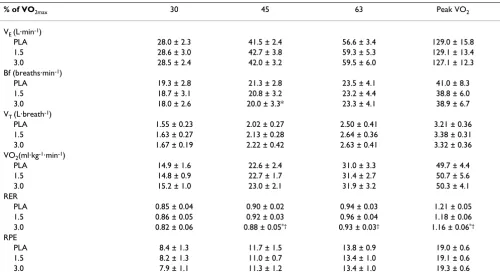
The mean respiratory and metabolic values during sub-maximal and sub-maximal exercise are displayed in Table 2. RER was not different between trials for the lowest exer-cise intensity (30% of VO2max). RER with CAF3 added was
Heart rate at rest and during exercise Figure 1
Heart rate at rest and during exercise. Differences in heart rate between placebo and caffeine trials. Placebo, 1.5 and 3.0 represent dose of caffeine in mg·kg body weight-1.
Values are listed as mean ± SE. * = the mean difference com-pared to placebo is significant (p < 0.05).
50.0 70.0 90.0 110.0 130.0 150.0 170.0 190.0
Rest 30% 45% 63% Peak
exercise intensity (%VO2max)
H
ea
rt R
ate
(
b
ea
ts
/m
in
)
placebo 1.5 mg/kg
3.0 mg/kg
* *
* *
* *
Table 1: Respiratory and Metabolic values at rest
Placebo 1.5 CAF 3.0 CAF
VE (L·min-1) 13.4 ± 3.1 13.3 ± 2.3 14.2 ± 3.0
Bf (breaths·min-1) 16.2 ± 4.6 14.6 ± 2.4 16.6 ± 3.9
VT (L·breath-1) 0.93 ± 0.26 0.99 ± 0.20 0.95 ± 0.18
VO2(ml·kg-1·min-1) 5.2 ± 0.8 5.6 ± 1.0 5.7 ± 0.8
RER 0.89 ± 0.08 0.86 ± 0.09 0.84 ± 0.09*
Values listed as mean ± SD. VE, ventilation; Bf, breathing frequency;
VT, tidal volume; VO2, oxygen consumption; RER, respiratory
exchange ratio. PLA, placebo; 1.5 and 3.0 represent dose of caffeine in
significantly lower (p < 0.05) compared to both the CAF1.5 and placebo trials at 45% of VO2max. RER with CAF3 was significantly lower (p < 0.05) compared to the CAF1.5 trial at 63% of VO2max. During maximal exercise RER with CAF3 was significantly lower (p < 0.05) com-pared to the placebo trial. There were no significant differ-ences for VE, VO2, VT or RPE during the submaximal workloads or at maximal exercise between trials. Bf was significantly lower (p < 0.05) at 45% of VO2max with CAF3 vs placebo. However there were no significant differences for Bf during any other submaximal workloads or at max-imal exercise. There were also no differences between the trials in the peak workload or in time to exhaustion at their maximum workload.
Discussion
The results of this study provide evidence that caffeine at low doses of 1.5 and 3.0 mg/kg body weight significantly decreased heart rate during low to moderate intensity cycle exercise in non-habitual caffeine users. These low doses of caffeine did not significantly affect heart rate at rest nor did they affect performance, HR, and BP at maxi-mal exercise. Our results differ from other studies in that systolic blood pressure was not higher in our subjects with caffeine compared to control during exercise. At these doses, caffeine had no effect on VE, VT, VO2, RPE, maximal power output and time to exhaustion. Therefore those
young adult athletes that use heart rate monitors as an indicator of their optimal pace should be aware of the effect of caffeine lowering effect on heart rate during sub-maximal exercise.
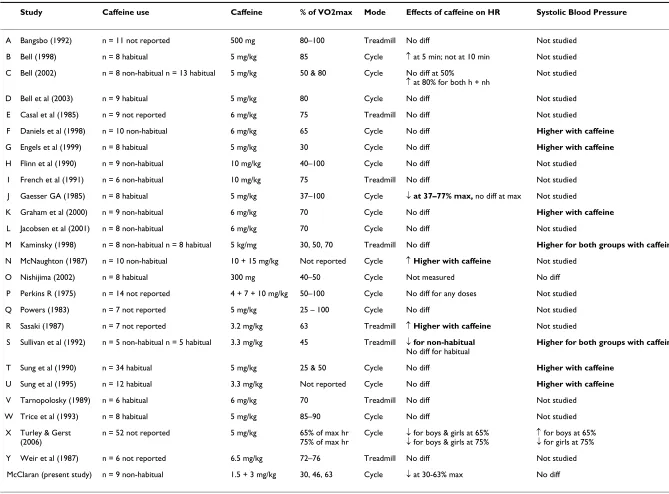
Investigating the cardiovascular effects of caffeine is not new. In 1930, Grollman [29] had individual subjects ingest various doses of caffeine and measured heart rate, blood pressure, VO2 and cardiac output. Because caffeine has been found to cause an increase in blood pressure, the potential negative health consequences of caffeine con-sumption are often a main focus of these studies. The majority of studies that have investigated cardiovascular effects of caffeine during exercise have used higher doses (≥ 5 mg/kg body weight) and whether the studies utilized habituated or non-habituated subjects has varied. To examine the potential role that study design differences (specifically dose, habituation status, and exercise inten-sity) might contribute to the equivocal cardiovascular effects of caffeine during exercise, we reviewed the litera-ture for studies which reported the effects of caffeine on heart rate and systolic blood pressure during exercise (Table 3).
Comparing the results of the current study to previous studies is somewhat difficult given the different doses of caffeine, types and intensities of exercise, and the varied use of either habituated or non-habituated subjects. How-ever, our finding of a lower heart rate with caffeine use during exercise is in agreement with three previous stud-ies. Sullivan et al. [11] studied five habituated and five non-habituated subjects who walked at 46% of VO2max and observed that the five non-habituated subjects showed a significantly lower heart rate after administra-tion of 3.3 mg/kg caffeine (133.9 vs 143.7 during pla-cebo) whereas the difference was not significant in the five habituated subjects (121.8 vs 124.4). Gaesser and Rich [10] gave 5 mg/kg caffeine to low to moderate caffeine users and found lower heart rates (6–10 bpm) compared to placebo at cycling exercise intensities between 30–70% of VO2max. They found no difference in HR above 75% of VO2max (HR > 160 bpm). More recently, Turley and Gerst [12] found lower heart rates in young boys and girls dur-ing cycle exercise at intensities of 41% and 64% of VO2max
(boys) and 51% and 77% of VO2max (girls) after a caffeine dose of 5 mg/kg. Of note is that Sullivan et al. [11] used 3.3 mg/kg caffeine and the other two [10,12] used a higher dose of caffeine (5 mg/kg). Further investigation would seem warranted with different levels of caffeine and comparing non-habituated vs. habitual caffeine users.
Our results are in contrast to a number of studies that have reported no effect of caffeine administration on exercise heart rate [13-28]. A possible explanation is that with one exception [23] each of the remaining 15 studies used a ≥ Systolic blood pressure at rest and during exercise
Figure 2
Systolic blood pressure at rest and during exercise. Differences in Systolic blood pressure between placebo and caffeine trials. Placebo, 1.5 and 3.0 represent dose of caffeine in mg·kg body weight-1. Values are listed as mean ± SE. * =
the mean difference compared to placebo is significant (p < 0.05)
90 110 130 150 170 190
Rest 30% 45% 63%
exercise intensity (%VO2max)
S
y
s
tol
ic
B
lood P
re
s
s
u
re
(
m
m
H
g)
placebo 1.5 mg/kg
5 mg/kg dose of caffeine. Of note is that Perkins used doses of 4, 7, and 10 mg/kg and found no heart rate dif-ference between any of the trials compared to control for exercise intensities at 50% of VO2max through maximal exercise. The development of tolerance to the cardiovascu-lar effects of caffeine in habitual users could also be a potential confounder [1,2]. For example Robertson [30] reported that three days of caffeine administration abol-ished the pressor effect of caffeine in previously caffeine naive subjects. From our review of the caffeine studies in Table 3 the role of habituation is unclear: In the studies we cited finding no change in heart rate during submaximal exercise, five used habituated subjects [14,16,25-27] and five used non-habituated subjects [16,18-21]. The remain-ing studies did not report the habituation of their subjects [13-15,23,24,28]. Furthermore Kaminsky [22] found no change in heart rate during submaximal exercise between their eight habituated vs eight non-habituated subjects with administration of 5 mg/kg of caffeine.
Our results are also in direct contrast to several studies which have found higher heart rates with caffeine during exercise. McNaughton [7] observed higher heart rates dur-ing cycldur-ing at workloads from 50 to 300 watts after high doses (10 and 15 mg/kg) of caffeine compared with pla-cebo. Sasaki [8] also found a significant increase in HR
with caffeine vs placebo but only during the last 30 min-utes of a 2 hr running bout (intensity – 62–67% VO2max).
With a similar low dose of caffeine used in our study (3.3 mg/kg), Sung [9] found a higher heart rate response to a 67 watts workload in hypertensive but not normotensive men. Finally, Bell [5,6] found that a dose of 5 mg/kg (in both habitual and non-habitual users) resulted in a signif-icant increase in HR at 80% and 85% VO2max but no effect of caffeine on HR during cycling at a lower intensity (50% of VO2max). Of note is that a separate previously
men-tioned study by Bell [14] found no difference in heart rates at 80% of VO2max. Considering the possible factors that might account for these findings not in agreement with the present study, the intensity of exercise and the higher dose of caffeine used may be the most likely. How-ever differences in mode of exercise, duration, habituation to caffeine, hypertension status, and perceived stress could also be confounders.
Even though cardiac output was not measured in this study, the similar levels in VO2 during each of the trials would lead us to speculate that there was a comparable cardiac output with the placebo and caffeine trials. Pin-comb [31] at rest and both Engels [17] and Sullivan [11] during exercise measured cardiac output and found no difference on the caffeine compared to the placebo days.
Table 2: Respiratory and metabolic values during submaximal and maximal exercise
% of VO2max 30 45 63 Peak VO2
VE (L·min-1)
PLA 28.0 ± 2.3 41.5 ± 2.4 56.6 ± 3.4 129.0 ± 15.8
1.5 28.6 ± 3.0 42.7 ± 3.8 59.3 ± 5.3 129.1 ± 13.4
3.0 28.5 ± 2.4 42.0 ± 3.2 59.5 ± 6.0 127.1 ± 12.3
Bf (breaths·min-1)
PLA 19.3 ± 2.8 21.3 ± 2.8 23.5 ± 4.1 41.0 ± 8.3
1.5 18.7 ± 3.1 20.8 ± 3.2 23.2 ± 4.4 38.8 ± 6.0
3.0 18.0 ± 2.6 20.0 ± 3.3* 23.3 ± 4.1 38.9 ± 6.7
VT (L·breath-1)
PLA 1.55 ± 0.23 2.02 ± 0.27 2.50 ± 0.41 3.21 ± 0.36
1.5 1.63 ± 0.27 2.13 ± 0.28 2.64 ± 0.36 3.38 ± 0.31
3.0 1.67 ± 0.19 2.22 ± 0.42 2.63 ± 0.41 3.32 ± 0.36
VO2(ml·kg-1·min-1)
PLA 14.9 ± 1.6 22.6 ± 2.4 31.0 ± 3.3 49.7 ± 4.4
1.5 14.8 ± 0.9 22.7 ± 1.7 31.4 ± 2.7 50.7 ± 5.6
3.0 15.2 ± 1.0 23.0 ± 2.1 31.9 ± 3.2 50.3 ± 4.1
RER
PLA 0.85 ± 0.04 0.90 ± 0.02 0.94 ± 0.03 1.21 ± 0.05
1.5 0.86 ± 0.05 0.92 ± 0.03 0.96 ± 0.04 1.18 ± 0.06
3.0 0.82 ± 0.06 0.88 ± 0.05*† 0.93 ± 0.03† 1.16 ± 0.06*†
RPE
PLA 8.4 ± 1.3 11.7 ± 1.5 13.8 ± 0.9 19.0 ± 0.6
1.5 8.2 ± 1.3 11.0 ± 0.7 13.4 ± 1.0 19.1 ± 0.6
3.0 7.9 ± 1.1 11.3 ± 1.2 13.4 ± 1.0 19.3 ± 0.6
Values listed as mean ± SD. VE, ventilation; Bf, breathing frequency; VT, tidal volume; VO2, oxygen consumption; RER, respiratory exchange ratio;
RPE, rating of perceived exertion. PLA, placebo; 1.5 and 3.0 represent dose of caffeine in mg·kg body weight-1.
* Significantly different from placebo (p < 0.05).
Journal of the International
Society of Sports Nutrition
2
007,
4
:11
http
://www.jissn.com/content/4/1/1
Page
(page number not for citation purposes)
A Bangsbo (1992) n = 11 not reported 500 mg 80–100 Treadmill No diff Not studied
B Bell (1998) n = 8 habitual 5 mg/kg 85 Cycle ↑at 5 min; not at 10 min Not studied
C Bell (2002) n = 8 non-habitual n = 13 habitual 5 mg/kg 50 & 80 Cycle No diff at 50%
↑at 80% for both h + nh
Not studied
D Bell et al (2003) n = 9 habitual 5 mg/kg 80 Cycle No diff Not studied
E Casal et al (1985) n = 9 not reported 6 mg/kg 75 Treadmill No diff Not studied
F Daniels et al (1998) n = 10 non-habitual 6 mg/kg 65 Cycle No diff Higher with caffeine
G Engels et al (1999) n = 8 habitual 5 mg/kg 30 Cycle No diff Higher with caffeine
H Flinn et al (1990) n = 9 non-habitual 10 mg/kg 40–100 Cycle No diff Not studied
I French et al (1991) n = 6 non-habitual 10 mg/kg 75 Treadmill No diff Not studied
J Gaesser GA (1985) n = 8 habitual 5 mg/kg 37–100 Cycle ↓ at 37–77% max, no diff at max Not studied
K Graham et al (2000) n = 9 non-habitual 6 mg/kg 70 Cycle No diff Higher with caffeine
L Jacobsen et al (2001) n = 8 non-habitual 6 mg/kg 70 Cycle No diff Not studied
M Kaminsky (1998) n = 8 non-habitual n = 8 habitual 5 kg/mg 30, 50, 70 Treadmill No diff Higher for both groups with caffeine
N McNaughton (1987) n = 10 non-habitual 10 + 15 mg/kg Not reported Cycle ↑ Higher with caffeine Not studied
O Nishijima (2002) n = 8 habitual 300 mg 40–50 Cycle Not measured No diff
P Perkins R (1975) n = 14 not reported 4 + 7 + 10 mg/kg 50–100 Cycle No diff for any doses Not studied
Q Powers (1983) n = 7 not reported 5 mg/kg 25 – 100 Cycle No diff Not studied
R Sasaki (1987) n = 7 not reported 3.2 mg/kg 63 Treadmill ↑ Higher with caffeine Not studied
S Sullivan et al (1992) n = 5 non-habitual n = 5 habitual 3.3 mg/kg 45 Treadmill ↓ for non-habitual No diff for habitual
Higher for both groups with caffeine
T Sung et al (1990) n = 34 habitual 5 mg/kg 25 & 50 Cycle No diff Higher with caffeine
U Sung et al (1995) n = 12 habitual 3.3 mg/kg Not reported Cycle No diff Higher with caffeine
V Tarnopolosky (1989) n = 6 habitual 6 mg/kg 70 Treadmill No diff Not studied
W Trice et al (1993) n = 8 habitual 5 mg/kg 85–90 Cycle No diff Not studied
X Turley & Gerst (2006)
n = 52 not reported 5 mg/kg 65% of max hr
75% of max hr
Cycle ↓for boys & girls at 65% ↓for boys & girls at 75%
↑for boys at 65% ↓for girls at 75%
Y Weir et al (1987) n = 6 not reported 6.5 mg/kg 72–76 Treadmill No diff Not studied
Therefore we would further speculate that the lower heart rate we observed during moderate exercise would indicate an increased or optimized stroke volume. The most likely mechanism would seem to be either an enhanced contrac-tility or a higher preload with caffeine use during submax-imal exercise in non-habituated subjects. Gould et al. [32] showed an augmented (but not significant) stroke volume with caffeine ingestion due to an enhanced left ventricular end-diastolic volume. Robertson [33] speculates that caf-feine's effect may be due to an enhancement of myocar-dial contractility caused by methylxanthines.
Another possible explanation of a lowered HR is due to the baroreflex reflexively lowering heart rate in response to an elevation of BP in an attempt to reestablish "nor-mal" BP [34]. Perhaps caffeine habituation might make this reflex less sensitive and therefore result in no HR change (and an increase in BP). In support of this, Sulli-van [11] found HR decreases in non-habitual users but not in habitual users, whereas the current study used non-habitual users. While Turley and Gerst [12] did not report caffeine use, because their subjects were children we might assume that caffeine use was highly variable. How-ever, Gaesser and Rich [10] used subjects who were low to moderate caffeine users (100–200 mg/kg daily who abstained from caffeine in the previous 24 hours) and found a lower heart rate during exercise with caffeine. Moreover, there has been previous mention of the studies that used non-habituated caffeine users and showed sim-ilar or higher heart rates after caffeine administration.
A final influence on the effect of caffeine on HR is the effect that caffeine may have in the face of "stress". Coffee has been shown to increase the HR response to mental stress [35]. The tendency of caffeine alone to reduce heart rate appears to be reversed when caffeine is consumed during active coping stress. Rest and low to moderate intensity exercise may be perceived as not very stressful, especially in healthy and fit people. Our data indicated that the effect of CAF on HR was not evident during higher intensity exercise, perhaps because of the perception of higher stress.
Lastly it is unclear as to why the lower heart rate during submaximal exercise with the 1.5 and 3 mg/kg caffeine tri-als disappears during near maximal and maximal exercise. This similar heart rate response at high levels of exercise is consistent with other studies using either habituated or non-habituated subjects [10,13,14,18,23,24,27]. Based on the previous discussion it could be that contractility or preload cannot be further optimized at high exercise intensity and therefore the caffeine effect is negated. Fur-ther follow-up caffeine studies measuring stroke volume would need to be conducted in order to fully illuminate this question.
We observed that systolic blood pressure was significantly higher at rest which is in agreement with most previous studies [4,11,16,17,20,22,25]. In a review Myers [4] notes that most of the recent studies at that time showed an increase in blood pressure with caffeine at rest. He sug-gested that the mechanisms of the higher blood pressure response to caffeine could mostly be attributed to a pres-sor effect caused by a sympathetic mediated vasoconstric-tion. It has also been postulated that the higher systolic blood pressure occurs because caffeine blocks the normal vasodilatory effects of adenosine which can also lead to peripheral vasoconstriction [11,17]. There remains more to be done before caffeine's mechanism of action on systolic BP is completely understood.
At the doses given in the current study caffeine had no effect on systolic BP during exercise and this result differs from previous studies showing increased systolic BP dur-ing submaximal exercise intensity [1,11,16,17,22,25,36]. As discussed previously when comparing the heart rate response, the difference in our findings could possibly be explained by the mitigating effect of habitual caffeine use. However it should be noted that the previous studies using non-habituated subjects [11,16,22] show a signifi-cantly higher systolic BP. Furthermore Kaminsky [22] and Sullivan [11] who compared habituated to non-habitu-ated subjects saw the same higher systolic BP response to caffeine in both groups. The above studies used different doses (between 3.3 mg/kg – similar to the present study and 6 mg/kg) and consistently found a higher systolic BP during submaximal exercise; therefore the amount of caf-feine administered does not seem a likely explanation. A closer analysis of our individual data revealed the follow-ing: Of the nine subjects tested, four showed a consist-ently higher systolic BP response with 3 mg/kg caffeine, three were consistently lower and the last two had equiv-ocal systolic BP data. Therefore there does not seem to be an easy explanation as to why there is a discrepancy between ours compared to other studies.
sub-maximal exercise bouts occurred within the window where caffeine elicited a drop in heart rate.
Conclusion
A review of lay press and scientific literature indicates a frequently made statement that caffeine ingestion increases heart rate. In an article for public education on the MayoClinic.com website [37] entitled "Caffeine: Does it help you lose weight?" a sentence reads: "Also, keep in mind that caffeine is a stimulant that can increase your heart rate ..." While technically accurate (contains the word "can"), it does not indicate at what dose this might likely be true. The association of caffeine and increased HR is also often reported in the scientific exercise and sports medicine literature. In a recent review article: "Caf-feine as an Ergogenic Aid", Keisler and Armsey [3] state "In the cardiovascular system, caffeine acts to increase heart rate and blood pressure." Again, at what dose, and whether the authors are speaking about resting or exercise heart rate, is unclear from the text. In the discussion sec-tion of their research study, Jacobson et al. [21] state, "There is general agreement that caffeine ingestion increases exercise heart rate because of its powerful effect on the sympathetic nervous system." For this statement the authors cite two references however, in neither cited study were heart rates reported. These accounts are clearly contradictory to the majority of the research literature and perpetuation of the notion that caffeine increases heart rate during exercise seems unwarranted. In addition we noticed that most of the recent studies that compared heart rates during exercise with caffeine administration have typically cited only a few studies and have not con-sidered the breadth of the possible issues. While not a complete review of all the relevant studies we feel that the studies we presented in Table 3 suggest there is more that needs to be done before there is general agreement on the caffeine effect on heart rate and blood pressure during exercise.
Further investigations of the cardiovascular effects of caf-feine are especially warranted with the recognition that its performance enhancing effects on endurance exercise can occur at doses near or below 3 mg/kg [1,38,39]. Already the average American consumes 238 mg of caffeine per day [1], however even more athletes may use these low caffeine doses to obtain the ergogenic benefit. Our study suggests in young, healthy subjects that a caffeine pill comparable to 1–3 cups of coffee lowers heart rate during submaximal exercise and therefore may alter workload selection when using a heart rate monitor as an index for exercise intensity. Clearly, clarification of caffeine's cardi-ovascular effects at these low but effective doses is impor-tant. In addition, the cardiovascular effects of caffeine with different exercise intensities, mode, sex, age and fit-ness as well as the mechanism(s) responsible for
cardio-vascular effects remains to be clarified. In addition further research could be completed that specifically determines if there are differences between habituated vs. non-habit-uated users and also that compares the effect of various other caffeine doses (e.g., 4, 5 & 6 mg/kg caffeine).
References
1. Graham TE: Caffeine and Exercise. Sports Med 2001, 31:785-807. 2. Paluska SA: Caffeine and exercise. Curr Sports Med Rep 2003,
2:213-219.
3. Keisler BD, Armsey TD: Caffeine as an ergogenic aid. Curr Sports Med Rep 2006, 5:215-219.
4. Myers MG: Effects of caffeine on blood pressure. Arch Intern Med
1988, 148:1189-1193.
5. Bell DG, Jacobs I, Zamecnik J: Effects of caffeine, ephedrine and their combination on time to exhaustion during high-inten-sity exercise. Eur J Appl Physiol Occup Physiol 1998, 77:427-433. 6. Bell DG, McLellan TM: Exercise endurance 1, 3, and 6 h after
caffeine ingestion in caffeine users and nonusers. J Appl Physiol
2002, 93:1227-1234.
7. McNaughton L: Two levels of caffeine ingestion on blood lac-tate and free fatty acid responses during incremental exer-cise. Res Quarter 1987, 58:255-259.
8. Sasaki H, Takaoka I, Ishiko T: Effects of sucrose or caffeine inges-tion on running performance and biochemical responses to endurance running. Int J Sports Med 1987, 8(3):203-207. 9. Sung BH, Lovallo WR, Whitsett T, Wilson MF: Caffeine elevates
blood pressure response to exercise in mild hypertensive men. Am J Hypertens 1995, 8(12 Pt 1):1184-1188.
10. Gaesser GA, Rich RG: Influence of caffeine on blood lactate response during incremental exercise. Int J Sports Med 1985,
6(4):207-211.
11. Sullivan JJ, Knowlton RG, Brown DD: Caffeine affects heart rate and blood pressure response to prolonged walking. J Cardiop-ulm Rehabil 1992, 12:418-422.
12. Turley KR, Gerst JW: Effects of caffeine on physiological responses to exercise in young boys and girls. Med Sci Sports Exerc 2006, 38:520-526.
13. Bangsbo J, Jacobsen K, Nordberg K, Christensen NJ, Graham T:
Acute and habitual caffeine ingestion and metabolic responses to steady-state exercise. J Appl Physiol 1992,
72:1297-1303.
14. Bell DG, McLellan TM: Effect of repeated caffeine ingestion on repeated exhaustive exercise endurance. Med Sci Sports Exerc
2003, 35:1348-1354.
15. Casal DC, Leon AS: Failure of caffeine to affect substrate utili-zation during prolonged running. Med Sci Sports Exerc 1985,
17:174-179.
16. Daniels JW, Mole PA, Shaffrath JD, Stebbins CL: Effects of caffeine on blood pressure, heart rate, and forearm blood flow during dynamic leg exercise. J Appl Physiol 1998, 85:154-159.
17. Engels HJ, Wirth JC, Celik S, Dorsey JL: Influence of caffeine on metabolic and cardiovascular functions during sustained light intensity cycling and at rest. Int J Sport Nutr 1999,
9:361-370.
18. Flinn S, Gregory J, McNaughton LR, Tristram S, Davies P: Caffeine ingestion prior to incremental cycling to exhaustion in rec-reational cyclists. Int J Sports Nutr 1990, 11(3):188-193. 19. French C, McNaughton L, Davies P, Tristram S: Caffeine ingestion
during exercise to exhaustion in elite distance runners. J Sports Med Phys Fitness 1991, 31:425-433.
20. Graham TE, Helge JW, MacLean DA, Kiens B, Richter EA: Caffeine ingestion does not alter carbohydrate or fat metabolism in human skeletal muscle during exercise. J Physiol 2000,
529:837-847.
21. Jacobson TL, Febbario MA, Arkinstall MJ, Hawley JA: Effect of caf-feine co-ingested with carbohydrate or fat on metabolism and performance in endurance-trained men. Exp Physiol 2001,
86(1):137-144.
22. Kaminsky LA, Martin CA, Whaley MH: Caffeine consumption habits do not influence the exercise blood pressure response following caffeine ingestion. J Sports Med Phys Fitness 1998,
Publish with BioMed Central and every scientist can read your work free of charge "BioMed Central will be the most significant development for disseminating the results of biomedical researc h in our lifetime."
Sir Paul Nurse, Cancer Research UK
Your research papers will be:
available free of charge to the entire biomedical community
peer reviewed and published immediately upon acceptance
cited in PubMed and archived on PubMed Central
yours — you keep the copyright
Submit your manuscript here:
http://www.biomedcentral.com/info/publishing_adv.asp
BioMedcentral
23. Perkins R, Williams MH: Effect of caffeine upon maximal mus-cular endurance of females. Med Sci Sports 1975, 7(3):221-224. 24. Powers SK, Byrd RJ, Tulley R, Callender T: Effects of caffeine
ingestion on metabolism and performance during graded exercise. Eur J Appl Physiol Occup Physiol 1983, 50(3):301-307. 25. Sung BH, Lovallo WR, Pincomb GA, Wilson MF: Effects of caffeine
on blood pressure response during exercise in normotensive healthy young men. Am J Cardiol 1990, 65:909-913.
26. Tarnopolsky MA, Atkinson SA, MacDougall JD, Sale DG, Sutton JR:
Physiological responses to caffeine during endurance run-ning in habitual caffeine users. Med Sci Sports Exerc 1989,
21:418-424.
27. Trice I, Haymes EM: Effects of caffeine ingestion on exercise-induced changes during high-intensity, intermittent exer-cise. Int J Sport Nutr 1995, 5(1):37-44.
28. Weir J, Noakes TD, Myburgh K, Adams B: A high carbohydrate diet negates the metabolic effects of caffeine during exer-cise. Med Sci Sports Exerc 1987, 19:100-105.
29. Grollman A: The action of alcohol, caffeine, and tobacco, on the cardiac output (and its related functions) of normal man.
J Pharmacol Exp Ther 1930, 39:313-327.
30. Robertson D, Wade D, Workman R, Woolsey RL, Oates JA: Toler-ance to the humoral and hemodynamic effects of caffeine in man. J Clin Invest 1981, 67:1111-1117.
31. Pincomb GA, Lovallo WR, Passey RB, Whitsett TL, Silverstein SM, Wilson MF: Effects of caffeine on vascular resistance, cardiac output, and myocardial contractility in young men. Am J Car-diol 1985, 56:119-122.
32. Gould L, Verkatararaman K, Goswami M, Gomprecht RF: The car-diac effects of coffee. Angiology 1973, 24(8):455-463.
33. Robertson D, Frolich JC, Carr RK, Watson JT, Hollifield JW, Shand DG: Effects of caffeine on plasma rennin activity, catecho-lamines and blood pressure. N Engl J Med 1978, 298:181-186. 34. Mosqueda-Garcia R, Tseng CJ, Biaggioni I, Robertson RM, Robertson
D: Effects of caffeine on baroreflex activity in humans. Clin Pharmacol Ther 1990, 48:568-574.
35. van Dusseldorp M, Smits P, Lenders JW, Temme L, Thien T, Katan MB: Effects of coffee on cardiovascular responses to stress: a 14-week controlled trial. Psychosom Med 1992, 54:344-353. 36. Nishijima Y, Ikeda T, Takamatsu M, Kiso Y, Shibata H, Fushiki T,
Mori-tani T: Influence of caffeine ingestion on autonomic nervous activity during endurance exercise in humans. Eur J Appl Physiol
2002, 87:475-480.
37. Mayo Clinic Health Information [http://www.mayoclinic.com/] 38. Cox GR, Desbrow B, Montgomery PG, Anderson ME, Bruce CR,
Macrides TA, Martin DT, Moquin A, Roberts A, Hawley JA, Burke LM:
Effect of different protocols of caffeine intake on metabolism and endurance performance. J Appl Physiol 2002, 93:990-999. 39. Kovacs EM, Stegen JHCH, Brouns F: Effect of caffeinated drinks