117 | P a g e
International Journal of Phytopharmacology
www.onlineijp.com
e- ISSN 0975 – 9328
Print ISSN 2229 – 7472
STANDARDIZATION AND QUANTIFICATION OF CURCUMIN
PRESENT IN CURCUMA LONGA EXTRACT USING HPLC
Shivarkar Rahul Shashikant
1*, S. B. Bhise
2and V. Rama Mohan Gupta
31Pharmacognosy Department, Sinhgad Institute of Pharmaceutical Sciences, Lonavala Kusgaon BK Lonavala Tal, Maval Dist,
Pune 410401, Maharashtra, India.
2A202, Navakar Residency, Behind Bibvewadi Police Chowki,Pune 411037, Maharashtra, India.
3Pulla Reddy Institute of Pharmacy, Near Dundigal Air Force Academy Annaram (V), Jinnaram (M) Medak (Dt) 502313,
Telangana, India.
ABSTRACT
Herbal product studies can be considered scientifically valid if the product tested was authenticated and characterized. Standardization of herbal drugs is generally based on one or more known and accepted active biochemical principle. Fingerprint analysis approach using high performance liquid chromatography has become the most potent tools for quality control of herbal medicines because of its simplicity and reliability. For the development of a botanical product, authentication of raw material is the basic starting point. However, the quality and consistency of a final product may dramatically affected due to harvesting, storing, processing and formulating methods by altering the desired active components or by increasing the possibility of unwanted contaminants. Thus, validated methods to ensure quality control in manufacturing and storage are required tools for optimal efficacy and safety of the products. In present work, Curcuma longa ethanolic extract was standardizing by quantifying curcumin using HPLC in this standard curcumin was used as biomarker. Standardization was done by considering retention time of curcumin peak of standard curcumin and that of the Curcuma longa extract. In both chromatograms curcumin peak has shown almost same retention time. By injecting various concentrations of curcumin (in methanol) in HPLC system, the linearity was observed in standard curcumin solutions ranging from 5 to 40 µg/ml. Using the data obtained from the linearity curve, the concentration of curcumin present in extract of Curcuma longa was calculated and it is found to be 57.4%.Thus HPLC is found to be suitable, sensitive and reliable method for the standardization and quantification of curcumin present in the Curcuma longa extractwith respect to curcumin as a marker. Thus this developed HPLC method is a useful validation tool for the standardization and quality control analysis of Curcuma longa, either extract or formulation form.
Key words: Standardization, Curcuma longa, Curcumin, HPLC, Retention time.
Corresponding Author Shivarkar Rahul Shashikant Email: [email protected]
INTRODUCTION
Fingerprint analysis approach using high Access this article online
Home page:
http://onlineijp.com/
DOI:
http://dx.doi.org/10.21276/ijp.2017.8.3.6
Quick Response code
Received:05.06.17 Revised:12.06.17 Accepted:28.06.17
performance liquid chromatography has become the most potent tools for quality control of herbal medicines because
of its simplicity and reliability (Dobrial R and Narayana D, 1998). For the development of a botanical product, authentication of raw material is the basic starting point. However, the quality and consistency of a final product may dramatically have affected due to harvesting, storing, processing and formulating methods by altering the desired active components or by increasing the possibility of unwanted contaminants. Thus, validated
118 | P a g e
methods to ensure quality control in manufacturing and storage are required tools for optimal efficacy and safety of the products. These controls are also critical for the evaluation of pharmacological, toxicological and clinical studies of the botanical supplements.
Herbal product studies cannot be considered scientifically valid if the product tested was not authenticated and characterized. Standardization of herbal drugs is generally based on one or more known and accepted active biochemical principle (Monfort et al, 1992). However, many a times where the active biochemical principle is not known, a characteristic compound is used as a "marker," which signifies the presence of the other biochemical compounds that give the herb its therapeutic properties. Besides the physical and chemical markers, genetic markers are also now recommended to be used to authenticate the basic ingredients of botanical and traditional drugs.
In general, one or two markers or
pharmacologically active components in herbs and or herbal mixtures are currently employed for evaluating the quality and authenticity of herbal medicines, in the identification of the single herb or herbal preparations, and in assessing the quantitative herbal composition of an herbal product (Bhutani K, 2000). This kind of the determination, however, does not give a complete picture of a herbal product, because multiple constituents are usually responsible for its therapeutic effects. These multiple constituents may work ‘synergistically’ and could hardly be separated into active parts.
Thus, it seems to be necessary to determine most of the phytochemical constituents of herbal products in order to ensure the reliability and repeatability of pharmacological and clinical research, to understand their bioactivities and possible side effects of active compounds and to enhance product quality control (Jain S et al., 2007). Several chromatographic techniques, such as high-performance liquid chromatography (HPLC), gas chromatography (GC), capillary electrophoresis (CE), thin layer chromatography (TLC) and high-performance thin layer chromatography (HPTLC) can be applied for the standardization of herbal medicines.
Curcuma is genus of about 70 spices of rhizomatous herbs distributed in South East Asia and especially India, China, Thailand, Italy, Malaysia, Archipelago and N. Australia. Commercially C. amada, C. angustifolia, C. aromatica, C. caesia, C. zedoria and C. longa is more important due to its uses like spice, condiment, antiseptic in bruises, as anti-inflammatory and in sprains (Kokate et al., 2003).
Curcuma longa, a perennial herb, is a member of the Zingiberaceae (ginger) family. Externally, the drug is yellowish-brown in color with characteristic odor and slightly bitter in taste. Round turmeric rhizome are oblong, while long variety is cylindrical and short branched. Root scars and annulations are present. The fracture is horny and
internal surface is orange. Rhizomes are 5 to 10 x 2 to 4 cm in size. It has oblong, pointed leaves and bears funnel- shaped yellow flowers (Leung, 1980).
HPLC has become the most versatile, safest, dependable fastest and sensitive chromatographic technique for quality control of drug components. In general, HPLC can be used to analyze almost all the compounds in the herbal medicines. Thus, over the past decades, HPLC has received the most extensive application in the analysis of herbal medicines. Reversed-phase (RP) columns may be the most popular columns used in the analytical separation of herbal medicines.
It is necessary to notice that the optimal separation condition for the HPLC involves many factors, such as the different compositions of the mobile phases, their pH adjustment, pump pressures, etc. Thus, a good experimental design for the optimal separation seems in general necessary. It can serve as a tool for identification, authentication and quality control of herbal drugs. Determination of total curcumin is very important for standardization of C. longa.
MATERIALS AND METHODS Extraction:
Curcuma longa rhizomes (Turmeric) collected from market and dried in oven at 50 ˚C Extraction of the powdered plant material (rhizome of Curcuma longa) was subjected to Soxhlet extraction using ethanol as a solvent. The extract material was evaporated on water bath and
Curcuma longa dried whole ethanolic extract was collected. This extract was further used for all phytochemical and pharmacological evaluation.
Rotary extraction can be preferentially be used for efficient and economic extraction. The turmeric, after crushing to a coarse powder, is loaded to the extractor and solvent (about 4-5 times of raw material) is charged. The contents are heated to boiling and then for refluxing 2-3 hours under the mild turbulence given by forced circulation or rotation. Three extractions are enough in rotary extractors for complete exhaustion of turmeric while it may take 4-5 extractions in vertical extractors. The extraction solvent after concentration under vacuum at maximum temperature of 55 ºC to an appropriate density is transferred to crystallizers, maintained at temperature 8-10
ºC. The crystals obtained are filtered, washed and dried in
vacuum tray dryer or fluid bed dry (Yogeshwaran, 2005).
Reference compound and reagents
Reference curcumin was procured from Loba Chemie, Mumbai. All HPLC grade solvents were obtained from Merck (Mumbai, India).
Preparation of standard solutions
119 | P a g e
diluted with HPLC grade methanol to get different concentrations of solution ranging from 5, 10, 20, 30, and 40 μg/ml using HPLC grade methanol. The max of
curcumin in methanol was found to be 425 nm. Hence the absorbance of the above mentioned standard solutions were recorded at 425 nm. Before use, the mobile phase was degassed by an ultrasonic bath. Separation was performed at room temperature.
Preparation of sample solution
10 mg of extract of Curcuma longa was accurately weighed and dissolved in 10 ml HPLC grade methanol to get solution of 1 mg/ml. This solution was further diluted to get concentration of50 µg/ml. This solution was then filtered using membrane filter before injecting into the HPLC system. The separation system consisted of a C18 reversed-phase column, an isocratic
elution system of methanol: water (70:30 % v/v) and an UV detector.
Instrument and Chromatographic Conditions Linearity and Range
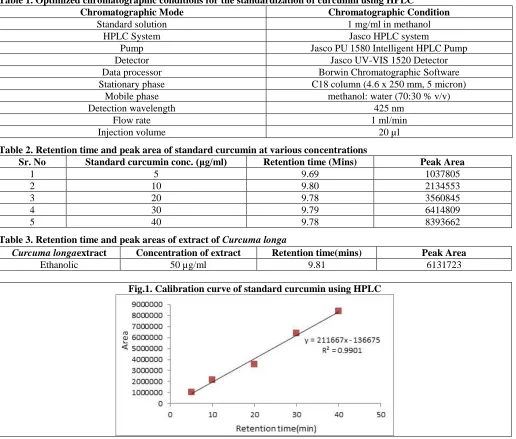
Identification was based on comparing retention times and UV–Vis spectral data of the peaks detected to those of original reference standard compound. The calibration curve was prepared by injecting various concentrations of the calibrator solutions. The calibration plot was found to be linear in the range 5g/ml to 40 g/ml. With a correlation coefficient was found to be 0.990. Retention time and peak area of standard curcumin at various concentrations and Curcuma longa extract are shown in table 1.2 and 2.3 respectively. The calibration curve of standard curcumin is shown in Fig 1.
Table 1. Optimized chromatographic conditions for the standardization of curcumin using HPLC
Chromatographic Mode Chromatographic Condition
Standard solution 1 mg/ml in methanol
HPLC System Jasco HPLC system
Pump Jasco PU 1580 Intelligent HPLC Pump
Detector Jasco UV-VIS 1520 Detector
Data processor Borwin Chromatographic Software
Stationary phase C18 column (4.6 x 250 mm, 5 micron)
Mobile phase methanol: water (70:30 % v/v)
Detection wavelength 425 nm
Flow rate 1 ml/min
Injection volume 20 µl
Table 2. Retention time and peak area of standard curcumin at various concentrations
Sr. No Standard curcumin conc. (μg/ml) Retention time (Mins) Peak Area
1 5 9.69 1037805
2 10 9.80 2134553
3 20 9.78 3560845
4 30 9.79 6414809
5 40 9.78 8393662
Table 3. Retention time and peak areas of extract of Curcuma longa
Fig.1. Calibration curve of standard curcumin using HPLC
Curcuma longaextract Concentration of extract Retention time(mins) Peak Area
120 | P a g e
Chromatograms of standard curcumin
Sr no. Curcumin concentration (µg/ml) Retention time(mins) Peak area
1. 05 9.69 1037805
Chromatograms of Curcuma longa extract
Sr no. Curcumin concentration (µg/ml) Retention time(mins) Peak area
1. 10 9.80 2134553
Sr no. Curcumin concentration (µg/ml) Retention time(mins) Peak area
1. 20 9.78 3560845
Sr no. Curcumin concentration (µg/ml) Retention time(mins) Peak area
121 | P a g e
Sr no. Curcumin concentration (µg/ml) Retention time(mins) Peak area
1. 40 9.78 8393662
Sr.No Curcumin concentration (µg/ml) Retention time(min) Peak area
1. 50 9.81 6131723
Chromatograms of standard curcumin with curcumin present in Curcuma longa extract by HPLC
RESULTS AND DISCUSSION
Standard curcumin was used as biomarker for the standardization of Curcuma longa extract. Standardization was done by considering retention time of curcumin peak of standard curcumin and that of the Curcuma longa
extract. In both chromatograms curcumin peak has shown almost same retention time. By injecting various concentrations of curcumin (in methanol) in HPLC system, the linearity was observed in standard curcumin solutions ranging from 5 to 40 µg/ml. Using the data obtained from the linearity curve, the concentration of curcumin present
in extract of Curcuma longa was calculated. Thus by calculation, extract of Curcuma longa contains 57.4% of curcumin.
CONCLUSION
It can thus be concluded that the Curcuma longa
122 | P a g e
standardization and hence gives more accurate results than other methods of standardization. Thus this developed HPLC method is a useful validation tool for the
standardization and quality control analysis of Curcuma longa, either extract or formulation form.
REFERENCES
Bhutani K. Fingerprinting of Ayurvedic Drugs, The Eastern Pharmacist, 50, 2000, 21-26.
Dobrial R, Narayana D. Ayurvedic Herbal Raw material, The Eastern Pharmacist, 48,1998, 31-35.
Jain S, Menghani E, Jain R. Biomarkers as a tool for validation of herbs and spices, International Journal of Food Safety, 9, 2007, 1-6.
Kokate C, Purohit A, Gokhale S. Terpenoids, Pharmacognosy, Nirali, New Dehli, India, 43, 2003, 11.110.
Leung A.Drugs and Cosmetics, Encyclopedia of Common Natural Ingredients Used in Food, New York, 1980, 313-314. Monfort G, Ayora T, Maldonado M, Loyhola I. Phytochemistry and. Analysis., 3, 1992, 117.
Rajpal V. Curcuma longa, Standardization of Botanicals, Eastern, New Dehli, India, 2, 2005, 120-132. Yogeshwaran. Turmeric: Traditional herb par excellence. Herbal Tech Industry,2, 2005, 12-18.
Cite this article:
Shivarkar Rahul Shashikant, Bhise SB and Rama Mohan Gupta V. Standardization and Quantification of Curcumin Present In Curcuma longa Extract Using HPLC. International Journal of Phytopharmacology, 2017;8(3):117-122.
DOI: http://dx.doi.org/10.21276/ijp.2017.8.3.6
1.