Monineath EL
Faculty of Economics, Chiang Mai University, Thailand
http://doi.org/10.31039/jomeino.2018.2.2.3
Abstract
This empirical study examines the factors affecting export performance in Cambodia through the period of 1993-2015. This study employed Autoregressive Distributed Lag (ARDL) model to investigate the long and short-run relationship among export and its determinant factors-inflation, real exchange rate, official development assistance, and trade liberalization. The study finds that INF obtains negative relationship with EX in both short and long run meanwhile TL has positive relationship with EX. But, RER has negative impact on the export performance in the short run only; ODA poses the significant positive relationship in the long run, vice versa. Unexpected positive relationship between crisis and export would be explain by insignificant impact of 1997 ASEAN financial crisis and the remaining growth of export during 2008 world economic crisis. The significant and negative coefficient of
ECMt−1 indicates the relative speed of adjustment to achieve
the long run equilibrium. This study suggests that government should prioritize to maintain inflation rate and real exchange rate, which negatively associate the export performance and export competitiveness of the country, at an optimum level. This study provides concrete evidence for policymakers in conducting the feasible policies to enhance and facilitate the trade liberalization in Cambodia
Received 21 March 2018 Revised 04 April 2018 Accepted 26 April 2018
Zaman University Publishing
Corresponding author:
36
Keywords: Export, Inflation, Real Exchange Rate, Trade Liberalization, Official Development Assistance,ARDL model, Cambodia
Introduction
The success from East Asian miracle of the outward looking strategies in the forms of export-oriented paradigm has been spread across the South East Asian nations including Cambodia. In the post-1991 Paris Peace agreement, Cambodia shifted from the planed market system to a free-market economy which adopted export-oriented strategy without getting through the stage of import-substitution industrialization (Natsuda et al., 2010). From national peace, stability and free-market economy catalyzed economic and industrial development in Cambodia; then, export sectors started to grow dramatically. Given the pre-existing abundance of low cost production in the form of low labor cost; the beauty of Normalized Trade Relationship (NTR) in exporting garment and textile products to US market; the quota-free and duty-quota-free under the Everything But Arms-General System of Preferences (GSP) provided by European Union in 2001, the Cambodian export has been become the major driver of economics growth which approximately 70% of the exports is dominated by the garment and textile products (Natsuda et al., 2010).
Upon the Cambodian economics’ structure shown in the table 1, export share to GDP has been increased in the post-1997 ASEAN financial crisis from average 29.44% to 50.99%. Also, it kept continuously on this upward trend till 65.43% before it faced the decline during 2008 World Financial Crisis and onward. Notably, reliance on imported products and raw materials for the domestic production and consumption, the large trade deficit appeared to shape negative share of net export of GDP in the last couple decades (see table 1). The gap exists between export and import also can be explained the sluggish growth of export since Cambodia heavily relies on garment and textile commodities in her exports.
37
Table 1: Economic Indicators in Cambodia, 1994-2015
Indicators 1994-1998 1999-2003 2004-2008 2009-2015
Export, percent of GDP 29.44 50.99 65.43 57.27
Import, percent of GDP 43.75 61.50 72.08 62.47
Net Export, percent of GDP -14.31 -10.51 -6.65 -5.20
Real GDP growth rate 6.32 8.78 10.25 6.00
Inflation rate 7.84 1.41 9.82 2.82
Net ODA, per Capita 35.63 33.59 43.76 52.76
Population growth 3.03 2.05 1.54 1.59
Real exchange rate 4475.93 5257.22 5038.66 3930.74
Source: Author’s calculation using data from World Bank Development Indicators (2016) & CEIC Database
However, export-led growth paradigm does not always make a win-win outcome all the time. Export-oriented countries which heavily depend on the market of developed countries -called “fallacy of composition” would make them become more vulnerable from unpredictable global economic shocks. Exactly, Cambodia which highly depends on EU and USA market for her export market would be not an exceptional.
Given conditions of the trade deficit, rising of debt, fluctuation of exchange rate, and high dependency on foreign market, it is still questionable whether above mentioned factors really affect the export performance of Cambodia or not. Hence, the purpose of this research paper is to investigate the factors affecting the export performance in Cambodia through the short-run and long short-run analysis using an advanced time series econometric analytical approach
1. Literature Review
The study of factors affecting the export performance has outweighed much attention from economic policymakers, researchers, think-tanks and academia proved by a number of existing literatures using immense economic and non-economic factors in explaining factors affecting the export performance. Through this review, author attempts to select the appropriate variables employed in the study of factor affecting export performance in Cambodia.
38
Though there are no significant relationship among the explanatory variables and trade balance in the short run analysis, the long run analysis revealed that real GDP per capita, inflation, exchange rate obtained negative effect on the trade balance, except the wrong sign of exchange rate owing to the devaluation/deprecation of Sudan currency.
Bhavan (2016) examined the determinants of export performance in the case of Sri Lanka over the period of 1980 to 2013 by using the gross capita formation, interest payment on foreign debt, import, foreign direct investment, per-capita income. Employing Johansen co-integration test to measure the long run relationship and Vector Error Correction Method (VECM), the results depicted that FDI, interest payment on foreign debt and import significantly impact on export in the long run; meanwhile, the negative impacts from the gross capital formation and per capita income of the export destination countries was existed. Also, there are existences in the short run of significant effect of foreign direct investment and per capita income of export destination countries.
Narayan and Narayan (2004) investigated the determinants of demand for Fiji’s export by employing the ARDL bound test approach and error correction model through the period from 1970 to 1999; authors used export price, trading partners’ income, and competitor price as variables to be assessed. The results shown the existence of long run relationship between Fiji’s export and its determinants; remarkably; the competitor price obtained most influence on the export followed by trading partner income, and export price. Meanwhile the short-run relationship analysis revealed that competitor price and trading partner income have significantly positive relationship, except negative relationship with export price.
Kakar et, al. (2010) used ARDL co-integration approach to measure the short and long-run relation between the Pakistan’s trade balance and its determinants—income, money supply and real exchange rate—over the period of 1970 till 2005. The results illustrated that income (GDP), real exchange rate, and money supply are statistically significant in both short and long run.
39
Funke and Ruhwedel (2001) studied on the export variety and export performance from the 10 emerging East Asia economies through the dynamic panel model employed GMM estimator. The authors measured the relationship between Export variable with Real Effective Exchange Rate (REER), product variety (PV) and the world GDP (Y). The results pinpointed that the world economic activities (world GDP) has positive impacts on export; accordingly, the higher relation of EX and PV is resulted from real exchange rate depreciation which is consistent with the existing theoretical and empirical finding.
From the above literature reviews illustrate the different variables employed to determine export performance including various econometric approaches. In this study, author adopts and employs the relevant variables in accordance with the Cambodia’s economic and export structures as well as using the ARDL bound testing approach to estimate the long and short run relationship between the Cambodia’s export and exogenous variables.
2. Methodology
Model SpecificationThe major problem in the time series data is non-stationary variables which produce unreliable and inefficient results, particularly the existence of spurious regression. Even so, this research study tends to employ ARDL framework developed by Pesaran, Shin & Smith (2001) though this approach does not require as important as the stationary variables. This ARDL model provides the number of advantages: firstly, the most appropriate for the small sample size; secondly, an order of integration of a series of the variables whether I(0), I(1) or mixed integration; thirdly, the free from residual correlation; fourthly, producing the speed of adjustment with the long run equilibrium without losing the long run formation; fifthly, capturing the co-integrating vector from the multiple co-integrating vectors (Uko, A. K. & Nkoro, E., 2016; Pesaran et al, 2001).
Given the limitation of data, only selected explanatory variables are used as factor affecting export performance in Cambodia. Henceforth, to investigate the long run and short run relationships among export performance and its determinant factors, the following EX-induced functional relationship is formulated:
𝐸𝑋𝑡 = (𝐼𝑁𝐹𝑡, 𝑅𝐸𝑅𝑡, 𝑂𝐷𝐴𝑡, 𝑇𝐿𝑡, 𝐶𝑆)
40 Where,
𝑙𝑛𝐸𝑋𝑡 = Logarithm of Cambodian Export at time t.
𝑙𝑛𝐼𝑁𝐹𝑡 = Logarithm of Inflation rare at time t
𝑙𝑛𝑅𝐸𝑅𝑡 = Logarithm of Real Exchange Rate, obtaining by multiplying the nominal exchange
rate by US CPI and dividing by domestic CPI at time t.
𝑙𝑛𝑂𝐷𝐴𝑡 = Logarithm of Official Development Assistance, percentage of GDP at time t
𝑙𝑛𝑇𝐿𝑡 = Logarithm of Trade Liberalization, measured as trade-to-GDP ratio at time t.
𝐶𝑆 = Crisis including economic crisis of 1997 ASEAN financial crisis, 2008 World
Economic Crisis for which CS=1 for the period of 1997 and 2009, and the rest of the year are CS =0.
𝛽1𝑡𝑜 𝛽5 = the parameters of independent variables.
𝛼0 = the intercept term
𝜀𝑡 = error terms,
From equation 1, the log-linear functional form is employed to reduce the possibility or severity of heterogeneity and directly obtained export elasticity with respect to regressors.
3. Data Description
41
4. Econometric Analysis
This research study employs the ARDL bound testing approach to co-integration developed by Pesaran, Shin & Smith (2001) to investigate the short run and long run relationship between Cambodia’s export and its determinants.
To conform the non-existence of variables’ stationary at I (2) before proceeding to ARDL Bound testing, Augmented Dickey and Fuller (ADF) test is employed. Basically, ARDL approach to cointegration includes the estimation of conditional error correction of the ARDL model for export performance and its determinants:
∆𝑙𝑛𝐸𝑋𝑡= 𝛼0 + ∑ 𝛽1∆𝑙𝑛𝐸𝑋𝑡−𝑖 𝑙
𝑖=0
+ ∑ 𝛽2∆𝑙𝑛𝐼𝑁𝐹𝑡−𝑖 𝑙
𝑖=0
+ ∑ 𝛽3∆𝑙𝑛𝑅𝐸𝑅𝑡−𝑖 𝑙
𝑖=0
+ ∑ 𝛽4∆𝑙𝑛𝑂𝐷𝐴𝑡−𝑖
𝑙
𝑖=0
+ ∑ 𝛽5∆𝑙𝑛𝑇𝐿𝑡−𝑖
𝑙
𝑖=0
+ ∑ 𝛽6∆𝐶𝑆𝑡−𝑖
𝑙
𝑖=0
+ 𝛿1𝑙𝑛𝐸𝑋𝑡−1
+ 𝛿2𝑙𝑛𝐼𝑁𝐹𝑡−1+ 𝛿3𝑙𝑛𝑅𝐸𝑅𝑡−1+ 𝛿4𝑙𝑛𝑂𝐷𝐴𝑡−1+ 𝛿5𝑙𝑛𝑇𝐿𝑡−1+ 𝛿6𝐶𝑆𝑡−1 + 𝜀𝑡 (2)
Where ∆ denotes the different operators; 𝛼0: presents drift constant; l is the optimal lag length; i is number of lags; the 𝛽𝑗 (1, . .6) with the summation signs corresponds to the short run dynamics of the variables; 𝛿1(1, … 6): depicts the long run relationship of variables; 𝜀𝑡is the Gaussian white noise.
To obtain the ARDL bounds testing approach, several steps and procedures are conducted. The F-test is used to test the existence of the long run relationship among the variable which the null hypothesis would be formed:
𝑯𝟎: 𝛿1 = 𝛿2 = 𝛿3 = 𝛿4 = 𝛿5 = 𝛿6 = 0 ; No co-integration
𝑯𝑨: 𝛿1 ≠ 𝛿2 ≠ 𝛿3 ≠ 𝛿4 ≠ 𝛿5 ≠ 𝛿6 ≠ 0 ; Co-integration
42
rejected. Even so, there is a case that the selected variables do not share the long run relationship if the F-statistic value falls with the upper and lower bound critical value which creates the inclusive to either accepted or rejected the null hypothesis.
If there is the evidence of existence of long run relationship (co-integration) of the variables, the following long run model (equation 3) is estimated:
𝑙𝑛𝐸𝑋𝑡 =𝛼0+ ∑ 𝛿1𝑙𝑛𝐸𝑋𝑡−𝑖 𝑙
𝑖=0
+ ∑ 𝛿2𝑙𝑛𝐼𝑁𝐹𝑡−𝑖 𝑙
𝑖=0
+ ∑ 𝛿3𝑙𝑛𝑅𝐸𝑅𝑡−𝑖 𝑙
𝑖=0
+ ∑ 𝛿4𝑙𝑛𝑂𝐷𝐴𝑡−𝑖 𝑙
𝑖=0
+ ∑ 𝛿5𝑙𝑛𝑇𝐿𝑡−𝑖
𝑙
𝑖=0
+ ∑ 𝛿6𝐶𝑆𝑡−𝑖
𝑙
𝑖=0
(3)
Lastly, if there is existence of long-run relationship, the Error Correction Model is employed to obtain the short-run dynamic coefficient, which ECM (t-1) indicates the correction mechanism in stabilizing the disequilibrium in the model, called speed of adjustment or feedback effect (Uko, A. K. & Nkoro, E., 2016). Hence, the ARDL specification of short run dynamics can be derived:
∆𝑙𝑛𝐸𝑋𝑡= 𝛼0+ ∑ 𝛽1∆𝑙𝑛𝐸𝑋𝑡−1
𝑙
𝑖=0
+ ∑ 𝛽2∆𝑙𝑛𝐼𝑁𝐹𝑡−1
𝑙
𝑖=0
+ ∑ 𝛽3∆𝑙𝑛𝑅𝐸𝑅𝑡−1
𝑙
𝑖=0
+ ∑ 𝛽4∆𝑙𝑛𝑂𝐷𝐴𝑡−1
𝑙
𝑖=0
+ ∑ 𝛽5∆𝑙𝑛𝑇𝐿𝑡−1
𝑙
𝑖=0
+ ∑ 𝛽6∆𝐶𝑆𝑡−1
𝑙
𝑖=0
+ 𝛾𝐸𝐶𝑀𝑡−1
+ 𝜀𝑡 (4)
To ascertain the goodness of fit of the ARDL model, a number of diagnostic tests including serial correlation test (Godfrey, 1978), normal distribution (Jarque & Bera, 1980), heteroscedasticity (White, 1980); ARCH (Engle, 1982) are employed and the cumulative sum of recursive residuals (CUSUM) is used to determine the stability of the model.
5. Result and Discussion
5.1 Unit Root Test Results43
table 2 pinpoint that EX, RER, ODA, TL are integrated order at I (1) whereas there is only INF that is integrated order at both I(0) and I(1).
Table 2: Result of unit root test using ADF (Augmented Dickey-Fuller) test
Variables
Level 1st Difference
Conclusion Constant
Constant and
Trend Constant
Constant and Trend
lnEX -2.6461 -3.2614 -3.8085* -4.4983* I(1)
lnINF -3.7880* -3.6449** -3.8085* -4.4983* I(0), I(1)
lnRER -2.6461 -3.2614 -3.0206** -3.6584** I(1)
lnODA -2.6665 -3.2977 -3.8867* -4.6162* I(1)
lnTL -2.6461 -3.2614 -3.8085* -3.6584** I(I)
Note: (*), (**), (***) represents 1%, 5% and 10% level of significance.
5.2 The Result of Long Run Relationship`
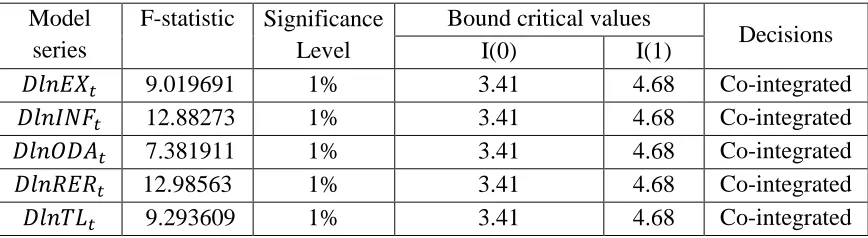
Table 3 shows that there are the presences of the long-run relationship among EX and its determinants (INF, ODA, RER, TL). All model series have the long run-relationship among the variables at 1% significance level which are determined by the computed F-statistic values.
Table 3: Co-integration test result (bounds test) Model
series
F-statistic Significance Level
Bound critical values
Decisions
I(0) I(1)
𝐷𝑙𝑛𝐸𝑋𝑡 9.019691 1% 3.41 4.68 Co-integrated
𝐷𝑙𝑛𝐼𝑁𝐹𝑡 12.88273 1% 3.41 4.68 Co-integrated
𝐷𝑙𝑛𝑂𝐷𝐴𝑡 7.381911 1% 3.41 4.68 Co-integrated
𝐷𝑙𝑛𝑅𝐸𝑅𝑡 12.98563 1% 3.41 4.68 Co-integrated
𝐷𝑙𝑛𝑇𝐿𝑡 9.293609 1% 3.41 4.68 Co-integrated
5.3 Long Run Relationship Analyses
44
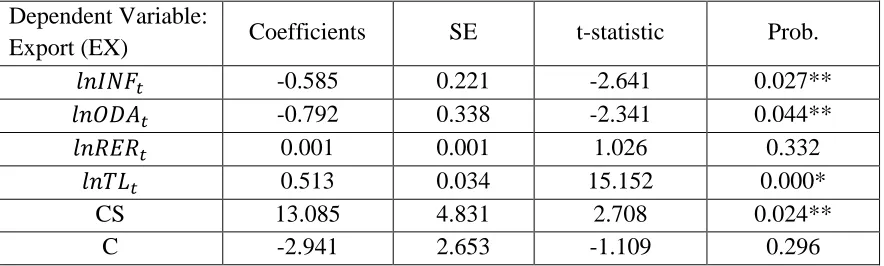
implies that the rise of INF and ODA hampers the improvement of Cambodian export performance from the status quo of the trade deficit. Aligning with previous findings, the official and foreign aid in creating dependency, fostering corruption, encouraging currency overvaluation harm the export performance of the country (Moyo, 2010; Elbadawi, 1999; younger, 1992; White & Wignaraja, 1992; and Van Wijnbergen, 1986). Meanwhile, inflation causes export to more expensive reduced the competitiveness of an exporting economy as foreign consumers would substitute in favor of alternative lower-price products (Epaphra, 2016). However, unexpected results of positive relationship between crises with export performance of Cambodia would be explained that insignificant impact of 1997 ASEAN financial crisis on Cambodia since the economic ties between Cambodia with Thailand, Malaysia and Indonesia was relatively small. Also, even the most country experience negative impact of 2008 world financial crisis, Cambodian economy and export growth still obtained the positive growth as government stimulated both fiscal and monetary policy to subsidy and maintain its economic stabilization (Jalilian, et al, G.,2009).Remarkably, Trade liberalization also obtains the positive long-run relationship with export which it is also consistent with the existing literatures embarked liberalization in improving the countries’ export performance (Ahmed, 2000; Thomas et al, 1999; Joshi & Little, 1996; Helleniner, 1994; and Weiss, 1992). Therefore, unexpected positive and statistically insignificant long-run relationship of RER exists. This finding is contrast to most economic literatures which confirmed the significant relationship between the RER and EX. However, this result conforms to Rodrik (2009)’s study which indicated the insignificant effect of real exchange rate on exports. Also, other studies of Eichengreen and Gupta (2015), Haddad and Pancaro (2010), and Eichengreen (2008) confirmed that exchange rate depreciation causes export and economic growth only in the short term, not the long term.
Table 4: Long-run coefficient using ARDL model (1, 1, 1, 1, 1) Dependent Variable:
Export (EX) Coefficients SE t-statistic Prob.
𝑙𝑛𝐼𝑁𝐹𝑡 -0.585 0.221 -2.641 0.027**
𝑙𝑛𝑂𝐷𝐴𝑡 -0.792 0.338 -2.341 0.044**
𝑙𝑛𝑅𝐸𝑅𝑡 0.001 0.001 1.026 0.332
𝑙𝑛𝑇𝐿𝑡 0.513 0.034 15.152 0.000*
CS 13.085 4.831 2.708 0.024**
C -2.941 2.653 -1.109 0.296
45 5.4 Short Run Relationship Analyses
The results of the short-run relationship estimated by ARDL model depicts that there are the significant negative relationship of D (ln INF) and D (ln RER) with D (ln EX). The negative relationship between RER and EX indicates the real exchange rate reduced the export performance of a country. It is on the par with the existing literatures that exchange rate has negative impact on the export of a country which already proved by the study of Doroodian (1999), Arize (2000), Sauer & Bohara (2001); and Doganlar (2002). The results still confirm that there is positive and statistically significant relationship in the short run among D (ln TL) and dummy variable of Crisis with EX. Therefore, the insignificant relationship between ODA and EX could be explained the effectiveness of official development assistant which is subjective to several factors might not be effective in the short run. As World Bank (2005) specified the factors such as investment and improvement in the trade facilitating infrastructure—roads and ports—have influences or offset on the relationship among these two variables. Also, others studies investigate the role of geographical characteristic of economy (Collier, 2008) and degree to vulnerability to external shocks—price shocks or extreme events (Collier & Dehn, 2001; Guillaumont & Chauvet 2001;2002) has been supported that the effectiveness of ODA on export performance depends on other factors. In addition, the 10% significant level and negative sign coefficient of ECM (t-1) for the selected models indicates the relative speed of adjustment exist to bring the long run equilibrium in the selected model which confirms that the model is corrected from the short run toward the long run equilibrium at adjustment rate of 92%.
Table 5: Short-run coefficient using ARDL model (1, 1, 1, 1, 1) Dependent Variable:
Export (EX) Coefficients SE t-statistic Prob.
𝐷𝑙𝑛𝐼𝑁𝐹𝑡 -0.121 0.051 -2.380 0.055**
𝐷𝑙𝑛𝑂𝐷𝐴𝑡 -0.061 0.188 -0.322 0.758
𝐷𝑙𝑛𝑅𝐸𝑅𝑡 -0.002 0.001 -1.976 0.096***
𝐷𝑙𝑛𝑇𝐿𝑡 0.527 0.027 19.796 0.000*
CS 3.925 0.767 5.120 0.002*
C 0.230 0.218 1.055 0.332
𝐸𝐶𝑀𝑡−1 -0.928 0.411 -2.261 0.065***
46 5.5 Diagnostics Test Result
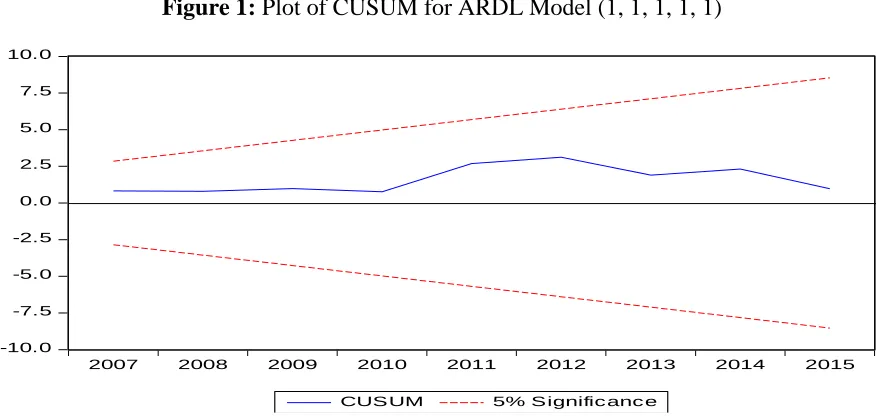
To ensure the non-existing of spurious regression and results, a number of several diagnostic tests are conducted to the ARDL projections. The results from the table 6 reveal the accepted null hypothesis of no serial correlation, no heteroscedasticity and normal distribution. Additionally, the stability test from figure 1 also confirms that model is stable. Henceforth, it could be confirmed from the test that the selected model of ARDL bound testing approach is reliable to determine the Cambodian export performance.
Table 6: Diagnostic tests for selected ARDL model (1, 1, 1, 1, 1)
Test series Coefficient Prob.
Serial Correlation LM test 3.2156 0.07
Normality Test (Jarque-Bera test) 0.8014 0.66
White Heteroskedasticity 10.6884 0.46
ARCH (Autoregressive Conditional Heteroskedasticity) 2.4145 0.12 Source: Author’s calculation using Eviews 9
Figure 1: Plot of CUSUM for ARDL Model (1, 1, 1, 1, 1)
-10.0 -7.5 -5.0 -2.5 0.0 2.5 5.0 7.5 10.0
2007 2008 2009 2010 2011 2012 2013 2014 2015
47
Conclusion
The empirical study investigates the factors affecting the Cambodian export performance in the short run and long run relationship through the period of 1993-2015 by employing ARDL bound testing approach.
The results reveal that there are the presences of the long run relationship among EX and its determinant factors (INF, ODA, RER, and TL) across all the models. The significant negative relationship between EX and INF in both short and long run implies that an increase in the relative price of commodities in the form of the inflation pressures the export to be underperformance. Though the current inflation rate of Cambodia is still manageable, it is higher than its peers which would erodes its competitiveness in the post-ASEAN integration. Meanwhile TL which obtains positive relationship with EX empirically supports the liberal neo-classical notions on the positive impact of free-trade on the country’s export performance proved by the increase share of export to Cambodia’s GDP. Even so, it is questionable the negative impact on the current trade deficit performance of Cambodia. Meanwhile the RER does the negative impact on the export performance in the short run only; conversely, ODA obtains the significant positive relationship in the long run, not the short run. More importantly, the significant and negative coefficient of ECMt−1 indicates the relative speed of adjustment to achieve the long run equilibrium.
48
Reference
Ahmed, N. (2000). Export response to trade liberalization in Bangladesh: a cointegration analysis. Applied Economics, 32(8), 1077-1084.
Ali, S. A. (2017). The Determinants of Sudan’s Trade Balance: An Empirical Investigation, 1970-2014. International Journal of Information Technology and Business
Management, 1-19.
Arize, A. C., Osang, T., & Slottje, D. J. (2000). Exchange-rate volatility and foreign trade: evidence from thirteen LDC's. Journal of Business & Economic Statistics, 18(1), 10-17.
Bhavan, T. (2016). The Determinants of Export Performance: The Case of Sri Lanka. International Research Journal of Social Sciences, 8-13.
Collier, P. (2008). The bottom billion: Why the poorest countries are failing and what can be done about it. Oxford University Press, USA.
Collier, P., & Dehn, J. (2001). Aid, shocks, and growth (Vol. 2688). World Bank Publications.
Doganlar, M. (2002). Estimating the impact of exchange rate volatility on exports: evidence from Asian countries. Applied Economics Letters, 9(13), 859-863.
Doroodian, K. (1999). Does exchange rate volatility deter international trade in developing countries?. Journal of Asian Economics, 10(3), 465-474.
Duasa, J. (2007). Determinants of Malaysian trade balance: An ARDL bound testing approach. Global Economic Review, 36(1), 89-102.
Eichengreen, B., & Gupta, P. (2015). Tapering talk: The impact of expectations of reduced Federal Reserve security purchases on emerging markets. Emerging Markets Review, 25, 1-15.
Eichengreen, B., & Gupta, P. (2014). Tapering talk: the impact of expectations of reduced Federal Reserve security purchases on emerging markets. Policy Research Working Paper Series, No. 6754, World Bank, Washington, DC.
Eichengreen, B. (2008). The real exchange rate and economic growth, Working Paper No. 4. Commission on Growth and Development, World Bank, Washington, DC.
Elbadawi, I. (1999). Can Africa Export Manufactures?: The Role of Endowment, Exchange Rates and Transaction Costs(Vol. 2120). World Bank Publications.
Engle, R. F. (1982). Autoregressive conditional heteroscedasticity with estimates of the variance of United Kingdom inflation. Econometrica: Journal of the Econometric Society, 987-1007.
49
Funke, M., & Ruhwedel, R. (2001). Export variety and export performance: empirical evidence from East Asia. Journal of Asian Economics, 12(4), 493-505.
Godfrey, L. G. (1978). Testing for higher order serial correlation in regression equations when the regressors include lagged dependent variables. Econometrica: Journal of the Econometric Society, 1303-1310.
Guillaumont, P., & Chauvet, L. (2001). Aid and performance: a reassessment. Journal of Development Studies, 37(6), 66-92.
Guillaumont, P., & Chauvet, L. (2002). Aid and Growth Revisited: Policy. In Economic Vulnerability and Political InstabilityV, paper presented at the Annual Bank Conference on Development Economics: Towards Pro $ Poor Policies, Oslo.
Haddad, M., & Pancaro C. (2010). Can real exchange rate undervaluation boost exports and growth in developing countries? yes, but not for long. Economic Premise, No. 20, World Bank, Washington, DC.
Helleiner, G. K. (Ed.). (1994). Trade policy and industrialization in turbulent times. Psychology Press.
Jalilian, H., Sophal, C., & Reyes, G. (2009). Global Financial Crisis Discussion Series Paper 4: Cambodia. London: Overseas Development Instittute (ODI).
Jarque, C. M., & Bera, A. K. (1980). Efficient tests for normality, homoscedasticity and serial independence of regression residuals. Economics letters, 6(3), 255-259. Joshi, V., & Little, I. M. D. (1996). India's economic reforms, 1991-2001. Oxford
University Press.
Kakar, M. K., Kakar, R., & Khan, W. (2010). The Determinants of Pakistan's Trade Balance: An ARDL Cointegration Approach. The Lahore Journal of
Economics, 15(1), 1.
Moyo, D. (2010). Dead aid: why aid makes things worse and how there is another way for Africa. London: Penguin Books.
Narayan, S., & Narayan, P. K. (2004). Determinants of demand for Fiji's exports: an empirical investigation. The Developing Economies, 42(1), 95-112.
Natsuda, K., Goto, K., & Thoburn, J. (2010). Challenges to the Cambodian garment industry in the global garment value chain. The European Journal of Development Research, 22(4), 469-493.
Nkoro, E., & Uko, A. K. (2016). Autoregressive Distributed Lag (ARDL) cointegration technique: application and interpretation. Journal of Statistical and Econometric Methods, 5(4), 63-91.
Pesaran, M. H., Shin, Y., & Smith, R. J. (2001). Bounds testing approaches to the analysis of level relationships. Journal of applied econometrics, 16(3), 289-326.
50
Sauer, C., & Bohara, A. K. (2001). Exchange rate volatility and exports: regional differences between developing and industrialized countries. Review of International Economics, 9(1), 133-152.
Thomas, V., & Nash, J. (1991). Reform of trade policy: recent evidence from theory and practice. The World Bank Research Observer, 6(2), 219-240.
Van Wijnbergen, S. (1985). Aid, export promotion and the real exchange rate: An African dilemma?. London: Centre for Economic Policy Research.
Weiss, J. (1992). Export response to trade reform: recent Mexican experience. Development Policy Review, 10(1), 43-60.
World Bank, (2016). World Bank Development Indicators. Washington, DC, the World Bank.
White, H. (1980). A heteroskedasticity-consistent covariance matrix estimator and a direct test for heteroskedasticity. Econometrica: Journal of the Econometric Society, 817-838.
White, H., & Wignaraja, G. (1992). Exchange rates, trade liberalization and aid: the Sri Lankan experience. World Development, 20(10), 1471-1480.