Volume 8, 2018, Pages 38–53 TNC’18. Trusted Numerical Computations
Numerical validation in quadruple precision using
stochastic arithmetic
S. Graillat
1, F. J´
ez´
equel
1,2, R. Picot
1,3, F. F´
evotte
3, and B. Lathuili`
ere
31
Sorbonne Universit´e, CNRS, Laboratoire d’Informatique de Paris 6, LIP6, F-75005 Paris, France
{Stef.Graillat,Fabienne.Jezequel,Romain.Picot}@lip6.fr
2 Universit´e Panth´eon-Assas, 12 place du Panth´eon, 75231 Paris CEDEX 05, France 3
EDF R&D, 7 boulevard Gaspard Monge, 91120 Palaiseau, France
{Francois.Fevotte,Bruno.Lathuiliere}@edf.fr
Abstract
Discrete Stochastic Arithmetic (DSA) enables one to estimate rounding errors and to detect numerical instabilities in simulation programs. DSA is implemented in the CADNA library that can analyze the numerical quality of single and double precision programs. In this article, we show how the CADNA library has been improved to enable the esti-mation of rounding errors in programs using quadruple precision floating-point variables,
i.e. having 113-bit mantissa length. Although an implementation of DSA called SAM exists for arbitrary precision programs, a significant performance improvement has been obtained with CADNA compared to SAM for the numerical validation of programs with 113-bit mantissa length variables. This new version of CADNA has been successfully used for the control of accuracy in quadruple precision applications, such as a chaotic sequence and the computation of multiple roots of polynomials. We also describe a new version of the PROMISE tool, based on CADNA, that aimed at reducing in numerical programs the number of double precision variable declarations in favor of single precision ones, taking into account a requested accuracy of the results. The new version of PROMISE can now provide type declarations mixing single, double and quadruple precision.
Keywords: accuracy, floating-point arithmetic, IEEE 754-2008 standard, numerical vali-dation, quadruple precision, rounding errors, stochastic arithmetic.
1
Introduction
Most numerical simulation programs use the single or double precision binary floating-point format, respectively defined in the IEEE 754-2008 standard [13] as binary32 and binary64. However quadruple or arbitrary precision may be required for unstable problems, such as the computation of a chaotic sequence or the approximation of multiple roots of a polynomial. The IEEE 754-2008 standard also defines a quadruple precision binary floating-point format, named
binary128, with 113-bit mantissa length, including one implicit bit.
The numerical stability of programs in single or double precision can be controlled using the CADNA1library [4,14] that implements Discrete Stochastic Arithmetic (DSA) [21]. CADNA
enables one to estimate rounding errors in a simulation program and to detect numerical insta-bilities that occur during its execution. CADNA has been successfully used for the numerical validation of academic and industrial simulation codes in various domains. Another library called SAM2 [8] uses DSA to control the numerical stability of arbitrary precision programs.
SAM is based on the MPFR3[6] arbitrary precision library.
In this paper we show how to estimate with CADNA rounding errors in quadruple pre-cision programs. Although the numerical validation of simulations in quadruple prepre-cision is possible using SAM with 113-bit mantissa length numbers, the performance cost of arbitrary precision features makes the improvement of CADNA preferable. We describe in this paper the functionalities added to the CADNA library for the control of accuracy of binary128 results. Furthermore we show how these modifications have enabled the improvement of the PROMISE4 software [9, 10] that is based on CADNA and aims at optimizing the precision of variables in numerical codes. Indeed, from a required accuracy of the results, PROMISE automatically determines the appropriate precision for each floating-point variable in a code. Thanks to the CADNA improvement described in this paper, PROMISE can now provide mixed-precision programs with not only declarations in single and double, but also in quadruple precision.
This paper is organized as follows. In Sect. 2we briefly present the principles of DSA and describe software tools related to DSA: CADNA, SAM, and PROMISE. In Sect.3we compare several solutions for performing numerical simulation in quadruple precision: the binary128
floating-point type, the MPFR arbitrary precision library and the QD5 package [11] that
pro-vides a double-double data type. In Sect. 4 we describe the new functionalities of CADNA related to the accuracy estimation of quadruple precision results. In Sect. 5 that is devoted to numerical experiments, we present results obtained in quadruple precision with CADNA for the computation of a chaotic sequence, the H´enon map, and the approximation of multiple roots of polynomials. In Sect.5, we also show the mixed precision configurations provided by PROMISE from quadruple precision programs and the speedups obtained. Finally, we conclude and discuss future works in Sect.6.
2
DSA and related software
2.1
Principles and validity of DSA
Discrete Stochastic Arithmetic (DSA) [21] enables one to estimate rounding errors during nu-merical simulations. It consists in executing each arithmetic operation three times with the random rounding mode: each result obtained is randomly rounded up or down with the prob-ability 1/2. Then the number of exact significant digits in the computed result is estimated with a 95% confidence interval using Student’s test. It must be pointed out that in contrast to other approaches, such as interval arithmetic [1], that compute guaranteed error bounds, DSA provides an estimation of rounding errors.
DSA is based on a model that assumes that rounding errors are independent centered uniformly distributed random variables. With the random rounding mode, rounding errors are random variables, but in practice they are not rigorously centered and Student’s test may give a biased estimation of the computed result. However it has been proved [2] that, even if rounding errors are not rigorously centered, the estimation obtained with DSA can be considered correct
2
http://www-pequan.lip6.fr/~jezequel/SAM
3
http://www.mpfr.org
4http://promise.lip6.fr
5
up to one digit.
The accuracy estimation may be invalid if both operands in a multiplication or a divisor are not significant [2]. Therefore during the execution of a program with DSA, the accuracy of all multiplication operands and divisors should be controlled. This dynamical control of multiplications and divisions is the so-calledself-validationof DSA.
2.2
Implementation of DSA
The CADNA [4, 14] library enables one to use DSA in programs written in C, C++, or For-tran. CADNA provides new numerical types: the stochastic types. A stochastic variable is composed of three perturbed floating-point values and an integer to store its accuracy. The CADNA library contains the definition of arithmetic operations, order relations, and mathemat-ical functions involving stochastic variables. Operations can be performed on combinations of integers, classical floating-point variables and stochastic variables. However only the accuracy of stochastic variables can be estimated.
The SAM library [8] enables one to estimate with DSA rounding errors in arbitrary precision programs. SAM is based on the MPFR [6] arbitrary precision library and can be used in programs written in C/C++. SAM with 24-bit (resp. 53-bit) mantissa length numbers is similar to CADNA in single (resp. double) precision, except the range of the exponent is only limited by the machine memory. In a program using SAM, the number of exact significant digits in a result can be estimated with the probability 95%, whatever its precision.
Because of the definition of arithmetic operations, mathematical functions, and order re-lations for stochastic variables in CADNA and SAM, a few modifications are required in user programs to be controlled with DSA: mainly changes in variable declarations and in input/out-put statements. Both CADNA and SAM can detect numerical instabilities that occur during the program execution. Those instabilities are of different types: some are related to the self-validation of DSA, some are due to numerical noise involved in an order relation or a mathematical function, some are due to a cancellation, i.e. a severe loss of accuracy due to the subtraction of two nearly equal numbers. At the end of the run, each type of instability together with its occurrence is printed.
In the current C/C++ CADNA version, two stochastic types are available: float stand
double st, respectively associated with single and double precision. The numerical stability of simulations in quadruple precision can be controlled with SAM using 113-bit mantissa length. However our aim is to add features to CADNA in order to enable the use of stochastic vari-ables in quadruple precision, without the performance cost of an arbitrary precision library. Indeed this new CADNA version will provide a quadruple precision stochastic type based on thebinary128 type defined in the IEEE 754-2008 standard.
2.3
The PROMISE software
The PROMISE (PRecision OptiMISE) software [9,10] is based on CADNA and aims at opti-mizing floating-point type declarations in simulation codes. The sequel relies on Definition 1
that makes clear the notion of decimal significant digits in common between two numbers.
Definition 1. The number of decimal significant digits in common between two real numbers
aandb is defined in Rby: fora6=b,Da,b= log10
a+b
2(a−b)
and for alla∈R, Da,a= +∞.
Then |a−b| =a+2b
andbis of the order of 10−3, which means thataandb have three significant decimal digits in
common.
In the following, we denote byCa set of variables to optimize in a program. Aconfiguration
is a bipartition (Cs, Cd) ofC. The set of all possible configurations is denoted byR.
A configuration (Cs, Cd) is said to beadmissible if, when all variables inCs(resp. Cd) are
declared in single (resp. double) precision, the resulting program satisfies the following criteria:
(i) it is compilable, (ii) it runs without error, and (iii) it yields results meeting accuracy requirements. A testing function τ : R → {3,7} determines if a configuration is admissible (3) or not (7).
The implementation of PROMISE relies on the Delta-Debugging (DD) algorithm [22], and more specifically its DDmax variant: being given a set of variablesC and a testing functionτ,
calling DDmax(C, τ) yields a configuration (Cs, Cd) which is admissible and locally maximal
in the sense that no variable inCd can be moved to Cs without causing the configuration to
become inadmissible.
PROMISE is implemented in two versions, which differ in how the source code is modified and how the accuracy requirements are checked for in the testing function. Fornrequired exact significant digits, the testing functionτ can be defined in two ways:
Full stochastic: for every tested configuration, a fully CADNA-instrumented version of the code is generated. A configuration is admissible if the number of exact significant digits estimated using DSA is at least n, and if these digits are in common, in the sense of Definition1, with a reference DSA computation in double precision.
Stochastic reference: only the reference result is computed in high-precision DSA. The eval-uation of every tested configuration is performed in standard floating-point arithmetic. A configuration is admissible if it produces results which have at leastnsignificant digits in common, in the sense of Definition1, with the reference results.
3
Quadruple precision arithmetic
3.1
The
binary128
format and its implementation
Several binary types are specified in the IEEE 754-2008 standard, such asbinary32, binary64, andbinary128, defined respectively on 32, 64, and 128 bits. Abinary128floating-point number consists of a sign bits, a 15-bit long exponente, and a 112-bit long mantissam. Although 112 bits are explicitly stored to represent the mantissa, its precision is actually 113 bits. Indeed like forbinary32andbinary64numbers,binary128numbers benefit from an implicit bit that is set to 1, except for the representation of zero or subnormal numbers.
A few 128-bit processors exist: up to our knowledge, only SPARC V8 [19] or V9 [20] and IBM POWER9 [18] processors feature 128-bit registers. On other architectures, thebinary128
floating-point type is emulated. We describe in this section how thebinary128format is imple-mented by the GCC compiler6 on a 64-bit processor.
In the GCC compiler, a binary128 number is defined as a bit field structure that consists of a sign bit, a 15-bit long integer for the exponent, a 48-bit long integer for the high part of the mantissa, and a 64-bit long integer for its low part. As already mentioned, although the mantissa length is physically 112 bits, its actual length is 113 bits. Arithmetic operations onbinary128 numbers require several steps. First, the 4 elements that define eachbinary128
number are extracted from the bit field structure. From the exponents, particular cases specified in the IEEE 754 standard may be identifed: some operations involving±0,±∞, orN aN (Not a Number) that is associated with an undefined or unrepresentable value. In such cases, the result is rapidly returned. Otherwise arithmetic operations are carried out on the integers representing the binary128 numbers. Rounding is performed before the creation of the bit field structure of the result. If an exception such asoverfloworunderflowoccurs, a status flag may be raised.
3.2
The
double-double
format and its implementation
Adouble-doublenumberais a pair (ah, al) of IEEE-754 floating-point numbers whereahandal
do not overlap,i.e. a=ah+al with|al| ≤2−53|ah|. Algorithms for arithmetic operations
in-volvingdouble-doublenumbers rely on error-free transformations. It is known that for the basic operations +,−,×, the approximation error of a floating-point operation is still a floating-point number (see for example [3]). From a pair of floating-point operands, an error-free transfor-mation provides both the result of the floating-point operation and the associated rounding term. Howeverdouble-double results are not necessarily rounded as specified in the IEEE 754 standard.
There are several implementations for thedouble-double library. The difference lies in the fact that the lower-order terms are treated in different ways. The main reference is the QD library [11] that is used in the performance comparison presented in Sect.3.3. In the QD library there exist several implementations ofdouble-doubleoperations, in particular, for addition and division, thesloppyversion that performs better, at the price of a possibly higher error. These sloppy algorithms should be used with parcimony. Indeed with the sloppy version of the ad-dition, there is no proof that the relative error on the result is bounded if the operands have opposite signs [15].
3.3
Performance comparison of quadruple precision programs
Performance comparison is performed on an Intel Xeon E5-2660 processor at 2.2 GHz and 32 GB RAM with the GNU compiler G++ 4.8.5 and the Intel compiler ICC 17. The MPFR arbitrary precision library, version 3.1.1, is used with 113-bit mantissa length numbers. Performances of two C++ codes are measured. Matrix performs a naive multiplication of two square matrices of size 1,000. Mapcomputes the sequence defined byU0= 1.1 and fori= 1,...,n,Ui= (0.1×
Ui−1−(1/3+Ui−1)2)/(1−Ui−1)3withn= 128,000,000. This sequence has been defined in order
binary128 MPFR DD DD sloppy 1 10 100 1000 10.4 42.2 18.9 18.8 16.9 107.3 64.2 62.9 Matrix Map ov er he ad
(a) GCC with O0
binary128 MPFR DD DD sloppy 1 10 100 1000 8.6 41.5 14.7 12.7 10.7 103.8 38.7 36.7 Matrix Map ov er he ad
(b) ICC with O0
binary128 MPFR DD DD sloppy
1 10 100 1000 41.4 166.3 13.4 9.5 14.0 138.1 13.2 12.1 Matrix Map ov er he ad
(c) GCC with O3
binary128 MPFR DD DD sloppy
1 10 100 1000 68.7 406.9 46.7 38.1 10.5 139.1 10.2 6.7 Matrix Map ov er he ad
(d) ICC with O3
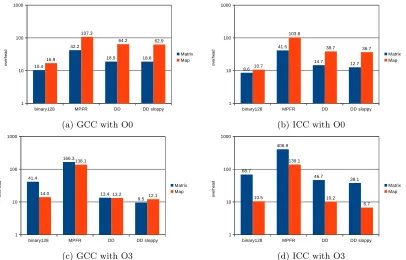
Figure 1: Performance ratio w.r.t double precision (binary64) ofbinary128, MPFR with 113-bit mantissa length, anddouble-double
From Figures 1a and 1b, if the compilation option O0 is chosen, binary128 performs the best. However, in our experiments, its average cost w.r.t. binary64is approximately a factor 12. Its performance ratio with respect to the double-double type varies from 1.5 to 4. It can be noticed that with the double-double type, the performance gain of the sloppy version is low: from 0.5% to 13%.
From Figure1, for matrix multiplication, the performance ratio ofbinary128overbinary64
is 4 or 8 times higher, depending on the compiler, with the O3 option than with O0. Indeed, on the one hand, matrix multiplication is particulary well optimized with the O3 option for the
binary32 or thebinary64format. On the other hand, whatever the optimization option, each arithmetic operation inbinary128 implies to access data structures to read the operands and write the result.
From Figures1cand1d, because thedouble-doubleprogram for matrix multiplication also benefits from a particularly good optimization with the O3 option, it performs 1.5 or 3 times better, depending on the compiler, than its binary128 counterpart. However, with the Map application, performances ofbinary128anddouble-doubleare similar. Withdouble-double, the performance gain of the sloppy version is higher with the O3 option than with O0. With O3, it varies from 8% to 34%.
extension of CADNA is based on thebinary128format of the IEEE 754-2008 standard.
4
DSA and related software in quadruple precision
4.1
Extension of CADNA to quadruple precision
In order to extend CADNA to quadruple precision, i.e. in order to define a new quad st
stochastic type associated to quadruple precision, a few non-trivial aspects need to be taken care of. First, a utility library is incorporated into CADNA, that allows manipulating quadru-ple precision numbers as easily as other standard floating-point numbers. Quadruquadru-ple precision floating-point numbers are named differently in GCC ( float128) and Intel ( Quad) compil-ers. In order to provide uniform access to these types, we use the float128 type from the
Boost::Multiprecisionlibrary. This type is a thin wrapper around the underlying quadruple precision floating-point type, and incurs no overhead with respect to the performance of native types. Moreover, all mathematical functions working on quadruple precision are suffixed with the letterq(e.g. logqorcosq). In order to allow to access mathematical functions under their usual names, we also provide overloaded definitions of standard functions for the float128
type.
With this being in place, stochastic arithmetic can be implemented for quadruple precision in the same way as single and double precision. Since version 2.0.0 of CADNA, for performance reasons, no explicit rounding mode switching is performed during program execution [4]. The CPU rounding mode is set towards plus infinity during program initialization, and rounding mode towards minus infinity is emulated taking advantage of properties such as a⊕−∞b =
−(−a⊕+∞−b) and a⊗−∞b=−(a⊗+∞−b) where⊕+∞ and⊗+∞ (resp. ⊕−∞ and ⊗−∞) are the floating-point operations rounded towards +∞ (resp. −∞). Such a technique can easily be applied to quadruple precision numbers, provided that an efficient implementation is available to flip the sign of a number. In CADNA, this operation is performed by bitwise XORing the floating-point number with an appropriate mask.
Like in the single and double precision version of CADNA, arithmetic operations involving any combination of numerical types with at least one stochastic type are overloaded. Indeed it is possible to mix in arithmetic operations integers, classical floating-point or stochastic variables, in single, double or quadruple precision.
A last detail which must be accounted for is the formatting of quadruple precision numbers for output. Standardprintf-like C functions and the standard C++ streaming operator (<<) indeed do not properly handle quadruple precision floating-point numbers. Therefore CADNA has been modified in order to enable to print quadruple precision classical or stochastic variables using theprintf C function and the C++ streaming operator. These new functionalities are based on the specializedquadmath snprintffunction.
4.2
Performance of CADNA in quadruple precision
The performance of CADNA is measured on the workstation already mentioned in Sect. 3.3
no instability self-validation all instabilities
GCC ICC GCC ICC GCC ICC
single matrix 15 16 16 18 34 44
map 10 6.8 15 7.3 20 11
double matrix 20 11 22 12 35 20
map 11 7.2 14 8.8 20 10
quadruple matrix 5.0 3.6 5.4 3.8 21 17
map 7.8 5.0 12 7.4 19 8.8
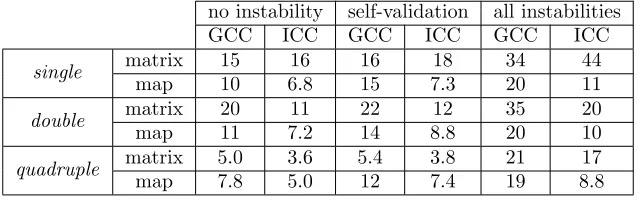
Table 1: CADNA overhead w.r.t. classic floating-point computation
of instabilities. As a remark, with both codes, unstable multiplications and cancellations are detected whatever the precision chosen (single, double or quadruple).
If instability detection is deactivated, CADNA overhead in single or in double precision varies from 7 to 20 depending on the code and the compiler. This overhead is mainly due to the extra computation inherent to CADNA, and furthermore codes with classic floating-point types in single or in double precision may benefit from better optimizations than their CADNA counterparts that use stochastic types. With the same instability detection level, CADNA overhead is lower in quadruple precision: it varies from 4 to 8. This better overhead in quadruple precision can be explained by the fact that thebinary128format is implemented as a data structure. Each arithmetic operation in classic floating-point quadruple precision requires accesses to such a structure. Therefore classic floating-point codes in quadruple precision do not take benefit from the same optimizations as in single or in double precision.
With CADNA, instability detection introduces extra execution time and this cost is not particularly higher in quadruple precision. The additional execution time due to self-validation (w.r.t. no instability detection) varies from 7% to 56% depending on the code, the compiler and the precision chosen. The overhead of the detection of all kinds of instabilities (w.r.t. no instability detection) is a factor 1.4 to 4.8. This cost is mainly due to the detection of cancellations that implies to compute for each addition or subtraction the number of correct digits of the operands and the result.
no instability self-validation all instabilities
CADNA SAM CADNA SAM CADNA SAM
GCC
matrix 240 679 251 754 1144 7387
map 133 547 207 2148 409 4684
ICC
matrix 163 698 170 724 791 7593
map 90 597 133 2145 160 4754
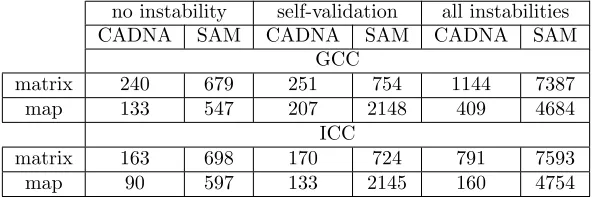
Table 2: Execution time in seconds using CADNA in quadruple precision and SAM with 113-bit mantissa length
4.3
Extension of PROMISE to quadruple precision
The PROMISE tool described in Sect. 2.3 can be extended to handle a third floating-point number type and optimize variable declarations between single, double and quadruple precision. The objective now consists in partitioning the full set of variablesCinto three subsetsCs, Cd
and Cq of variables whose precision can be respectively set to single, double or quadruple
while still producing an accurate enough result. A problem posed by such an extension is that the DDmax algorithm produces configurations that are bipartitions of the variables set,
whereas in our new setup, tested configurations should be tripartitions of the variables set. The strategy used in this work to overcome this difficulty is to perform two Delta-Debugging steps in a row, as presented in Algorithm1: in a first stage, a DDmax algorithm is used to test
the full set of variables C for downgrade from quadruple to double precision. This allows to determine a maximal subsetCd
0 of variables which can be downgraded to double precision. Its
complement Cq contains variables which must remain in quadruple precision for the result to
meet accuracy requirements. In a second stage, variables inCd
0 are tested for downgrade from
double to single precision.
Algorithm 1Two-tier Delta-Debugging algorithm
Input: C: set of variables to optimize
Output: (Cs, Cd, Cq): admissible configuration inC
(Cd
0, Cq) = DDmax(C, τq→d)
(Cs, Cd) = DDmax C0d, τC
q
d→s
return (Cs, Cd, Cq)
The same Delta-Debugging algorithm is used for both stages; only the set of variables and the test functions are adjusted. A global testing functionτ, shown in Algorithm2, defines how to test the validity of any given configuration (Cs, Cd, Cq). The testing functions used in each
Delta-Debugging stage are simply defined as partial applications of this global test function:
τq→d(Cd, Cq) =τ ∅, Cd, Cq
and τCq
d→s(C
s, Cd) =τ Cs, Cd, Cq
.
Algorithm 2Global testing functionτn
Inputs: n: requested number of exact significant digits (Cs, Cd, Cq): configuration to test
Output: admissibility of the given configuration
if (Cs, Cd, Cq) was previously testedthen
return the result in cache end if
Update the source code according to (Cs, Cd, Cq) if the source code compilation failsthen
return7 end if
Run the modified program if the execution failsthen
return7
else if the result meets accuracy requirements ofnsignificant digitsthen return3
end if return7
5
Numerical experiments
In this section, we first present quadruple precision results obtained with CADNA for the computation of a chaotic sequence, the H´enon map, and the approximation of multiple roots of polynomials. Then we show that the PROMISE software can now provide, from initial numerical programs in C/C++, new programs with type declarations possibly mixing single, double and quadruple precision, depending on the requested accuracy of the results.
5.1
H´
enon map
The H´enon map is a discrete-time dynamical system [12]. It maps a point (xi, yi) ∈R2 to a
new point defined byxi+1= 1 +yi−axi2 andyi+1=bxi. Depending on the parametersaand
b, the system can be regular or chaotic. Here we focus on the values of the classical H´enon map obtained witha= 1.4 andb= 0.3, starting from x0 = 1 andy0= 0. With those parameters,
the map is considered as chaotic.
Figure 2 shows the number of exact significant digits estimated by CADNA in the results
xi obtained using single, double and quadruple precision. One can observe that the accuracy
of xi regularly decreases with the number i of iterations performed. A similar figure, that is
not displayed here, describes the loss of accuracy of the resultsyi. At a certain iteration, which
depends on the precision chosen, the results have no more correct digits.
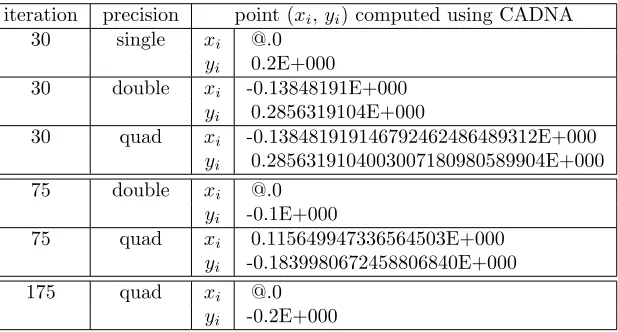
Table 3 presents at different iterations the results (xi, yi) computed using CADNA with
0 5 10 15 20 25 30 35
0 20 40 60 80 100 120 140 160 180 200
Number of e
xact signi
fi
cant digits
Number of iterations
quad double single
Figure 2: Accuracy estimated by CADNA of coordinatesxi of the H´enon map with a= 1.4,
b= 0.3,x0= 1, andy0= 0.
iteration precision point (xi,yi) computed using CADNA
30 single xi @.0
yi 0.2E+000
30 double xi -0.13848191E+000
yi 0.2856319104E+000
30 quad xi -0.138481919146792462486489312E+000
yi 0.2856319104003007180980589904E+000
75 double xi @.0
yi -0.1E+000
75 quad xi 0.115649947336564503E+000
yi -0.1839980672458806840E+000
175 quad xi @.0
yi -0.2E+000
Table 3: At different iterations, points (xi,yi) of the H´enon map computed using CADNA with
single, double or quadruple precision (a= 1.4,b= 0.3,x0= 1, and y0= 0).
5.2
Multiple roots of polynomials
Newton’s method enables one to compute a root of a functionf. From a root approximationx0,
it consists in computing the sequencexn+1=xn−ff0((xxn)
n). The stopping criterion usually relies
on a thresholdεand may be for instance|xn+1−xn|< εor
xn+1−xn
xn+1
< ε ifxn+1 6= 0. With
DSA, the sequence can be computed until the difference between two successive approximations
xnandxn+1is not significant. In this case, the transformation ofxnintoxn+1is due to rounding
errors and further iterations are useless: the number of iterations has been optimized.
approxima-tion and the root. In Theorem1,∼∞ means that quantities are asymptotically equivalent as
n→ ∞.
Theorem 1. Let xn and xn+1 be two successive approximations computed using Newton’s
method of a polynomial rootαof multiplicity m≥2. Then
Dxn,xn+1 ∼∞Dxn+1,α+ log10(m−1).
From Theorem1, if the convergence zone is reached, then the digits common to two succes-sive approximationsxnandxn+1are also in common with the exact rootα, up to log10(m−1).
If iterations are performed until the difference between two successive approximationsxn and
xn+1is not significant, then the significant digits of the last approximationxn+1 which are not
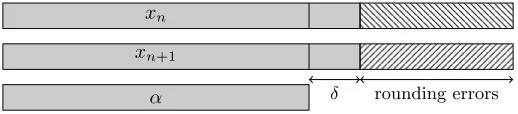
affected by rounding errors are in common with the exact rootα, up toδ=dlog10(m−1)e, as illustrated in Figure3.
xn+1
xn
α δ rounding errors
Figure 3: Representation of the last iterates xn and xn+1 of Newton’s method, and the first
digits of the exact multiple rootα: ifxn−xn+1is not significant, then the digits ofxn+1which
are not affected by rounding errors are in common withα, up toδ.
Table4presents for each rootαiofP(x) = (x−1)2(3x−1)3, the valueδi =dlog10(mi−1)e,
the number of significant digits not affected by rounding errors estimated by CADNA of its approximation by Newton’s method, and the number of significant digits in common with the exact root according to Definition1.
precision α1= 1,δ1= 0 α2= 1/3,δ2= 1
CADNA exact CADNA exact
single 4 3.1 3 2.2
double 7 7.3 5 5.0
quad 17 16.6 12 11.0
Table 4: For each root ofP(x) = (x−1)2(3x−1)3, number of digits not affected by rounding errors estimated by CADNA and number of digits in common with the exact root.
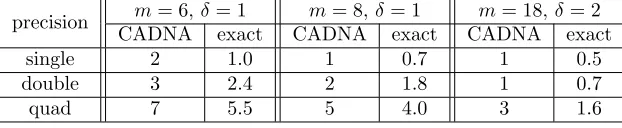
For each polynomial Pm(x) = (x−1)m with m = 6, m= 8, and m = 18, Table 5 shows
the valueδ=dlog10(m−1)e, the number of significant digits not affected by rounding errors
estimated by CADNA of its computed root, and the number of significant digits in common with the exact root according to Definition1.
As expected, from Tables 4 and 5, if the root multiplicity increases, the accuracy of the approximation obtained decreases. Depending on the root multiplicity, quadruple precision may be required to achieve satisfactory accuracy. From Tables4and 5, ifδ=dlog10(m−1)e,
precision m= 6,δ= 1 m= 8,δ= 1 m= 18,δ= 2
CADNA exact CADNA exact CADNA exact
single 2 1.0 1 0.7 1 0.5
double 3 2.4 2 1.8 1 0.7
quad 7 5.5 5 4.0 3 1.6
Table 5: ForPm(x) = (x−1)m number of digits not affected by rounding errors estimated by
CADNA and number of digits in common with the exact root.
5.3
Autotuning of floating-point types with three possible precisions
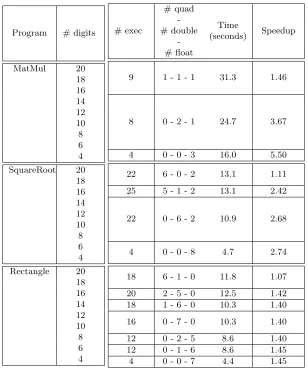
The PROMISE tool has already enabled tuning of floating-point types in programs to produce, taking into account accuracy requirements, mixed-precision configurations,i.e. with single and double precision variables. PROMISE has been successfully tested on programs implementing several numerical algorithms including linear system solving and also on an industrial code that solves the neutron transport equations [9]. In this section, we aim at showing the feasiblity of us-ing PROMISE to automatically provide modified programs with variable declarations in sus-ingle, double, and quadruple precision. Table6presents results provided by the “stochastic reference” version of PROMISE, already mentioned in Sect.4.3, with the following simple programs: ma-trix multiplication (MatMul), Babylonian method for square root computation (SquareRoot), and rectangle method for the computation of integrals (Rectangle). For each program, differ-ent rows in Table 6 correspond to several accuracy requirements: 4 to 20 (with step 2) exact significant digits. In the case of matrix multiplication, all elements of the resulting matrix must satisfy the accuracy criterion.
The performance of PROMISE is measured on the workstation already mentioned in Sect.3.3
with the same compilers and the compilation option O3. The results reported in Table6 are: the number of executions of the transformed programs (# exec); the number of variables which must be stored in quadruple precision (# quad); the number of variables which can be relaxed to double precision (# double); the number of variables which can be relaxed to single precision (# float); the total execution time of PROMISE, including the compilation and the execution of the transformed codes, as well as the time spent in PROMISE’s own routines; the speedup of the proposed configuration, when run without CADNA, w.r.t. the initial configuration (all variables in quadruple precision).
As the number of required digits decreases, the number of variables in single or in double precision increases and the speedup of the transformed program w.r.t. the quadruple precision one also increases. This speedup is up to 5.5 if 4 correct digits are requested for matrix multiplication. In the numerical experiments carried out with the two-precision version of PROMISE [9], lower speedup has been obtained (up to 1.3). In this case, speedup was measured w.r.t. the double precision configuration. The better speedup obtained with the three-precision version of PROMISE can be explained by the heavy overhead of quadruple precision w.r.t. double or single precision.
6
Conclusion and perspectives
Program # digits
MatMul 20 18 16 14 12 10 8 6 4 SquareRoot 20
18 16 14 12 10 8 6 4 Rectangle 20
18 16 14 12 10 8 6 4
# exec
# quad -# double
-# float
Time
(seconds) Speedup
9 1 - 1 - 1 31.3 1.46
8 0 - 2 - 1 24.7 3.67
4 0 - 0 - 3 16.0 5.50
22 6 - 0 - 2 13.1 1.11 25 5 - 1 - 2 13.1 2.42
22 0 - 6 - 2 10.9 2.68
4 0 - 0 - 8 4.7 2.74
18 6 - 1 - 0 11.8 1.07 20 2 - 5 - 0 12.5 1.42 18 1 - 6 - 0 10.3 1.40 16 0 - 7 - 0 10.3 1.40 12 0 - 2 - 5 8.6 1.40 12 0 - 1 - 6 8.6 1.45 4 0 - 0 - 7 4.4 1.45
Table 6: Experimental results of PROMISE with three types on several test cases.
DSA in arbitrary precision. The performance cost of the CADNA library in a quadruple preci-sion program is reasonable: in our experiments with the GCC and ICC compilers, a factor 4 to 8 has been measured if instability detection is deactivated. This new version of CADNA can be used to control accuracy in programs that require quadruple precision, such as the simulation of chaotic phenomena or the computation of multiple roots of polynomials. Thanks to the quadruple precision in CADNA, the PROMISE software has been improved. We have shown how to automatically determine in a program an appropriate configuration of types that would possibly mix single, double and quadruple precision and would respect an accuray threshold on the results.
and with MPI the exchange of this kind of variables between processors.
With the O3 compilation option, thedouble-doubletype of the QD library performs better than the binary128 type of GCC or ICC. Therefore an implementation of DSA based on the QD library is another possible extension to this work. Becausedouble-double results are not necessarily rounded as specified in the IEEE 754 standard, this perspective will require to rethink somedouble-doublealgorithms in order to compute results with directed rounding.
7
Acknowledgement
The authors wish to thank ANR (Agence Nationale de la Recherche, France) for its financial support (project FastRelax ANR-14-CE25-0018-01).
References
[1] G. Alefeld and J. Herzberger.Introduction to interval analysis. Academic Press, 1983.
[2] J.-M. Chesneaux. L’arithm´etique stochastique et le logiciel CADNA. Habilitation `a diriger des recherches, Universit´e Pierre et Marie Curie, Paris, France, November 1995.
[3] T.J. Dekker. A floating-point technique for extending the available precision. Numerische Math-ematik, 18(3):224–242, 1971.
[4] P. Eberhart, J. Brajard, P. Fortin, and F. J´ez´equel. High performance numerical validation using stochastic arithmetic. Reliable Computing, 21:35–52, 2015.
[5] P. Eberhart, J. Brajard, P. Fortin, and F. J´ez´equel. Estimation of Round-off Errors in OpenMP Codes. InIWOMP 2016 - 12th International Workshop on OpenMP, volume 9903 ofLecture Notes in Computer Science, pages 3–16. Springer International Publishing, 2016.
[6] L. Fousse, G. Hanrot, V. Lef`evre, P. P´elissier, and P. Zimmermann. MPFR: A multiple-precision binary floating-point library with correct rounding. ACM Trans. Math. Softw., 33(2):13:1–13:15, 2007.
[7] S. Graillat, F. J´ez´equel, and M.S. Ibrahim. Dynamical control of Newton’s method for multiple roots of polynomials. Reliable Computing, 21, 2016.
[8] S. Graillat, F. J´ez´equel, S. Wang, and Y. Zhu. Stochastic Arithmetic in Multiprecision. Mathe-matics in Computer Science, 5(4):359–375, 2011.
[9] S. Graillat, F. J´ez´equel, R. Picot, F. F´evotte, and B. Lathuili`ere. Auto-tuning for floating-point pre-cision with Discrete Stochastic Arithmetic.https://hal.archives-ouvertes.fr/hal-01331917, June 2016. working paper or preprint.
[10] S. Graillat, F. J´ez´equel, R. Picot, F. F´evotte, and B. Lathuili`ere. PROMISE: floating-point preci-sion tuning with stochastic arithmetic. In17th international symposium on Scientific Computing, Computer Arithmetic and Validated Numerics (SCAN 2016), Uppsala, Sweden, September 2016. [11] Y. Hida, X.S. Li, and D.H. Bailey. Library for double-double and quad-double arithmetic. Technical report, NERSC Division, Lawrence Berkeley National Laboratory, USA, 2008. http: //www.davidhbailey.com/dhbpapers/qd.pdf.
[12] M. H´enon. A two-dimensional mapping with a strange attractor.Comm. Math. Phys., 50(1):69–77, 1976.
[13] IEEE Computer Society.IEEE Standard for Floating-Point Arithmetic. IEEE Standard 754-2008, August 2008. Available athttp://ieeexplore.ieee.org/servlet/opac?punumber=4610933. [14] F. J´ez´equel and J.-M. Chesneaux. CADNA: a library for estimating round-off error propagation.
Computer Physics Communications, 178(12):933–955, 2008.
[16] V. Lef`evre and P. Zimmermann. Optimized Binary64 and Binary128 Arithmetic with GNU MPFR. In24th IEEE Symposium on Computer Arithmetic, London, United Kingdom, July 2017. [17] S. Montan, J.-M. Chesneaux, C. Denis, and J.-L. Lamotte. Towards an efficient implementation of
CADNA in the BLAS: example of DgemmCADNA routine. In15th GAMM - IMACS International Symposium on Scientific Computing, Computer Arithmetic, and Validated Numerics (SCAN), December 2012.
[18] OpenPOWER foundation.Power ISA Version 3.0 B, 2017.https://openpowerfoundation.org/ ?resource_lib=power-isa-version-3-0.
[19] SPARC International, Inc. The SPARC Architecture Manual, Version 8, 1992. https://web. archive.org/web/20050204100221/http://www.sparc.org/standards/V8.pdf.
[20] SPARC International, Inc. The SPARC Architecture Manual, Version 9, 1994. https://web. archive.org/web/20110728044139/http://www.sparc.org/standards/SPARCV9.pdf.
[21] J. Vignes. Discrete Stochastic Arithmetic for validating results of numerical software. Numerical Algorithms, 37(1–4):377–390, December 2004.