www.soundeffects.dk
The resonating past
ABSTRACT
Although many studies have focussed on the visual and textual media practices surrounding the cultural commemoration of 9/11, few have examined the audio media practices related to the event. As a response to this lack the article is an analysis of Stephen Vitiello’s World Trade Center Recordings: Winds After Hurricane Floyd (1999) as it was installed at the MoMA PS1 memorial exhibition September 11 (2011) which explored the ‘enduring and far-reaching resonance’ of the attacks. The piece is analysed as what Pierre Nora calls a lieu de mémoire, with a specific focus on what we, in line with media archaeologist Wolfgang Ernst, may call the technical ‘chrono-poetical’ folding of time. The aim of the article is to show how Vitiello’s work, due to its media specific archival practices, addresses the events of 9/11.
Modern memory is above all archival. It relies entirely on the materiality of the trace,
the immediacy of the recording […]. What began as writing ends as high fidelity and
tape recording. (Nora, 1989, p. 13)
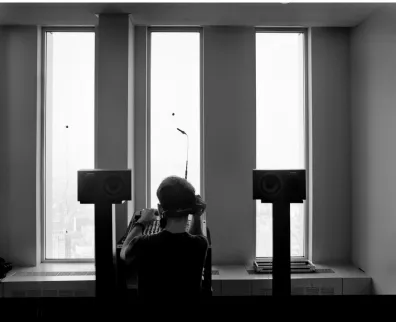
‘There was this kind of intimacy of just sitting there, especially at night, and just listening to vibrations of the building, and just getting to know the building and the soundscape of New York’ (National Public Radio, n.d., 2:15). With these words, Ste-phen Vitiello describes how he recorded the sounds of the North Tower of the World Trade Center complex. The recordings were made in 1999 during a six months’ artist
residency in an empty office on the 91st floor of the North Tower where Vitiello set
up his studio and spent days and nights listening to the tower and its surroundings. The recordingswere Vitiello’s personal, albeit technologically mediated memory of the towers, as he himself emphasises: ‘it [the piece] was my own experience, my own relationship to the building and to the sounds of New York’ (National Public Radio, n.d., 4’30”). They function an ‘ear witness’ (Schafer, 1977, p. 8) – a sonic par-allel to an ‘eyewitness’ – of the towers, and in that sense an ‘aural portrait’ of the towers pre-9/11 (Kim-Cohen, 2009, p. 129).
Owing to the tragic course of history, Vitiello’s piece soon assumed the status of a memorial for a lost site. The recordings were turned into the work World Trade Center Recordings: Winds After Hurricane Floyd (1999/2002) and presented as a sound installa-tion with eight minutes and 20 seconds of surround sound at the Whitney Biennial in 2002 – just months after the September 11, 2001 attack. Further cementing this commemorative function was the exhibition September 11 at MoMA PS1 in 2011 on the tenth anniversary of the attacks – an exhibition that explored the ‘enduring and far-reaching resonance’ (MoMA PS1 webpage) of the tragic events. Vitiello’s piece seems indeed in the literal sense to be a ‘resonance’ of a past, bearing in mind that the word etymologically stems from the Latin word resonantia, meaning ‘echo’, and
vibrations Vitiello picked up during his artist residency in the North Tower (Bjørn-sten, 2012). The practice of recording and archiving sounds thus becomes entangled with memory – both Vitiello’s personal memory and our broader cultural memory of World Trade Center and its demolition.
This article asks how memory and technology are entangled in Vitiello’s piece. The purpose is not, primarily, to give more knowledge about the singular piece, but rather to interrogate the ways in which our cultural memory is reliant on technol-ogy, and in this case on a technology based on the recording and resounding of vibrations.
Thus the article is ultimately contributing to the on-going examination of how we are technical beings, as the French thinker Bernard Stiegler (Stigeler 1998, p. 50) claims. With regards to memory Stiegler writes that the interior (the memory) and the exterior (for instance a recording) are constituted by a movement between the two – and we come to be through this process of exteriorisation (p. 142). In Vitiello’s piece the process of exteriorisation is different from the typical ‘memoire’ in the sense that it does not rely on writing and language. It is a ‘resonance of the past’ rather than a conventional account of it. It is ‘vibrative’ rather than
narra-tive. Accordingly it seems to follow the French historian Pierre Nora’s definition
of modern memory, when he writes that ‘Modern memory is above all archival. It relies entirely on the materiality of the trace, the immediacy of the recording
[…]. What began as writing ends as high fidelity and tape recording’ (Nora, 1989, p. 13). According to Nora’s definition, Vitiello’s piece seems to be the quintessential
modern memory; it certainly does not rely on writing, but on recording and the materiality of the trace.
The article will investigate how, specifically, the media-specific, archival prac -tices condition the levels of memory at play in Vitiello’s piece and how they inter-act. Others have written about Vitiello’s now iconic piece and how sound relates to memory (Toop 2004, Kim-Cohen 2009, Bjørnsten, 2012). In contrast, the main focus of my analysis is not sound as such, but this ‘materiality of the trace’ and the way it contributes to the piece’s overall function as a commemorative lieu de mémoire – a place where our memory ‘crystallizes and secretes itself’ (Nora, 1989, p. 9). My article is thus a small contribution to the more general discussion on how material, digital, aesthetic practices constitute collective, cultural memory.
Cultural memory
events memories of the event were installed in people far beyond the actual eyewit-nesses present in Manhattan that day (Grusin, 2010, p. 5).
According to the French thinker Jean Baudrillard, 9/11 is a world event, not merely because it gained worldwide media coverage, but because it was a setback for globalisation (Baudrillard, 2002, p. 3). In other words, not only was this event one we witnessed worldwide, more importantly, it fundamentally changed us and who ‘we’ are, as it drew new lines of otherness, lines that would reshape the global
political landscape with stark, immediate consequences such as the war in Iraq. In consequence, when we talk about ‘our’ cultural memory of 9/11, it does not refer to the sum of individual memories of those who experienced the attacks either at first
hand or saw the recordings of them. Instead it the term cultural memory designates the symbolic order of media, institutions and practices by which groups construct and internalise a shared past (Erll, 2008, pp. 3-5). Cultural memory encompasses the memory ‘we’ have as a collective of this event as something that not only hap-pened in, but to our culture, to us. It is thus also a construction of a present and of who ‘we’ are as a collective. As Andreas Huyssen states, it is important to remember that ‘while memory discourses appear to be global in one register, in their core they
remain tied to the histories of specific nations and states’ (Huyssen, 2003, p. 16). In
line with Huyssen’s statement, Nora’s study of memory focuses on commemorative practices in French culture and may be considered in line with other studies of how ideas of a shared, ‘imagined’ community are established and maintained culturally,
for instance Benedict Anderson’s (1983) influential study of modern nationalisms.
Lieux de mémoire
A key figure in cultural memory studies is the German sociologist Maurice Hal -bwach, who in the 1920s drew attention to the collective aspect of memory with his seminal concept of mémoire collective, collective memory, which encompasses both how individuals remember by placing themselves in the perspective of the group, and how the memories of a group are realised and manifested in the indi-vidual (Halbwach, 1992, p. 40). Since the early 1980s the notion of how our pasts are
remembered in the present has gained substantial attention in the growing field of
memory studies, where the concept of cultural memory has been established as a lens for studying the relationships between past and present. These new discourses on cultural memory were invigorated particularly by the debate over the Holocaust and the memory of it (Erll, 2008; Huyssen, 2003).
cul-tural obsession of monumental proportions across the globe’ (2003, p. 16), in line
with Nora, who characterises modern memory as the prodigious expansion and democratisation of archival memory embodied in a material form:
The less memory is experienced from the inside the more it exists only through its exterior scaffolding and outward signs – hence the obsession with the archive that marks our age, attempting at once the complete conservation of the present as well as the total preservation of the past. (Nora, 1989, p. 13)
According to Nora, the natural milieux de mémoire – environments of memory – have
ceased to exist. As an example Nora mentions the old peasant culture, the ‘quintes -sential repository of collective memory’, which disappeared (and was discovered as an object of study) with the industrial expansion (Nora, 1989, p. 7). Nora claims that this loss of collective memory sparked the urge to create archives, celebrate anni-versaries, organise celebrations and commemorations and so on (p. 12). Both Nora (1989) and Huyssen (2003) note two aspects of the preoccupation with the past: one being the general cultural amnesia connected to our externalisation of memory in new media, which entails a loss of the natural culture of remembrance, and the
other being the intensified global-political and national/regional use of strategies
for creating pasts to legitimise the present.
Essential to how we remember our past is what Pierre Nora (1989) calls lieux de mémoire – sites of memory – that have now replaced the traditional, natural milieux de mémoire. Nora’s concept offers a framework for a new critical study of both old and new commemorative practices, as demonstrated in his voluminous three-vol-ume anthology Les Lieux de Mémoire (1984-1992). Even though Nora uses the term place (lieux) of memory more immaterial works can also function as lieux de mémoire.
La Marseillaise, the French celebration of Bastille Day,even a historical generation, or a veteran’s group may be a lieu de mémoire, if they connect the material, symbolic and functional dimensions (p. 14). When Vitiello’s World Trade Center Recordings: After Hurricane Floyd were installed in and framed by memorial exhibitions, it became what Nora calls a lieu de mémoire:a place for the shared cultural memory of 9/11.
9/11 – media and the collapse of cultural time
events first-hand. At the same time the continuously replay and commentary on
multiple platforms, contrasted the immediacy with the logic of hypermediacy, which simultaneously provided (multiple) narrative framings of the event as it happened (Grusin, 2010). Futhermore, Grusin also claims that the events of 9/11 were also to some extent even ‘pre-mediated’:
Premediation works to prevent citizens of the global mediasphere from experienc-ing again the kind of systemic or traumatic shock produced by the events of 9/11 by perpetuating an almost constant, low level of fear or anxiety about another terrorist attack. Premediation does not displace remediation but deploys it in different aes-thetic, sociotechnical, or political formations. The double logic of remediation still
obtains, but its conflicting media logics are formally different. (Grusin, 2010, p. 2)
The events of 9/11 were for instance ‘premediated’ by blockbuster movies
(Simp-son, 2006, pp. 4-5); this was especially the case with the secondary events that followed such as the war in Iraq (Grusin, 2010). The fundamental dependence on
media led some, including Baudrillard, to call the events of 9/11 a ‘medial simula-crum’ (Baudrillard, 2002). The large number of images related to the 9/11 events not
only gave the global community a first-hand view of the events, they also played
a hitherto unprecedented role. There is general agreement that whereas media have always ‘played a key role in politics, war and collective perceptions about the shape of history’ (Mitchell, 2011, p. 5), 9/11 changed the role of the media practices involved. There were not only more images of this event than of any previous terror
attacks, but a ‘war of images’, as W.T.J. Mitchell calls it. Consequently, in the case of
9/11 we have to understand the event itself as a media event deeply entangled in the logics and practices of new, digital media.
The media exposure of 9/11 also affected the experience of the temporal dimen-sion of the event. Firstly, the constant loop of the same images of the burning towers stretched and emphasised the ‘now’ of the event, which in turn was imme-diately perceived as a historical event, a precipitous disruption of cultural time. Here something was suddenly and forcefully destroyed instead of evolving over time.
Consequently, the world immediately experienced a ‘before and after’ 9/11, as the event occurred (Simpson, 2006). Secondly, adding to this the sense of a disruption
of time, the process of commemoration was felt by many as coming too soon and as forced, even before there was any agreement on what to commemorate: ‘the ruins
were still smouldering with underground fires when the architects and developers
came forth, emphasizing the need to rebuild fast and big, possibly even bigger than before’, Andreas Huyssen states (2003, p. 158). Furthermore, the political response
by the Bush administration was quick to interpret the situation with an overarch -ing, hegemonic narrative that led to secondary actions – the ‘war on terror’ and the
In conclusion, if we want to understand the cultural memory of 9/11 we need to take into account not only the traumatic event in it self, but also the event’s complex relation to time and media as well as the simultaneous attempts to interpret and conclude on what the event was. Or rather: the traumatic event ‘in it self’ seems to include a complex relation to time, to media and remediation, and to interpretation.
World Trade Center Recordings: Winds after Hurricane Floyd
The idea that a sound recording may be used as a part of commemorative practices was born with the invention of sound recording if self. In 1891 the inventor of the phonograph, Thomas Alva Edison, wrote a newspaper article stating that this new technology could be used as a part of commemorative practices. He suggested what he called ‘The Family Record’, which would be ‘a registry of sayings, reminiscences, etc., by members of a family, in their own voices: and of the last words of dying per-sons’ (Edison, 1891, p. 13, see also Kim-Cohen, 2009, p. 131). Today this commemora-tive function is not the typical focus of the way sound recordings circulate in our society, but after 9/11 we did see that various sound recordings were used in formal-ised memorial projects. One example is The Sonic Memorial Project which is an open archive and online audio installation that collects stories, ambient sounds, voice-mails and archival recordings ‘to tell the rich history of the twin towers, the neigh-bourhood and the events of 9/11’ (Sonic Memorial Project). On this online platform visitors may listen to a variety of sound recordings, including stirring recordings of 911 calls and voicemails from loved ones lost to the tragic event.
In contrast there are no human voices, we can identify with, in Vitiello’s piece, and the sounds are not recognisable as sounds from that particular place, simply because Vitiello did not record sounds that a public would hear if they had ever been inside the buildings of the World Trade Center complex. Vitiello’s original idea for his work was to open the windows of the studio and record the building’s imme-diate external soundscape, but he soon learned that the windows of the buildings
did not open. Instead, he affixed contact microphones to the windows, and with the right accentuation of frequencies he could suddenly hear the big world of sounds of
New York that the windows shut out. The sounds varied depending on the weather and what was happening outside. He heard church bells, an airplane, even people on the streets below and the roar of wind. Sometimes the sounds he heard were merely a massed, unrecognisable drone. At one point the microphones also picked up the creaking and cracking sounds of the building itself swaying under the pres-sure of Hurricane Floyd (Vitiello, 2001, p. 31).
vari-ous data gathered from the technological processes was sonified, transformed into sound, or rather audified – which simply means the ‘direct translation of data wave -form into sound’ (Kramer in: Dombois and Eckel, 2011, p. 301).1 In this case ‘data’ is
the physical input of the electromagnetic wave propagation of the light sources.
This technique allowed Vitiello to immediately perceive light signals as sounds. At
night he would point the photocells at different light sources seen from his build-ing – for instance, light from police cars or from windows in other buildbuild-ings – often using a telescope and listen to them (National Public Radio, n.d.).
Figure 1. Stephen Vitiello, World Trade Center Recordings, photo by Johnna MacArthur, 1999.
Vitiello’s final piece consists of a variety of more or less recognisable sounds, includ -ing police sirens, but also electronic sounds and noises: a deeper, pulsat-ing drone, a
higher pitched, more flickering sound, a hissing noise, and then at times a strange
creaking, which almost sounds like an old wooden ship, but which is in fact the sound of the towers swaying under the pressure of the wind. These cracking,
were presented to the audience in a small, dark room in the cellar of MoMA PS1 without any visual or textual elements asides from the title.2
Vitiello’s piece is a fascinating case as a commemorating piece, because of the complex relation to its referent, The World Trade Center. It is only due to the title that the listener will know that he or she is listening to sounds collected from inside one of the iconic buildings, but the piece’s relation to the referent is still prevailing. The title World Trade Center Recordings: Winds After Hurricane Floyd connects the piece to a larger intertextual network of texts about the Twin Towers and 9/11, and these paratexts (Genette, 1997) condition how we experience and interpret the sounds
we hear. The title also tells us that we are listening not only to a specific place, but also at a specific time namely immediately after Hurricane Floyd – a natural
force that, according to Vitiello made the towers sway, and which may be read as a presentiment of their impending demolition. Finally the title tells us that this is a recording, a documentation of something that was there. Roland Barthes suggests that the main effect of photography, in contrast to painting, is that it always carries
its referent with it: ‘the referent adheres’, he writes (Barthes, 1981, p. 6). A similar analysis could be made in relation to sound recordings, in particular field record -ings that tell their audience where the sounds were found – as Vitiello’s World Trade Center Recordings does. When we are told that we are listening to a field recording it encourages us to activate our knowledge about the specific site and its history.
In addition Vitiello’s piece is to some extent an abstract and open piece (Eco, 1984) with many indeterminacies that leave room for interpretation. However, the com-position also include sounds that are clearly not from the building, but from its
environment (traffic noise, wind, noise) as well as odd sounds that do sound like swaying material, a wooden ship perhaps, but definitely not like that of a building.
The referent postulated in the title, is thus to some degree also contradicted by the sonic level. It is this complex relation to the referent the following text wishes to explore in order to analyse Vitiello’s piece as a lieu de mémoire.
Symbolic representations of symbolic representations
Seth Kim-Cohen (2009, p. 131) suggests, with reference to Edison’s statement, that what we hear in Vitiello’s piece are the fallen towers ‘in their own voices’:
Kim-Cohen states that the recordings are ‘texts about texts’ or ‘symbolic represen-tations of symbolic represenrepresen-tations’, which is contrary to Vitiello’s own description of the recordings that emphasises the experience of listening to the materiality of the buildings.
Kim-Cohens main point is that, in contrast to the dogmas of the dominant dis-courses on sound art, this piece does not owe its effects to the sounds-in-them-selves, but to the textual and intertextual nature of sound (Kim-Cohen, 2009, p. xvii). This is particularly evident because of the way the destruction of the towers gave the recordings a ‘monumental gravitas’ that ‘demands that attention be paid to the intertextuality latent in all sound’ (p. 130). Kim-Cohen also stresses the fact that ‘Vitiello’s recordings accumulate their most important textual meanings after the act of creation. The recordings were, in a sense, rerecorded when the towers fell’ (p. 130). In Kim-Cohen’s analysis the sound recordings function as a surface onto which
the intertextual and cultural-symbolic matrixes affix themselves in the listening
act. What we hear, when we listen to Vitiello’s recordings is, in other words, what we know about the event, which is a phrase Kim-Cohen uses about a similar artwork
(p. 132). Kim-Cohen’s analysis is both a critique of naïve ideas of representation, e.g.
that we have an immediate access to the referent through the medium of record-ing, and the modernistic focus on the medium of sound-in-it-self, by insisting on the textual and intertextual nature of sound following a more conceptual approach (p. xvii). Here the focus is on discourse and not the phenomenon. This goes very well with Kim-Cohen’s understanding of the referent, the now ‘fallen towers’, as some-thing that in itself is a symbolic representation or ‘a text’. This is consistent with Baudrillard’s account of the 9/11 events and his distinction between the towers as architecture and as symbols. Baudrillard suggests that the violence of the event was not primarily an effect of the material destruction of buildings (and the lives lost), but of the attack on the buildings as symbols of capitalism (Baudrillard, 2002, p. 38) or of ‘corporate modernism’ (Huyssen, 2003, p. 149). In Kim-Cohen’s analysis the referent of Vitiello’s piece is thus the architecture as symbols, not as a material phenomena.
When Kim-Cohen reduces this sound installation to ‘a text’ or a ‘symbolic repre-sentation’ there are elements that his analysis cannot grasp. One element is the way that the piece resists the interpretation as symbols of America’s capitalist empire, because of the sounds that do not sound like ‘the towers’. If we want to address this effect, we need to understand the piece as a combination of text, sound, the operative performance of sound recording, installation, title and other paratexts. On a more general level I with to suggest that there is a material level at play that
cannot be reduced to ‘discourse’. My claim is not in favour of a naïve realism that
Both positions do not work well with Vitiello’s piece that brings attention to a ref-erent – The World Trade Center – that at the same time is never fully represented, but stays withdrawn or unresolved. However, a narrow focus on discourse fails to address the way in which sound recordings operate in our culture, where they do produce objects, in particular in science. They not produce objects in a field iso -lated from discourse, but also not in the same way as discourse. I wish to argue that
Vitiello’s piece inscribes itself in this way of producing objects through sonification
and sound recording, and that this is an essential aspect of its function as a lieu de mémoire. In the following analysis it is however still a basic premise that Vitiel-lo’s piece is not just sounds or sound recordings, but a combination of installation, sounds, the technological operation and title, as well as other paratexts.
Listening to the body electric
World Trade Center Recordings is Vitello’s personal, and thus human, experience, as already mentioned. But the personal memory in Vitiello’s piece is deeply entangled with the technological. In media theory sound recordings are generally described as something that has the ability to remember. For instance, the German media historian Friedrich Kittler states:
If the phonographic disk had self-consciousness, it could point out while replaying a song that it remembers this particular song. And what appears to us as the effect
of a rather simple mechanism would, quite probably, strike the disk as a miraculous
ability: memory. (Kittler, 1999, p. 31)
This ability to remember is inherent in all recordings: they ‘remember’ the sounds so that they can be played back. In Vitiello’s piece the agency of the technologi-cal operation is even enhanced, because his personal memory of the towers is co-produced by the technological operations – we cannot distinguish the two. This co-production can be experienced in the piece and is thus part of the piece, because the subject of focalisation – the focalizer (Bal, 1997, p. 47) or the one listening – in Vitiello’s piece is obviously not only a human, but also a technological ear. The non-human listening perspective is as present to the listening experience as the (com-plex) referent is – because the two cannot be distinguished.
There seems to be an almost scientific operation in this artistic practice. Vitiello
himself says that he was listening through a sort of ‘stethoscope made of the two
mics fixed to the windows, sent into my headphones via a mixing desk’ (Vitiello,
2001, p. 31). Returning to the comparison to Edison’s ‘Family Record’, another con-clusion could then be that in Vitiello’s piece we are not listening to voices of family members, but to stethoscopic recordings of their heartbeats and other internal
is this case is a sonic image produced by the stethoscopic investigation – is a tech-nological construction that brings into being their objects by giving them a voice. Therefore we cannot distinguish between the already given reality and the techno-logical instrument that ‘reveals it’, Ihde claims. Instead the act of conceptualized interrogation involves a combination of instrument design and experimentation that gives a voice to what was previously non-existent and inaudible (Cazeaux 2017, p. 54). According to Ihde the technological operation does not ‘construct’ its object via discourse alone, but in the technological process by which the object is given a
voice. Vitiello’s recordings do not elude to be scientific, standardized representa
-tion, but it is build on data collected at the site and it therefore holds an affinity to
‘reality’ similar to science. The recording also does not illude to be an exact presen-tation of a reality, but seems exactly to support an understanding of the referent as something that is dependent on and entangled in the technological operation.
What we hear seems to be what Axel Volmar calls ‘listening to the body electric’, where the bodies begin to ‘aurally express themselves through a mediated form of electrical auscultation’ (Volmar, 2010, p. 12).
However, should we attempt to listen to ‘the fallen towers in their own voices’, they would elude us, because what we hear are not the sounds of the building itself,
but the audification of a wide range of vibrations surrounding and penetrating the
building; both the mechanical vibrations of pressure from the air – sound from the streets, the roar of wind – and the electromagnetic vibrations of light from sur-rounding light sources. This dimension is also mentioned in Kim-Cohen’s analysis, although solely with a focus on the contact microphones, when he writes that:
the vertiginous glass curtain acting as a distended microphonic diaphragm, he [Vitiello] converted one of the world’s tallest buildings into the world’s largest micro-phone. The resulting recordings depict a sound world beyond the reach of most
human beings, beyond even the reach of most of humanity’s edifices. We hear wind and street traffic, the bellow of a ship in New York harbour. We are surprised to be
able to pick out an occasional voice from the streets a thousand feet below. (Kim-Cohen, 2009, p. 129)
The Canadian composer and scholar Murray R. Schafer describes how a sound
recorder may be used to document soundscapes and significant changes in a sound
-scape. He suggests specific analytical terms, which may be used to analyse a given
soundscape: A keynote sound is the background, the anchor or fundamental tone,
which is not always heard consciously, but still ubiquitously and thus defines a
place. In a landscape this may be the sound of wind and trees. In contrast, signals
traf-fic – and signals – sirens and church bells – that are characteristic of that specitraf-fic place at that specific time, namely downtown Manhattan in 1999 after Hurricane
Floyd. Even though Vitiello’s piece is clearly not only an ethnological ‘phonography’ (Truax, 2012, p. 195) documenting a soundscape, these soundscape effects do allow the listener to experience World Trade Center as material structures in the context of the metropolis. In fact in this recording we cannot distinguish between mate-rial structure and surrounding context, because what we hear is the surrounding context vibrating in the material structure. They are entangled, as one large hybrid
body or field.
To many New Yorkers, the reading of the North and South Towers of the World
Trade Center as symbols of capitalism was a too narrow or even ‘infantile’ defini -tion, as Huyssen puts it. To him, they were instead landmarks of a ‘home in the
metropolis’ (Huyssen, 2003, p. 160), whose monumental size crowded out other
landmarks, and according to Huyssen, this monumentality is at ‘the core of their
afterimage and its effects’ (p. 160). As a commemorative piece, Vitiello’s recordings
seems to be in line with Huyssen’s experience of the World Trade Center, and it can thus serve a counterweight to the ‘infantile’ narrow and hegemonic narratives that were experienced after the attacks. This goes well in line with art critic Arthur Danto’s description of Vitiello’s piece as ‘9/11 art’: 9/11 art differs from memorial art, according to Danto. The latter must be ‘public and take on the responsibility of putting the event at a distance, and must negotiate the controversies such memori-als generate’, while 9/11 art is ‘private and personal’ and dememori-als with ‘the mitigation of grief’ (Danto, 2002). This lack of distance is characteristic to Vitiello’s piece where
we are immersed into this vibrating field of sound event.
According to Schafer, a soundscape consists of ‘events heard, not objects seen’ (Schafer, 1977, p. 8), and we hear both the environment of the towers and the swaying structure of the towers themselves, but as events. The French composer Pierre Schaeffer stresses that a sound recording not only reproduces the existing, but creates ‘new phenomena to observe’ and allows ‘new positions of observation’ (Schaeffer, 2004, p. 81). In particular, he describes how a sound recording allows us to experience the objet sonore detached from its referential affinity, which is what he calls an acousmatic mode of listening that allows us to focus on the qualities of the abstract sound object itself. In Vitiello’s piece the referential affinity is detached and also maintained at the same time. When we sit in the dark room of the
installa-tion, we hear musical qualities, rhythm, colour in the object sonore, but the techno-logical operations are not merely used as an instrument that produces new abstract
sounds or music, but also as a way to explore the specific site of the North Tower.
And thus the referent is maintained, but we are offered a new or skewed view on it. In this way a new phenomenon occurs, not an entirely abstract objet sonore, but
acousmatic field produced by material vibrations heard through the building as a conductor. The sonification of the towers as a membrane establishes a strong sense
of immediacy (Grusin, 2010), but it is the immediacy of strange, withdrawn, vibrat-ing matter stretched across time. It is a voice of somethvibrat-ing that is not limited as an object that can be distinguished from the technological mediation, since it itself is a membrane, a media. It is a temporal phenomenon that connects the towers to both their immediate context (the streets) and to larger, even global weather systems (hurricanes) as well as to time.
‘Re-presencing’ the past
A basic premise for my analysis is that a sound recording functions in a fundamental different way that a text, and that a listener listens to sound recordings in a differ-ent way than he or she reads a text. Wolfgang Ernst (2013) insists that there is a dif-ference between the performative speech act of language that can describe its object and the operative act of reproducing technologies that represent their objects via physical, mechanical operations. He draws on the linguist Émile Benveniste’s clas-sical distinction between histoire and discourse as differentiating between two dif-ferent registers of the speech act, on the level of enunciation. Histoire is the speech act that effaces its source and the act of enunciation, whereas discourse does not, because it includes deictic markers that indicate it, such as ‘I’, ‘you’, ‘here’, ‘now’. The distinction between histoire and discourse in written language is not a description of objective and subjective language – though the history we read in our history books may disguise its own act of enunciation, it is still a product of it – it is still told, nar-rated, although it hides the traces of its own narrative act.
The typical memoire includes words such as ‘I’ (‘I remember’), whereas the typ-ical history book uses words such as ‘he’, ‘she’ and impersonal address, so that the story told seems to emanate from a neutral and objective place (Benveniste 1974 p. 205). Ernst (2013) emphasises that when we move from language to technical reproduction, at the media archaeology level we will have a histoire with the actual
absence of a narrator. In keeping with Barthes’ thinking, he emphasises how, with regard to photography, ‘the technological reproduction of the past […] works with-out any human presence because evidence and authenticity are suddenly provided by the technological apparatus’ (Ernst, 2013, p. 48).
There is a re-presencing (Ernst, 2014) of the past at the level of recording, which is different from the textual, narrative re-presentation of the past. Ernst calls this technological practice of temporal dramatic composition the ‘dramaturgy of time’ (2013, p. 50), and it is inherent to all sound recordings. It is not present as a literary
-lation’ (2014, p. 30): The recording is a repetition of a vibration of the past, and not a description of it.
Accordingly, at the level of recording Vitiello’s piece is a techno-cultural opera-tion that combines past and present, not via the narrative speech act, but via what
we, with Ernst, may call the ‘detached scientific’ (2014, p. 49) recorder in the various
technologies applied by Vitiello. This ‘dramaturgy of time’ (2013, p. 50) is enhanced and thickened because of the lack of human voices and explicit narrative or musi-cal content that would normally be the focus of our listening. Even though Vitiello’s piece is his personal, artistic documentation of the towers, it is completely with-out deictic markers: We never hear the sounds, the voices or the footsteps of the recording artist, instead the subject of focalisation is the technological ear of the sound (re)production. Adding to this dramaturgy of time is the fact that we listen to a material that was vibrating, pulsating, and these vibration happen again as we listen to them.
In his analysis of the Abu Ghraib pictures Richard Grusin (2010) stresses the
media-specificity, or mediality, of the images as an origin of affect. The term ‘affect’
refers to a physical feeling that strikes us – as a gut feeling – before representation. It ‘functions in our image-based media culture in ways that are distinct from either objective reason or subjective emotion’ (Grusin, 2010, p. 79). Grusin explains that the fact that the Abu Ghraib pictures so obviously contained traces of the private media practice in which they were embedded was the source of the affect (Grusin, 2010, pp. 83-90). Ernst describes a more general link between the temporality of media
storage and affect by noting the affinity between the temporal affect of trauma and
technology-induced ‘temporeality’. He uses the word ‘temporeality’ and not just ‘tem-porality’ in order to emphasise that this time-effect is a result of the technological operation of the sound recorder and not a discursive, symbolic, rhetorical strategy. Friedrich Kittler describes the phonographic recording as storage of time – storage that does not use the symbolic writing systems of text and musical scores (1999,
p. 4). With reference to the distinctions made by Jacques Lacan between the sym -bolic and the real, Kittler places cinema in the realm of the sym-bolic, whereas ‘The
real […] has the status of the phonography’ (Kittler, 1999, p. 16). This non-symbolic
real is what Ernst incorporates into the word ‘temporality – ‘temporeality’. As with trauma, a recording is not a symbolic, orderly, sign-based re-presentation of a past, but actual, signal-based re-sounding or ‘re-presencing’ of a past.
In consequence, in World Trade Center Recordings the source of affect is not that we recognise the voices of the towers, but instead that we are listening to the
‘re-presencing’ of a traumatic site as an event, a field of vibrations. A past we cannot
the traumatic past that lives on in the present and to which we are unable to give symbolic meaning. The traumatic ‘chrono-poetics’ of the technological operations are enhanced as we listen to the piece after the events of 9/11, and the collapse of cultural time that was experienced with these events. And reversely: With its com-plex relation to time World Trade Center Recordings seems to enhance the complex relation to time that was part of the events of 9/11.
In the Echo of No Towers
With the phrase In the Echo of No Towers, the interviewer Mark Wiedenbaum (2011) tacitly draws a parallel between Vitiello’s piece and Art Spiegelman’s autobiographi-cal, graphic novel In the Shadow of No Towers (2004). Spiegelman unfolds his personal memory of the traumatic event: It is described to us through various narrative
(textual and visual) strategies that establish a first-person perspective. According to Grusin, Spiegelman’s book clearly exemplifies the double logic of remediation
(Bolter and Grusin, 1999), insisting simultaneously on the unmediated authenticity of ‘what he had “experienced” and “actually saw” and the hypermediacy of “media images that threatened to engulf” him’ (Grusin, 2010, p. 27).
Vitiello’s piece is different because it was not recorded with the intent to reflect
on the events of 9/11. However, after the events the portrait Vitiello made with his
World Trade Center Recordings: After Hurricane Floyd has come to play a role as a com-memorating piece that is experienced in the light of the events of 9/11, or even as ‘9/11 Art’ as Arthur Danto (2012) describes it.
World Trade Center Recordings: After Hurricane Floyd places us in relation to a reso-nating past where the World Trade Center does not appear to our senses as a dis-tinct object. Instead the ‘voice’ it is given through the recordings is a complex voice that resists interpretation, and avoids the grand narratives and symbolic interpre-tations that seemed to invade and colonise the events of 9/11. Instead of unfolding a his own human and personal perspective on the lived life in the towers, Vitiel-lo’s piece allows us to experience the ‘sharing of perception of the environment between the animate (the living subject) and the inanimate (the object, the seeing
machine)’ (Virilio, 1994, p. 62), which, according to the French thinker Paul Virilio,
is key to contemporary digital culture and, in particular, the events of 9/11. We are invited to experience the World Trade Center as something that is inseparable from the technological operation that gives it a voice, as something that cannot be distin-guished from its technological remediation the same way the events of 9/11 cannot be separated from the media and remediation.
sur-roundings to be heard, from the local scale – the traffic in the streets and the light
from the windows surrounding this centre of capitalism – to the global scale of the huge Atlantic weather phenomenon of Hurricane Floyd formed off the coast of Africa. World Trade Center Recordings thus allows us to experience the iconic place as something that is not only inseparable from the media that gives it a voice, but also as something that is already a media to its own surroundings. Even though Vitiello’s
investigation is almost scientific the World Trade Center does not appear to the lis
-tener as a scientific matter of fact, but as a matter of concern; a complex gathering
that connects the material structure to the life in the metropolis as well as to global
contexts. In consequence the piece seems to suggest that the buildings in The World
Trade Center complex were never merely symbols, nor merely architectural struc-tures, but always something deeply entangled with their surroundings, similar to what Bruno Latour calls ‘a thing’.
In order to explain what ‘a thing’ is Latour uses the tragic crash of the shut-tle Columbia in early 2003 as an example of the metamorphosis of an object into a thing. Here a ‘completely mastered, perfectly understood […] matter-of-factual projectile into a sudden shower of debris falling onto the United States’ (Latour, 2004, p. 235). He ends his essay by describing how the demolition of the Twin Towers revealed the buildings as things:
Was it not extraordinarily moving to see, for instance, in the lower Manhattan reconstruction project, the long crowds, the angry messages, the passionate emails, the huge agoras, the long editorials that connected so many people to so many varia-tions of the project to replace the Twin Towers? As the architect Daniel Libeskind said
a few days before the decision, building will never be the same. (Latour, 2004, p. 236)
Vitiello’s installation seems above to invite us to experience the materiality of the North Tower, not as an object, not as a mere matter of fact, but as a highly complex, historically situated, richly diverse matter of concern (Latour, 2004, p. 237).
References
Anderson, Benedict. (1983). Imagined Communities. Reflections on the Origin and Spread of Nationalism. London: Verso.
Barthes, Roland. (1981). Camera Lucida, New York: Hill and Wang.
Bal, Mieke. (1997). Dispersing the gaze: Focalization. In: Looking in: The Art of Viewing, London og New York; Routledge (pp. 41-65).
Baudrillard, Jean. (2002). The Spirit of Terrorism and Other Essays. Translated by Chris Turner. London: Verso.
Benveniste, Émile. (1971). Problems in General Linguistics. Miami: University of Miami Press.
Bjørnsten, Thomas (2012). “Resounding Catastrophe: Auditory Perspectives on 9/11” in Kristin Veel, Carsten Meiner (eds)The Cultural Life of Catastrophes and Crises, Berlin: Walter de Gruyter
Danto, Arthur. (2002). The Art of 9/11. The Nation, September 5. Accessed January 2017.
Dombois, Florian and Eckel, Gerhard. (2011). Audification. In: Thomas Hermann, Andy Hunt and
John G. Neuhoff (Eds.), The Sonification Handbook (pp. 301-325). Berlin: Logos Verlag.
Eco, Umberto. (1984). The Role of the Reader, Explorations in the Semiotics of Texts. Bloomington: Indiana University Press.
Edison, Thomas Alva. (1891). How sound is reproduced. The Phonogram, 1(1), 13-16.
Erll, Astrid. (2008). Cultural Memory Studies: An Introduction. In: Astrid Erll and Ansgar Nünning (Eds.), Cultural Memory Studies: An International and Interdisciplinary Handbook (pp. 1-18). Berlin: Walter de Gruyter.
Ernst, Wolfgang. (2013). Digital Memory and the Archive. Minnesota: University of Minnesota Press. Ernst, Wolfgang. (2014). Temporalizing the Present, re-presencing the past, Chronotechnical
Reali-ties. Unpublished lecture at the symposium Technocultures: Technologies, Subjectivities and Temporalities of Digital Culture.
Genette, Gérard. (1997). Paratexts. thresholds of interpretation. Cambridge: Cambridge University Press. Grusin, Richard. (2010). Premediation: Affect and Mediality after 9/11. London: Palgrave Macmillan. Halbwach, Maurice. (1992). On Collective Memory. Chicago: University of Chicago Press.
Huyssen, Andreas. (2003). Present Pasts: Urban Palimpsests and the Politics of Memory. Stanford: Stanford University Press,
Kim-Cohen, S. (2009). In the Blink of an Ear. Toward a Non-cochlear Sonic Art. London & New York: Con-tinuum.
Kittler, Friedrich. (1999). Gramophone, Film, Typewriter. Berlin: Brinkmann and Bose.
Latour, Bruno. (2004). Why Has Critique Run Out of Steam? Critical Inquiry, winter, 225-248. Mitchell, W.T.J. (2011). Cloning War on Terror. Chicago: University of Chicago Press.
MoMA PS1. September 11. Accessed in December 2016 at: http://momaps1.org/exhibitions/view/338 National Public Radio. (N.d.). Interview with Stephen Vitiello. Accessed on October 21, 2016 at: www.
stephenvitiello.com/mp3/nprpieceonwtc.mp3
Nora, Pierre. (1989). Between Memory and History: Les Lieux de Memoire. Representations, 26, 7-24.
Special Issue: Memory and Counter-Memory.
Nora, Pierre. (1984-1992) Les Lieux de Mémoire I-III, Paris: Gallimard
Schaeffer, Pierre. (2004). Acousmatics. In: Christoph Cox and Daniel Warner (Eds.), Audio Culture: Reading in Modern Music (pp. 76-81). London: Continuum.
Schafer, Muray R. (1977). The Tuning of the World. Vermont: Destiny Books.
Simpson, David. (2006). 9/11 The Culture of Commemoration. Chicago: University of Chicago Press.
Sonic Memorial Project. (N.d.). Website. Accessed in December 2016 at: www.sonicmemorial.org
Spiegelman, Art. (2004). In the Shadows of No Towers. New York: Pantheon.
Stiegler, Bernard. (1998). Technics and Time 1: The Fault of Epimetheus. Translated by Richard Beards-worth and George Collins. Stanford: Stanford University Press.
Toop, David (2004) Haunted Weather – Music, Silence and Memory, London: Serpents Tail
Truax, Barry. (2012). Sound, Listening and Place: The Aesthetic Dilemma. Organised Sound, 17(03), 193-201.
VCU InSight. (2011). Sound Artist Stephen Vitiello. Interview. October 10, 2011. Accessed in Septem-ber 2015 at: https://www.youtube.com/watch?v=snvDdM0Hugg
Virilio, Paul. (1994). The Vision Machine. Indianapolis: Indiana University Press.
Vitiello, Stephen. (2001). Music from the 91st floor. The Wire, 213, 31.
Volmar, Axel. (2010). Listening to the Body Electric. Electrophysiology and the Telephone in the Late 19th Century. In: The Virtual Laboratory. Http://vlp.mpiwg-berlin.mpg.de/essays/data/art76.
Berlin: Max-Planck-Institute for the History of Science.
Wiedenbaum, Marc. (2011). In the Echo of No Towers. Interview. Disquiet. Website, September 8,
Notes
1 Since the final piece may include sounds that are not the direct result of data I use the word
’sonification’ in the rest of the article and not ’audification’, as the former refers to the more
general translation of data into sound, while the latter more narrowly refers to the direct
audification.