[Elewe* 4(4): April, 2017] ISSN 2349-4506
Impact Factor: 2.785
G
lobal
J
ournal of
E
ngineering
S
cience and
R
esearch
M
anagement
A NOVEL RFID-NETWORK PLANNING BASED ON MDB-FA METHOD
Adel Muhsin Elewe*, Khalid bin Hasnan, Azli bin Nawawi
*
Faculty of Mechanical and Manufacturing Engineering, UTHM, Batu Pahat, Johor, Malaysia
DOI: 10.5281/zenodo.556396
KEYWORDS
:
RFID Networks Planning, MCS, DBSCAN, Firefly Algorithm, MDB-FA.ABSTRACT
RFID Network Planning (RNP) strategy based on the functional parameters is often deployed in large scale applications to efficiently track assets and can lead to significant revenue gain. Topology network design is the most important factor in hard optimization problems of network planning. This paper present a novel approach of firefly algorithm correlated with Monte Carlo simulation and DBSCAN technique. The sequence of operation started with Monte Carlo simulation (MCS) which is used to generate tag placements based on network topology design modules as a method to evaluate the deterministic indicators in NP-hard problems. The generated data are utilized as an input representation to apply into firefly algorithm based on Density-Based Algorithm (DBSCAN) to find the optimal network solution. The current work has produced much superior results for large scale and show the effectiveness in C-Shape. The results show that the proposed algorithm is capable of achieving high coverage and use of fewer readers in actual design conditions.
INTRODUCTION
[Elewe* 4(4): April, 2017] ISSN 2349-4506
Impact Factor: 2.785
G
lobal
J
ournal of
E
ngineering
S
cience and
R
esearch
M
anagement
NETWORK PLANNING FORMULATION
Modeling is the process of producing a representation of some system of interest. It aims to describe the different aspects of the real world, their interaction, and their dynamics through mathematics. In RNP problems, the mathematical model must be able to address universal concepts in order to obtain a successful numerical simulation[2]. The method for the development of engineering models can be planned as in below:
Stage1: Topological Model
The topology of the RNP area is very crucial for a highly complex optimization problem. This feature can ensure the accurate tag distribution in the working area in order to generate the best results. The design of the RNP topology can justify the optimum setting for parameters of interest based on the reliability characteristics of the tag positions [10]. Type equation here.In this study, the mathematical formula of Topological Model considered a UTHM library. This model represents a complex task because of the circular shape of the building and the C-Shape of the stored distributed books. Monte-Carlo simulation approach was applied for generating synthetic data[11] as the following:
Step 1: Generate random normal values for tags position in each storage length that are identically and independently distributed using the formula:
x = r ∗ cos(θ) (1) y = x ∗ tan(θ) (2) where r is the radius from the center of the building to the stored books location. (θ) is the centerline angle of book storage position.
Step 2: Generate random data series for tags layout distribution in the warehouse as the formula:
Xn = ∑ xi (3) Yn = ∑ yi (4)
Step 3: Store the set of tags position for transfer to the firefly algorithm to find the optimal readers position based on the RFID objective function.
Λ = (Xn, Yn) (5)
Stage 2: RFID Objective Function Parameters
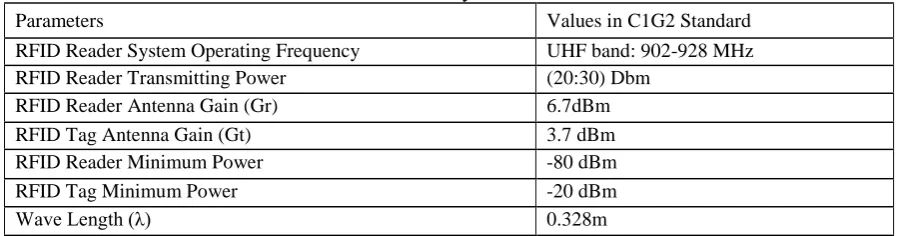
The setting of parameters in the RFID objective function optimization is very critical. The RFID system is intricate when applied in network planning. The RFID system must fulfill the objective function; otherwise it will be a huge burden to the corporation or company. The effective parameters are working in a certain sequence in the RNP network planning. This sequence expresses the correlation between the parameters that need to be balanced when the FRID system is applied. The high impact of applying a highly complex system such as the RFID system can be achieved by reliable RFID planning system. The reliable parameters are considered by the Electronic Product Code (EPC). The specific values of these parameters are shown in Table 1
Table 1: RFID System Parameters
Parameters Values in C1G2 Standard
RFID Reader System Operating Frequency UHF band: 902-928 MHz RFID Reader Transmitting Power (20:30) Dbm
RFID Reader Antenna Gain (Gr) 6.7dBm
RFID Tag Antenna Gain (Gt) 3.7 dBm
RFID Reader Minimum Power -80 dBm
RFID Tag Minimum Power -20 dBm
Wave Length (λ) 0.328m
[Elewe* 4(4): April, 2017] ISSN 2349-4506
Impact Factor: 2.785
G
lobal
J
ournal of
E
ngineering
S
cience and
R
esearch
M
anagement
(6)
Ptagi= Actual received power at each tag Preq= required threshold power
NT=Number of tags in working area
The Friis transmission equation power at each tag can be calculated by the following equation:
) 4 ( 2 / ) . . ( d Gr Gt Pt Pr (7)
where λ is wavelength (m), Pr is power input at receiving antenna, Pt is power output at transmitting antenna, d is distance between tag and reader, Gt is transmitting antenna gain, Gr is receiving antenna gain. The tags located inside the reading area will normally be detected, but collisions will occur if any other reader interferes. The problem of interference can be solved by separating the reader’s interrogation ranges and varying the radiated power of readers. Due to changing the positions of readers away from each other and variation of radiated power, the interference is formulated as:
]
max
)
1
i
(j
[
(
,
)
(
)
1
1
.
int
N
d
t
R
i
R
j
r
i
r
j
i
(8)where Nmax represents the total number of readers, “dt” represents the distance between readers, Ri represents the position of ith reader, Rj represents the position of jth reader, ri represents the interrogation range of ith reader and rj represents the interrogation range of jth reader. The set of present objective functions will be applied in the firefly algorithm to find the optimum level of network planning.
Stage3: Density-Based Algorithm
Density-Based Algorithm (DBSCAN) is a data clustering algorithm proposed by Ester in 1996. It is a method of quick logical division by grouping a set of points in a space that are closely packed together [13][7]. In this paper, the DBSCAN algorithm is used to break the tag distribution area into smaller parts in order to discretize them into several small typical density points making them a discrete problem. The aim of using this method is to classify the tags into groups to find out the primary number of required readers that are needed to cover the tags and the primary position of each reader. The idea of using this information as an input representation to the firefly algorithm is to reduce the iteration process and increase the accuracy of results, especially with the large-scale RNP problems.
DBSCAN can categorize the tags’ information positions into separate clusters that lie close to each other based on the reader propagation range by computing process three steps:
Step 1: find the Eps-neighborhood which represents the cluster region of the space of propagation range radiated from the RFID reader.
Step 2: finding Density-reachable
step 2: Evaluate the Density-reachable of the tag distribution that can be reached by propagation based on chain of points.
Step 3: Go through the selection process according to tags density.
Stage 4: Setting of Firefly Algorithm
Firefly algorithm appears to be an effective tool due to the high potential power in solving optimization problems. It also seems to be a favorable optimization tool in part due to the effect of the attractiveness function [7]. Three idealized rules are combined into the Firefly algorithm (FA) operation [7]:
i) All fireflies are unisex so that a firefly is attracted to all other fireflies )
1 i (
min
T tagi req
[Elewe* 4(4): April, 2017] ISSN 2349-4506
Impact Factor: 2.785
G
lobal
J
ournal of
E
ngineering
S
cience and
R
esearch
M
anagement
ii) There is a proportional attractiveness of firefly’s brightness. The attracted one is the brighter, and if the firefly could not detect the brighter one, it moves randomly.iii) The objective function value is proportional with the brightness of a firefly.
Light intensity and attractiveness are the main variables in firefly algorithm. Attractiveness is dependent upon the light intensity; therefore, the light intensity follows the inverse square law as the following equation [14][15]:
2 ) ( 1 r I I O r
(9)where I(r) represents the light intensity, r is distance, I0 represents the light intensity at the source and γ is considered the light absorption coefficient. The attractiveness β of a firefly is proportional to its brightness as the following equation: 2 ) ( 1 r o r
(10)where β0 represents the attractiveness at r = 0. The process of search space mainly depends on attractiveness. The distance between two fireflies can be defined using Cartesian distance:
F k k j k i j i ji x x x x
r 1 . , , ( (11) where F is the number of problem parameters.
Firefly i is attracted toward the more attractive firefly j, and the movement is defined as
) 5 . 0 ( ) ( ) ( )
( 2,
rand x x r t x t
x r j i
o i i j i
(12)where β0 is considered attractiveness at r = 0, α is randomization parameter, rand represents random number uniformly distributed between 0 and 1, ri;j is distance between fireflies i and j. The pseudo-code of firefly is available in.
APPLICATION OF MDB-FA
Three different algorithms have been combined with the aim of enhancing the exploitation and exploration of the search domain to solve the multi-objective radio frequency identification (RFID) network planning problem efficiently. The solution process is to represent each firefly as a real vector with readers. The readers’ positions are applied in the first two dimensions while the propagation range takes place the third dimension. The optimization technique is built based on changing the readers’ positions to enhance the tag coverage and the interference. The overall method can be described as a sequence of MDB-FA processes. These processes are to be applied in the sequence as shown in Figure 1.
Figure 1: MDB-FA Algorithms for RNP Network Planning Optimization
The operation will remain switched on until reaching the best position vectors that meet the best objective functions. The step-by-step operating procedure of hybrid firefly with DBSCAN algorithm based on Monte Carlo Simulation is described as follows:
[Elewe* 4(4): April, 2017] ISSN 2349-4506
Impact Factor: 2.785
G
lobal
J
ournal of
E
ngineering
S
cience and
R
esearch
M
anagement
Step2. Specify the Eps-neighborhood domain by calculating the radiated power of reader (r) from equation (3). Step3. Initialize number of readers “N” and position Ƥs of each reader by applying the DBSCAN algorithm. Step4. Transfer the DBSCAN algorithm results in FIREFLY algorithm.Step5. Evaluate the fitness of each reader based on equations (6), (7) and (8).
Step6. Update the position of all readers. Re-evaluate the fitness of each reader. The independent value of position and velocity will be specified based on the best fitness.
Step7. Repeat steps 5 and 6 until convergence or reaching a stop operation.
RESULTS AND DISCUSSION
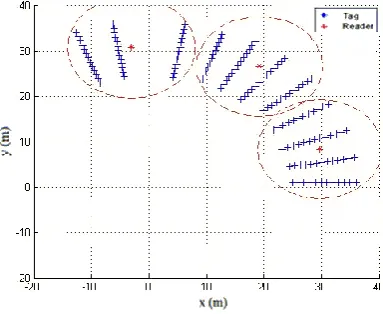
The present method (MDB-FA) results are obtained through applying FA algorithms based on Monte Carlo simulation that observe good solutions to the multi-objective optimization RNP problem. The graphical results of Monte Carlo simulation algorithm are presented in Figure 2. It can be observed that the generated tags are trapped in the store circular domain range conditions with C-Shape tags distribution.
Figure 2. MCS Result
This result of tag distribution is similar to real store books environment in the UTHM library. Each tag is identified in (x,y) position and collected as a group. The set of tags is transferred to the second algorithm (i.e. DBSCAN) which is developed to cluster the tags based on the tag density in the selected domain. The result from this process is the basic number of readers needed to cover all the tags distributed in the books domain. All the present information tested in the firefly algorithm. Figure 3 displays the firefly plot result after the present sequence of operations and can be compared with Figure 4.
[Elewe* 4(4): April, 2017] ISSN 2349-4506
Impact Factor: 2.785
G
lobal
J
ournal of
E
ngineering
S
cience and
R
esearch
M
anagement
This represents the traditional results of firefly algorithm in traditional application (i.e. without DBSCAN process).Figure 4: FA Result
All the results are arranged in Table 5 in order to specify the propagation range of each reader and also the (x,y) axis position of each reader with the amount of covered tags.
Table 2: MDB-FA Results Summary
Algorithm
Radiation
pattern Coverage Reader N interference
MDB-FA circle 100% 3 0.001
FA circle 100% 4 0.02
The results show that the MDB-FA algorithm has the ability to search and find good solutions to the RNP problem in case of C-Shape domain. Figure 3 observe a 3 readers to cover all the tags, while Figure 4 employ 4 readers which means the MDB-FA reduce the reader numbers with optimal interference.
CONCLUSION
In this paper, many of the advanced and specialized methods in the field of RNP network planning have been addressed. The methodology is developed to model and optimize the design of RFID system in a C-Shape which represents the distributed books in UTHM library. The study yielded some challenges regarding the RFID system operating efficiency such as optimal tag coverage, reader interference and the required number of readers. To solve the challenges in RNP network, the MDB-FA algorithm is developed to find the optimal number of RFID readers required and their location in the system. The present algorithm satisfied the objectives which maximize the RF coverage, minimize the overlapped area, readers requirement and the level of interference. The presented approaches mimic the internal design of the tags domain and the features of tag distribution which represents a major destination for Internet of Things (IoT).
REFERENCES
1. Suriya and J. D. Porter, "Genetic Algorithm Based Approach for RFID Network Planning," 2014. 2. Y. Tan, Y. Shi, F. Buarque, A. Gelbukh, and D. Hutchison, Advances in Swarm and Computational"
2015.
[Elewe* 4(4): April, 2017] ISSN 2349-4506
Impact Factor: 2.785
G
lobal
J
ournal of
E
ngineering
S
cience and
R
esearch
M
anagement
4. H. Feng and J. Qi, "Planning Using a New Hybrid Evolutionary Algorithm" 2013, vol. 2, no. 1, pp. 179–188,.
5. N. Irfan, "Design and Optimization of RFID Systems" 2014, PhD Thesis.
6. O. Botero and C. Hakima, "RFID network topology design based on Genetic Algorithms" 2011, PhD Thesis.
7. A. M. Elewe, K. Bin Hasnan, and A. Bin Nawawi, "Hybridized Firefly Algorithm For Multi-Objective Radio Frequency Identification ( Rfid ) Network Planning" 2017, ARPN Journal of Engineering and Applied Sciences, vol. 12, no. 3, pp. 834–840,.
8. F. M. Al-naima and R. T. Hussein, "2013 Sixth International Conference on Developments in eSystems Engineering PSO Based Indoor RFID Network Plannin" 2014, pp. 9–14
9. C. Chou, " RFID Network Design Methodology for Decision Problem in Health Care," 2014, pp. 1586– 1592,.
10. O. Botero, "Heterogeneous RFID framework design , analysis and evaluation Oscar Botero" 2012. 11. I. Masood, "Issues in Development of Artificial Neural Network-Based Control Chart Pattern
Recognition Schemes" 2010, vol. 39, no. 3, pp. 336–355.
12. K. Hasnan, A. Ahmed, Q. Bakhsh, K. Hussain, K. Latif, U. Tun, H. Onn, P. Raja, and B. Pahat, "A Novel Optimal RFID Network Planning by MC-GPSO" 2015, vol. 8, no. August.
13. D. Mining, "DBSCAN A Density-Based Spatial Clustering of Application with" 2011,Linköpings Univ. - ITN 2011-11-30, pp. 1–8.
14. N. Bacanin and M. Tuba, "Hierarchical Multiobjective RFID Network Planning Using Firefly Algorithm" 2015, pp. 282–285,.