22
An Efficient Coupled Genetic Algorithm-NLP Method for Heat
Exchanger Network Synthesis
E. Rezaei∗, S. Shafiei
Faculty of Chemical Engineering, Sahand University of Technology, Tabriz, Iran.
Abstract
Synthesis of heat exchanger networks (HENs) is inherently a mixed integer and nonlinear programming (MINLP) problem. Solving such problems leads to difficulties in the optimization of continuous and binary variables. This paper presents a new efficient and robust method in which structural parameters are optimized by genetic algorithm (G.A.) and continuous variables are handled due to a modified objective function for maximum energy recovery (MER). Node representation is used for addressing the exchangers and networks are considered as a sequence of genes. Each gene consists of nodes for generating different structures within a network. Results show that this method may find new or near optimal solutions with a less than 2% increase in Hen annual costs.
Keywords: Heat exchanger networks (HENs), Optimization, Genetic Algorithm (G.A.),
NLP formulation
∗ Corresponding author: E-mail: [email protected]
1- Introduction
There are three major methods for heat exchanger network synthesis. The first is pinch technology and is based on thermodynamic concepts that have been introduced by Linnhoff and Flower [1] and Linnhoff and Hindmarsh [2]. A good review on this technology is Shenoy’s book [3]. The second one belongs to optimization methods and the minimization of the total annual cost of networks by mathematical programming that have been proposed by Ciric and Floudas [4] and Yee and Grossmann [5]. A summary of the history of these methods has been collected by Floudas [6]. In recent years, trends in mathematical methods were
to simplify MINLP formula-tion and attain a global solution like the MILP synthesis method [7], graph theory [8] and global optimization [9]. The last one is methods that combine the above concepts proposed by Zhu and Nie [10].
In mathematical programming methods the problem is defined as an MINLP problem and is solved by deterministic, stochastic or coupling them. Deterministic methods like GBD, OA and etc failed to converge due to the mixed nature of binary and continuous variables.
Iranian Journal of Chemical Engineering, Vol. 5, No. 1 23 et al. [13], [14], and tabu search (T.S.) by Lin
and Miller [15].
Athier et al. [11], [12] have used a coupled S.A.-NLP method in which S.A. controls structural optimization and SQP optimizes continuous parameters. Anyway, S.A. cannot reach global structure and the writers had problems in the convergence of their NLP. A G.A. and S.A. coupled method has been used for the optimization of both binary and continuous variables by Yu et al. [16] to avoid trapping in local optima. As it is known, handling the constraints in the G.A. needs special aspects, and convergence in continuous parameters leads to many iterations. Therefore, due to the discrete nature of the G.A., it seems that the it is very useful and efficient for structural optimization.
In this paper, G.A. is used for structural parameters, while the fitness of each structure is specified by a modified NLP formulation that is based on maximum energy recovery (MER), which has been described by Lewin et al. [13], [14].
In the following sections the new representation of the HEN structure is mentioned and G.A. operators and NLP formulation are presented. Some case studies are then studied and the results are compared with those reported in the literature.
2- Problem definition
The problem can be defined as follows: A set of hot and cold streams with their inlet and outlet temperatures are given. Also heat capacity flow rates and heat transfer coefficients of the streams are known. Hot and cold utility are available as external sources for the cooling and heating of the process streams. The objective is to design a network with the minimum total annual cost which is determined by the summation of area and utility costs.
3- Representation of network
In the present method a HEN is treated as a chromosome and exchangers within it are
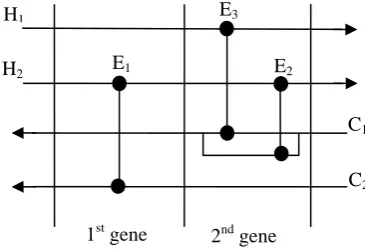
considered as a sequence of genes. Therefore each gene includes the address of an exchanger. For addressing the location of exchangers the node representation is used like Fig. 1, in which the number of splitters and their branches can be set manually in each gene. This kind of addressing is usual and has been used by some researchers like Bochenek and Jezowski [17] and Zhu and Asante [18].
Figure 1. Nodes in each gene with 2 branches in each splitter
When two nodes are selected, an exchanger is defined between those nodes. The number of genes in each network depends on the size of the problem and varies in different case studies. Consider an HEN shown in Fig. 2 with three exchangers.
Figure 2. An HEN with three exchangers
An exchanger address matrix (EAM) is proposed for showing the location of
1st gene
C1
C2
2nd gene
E1 E2
E3 H1
H2
ith gene H1
H2
C1
C2 1
24 Iranian Journal of Chemical Engineering, Vol. 5, No. 1 exchangers in the network like the following
matrix for Fig. 2. in which each row is an address of an exchanger.
⎥ ⎥ ⎥ ⎦ ⎤ ⎢ ⎢ ⎢ ⎣ ⎡ = 2 1 1 1 1 : E 2 2 1 1 2 : E 1 1 2 1 2 : E EAM 3 2 1
If splitting occurs in a gene, the nodes of the splitter are numbered from 1 to the number of branches, otherwise the number of each node will be 1. In the EAM the first column is the hot stream number, the 2nd is the node number of the hot stream. The 3rd and the 4th are similar numbers for cold streams. The 5th column represents the gene number.
This representation is specially suited for G.A. operators in order to create feasible structures which will be described in the next section.
4- G.A. operators
Three operators are used for this evolutionary algorithm, reproduction, crossover and mutation.
a) Reproduction: In each population some structures are exactly copied to the next generation due to the survival rate which is set at 40-50%. Selection of these chromosomes is determined by their relative fitness and roulette wheel. For more robustness of the algorithm elitism is added to save the best solution in each population. The number of structures in the initial population depends on the size of the problem. In small scale examples 20 chromosomes are sufficient to reach the best solution. Note that the initial population is produced randomly. It is clear that the number of iterations is proportional to the size of the initial population and chromosome length. So 40-50 iterations are employed to reach stopping criteria of the algorithm.
b) Crossover: For combining the genetic materials, single point crossover is used. Two parents are selected by roulette
wheel and a random gene number is generated to decompose the parents into four parts. These parts can combine together to produce offspring. In this article the rate of crossover is 50-60%. c) Mutation: The definition of mutation and
its rate plays an important role in the convergence of the algorithm. Because the NLP formulation is able to set the heat load of some exchangers to zero, mutation does not eliminate exchangers from the network and only changes the address of exchangers in genes. This operator removes the whole exchangers in a gene and considers new random addresses within the gene. In this way a splitter may be removed and an exchanger may be replaced or vise versa. The best mutation rate for this definition of mutation is 2-4%.
5- NLP formulation
Lewin et al. [13], [14] have used an NLP formulation for maximum energy recovery (MER) and the present formulation is based on their method. Although this approach is efficient, they have not considered a search for minimum approach temperature in the network. Thus, in this work a search was added to find the optimum ΔTmin. In this method area calculations are not considered explicitly in the formulation and a penalty term was added to reduce costs as much as possible. In fact, this term modifies the objective function and relaxes some exchangers from pinching at ΔTmin. This penalty is a very important part of the formulation. The objective function is:
Maximize X T /S.F.
.) exch of . no ( 2 1 i . exch of . no 1 i i ⎟⎟ ⎠ ⎞ ⎜⎜ ⎝ ⎛ Δ +
∑
∑
= = (1)Iranian Journal of Chemical Engineering, Vol. 5, No. 1 25 objective which is maximum energy
recovery.
Constraints of this NLP are:
a) Energy balance for each exchanger on hot and cold streams. (Nonlinear if splitting occurs)
b) Energy balance for hot and cold utilities. Heaters and coolers are included in the formulation and if they are not needed, the optimization sets their loads to zero. (Linear)
c) Mass balance for splitters. (Linear) d) Monotonic decrease or increase of
tem-peratures on streams. (Linear)
e) Hot and cold end approach temperatures must be equal or greater than ΔTmin in each exchanger including utility exchangers. (Linear)
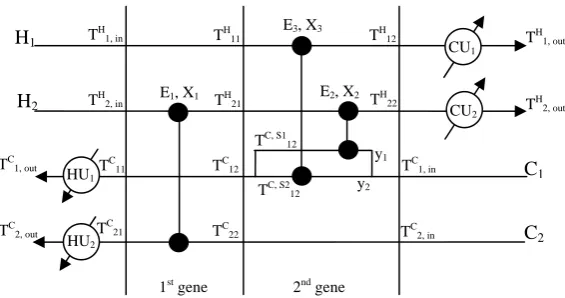
f) Energy balance at mixing points. (Linear) For example, the constraints for Fig. 3 are:
Figure 3. A network with three exchangers
a) Exchangers energy balance:
E1: TH2, in - X1/FH2 = TH21 , TC22 + X1/FC2 = TC21
E2: TH21 – X2/FH2 = TH22 , TC1, in + X2/(y1FC1) = TC, S112
E3: TH11 – X3/FH1 = TH12 , TC1, in + X3/(y2FC1) = TC, S212
b) Utilities energy balance:
H1: TH12 - CU1/FH1 = TH1, out , H2: TH22 – CU2/FH2 = TH2, out
C1: TC11 + HU1/FC1 = TC1, out , C2: TC22 + HU2/FC2 = TC2, out
c) Mass balance on splitters:
y1 + y2 = 1
CU1
CU2
HU1
HU2
H1
H2
C1
C2 TH
1, in TH11 TH12 TH1, out
TH2, in TH21 TH22 TH2, out
TC1, in
y1
y2
TC, S1
12
TC, S2
12
TC12
TC11
TC 1, out
TC
2, out T
C
21 TC22 TC2, in
E1, X1
E3, X3
E2, X2
26 Iranian Journal of Chemical Engineering, Vol. 5, No. 1 d) Monotonic decrease or increase in temperatures:
H1: TH1, in > TH11 > TH12 > TH1, out
For other streams the same relations must written.
e) Minimum approach temperatures:
E1: TH2, in – TC21 ≥ ΔTmin , TH21 – TC22 ≥ ΔTmin
The same inequalities exist for E2, E3, CU1, CU2, HU1 and HU2
f) Mixing point energy balance:
TC12 = y1TC, s112 + y2TC, s212
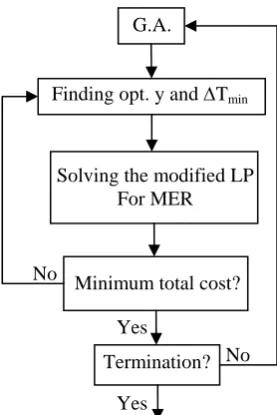
In the above equations Tij shows the temperature of ith stream that exists at jth gene, and F is heat capacity flow rate. According to the above, the overall algorithm is shown in Fig. 4.
Figure 4. The algorithm for HEN synthesis
In Fig. 4, the G.A. produces different networks in each population and then each network is optimized by finding the related minimum annual cost which is the summation of area and utility costs. In this algorithm split ratios and minimum approach
temperatures are not optimized simu-ltaneously with exchanger heat loads. Instead an inner loop is utilized to find the best y and
ΔTmin. In this loop the problem is converted to modified linear programming for finding MER. Therefore the NLP is converted to a search for y and ΔTmin and an LP for MER because the nonlinear terms in constraint (a) are eliminated by known split ratios.
Care must be taken for small split ratios because they import ill conditioning to the LP. So split ratios are bounded from 0.1 to 0.9 and a post analysis is needed for removing by-passes if they impose additional area to the network. Also the search range for
ΔTmin is set to [0.1, 30]. At last, the fitness of each network is determined due to the best cost found by the inner loop.
In summary, this work has the following differences with the Lewin et al. method [13,14]:
a) Representation of network b) Definition of mutation operator
c) Modification in LP by introducing a penalty term
d) Search for ΔTmin
e) Elimination of by-passes
These modifications help the algorithm to find better and more promising solutions and converge in relatively few iterations.
It is notable that this method is not based on pressure drop aspects and the constant heat transfer coefficients are assumed for the Finding opt. y and ΔTmin
Solving the modified LP For MER
Minimum total cost?
Termination?
Yes Yes
No No
Iranian Journal of Chemical Engineering, Vol. 5, No. 1 27 synthesis. In the rest of this paper some case
studies are presented.
6- Case studies
Four case studies are solved by MATLAB codes. The first is an example solved by Yee and Grossmann [5] and Shirvakumar and Narasimhan [8]. The second and third belong to Lin and Miller [15] and the last is example 4S1 from Shenoy [3]. For all these problems counter current heat exchangers were considered. The mutation and crossover rates are set to 3 and 60% respectively and the
number of chromosomes in each population is 20-30. To control the size of the problem only two branches are allowed in splitters.
6-1- Case 1
This case has two hot streams and two cold streams with power cost function and originally analyzed by Yee and Grossmann [5]. The data for this example are given in Table 1. Five genes are put into each chromosome for the synthesis of this network.
Table 1. Data for case 1
Streams T
in
(K) Tout (K)
FCp
(kW/K)
Cost ($/kW/yr)
H1 443 333 30
H2 423 303 15
C1 293 408 20
C2 353 413 40
Steam 450 450 80
Water 293 313 20
U=.8 kW/m2K for all exch. except ones involving steam U=1.2 kW/m2K for matches involving steam
Annualized cost ($/year) = 1000A0.6 for all exch. except heaters, A in m2 Annualized cost ($/year) = 1200A0.6 for heaters, A in m2
Chen,s approximation is used for LMTD
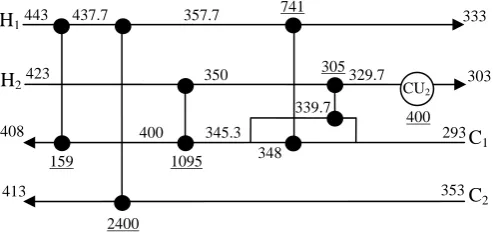
The final network has six exchangers and is shown in Fig. 5, in which the value of y1 and
ΔTmin are 0.33 and 4.7 K respectively. In this figure the underlined numbers are heat loads. The total cost of this network is 80250 $/yr,
while Yee and Grossmann [5] reported a value of 80274 $/yr and Shirvakumar and Narasimhan’s solution gives a value of 80851 $/yr [8].
Figure 5. Optimal design for case 1 H1
H2
C1
C2 CU2
443 437.7 357.7 333
423 350 329.7 303
293 339.7
348 345.3 400
408
353 413
159
2400 1095
741
305
28 Iranian Journal of Chemical Engineering, Vol. 5, No. 1 One of the advantages of the G.A. is that it
does not produce only one solution. The second best network has six exchangers and one by-pass with a total cost of 81987 $/yr. By removing this by-pass the cost decreases to 81631 $/yr.
As shown in Fig. 6 the best solution is achieved after 43 iterations. Also, the average cost of populations vs. iterations is plotted in Fig. 7.
Figure 6. Minimum Cost vs. Iteration for case 1
Iranian Journal of Chemical Engineering, Vol. 5, No. 1 29 The same solution may be achieved by the
superstructures of Yee and Grossmann [5] if the number of stages is set to more than Max {NH, NC}, which is two in this problem.
6-2- Case 2
This example has been studied by Lin and
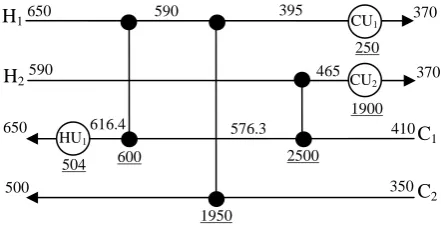
Miller [15] with the optimal solution of 154997 $/yr and six exchangers. Table 2 includes stream and cost data for this case and Fig. 8 shows the best solution found by this coupled method in which each chromosome has five genes.
Table 2. Data for case 2
Streams T
in
(K) Tout (K)
FCp
(kW/K)
Cost ($/kW/yr)
H1 650 370 10
H2 590 370 20
C1 410 650 15
C2 350 500 40
Steam 680 680 80
Water 300 320 15
U=0.5 kW/m2K for all exch. except ones involving steam U=0.833 kW/m2K for matches involving steam
Annualized cost ($/year) = 5500+150A for all exch., A in m2 Chen,s approximation is used for LMTD
Figure 8. Best Network for case 2
The genetic algorithm finds the same structure as Lin and Miller [15] with the annual cost of 156730 $/yr. As the NLP formulation do not optimize the area of exchangers simultaneously with other parameters, an increase of 1.1% occurs in
total annual cost.
6-3- Case 3
This case is solved by Lin and Miller [15] and Zamora and Grossmann [19] with the global solution of 82043 $/yr and five H1
H2
C1
C2 CU2
650 590 395 370
590 465 370
410 576.3
616.4 650
350 500
600
1950
1900 CU1
HU1
250
30 Iranian Journal of Chemical Engineering, Vol. 5, No. 1 exchangers. The problem has three hot
streams and two cold streams. Also, logarithmic mean temperature difference is replaced with an arithmetic mean and each stream has a specific heat transfer coefficient. Table 3 includes information from streams and cost data.
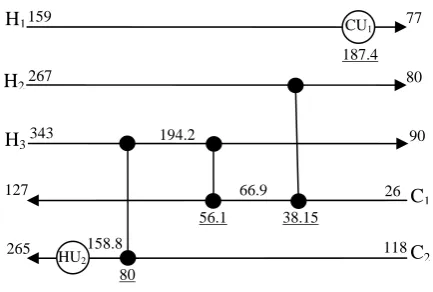
The first solution created by the G.A. has
five exchangers which are indicated in Fig. 9. The cost of this network is 82151 $/yr and an error of 0.13% occurs due to the NLP formulation. If the penalty term is not used in the objective function the cost of the best network increases about 16%, showing the important role of this term in the formulation.
Table 3. Data for case 3
Streams T
in
(K)
Tout (K)
h (kW/(m2°C))
FCp
(kW/K)
Cost ($/kW/yr)
H1 159 77 0.1 2.285
H2 267 80 0.04 0.204
H3 343 90 0.5 0.538
C1 26 127 0.01 0.933
C2 118 265 0.5 1.961
Steam 300 300 0.05 110
Water 20 60 0.2 10
Annualized cost ($/year) = 7400+80A for all exch., A in m2
Figure 9. Best network for case 3
6-4- Case 4
As the number of splitters increases in a network, difficulties arises due to some industrial aspects like the control of temperatures in mixers and piping of the network. This case is solved by Shenoy [3] and his network has six exchangers and two
splitters with an annual cost of 240030 $/yr. In this example, each gene is forced to have only one splitter to reduce the total number of splitters in the network. Table 4 shows the data of this problem.
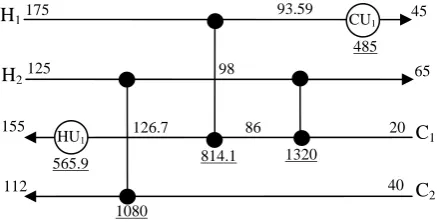
Fig. 10 indicates the best solution with 5 exchangers and no splitters. The cost of this H2
H3
C1
C2
267 80
343 90
26 66.9
127
118 265
80
56.1
CU1
HU2
187.4
38.15
H1159 77
194.2
Iranian Journal of Chemical Engineering, Vol. 5, No. 1 31 network is 241923 $/yr, which is 0.8%
greater than the solution of Shenoy [3]. The second best network achieved by this method has six exchangers and one splitter with a cost of 245140 $/yr. As can be seen from the first and second solution, the restriction in
the number of splitters in each gene does not import considerable increase in the annual cost. So it is useful to reduce the number of splitters to avoid difficulties in control or piping aspects.
Table 4. Data for case 4
Streams Tin (°C) Tout (°C) FCp (kW/°C)
Cost ($/kW/yr)
H1 175 45 10
H2 125 65 40
C1 20 155 20
C2 40 112 15
Steam 180 179 120
Water 15 25 10
U=0.1 kW/m2K for all exchangers
Cost ($) = 30000+750A0.81 for all exchangers, A in m2 Plant life time: 5 yr, Rate of interest: 10%
LMTD is used for area calculations
Figure 10. Best solution find for case 4 with restriction in no. of splitters
7- Conclusion
In this paper a new coupled G.A.-NLP formulation is presented in which new representation for HEN is considered by definition of exchangers as genes. The NLP is an optimization problem for the maximization of energy recovery with a penalty term that relaxes exchangers from pinching at ΔTmin. Although G.A. produces good solutions, there is no guarantee to find the optimum solution and it is unnecessary to formulate the NLP so restrictively. So in this work areas were not optimized
simultaneously with other parameters. This kind of formulation greatly reduces the complexity of the problem.
The case studies show that this method is very efficient and has a maximum increase of less than 2% in HEN annual cost. One of the advantages of this method is that it does not require an initial guess for structural and continuous variables because of the use of the G.A. and the simplex method for the optimization of continuous parameters. Many solvers have problems in the convergence of binary and continuous variables, and their H1
H2
C1
C2
175 93.59 45
125 65
20 86
126.7 155
40 112
1080
CU1
HU1
485
32 Iranian Journal of Chemical Engineering, Vol. 5, No. 1 robustness weakens when the size of
networks increases. But this work is not sensible to the size of problems and is very robust because the usual NLP is replaced with an LP which is easier to optimize. So this method can be extended to industrial problems in future works.
Nomenclature
Ci ith cold stream, i=1…,nC
CUi heat load of ith cold utility exchanger, i=1…,nH
Ei ith exchanger
F heat capacity flow rate Hi ith hot stream, i=1…,nH
HUi heat load of ith hot utility exchanger, i=1…,nC
LMTD logarithmic mean temperature dif-ference
NC number of cold streams NH number hot streams
Tij temperature of ith stream that exits at jth gene
U overall heat transfer coefficient Xi heat load of ith exchanger
y split ratio
ΔT approach temperature in hot or cold end of an exchanger
ΔTmin minimum approach temperature in a network
Indices
C cold H hot in inlet out outlet
si ith branch of a splitter
References
1. Linnhoff, B. and Flower, J. R., “Synthesis of heat exchangers networks, systematic generation of energy optimal networks,” AIChE J., 24, 633-642 (1978).
2. Linnhoff, B. and Hindmarsh, E., “The pinch design method for heat exchangers networks,” Chemical and Engineering Science, 38, 745-763 (1983).
3. Shenoy, U. V., Heat exchanger network synthesis: the pinch technology based approach, Gulf publishing Co, Houston (1995).
4. Ciric, A. R. and Floudas, C. A., “Heat exchanger network synthesis without decomposition. Computers and Chemical Engineering,” 15, 385-396 (1991).
5. Yee, T. F. and Grossmann, I. E., “Simultaneous optimization models for heat integration – Heat exchanger network synthesis,” Computers and Chemical Engineering, 14, 1165-1184 (1990).
6. Floudas, C. A., Nonlinear and mixed integer optimization, Oxford University Press, New York (1995).
7. Barbaro, A., and Begajewicz, M. J., “New rigorous one-step MILP formulation for heat exchanger network synthesis,” Computers and Chemical Engineering, 29, 1945-1976 (2005).
8. Shirvakumar, K. and Narasimhan, S., “A robust and efficient NLP formulation using graph theoretic principles for synthesis of heat exchanger networks,” Computers and Chemical Engineering, 26, 1517-1532 (2002).
9. Bjork, K. M. and Westerland, T., “Global optimization of heat exchanger network synthesis problems with and without the isothermal mixing assumption,” Computers and Chemical Engineering, 26, 1581-1593 (2002).
10. Zhu, X. X. and Nie, X. R., “Pressure drop consideration for heat exchanger network grassroots design,” Computers and Chemical Engineering, 26, 1661-1676 (2002).
11. Athier, G., Floquet, P., Pibouleau, L. and Domenech, S., “Optimization of heat exchanger networks by coupled simulated annealing and NLP procedures,” Computers and Chemical engineering, 20, 13-18 (1996). 12. Athier, G., Floquet, P., Pibouleau, L. and
Iranian Journal of Chemical Engineering, Vol. 5, No. 1 33 13. Lewin, D. R., Wang, H. and Shalev, O., “A
generalized method for HEN synthesis using stochastic optimization–I. General frame-work and MER optimal synthesis,” Computers and Chemical Engineering, 22, 1503-1513 (1998).
14. Lewin, D. R., “A generalized method for HEN synthesis using stochastic optimization – II. The synthesis of cost-optimal networks,” Computers and Chemical Engineering, 22, 1387-1405 (1998).
15. Lin, B. and Miller, D. C., “Solving heat exchanger network synthesis problems with tabu search,” Computers and Chemical Engineering, 28, 1451-1464 (2003).
16. Yu, H., Fang, H., Yao, P. and Yuan, Y., “A combined genetic algorithm/simulated annealing for large system energy integration,” Computers and Chemical Engineering, 24, 2023-2035 (2000).
17. Bochenek, R. and Jezowski, J. M., “Genetic algorithms approach for retrofitting heat exchanger network with standard heat exchangers,” 16th European Symposium on Computer aided Process Engineering and 9th International Symposium on Process Systems Engineering. 871-876 (2006).
18. Zhu, X. X. and Asante, N. D., “Diagnosis and optimization approach for heat exchanger network retrofit.,” AIChE J., 45, 1488-1503 (1999).