VOLUME 39, ARTICLE 39, PAGES 1039
,
1064
PUBLISHED 13 NOVEMBER 2018
https://www.demographic-research.org/Volumes/Vol39/39/ DOI: 10.4054/DemRes.2018.39.39
Research Article
Housework division and gender ideology:
When do attitudes really matter?
Renzo Carriero
Lorenzo Todesco
© 2018 Renzo Carriero & Lorenzo Todesco.
This open-access work is published under the terms of the Creative Commons Attribution 3.0 Germany (CC BY 3.0 DE), which permits use, reproduction, and distribution in any medium, provided the original author(s) and source are given credit.
1 Introduction 1040
2 Theoretical background 1041
3 Aims of the study and research hypotheses 1044
4 Data and variables 1046
5 Results 1050
6 Discussion and conclusions 1055
7 Acknowledgements 1057
Housework division and gender ideology:
When do attitudes really matter?
Renzo Carriero1
Lorenzo Todesco2
Abstract
BACKGROUND
Attitudes toward gender roles are one of the factors that have received most attention in the literature on housework division. Nevertheless, egalitarian attitudes often do not match egalitarian domestic behaviors.
OBJECTIVE
The paper’s central hypothesis is that women’s ability to assert their egalitarian beliefs is linked to having sufficient personal resources in economic and cultural terms.
METHODS
We use the 2013–2014 Italian time-use survey (N = 7,707 couples) and analyze how relative resources and women’s education moderate the relationship between gender ideology and housework division.
RESULTS
Consistent with our hypothesis, for a woman, the effect of gender ideology is strongest when she earns roughly as much or more than her partner and when she holds a college degree. When the woman’s income is lower than the man’s, the effect of women’s gender ideology is quite small. If the woman does not have a degree, her egalitarian attitudes will not translate into her doing less housework.
CONCLUSIONS
Gender ideology matters, but a solid bargaining position is needed in order to put it into practice. Social policies promoting gender equality in education and the labor market can increase women’s capacity for translating egalitarian attitudes into actual behavior.
CONTRIBUTION
This paper’s original contribution is in analyzing whether and how relative resources and education influence the effect of gender ideology on the division of housework.
Moreover, our analysis goes beyond most existing studies in its rare combination of behavior measures collected through a reliable time-use diary procedure and information regarding partners’ gender ideology.
1. Introduction
The relationship between gender attitudes and housework division has been extensively investigated in recent decades. However, impressive as this research effort has been, further scrutiny is needed: The literature shows that these attitudes do not always have the expected effect on behavior. Moreover, a long-standing strand of research – to which this paper contributes – has demonstrated that attitudes (as well as values and preferences) do not necessarily translate into actual practice, both because of the actors’ characteristics and because of structural constraints (Ajzen and Fishbein 2005; Bühlmann, Elcheroth, and Tettamanti 2010; Gash 2008; Schober and Scott 2012). This also holds for the division of household labor. We believe that a plausible micro-level explanation for the discrepancy between attitudes and behavior is that social actors and the couple have certain characteristics that help or hinder the translation of gender ideologies into domestic practice. In particular, we consider the role of relative income and women’s educational attainment. The former is an indicator of the power dynamics in the household, while the latter is associated with how deeply egalitarian gender attitudes are internalized – though it also has a clear link with human capital. This paper’s original contribution is in analyzing whether and how these characteristics – which have attracted considerable attention in the housework literature – influence the effect of gender ideology on the division of household labor. From the empirical standpoint, our analysis goes beyond most existing studies in its rare combination of behavior measures collected through a reliable time-use diary procedure together with information regarding partners’ gender ideology.
2. Theoretical background
Research on the micro-level dynamics that affect the division of housework has a long history to its credit, producing an enormous number of studies since the 1990s (Coltrane 2000), sometimes even in non-Western countries (Tsuya et al. 2012).3 The
theoretical perspectives that have been applied so far draw on both the rational choice model and on symbolic interactionism, but have proven only partially effective in illuminating what really counts in this negotiation between the partners in a couple. One widely tested rational-choice-based theory, the relative resources framework, sees housework as a set of monotonous and unrewarding tasks that individuals would rather avoid. Accordingly, one partner will use the power resulting from the economic resources at their command to shift a share of the housework load on to the other partner (Blood and Wolfe 1960; Brines 1993; McDonald 1977).4 Thus, the partner who
earns more will only allow the other to access his or her earnings in exchange for doing the chores. The economically weaker partner has no choice but to accept and make the best of a bad or baddish deal, unless he or she is willing to break off the relationship.5
The empirical underpinnings of relative resources theory, however, can be somewhat shaky. While it is true that a partner’s share of domestic labor drops as his or her relative earnings increase (Procher, Ritter, and Vance 2017; Sullivan and Gershuny 2016), no study has ever been able to show that women who out-earn their partners do less of the housework, as this gender-neutral theory would lead us to expect.
Another perspective that attempts to explain housework division is the gender roles theory (or gender ideology theory; see, for example, Lachance-Grzela and Bouchard 2010). This theory, which is rooted in symbolic interactionalism, is traditionally counterposed to relative resources theory, and in fact the distance between the two is considerable: Gender role theory has no room for exchange and rational
3 There is also a flourishing stream of research dealing with the effects of the institutional and cultural context
on housework division (among recent studies see, e.g., Bianchi et al. 2014; Fahlén 2016).
4 A vast literature in economics also deals with the gender division of household tasks, in some cases with an
approach not so far from the sociological one based on relative resources. According to the economic model known as the “collective choice model” (see, for an introduction, Browning, Chiappori, and Weiss 2014), partners’ bargaining power determines the division of tasks, and the factors affecting bargaining power are called “distribution factors.” The collective choice model assumes that partners efficiently cooperate within the household even if they have different preferences.
5Another rational choice approach that is widely used to investigate housework division is time availability
choice models, as it refers to cultural and symbolic aspects of gender (Berk 1985; Butler 1990; Ferree 1990; Jackson and Scott 2002; West and Zimmerman 1987). Great importance is thus assigned to gender ideology, or in other words the support individuals show for a model of the division of paid work, housework, and care work based on the metaphor of separate spheres for men and women (Kerber 1988). Women who have a traditional gender ideology do a larger share of the housework than those with egalitarian attitudes, as they believe such tasks to be part of their female identity. By contrast, egalitarian women do less housework than the traditionalists: from their point of view, household chores should be equally divided between the sexes. The same holds true for men, though naturally with the opposite effects: Traditionalists do less in the home, egalitarians more.
Several studies have found consistent empirical support for this theory (see, among the most recent, Aassve, Fuochi, and Mencarini 2014; Grunow and Baur 2014). Nevertheless, on its own it throws insufficient light on the micro-dynamics of housework division. In fact, according to Artis and Pavalko (2003), the conclusions reached by the literature in this area are anything but uniform and definitive. In some studies the results are not in line with expectations, as the relationships found between gender attitudes and housework fall shy of statistical significance: among women (Chesters 2012; Cunningham 2005; Parkman 2004), among men (Bianchi et al. 2000), or among both sexes (Erickson 2005). In one case (Treas and Tai 2016), findings are entirely at odds with the theoretical assumptions, with men who have egalitarian attitudes toward gender roles doing less housework than traditionalists. One comparative study (Crompton, Brockmann, and Lyonette 2005) finds that the relationship between gender role attitudes and the domestic division of labor is as expected in some countries but not in others. Lastly, it should be emphasized that the studies conducted to date generally do not explicitly indicate the difference between egalitarian and traditional individuals in the time spent doing housework and in the share of housework. This makes it difficult to understand how much gender ideology actually counts in apportioning domestic work.
behaviors is strong if empirical measures of both comply with a principle of compatibility, or in other words if behavior is assessed using a range of measures situated at the same level of generality as the attitudes. This is not usually the case in large-scale surveys: In the area of interest to us here, the content of the questions used to tap attitudes is very general (spanning, for example, the role of women and men in the home, in the job market, and in politics), while the items regarding behavior are very specific, centering on the distribution between partners of domestic tasks or care work. An analysis of secondary data such as that presented here offers little or no scope for obviating this problem. However, it is important that it is borne in mind in order to understand why gender attitudes have often failed to explain domestic behaviors (on this point see, e.g., Poortman and Van Der Lippe 2009). The problem of the compatibility of attitudes and behaviors is also aggravated by the difficulty of assessing the former empirically (Davis and Greenstein 2009). Regarding the topic addressed here, several scholars have raised objections concerning the unidimensionality of gender role attitudes (Braun 2008; Constantin and Voicu 2015; Knight and Brinton 2017; Lomazzi 2017) as measured in various international surveys (EVS/WVS, ISSP). The lack of unidimensionality compounds the compatibility problem.6
The second set of reasons for the poor empirical support afforded to gender role theory arises from the fact that, generally speaking, the influence of attitudes on behaviors varies according to the characteristics of the actors and of the social context in which they interact. For example, and without claiming to be exhaustive, the individual characteristics that are necessary for the behavior to take place include motivation, cognitive capacity, vested interests, and involvement with the specific attitude object (Ajzen and Fishbein 2005). Regarding the contextual characteristics, several studies of the discrepancies and incoherencies between couples’ egalitarian gender values and practices have shown that societal gender norms and current social policies can have a significant influence on whether egalitarian ideals can be put into practice in the division of paid and unpaid work (Bühlmann, Elcheroth, and Tettamanti 2010; Gash 2008; Jacobs and Gerson 2016; Schober and Scott 2012). When interpreting these findings and applying them to the case of housework division in the micro perspective adopted here, it is first necessary to consider gender attitudes in the light of the power relations within the couple. While relative resources theory ignores individuals’ actual preferences regarding housework (Carriero and Todesco 2016; Poortman and Van Der Lippe 2009) and assumes that everyone finds it distasteful, gender role theory does not give due consideration to the bargaining power that partners in a couple can use to get their own way. This limitation could be one of the reasons for the modest effects found by much research to date: An egalitarian woman might not be
6 From the empirical standpoint, the small number of items generally used in large-scale surveys (not more
able to gain leverage for her vision of gender roles if – as is true in many cases – the bargaining power she enjoys due to her economic resources is less than that of her partner. The explanatory power of gender attitudes would thus be greater if the actor’s material conditions in terms of earnings are such that his or her desires prevail. If not, the explanatory power will be lower, or even nonexistent.
Another factor to be considered is the actors’ level of education, not only in the sense of their human capital – which also touches on the aspects of income and bargaining power we have just discussed – but also as an indicator of the moral and intellectual properties that formal education helps develop. In particular, many studies (Bobo and Licari 1989; Converse 1964; Desjardins and Schuller 2006; Kane 1995; Kerckhoff, Raudenbush, and Glennie 2001; Lipset 1960; Ohlander, Batalova, and Treas 2005) have stressed education’s role in moral enlightenment, i.e., in developing qualities such as tolerance, civic virtue, social engagement, and egalitarian ideals, as well as mental and intellectual properties such as cognitive sophistication, mental flexibility, and having coherent belief systems. Accordingly, higher educational attainment can be expected to lead to gender attitudes that are not only more egalitarian but also more strongly and consciously internalized, especially by women. For them, then, the question of housework – given its unbalanced division between the sexes – hits closer to home, literally. The literature shows that the strength of attitudes, difficult to measure as it may be, is a major factor in determining attitude–behavior consistency (Petty and Krosnick 1995): An individual who expresses a strongly held attitude will more readily adopt a consequent behavior than someone expressing an attitude that is less strongly held. For women, then, high educational attainment can be regarded as a crucial individual characteristic that, over and above the economic resources associated with it, tightens the link between attitudes and housework division. The moderating effect of women’s relative income and education level on the relationship between gender role attitudes and domestic behavior is addressed by the empirical analysis presented in the following pages.
3. Aims of the study and research hypotheses
characteristics that help translate attitudes into behavior. The only available studies focus on the role played by the respondent’s sex (Chesters 2011; Fuwa 2004; Knudsen and Wærness 2008) and union type (marriage vs. cohabitation, Davis, Greenstein, and Gerteisen Marks 2007), and the partner’s gender attitudes (Bianchi et al. 2000; Greenstein 1996). Indirect support for the plausibility of our research hypotheses is provided by the study of data from 28 nations conducted by Davis and colleagues (2007), who find that gender ideology has a stronger association with the division of household labor in cohabiting households than in married-couple households. These scholars explain their findings with an argument similar to that presented above: The characteristics of the partners and of the relationship context in which they interact can make egalitarian gender ideologies more or less likely to translate into an egalitarian division of housework. As marriage is a more traditional relationship context than cohabitation, to some extent it reduces the effects of the partners’ beliefs about who should do the housework.
In addition to observing the role of gender attitudes from a fresh vantage point, the present study also provides a better understanding of the weight of relative income when couples bargain over who will do the chores. As we have seen, the direct influence of money on this allocation matters only so much. However, the possibility that it can act indirectly by creating the conditions under which a partner’s views can prevail has never been tested.
This study is based on data collected in Italy, and it is important to emphasize that it is the first Italian investigation to conduct close, national-level scrutiny of the effect of gender ideology on the division of household labor. The few previous studies that have addressed this topic (see, e.g., Carriero and Todesco 2016; Todesco 2015) are chiefly based on local data: In fact, until recently the representative national data needed for this kind of analysis was not available.7 Italy’s institutions and culture are
highly conservative as regards gender roles and gender equity (European Institute for Gender Equality 2015). According to a number of comparative studies (Fuwa 2004; Knudsen and Wærness 2008; Stier and Lewin-Epstein 2007), in such contexts individual characteristics – including gender ideology – have a more limited effect on housework division than in less traditional countries. Thus, the analysis presented here provides a conservative empirical test: If the results are in line with expectations we can assume that these findings will apply to an even greater extent in countries that are more egalitarian than Italy.
The hypotheses tested in this study concern the role of relative resources and women’s educational attainment in determining how closely the couple’s division of housework will match the woman’s gender ideology:
7 The role of gender ideology has been also studied in relation to perception of housework fairness (e.g.,
Hypothesis 1: As the woman’s relative resources increase, the effect of her gender ideology will be stronger. In particular, we hypothesize that there will be little or no effect when the woman earns less than the man. By contrast, when the woman earns roughly as much as or more than the man, we expect that the effect of her gender ideology will be significantly stronger.
Hypothesis 2: As the woman’s educational attainment increases, the effect of her gender ideology will be stronger. In particular, we expect to find little or no effect when the woman has a medium–low level of education. If the woman has a high level of education attainment her egalitarian attitude will have a stronger effect.
4. Data and variables
The data analyzed in this study comes from the latest time-use survey by the Italian National Institute of Statistics (ISTAT), conducted in 2013–2014. In this type of survey the respondents (a sample of individuals and households representative of the Italian population aged three and over) fill in a diary recording their activities on a given day assigned to them at random. Days are allocated to the sample in all the weeks of the year in order to be representative of weekdays (Monday through Friday), Saturdays, and Sundays. A weighting procedure is used for weekend days (which are over-represented), so that time-use estimates refer to a typical day.
Thanks to the survey design, which involves collecting diaries from all family members, it was possible to produce reliable estimates of the time devoted to housework and how it is divided between the couple. It is thus not necessary to rely – as most of the literature has done – on reconstructions or stylized estimates based on respondents’ statements about their own engagement in domestic labor or their partner’s engagement, which ‒ it goes without saying ‒ are subject to a significant margin of error (Kan 2008).
not consider gardening, home maintenance and repairs, shopping of all kinds, paying bills, and all activities involved in caring for children or other family members.8
The independent variable of greatest interest is the woman’s gender attitude. This variable is made to interact with relative income and the woman’s level of education in order to determine whether these variables moderate the relationship between gender attitude and housework division.9 The 2013–2014 ISTAT time-use survey presented
respondents with a battery of items that tap into their gender role attitudes. Unlike other surveys which present statements about the private sphere (e.g., the family) and the public sphere (jobs, politics), the ISTAT items concentrate almost entirely on the former, dealing chiefly with domestic matters. In theory at least the survey should thus be more homogeneous and compatible with the dependent variable, which refers to a behavior enacted in the private sphere. The survey includes the following six items (the percentage of respondents who state that they agree or strongly agree is indicated in brackets):
1. It is better for the family if the man is the principal breadwinner and the woman has primary responsibility for the home (50.2%);
2. If both spouses/partners work full time, they should share equally in the housework (doing the laundry, ironing, cleaning the house, cooking, etc.) (71.5%);
3. If both parents work and the child is ill, the parents should take turns staying home to care for him or her (78.2%);
4. Men are as good at doing housework as women (43.6%);
5. Fathers are as good at taking care of little children as mothers (e.g., at cooking for them, bathing them, changing diapers, etc.) (56.4%);
6. It is important that the house always be clean and neat (91.7%).
As a look at the content validity of these items shows, two of them (4 and 5) express what Boudon (1995) calls “positive beliefs,” whereas the others express “normative beliefs.” Furthermore, the sixth item, in addition to having little
8 Focusing on core housework allows us to investigate the very essence of the issue: Why are these activities
so gendered? We also run our models using the female share of total housework (excluding childcare, as it pertains only to couples with children): As expected, results are still significant and comparable with those presented here, although the effects are slightly attenuated (table not shown, available on demand).
9 As regards causal order, we can be fairly confident that in most cases gender ideology follows from
discriminatory power (over 90% of respondents agreed), would seem to lie on a plane that is remote from gender ideology, as it expresses a preference for a high standard of cleanliness and order. The scale’s reliability was assessed by calculating Cronbach’s alpha, finding that items 2–5 show good internal consistency, while the first and sixth items clearly do not.10 Cronbach’s alpha as calculated for the scale with items 2–5 was
fairly good (0.70) – particularly considering the small number of items – but was lower (0.61) when all items were included. Given the tone of the statements, we can consider the resulting scale to be an indicator of gender role egalitarianism in the household. Operationally, we calculated the average of the scores between 1 (strongly agree) and 4 (strongly disagree) assigned to each item. The single items were recoded in order to obtain a scale where higher values correspond to egalitarian beliefs.
Relative income was captured by a question about which of the partners contributes most to household income (the man, the woman, or both equally). Though this question is apparently factual, the woman’s answer differed from the man’s for a far from negligible proportion of couples (around 15%). As this variable is crucial to our analysis, we did not take one of the two contrasting answers to be true. Rather, we considered only those couples whose responses were mutually consistent, and assigned those that were contradictory to a residual category as not determined. The other control variables were the woman’s age group,11 a dummy for whether the man is older than the
woman, a dummy for union status (married/not married), both partners’ level of education, both partners’ social class12 and employment status, the number of children,
the age of the youngest child, the number of other adults in the household, and the geographical area of residence.13 The sample size was 7,707 couples with valid values
for all variables, and the population weight provided by ISTAT was applied to the data. Descriptive statistics for the variables used in the analysis are shown in Tables 1 and 2.
10 This is also confirmed by exploratory factor analysis (results available on request).
11 Age refers only to women, as the public time-use data file only indicates broad age groups. Consequently,
also considering the partner’s age could entail serious collinearity problems.
12 Social class is defined using information on current or last occupation. Class is coded according to a
modified (aggregated) version of the Cobalti-Schizzerotto scheme (Cobalti and Schizzerotto 1994), which is very similar to the Erikson-Goldthorpe-Portocarero scheme (Erikson and Goldthorpe 1992). The service class includes large employers, professionals, and managers. The middle class includes all non-manual employees and teachers. The self-employed are small employers, shop owners, and own account workers. Manual workers are blue-collar employees.
13 Following other scholars (Jenkins and O’Leary 1995), we do not include paid work time among the
Table 1: Descriptive statistics for the variables used in the analysis (N = 7,707)
Variable Mean or % Std. Dev. Min Max
Woman’s share of core housework (%) 84.60 22.10 0 100
Woman’s egalitarian attitude (scale) 2.77 0.61 1 4
Man’s egalitarian attitude (scale) 2.74 0.63 1 4
Partners’ relative income (ref: man higher) 6.30%
Woman higher 19.24%
About equal 61.35%
Not determined 13.11%
Woman’s education (ref: less than secondary) 43.45%
Secondary education 40.25%
Tertiary education 16.31%
Man’s education (ref: less than secondary) 48.65%
Secondary education 37.93%
Tertiary education 13.42%
Woman’s age (ref: <35) 15.99%
35–44 29.26%
45–54 29.91%
55–64 24.84%
Man’s age (ref: same age or woman older) 61.05%
Older than woman 38.95%
Union status (ref: married) 90.82%
Unmarried 9.18%
Woman’s employment status (ref.: employed) 46.16%
Looking for job 6.16%
Housewife 39.62%
Other not in employment 8.06%
Man’s employment status (ref: employed) 72.42%
Looking for job 5.26%
Other not in employment 22.32%
Woman’s social class (ref.: service class) 7.52%
Middle-class 32.50%
Self-employed 7.65%
Manual workers 30.33%
Never worked 22.00%
Man’s social class (ref.: service class) 20.19%
Middle-class 23.01%
Self-employed 14.87%
Manual workers 41.25%
Never worked 0.68%
Number of children 1.28 0.95 0 5
Number of other adults 1.34 0.97 0 5
Age of youngest child (ref: no children) 23.88%
0–5 years 22.26%
6–10 years 12.84%
11–14 years 9.00%
15–24 years 21.19%
25+ years 10.83%
Region (ref: North) 46.88%
Centre 18.41%
Table 2: Woman’s gender attitudes by relative resources and education
Woman’s gender ideology (egalitarianism scale)
Mean SD N
Relative resources
Woman higher 2.94 0.60 536
About equal 2.86 0.59 1675
Man higher 2.73 0.61 4498
Not determined 2.76 0.61 998
Woman’s education
Less than secondary 2.65 0.59 3252
Secondary education 2.81 0.59 3183
Tertiary education 3.01 0.61 1272
5. Results
Before turning to the details of the multivariate analysis models we first present some descriptive data. Among the couples considered in the analysis the average share of core housework by the woman was 84.6% (see Table 1). When the sample is divided on the basis of the key variables (woman’s gender attitudes, education, and relative resources), certain non-negligible variations between the subgroups can be seen (Table 3). When the woman has traditional attitudes (low values on the egalitarianism scale) her share of core housework rises to 88.7%, while it drops to 79.2% when she has clearly egalitarian attitudes; by contrast, it is in line with the overall average if she has mildly egalitarian attitudes.14 The woman’s share of core housework also drops below
80% in couples where the woman has a college degree (76.0%), but rises up to 88.5% when she has less than secondary education. However, the largest differences in housework division are associated with differences between the partners in terms of income. If the woman is the highest earner she does 69.3% of the housework, if her income is roughly equal to her partner’s her share of the housework rises to 80.7%, and when the man is the main breadwinner it reaches nearly 90%.15
14 Woman’s gender attitude subgroups were obtained by dividing the scale variable in tertiles.
15 For the sake of completeness, the table also shows the share of core housework for couples that provided
Table 3: Woman’s share of core housework (%) by woman’s gender attitudes, woman’s education, and relative resources: Couples where the woman is under 65 years of age
Woman’s share of core housework
Mean Std. dev. N
Gender attitudes
(egalitarianism scale) Low 88.65 19.01 2,933
Medium 84.12 22.69 2,666
High 79.23 24.29 2,108
Education Less than secondary 88.49 19.30 3,252
Secondary 83.90 22.26 3,183
Tertiary 75.97 25.79 1,272
Relative income Man higher 88.63 17.99 4498
About equal 80.74 22.53 1675
Woman higher 69.26 29.07 536
Not determined 78.76 28.59 998
Total 84.60 22.10 7,707
Source: Our calculations from ISTAT time-use data for 2013–2014.
These initial data indicate that gender ideology probably has an influence of some kind on the division of household labor, but it is not the only factor that matters. In any case, to assess its impact depending on relative income and education while minimizing the risk of finding spurious relationships it is necessary to employ multivariate analysis models.
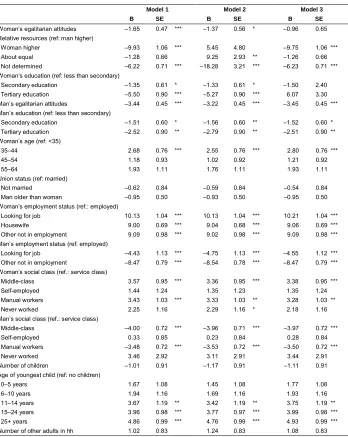
The first model we present estimates the effect of the women’s gender ideology net of the control variables, relative income, and the woman’s education (Table 4, model 1). The findings are in line with expectations: For each one-point increase on the scale of gender egalitarianism we note a significant drop of 1.65 percentage points in the woman’s share of housework. Since the scale goes from 1 to 4, moving from the most traditional to the most egalitarian attitude decreases the female housework burden by almost 5 percentage points (–1.65 * 3 = –4.95)
Table 4: Effects of gender ideology on the woman’s share of core housework. Results from OLS regression models (N = 7,707)
Model 1 Model 2 Model 3
B SE B SE B SE
Woman’s egalitarian attitudes –1.65 0.47 *** –1.37 0.56 * –0.96 0.65 Relative resources (ref: man higher)
Woman higher –9.93 1.06 *** 5.45 4.80 –9.75 1.06 ***
About equal –1.28 0.66 9.25 2.93 ** –1.26 0.66
Not determined –6.22 0.71 *** –18.28 3.21 *** –6.23 0.71 ***
Woman’s education (ref: less than secondary)
Secondary education –1.35 0.61 * –1.33 0.61 * –1.50 2.40
Tertiary education –5.50 0.90 *** –5.27 0.90 *** 6.07 3.30
Man’s egalitarian attitudes –3.44 0.45 *** –3.22 0.45 *** –3.45 0.45 *** Man’s education (ref: less than secondary)
Secondary education –1.51 0.60 * –1.56 0.60 ** –1.52 0.60 *
Tertiary education –2.52 0.90 ** –2.79 0.90 ** –2.51 0.90 **
Woman’s age (ref: <35)
35–44 2.68 0.76 *** 2.55 0.76 *** 2.80 0.76 ***
45–54 1.18 0.93 1.02 0.92 1.21 0.92
55–64 1.93 1.11 1.76 1.11 1.93 1.11
Union status (ref: married)
Not married –0.62 0.84 –0.59 0.84 –0.54 0.84
Man older than woman –0.95 0.50 –0.93 0.50 –0.95 0.50
Woman’s employment status (ref.: employed)
Looking for job 10.13 1.04 *** 10.13 1.04 *** 10.21 1.04 ***
Housewife 9.00 0.69 *** 9.04 0.68 *** 9.06 0.69 ***
Other not in employment 9.09 0.98 *** 9.02 0.98 *** 9.09 0.98 *** Man’s employment status (ref: employed)
Looking for job –4.43 1.13 *** –4.75 1.13 *** –4.55 1.12 ***
Other not in employment –8.47 0.79 *** –8.54 0.78 *** –8.47 0.79 *** Woman’s social class (ref.: service class)
Middle-class 3.57 0.95 *** 3.36 0.95 *** 3.38 0.95 ***
Self-employed 1.44 1.24 1.35 1.23 1.35 1.24
Manual workers 3.43 1.03 *** 3.33 1.03 ** 3.28 1.03 **
Never worked 2.25 1.16 2.29 1.16 * 2.18 1.16
Man’s social class (ref.: service class)
Middle-class –4.00 0.72 *** –3.96 0.71 *** –3.97 0.72 ***
Self-employed 0.33 0.85 0.23 0.84 0.28 0.84
Manual workers –3.48 0.72 *** –3.53 0.72 *** –3.50 0.72 ***
Never worked 3.46 2.92 3.11 2.91 3.44 2.91
Number of children –1.01 0.91 –1.17 0.91 –1.11 0.91
Age of youngest child (ref: no children)
0–5 years 1.67 1.08 1.45 1.08 1.77 1.08
6–10 years 1.94 1.16 1.69 1.16 1.93 1.16
11–14 years 3.67 1.19 ** 3.42 1.19 ** 3.75 1.19 **
15–24 years 3.96 0.98 *** 3.77 0.97 *** 3.99 0.98 ***
25+ years 4.86 0.99 *** 4.76 0.99 *** 4.93 0.99 ***
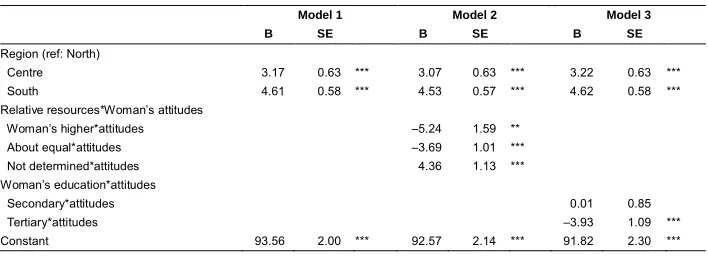
Table 4: (Continued)
Model 1 Model 2 Model 3
B SE B SE B SE
Region (ref: North)
Centre 3.17 0.63 *** 3.07 0.63 *** 3.22 0.63 ***
South 4.61 0.58 *** 4.53 0.57 *** 4.62 0.58 ***
Relative resources*Woman’s attitudes
Woman’s higher*attitudes –5.24 1.59 **
About equal*attitudes –3.69 1.01 ***
Not determined*attitudes 4.36 1.13 ***
Woman’s education*attitudes
Secondary*attitudes 0.01 0.85
Tertiary*attitudes –3.93 1.09 ***
Constant 93.56 2.00 *** 92.57 2.14 *** 91.82 2.30 ***
Note: *: p<0.05; **: p<0.01; ***: p<0.001.
Source: Our calculations from ISTAT time-use data for 2013–2014.
For a better grasp of the size and sign of the main coefficients and of the interaction of the woman’s gender attitudes, the estimated effects were also shown in a graph (Figure 1). The findings fully support our hypothesis. When the man is the main breadwinner of the couple, for each one-point increase on the scale of gender egalitarianism we note a significant decrease of 1.37 percentage points in the woman’s share of housework. When both partners contribute equally to the household income the effect is significantly stronger: A drop was found of –1.37 + –3.69 = –5.06 percentage points, and of –1.37 + –5.24 = –6.61 percentage points when the woman earns more than the man (the difference between the former and the latter is not statistically significant, result not shown). Therefore, in a couple where the woman is the main breadwinner, moving from the most traditional to the most egalitarian attitude decreases the female housework burden by almost twenty percentage points (6.61*3= 19.83).
Figure 1: Estimated effects of woman’s gender attitudes on the basis of relative income (from model 2, Table 4)
Figure 2: Estimated effects of woman’s gender attitudes on the basis of education (from model 3, Table 4)
60 7 0 8 0 90 1 00 W o m an 's sh ar e o fc o re h ou se w o rk
1 2 3 4
Woman's gender attitudes (egalitarianism scale)
Woman higher About equal Man higher
Predictive Margins with 95% CIs
7 0 7 5 80 8 5 9 0 9 5 W o m a n 's sh ar e of co re ho us ew or k
1 2 3 4
Woman's gender attitudes (egalitarianism scale) Less than secondary Secondary Tertiary
The gender ideology of women with less than secondary education does not affect the housework division at all. The same result is found for secondary-educated women (the interaction term between secondary education and gender ideology amounts to zero and is not statistically significant). In the case of women with a college degree the effect is significant and in line with expectations: For each one-point increase on the scale of gender egalitarianism we note a significant drop of 4.89 (–0.96 + –3.93) percentage points in the woman’s share of housework. Moving from the most traditional to the most egalitarian attitude decreases the female housework burden by almost fifteen percentage points (4.89 * 3 = 14.67).
It should be borne in mind that the greater effect by women’s gender ideology shown here is presumably not simply due to a question of balance of power arising from the fact that a woman with a college degree is generally better employed and better paid than a less-educated woman, as the model controls for relative income and social class. Rather, it confirms the hypothesis that women’s high educational attainment gives greater prominence to their gender role attitudes, which are then more consistent with the actual division of labor in the household.
6. Discussion and conclusions
In this paper we have investigated the conditions under which a woman’s gender ideology has a greater or lesser influence on how housework is allocated between partners. This is a novel approach, as the literature has devoted little attention to how certain salient characteristics of the social actors impact the relationship between gender role attitudes and housework division. Previous empirical studies have not produced unambiguous empirical support for gender role theory, and one reason for this can be traced to the fact that the attitudes–behavior relationship varies according to certain characteristics of the actors. On the empirical level, the major strength of the analysis presented here is that it uses estimates of housework from time-use diaries, which the literature unanimously considers more reliable than estimates derived from questionnaires with direct questions (Kan 2008). However, time-use surveys rarely collect data on gender ideology as well.
put them into practice. In addition, this study indicates that relative resources, though insufficient on their own, still play an important part in explaining the division of household labor, given that they moderate the relationship between the latter and gender ideology.
For any given level of relative resources, gender ideology can also play a significant role when it is combined with the woman’s high educational attainment. In this situation the woman’s egalitarian beliefs contribute to reducing her housework burden. As the interaction effect between educational attainment and gender ideology operates irrespective of relative resources, we can rule out the possibility that it reflects effects springing from the partner’s capacity for producing income in a rational choice interpretation of housework division. It is thus plausible that educational attainment is a factor that tends to reinforce the strength with which egalitarian beliefs are held.
A few limitations of the study should be acknowledged. First, it is unable to demonstrate empirically that highly educated women have gender attitudes that are not only more egalitarian but are also more deeply rooted and strongly held. Another limitation lies in the study’s use of cross-sectional data, which does not lend itself to making strong causal inferences. For one thing, the relationships between the variables of main interest may be partially spurious if there are confounding variables that are not considered in the study (for example, characteristics of the respondents’ family of origin). Moreover, causal directionality cannot always be clearly determined. The most problematic case is probably the one involving relative resources and gender ideology. Given our theoretical framework we assume that the former affects the latter, but a reverse causation cannot be ruled out. However, some empirical studies support our assumption. Analysis by Fan and Mooney Marini (2000) based on longitudinal data shows that gender ideology changes over time (in this respect, see also Davis 2006), and in adulthood is influenced by variables such as employment status, entry into marriage, and parenthood. Another longitudinal study finds similar results (Cunningham et al. 2005). Since gender ideology in adulthood is not a simple given, it seems reasonable to assume that it can also be affected by income. It should be noted that income is an indicator of how much the couple departs from or adheres to the principle of separate spheres for men and women, thus influencing the partners’ attitudes towards this principle in order to avoid cognitive dissonance. Finally, the relationship between gender ideology and housework division may also suffer from equivocal causal directionality: Here, as in all the literature on this topic, it is assumed that gender ideology affects housework division, but the effect could operate in the other direction if the respondents end up adapting their attitudes to their actual domestic situation in order to reduce cognitive dissonance.16 Our research design based on
cross-16 For example, an egalitarian woman could become more traditional in her attitudes if she has to do much of
sectional data does not allow reaching a clear-cut answer on all these issues. However, we think that our interpretations are the most plausible, given the indirect confirmation of other research based on longitudinal data. The role of relative income and female education in the relationship between gender ideology and housework division has been analyzed here for the first time: Given the limitations of the present study, future research on this topic employing longitudinal data would be especially welcome.
From the methodological standpoint, this study provides insights that could be applied in future data collection campaigns. In an analysis of secondary data such as this, little can be done to improve the measurement of gender attitudes, apart from selecting the items showing the highest correlation with each other. The literature suggests constructing attitude measures that are as compatible as possible, in terms of generality, with the behavior measures that should correlate with the attitudes. The ISTAT survey we used has already acted on this suggestion to some extent by asking respondents questions dealing predominately with their attitudes towards housework and care work. Nevertheless, it is likely that most researchers and users of the data collected by large-scale surveys are interested in capturing attitudes toward general objects, such as women’s role in various social contexts, and in relating these attitudes not just to housework but to many specific behaviors. Consequently, it will not be easy to implement these suggestions in large-scale investigations. Gender role theory thus faces greater practical obstacles to empirical testing than rational choice theory.
What do this study’s findings imply for social policies promoting gender equality? It is unlikely that such policies will be able to exert a direct effect on gender ideology in the short term. Nevertheless, our findings show that women’s income and educational attainment – where there is greater room for action – can increase the capacity to translate potential egalitarian attitudes into actual behavior. There is thus good reason to believe that policies that improve women’s access to and ability to remain in educational programs and the job market and that eliminate the gender discrimination that blocks their career advancement can also have an effect on the division of housework. Our findings suggest that this effect would operate not only by rebalancing economic power within the couple but also by making it possible for egalitarian gender attitudes to translate into a more equitable division of household labor.
7. Acknowledgements
References
Aassve, A., Fuochi, G., and Mencarini, L. (2014). Desperate housework: Relative resources, time availability, economic dependency, and gender ideology across Europe. Journal of Family Issues 35(8): 1000–1022. doi:10.1177/0192513X 14522248.
Ajzen, I. and Fishbein, M. (2005). The influence of attitudes on behavior. In: Albarracín, D., Johnson, B.T., and Zanna, M.P. (eds.). The handbook of attitudes. Mahwah: Lawrence Erlbaum Associates: 173–221.
Artis, J.E. and Pavalko, E.K. (2003). Explaining the decline in women’s household labor: Individual change and cohort differences. Journal of Marriage and Family65(3): 746–761.doi:10.1111/j.1741-3737.2003.00746.x.
Berk, S.E. (1985). The gender factory: The apportionment of work in American households. New York: Plenum Press.doi:10.1007/978-1-4613-2393-8.
Bianchi, S.M., Lesnard, L., Nazio, T., and Raley, S. (2014). Gender and time allocation of cohabiting and married women and men in France, Italy, and the United States.Demographic Research: Special Collection on New Relationships from a Comparative Perspective31(8): 183–216.doi:10.4054/DemRes.2014.31.8. Bianchi, S.M., Milkie, M.A., Sayer, L.C., and Robinson, J.P. (2000). Is anyone doing
the housework? Trends in the gender division of household labor. Social Forces 79(1): 191–228.doi:10.1093/sf/79.1.191.
Blood, R.O. and Wolfe, D.O. (1960).Husbands and wives. New York: Free Press. Bobo, L. and Licari, F.C. (1989). Education and political tolerance: Testing the effects
of cognitive sophistication and target group affect. Public Opinion Quarterly 53(3): 285–308.doi:10.1086/269154.
Boudon, R. (1995). Le juste et le vrai: Essais sur l’objectivité des valeurs et de la connaissance. Paris: Fayard/Seuil.
Braun, M. (2008). Using egalitarian items to measure men’s and women’s family roles. Sex Roles59(9–10): 644–656.doi:10.1007/s11199-008-9468-5.
Brines, J. (1993). The exchange value of housework.Rationality and Society5(3): 302– 340.doi:10.1177/1043463193005003003.
Bühlmann, F., Elcheroth, G., and Tettamanti, M. (2010). The division of labour among European couples: The effects of life course and welfare policy on value– practice configurations. European Sociological Review 26(1): 49–66.
doi:10.1093/esr/jcp004.
Butler, J. (1990).Gender trouble. New York: Routledge.
Carriero, R. and Todesco, L. (2016).Indaffarate e soddisfatte: Donne, uomini e lavoro familiare in Italia. Rome: Carocci.
Carriero, R. and Todesco, L. (2017). The interplay between equity and gender ideology in perceived housework fairness: Evidence from an experimental vignette design.Sociological Inquiry87(4): 561–585.doi:10.1111/soin.12162.
Chesters, J. (2011). Gender convergence in core housework hours: Assessing the relevance of earlier approaches for explaining current trends. Journal of Sociology49(1): 78–96.doi:10.1177/1440783311427482.
Chesters, J. (2012). Gender attitudes and housework: Trends over time in Australia. Journal of Comparative Family Studies43(4): 511–526.
Cobalti, A. and Schizzerotto, A. (1994). La mobilità sociale in Italia. Bologna: Il Mulino.
Coltrane, S. (2000). Research on household labor: Modeling and measuring the social embeddedness of routine family work. Journal of Marriage and the Family 62(4): 1208–1233.doi:10.1111/j.1741-3737.2000.01208.x.
Constantin, A. and Voicu, M. (2015). Attitudes towards gender roles in cross-cultural surveys: Content validity and cross-cultural measurement invariance. Social Indicators Research123(3): 733–751.doi:10.1007/s11205-014-0758-8.
Converse, P.E. (1964). The nature of belief systems in mass publics. In: Apter, D.E. (ed.).Ideology and discontent. Glencoe: Free Press: 206–261.
Crompton, R., Brockmann, M., and Lyonette, C. (2005). Attitudes, women’s employment and the domestic division of labour: A cross-national analysis in two waves. Work, Employment and Society 19(2): 213–233. doi:10.1177/095 0017005053168.
Cunningham, M., Beutel, A.M., Barber, J.S., and Thornton, A. (2005). Reciprocal relationships between attitudes about gender and social contexts during young adulthood. Social Science Research 34(4): 862–892. doi:10.1016/j.ssresearch. 2005.03.001.
Davis, S.N. (2006). Gender ideology construction from adolescence to young adulthood.Social Science Research36(3): 1021–1041.doi:10.1016/j.ssresearch. 2006.08.001.
Davis, S.N. and Greenstein, T.N. (2009). Gender ideology: Components, predictors, and consequences. Annual Review of Sociology 35: 87–105. doi:10.1146/ annurev-soc-070308-115920.
Davis, S.N., Greenstein, T.N., and Gerteisen Marks, J.P. (2007). Effects of union type on division of household labor: Do cohabiting men really perform more housework? Journal of Family Issues 28(9): 1246–1272. doi:10.1177/0192 513X07300968.
Desjardins, R. and Schuller, T. (2006). Measuring the effects of education on health and civic engagement. Paris: OECD Centre for Educational Research and Innovation.
Domínguez-Folgueras, M. (2013). Is cohabitation more egalitarian? The division of household labor in five European countries. Journal of Family Issues 34(12): 1623–1646.doi:10.1177/0192513X12464948.
Erickson, R.J. (2005). Why emotion work matters: Sex, gender, and the division of household labor.Journal of Marriage and Family67(2): 337–351.doi:10.1111/ j.0022-2445.2005.00120.x.
Erikson, R. and Goldthorpe, J.H. (1992).The constant flux: A study of class mobility in industrial societies. Oxford: Clarendon Press.
European Institute for Gender Equality (2015).Gender equality index 2015: Measuring gender equality in the European union 2005–2012. Vilnius: European Institute for Gender Equality.
Fahlén, S. (2016). Equality at home: A question of career? Housework, norms, and policies in a European comparative perspective.Demographic Research: Special Collection on Finding Work–Life Balance 35(48): 1411–1440. doi:10.4054/ DemRes.2016.35.48.
Fan, P.L. and Mooney Marini, M. (2000). Influences on gender-role attitudes during the transition to adulthood. Social Science Research 29(2): 258–283. doi:10.1006/ ssre.1999.0669.
Ferree, M.M. (1990). Beyond separate spheres: Feminism and family research.Journal of Marriage and the Family52(4): 866–884.doi:10.2307/353307.
Fuwa, M. (2004). Macro-level gender inequality and division of household labor in 22 countries. American Sociological Review 69(6): 751–767. doi:10.1177/000312 240406900601.
Gash, V. (2008). Preference or constraint? Part-time workers’ transitions in Denmark, France and the United Kingdom. Work, Employment and Society 22(4): 655– 674.doi:10.1177/0950017008096741.
Gough, M. and Killewald, A. (2010). Gender, job loss, and housework: The time availability hypothesis revisited. Ann Arbor: Institute for Social Research, University of Michigan (PSC Research Report No. 10-710).
Gough, M. and Killewald, A. (2011). Unemployment in families: The case of housework. Journal of Marriage and Family 73(5): 1085–1100. doi:10.1111/ j.1741-3737.2011.00867.x.
Greenstein, T.N. (1996). Husbands’ participation in domestic labor: Interactive effects of wives’ and husbands’ gender ideologies.Journal of Marriage and the Family 58(3): 585–595.doi:10.2307/353719.
Grunow, D. and Baur, N. (2014). The association between norms and actions. The case of men’s participation in housework. Comparative Population Studies 39(3): 521–558.doi:10.12765/CPoS-2014-10en.
Horne, R.M., Johnson, M.D., Galambos, N.L., and Krahn, H.J. (2017). Time, money, or gender? Predictors of the division of household labour across life stages. Sex Roles 78(11–12): 731–743.doi:10.1007/s11199-017-0832-1.
Huber, J. and Spitze, G. (1983).Sex stratification: Children, housework, and jobs. New York: Academic Press.
Jacobs, J.A. and Gerson, K. (2016). Unpacking Americans’ views of the employment of mothers and fathers using national vignette survey data. Gender and Society 30(3): 413–441.doi:10.1177/0891243215597445.
Jenkins, S.P. and O’Leary, N.C. (1995). Modelling domestic work time. Journal of Population Economics8(3): 265–279.doi:10.1007/BF00185253.
Kalleberg, A.L. and Rosenfeld, R.A. (1990). Work in the family and in the labor market: A cross-national, reciprocal analysis. Journal of Marriage and Family 52(2): 331–346.doi:10.2307/353030.
Kan, M.Y. (2008). Measuring housework participation: The gap between ‘stylised’ questionnaire estimates and diary-based estimates. Social Indicators Research 86(3): 381–400.doi:10.1007/s11205-007-9184-5.
Kane, E.W. (1995). Education and beliefs about gender inequality. Social Problems 42(1): 74–90.doi:10.2307/3097006.
Kerber, L.K. (1988). Separate spheres, female worlds, woman’s place: The rhetoric of women’s history. The Journal of American History 75(1): 9–39. doi:10.2307/ 1889653.
Kerckhoff, A.C., Raudenbush, S.W., and Glennie, E. (2001). Education, cognitive skill, and labor force outcomes. Sociology of Education 74(1): 1–24. doi:10.2307/ 2673142.
Knight, C.R. and Brinton, M.C. (2017). One egalitarianism or several? Two decades of gender-role attitude change in Europe. American Journal of Sociology 122(5): 1485–1532.doi:10.1086/689814.
Knudsen, K. and Wærness, K. (2008). National context and spouses’ housework in 34 countries. European Sociological Review 24(1): 97–113. doi:10.1093/esr/jcm 037.
Lachance-Grzela, M. and Bouchard, G. (2010). Why do women do the lion’s share of housework? A decade of research. Sex Roles63(11–12): 767–780.doi:10.1007/ s11199-010-9797-z.
Lipset, S.M. (1960).Political man. London: Heinemann.
McDonald, G.W. (1977). Family power: Reflection and direction.Pacific Sociological Review20(4): 607–621.doi:10.2307/1388718.
Ohlander, J., Batalova, J., and Treas, J. (2005). Explaining educational influences on attitudes toward homosexual relations.Social Science Research34(4): 781–799.
doi:10.1016/j.ssresearch.2004.12.004.
Parkman, A.M. (2004). Bargaining over housework: The frustrating situation of secondary wage earners. The American Journal of Economics and Sociology 63(4): 765–794.doi:10.1111/j.1536-7150.2004.00316.x.
Petty, R.E. and Krosnick, J.A. (1995). Attitude strength: Antecedents and consequences. Mahwah: Lawrence Erlbaum Associates.
Poortman, A. and Van Der Lippe, T. (2009). Attitudes toward housework and child care and the gendered division of labor.Journal of Marriage and Family71(3): 526– 541.doi:10.1111/j.1741-3737.2009.00617.x.
Procher, V., Ritter, N., and Vance, C. (2017). Housework allocation in Germany: The role of income and gender identity. Social Science Quarterly 99(1): 43–61.
doi:10.1111/ssqu.12390.
Ross, C. (1987). The division of labor at home. Social Forces 65(3): 816–833.
doi:10.1093/sf/65.3.816.
Schober, P. and Scott, J. (2012). Maternal employment and gender role attitudes: Dissonance among British men and women in the transition to parenthood. Work, Employment and Society 26(3): 514–530. doi:10.1177/0950017012438 577.
Stier, H. and Lewin-Epstein, N. (2007). Policy effects on the division of housework. Journal of Comparative Policy Analysis 9(3): 235–259. doi:10.1080/138769 80701494657.
Sullivan, O. and Gershuny, J. (2016). Change in spousal human capital and housework: A longitudinal analysis. European Sociological Review 32(6): 864–880.
doi:10.1093/esr/jcw043.
Todesco, L. (2013).Quello che gli uomini non fanno. Il lavoro familiare nelle società contemporanee. Rome: Carocci.
Treas, J. and Tai, T. (2016). Gender inequality in housework across 20 European nations: Lessons from gender stratification theories.Sex Roles74(11): 495–511.
doi:10.1007/s11199-015-0575-9.
Tsuya, N.O., Bumpass, L.L., Choe, M.K., and Rindfuss, R.R. (2012). Employment and household tasks of Japanese couples, 1994–2009. Demographic Research 27(24): 705–718.doi:10.4054/DemRes.2012.27.24.