Trends in the Design of E-Learning and Online Learning
Meaghan Lister
Industrial Trades and Technology Waterfront Campus
Holland College
98 Water Street, Summerside, PE, Canada C1N 4N6
Abstract
Designing online learning involves choosing components which help enhance student learning and allow learners to engage with the content. An analysis of the literature was conducted to identify similarities and differences, to identify patterns and to search for common themes on the design of e-learning and online courses. The findings of the analysis suggest that there are four main considerations when designing e-learning and online courses: i) course structure, ii) content presentation, iii) collaboration and interaction, and iv) timely feedback. Keywords: e-learning, design, online learning, considerations, collaboration, course structure, content presentation, feedback
Introduction
The purpose of this paper is to identify the components that are important to include in the design of e-learning or online courses in order to enhance student learning (Gedik, Kiraz, & Ozden, 2013; Dahalan, Hasan, Hassan, Zakaria, & Noor, 2013). E-learning and online courses refer to courses delivered partially or fully online, in a synchronous or asynchronous manner (Gedik et al., 2013). The online learning environment is different from regular classrooms with different patterns of social interaction. In many online learning situations, students and faculty may never meet face-to-face. It is an important theme because, with the increase in the number of courses
delivered online (Dahalan et al., 2013; Gedik et al., 2013; Swan, Day, Bogle, & Matthews 2014), it is important that online course offerings be as high quality and effective as courses delivered through traditional methods (Ausburn, 2004; Swan et al, 2014). An appropriate design will allow learners to engage with their learning (Dahalan et al., 2013).
Organization of the paper
This paper begins with a methods’ section that describes how the analysis was conducted. The findings’ section reports the themes identified through the analysis of the 17 studies. The discussion section examines the results in more detail by assessing, critiquing, interpreting and evaluating the findings of the 17 studies. The conclusion highlights the primary findings with respect to designing e-learning and online learning, and presents implications for practice and limitations of the study.
Methods
The 17 sources were selected from 14 peer-reviewed educational technology journals. Because all sources were selected from educational technology journals, all included an electronic
learning, and blended learning. The tables of contents of refereed open-access electronic journals that are specifically concerned with educational technology were reviewed for additional studies. The studies were retrieved from the following journals: Australasian Journal of
Educational Technology, Contemporary Issues in Technology and Teacher Education,
Educational Media International, Educational Technology Research and Development, Electronic Journal of e-Learning, European Journal of Open, Distance and e-‐Learning, International Journal Of Human-Computer Interaction, International Review of Research in Open and Distance
Learning, Internet and Higher Education, Journal of Asynchronous Learning Networks, Journal of Interactive Online Learning, Journal of Online Learning and Teaching, Journal of Research on Technology in Education, World Journal on Educational Technology,
Two of the studies (Ausburn, 2004; Dehalan et al, 2013) used quantitative data. Six of the studies (Bentley, Selassie, & Shegunshi, 2012; Callahan, Saye, & Brush, 2013; Gedik et al., 2013; Grant & Thornton, 2007; Kearney, 2006; Lee & Dashew, 2011) used qualitative data while the
remainder of the studies used a mixed methods approach that used both qualitative and quantitative methods to collect and analyze data. In five of the studies (Ausburn, 2004; Doum & Badadur, 2014; Gedik et al., 2013; Kim, Kim, Khera & Getman, 2014; Lee & Dashew, 2011) research was conducted in a blended environment consisting of a combination of online and face to face instruction, while the remainder of the studies conducted research in a strictly online environment.
The number of participants in the studies ranged from three to 1108 with six studies (Callahan et al., 2013; Chen, 2007; Gedik et al, 2013; Grant & Thornton, 2007; Hrastinski, Keller, Carlsson, Hogskolan i Jonkoping & Ihh, 2010; Moallem, 2007) having fewer than 15 participants. All of the studies used adult participants. Five of the studies (Dehalan et al., 2013; Gedik et al., 2013; Grant & Thornton, 2007; Koutsabasis, 2011; Lee & Dashew, 2011) were conducted with course
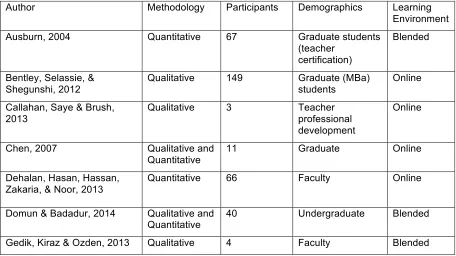
lecturers and faculty. Five of the studies were conducted with undergraduate students (Domun & Badadur, 2014; Hrastinski et al., 2010; Kearney, 2006; Kim et al., 2014; Koutsabasis, 2011) and seven of the studies (Ausburn, 2004; Bentley, Selassie, & Shegunshi, 2012; Callahan et al., 2013; Chen, 2007; Lee, 2014; Moallem, 2007; Swan et al., 2014) were conducted with graduate students. Table 1 details the characteristics of the 17 studies analyzed.
Table 1.
Summary of the Descriptive Characteristics of Studies
Author Methodology Participants Demographics Learning
Environment
Ausburn, 2004 Quantitative 67 Graduate students
(teacher certification)
Blended
Bentley, Selassie, & Shegunshi, 2012
Qualitative 149 Graduate (MBa) students
Online
Callahan, Saye & Brush, 2013
Qualitative 3 Teacher
professional development
Online
Chen, 2007 Qualitative and
Quantitative
11 Graduate Online
Dehalan, Hasan, Hassan, Zakaria, & Noor, 2013
Quantitative 66 Faculty Online
Domun & Badadur, 2014 Qualitative and Quantitative
40 Undergraduate Blended
Grant & Thornton, 2007 Qualitative 12 Faculty Online
Hrastinski, Keller, Carlsson, Hogskolan I Jonkoping, Ihh, 2010
Qualitative Undergraduate Online
Kearney, 2006 Qualitative 21 Undergraduate Online
Kim, Kim, Khera, & Getman, 2014
Qualitative and quantitative
115 Graduate students (teachers)
Blended
Koutsabasis, 2011 Qualitative 131 students
37 instructors
Undergraduate students and instructors
Online
Lee, 2014 Qualitative and
quantitative
81 Graduate students
(teachers)
Online
Lee & Dashew, 2011 Qualitative 78 Faculty Blended
Moallem, 2007 Qualitative and quantitative
14 Graduate Online
Swan, Day, Bogle, & Matthews, 2014
Qualitative 214 Graduate students (teachers)
Online
Teräs & Herrington, 2014 Qualitative and quantitative
27 Students in post-graduate program on teaching in higher education
Online
The purpose of the analysis was to identify similarities and differences, to identify patterns and to search for common themes on the components of e-learning and online courses which contribute to course designs which enhance learning. A qualitative meta-analysis was conducted to
“synthesize the theories, methods, and findings of both qualitative and quantitative” (Ke, 2009, p. 6) studies related to the design of e-learning and online learning. A qualitative meta-analysis “is an approach towards formulating a complete depiction of the subject” (Ke, 2009, p.6). As part of the analysis, literature was selected based on its relevance to design. Once selected, the studies were numbered, alphabetized and read. Each study was re-read and annotated, focusing specifically on the data, findings, conclusions and implications that related directly to e-learning and online course design considerations (Creswell, 2012). Components were identified from each study and then grouped into common subthemes. Notes were analyzed to identify common themes and findings and topics that occur and reoccur in the studies.
Findings
The analysis of 17 studies revealed four main sub-themes of design in e-learning and online learning. The sub-themes that emerged from the analysis were (i) structure and security, ii) content presentation, iii) collaboration and interaction, and iv) feedback.
Structure and Security
Analysis of the literature revealed that course designers must consider carefully the structure in designing e-learning and online learning courses (Ausburn, 2004, Bentley, Selassie, &
Similarly, in interviews and focus groups conducted by Grant and Thornton (2007), best practices for course design included providing clear guidelines and expectations for students. Callahan et al. (2013) found that because learners tended to explore the materials in a non-linear fashion, explicit instructions were needed to help ensure learners can use the materials effectively. Six studies (Bentley, Selassie, & Shegunshi, 2012; Callahan et al., 2013; Chen, 2007; Gedik et al., 2013; Kim et al., 2014; Lee, 2014) reported that orientations conducted at the outset of a course were necessary to provide guidance and direction to help learners get started. This orientation should be designed to ensure that students are familiar with the available resources and tools in the learning environment (Chen, 2007). Kim et al. (2014) found that a “clear course structure with supporting tools such as guiding prompts and instructions must be designed to help students prepare for participation and then success in achieving learning goals” (p. 45).
Lee (2014) found that learners wanted clear rubrics and examples of completed assignments for guidance. This agrees with the finding of Kim et al. (2014) in that 100% of learners strongly agreed or agreed that clear guidelines, including rubrics, and sample completed assignments are important.
Swan et al. (2014) found that the use of the Quality Matters standards in conjunction with the Community of Inquiry Model for course design, positively supported student learning. Quality Matters provide standards for the design of online and blended courses and assumes that effective learning “flows from well-specified outcomes, objectives and assessments” (Swan et al., 2014, p. 74).
Content Presentation
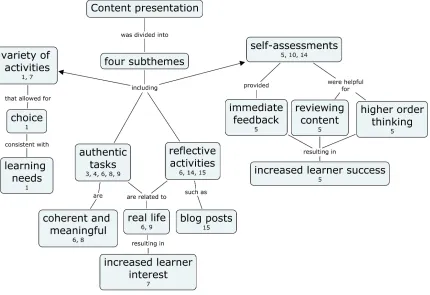
Analysis revealed that students valued variety in activities (Grant & Thornton, 2007; Moallem, 2007) as well as choice (Ausburn, 2004) in online learning. Providing choice in activities and topics allows students to choose activities that are consistent with their learning interests and needs (Ausburn, 2004).
Analysis revealed that three of 17 studies (Gedik et al., 2013; Chen, 2007; Dahalan et al., 2013) recommended the use of authentic tasks in content presentation. Authentic tasks are coherent, meaningful, and purposeful activities which support student learning by immersing learners in the demands of real life environments (Gedik et al., 2013). Chen (2007) found that 100% of students reported that authentic hands-on projects were the most valuable aspect of the course. Authentic tasks provide a meaningful, real-life context for the learning tasks and assignments. Dahalan et al. (2013) also reported that by using real life examples, it allows learners to see relevance of the course content and supports learners in connecting their learning with real life. Authentic tasks were found by Kearney (2006) to be effective in helping learners to develop content knowledge. Three of 17 studies (Grant & Thornton, 2007; Swan et al., 2014; Teräs & Herrington, 2014) supported the use of reflective activities. Teräs and Herrington (2014) indicate that reflection is one component of authentic e-learning. They implemented this aspect into the course design by encouraging constant reflection on readings and the projects through blog posts (Teräs & Herrington, 2014). Teräs and Herrington (2014) also encouraged students to comment on blogs posts and discussions written by classmates. Personal blogs were found to be effective in supporting reflection in a systematic manner, and were reported by students to be rewarding learning experiences (Teräs & Herrington, 2014)
Grant and Thornton (2007) reported that assignments that encourage reflection require students to relate course content materials to their personal lives” (p. 351). By relating course materials to real life, students are more engaged in their learning as students can choose topics and
connections which are interesting and relevant to them (Grant & Thornton, 2007).
Three of 17 studies (Domun & Badadur, 2014; Kim et al., 2014; Swan et al., 2014) recommended the use of assessments in online and e-learning. Domun and Bahadur (2014) provided self-assessments within the online learning environment which provided students with immediate feedback. Students reported that these self-assessments were helpful for reviewing the content and stimulating higher order thinking (Domun & Badadur, 2014). The immediate feedback was not only desired, but also resulted in higher scores for the treatment group over the control group who did not have access to self-assessments (Domun & Badadur, 2014).
Collaboration and Interaction
Interaction is a key ingredient in the learning environment. Analysis of the studies revealed that all but 4 of the 17 studies (Callahan et al., 2013; Dehalan et al, 2013; Domun & Badadur, 2014; Kearney, 2006) indicated the importance of designing opportunities for collaboration and interaction within online courses.
Interaction was facilitated through discussion forums, chat, and email (Chen, 2007; Gedik et al., 2013; Grant & Thornton, 2007). Students valued both student-to-student interaction, as well as opportunities for instructor-to-student interaction (Ausburn, 2004; Bentley, Selassie, & Shegunshi, 2012; Grant & Thornton, 2007). Instructor-to-student interaction consisted of facilitating
discussions (Gedik et al., 2014; Kim et al., 2014), coordinating group work, as well as providing information (Gedik et al., 2013). Grant and Thornton (2007) indicated that interactivity between students and instructors is “fundamental to building community in the online environment” (p. 350). Koutsabasis (2011) found that e-learning platforms increase opportunities for direct communication with instructors regarding course content.
Students value frequent opportunities for communication between learners. Both formal and informal interaction between students was facilitated through discussion forums in six of 17 studies (Ausburn, 2004; Chen, 2007; Gedik et al., 2013; Grant & Thornton, 2007; Moallem, 2007; Teräs & Herrington, 2014). Hrastinski et al. (2010) found that synchronous discussion could be used to support students when working on group projects and was useful for decision making and planning.
and experience with the course (Chen, 2007). Moallem (2007) found that students ranked collaborative team activities as most contributing to student learning. Not all studies positively supported collaboration. Koutsabasis (2011) reported that students prefer “face-to-face interaction and collaboration” (p. 205) and a significant percentage of students reported that collaboration tools did not help them with their studies. Kearney (2006) found that collaboration was promoted through the use of authentic learning tasks while Teräs and Herrington (2014) found that collaboration was improved through the use of discussion forums for informal
discussion and interaction. This collaboration helped learners form a learning community. Kim et al. (2014) found that learning communities “connect students and help them collaborate” (p. 45). Feedback
One type of interaction between the instructor and student is feedback. Analysis revealed that nine of 17 studies (Bentley, Selassie, & Shegunshi, 2012; Chen, 2007; Dehalan et al., 2013; Domum & Badadur, 2014; Gedik et al., 2013; Grant & Thornton, 2007; Lee, 2014; Lee & Dashew, 2011; Teräs & Herrington, 2014) cited prompt and timely feedback as a critical component of online learning. Chen (2007) reported that the instructor’s close monitoring, and provision of immediate feedback to learners has “a direct impact on the success of students’ learning” (p. 83). Lee and Dashew (2011) reported that instructor feedback is critical in order to facilitate a
comfortable learning environment.
Dahalan et al. (2013) reported that timely feedback is essential to maintain motivation and course satisfaction, and that female lecturers are more likely to do this than male lecturers. Learners indicated that “constructive and clear feedback on their work” was needed in order to improve their work (Lee, 2014, p. 16). More than 95% of students agreed or strongly agreed that the professor’s timely and constructive feedback on student work was important (Lee, 2014). Instructors should establish expectations around timelines for response to email, as well as feedback on discussions and assignments (Grant & Thornton, 2007).
Discussion
This literature review presented evidence that course designers must consider carefully the structure in designing e-learning and online learning courses (Ausburn, 2004, Bentley, Selassie, & Shegunshi, 2012; Callahan et al., 2013, Chen, 2007; Grant & Thornton, 2007, Kim et al., 2014, Lee, 2014, Swan et al., 2014, Teräs & Herrington, 2014). Gedik et al. (2013) encouraged course designers to identify a pedagogical approach to course design up front. Many studies (Ausburn, 2004; Bentley, Selassie, & Shegunshi, 2012; Callahan et al., 2013; Gedik et al., 2013; Grant & Thornton, 2007; Kim et al., 2014; Lee, 2014; Swan et al., 2014; Teräs & Herrington, 2014)
reported that a course structure with clearly communicated expectations, rubrics, and assignment examples, was a critical component of good online course design.
Six studies (Bentley, Selassie, & Shegunshi, 2012; Callahan et al., 2013; Chen, 2007; Gedik et al., 2013; Kim et al., 2014; Lee, 2014) reported that orientations conducted at the outset of a course were necessary to provide guidance and direction to learners to help them get started. Presentation of course materials was reported by seven (Chen, 2007; Dahalan et al., 2013; Domun & Badahur, 2014; Gedik et al., 2013; Grant & Thornton, 2007; Kearney, 2006; Teräs & Herrington, 2014) of 17 studies as being an important consideration in the design of e-learning and online courses. Options to consider in the design of content presentation included authentic tasks (Chen, 2007; Dahalan et al., 2013; Gedik et al., 2013; Kearney, 2006), active learning through reflection (Grant & Thornton, 2007; Teräs & Herrington, 2014); and self-assessments (Domun & Badahur, 2014).
Authentic tasks are coherent, meaningful, and purposeful real life activities (Gedik et al., 2013). Using real life examples allows learners to see the relevance of the course content, supports learners in connecting their learning with real life (Dahalan et al., 2013) and in developing content knowledge (Kearney, 2006).
course content to their personal lives (Grant & Thornton, 2007). This supports students in becoming more engaged with their learning (Grant & Thornton, 2007).
Prompt and timely feedback was highly valued by learners and is a critical factor to consider in the design of e-learning and online learning (Chen, 2007; Dehalan et al., 2013; Domum & Badadur, 2014; Gedik et al., 2013; Grant & Thornton, 2007; Lee, 2014; Teräs & Herrington, 2014). Incorporating self-assessments into the online learning environment not only provides students with immediate feedback, a feature that was highlighted in eight of 16 studies (Bentley, Selassie, & Shegunshi, 2012; Chen, 2007; Dehalan et al., 2013; Domum & Badadur, 2014; Gedik et al., 2013; Grant & Thornton, 2007; Lee, 2014; Teräs & Herrington, 2014), but also is reported by students as being helpful for reviewing content, and stimulating higher order thinking (Domun & Bahadur, 2014). Self-assessments resulted in higher summative assessment scores when compared with students who did not have access to self-assessments (Domun & Bahadur, 2014).
Student-to-student and student-to-instructor interaction (Ausburn, 2004; Grant & Thornton, 2007; Lee & Dashew, 2011) is a key ingredient in the learning environment. Analysis of the studies revealed that all but 4 of the 17 studies (Callahan et al., 2013; Dehalan et al, 2013; Domun & Badadur, 2014; Kearney, 2006) indicated the importance of designing opportunities for collaboration and interaction within online courses.
Interaction was facilitated through discussion forums, chat, and email (Chen, 2007; Gedik et al., 2013; Grant & Thornton, 2007). Discussion forums were used in six of 17 studies to support both formal and informal communication between students (Ausburn, 2004; Chen, 2007; Gedik et al., 2013; Grant & Thornton, 2007; Moallem, 2007; Teräs & Herrington, 2014). Contrary to this finding however, Lee (2014) found that students believed that the use of online discussion forums was less important in making online learning satisfactory and recommended that further investigation into how to format and structure online discussions was necessary to ensure student satisfaction.
Students enjoyed the opportunity to collaborate with other learners in online learning
environments (Chen, 2007). Students also believed collaboration was beneficial to their learning (Chen, 2007; Moallem, 2007). Collaboration was enhanced through the use of authentic tasks (Kearney, 2006) and informal communication in discussion forums (Kim et al., 2014; Teräs & Herrington, 2014). Not all studies positively supported collaboration.
Conclusions, limitations and implications
The findings of the 17 studies suggest that there are four main considerations when choosing components to incorporate into the design of e-learning and online courses: i) course structure, ii) content presentation, iii) collaboration and interaction, and iv) timely feedback.
Many studies (Ausburn, 2004; Callahan et al., 2013; Gedik et al., 2013; Grant & Thornton, 2007; Kim et al., 2014; Lee, 2014; Swan et al., 2014; Teräs & Herrington, 2014) reported that a clear course structure with clearly communicated expectations, rubrics, and assignment examples, was a critical component of good online course design. Including an orientation at the beginning of e-learning and online courses provides guidance and direction to learners to help them navigate the course successfully and understand the features of the learning environment (Callahan et al., 2013; Chen, 2007; Gedik et al., 2013; Kim et al., 2014; Lee, 2014).
Options to consider in the design of content presentation included authentic tasks (Chen, 2007; Dahalan et al., 2013; Gedik et al., 2013; Kearney, 2006), active learning through reflection (Grant & Thornton, 2007; Teräs & Herrington, 2014); and self-assessments (Domun & Badahur, 2014). Using authentic tasks allows learners to see the relevance of the course content, supports the development of connections between real life and learning (Dahalan et al., 2013) and helps learners develop content knowledge (Kearney, 2006).
facilitated through discussion forums, chat, and email (Chen, 2007; Gedik et al., 2013; Grant & Thornton, 2007).
Prompt and timely feedback was highly valued by learners and seen as a critical factor to consider in the design of e-learning and online learning (Chen, 2007; Dehalan et al., 2013; Domum & Badadur, 2014; Gedik et al., 2013; Grant & Thornton, 2007; Lee, 2014; Teräs & Herrington, 2014). Incorporating self-assessments into the presentation of the content allows for immediate feedback to learners as well as providing support for review (Domun & Badahur, 2014; Kim et al., 2014; Swan et al., 2014). Instructors should take advantage of features built into learning management systems such as auto-correcting that can assist instructors in providing more rapid feedback to learners.
Some limitations existed affecting the results of the findings. Some studies had small sample sizes with fewer than 15 participants, thus limiting the results and the generalizability of the findings (Callahan et al., 2013; Chen, 2007; Gedik et al., 2013; Grant & Thornton, 2007; Moallem, 2007). The majority of the studies examined were based on student feedback rather than
empirical evidence. Only two of the studies (Ausburn, 2004; Moallem, 2007) considered learning styles in their determination of design considerations for e-learning and online learning. Ausburn (2004) provided support for the fact that “learners with different characteristics may differentially prefer and benefit from various instructional features and goals” (p. 334). Contrary to this, Moallem (2007) found that learning tasks, the learning context, and level of interaction “may play a more significant difference in improving instructional effectiveness in online learning” (p. 238) than learning styles. Additional studies are needed to clarify the role of learning styles and preferences within online learning environments.
The implications of this analysis relate specifically to instructional designers, faculty and teachers designing e-learning and online courses. There are many considerations in transitioning from traditional classroom teaching to teaching online (Gedik et al., 2013; Grant & Thornton, 2007; Lee & Dashew, 2011; Moallem, 2007). Delivering a course in an online environment requires different delivery methods and teaching and learning activities. Well-designed courses require faculty that understand and are familiar with these considerations (Grand & Thornton, 2007) and therefore to ensure this, training, support and guidance should be provided to faculty who are preparing to teach online. Course instructors need to understand which components of e-learning are effective for promoting learning as well as how to best use these components in course delivery. Rubrics such as Quality Matters and the Community of Inquiry Model (Swan et al., 2014) when used together can provide a checklist against which faculty can assess their own courses to ensure that all components of quality course design are considered. Training and guidance should also be provided to faculty in how to effectively use technology in the online environment, as well as the learning management system (Gedik et al., 2013) as technological problems can create a negative perception of the course design for learners.
References
Ausburn, L.J. (2004). Course design elements most valued by adult learners in blended online education environments: An American perspective. Educational Media International, 41(4), 327-337. Retrieved from
https://www.uwec.edu/AcadAff/resources/edtech/upload/CourseDesignElementsMostValued ByAdultLearners.pdf
Bentley, Y., Selassie, H., & Shegunshi, A. (2012). Design and evaluation of student-focused eLearning. Electronic Journal of e-Learning, 10(1), 1-12.
Callahan, C., Saye, J. & Brush, T. (2013). Designing web-based educative curriculum materials for the social studies. Contemporary Issues in Technology and Teacher Education, 13(2), 126-155. Retrieved from http://www.editlib.org/p/41444/.
Creswell, J. W. (2012). Educational Research: Planning, conducting, and evaluating quantitative
and qualitative research (4th ed.). Boston, MA: Pearson Education Inc.
Dahalan, N., Hasan, H., Hassan, F., Zakaria, Z. & Noor, W., A., W., M. (2013). Engaging students online: Does gender matter in adoption of learning material design? World Journal on
Educational Technology, 5(3), 413-419. Retrieved from
http://www.world-education-center.org/index.php/wjet/article/view/371/pdf_224
Domun, M. & Bahadur, G. (2014). Design and development of a self-assessment tool and investigating its effectiveness for e-learning. European Journal of Open, Distance and
e-‐Learning, 17(1). Retrieved from
http://www.eurodl.org/materials/contrib/2014/Domun_Bahadur.pdf
Gedik, N., Kiraz, E, & Ozden, M.Y. (2013). Design of a blended learning environment:
Considerations and implementation issues. Australasian Journal of Educational Technology, 29 (1). Retrieved from http://ascilite.org.au/ajet/submission/index.php/AJET/article/view/6. Grant, M. & Thornton, H. (2007). Best practices in undergraduate adult-centered online learning:
Mechanisms for course design and delivery. Journal of Online Learning and Teaching, 4(3), 346 - 356. Retrieved from http://jolt.merlot.org/documents/grant.pdf.
Hrastinski, S., Keller, C., Carlsson, S. A., Högskolan i Jönköping, Internationella
Handelshögskolan, & IHH, I. (2010). Design exemplars for synchronous e-learning: A design theory approach. Computers & Education, 55(2), 652-662.
doi:10.1016/j.compedu.2010.02.025
Ke, F. (2008). A qualitative meta-analysis of computer games as learning tools. In R. E. Ferdig (Ed.), Handbook of Research on Effective Electronic Gaming in Education (pp. 1-32), New York: IGI Global.
Kearney, M. (2006). Prospective science teachers as e-learning designers. Australasian Journal of Education Technology, 22(2), 229 – 250.
Kim, M.K., Kim, S.M., Khera, O. & Getman, J. (2014). The experience of three flipped classrooms in an urban university: An exploration of design principles. Internet and Higher Education, 22, 37 – 50.
Koutsabasis, P. J. (2011). Perceived Impact of Asynchronous E-Learning After Long-Term Use: Implications for Design and Development. International Journal of Human-Computer Interaction, 27(2), 191-213.
Lee, J. (2014). An exploratory study of effective online learning: Assessing satisfaction levels of graduate students of mathematics education associated with human and design factors of an online course. International Review of Research in Open & Distance Learning, 15(1). Retrieved from http://facultyecommons.org/wp-content/uploads/2014/01/APLeePDF.pdf Lee, R., & Dashew, B. (2011). Designed learner interactions in blended course delivery. Journal
of Asynchronous Learning Networks, 15(1), 72-80.
Moallem, M. (2007). Accommodating individual differences in the design of online learning environments: A comparative study. Journal of Research on Technology in Education, 40(2), 217-245.
Swan, K., Day, S., Bogle, L., and Matthews, D. (2014). A collaborative, design-based approach to improving an online program. The Internet and Higher Education, 21, 74-81.
http://dx.doi.org/10.1016/j.iheduc.2013.10.006
Teräs, H., & Herrington, J. (2014). Neither the frying pan nor the fire: In search of a balanced authentic e-learning design through an educational design research process. The
International Review of Research In Open And Distance Learning, 15(2). Retrieved from
This work is published under a Creative Commons Attribution-Non-Commercial-Share-Alike License