MERLOT Journal of Online Learning and Teaching Vol. 10, No. 3, December 2014
Virtually the Same?:
Student Perceptions of the Equivalence of Online Classes to Face-to-Face
Classes
Carrie Anne Platt
Associate Professor Department of Communication
North Dakota State University Fargo, ND 58102 [email protected]
Amber N. W. Raile
Assistant Professor & Director of Business Communications Curriculum Jake Jabs College of Business & Entrepreneurship
Montana State University Bozeman, MT 59717 [email protected]
Nan Yu
Assistant Professor Department of Communication
North Dakota State University Fargo, ND 58102 [email protected]
Abstract
Given the increasing number of online courses and the established association between student perceptions of learning environments and academic outcomes, this study investigated student perceptions of the equivalence of online classes and face-to-face classes. In contrast to previous studies on student perceptions of equivalence, which primarily used specific online classes as points of reference, this study focused on students’ perceptions of online courses in general. Overall, students did not perceive online and face-to-face classes to be equivalent, but previous exposure to online classes was positively associated with perceptions of general equivalence, comparative flexibility, comparative knowledge gained, and comparative level of interaction in online versus face-to-face classes. The final part of the paper applies these findings to the educational setting by discussing their implications for programs seeking to expand online course offerings.
Keywords: online classes, distance learning, student perceptions, equivalence, online course experience
Introduction
MERLOT Journal of Online Learning and Teaching Vol. 10, No. 3, December 2014
increased in response to increasing student demand for more flexible and convenient models of higher education (Kaya, 2010).
Online course delivery methods have the potential to transform the landscape of higher education by expanding educational opportunities, transforming student populations, and prompting the development of new pedagogical methods. But, some have argued that this rapid embrace of online learning,
particularly the widespread adoption of MOOCs, could lead to negative pedagogical outcomes (e.g., Allen, 2006; Allen & Seaman, 2014). A central concern of such critiques is whether the online course
experience is sufficiently equivalent to the teaching and learning that occur in the face-to-face context. To that end, a large portion of the previous research on online classes focused on assessing the relative equivalence of online and face-to-face learning environments. The results of several meta-analyses (Benoit, Benoit, Milyo, & Hansen, 2006; Bernard et al., 2004; Jahng, Krug, & Zhang, 2007; Sitzmann, Kraiger, Stewart, & Wisher, 2006) suggest that online and face-to-face courses are relatively comparable in terms of learning outcomes.
Actual equivalence, however, is just one piece of the puzzle. The perceived equivalence of online and face-to-face courses can also affect students’ learning experiences, the pedagogical outcomes of individual courses, and the acceptance of online classes at any given institution of higher education. The question of perceived equivalence is beginning to garner attention outside the academy (e.g., Choney, 2011), reflecting the growth of online education and its larger implications. However, recent surveys (e.g., Parker, et al., 2011) do not separate the general public from the students who might enroll in online courses.
The systematic study of student perceptions is important for two reasons. The first is the documented connection between student perceptions of the learning environment and academic outcomes, with perception influencing both how students approach a course and how much they learn (Kilgo, Sheets, & Pascarella, 2013; Lizzio, Wilson, & Simons, 2002; Sherblom, 2010). Second, understanding student perspectives helps both administrators and educators make more informed decisions when it comes to course offerings and course design. Without empirical data, these discussions may be based on faulty assumptions about student perceptions of equivalence and student demand for online classes.
This study assesses students’ general perceptions of online course delivery, focusing on the question of whether students view online classes to be equivalent to face-to-face courses. In that sense, the current study provides both a sampling of student opinion on the topic of online classes and a model for
measuring perception in a more generalized sense.
Student Perceptions of Online vs. Face-to-Face Courses
A significant amount of research has focused on understanding how students perceive specific online courses. Reflecting both the selling points and the pedagogical concerns associated with online course delivery, previous studies explored student perceptions of flexibility or control in the learning process, perceived levels of interaction with the instructor and/or classmates, perceived knowledge gained, and satisfaction with instruction. Such studies frequently focused on how these factors influenced students’ overall preferences for each delivery type. Specific to the topic of equivalence, the majority of previous studies found that students do not perceive online courses to be equivalent to face-to-face courses. It is important to note, however, that the majority of these studies investigated student perceptions of specific
online courses, a methodological approach that limits the generalizability of results and can produce conflicting findings. The rest of this section is organized by the areas of difference that have been found to influence student perceptions of course delivery methods.
Flexibility
Students generally perceive online courses to be significantly more flexible than face-to-face courses. Online courses offer them greater control over when and where they will complete their coursework, which makes them an attractive option for time-crunched, place-bound, and/or non-traditional students (Schwartzman, 2007). When surveyed on the topic of online classes, students reported choosing to enroll in online classes for cost efficiency, convenience, and flexibility (Leasure, Davis, & Thievon, 2000), to accommodate work demands (Horspool & Yang, 2010), because they are facing constraints or conflicts in their course schedule that prohibit them from taking a face-to-face section of a course
MERLOT Journal of Online Learning and Teaching Vol. 10, No. 3, December 2014
studies is critical to their academic success (Roblyer, 1999). With increased flexibility and freedom, however, comes greater responsibility for setting deadlines and ensuring that one is making steady progress through the workload. For those who are not self-motivated learners, the tendency to procrastinate may have a negative impact on online course performance or completion (Deimann & Bastiaens, 2010). This tendency may be why some students cite having less flexibility, and thus fewer opportunities to procrastinate, as a major reason for choosing face-to-face courses over online courses (Leasure et al., 2000). Greater amounts of flexibility may also be associated with lower amounts of interaction with instructors and peers (Shedletsky & Aitken, 2001).
Interaction
Face-to-face courses are perceived by students as offering higher levels of interaction, both with the instructor and with other students in the class, than online courses. Roblyer (1999) found that one’s preference for face-to-face courses was associated with how much one valued interaction and communication with the instructor and other students, thus suggesting that face-to-face courses are perceived as more interactive. Bejerano (2008) critiqued lost opportunities for interaction in online
courses, pointing out that lower levels of interaction generally lead to less academic and social integration. When asked to rank levels of interaction in face-to-face courses, hybrid courses, and fully online courses, students tend to rank face-to-face courses as offering the greatest number of opportunities for feedback, as well as the most immediate instructor feedback (Faux & Black-Hughes, 2000; Leasure et al., 2000). It is important to note that there has been little research comparing actual differences in student
participation in online courses with face-to-face courses (Rocca, 2010).
Past research on student satisfaction with instruction in face-to-face versus online courses also found that students prefer higher levels of interaction with their instructors. Horspool and Yang (2010) found that while students in the face-to-face and online sections they studied gave their instructors equally positive ratings when it came to how quickly they responded to questions, there were significantly different levels of agreement on whether students felt they had sufficient levels of interaction with the professor, with a higher proportion of online students reporting that they disagreed or strongly disagreed. The desire for more interaction in the online classroom may also explain why other comparative studies have found higher ratings of instructional quality and student satisfaction in face-to-face learning environments (Cryan, Mentzer, & Teclehaimanot, 2007; Johnson, Aragon, Shaik, & Palma-Rivas, 2000), though the course-specific nature of previous research makes it difficult to generalize this finding.
Differences in levels of interaction may be attributed to the fact that, as a form of distance education, today’s online courses are the descendants of yesterday’s correspondence courses, which were frequently conducted asynchronously through the mail. The ability to work at one’s own pace remains, but so does the reduced interaction with peers (Bates, 2010). Advances in technology have enabled greater levels of engagement and interaction in the online classroom (Ballard, 2009; McBrien, Cheng, & Jones, 2009; Rhode, 2009), but many online courses retain asynchronous elements that limit interaction in favor of letting students work at their own pace (Parry, 2010b; Vess, 2005). Student perceptions of interaction do not seem to have shifted in response to technological advances. Students still perceive communication in face-to-face courses as faster, easier, and more immediate than communication in online courses (An & Frick, 2006) and have higher expectations for interaction in face-to-face courses (Lapointe & Reisette, 2008).
Knowledge Gained
When looking at individual studies comparing online and face-to-face course delivery, there appears to be a lack of consistency in results. Some find online classes result in greater knowledge gained (e.g., Koory, 2003); others find face-to-face classes have better results (e.g., Cryan et al., 2007); some studies have found no significant differences between the two (e.g., Clark & Jones, 2001; Hollerbach & Mims, 2007; Johnson et al., 2000). This variation may be due to a focus on individual cases, making it difficult to control for the type of knowledge gained, the comparability of the instructional methods across classes, demographic factors that might lead to disproportionate representation between the online and face-to-face samples, or the format of the online classes (e.g., synchronous vs. asynchronous). Meta-analyses that have controlled for these factors suggest that online and face-to-face courses are relatively
MERLOT Journal of Online Learning and Teaching Vol. 10, No. 3, December 2014
to be established.
Although a large amount of previous research has attempted to measure differences in learning outcomes between face-to-face and online classes, there has been less attention paid to how much students perceive they are learning from each type of course. Studies that considered this issue found significant differences in perceived knowledge gains between the two conditions. Horspool and Yang (2010), for example, compared an online section with a face-to-face section of a performance-based introduction to music course. Students in both sections were asked to rate how well they felt they had achieved the stated learning outcomes, which were the same in both courses. Students in the face-to-face course reported significantly higher levels of achievement than those in the online course, differences that the authors attribute to a wider variety of opportunities to practice skills during face-to-face class meetings.
Research Goals and Questions
As argued in the introduction, investigating how students perceive the online learning environment is important to programs considering further expansion of their online offerings. Previous research on this topic has examined student perceptions of flexibility, interaction, and knowledge gained in online classes. In sum, students seem to view online classes as more flexible but with fewer opportunities for interaction than face-to face courses. Meta-analyses have found that learning outcomes are comparable, though students perceive that they are learning less in online classes. A large portion of past and current research on online classes focused on learning outcomes and student perceptions of specific online classes. With this type of approach, student responses may be influenced by how a specific course was taught, limiting the generalizability of findings. A notable exception to this trend was Burns’ (2013) study of graduate students’ perceptions of online courses in an adolescence education program. Although Burns’ research was limited to one academic program, it revealed substantial differences based on students’ previous online course experience and showed the value of expanding the scope of investigation beyond single classes.
The current study approaches undergraduate student perceptions with a similarly broad scope, by asking students to assess the equivalence of online and face-to-face courses along several different dimensions, without reference to specific courses or programs.
RQ1: What are student perceptions of equivalence, specifically a) general equivalence,
b) comparative flexibility, c) comparative level of interaction, d) comparative knowledge gained, and e) comparative ease, of online versus face-to-face courses?
The second research question is informed by two factors shown to affect individual perceptions: mere exposure and involvement. Mere exposure, or the exposure effect (Zajonc, 1968), suggests that
familiarity breeds favorability – that merely being exposed to something makes one view it more favorably. This effect has been strongly supported in the literature (see Bornstein [1989] for meta-analysis), and suggests that taking online classes will lead to more favorable views of online learning (compared to no exposure to online classes). Involvement is defined as “a motivational state induced by an association between an activated attitude and the self-concept” (Johnson & Eagly, 1989, p. 290). In other words, feeling some connection to an entity or idea will affect the way one interprets it. In the social influence literature, involvement is incorporated into several theories of persuasive message processing, including Social Judgment-Involvement Theory (Sherif, Sherif, & Nebergall, 1965) and the Extended Elaboration Likelihood Model (Slater, 1997). Applying the theoretical concept of involvement to the perception of online classes suggests that students who have taken more online classes will feel more involved and thus have different opinions of this course delivery format when compared to those who have taken fewer – or no – online classes.
MERLOT Journal of Online Learning and Teaching Vol. 10, No. 3, December 2014
courses, the current study also explores the relationship between the number of online courses taken and perceptions of equivalence.
RQ2: What is the relationship between the number of online courses taken and perceptions of equivalence, specifically a) general equivalence, b) comparative flexibility, c) comparative level of interaction, d) comparative knowledge gained, and e) comparative ease, of online versus face-to-face courses?
Method
Participants
The current study had 289 total participants: 87 males (30.1%), 194 females (67.1%), and 8 (2.8%) who declined to identify their sex. The mean age of the participants was 21.62 with SD = 3.82, ranging from 18 to 50. The sample included 11 first year students, 62 sophomores, 98 juniors, 74 seniors, 38 super seniors (i.e., more than four years of university enrollment), 1 graduate student, and 5 who declined to identify their current academic status. The majority of the sample (n = 213, 73.7%) had taken at least one online college course; the number of online classes taken ranged from 0 to 16.
Procedure
After Institutional Review Board approval, participant recruitment was conducted via an e-mail sent to students enrolled in participating communication courses at a mid-size public university in the midwestern United States. To obtain a broader sample, the researchers chose courses ranging from the 200- to 400-level, varying in topic from research methods to organizational communication, and in both online and face-to-face formats. To limit the influence of course content or format on results, participants were instructed to consider their general experience with online and face-to-face courses when responding to questions, rather than evaluating specific courses they had taken.
Interested participants followed a link to an online survey. The first page consisted of a consent form; if they consented to participate, students responded to questions measuring their perceptions of general equivalence, flexibility, level of interaction, knowledge gained, and ease of online courses compared to face-to-face courses. Participants received either extra credit or research participation points.
Measures
Perceptions of general equivalence, flexibility, level of interaction, knowledge gained, and ease of online courses compared to face-to-face courses were measured. The authors constructed scales due to the lack of established scales for measuring student perceptions of online classes (see Appendix). All scales showed acceptable validity based on the results of confirmatory factor analyses (CFA) in LISREL 8.80 (Jöreskog & Sörbom, 2006). Participants provided demographic information at the end of the survey.
General equivalence. This four-item scale looked at the extent to which students perceived online courses to be equivalent to face-to-face courses overall on a seven-point Likert-type scale (e.g., “I think online classes are different/similar when compared to face-to-face classes”). A low mean score indicated a perceived lack of equivalence between online and face-to-face courses; a high mean score indicated perceived equivalence. The scale showed validity (2 [df = 2, N = 289] = 12.39, p < .01; GFI = 0.98; AGFI = 0.89; CFI = 0. 99; RMSEA = 0.14) and acceptable reliability (Cronbach’s α = .88).
Comparative flexibility. Flexibility was measured with seven items rated on a seven-point Likert-type scale (e.g., “Compared to face-to-face classes, I think online classes are tough/easy to fit into my schedule”). A low mean score indicated a perception that online classes were less flexible than face-to-face classes; a high mean score indicated a perception that online classes were more flexible. The scale showed validity (2 [df = 14, N = 289] = 108.54, p < .01; GFI = 0.91; AGFI = 0.81; CFI = 0. 93; RMSEA = 0.15) and acceptable reliability (Cronbach’s α = .84).
MERLOT Journal of Online Learning and Teaching Vol. 10, No. 3, December 2014
in online classes. The scale showed validity (2 [df = 3, N = 289] = 596.18, p < .01; GFI = 0.69; AGFI = 0.52; CFI = 0. 89; RMSEA = 0.24) and strong reliability (Cronbach’s α = .94).
Comparative knowledge gained. The perceived amount of knowledge gained by participants in online courses compared to face-to-face courses was measured using a six-item, seven-point Likert-type scale (e.g., “Compared to a face-to-face class, I think I would learn less/more in an online class”). A low mean score indicated a perception that one learned less in online classes than in face-to-face classes; a high mean score indicated a perception that one learned more in online classes. The scale showed validity (2 [df = 9, N = 289] = 100.88, p < .01; GFI = 0.90; AGFI = 0.76; CFI = 0. 96; RMSEA = 0.18) and strong reliability (Cronbach’s α = .95).
Comparative ease. This five-item scale measured perceived ease of online courses relative to face-to-face courses on a seven-point Likert-type scale (e.g., “Compared to face-to-face-to-face-to-face classes, I think online classes are more difficult/easier in general”). A low mean score indicated a perception that online classes were harder than face-to-face classes; a high mean score indicated a perception that online classes were easier. The scale showed validity (2 [5, N = 289] = 18.06, p = .003; GFI = .98; AGFI = .93; IFI = .97; CFI = .97; RMSEA = .10) and reliability (Cronbach’s α = .75).
Results
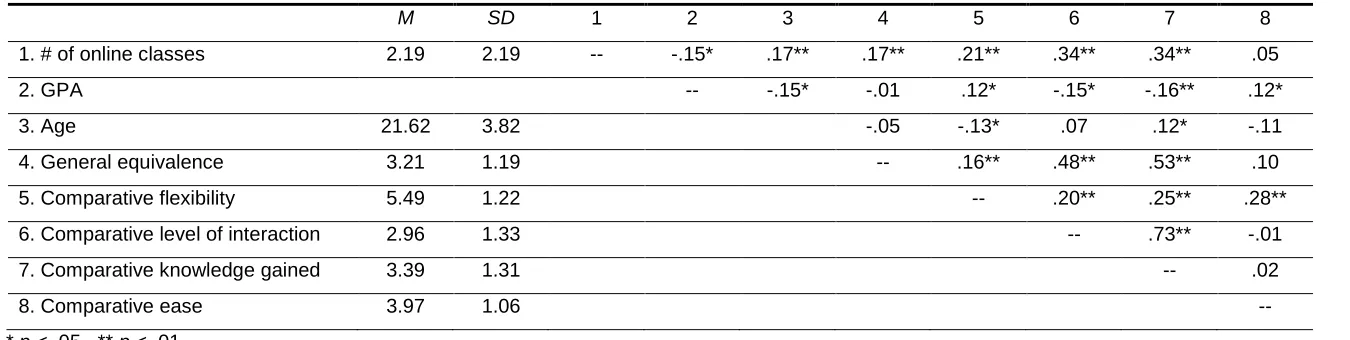
To answer RQ1, descriptive statistics for general equivalence, comparative flexibility, comparative level of interaction, comparative knowledge gained, and comparative ease were calculated (see Table 1). All five scales asked participants to compare online classes to face-to-face classes. To summarize, participants did not see online courses as equivalent to face-to-face courses in a general sense (M = 3.21, SD = 1.19). This lack of perceived equivalence might be explained by the more specific comparisons made in
response to other scales. Online courses were seen as more flexible than face-to-face courses (M = 5.49,
SD = 1.22). However, participants perceived fewer opportunities to interact with their instructor and classmates (M = 2.96, SD = 1.33), and reported feeling that they gained slightly less knowledge in online classes (M = 3.39, SD = 1.31), Despite these differences, participants saw online and face-to-face courses as relatively similar in terms of rigor (M = 3.97, SD = 1.06).
To answer RQ2, general equivalence, comparative flexibility, comparative level of interaction,
MERLOT Journal of Online Learning and Teaching Vol. 10, No. 3, December 2014
Table 1
Descriptive Statistics and Correlations between Participant Characteristics and Perceptions of Online vs. F2F1 Courses
M SD 1 2 3 4 5 6 7 8
1. # of online classes 2.19 2.19 -- -.15* .17** .17** .21** .34** .34** .05
2. GPA -- -.15* -.01 .12* -.15* -.16** .12*
3. Age 21.62 3.82 -.05 -.13* .07 .12* -.11
4. General equivalence 3.21 1.19 -- .16** .48** .53** .10
5. Comparative flexibility 5.49 1.22 -- .20** .25** .28**
6. Comparative level of interaction 2.96 1.33 -- .73** -.01
7. Comparative knowledge gained 3.39 1.31 -- .02
8. Comparative ease 3.97 1.06 --
* p < .05 ** p < .01
1
MERLOT Journal of Online Learning and Teaching Vol. 10, No. 3, December 2014
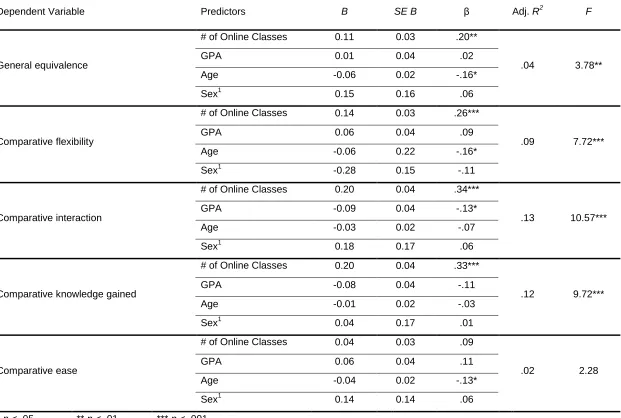
Table 2
Summary of Regression Results
Dependent Variable Predictors B SE B β Adj. R2 F
General equivalence
# of Online Classes 0.11 0.03 .20**
.04 3.78**
GPA 0.01 0.04 .02
Age -0.06 0.02 -.16*
Sex1 0.15 0.16 .06
Comparative flexibility
# of Online Classes 0.14 0.03 .26***
.09 7.72***
GPA 0.06 0.04 .09
Age -0.06 0.22 -.16*
Sex1 -0.28 0.15 -.11
Comparative interaction
# of Online Classes 0.20 0.04 .34***
.13 10.57***
GPA -0.09 0.04 -.13*
Age -0.03 0.02 -.07
Sex1 0.18 0.17 .06
Comparative knowledge gained
# of Online Classes 0.20 0.04 .33***
.12 9.72***
GPA -0.08 0.04 -.11
Age -0.01 0.02 -.03
Sex1 0.04 0.17 .01
Comparative ease
# of Online Classes 0.04 0.03 .09
.02 2.28
GPA 0.06 0.04 .11
Age -0.04 0.02 -.13*
Sex1 0.14 0.14 .06
MERLOT Journal of Online Learning and Teaching Vol. 10, No. 3, December 2014
The comparison of the regressions to the correlations indicates that only comparative interaction remained significantly negatively associated with GPA (β = -.13, t = -2.11, p = .04) when both variables were included in the regression equation. The associations between GPA and the other dependent variables were no longer significant. However, the number of online classes remained significantly positively associated with general equivalence (β = .20, t = 3.19, p = .002), comparative flexibility (β = .26, t = 4.31, p < .001), comparative knowledge gained (β = .33, t = 5.62, p < .001), and comparative level of interaction (β = .34, t = 5.71, p < .001). Age remained significantly negatively associated with perceptions of comparative flexibility (β = -.16, t = 2.59, p = .01) and was also negatively associated with views of general equivalence (β = -.16, t = -2.56, p = .01). Participant sex did not significantly relate to any of the dependent variables.
Discussion
This current study investigated students’ perceptions of equivalence between online and face-to-face courses across five dimensions, and the relationship between those perceptions and previous exposure to online courses. Overall, experience with online courses was related to perceptions of equivalence. Consistent with the theories of mere exposure and involvement, perceived overall equivalence increased with the number of online courses taken. Exposure did not seem to affect perceptions of rigor.
Participants perceived the two formats as being equivalent in terms of difficulty, and relative ease was unrelated to the number of online courses taken. There was a relationship between exposure to online courses and perceptions of flexibility; consistent with previous research (Leasure et al., 2000; Richards & Ridley, 1997; Roblyer, 1999), the number of online courses taken was positively associated with
perceived flexibility.
Previous online course experience influenced level of perceived interaction with the instructor and other students enrolled in the class. Online course experience was positively associated with more favorable views of the amount of interaction in online classes, although online and face-to-face classes were not perceived as having comparable levels on average. Consistent with past research (Faux & Black-Hughes, 2000; Leasure et al., 2000), the majority of students in this study perceived online courses to offer fewer opportunities for interaction than face-to-face courses. This perception may be less likely to change with increased exposure to online courses due to the dominance of asynchronous technologies in online course delivery (Parry, 2010b), which may privilege the self-pacing of instruction over student interaction with the instructor and other students.
Though several meta-analyses have found comparable knowledge gains in online versus face-to-face courses, students perceive face-to-face courses as resulting in greater knowledge gains (Horspool & Yang, 2010). The current study’s findings suggest that the amount of experience with online courses also influences student perceptions of knowledge gained. Students with less exposure to online courses perceived online learning environments as less conducive to learning. This finding may be explained by previous research on student preferences, which has found that prior experience with online course delivery leads to more favorable attitudes toward online courses (Bee & Usip, 1998; Burns, 2013; Tallent-Runnels et al., 2006). This finding may also reflect the tendency for self-directed learners to take more online courses and benefit more from this format of course delivery (An & Frick, 2006; Leasure et al., 2000).
To account for other contextual factors, GPA, age, and sex were included as control variables in the regression analyses. Though GPA was significantly correlated with a number of dependent variables, comparative level of interaction had the only significant association in the regression analyses, which suggested that its association with the number of online classes a student had taken explained those results. Participant age affected perceptions of general equivalence and comparative ease and flexibility. Older participants saw online courses as being less equivalent to face-to-face courses in general, and more challenging. Because of the wording of these items (e.g., “Compared to face-to-face classes, I think online classes are more difficult in general”), lack of equivalence is not necessarily negative. Finally, participant sex was not significantly associated with any of the variables of interest.
Implications for Online Education and Educators
MERLOT Journal of Online Learning and Teaching Vol. 10, No. 3, December 2014
how student perceptions of the learning environment might affect both students’ approaches to online learning and their learning outcomes in online courses and emphasized the practical value of this type of data for making decisions about online offerings. In line with this second implication, the remainder of the paper will consider the practical implications of these results for programs seeking to expand their online course offerings.
Student perceptions of and preferences for online courses seem to be influenced by prior experience with online courses, a factor that is likely to increase as colleges and universities expand their online course offerings (Allen & Seaman, 2010). It is also important to note, however, that while those who reported taking more online courses tended to perceive online courses as more equivalent to face-to-face courses than those who reported taking fewer to no online courses, almost none of the
respondents viewed online courses as fully equivalent to face-to-face courses. The mean general equivalence score was 3.21 (SD = 1.19) on a scale from 1 to 7, with 1 indicating that online courses were perceived as “not at all equivalent” to face-to-face courses and 7 indicating that online courses were perceived as “very equivalent” to face-to-face courses. This suggests that if equivalence is a concern for an instructor, a department, an institution, and/or students, then efforts must be made to establish and assess equivalence, and those efforts should be communicated to the student
population.
Relevant to the issue of perceived equivalence, the results on “comparative ease” also challenge the assumption that online courses are perceived as easier than their face-to-face counterparts (M = 3.97,
SD = 1.06, range 1.00-7.00 with 1.00 indicating that online courses are significantly more difficult and 7.00 indicating that online courses are significantly less difficult). This assumption may fuel concerns that students will elect to take online courses because they prefer to take a less rigorous version of a face-to-face course (Parry, 2009). Although the study respondents did not perceive online courses to be generally equivalent to face-to-face courses, they also did not perceive them as easier.
Second, consistent with previous research (Horspool & Yang, 2010; Leasure et al., 2000; Richards & Ridley, 1997; Roblyer, 1999), the students in this study perceived online courses to be more flexible than face-to-face courses, which suggests that students expect to have more control over the pace of their learning, fewer set deadlines, and greater autonomy in online courses. This expectation of flexibility may be a double-edged sword for both online instructors and departments offering online courses. It can attract students to online offerings, thus increasing enrollment, and can lead to positive learning outcomes (Sitzmann et al., 2006), but the expectation of flexibility may also constrain pedagogical options. If students expect to work at their own pace and according to their own
schedule, imposing deadlines for assignments or attempting to arrange synchronous online
interactions, like a group chat, may meet with resistance, particularly if the culture of online courses at one’s university is primarily characterized by asynchronous interaction or self-pacing by students. Interestingly, older students did not share this perception of increased flexibility, a finding that should be explored in future research.
Third, although Sitzmann et al. (2006) found that the level of interaction in an online course does not contribute to knowledge gained, the present study found a significant correlation (r = .73, p < .001) between perceived interactivity and perceived knowledge gained. Students who perceived online courses to be more interactive also perceived greater knowledge gained in online classes. This finding is consistent with previous pedagogical research on the advantages of active learning over passive reception of content (Davis, 2009; McKeachie & Svinicki, 2006). It suggests that online instructors should make an effort to integrate and promote greater levels of interaction in their courses, whether that interaction occurs in a synchronous or asynchronous format.
Limitations and Suggestions for Future Research
MERLOT Journal of Online Learning and Teaching Vol. 10, No. 3, December 2014
of course offerings. Students from much larger universities or smaller colleges might respond differently to the survey. Including college students from a variety of areas and different types of colleges (both inside and outside the United States) would increase the generalizability of the results.
Second, the study focused on student perceptions of two course delivery methods (i.e., face-to-face vs. online) but did not gather information on what led to these perceptions. Nor did the study account for the relative importance of each pedagogical element to students. Future research could use other methods to investigate how these perceptions of equivalence, flexibility, level of interaction,
knowledge gained, and ease are formed, and establish the relative weight of each element (e.g., students might privilege flexibility over interaction). The finding that experience with online courses relates to perceptions of equivalence, for example, suggests that factors such as age, experience with technology, location, and time constraints may influence the formation of these perceptions. Experience with technology, specifically how comfortable students feel communicating and learning online, has been related to satisfaction with courses (Palmer & Holt, 2009) and might also affect perceived equivalence. Future studies could more directly explore experience with technology and other predictors potentially affecting perceptions of equivalence.
Conclusion
The current study investigated student perceptions of the equivalence of online classes and face-to-face classes and how these perceptions may be influenced by students’ previous learning
experiences. The findings highlight the importance of listening to the voices of those who will be taking online courses, particularly at a time when many universities are exploring new avenues for engaging students both on- and off-campus. The current study also demonstrates the value of gathering data to inform these decisions, rather than relying on assumptions about student perceptions or student demand. Although students do not yet see online classes as equivalent to face-to-face classes, they also do not, contrary to conventional wisdom, perceive online courses to be easier. The findings of this study suggest that the perception of greater flexibility may be what is driving demand for online classes. Future research that focuses on student perceptions will help educators better understand the reasoning behind the perceptions documented by this study.
References
Allen, I. E., & Seaman, J. (2010). Class differences: Online education in the United States, 2010. Babson Park, Massachusetts: BABSON Survey Research Group. Retrieved from
http://sloanconsortium.org/publications/survey/class_differences
Allen, I. E., & Seaman, J. (2014, January). Grade change: Tracking online education in the United States. Babson Park, Massachusetts: BABSON Survey Research Group. Retrieved from
http://www.onlinelearningsurvey.com/reports/gradechange.pdf
Allen, T. H. (2006). Is the rush to provide on-line instruction setting our students up for failure?
Communication Education, 55, 122-126.
An, Y. J., & Frick, T. (2006). Student perceptions of asynchronous computer-mediated communication in face-to-face courses. Journal of Computer-Mediated Communication, 11, article 5.
doi: 10.1111/j.1083-6101.2006.00023.x
Ballard, J. (2009, August 6). Technological advancements increase human interaction in online classes.
The Missourian. Retrieved from
http://www.columbiamissourian.com/stories/2009/08/06/technological-advancements-online-classes-higher-education-create-more-interactions/
Bates, T. (2010, October 16). The pros and cons of self-paced online learning. E-learning and distant education resources. Retrieved from http://www.tonybates.ca/2010/10/16/the-pros-and-cons-of-self-paced-online-learning/
Bee, R. H., & Usip, E. E. (1998). Differing attitudes of economics students about Web-based instruction.
MERLOT Journal of Online Learning and Teaching Vol. 10, No. 3, December 2014
Bejerano, A. R. (2008). The genesis and evolution of online degree programs: Who are they for and what have we lost along the way? Communication Education, 57, 408-414. doi:
10.1080/03634520801993697
Benoit, P. J., Benoit, W. L., Milyo, J., & Hansen, G. J. (2006). The effects of traditional vs. web-assisted instruction on student learning and satisfaction.
Bernard, R. M., Abrami, P. C., Lou, Y., Borokhovsk, E., Wade, A., Wozney, L., Wallet, P. A., Fiset, M., & Huang, B. (2004). How does distance education compare with classroom instruction? A meta-analysis of the empirical literature. Review of Educational Research, 74, 379–439.
doi: 10.3102/00346543074003379
Burns, B. (2013). Students' perceptions of online courses in a graduate adolescence education program.
MERLOT Journal of Online Learning and Teaching, 9. http://jolt.merlot.org/vol9no1/burns_0313.htm
Choney, S. (2011, August 30). Steal this report: College plagiarism up, says PEW report. Retrieved from http://digitallife.today.com/_news/2011/08/30/7524387-steal-this-report-college-plagiarism-up-says-pew-report.
Clark, R. A. & Jones, D. (2001). A comparison of traditional and online formats in a public speaking course. Communication Education, 50, 109-124. doi: 10.1080/03634520109379238
Cryan, J. R., Mentzer, G., & Teclehaimanot, B. (2007). Two peas in a pod? A comparison of face-to-face and web-based classrooms. Journal of Technology and Teacher Education, 15, 233-246.
http://editlib.org/p/19863/
Davis, B. G. (2009). Tools for teaching (2nd ed.). San Francisco, CA: Jossey-Bass.
Deimann, M., & Bastiaens, T. (2010). The role of volition in distance education: An exploration of its capacities. The International Review of Research in Open and Distance Learning, 11. Retrieved from http://www.irrodl.org/index.php/irrodl/article/view/778.
Faux, T. L., & Black-Hughes, C. (2000). A comparison of using the Internet versus lectures to teach social work history. Research on Social Work Practice, 10, 454–466.
Hollerbach, K., & Mims, B. (2007). Choosing wisely: A comparison of online, televised, and face-to-face instructional methods on knowledge acquisition of broadcast audience concepts. Journalism & Mass Communication Educator, 62, 176-189. doi: 10.1177/107769580706200205
Horspool, A., & Yang, S. S. (2010). A comparison of university student perceptions and success learning music online and face-to-face. MERLOT Journal of Online Learning and Teaching, 6, 15-29.
http://jolt.merlot.org/vol6no1/horspool_0310.pdf
Jahng, N., Krug, D., & Zhang, Z. (2007). Student achievement in online distance education compared to face-to-face education. European Journal of Open, Distance and E-Learning, 2007,
http://www.eurodl.org/index.php?article=253.
Jöreskog, K., & Sörbom, D. (2006). LISREL 8.80 for Windows. Scientific Software International.
Johnson, S. D., Aragon, S. R., Shaik, N., & Palma-Rivas, N. (2000). Comparative analysis of learner satisfaction and learning outcomes in online and face-to-face learning environments. Journal of Interactive Learning Research, 11, 29–49. http://editlib.org/p/8371/
Johnson, B. T., & Eagly, A. H. (1989). Effects of involvement on persuasion: A meta-analysis.
Psychological Bulletin, 106, 290-314.
Kaya, T. (2010, November 16). Enrollment in online courses increases at the highest rate ever. The Chronicle of Higher Education. Retrieved from http://chronicle.com/blogs/wiredcampus/enrollment-in-online-courses-increases-at-the-highest-rate-ever.
MERLOT Journal of Online Learning and Teaching Vol. 10, No. 3, December 2014
Koory, M. A. (2003). Differences in learning outcomes for the online and F2F versions of “An introduction to Shakespeare.” Journal of Asynchronous Learning Networks, 7, 18–35.
Lapointe, L., & Reisette, M. (2008). Belonging online: Students’ perceptions of the value and efficacy of an online learning community. International Journal on E-Learning, 7, 641-665.
http://editlib.org/p/24419/
Leasure, A., Davis, L., & Thievon, S. (2000). Comparison of student outcomes and preferences in a traditional vs. world wide web-based baccalaureate nursing research course. Journal of Nursing Education, 39, 149-154.
Lizzio, A., Wilson, K., & Simons, R. (2002). University students’ perceptions of the learning environment and academic outcomes: Implications for theory and practice. Studies in Higher Education, 27, 27-52. doi: 10.1080/03075070120099359
McBrien, J. L., Cheng, R., & Jones, P. (2009). Virtual spaces: Employing a synchronous online classroom to facilitate student engagement in online learning. The International Review of Research in Open and Distance Learning, 10. Retrieved from http://www.irrodl.org/index.php/irrodl/article/view/605.
McKeachie, W. J., & Svinicki, M. (2006). Teaching tips: Strategies, research, and theory for college and university teachers (12th ed.). Boston: Houghton Mifflin.
Palmer, S. R., & Holt, D. M. (2009). Examining student satisfaction with wholly online learning. Journal of Computer Assisted Learning, 25, 101–113. doi: 10.1111/j.1365-2729.2008.00294.x
Parker, K., Lenhart, A., & Moore, K. (2011, August 28). The digital revolution and higher education: College presidents, public, differ on value of online learning. Retrieved from Pew Internet & American Life Project, http://pewinternet.org/Reports/2011/College-presidents.aspx.
Parry, M. (2009, August 31). Professors embrace online courses despite qualms about quality. The Chronicle of Higher Education. Retrieved from http://chronicle.com/article/Professors-Embrace-Online-C/48235/.
Parry, M. (2010a, January 26). Colleges see 17 percent increase in online enrollment. The Chronicle of Higher Education. Retrieved from http://chronicle.com/blogs/wiredcampus/colleges-see-17-percent-increase-in-online-enrollment.
Parry, M. (2010b, October 10). Will technology kill the academic calendar? Online, semesters give way to students who set their own schedules. The Chronicle of Higher Education. Retrieved from
http://chronicle.com/article/Will-Technology-Kill-the/124857.
Rhode, J. (2009). Interaction equivalency in self-paced online learning environments: An exploration of learner preferences. The International Review of Research in Open and Distance Learning, 10. Retrieved from http://www.irrodl.org/index.php/irrodl/article/view/603.
Richards, C. N., & Ridley, D. R. (1997). Factors affecting college students’ persistence in online computer-managed instruction. College Student Journal, 490–495.
Roblyer, M. D. (1999). Is choice important in distance learning? A study of student motives for taking Internet-based courses at the high school and community college levels. Journal of Research on Computing in Education, 32, 157-171.
Rocca, K. A. (2010): Student participation in the college classroom: An extended multidisciplinary literature review. Communication Education, 59, 185-213. doi: 10.1080/03634520903505936
Schwartzman, R. (2007). Refining the question: How can online instruction maximize opportunities for all students? Communication Education, 56, 113-117. doi: 10.1080/03634520601009728
Shedletsky, L. J., & Aitken, J. E. (2001). The paradoxes of online academic work, Communication Education, 50, 206-217. doi:10.1080/03634520109379248
MERLOT Journal of Online Learning and Teaching Vol. 10, No. 3, December 2014
Sherif, C. W., Sherif, M., & Nebergall, R. E. (1965). Attitude and attitude change: The social judgment-involvement approach. Philadelphia: Saunders.
Sitzmann, T., Kraiger, K., Stewart, D., & Wisher, R. (2006). The comparative effectiveness of web-based and classroom instruction: A meta-analysis. Personnel Psychology, 59, 623-664. doi: 10.1111/j.1744-6570.2006.00049.x
Slater, M. D. (1997). Persuasion processes across receiver goals and message genres. Communication Theory, 7, 125-148.
Tallent-Runnels, M. K., Thomas, J. A., Lan, W. Y., Cooper, S., Ahern, T. C., Shaw, S. M., et al. (2006). Teaching courses online: A review of the research. Review of Educational Research, 76, 93–135.
doi: 10.3102/00346543076001093
U.S. Department of Education. (2010). Profile of undergraduate students: 2007-08. Retrieved from http://nces.ed.gov/pubs2010/2010205.pdf.
Vess, D. L. (2005). Scholarship of teaching and learning: Asynchronous discussion and communication patterns in online and hybrid history courses. Communication Education, 54, 355-364. doi:
10.1080/03634520500442210
Appendix
General equivalence items:
1. I think online classes are different/similar when compared to face-to-face classes.
2. I think online classes are not alike at all/very alike when compared to face-to-face classes.
3. I think online classes are not equivalent/very equivalent when compared to face-to-face classes.
4. I think online classes are not at all the same/very much the same when compared to face-to-face classes.
Comparative flexibility items:
1. Compared to face-to-face classes, I think online classes offer less/more flexibility in managing my study time.
2. Compared to face-to-face classes, I think online classes offer less/more flexibility in my study location.
3. Compared to face-to-face classes, I think online classes offer less/more flexibility in designing my own study agenda.
4. Compared to face-to-face classes, I think online classes offer less/more flexibility in organizing my study materials.
5. Compared to face-to-face classes, I think online classes offer less/more flexibility in terms of deadlines.
6. Compared to face-to-face classes, I think online classes are tough/easy to fit into my schedule.
7. Compared to face-to-face classes, I think online classes prevent me from/allow me to work at my own pace.
Comparative level of interaction items:
1. When comparing to a face-to-face class, I think I could be less/more engaged in an online class.
2. When comparing to a face-to-face class, I think I could be less/more attentive in an online class.
3. When comparing to a face-to-face class, I think I could participate in fewer/more class discussions in an online class.
MERLOT Journal of Online Learning and Teaching Vol. 10, No. 3, December 2014
5. When comparing to a face-to-face class, I think I could have fewer/more chances to interact with the instructor in an online class.
6. When comparing to a face-to-face class, I think I could have fewer/more chances to interact with my classmates in an online class.
7. When comparing to a face-to-face class, I think I could be less/more willing to express my opinions in an online class.
8. When comparing to a face-to-face class, I think I could get to know less/more about the instructor in an online class.
9. When comparing to a face-to-face class, I think I could get to know less/more about my classmates in an online class.
10. When comparing to a face-to-face class, I think I could feel less/more like a member of the class in an online class.
Comparative knowledge gained items:
1. Compared to a face-to-face class, I think I would learn less/more in an online class.
2. Compared to a face-to-face class, I think I would understand less/more in an online class.
3. Compared to a face-to-face class, I think I would take away less/more information in an online class.
4. Compared to a face-to-face class, I think I would gain less/more knowledge in an online class.
5. Compared to a face-to-face class, I think I would be less/more motivated to learn in an online class.
6. Compared to a face-to-face class, I think I would feel less/more of a desire to learn in an online class.
Comparative ease items:
1. Compared to face-to-face classes, I think online classes are more difficult/easier in general.
2. Compared to face-to-face classes, I think online classes are more difficult/easier to get a high grade in.
3. Compared to face-to-face classes, I think online classes are more difficult/easier to follow.
4. Compared to face-to-face classes, I think online classes are less/more challenging. (reverse coded)
5. Compared to face-to-face classes, I think online classes have more difficult/easier assignments.
This work is published under a Creative Commons Attribution-Non-Commercial-Share-Alike License