Iranian Journal of Chemical Engineering Vol. 11, No. 4 (Autumn 2014), IAChE
Aqueous Quinoline Treatment with Iron/ Copper Activated UV/
Persulfate Process in a Falling Film Photo-Reactor
J. Saien*, H. Asgari
Bu–Ali Sina University, Hamedan, Iran
Abstract
This article reports the application of the homogenous UV/ persulfate process, activated with iron copper ions, for the treatment of quinoline (Qu) in aqueous solutions. A photo-reactor with a radial falling solution film around the UV lamp was utilized. Under established optimum conditions of [Qu]0= 40 mg/L, [PS]= 1000 mg/L, pH 6,
[Fe2+] / [Cu2+]= 1 mg/L and after 70 min, 88.3%, 94.8% and 96.4% degradations were
achieved with UV/PS, UV/PS/Fe2+ and UV/PS/Cu2+ processes, respectively.
Accordingly, total organic carbon (TOC) removals were 31.2%, 36.1% and 82.2% after 120 min, which highlights the amazing power of copper ions in the treatment. For each case, pseudo first order reactions were obtained for the used processes. The required irradiation energy per cubic meter of aqueous solutions was 127.6, 100.5 and 71.8 kWh for the used processes, respectively. Meanwhile, the role of active radicals was investigated using radical scavengers of ethanol and tert-butyl alcohol, indicating about 48.9% contribution of sulfate radicals in the degradation mechanism.
Keywords: UV/ Persulfate, Quinoline, Falling Film Reactor, Kinetic, Energy
Consumption
1. Introduction
Many persistent and highly toxic hazardous materials are present in wastewaters from chemical factories. Quinoline (Qu) is a heterocyclic nitrogen compound that is used as a raw material and a solvent in the manufacturing of dyes, paints, herbicides and other fine chemicals [1]. It is also used for the production of many antiseptics, antibiotics and pharmaceuticals [2, 3]. Further, it exists in coal tar, mineral oil and petroleum wastewaters [4, 5]. With an N-heteroatom incorporated in the ring system,
Corresponding author: [email protected]
Qu has higher solubility in water than its homo-cyclic analogs and can easily be transferred in soils, sediments and aquifer materials; consequently, it appears as a contaminant, especially in close landfills [6, 7]. Hence, Qu is hardly biodegradable, tends to huddle in natural water environments and exhibits toxic properties [8].
The well-known advanced oxidation processes (AOPs) are promising techniques for oxidative dissolution and mineralization of many organics in waters and wastewaters. AOPs are based on the generation of very reactive species such as HO
pollutants [9, 10]. Although advanced oxidation processes (AOPs) using O3 [11]
and H2O2 [12] have shown good
performances in wastewater remediation, they frequently exhibit high running costs and other drawbacks [13, 14].
Due to the excellent properties of persulfate (PS) anion and the lower price of its salts, growing attention has been paid over recent years to utilizing different processes with this reagent. It is also used for in situ chemical oxidation (ISCO) to transform groundwater or soil contaminants into less harmful chemical species [15]. PS salts dissociate in water to the PS anion (S O2 28
) which is kinetically slow in reacting with many organics [16]; however, it has been well established that it can be photo-chemically or thermally activated to generate sulfate radical (SO4) [17, 18], which is a stronger oxidant
(redox potential 2.6 V) with a kinetically fast reacting tendency with organic pollutants in contaminated waters. PS is normally available as a salt associated with ammonium, sodium or potassium. Previous works have reported that potassium persulfate (KPS) gives better results in photo oxidative removal of some organic materials than other PS salts under natural pH [9]. PS is usually activated by heat [19], UV light [20], bases [21], soil minerals [22] and radiolysis [23] as well as transition metals (Fe2+ and Cu2+) [24, 25] to form sulfate
radicals. In soils and groundwater, the sulfate radicals are free to react with a wide range of contaminants which can further generate other reactive species, such as hydroxyl radicals (OH
), peroxymonosulfate (HSO5)
and hydrogen peroxide (H2O2) [22] that are
vital in degrading organic pollutants in water and soil. Briefly, generation of the radicals has been described via the following reactions [9, 18]:
h 2
2 8 4
S O 2SO
(1)
2
4 2 4
SO + H O SO + OH H
(all pHs)
(2)
2
4 4
SO + OH SO + OH
(mostly in alkaline pHs) (3)
2
2 8 2 8
S O OH S O OH
(4)
2
4 4
SO OH SO OH
(5)
In this process, sulfate ions are produced which may lead to an increase in salt content in the effluent; however, this case does not seem to be a serious problem, because there are no legal restrictions on sodium/potassium sulfate in wastewaters [18, 26]. Accordingly, transition metal ions, especially ferrous metals, have been proven to be efficient PS activators [24]. Ferrous ions can rapidly activate PS to form sulfate radicals (SO4 ) at
a high rate constant of k= 27 M−1s−1.
However, the high reduction potential of Fe2+ ions and the high redox potential of the generated sulfate radicals may initiate an even stronger but not favorable, scavenging reaction of sulfate radicals by Fe2+ ions (k= 4.6 ×10⁹ M−1s−1) [19]. Ferrous ions are
converted simultaneously by both PS ion and sulfate radicals and the final reaction product (SO24) remains in the system. The reactions
2 2 3 2
2 8 4 4
Fe S O Fe SO SO
k = 27 M−1s−1 (6)
2 3 2
4 4
Fe SO Fe SO
k = 4.6 × 10⁹ M−1s−1 (7)
Similarly, Cu2+ ions activate PS to form
sulfate radicals and sulfate ions. Nevertheless, study in copper to activate PS has received little attention [27]. Copper ions can be oxidized to Cu3+ as [28]:
2 2 3 2
2 8 4 4
Cu S O Cu SO SO
(8)
Leading to copper ions being generated to contribute in the oxidation of pollutants and give more efficiency compared to activation with iron ions [24].
No attempt has been made so far for the photodegradation treatment of Qu in the presence of PS. This study attempts to investigate using UV/PS for the treatment of Qu by means of a high performance and low energy consumption photo-reactor with solution falling film device. The influencing parameters of contaminant initial concentration, pH, oxidant concentration, as well as iron and copper ions activator dosages are evaluated. From TOC analysis, the extent of the substrate mineralization is followed. Also, the role of active radicals is studied using radical scavengers of ethanol (EtOH) and tert-butyl alcohol (t-BuOH). Further, the reactions kinetic are investigated and the consumed irradiation energy is evaluated for each of the used processes.
2. Experimental
2-1.Materials
All reagents were used as received without further purifications. Quinoline, C9H7N
(≥97%), MeOH (HPLC grade), CH3COOH
(HPLC grade), EtOH (99.9%) and t-BuOH (>99%), K2S2O8 (99%), FeSO4.7H2O
(99.5%) for supplying Fe2+ ion, CuSO
4.5H2O
(99%) for Cu2+ ion, H
2SO4 (98%), NaOH
(≥97%) were all Merck products. All
solutions were made up in deionized water with conductivity less than 0.08 ìS/cm.
2-2. Reactor set-up and procedure
thermostat bath to regulate the reactor temperature with an accuracy of ± 0.1 ºC.
Figure 1. The used photo-reactor setup; 1: reactor, 2: quartz tube, 3: UV lamp, 4: temperature regulating coil, 5: pump, 6: distributor, 7: thermostat.
To perform each experiment, a solution (1 L) with an initial concentration of Qu (within 20-60 mg/L) was prepared. The pH was adjusted to the desired value by means of a pH meter (Denver, UB-10) using dilute H2SO4 (0.1 M) or NaOH (0.1 M) solutions
and after addition of KPS (corresponding to desired PS ion concentration), the solution was transferred into the reactor. To initiate the process, the lamp was turned on and samples (3 mL) were withdrawn at regular times to analyze the Qu concentration. All experiments were conducted at 25ºC, as the most conventional environmental temperature.
2-3. Analytical method
The Qu concentration in each sample was analyzed with a UV–Vis spectrophotometer
(Jasco, V-630), measuring the absorbance at ëmax= 312 nm joined with a calibration curve
and in agreement with the Beer–Lambert’s
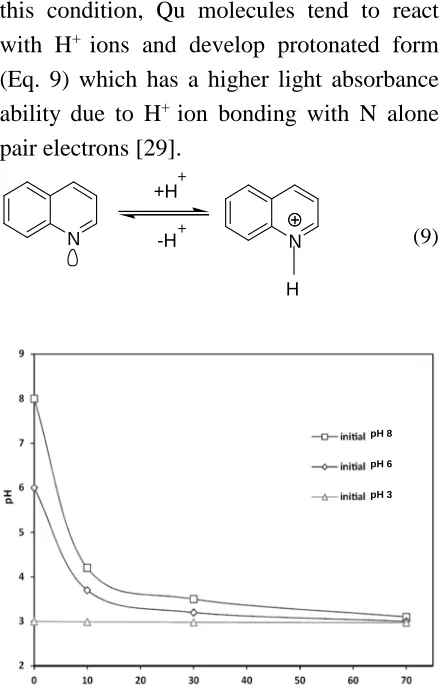
law (absorbance less than 1.3). As was mentioned in introduction section, reactions between PS and most organic pollutants are slow; however, with the effect of UV light, PS ions decompose into active sulfate radicals which in turn speed up th e oxidation process. The generation of sulfate radicals is accompanied by the H+ generation (Eqs. 1-3) and consequently, as can be seen in Fig. 2, pH of the solution decreases. Under this condition, Qu molecules tend to react with H+ ions and develop protonated form
(Eq. 9) which has a higher light absorbance ability due to H+ ion bonding with N alone pair electrons [29].
N
+H
N
H
-H (9)
Figure 2.Variation of solution pH during UV/PS process with different initial pH values: [Qu]0= 40
mg/L and [PS]= 1000 mg/L.
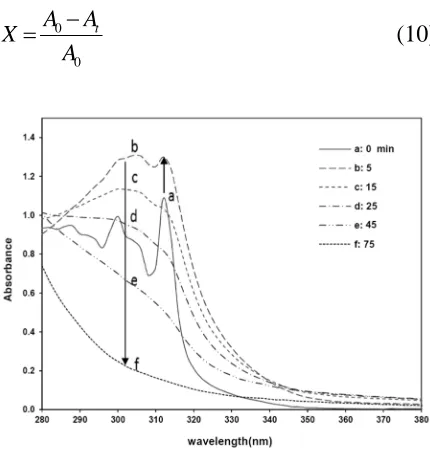
The UV-Vis spectra (Fig. 3) shows that the UV absorbance atëmax rises in the first 5
minutes; then it decreases during the remaining process time. Accordingly, the
process was considered in degradation mode of Qu just after this first 5 minutes of reaction progress. By measuring the initial absorption (A0) and at any time (At ) of the solution at ëmax; the extent of contaminant
degradation efficiency (X) was calculated as:
0
0
t
A A X
A
(10)
Figure 3.UV-Vis spectrum of Qu at different times of UV/PS process: [Qu]0= 40 mg/L, [PS]= 1000 mg/L
and pH 6.
Consequently, optimization of the process was aimed, based on the obtained X values, but other important complementary analysis were also employed.
Because of different intermediates produced during the degradation process and in order to examine the interference in the UV-Vis absorption at ëmax, the only Qu concentration
was followed via the HPLC peaks joined with the relevant calibration curve. The HPLC equipment (SYKAM, Germany) was equipped with a column (Nucleosil C18, 4.6
× 250 mm) and UV spectrophotometer as a
detector and the mobile phase was a mixture of 30% methanol and 70% (pH 5.5, 50 m
acetic acid + 8% methanol) flowing with a rate of 1mL/min. The HPLC peak of Qu appears at the retention time of 20.40 min [30].After determining Qu concentration, the
specific degradation efficiency was obtained from Eq. (10), unless the initial, [Qu] and 0 any time, [Qu]t concentrations (in mg/L) were substituted with the amounts of HPLC absorbance. The efficiencies based on HPLC and UV-Vis analysis methods are very close (maximum difference of about 7% at Qu degradation efficiency of about 37%) and approach the same values after about 70 min. This closeness indicates that UV-Vis analysis is reliable to follow Qu concentration at different times. Previous studies on Qu degradation with AOP methods of wet oxidation process and UV/TiO2 process
[31-33]indicate formation of nicotinic and
picolinci acids and 2(1H)-quinolinone intermediates which have different ëmax.
Furthermore, the total organic carbon (TOC)
of samples was measured (under optimum conditions)by means of a TOC meter (multi,
N/C 3100, Germany) and similarly, the initial and any time TOC values (in mg/L) were used todetermine the extent of substrate
mineralization.
3. Results and discussion
well as PS amount, a decrease in degradation efficiency is expected with higher substrate dosages; however, as is obvious, degradation efficiency was not significant when initial concentration increased from 20 to 40 mg/L (8.7% difference after 70 min). This implies that 40 mg/L initial Qu concentration is representative.
Figure 4. Effect of initial Qu concentration on its degradation efficiency:[PS]= 1000 mg/L and pH 6.
3-2. Effect of solution pH
The pH dependency of the UV/PS process, under typical initial PS concentration of 1000 mg/L is depicted in Fig. 5. The efficiency gradually decreases with either an increase or a decrease in pH with respect to the solution natural pH of 6. Similar trends of variations have been previously reported for pollutants degradation via activated PS [20, 35]. Under alkaline conditions, SO4 species undergo
reactions with OH- to generate OH
radicals according to Eq. (3). Despite conversion of
4
SO to 2 4
S O and producing OH radicals
with the redox potential of 2.8 V [36] which is slightly more than redox potential of SO4
(2.6 V), extra amounts of 2 4
S O
ions can
inactivate OH
and SO4
species, since
2 4
S O at high concentrations can perform as OH
radical scavenger (Eqs. 2 and 3) [37].
Figure 5. Effect of pH on degradation efficiency: [Qu]0= 40 mg/L and [PS]= 1000 mg/L.
On the other hand, applying acidic conditions leads to additional generation of SO4
radicals, according to the following equations
[17]:
2 +
2 8 2 8
S O + H HS O
(11)
2 +
2 8 4 4
HS O SO SO H
(12)
which in turn, may cause radical with radical reactions instead of radical with pollutant [38].It is noteworthy, according toEqs. (2
and 3), that H is released while+ OH-is
3-3. Effect of persulfate initial concentration
The initial concentration of S O 2 82
was found to be an important parameter for the degradation of Qu in the UV/PS process. As is demonstrated in Fig. 6, increase of PS, up to about 1000 mg/L, causes the efficiency to improve due to more reactive radical generation. However, as reported in previous studies[9,39], increase in the PS
concentration could not continuously ensure an improvement in the pollution removal since PS itself is a scavengerofSO4
, indicated by the following equation:
2 2
4 2 8 2 2 8
SO S O SO S O
k = 5.5 × 10⁵
M−1s−1 (13)
Figure 6. Effect of oxidants concentration on degradation efficiency: [Qu]0= 40 mg/L and pH 6.
Hence, the optimal value for PS is about 1000 mg/L at which a high efficiency of 88.3% can be achieved after 70 min treatment.
3-4. Process intensification with Fe2+ and Cu2+
ions
Further activation of PS reagent was examined using different concentrations of
Fe2+ and Cu2+, within 0.5
–4 mg/L. Fig. 7 A
shows that in the UV/PS/Fe2+ process, Qu undergoes a more efficient degradation compared with UV/PS process. This confirms that, according to Eqs. (6,7), Fe2+
ions accelerate PS activation to form sulfate radicalsSO4
and therefore improved
degradation efficiency. In this regard, 1 mg/L of Fe2+ was found to be the optimum dosage. Higher Fe2+dosages can act as an effective
scavenger of sulfate radicals, therefore, a balance between generation and consumption of sulfate radicals appeared in the presence of higher amounts of Fe2+ ions [24,40].
(a)
(b)
Figure 7. Effect of iron (a) and copper(b) concentrations on degradation efficiency: [Qu]0= 40
In UV/PS/Cu2+ process, Cu2+ ions give a
continuous enhancement in degradation during the reaction period. As indicated by Eq. (8), Cu3+ species are generated which, despite its unstable state, may act as an oxidant for Qu degradation [24]. Using 1 mg/L, of copper ion provides about 93.7% of Qu degradation in less than 40 min and higher dosage gives no more promotion (Fig. 7b). So, similar to Fe2+, 1 mg/L can be
introduced as the optimum Cu2+
concentration. Also, it can be observed in Fig. 7 (a and b) that the metal ions alone (with no UV and no PS) do not provide any degradation.
Depicted in Fig. 8 is a comparison between three conducted processes; among them, UV/PS/Cu2+ shows the most effective degradation (93.7% compared to 60.8% with UV/PS and 81.9% UV/PS/Fe2+, all after 40
min). It must be mentioned that applying just UV light irradiation or PS without UV light irradiation (darkness) does not provide any degradation for Qu.
Figure 8. Qu degradation with different processes: [Qu]0= 40 mg/L, [PS]= 1000 mg/L, [Fe2+]= 1 mg/L,
[Cu2+]= 1 mg/L and pH 6.
3-5. Mineralization assessment
Organics due to the mineralization will be
converted to CO2 and H2O and TOC criterion
indicates the extent of conversion of carbons and heteroatoms into inorganic species. For UV/PS, UV/PS/Fe2+ and UV/PS/Cu2+ processes, under the mentioned optimum conditions TOC measurements were performed at different times and corresponding efficiency based on initial and any time TOC values were obtained. As is presented in Fig. 9, interestingly, UV/PS/Cu2+ process provides the highest
TOC efficiency more than double of the other processes, elevates significantly within 70-120minandreachesto82.2%
mineralization. Such a sharp increase is not observed for the other two processes. The reason can be discussed in terms of copper activity which results in a continuous degradation not only with Qu but also with intermediates throughout the reaction period [24].
Figure 9. Comparison of TOC removal for the used processes: [Qu]0= 40 mg/L, [PS]= 1000 mg/L, [Fe2+]=
1 mg/L, [Cu2+]= 1 mg/L and pH 6.
3-6.The role of radical oxidizing species in degradation mechanism
Degradation of organic pollutants by PS reagent is generally considered to occur upon reaction with SO4
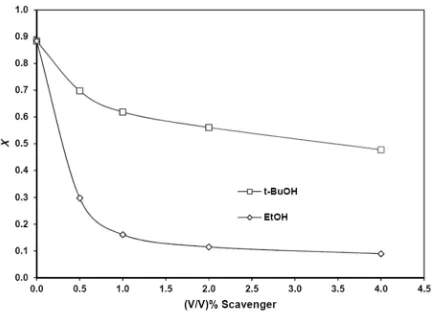
Qu degradation, two alcohol radical scavengers, EtOH and t-BuOH, were used to capture reactive species during the process. EtOH can quench both hydroxyl and sulfate radicals whereas t-BuOH reacts mainly with hydroxyl radicals and poorly with sulfate radicals [41]. The difference in the extent of progress with the scavengers can therefore represent the sulfate radicals contribution in degradation.
The influence of using alcohols is presented in Fig. 10 for a typical time of 70 min. EtOH has decreased the efficiency much more than BuOH. Adding 4% (V/V) of EtOH or t-BuOH, for instance, has caused a 8.9% and 47.7% decrease in efficiency, respectively, compared to normal operations. These observations imply that both radical species are effective in the degradation process and the average contribution of hydroxyl and sulfate radicals is obtained about 51.1% and 48.9%, respectively.
Figure 10. Influence of scavengers in UV/PS process after70 min: [Qu]0= 40 mg/L, [PS]= 1000 mg/L and
pH 6.
Qu degradation in the presence of hydroxyl radicals leads to the formation of three major intermediates: pyridine-2-carboxylic acid (picolinic acid), pyridine-3-carboxylic acid
(nicotinic acid) and 2(1H)-quinolinone
[31-33].It is thought that similar to hydroxyl
radicals, an oxidation–reduction reaction
occurs by sulfate radicals and organic compounds can be decomposed. BothOH
and SO4
are electrophilic species that usually attack the positions with higher electron density. The formation of the first formed intermediates may depend on the electrophilic substitution between Qu and
•OH as well as Qu and
4 SO
.The initial
oxidation mainly occurs at positions 5 and 8 of the aromatic ring, resulting in the formation of 5,8-quinolinedione. In the continuity, considering that the electron cloud density of the pyridine ring is lower than that of the aromatic ring, the pyridine ring is relatively difficult to be oxidized and the cleavage occurs in the aromatic ring. The reactions then occur consecutively to generate picolinic and nicotinic acids. In another parallel branch, hydroxyl radicals may react with Qu and at the C-2 position of the pyridine ring[31-33] leading to generate
2(1H)-quinolinone. The decomposition continues by ring opening to final steps of mineralization. The nitrogen content in the Qu converts to ammonia or nitrate ions species.
3-7. Kinetic study
Due to the practical applications, the kinetic degradation of Qu was investigated with UV/PS, UV/PS/Fe2+ and UV/PS/Cu2+
constant after about 40 min. So, the kinetic of this process was considered within this period of time.
The utilized kinetic model is here the
common power equation [42,43]:
[Qu]
nr
k
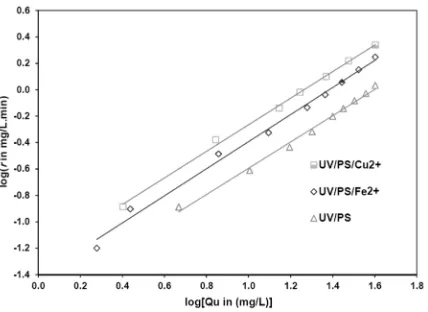
(14)Where r, k and n denote rate, rate constant and order of the reaction, respectively. To obtain the appropriate kinetic parameters the differential method of data analysis based on the degradation rates calculated from Qu concentration variation versus time was used according to:
log
r
log
k
n
log[Qu]
(15)The plots in Fig. 11 show good agreement of the experimental data with the above equation (R2 values close to unity). Kinetic
parameters of the used processes together with the coefficients of determination are listed in Table 1. The results consistently show (within experimental error) pseudo first order reaction rates.
Figure 11. The kinetic diagram of the used processes: [Qu]0= 40 mg/L, [PS]= 1000 mg/L,[Fe2+]= 1 mg/L, [Cu2+]= 1 mg/L and pH 6.
Table 1
Kinetic parameters in different processes; [Qu]0=40 mg/L, [PS]=1000 mg/L, [Fe2+]=1 mg/L, [Cu2+]= 1mg/L and pH 6 .
Process n k (mg/L)1-n/min R2
UV/PS 0.99 0.030 0.997
UV/PS/Fe2+ 0.99 0.038 0.992
UV/PS/Cu2+ 1.00 0.053 0.993
3-8. Irradiation energy consumption
Dependency to the dose of UV light is vital since UV light is the main effective agent in The activation of KPS for producing hydroxyl and sulfate radicals in the reaction media. The photochemistry commission of the international union of pure and applied chemistry (IUPAC) has proposed a figure-of-merit (or more appropriately, an efficiency index, to compare electrical efficiency of different AOPs) for UV-based AOPs. It is a criterion of the irradiation efficiency in an AOP. It is defined (for low concentration of pollutants) as the electrical energy in kilowatt hours (kWh) required bringing about the degradation of a contaminant by one order of magnitude for 1 m3 of contaminated solutions. Considering first-order degradation kinetics, the UV dose is calculated for each of the processes as[44]:
1000
60 log( / )
EC
i f
P t E
V C C
(16)
Where P is the lamp power (kW), t is the irradiation time, V is the solution volume (L) in the reactor and C and i C are the initial f
kinetic for the decay of Qu concentration, the constant ratio of ln(Ci /Cf ) /t represents the
rate constant, k (in min-1).The above equation can therefore be written as:
38.4 EC
P E
V k
(17)
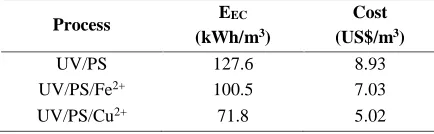
Thus, the required EEC for the photochemical degradation of Qu solution with UV/PS, UV/PS/Fe2+ and UV/PS/Cu2+ was obtained as 127.6, 100.5 and 71.8 kWh/m3, respectively. Considering the
electrical energy price in the U.S. market, 0.07 US$/kWh (in 2014) [45], the electrical energy cost will be about 8.93, 7.03 and 5.02 US$/m3 for the used processes, respectively. The comparison, presented in Table 2, together with all relevant conditions shows that the process of UV/PS/Cu2+consumes much lower energy in Qu degradation.
Table 2
Comparison of energy consumption for degradation in different processes: [Qu]0= 40 mg/L, [PS]= 1000
mg/L, [Fe2+]= 1 mg/L, [Cu2+]= 1 mg/L and pH 6.
Process EEC (kWh/m3)
Cost (US$/m3)
UV/PS 127.6 8.93
UV/PS/Fe2+ 100.5 7.03
UV/PS/Cu2+ 71.8 5.02
4. Conclusions
The activated persulfate by ultraviolet light and intensified with metal ions were successfully examined to degrade quinoline in homogenous reactions by means of a high performance radial falling film photo-reactor. The more important deduced aspects from this study are: i) the pertinent optimum conditions were: [Qu]0= 40 mg/L, [PS]=
1000 mg/L, [Fe2+]= 1 mg/L, [Cu2+]= 1 mg/L
and natural pH of 6; ii) progress of the processes was not so sensitive to pH variations and naturally provided pH was effective; iii) under optimum conditions, for the three treatment processes of UV/PS, UV/PS/Fe2+ and UV/PS/Cu2+, a substrate degradation around 90% was achieved after 70 min treatment; iv) mineralization assessment by TOC criterion indicated a wide advantage of using metal activators. Process intensifying with copper ions was revealed to generate much more efficient during short times; v) adding radical scavengers showed that both the sulfate and hydroxyl radicals were active with nearly half contribution from each, vi) pseudo first order reaction rates were relevant for the used three processes; and vii) the use of metal ions was shown to significantly save energy.
Acknowledgments
The authors wish to acknowledge the Bu-Ali Sina University authorities for providing the financial support to carry out this work.
References
[1] Liu, H., Yang, C., Pu, W. and Zhang, J., "Removal of nitrogen from wastewater for reusing to boiler feed-water by an anaerobic/aerobic/membrane bioreactor", Chem. Eng. J., 140, 122 (2008).
[2] Luostarinen, S., Luste, S. and Rintala, J., "Nitrogen removal from on-site treated anaerobic effluents using intermittently aerated moving bed biofilm reactors at low temperatures", Water Res., 40, 1607 (2006).
production wastewater by membrane bioreactor", Desalination, 246, 285 (2009). [4] Gupta, V. K., Mittal, A., Kurup, L. and
Mittal, J., "Adsorption of a hazardous dye, erythrosine, over hen feathers", J. Coll. Inter. Sci., 304, 52 (2006).
[5] Jeong, Y. S. and Chung, J. S., "Biodegradation of thiocyanate in biofilm reactor using fluidized-carriers", Pro. Biochem., 41, 701 (2006).
[6] Bai, Y., Sun, Q., Zhao, C., Wen, D. and Tang, X., "Simultaneous biodegradation of pyridine and quinoline by two mixed bacterial strains", Appl. Microbiol., 82, 963 (2009).
[7] Zhu, S. N., Liu, D. Q., Fan, L. and Ni, J. R., "Degradation of quinoline by Rhodococcus sp. QL2 isolated from activated sludge", J. Hazard. Mater., 160, 289 (2008).
[8] Seo, J. S., Keum, Y. S. and Li., Q. X., "Bacterial degradation of aromatic compounds", Int. J. Environ. Res. Public. Health., 6, 278 (2009).
[9] Salari, D., Niaei, A., Aber, S. and Rasoulifard, M. H., "The photooxidative destruction of CI Basic Yellow 2 using UV/S2O82− process in a rectangular
continuous photoreactor", J. Hazard. Mater., 166, 61 (2009).
[10] Zhao, J., Zhang, Y., Quan, X. and Chen, S., "Enhanced oxidation of 4-chlorophenol using sulfate radicals generated from zero-valent iron and peroxydisulfate at ambient temperature", Sep. Purif. Technol., 71, 302 (2010).
[11] Dantas, R. F., Contreras, S., Sans, C. and Esplugas, S., "Sulfamethoxazole abatement by means of ozonation", J. Hazard. Mater.,
150, 790 (2008).
[12] Petrovic, M. and Barceló, D., "LC-MS for identifying photodegradation products of pharmaceuticals in the environment", Trends. Anal. Chem., 26, 486 (2007).
[13] Oh, S. Y., Kang, S. G. and Chiu, P. C., "Degradation of 2, 4-dinitrotoluene by persulfate activated with zero-valent iron", Sci. Total. Environ., 408, 3464 (2010). [14] Schmidt, J. T., Ahmad, M., Teel, A. L. and
Watts, R. J., "Hydrogen peroxide stabilization in one-dimensional flow columns" J. Contam. Hydrol., 126, 1 (2011).
[15] Huling, S. G. and Pivetz, B., "Engineering Issue: In-situ Chemical Oxidation", EPA 600/R-06/072 Washington, https://www. epa.gov/ada/topics/oxidation_issue.html; (2006).
[16] Osgerby, I. T., ISCO Technology Overview: Do You Really Understand the Chemistry? in: E.J. Calabrese, P.T. Kostecki, J. Dragun (Eds.), Contaminated Soils, Sediments and Water, Springer, NY; (2006).
[17] House, D. A., "Kinetics and mechanism of oxidations by peroxydisulfate", Chem. Review., 62, 185 (1962).
[18] Lau, T. K., Chu, W. and Graham, N. J., "The aqueous degradation of butylated hydroxyanisole by UV/S2O82-: study of
reaction mechanisms via dimerization and mineralization", Environ. Sci. Technol., 41, 613 (2007).
[19] Liang, C. and Su, H. W., "Identification of sulfate and hydroxyl radicals in thermally activated persulfate", Ind. Eng. Chem. Res.,
48, 5558 (2009).
[20] Saien, J., Soleymani, A. R. and Sun, J., "Parametric optimization of individual and hybridized AOPs of Fe2+/H
2O2 and
UV/S2O82− for rapid dye destruction in aqueous media", Desalination, 279, 298 (2011).
[21] Furman, O. S., Teel, A. L. and Watts, R. J., "Mechanism of base activation of persulfate", Environ. Sci. Technol., 44, 6423 (2010).
Wu, Y. J., "Oxidative degradation of MTBE by pyrite-activated persulfate: proposed reaction pathways", Ind. Eng. Chem. Res., 49, 8858 (2010).
[23] Criquet, J. and Karpel, V. L. N., "Electron beam irradiation of aqueous solution of persulfate ions", Chem. Eng. J., 169, 258 (2011).
[24] Liu, C., Shih, K., Sun, C. and Wang, F.,“Oxidative degradation of propachlor by ferrous and copper ion activated persulfate", Sci. Total. Environ., 416, 507 (2012).
[25] Xu, X. R. and Li, X. Z., "Degradation of azo dye Orange G in aqueous solutions by persulfate with ferrous ion", Sep. Purif. Technol., 72, 105 (2010).
[26] Malato, S., Ricter, C., Blanco, J. and Vincent, M., "Photocatalytic degradation of industrial residual waters", Sol. Energy, 56, 401 (1996).
[27] Liang, H. Y., Zhang, Y. Q., Huang, S. B. and Hussain, I., "Oxidative degradation of p-chloroaniline by copper oxidate activated persulfate", Chem. Eng. J., 218, 384 (2013).
[28] Xua, X., Yea, Q., Tanga, T. and Wanga, D., "Hg0 oxidative absorption by K
2S2O8
solution catalyzed by Ag+ and Cu2+" J.
Hazard. Mater., 158, 410 (2008).
[29] Nedoloujko, A. and Kiwi, J., "Parameters affecting the homogeneous and heterogeneous degradation of quinoline solutions in light-activated processes", J. Photochem. Photobiol. A: Chem., 110, 149 (1997).
[30] Elsila, J. E., Hammond, M. R., Bernstein, M. P., Sandford, S. A. and Zare, R. N., "UV photolysis of quinoline in interstellar ice analogs", Meteori. Plane. Sci., 41, 785 (2006).
[31] Thomsen, A. B., "Degradation of quinoline by wet oxidation-kinetic aspects and reaction mechanisms", Water. Res., 32, 136 (1998).
[32] Zhu, S., Yang, X., Yang, W., Zhang, L., Wang, J. and Huo, M., "Application of porous nickel-coated TiO2 for the
photocatalytic degradation of aqueous quinoline in an internal airlift loop reactor" Int. J. Environ. Res. Public. Health, 9, 548 (2012).
[33] Jing, J., Li, W., Boyd, A., Zhang, Y., Colvin, V. L. and Yu, W. W., "Photocatalytic degradation of quinoline in aqueous TiO2 suspension", J. Hazard. Mater., 237, 247 (2012).
[34] Jianlong, W., Xiangchun, Q., Liping, H., Yi, Q. and Hegemann, W., "Kinetics of co-metabolism of quinoline and glucose by Burkholderia pickettii", Pro. Biochem., 37, 831 (2002).
[35] Soleymani, A. R., Saien, J. and Bayat, H., "Artificial neural networks developed for prediction of dye decolorization efficiency with UV/K2S2O8 process", Chem. Eng. J.,
170, 29 (2011).
[36] Buxton, G. V., Greenstock, C. L., Helman, W. P. and Ross, A. B., "Critical review of rate constants for reactions of hydrated electrons, hydrogen atoms and hydroxyl radicals (•OH/ O•−) in aqueous solution", J. Phys. Chem., 17, 513 (1988).
[37] Lipczynska-Kochany, E., Sprah, G. and Harms, S., "Influence of some groundwater and surface waters constituents on the degradation of 4-chlorophenol by the Fenton reaction", Chemosphere, 30, 9 (1995).
[38] Peyton, G. R., "The free-radical chemistry of persulfate-based total organic carbon analyzers", Mar. Chem., 41, 91 (1993). [39] Hori, H., Yamamoto, A., Hayakawa, E.,
[40] Tsitonaki, A., Petri, B., Crimi, M., Mosbæk, H., Siegrist, R. L. and Bjerg, P. L., "In situ chemical oxidation of contaminated soil and groundwater using persulfate: a review", Crit. Rev. Environ. Sci. Technol., 40, 55 (2010).
[41] Anipsitakis, G. P. and Dionysiou, D. D., "Radical generation by the interaction of transition metals with common oxidants", Environ. Sci. Technol., 38, 3705 (2004). [42] Saien, J., Ardjmand, R. and Iloukhani, H.,
"Photocatalytic decomposition of sodium dodecyl benzene sulfonate under aqueous media in the presence of TiO2", Phys.
Chem. Liq., 41, 519 (2003).
[43] Sharma, S., Mukhopadhyay, M. and Murthy, Z., "Rate parameter estimation for 4-chlorophenol degradation by UV and organic oxidants", J. Ind. Eng. Chem., 18, 249 (2012).
[44] Bolton, J. R., Bircher, K. G., Tumas, W. and Tolman, C. A., "Figures-of-merit for the technical development and application of advanced oxidation technologies for both electric-and solar-driven systems (IUPAC Technical Report)", Pure. Appl. Chem., 73, 627 (2001).
[45] US Government Energy Information Administration, Independent Statistics and Analysis,
![Figure 5. Effect of pH on degradation efficiency: [Qu]0= 40 mg/L and [PS]= 1000 mg/L.](https://thumb-us.123doks.com/thumbv2/123dok_us/8887312.1823206/6.595.74.291.234.410/figure-effect-ph-degradation-efficiency-qu-mg-ps.webp)
![Figure 6. Effect of oxidants concentration on degradation efficiency: [Qu]0= 40 mg/L and pH 6](https://thumb-us.123doks.com/thumbv2/123dok_us/8887312.1823206/7.595.304.521.335.696/figure-effect-oxidants-concentration-degradation-efficiency-qu-mg.webp)
![Figure 9. Comparison of TOC removal for the used processes: [Qu]0= 40 mg/L, [PS]= 1000 mg/L, [Fe2+]= 1 mg/L, [Cu2+]= 1 mg/L and pH 6](https://thumb-us.123doks.com/thumbv2/123dok_us/8887312.1823206/8.595.74.290.493.653/figure-comparison-toc-removal-used-processes-qu-cu.webp)