ISSN: 2151-7452
Jeni Henrickson is a PhD candidate in Learning Technologies and works with the Learning Technologies Media Lab at the University of Minnesota. Her focus is on researching and designing adventure learning environments, exploring the uses of mobile and other emerging technologies in formal and informal learning environments, and getting kids outdoors, actively interacting with the natural environment and their local communities. She can be reached at [email protected].
Aaron Doering is an associate professor in Learning Technologies and co-director of the Learning Technologies Media Lab at the University of Minnesota, where he also holds the Bonnie Westby Huebner Endowed Chair in Education and Technology and is a fellow with the Institute on the Environment. An adventure learning pioneer, Aaron has completed education-related expeditions in the Arctic at least annually since 2004, tied to issues such as climate change, sustainability, and Arctic culture. His research focuses on how adventure learning impacts the classroom experience; designing and developing online learning environments; and K-12 technology integration. He can be reached at [email protected].
Teaching Sustainability through Adventure
Jeni Henrickson, University of Minnesota
Aaron Doering, University of Minnesota
Journal of Sustainability Education http://www.susted.org/
Introduction
It’s the adventure that captivates the students. The students are enthralled with feeling as if they are part of the experience.
Sheryl Johannsen, 4th Grade Teacher
In literature and real life, adventure captivates our imagination and draws us into its path. We become caught up in wonderment of the risk being undertaken, the uncertain outcomes in the balance, and the courage, strength, and daring displayed by those involved. It can be a
transformational experience for participants and observers alike.
Adventure is typically defined as an event involving risk, challenge, and excitement, as an out-of-the-ordinary experience whose outcome at the start is unknown (Merriam-Webster, 2012; Miles & Priest, 1990; Weir, 2004). It does not need to involve a physical challenge; the challenge may instead be purely of the mind (e.g., via an immersive online game). It is, however, inherently experiential, and particularly so if reflection and sharing are built into the experience, along with opportunities to practice solving real-world issues. It has the potential to help build deep connections to the natural world, and both reflection on and action toward issues of sustainable development.
Adventure has been incorporated into sustainability education in a variety of ways throughout history: through literature, outdoor and physical education, field-based exploration and research, and most recently, technology, which has, for example, allowed learners to journey virtually along with explorers and scientists on expeditions to the far-reaches of the world. Technology has in fact enhanced and expanded the types of adventures we can engage in today, such as through advances in equipment and tools that allow us to explore regions of the planet that were previously inaccessible, or to participate in events previously unimagined via the personal computer, the Internet, and mobile devices.
The purposeful use of adventure in education perhaps began with the formation of an expeditionary society for boys in Great Britain in 1932. The Public Schools Exploring Society allowed boys the opportunity to participate in adventure experiences abroad. It was founded with an educative mission grounded in experiential learning, with the goal of teaching that exploration had a scientific end and was not just a pleasure trip or adventure for adventure’s sake (Allison, Stott, Felter, & Beames, 2011). It may be argued, however, that adventure has in fact been part of education since ancient times, as some indigenous cultures have sent youth into the wilderness on quests of personal discovery and challenge as part of cultural, wilderness, and survival
learning processes for many hundreds of years (Berry, 2011; Miles & Priest, 1990).
Adventure today is infused into numerous aspects of our lives and society: adventure travel, adventure sports, and adventure games to name a few; along with movies, books, and scientific explorations. Some forms of adventure exist purely for the thrill-seeker, for the fun of it; they are not necessarily intended as learning or growth experiences. There are, however, ways that adventure is being incorporated into both formal and informal education, including
education for sustainability, that combine the risk-taking, adrenaline-producing, imagination-inspiring elements of adventure with a sound pedagogy to produce rich learning experiences with multiple benefits. The best known of these learning models are adventure education and
adventure learning.
Vol. 5, May 2013 ISSN: 2151-7452
the GoNorth! Adventure Learning Series, and advance suggestions for how adventure might be employed in distance, online, and mobile learning in ways that promote experiential learning and sustainability education. User-driven adventure learning is proposed as one model that educators and designers can draw from in both formal and informal learning settings as a means to fuse adventure, sustainability education, and technology in a pedagogically meaningful way.
Adventure Education
Seminal thinkers who have influenced the adventure education approach to learning include John Dewey and Kurt Hahn. Dewey focused on the importance of spurring a continuum of learning where students are learning not just from teachers but also from their peers and their environment as they draw on and extend preexisting knowledge. He wrote, “Every experience both takes up something from those which have gone before and modifies in some way the quality of those which come after” (1938, p. 35). Dewey also emphasized the role of collaborative learning and creative problem solving in education.
Hahn was a German educator who founded schools in Germany and Great Britain that were grounded in experiential and service-based learning with a focus on character development (Berry, 2011). Adventure education might in fact be considered an outgrowth of organizations such as the aforementioned Public Schools Exploring Society, along with the growing interest in experiential education beginning in the first half of the twentieth century, and the creation of schools and organizations such as the Salem School (www.salem-net.de/en/home.html),
Gordonstoun School (www.gordonstoun.org.uk), and Outward Bound (www.outwardbound.org), all of which were founded by Hahn.
Adventure education has taken the form of team/trust building, cooperative games, physical education, and outdoor risk challenges (e.g., high ropes courses, nature and wilderness activities, expeditionary pursuits). It typically occurs within small-group settings, with the learning and experience limited to the individual and the small group. While adventure education is not restricted to outdoor pursuits, it is often associated with the outdoors and environmental and sustainability education, and is typically employed in informal or nonformal settings.
In adventure education programs, participants are physically or psychologically
challenged, with a focus on risk-taking, problem solving, and individual psychological growth and development (Berry & Hodgson, 2011; Miles & Priest, 1990). Typical desired learning outcomes of adventure education include enhanced self-concept and interpersonal skill building (Hattie, Marsh, Neill & Richards, 1997). Hattie et al. (1997) identified six specific outcome areas for adventure education: leadership, self-concept, academic, personality, interpersonal, and adventuresomeness. Formal processing or reflection activities are incorporated into some, but not all, adventure education programs, with other programs taking instead the nonfacilitiated, or “mountains speak for themselves,” approach (Bunyan, 2011; James, 1980).
Journal of Sustainability Education http://www.susted.org/
Adventure Learning
In the early 1990s, explorers such as Will Steger, Dan Buettner, Robert Ballard, Lonnie Dupre, and Paul Pregont began experimenting with ways to use technology to connect
classrooms with their adventures on the trail in the hopes of educating students about
environmental and social issues worldwide. These experiments led in 2004 to the development of Arctic Transect 2004—a 3,000-mile dogsled journey across Arctic Canada that was tied to a comprehensive curriculum and online learning environment centered on sustainability
education—and the establishment of a new pedagogical framework known as adventure learning (Doering, 2006, 2007; Doering & Miller, 2009).
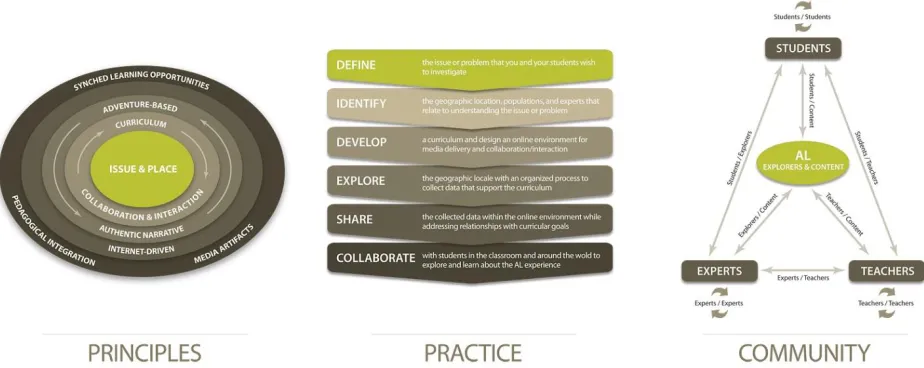
Adventure learning (AL) provides a framework for the design of learning experiences that allow learners to explore real-world issues through authentic, field-based narratives within an interactive online learning environment (Doering, 2006, 2007). AL blends experiential (Dewey, 1938; Kolb, 1984), inquiry-based (Bransford, Brown, & Cocking, 1999), and authentic (Jonassen, 1991) learning, and synchs an online learning environment with teacher-led classroom activities. It is grounded in nine core principles: (1) a defined issue and place; (2) authentic narratives; (3) an element of adventure; (4) a sound curriculum grounded in inquiry; (5)
collaboration and interaction opportunities between learners, experts, teachers, and content; (6) synched learning opportunities that tie together content with curriculum; (7) an online venue to deliver content; (8) multiple media that enhance the curriculum; and (9) scaffolding for teachers as well as learners (Doering, 2006; Doering & Miller, 2009; see Fig. 1).
Vol. 5, May 2013 ISSN: 2151-7452
Figure 1. The principles, practice, and community models for adventure learning (Doering & Miller, 2009).
Adventure learning moves adventure beyond the realm of individual and small-group participation to online learning in classrooms throughout the world. Unlike adventure education, AL is not an isolated learning experience with a small group of participants (see Table 1 for a comparison of adventure education and adventure learning.). Reflecting on the experience, sharing it with others, and synching it with a curriculum and interactive online educational activities are central to AL. AL also targets not only building awareness and understanding of an issue, but becoming actively involved in problem solving real-world issues and crafting
innovative solutions to them. These are key components in sustainability education, for, as Kemmis and Mutton (2012) point out, it is critical that ESD guides learners in developing skills that lead to action, rather than simply generating an understanding of an issue.
A prime example of an AL program is the GoNorth! series of circumpolar dogsledding expeditions (Fig. 2; also see chasingseals.com/gonorth), “a program whose central goal was to deliver an online multidisciplinary K–12 program focused on climate change, sustainability, and Arctic culture” (Veletsianos, Doering, & Henrickson, 2012, p. 48). Other examples of projects that have employed the AL framework to greater or lesser degrees include Earthducation (earthducation.com), North of Sixty° (n60.co), the Quest series of bicycle treks (e.g., see www.teachervision.fen.com/tv/classroomconnect/maya/index.html), the Jason Project
Journal of Sustainability Education http://www.susted.org/
Figure 2. Arctic Transect 2004 and the GoNorth! Adventure Learning Series delivered an online multidisciplinary K–12 program tied to a live dogsledding expedition and focused on climate
change, sustainability, and Arctic culture.
In AL, field expeditions and authentic narrative play a key role. The field expeditions form the heart of the program. They bring excitement, engagement, and challenge to the learning and serve as journeys of discovery that are synched with the AL curriculum. These field
expeditions also offer a means to gather authentic narrative, data, and media assets to be shared with learners. The narratives and media involve much more than simply capturing the voices of the explorers as they embark on the field expedition. The focus of the expedition is on capturing the narratives of people who live and/or work in the place where the expedition is taking place and/or who are connected to the real-world issue being explored.
Technology also plays an important role in adventure learning, from the collection of assets to the delivery of the AL program online. Expedition teams typically make use of laptops, GPS units, cameras, audio recorders, and satellite technologies, among other items, to collect and share data, media, and narratives from the field within the online learning environment.
Vol. 5, May 2013 ISSN: 2151-7452
AL programs have been consistently shown to serve as an effective means to engage students in learning, involving students in active and innovative problem solving, and as a successful model for interdisciplinary teaching and learning that integrates real-world issues and inquiry-based learning across the curriculum (Doering, 2007; Doering & Miller, 2009; Doering & Veletsianos, 2008; Doering, Scharber, Riedel, & Miller, 2010; Koseoglu & Doering, 2011; Moos & Honkomp, 2011; Veletsianos & Doering, 2010). Further, AL programs have been shown to offer potential for providing impactful teacher professional development and to influence teacher motivation and learning (Veletsianos, Doering, & Henrickson, 2012).
Many online learning environments use generic or stock media and text to feed content to the learner, are focused largely on cognitive elements, and offer no venue for learners to interact with each other or share their questions, stories, and discoveries. Thus, they are missing the opportunity to generate a more meaningful, personalized, and engaging experience (Parrish & Botturi, 2009; Wilson, Parrish, & Veletsianos, 2008). One of the goals of an AL environment is to move beyond stagnant and generic transmittal of information to a passive audience. AL seeks instead to immerse and engage the learner in the issue and location, generate critical and creative thinking and active reflection on the issue, and inspire learners to become involved in finding innovative local and global solutions to social and sustainability issues (Doering & Veletsianos, 2008). In sum, one of the major goals of AL is to help generate transformative learning.
With its grounding in experiential, authentic, and inquiry-based pedagogies, adventure learning is a framework that aligns well with environmental education (EE) standards, including both the North American Association for Environmental Education (NAEE; www.naaee.org) guidelines for quality EE, and the EE awareness to action model. The awareness to action model, established as part of the Tbilisi Declaration during the world's first intergovernmental
conference on environmental education in 1977, provides a framework for EE that moves learners from awareness about and sensitivity toward the natural environment, through knowledge-, attitude-, and skill-acquisition, with the ultimate goal of the learner actively participating in environmental stewardship, whether on an individual or larger group level. AL has been shown to move learners and teachers through a similar process, with similar
transformative results (Doering & Veletsianos, 2008; Veletsianos, Doering, & Henrickson, 2012; Veletsianos & Kleanthous, 2009; Wilson & Parrish, 2011).
Transformative learning disrupts a learner’s perception of an issue and challenges them to reflect critically upon previously held assumptions and beliefs about that issue or about other people (Mezirow, 1991, 1997). It also leaves an enduring imprint on learners and enhances their ability to creatively and collaboratively solve problems and to transfer their learning across domains (Wilson, Parrish, & Veletsianos, 2008). AL has been recognized as an example of a framework that has the power to generate transformative learning (Doering & Veletsianos, 2008; Veletsianos & Kleanthous, 2009; Wilson & Parrish, 2011). In discussing transformative learning experiences and the role that emerging technologies play within them, Veletsianos (2011) advocates for “a move towards technology use to provide the opportunities for personally relevant and meaningful transformation” (p. 42), noting, “At the core of recent theoretical and technological advances in online learning is the notion of utilizing technology as an impetus for designing novel learner experiences and opportunities for engagement with online communities” (p. 42). He cites adventure learning as one example of a type of learning environment that has potential to fulfill such objectives.
Journal of Sustainability Education http://www.susted.org/ learning is multidisciplinary, immerses learners in real-world scenarios, and engages them in complex, inquiry-based problem solving, helping make things meaningful by presenting them with people, stories, and issues they might encounter or could envision encountering in everyday life (Lombardi, 2007).
Table 1. Comparison of Adventure Education with Adventure Learning
Adventure Education Adventure Learning
Target learner Direct participants. Direct participants, online followers,
educators, and field experts.
Pedagogical focus Experiential and place-based. Experiential and inquiry-based.
Pedagogical approach Varies widely depending on the
program. Sometimes includes a structured curriculum and embedded reflection time; sometimes takes a “mountains speak for themselves” approach. Typically includes elements of risk-taking, problem solving of issues directly tied to the adventure experience, and individual
psychological growth and development.
Multidisciplinary and synched with a predesigned curriculum that aligns with the field experiences. Learner
interaction, reflection, and sharing play a key role. Learners interact not only among themselves and with a classroom teacher, but also with the adventurers and with experts in the field. Typically includes elements of risk-taking, problem solving of both issues tied to the adventure experience as well as larger real-world issues, and intellectual/creative/social growth and development.
Technology use Generally restricted to field tools such
as GPS devices and tools needed to engage in outdoor adventures.
Broad. Encompasses not only field tools but also tools that allow for online sharing, reflection, and interaction.
Group size Small (usually less than 10). Direct participant group is generally
small (less than 10), but online followers have numbered in the millions with the most popular programs.
Role of adventure Adventure serves as a key engagement
factor in the learning experience.
Adventure serves as a key engagement factor in the learning experience.
Typical desired learning outcomes
Enhanced leadership skills, self-concept, intellectual understanding, personality, interpersonal skills, and adventuresomeness.
Vol. 5, May 2013 ISSN: 2151-7452
The Role of Adventure in Adventure Learning
While multiple studies exist exploring the impact of adventure education and adventure learning in student and teacher engagement, motivation, and learning, for this study we were interested in specifically investigating (1) how students perceive adventure when participating in an adventure learning program and (2) what role teachers believe adventure plays in teaching and learning. To answer these questions, we drew on data gathered from classrooms participating in the GoNorth! Adventure Learning Series, a series of five dogsledding expeditions conducted over five years throughout the circumpolar Arctic that was tied to a multidisciplinary K-12 curriculum centered on climate change, sustainability, and Arctic culture.
Each year, a team of GoNorth! explorers, scientists, and educators traveled out by dogsled into a different region of the Arctic, visiting remote communities and schools,
interviewing local residents and participating in cultural events, and collecting both scientific and cultural data, as they covered thousands of miles through landscapes previously unknown to the millions of schoolchildren who were following the team’s journey online. The expedition team posted weekly updates online that included photos, videos, text, maps, and interactive graphics, all of which was synched with a previously designed, comprehensive curriculum that had been provided to teachers prior to the expedition start. The GoNorth! online learning environment also included multiple opportunities for classrooms to interact with the team, a variety of field experts worldwide, and each other. In addition, classrooms could share their own projects and data related to the expedition within this online environment.
Participants and Data
This study is informed by six teachers and 185 students in three public elementary schools in a large Midwestern city. These individuals used the GoNorth! AL programs in their 3rd, 4th, and 5th grade classrooms during the 2005-2009 academic years. The data corpus informing this study consist of 12 classroom observations, 11 focus groups with participating students, and 6 personal interviews with participating teachers.
Data Analysis
We used the constant comparative method (Glaser & Strauss, 1967) to analyze
participants’ interview responses. Researchers engaged in open coding of the data where they independently read and analyzed the data to (a) note emerging patterns and (b) gain an
understanding of participant experiences. The researchers then met five times to discuss results, compare notes, and collaboratively analyze data in search of common meanings. The patterns discovered were compiled and reanalyzed in order to confirm and disconfirm themes across and between participants. Analysis continued until no more patterns could be identified and
researchers felt that the data had been saturated (i.e., when researchers felt the data had been completely represented by current codes/themes). Once these patterns were identified, they were grouped into the themes.
Triangulation and Rigor
Triangulation methods were used to examine the accuracy of the collected data and reduce the possibility of researcher bias in drawing conclusions from the data:
Journal of Sustainability Education http://www.susted.org/ (2) Researchers analyzed data independently and then met to compare and discuss their
findings.
(3) One researcher examined the themes and the extent to which they were congruent with participants’ experiences as revealed through publicly available artifacts shared by participants in the online learning environment.
Findings
Data revealed that adventure provided motivation and engagement both for the students and the teachers in ways neither had experienced before in the learning process. These themes are described next, using both teacher and student quotes to illustrate and clarify the findings.
Adventure affords a desire for learners to be part of the entire adventure learning experience Over 70 percent of the students noted that once they learned about the GoNorth! adventure (the dogsledding expedition in the Arctic) they wanted to follow along until the adventure was completed. Students commented that normally they would engage in a learning experience for the minimal amount of time to complete the activity and quickly move on to the next task. When adventure was part of the learning experience, they returned to the learning environment not only during class, but also during study halls, at home, and on mobile devices. Brad said, “I really wanted to see what was going to happen next. I followed the expedition from Week 1, when the team was getting ready, and I wanted to follow them until they reached the destination.” Sara said, “I normally just want to get my assignments done and move on. With GoNorth! I continually returned to see what was happening next. I loved to see all the different people and cultures.” Over 50 percent of the students also noted that the learning experience was as if they were reading a book. Chelsea said, “I love reading books and to be able to be part of this adventure was like reading a book. A book that you couldn’t put down.” She continued to explain that she would return to the learning environment as often as she could to read the new updates and to see what the next adventure was. Donny noted, “Whether it was the dogs or the Inuit or the team’s crazy experiences, I wanted to be part of the entire adventure. I think my parents were wondering why I was always on the computer.”
Adventure provides motivation for learners
Ninety percent of the students interviewed noted that adventure motivated them to learn. With this extremely high percentage came numerous explanations of what motivation meant to them. Sue said, “I hate school. I didn’t hate this. I wanted to be part of the adventure and I wanted to see what was happening at all times.” Charlie explained that the adventure motivated him outside the classroom walls. He said, “As I watch all the explorers and I see all the different people throughout the world, I want to be like them. I want to be an explorer. I want to find new things.” Ty commented that he really didn’t feel like class was work, as in the past. He said, “At times I realized that I was spending so much time with [GoNorth!] and that I loved it. I didn’t hate it. I really liked the entire experience.”
Adventure brings an understanding of the real world to learners
Vol. 5, May 2013 ISSN: 2151-7452
mom’s hoods and how everyone drove a snowmobile.” George said, “It was crazy to see reindeer and that people were racing with them. I really didn’t think reindeer existed.” Beth said, “I love that I could follow along and every day I learned a new thing about the world.”
Adventure motivates teachers to become part of the learning community
All six of the teachers interviewed commented that they were motivated to be part of the learning community because they, too, wanted to follow along and be part of the adventure. From comments about the daily updates to the how the adventure connected to the curriculum, the teachers noted the idea of adventure was what was needed in the classroom and beyond. Amy said, “I’ve been teaching for six years and I was so excited to be part of this learning experience. I, like my students, wanted to follow along and learn the real-world experiences. I also wanted to get other teachers involved within my school while also connecting with other teachers literally throughout the world.” Luke noted, “Every learning experience needs to have some adventure. Students and teachers, too, are motivated to be part of something that is real, ongoing, and has a beginning and an end.”
Adventure motivates the teachers through their perception of their learners’ excitement
Five of the six teachers commented that they were motivated because their students were motivated. Kara said, “I don’t think it is said enough, but if you see your students motivated, you get motivated. That’s what happens when I bring adventure into the classroom.” Jessie said, “My students loved to go on to the website and see what new was happening. They were learning and they didn’t know it. I was so motivated and excited to bring a project in the classroom where an adventure was at the heart of it.” Every teacher interviewed had some additional items
throughout the classroom as a result of the adventure they were following. This ranged from an actual miniature dogsled that a class had built to photos of the explorers and dogs on the classroom walls.
In summary, we found that the adventure within the GoNorth! Adventure Learning Series provided heightened motivation, excitement, community-building, real-world understanding, and learner participation. Teachers and students alike became engaged in learning in a new and impactful way as they followed along with the adventures of the expedition team. They found themselves drawn into the expedition in a visceral way through the affordances of the
technology; the powerful stories, data, and media assets shared by the team; and the online interaction opportunities, all of which allowed them to feel as though they were part of the adventure itself. They also found themselves engaged with the issues that were raised, and collaborating to craft new ways to contribute to solve issues, both on a local and a global scale.
The Future of Adventure in Education
Journal of Sustainability Education http://www.susted.org/ This brings us to future developments in adventure in sustainability education, and the concept of user-driven adventure learning environments (UDALE) in which learners create and share self-initiated AL projects online (Doering & Miller, 2009; see Fig. 1). Though the best-known and -researched AL programs to date, such as the GoNorth! Adventure Learning Series, have involved large-scale expeditions and remote locales, it’s important to emphasize that AL programs can just as effectively focus on ordinary, everyday adventures with people familiar to us (Henrickson & Doering, 2013; Veletsianos, Miller, Bradley Eitel, Eitel, & Hougham, 2012). User-driven AL environments have the potential to allow learners to act not only as explorers and expedition leaders within their own communities seeking out answers to their own questions, but also to serve as teachers and facilitators, strengthening their knowledge of a subject and a geographical area as they communicate to others about it. Learners engaged with UDALE also have the opportunity to practice their social networking skills as they interact with others online around a topic that is important to them. One of the keys to UDALE as regards sustainability education is that learners, in developing and implementing their own adventure tied to a real-world issue and location, become active problem solvers and innovators, engaged with an issue on a level not possible in the classroom alone.
One of the challenges to date with implementing UDALE has been that there are no existing online environments or tools that provide the optimal structure and scaffolding needed for teachers and learners to be able to easily create and share an AL project. That is about to change with the introduction of two new AL tools that will be free for educational use: the
WeExplore online learning environment and the Nature Detective mobile app. In combination,
these tools will allow learners to: (1) identify an AL expedition or exploration they would like to undertake and provide some background about the location and issue they are choosing to focus on; (2) go out into the field and collect, geolocate, and organize photos, videos, audio files, maps, and field notes associated with that expedition; and (3) incorporate those assets into their AL project within a shared and socially networked online learning environment.
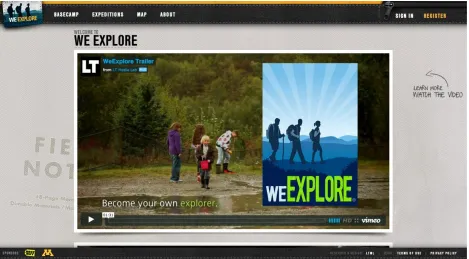
WeExplore (Fig. 3) is a new project by the Learning Technologies Media Lab at the
Vol. 5, May 2013 ISSN: 2151-7452
Figure 3.WeExplore: a user-driven adventure learning environment.
Mobile technologies are also being explored as a means to engage learners in AL and help them form a closer connection with both the natural world and their local community. The
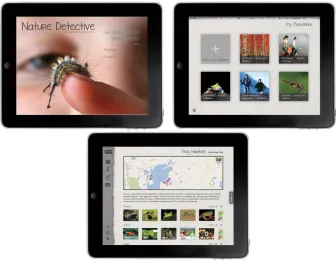
Nature Detective app (Fig. 4) is a mobile AL tool in development that will allow learners to go
Journal of Sustainability Education http://www.susted.org/
Figure 4.Nature Detective app: an adventure learning tool.
Conclusion
Adventure has played a role in sustainability education for more than a century.
Adventure education and adventure learning are two frameworks that offer teachers a means to introduce adventure in formal and informal learning in a pedagogically meaningful way, drawing on experiential and inquiry-based approaches and, in the case of adventure learning,
incorporating the multitude of affordances that technology has to offer as well as the opportunity to practice active problem solving of real-world issues. In both adventure education and
adventure learning, adventure is key. It serves not only as a “hook” to draw the learner or participant into the learning pursuit, but also introduces a challenge to the learner along with an element of risk and uncertainty via the opportunity to embark on an exploration of a specific physical or psychological challenge or a specific location and issue.
The introduction of user-driven adventure learning environments (UDALE) and new online and mobile tools and technologies are making it easier than ever for teachers and learners to create and share with the world their own adventures, and to extend learning well beyond the walls of the classroom. In many respects, UDALE merges components of adventure education and adventure learning, allowing learners the opportunity to engage in their own physical
adventure while concurrently teaching others about a real-world issue, sharing authentic data and narratives, and employing technology for data collection, disbursement, and collaborative
involvement with other learners and field experts.
Vol. 5, May 2013 ISSN: 2151-7452
adventure in sustainability education will lead to refinement of these adventure-in-education models and perhaps initiate a new age of exploration and discovery and a new approach to sustainability education.
References
Allison, P., Stott, T., Felter, J., & Beames, S. (2011). Overseas youth expeditions. In M. Berry & C. Hodgson, Adventure education: An introduction (pp. 187-205). London: Routledge. Berry, M. (2011). Learning and teaching in adventure education. In M. Berry & C. Hodgson,
Adventure education: An introduction (pp. 63-83). London: Routledge.
Berry, M., & Hodgson, C. (2011). Adventure education: An introduction. London: Routledge. Bransford, J., Brown, A., & Cocking, R. (Eds.). (1999). How People Learn: Brain, Mind,
Experience, and School. Washington, DC: National Academy Press.
Bunyan, P. (2011). Models and milestones in adventure education. In M. Berry & C. Hodgson,
Adventure education: An introduction (pp. 5-23). London: Routledge.
Dewey, J. (1938/1997). Experience and education. New York: Simon & Schuster.
Doering, A. (2006). Adventure learning: Transformative hybrid online education. Distance
Education, 27(2), 197–215.
Doering, A. (2007). Adventure learning: Situating learning in an authentic context. innovate, 3(6). Retrieved July 6, 2009, from
http://innovateonline.info/index.php?view=article&id=342&action=article.
Doering, A., & Miller, C. (2009). Online learning revisited: Adventure learning 2.0. In C. Crawford et al. (Eds.), Proceedings of Society for Information Technology and Teacher
Education International Conference 2009 (pp. 3729–3735). Chesapeake, VA: AACE.
Doering, A., Miller, C., & Veletsianos, G. (2008). Adventure Learning: Educational, social, and technological affordances for collaborative hybrid distance education. Quarterly Review
of Distance Education, 9(3), 249-266.
Doering, A., Scharber, C., Riedel, E. & Miller, C. (2010). "Timber for President": Adventure Learning and Motivation. Journal of Interactive Learning Research, 21(4), 483-513. Doering, A., & Veletsianos, G. (2008). Hybrid Online Education: Identifying Integration Models
using Adventure Learning. Journal of Research on Technology in Education, 41 (1), 101-119.
Glaser, B. G., & Strauss, A. L. (1967). The discovery of grounded theory: Strategies for
qualitative research. Chicago: Aldine Pub. Co.
Hattie, J. A., Marsh, H. W., Neill, J. T. & Richards, G. E. (1997). Adventure education and Outward Bound: Out-of-class experiences that have a lasting effect. Review of
Educational Research, 67, 43-87.
Henrickson, J., & Doering, A. (2013 [forthcoming]). Adventure learning and
learner-engagement: Frameworks for designers and educators. Journal of Interactive Learning
Research, 24(4).
Herrington, J., Oliver, R. and Reeves, T. C. (2003). Patterns of engagement in authentic online learning environments. Australian Journal of Educational Technology, 19(1), 59-71. http://www.ascilite.org.au/ajet/ajet19/herrington.html.
James, Thomas. (1980). Can the mountains speak for themselves? Colorado Outward Bound School. Retrieved from http://wilderdom.com/facilitation/Mountains.html
Journal of Sustainability Education http://www.susted.org/ Kemmis, S., & Mutton, R. (2012). Education for sustainability (EfS): Practice and practice
architectures. Environmental Education Research, 18(2), 187-207.
Kolb, D. A. (1984). Experiential Learning: Experience as the source of learning and
development. New Jersey: Prentice Hall.
Koseoglu, S., & Doering, A. (2011). Understanding complex ecologies: an investigation of student experiences in adventure learning programs. Distance Education, 32(3), 339-355. Lombardi, Marilyn M. Authentic learning for the 21st century: An overview. Educause Learning
Initiative. Retrieved from http://net.educause.edu/ir/library/pdf/ELI3009.pdf. Merriam-Webster. (2012). Adventure. Retrieved from
http://www.merriam-webster.com/dictionary/adventure.
Mezirow, J. Transformative Dimensions of Adult Learning. San Francisco: Jossey-Bass, 1991. Miles, J. C., & Priest, S. (1990). Adventure education. State College, PA: Venture Publishing. Miller, C., Veletsianos, G., & Doering, A. (2008). Curriculum at forty below: A
phenomenological inquiry of an educator explorer's experiences with adventure learning in the Arctic. Distance Education, 29(3), 253-267.
Moos, D., and Honkomp, B. (2011). Adventure learning: Motivating students in a Minnesota middle school. Journal of Research on Technology in Education, 43(3), 231–252. Parrish, P., & Botturi, L. (2009). Assessing engagement and aesthetic qualities in learning
experiences. Manuscript in preparation. Retrieved from http://www.comet.ucar.edu/~pparrish.
Sobel, D. (2004). Place-based Education: Connecting Classrooms & Communities. Orion Society. Nature Literacy Series, No. 4.
Veletsianos, G. (2011). Designing opportunities for transformation with emerging technologies.
Educational Technology, 51(2), 41-46.
Veletsianos, G., & Doering, A. (2010). Long-term student experiences in a hybrid, open-ended and problem based Adventure Learning program. Australasian Journal of Educational
Technology, 26(2), 280-296.
Veletsianos, G., Doering, A., & Henrickson, J. (2012). Field-based professional development of teachers engaged in distance education: experiences from the Arctic. Distance
Education, 33(1), 45-59.
Veletsianos, G., & Kleanthous, I. (2009). A review of adventure learning. The International
Review Of Research In Open And Distance Learning, 10(6), 84-105. Retrieved from
http://www.irrodl.org/index.php/irrodl/article/view/755.
Veletsianos, G., Miller, B., Bradley Eitel, K., Eitel, J.U.H. & Hougham, R.J. (2012). Localizing adventure learning: Teachers and students as expedition leaders and members. In P. Resta (Ed.), Proceedings of Society for Information Technology & Teacher Education
International Conference 2012 (pp. 2164-2169). Chesapeake, VA: AACE.
Weir, W. (2004, August). What is adventure? Adventure Cyclist. Retrieved from http://www.adventurecycling.org/resources/whatisadventure.pdf.
Wilson, B. G. & Parrish, P. E. (2011). Transformative learning experience: Aim higher, gain more. Educational Technology, 51(2): 10-15.
Vol. 5, May 2013 ISSN: 2151-7452
Jeni Henrickson
Aaron Doering