Privacy Law
Volume 11
Issue 4
Computer/Law Journal - Winter 1992
Article 2
Winter 1992
Computer Networks, Libel and the First
Amendment, 11 Computer L.J. 555 (1992)
Terri A. Cutrera
Follow this and additional works at:
http://repository.jmls.edu/jitpl
Part of the
Computer Law Commons,
First Amendment Commons,
Internet Law Commons,
Privacy Law Commons, and the
Science and Technology Law Commons
http://repository.jmls.edu/jitpl/vol11/iss4/2
This Article is brought to you for free and open access by The John Marshall Institutional Repository. It has been accepted for inclusion in The John Marshall Journal of Information Technology & Privacy Law by an authorized administrator of The John Marshall Institutional Repository.
Recommended Citation
THE FIRST AMENDMENT
By TERRI
A.
CUTRERA*I. INTRODUCTION
Computer bulletin boards are among the fastest-growing compo-nents of the burgeoning electronic information market in the 1990s. By linking individual personal computers together via modem, computer bulletin boards offer subscribers information and features much like electronic magazines, as well as provide them with electronic mail and shopping services. Along with the emergence of this nascent media has come many legal questions concerning the rights and responsibilities of both computer bulletin board users and operators. One of the most in-teresting questions concerns the liability of computer bulletin board op-erators for false and defamatory statements carried on their systems.
This article will explore the issue of system operator liability for defamatory material published on computer bulletin boards. First the nature of computer bulletin boards will be examined in an effort to dis-cover why defamation is so endemic to this media. The basics of defa-mation law from its common law origins to the first amendment gloss imposed upon it by the Supreme Court will be reviewed. The critical questions as to the legal classification of bulletin board systems-whether they should be considered publishers, broadcasters, private in-formation services, or common carriers-will be examined in light of the legal properties of each type of media. An important recent case, Cubby, Inc. v. Compuserve, Inc.' will be studied to ascertain what direc-tions federal courts are taking in this area. Finally, the methodology of classifying technological advances, the needs of computer users and the interests of computer bulletin board networks will be reviewed in order to recommend one possible solution to the questionable legal status of
* J.D. Candidate, 1993, University of Missouri-Kansas City School of Law; M.A. in
Chemistry, University of Oregon, 1979; B.S. in Earth & Planetary Sciences, Massachusetts Institute of Technology, 1976. The author would like to thank Professor Patricia Harris O'Connor and Professor Nancy Levit for their support and encouragement, both with this paper and throughout law school.
computer information services-that the exact legal relationship and re-sponsibilities between members and providers should be left solely up to the freedom of the parties to contract for services.
II. THE NATURE OF COMPUTER BULLETIN BOARDS
Electronic bulletin board systems are strange, hybrid entities that defy the legal system's propensity to define and pigeon-hole human con-structs. These networks are not exactly like magazines, not exactly like telephone calls, not exactly like television programs, and not exactly like neighborhood coffeehouses. Computer networks are, however, a seductive and proliferating cultural phenomenon.
An electronic information network consists of computers, ranging in size from small PCs to large mainframes, connected via modem to a central node computer which is owned and operated by the system op-erator [sysop]. Sysops can be individual hobbyists, educational institu-tions, governmental departments or even large commercial entities. All that is required to get the system online is a moderate sized personal computer, a modem and any of the large variety of commercially avail-able BBS software.
The relative simplicity and low cost of starting a computer bulletin board has resulted in the creation of numerous boards of varying sizes and constituencies throughout the world. The latest estimate is that 50,000 bulletin boards are currently online in the United States,2 an in-crease of over 35,000 in the last year.3 In fact, online services have be-come so numerous that BOARDWATCH,4 a monthly magazine for BBS
users and operators, publishes only partial lists of national online infor-mation services and supplements this with lists of individuals who keep lists of bulletin boards.
The subject matter of computer bulletin boards is tailored to all tastes-from the general5 to the prurient6 to the arcane.7 This wide
va-2. Oldenburg, Rights on the Line; Defining the Limits on the Networks, WASH. POST,
Oct. 1, 1991, STYLE, at E5.
3. Silver, Action of the Boards, U.S. NEWS & WORLD REP., Nov. 18, 1991, at 96.
4. See generally BOARDWATCH MAG., Mar. 1992. BOARDWATCH is available in most large computer stores or from Boardwatch Magazine, 5970 South Vivian Street, Littleton, Colorado 80127.
5. Good examples of general-interest bulletin boards are services such as Com-puServe, Prodigy and Genie which provide a multitude of services (such as news and in-formation, private electronic messaging, and shopping malls) for their subscribers.
6. Adult bulletin boards such as Lifestyles B.B.S. ("where couples and singles meet and talk dirty"); Pleasure Dome ("sexually explicit fantasy chat system") and Nixpix ("large library of adult GIF graphic images") are among the fastest growing components of the BBS market.
7. Specialty bulletin boards abound covering such eclectic topics as taming exotic
riety of available services undoubtedly accounts for a large part of bul-letin boards' popularity. Although national services offer the greatest choices, most are accessible only through long distance phone numbers causing frequent users to amass large telephone bills. Local computer networks are more topically limited8 but are much cheaper to use on a daily basis. Large commercial enterprises such as Prodigy, launched by a joint venture of Sears and IBM, offer general information services na-tionwide to users via local telephone lines for one flat monthly fee.9 The wide variety of bulletin boards and the economy and user friendly formats of the large national services help account for the growing pop-ularity of computer networking over the last few years.
Another factor contributing to the attractiveness of BBSs is the an-onymity afforded their users. From the privacy of his home a computer networker can connect with other people to discuss anything that strikes his fancy-even sensitive topics-in a frank and open manner. Most bulletin boards allow a subscriber to sign on using a pseudonym or a modification of his name.1 0 Even when a person does use his own name others on the service are unaware of his physical appearance, place of residence or telephone number. This creates the unique oppor-tunity for people to reveal intimate secrets of their lives anonymously to others, without ever having to worry about meeting the "listener" face to face. People also use this situation to alter the facts of their own lives-such as the bachelor on one Atlanta chat line whose clever writ-ing style and description of himself as debonair and wealthy belied the fact that he was living on a disability pension, suffered from cerebral palsy and dictated his remarks to his elderly mother." This example illustrates an axiom of life in the Net: you never know exactly who you are talking to. Any anxiety arising from this situation, however, is more than compensated for by the security gained from realizing that no one knows exactly who you are either.
Federal R&D budget-technical market labor market statistics (Science Resource Studies BBS); and even an online Zen Buddhist Monk/PC consultant (That Old Frog's Swamp).
8. The March 1991 issue of BOARDWATCH MAGAZINE, for example, lists about 180
lo-cal bulletin boards in the Orlando, Florida area. The subject matter of these networks, while still surprisingly diverse, does not represent the wide range offered by national services.
9. Prodigy is now the largest computer bulletin board service, boasting 1.1 million
subscribers. See Charles, Libel Law Comes On-Line, AM. LAW. MEDIA, L.P. THE
RE-CORDER, Jan. 17, 1992, at 8. Prodigy services are available to subscribers for the flat
monthly fee of $12.95.
10. This strategy is widely used by female subscribers who often alter their names to sound more masculine. This is because, sooner or later, most female users find sexually explicit come-ons or slurs in their electronic mailboxes.
The attraction of pursuing interests with kindred spirits, the secur-ity in being able to express thoughts anonymously, and the abilsecur-ity to step outside of oneself and adopt an alter ego all contribute to the popu-larity and allure of computer bulletin boards. Unfortunately, these at-tributes are also the sources of many of the medium's most serious and persistent problems.
III. ILLEGAL ACTIVITIES ON COMPUTER BULLETIN BOARDS
James Madison once commented "[s]ome degree of abuse is insepa-rable from the proper use of everything; and in no instance is this more true than in that of the press.' 12 Computer bulletin boards are the modern equivalents of the 18th century press and their abuses are, in fact, inseparably intertwined with their use. Much attention has been paid in recent years to the illegal use of electronic networks by com-puter criminals, spies and adolescent hackers.'3 In the public percep-tion, such activities as defrauding credit card providers, illegally accessing private systems in order to destroy or pilfer information con-tained therein, posting stolen telephone charge numbers, and releasing virus infestations have all been closely associated with computer bulle-tin board use.
The liability of both the perpetrators and their bulletin board hosts for computer crimes has created much discussion in the legal commu-nity.14 The possibility that a sysop might be held liable for illegal activ-ity on his bulletin board was driven home on May 16, 1984 when the personal computer and data storage devices of Thomas G. Tcimpidis were seized by the Los Angeles police after the bulletin board he oper-ated was found to contain a stolen telephone credit card number.15 Tcimpidis plead not guilty to misdemeanor charges of telephone fraud for "knowingly and willfully publishing" the stolen numbers.16 Charges against Tcimpidis were ultimately dropped by the prosecution who could not prove the scienter elements.17 Although few, if any, sysops have been convicted as a result of illegal activities on their boards, the
12. Madison, Report on the Virginia Resolutions of 1798, quoted in Gertz v. Robert Welch Inc., 418 U.S. 323, 340 (1974).
13. See generally Cutrera, The Constitution in Cyberspace: The Fundamental Rights
of Computer Users, 60 U.M.K.C. L. REV. 139 (1991).
14. See Colleagues Debate Dennings Comments, 34 COM. ACM 33 (March 1991); Bar-low, Crime and Puzzlement: In Advance of the Law on the Electronic Frontier, WHOLE
EARTH REV., Fall 1990; Gemignani, What is Computer Crime and Why Should We Care, 10 U.A.L.R. L.J. 55 (1987).
15. Pollack, Free Speech Issues Surround Computer Bulletin Board Use, N.Y. TIMES,
Nov. 12, 1984, § A, at 1, col. 1.
16. Id.
government has repeatedly seized and impounded the equipment of op-erators when stolen material has surfaced on their systems.18 The
lia-bility debate was recently revitalized due to an unfortunate incident that occurred on America Online19
in December, 1991, when subscribers were found to be exchanging child pornography as downloadable GIF (Graphics Interchange Format) files.2° In this instance the FBI said the traffickers and not America Online were under investigation,2 1 perhaps signaling a change in law enforcement's stand as to sysop liability. As computer crime increases in the years to come, the legal system will need to reach a definitive resolution to the question of a system opera-tor's liability for crimes associated with his bulletin board. At the pres-ent time, however, the answer remains elusive.
As murky as criminal liability for bulletin board operators may be, their possible civil liability is even less clear. Commentators have re-cently proposed making hackers and sysops civilly liable for damages caused by virus releases.22 Other scholars have pondered the complex-ity of copyright infringement when documents are electronically pub-lished, recopied or altered on a computer bulletin board.23 But as anyone who spends much time on the boards can attest, the one issue of civil liability that presents itself most prominently is that for defamation.
Because of the remote nature and the anonymity of bulletin board interactions and also possibly because of the below average social skills of some users,24 discussions on posted topics have a tendency to become very nasty. When people talk person to person they can see each others' expressions and sense each others' mood. Similarly, when peo-ple talk on the telephone, they can hear each others' tone of voice. Opinions read off a computer screen, devoid of any physical human in-teraction, carry a stronger message than if they were said over the
18. See Cutrera, supra note 13.
19. America Online is a national computer bulletin board service with a user friendly
format and about 150,000 members. See Schwartz, Sex Crimes on Your Screen, NEWS-WEEK, Dec. 23, 1991 at 66.
20. See id. See also Lindquist, "Child Porn" Sent on America Online,
COM-PUTERWORLD, Dec. 9, 1991 at 7.
21. See Schwartz, supra note 19.
22. See generally Samuelson, Can Hackers Be Sued for Damages Caused by Computer
Viruses, 32 COM. ACM 666 (1989).
23. See generally Branscomb, Common Law for the Electronic Frontier; Computers,
Networks and Public Policy, ScI. AM., Sept. 1991, at 154; Meeks, As BBSes Mature, Liabil-ity Becomes an Issue, INFOWORLD, Jan. 22, 1990 at 14.
24. See Denning, Concerning Hackers Who Break Into Computer Systems (paper presented at the 13th National Computer Security Conference, Washington, D.C., Oct. 1-4,
phone or face-to-face.25 "The result is a phenomenon that computer ex-perts call 'flaming'-the electronic version of an out-of-control shouting match. '26 A simple discussion about the quality of a movie or a book can quickly degenerate into vicious ad hominem attacks.27 Some serv-ices such as Prodigy attempt to eliminate offensive messages before they are openly posted; but most systems accept flaming as a way of life and rely on the "white corpuscle effect" (users rush to the scene of the infection and eliminate the problem themselves)28 to rid the board of irritants. Some networkers actually enjoy insult matches and a few boards are notorious flamer hang-outs.29
In addition to flaming, bulletin boards are besieged by ubiquitous gossip. Just as neighbors enjoy trading juicy stories over the back fence, network subscribers love to discuss the lives of public figures and well-known computer celebrities. What they do not realize, of course, is that whispering gossip in private is different from publishing it nationwide on a computer bulletin board. It is not uncommon to encounter posted messages from a self-proclaimed "Hollywood insider" discussing which stars have AIDS or from a local flamer listing all of the "verified" homosexuals on the Board.
A third, and perhaps the most potentially litigated, source of defa-mation on computer bulletin boards is the product review/advice col-umns. In these areas either the network itself or one of its agents or contractors reviews and comments on the quality of various computer products and services. Occasionally users will message in and post their own impressions of the items, often without any logical rationale or facts to support their opinions. A good or service trashed on a nation-wide network can suffer a real market loss which can lead to the filing of a defamation suit.3 0
25. Barringer, Electronic Bulletin Boards Need Editing, No They Don't, N.Y. TIMES,
Mar. 11, 1990, § 4, at 4, col. 1, quoting Frank Connolly, director of academic computing at American University in Washington.
26. Id., quoting Eugene Spafford, assistant professor of computer science at Purdue
University.
27. For example, a recent post of the Prodigy (the family network) Movie Club read:
"Only a brainless, spineless, gelatinous cube of flesh like you could like that piece of crap ." Prodigy, Arts Club, Science Fiction Topic, posted Sept. 1990.
28. Oldenburg, supra note 2, quoting Cliff Figallo, manager of The Well (Whole
Earth 'Lectronic Link), a San Francisco based bulletin board.
29. One bulletin board known for free, no holds barred discussions is Usenet, a
world-wide system based on Unix computers and connected to the Internet. Usenet contains nearly a thousand newsgroups, one of which, dedicated to flaming, is called alt.flame. When a flame war gets out of hand on another newsgroup the flamers are told to take their discussion to alt.flame.
In order to assess the liability of bulletin board operators for de-famatory matter published on their services, it is necessary to first un-derstand the basics of defamation law. The tort of defamation which encompasses both slander and libel will be discussed in the next section.
IV. THE COMMON LAW TORT OF DEFAMATION
The history of defamation law is a complex and convoluted one. Originally, the crime of slander was punishable by seigniorial and then ecclesiastical courts as a sin against God.3l In order for the common law courts to claim jurisdiction in a slander case a real, temporal injury sep-arate from the spiritual injury had to be shown.32 Libel actions, on the other hand, arose in the seventeenth century and were punishable as the crime of sedition.33 Because of the political nature of a libel action no actual injury needed to be shown in order for a plaintiff to recover damages.3 4 Due to these separate origins "libel became identified with written or printed defamation while slander remained oral.' '35
The four elements of defamation are (1) a false and defamatory statement about another (2) published without privilege to a third per-son (3) by a publisher who was at least negligent (4) which caused pre-sumed or actual damages.36 In Missouri, for example, "a communication is defamatory if it tends so to harm the reputation of another as to lower him the estimation of the community or to deter third persons from associating or dealing with him.'37 A defamatory communication may consist of a false statement of fact or a statement in the form of an opinion which implies undisclosed defamatory facts.38 Plaintiffs in defamation suits may be any living individual, a definable group of people, or a business corporation. In response to a defamation claim the truth is an absolute defense;39 also certain statements are absolutely privileged and other statements receive a conditional privilege.40
31. Prosser, Libel Per Quod, 46 VA. L. REv. 838, 841 (1960). 32. Id
33. W. PROSSER, ET. AL., TORTS 853 (8th ed. 1988). 34. Id.
35. Id.
36. Thornton, Gerlach & Gibson, Legal Issues in Electronic Publishing: Libel, 36 FED.
COM. L.J. 178 (1984).
37. Henry v. Halliburton, 690 S.W.2d 775, 776 (Mo. 1985), quoting Restatement
(Sec-ond) of Torts § 559. Judge Welliver's opinion in this case is an excellent review of the
common law of defamation.
38. W. PROSSER, supra note 33 at 874. The Missouri Supreme Court takes a more
lib-eral stance and has held that statements of opinion are constitutionally protected from defamation actions. 690 S.W.2d at 786, 787.
39. MO. CONST., art. 1, § 8.
Although modern practice has combined slander and libel under the common tort of defamation, the legal distinction between them re-mains. Determining when an action is slander and when it is libel, how-ever, is far from clear cut. Nevertheless it is important to make this distinction since slander actions require proof of special damages4
' while libel actions do not. Over the years, case law has confused the oral/written test because some non-oral occurrences such as searching a women's handbag have been ruled to be slander42 while some oral com-munications such as dictating a letter have been held to be libel.43 Pro-fessor Prosser concludes that in modern tort law libel is the "embodiment of the defamation is some more or less permanent physi-cal form"44 while slander tends to be more transitory.45 But how does this distinction apply to the world of electronic communications? Elec-tronic signals stored in a computer are transitory. Messages posted on a bulletin board have no permanent, physical form and can be erased in-stantaneously. For these reasons, some commentators have thought-fully pointed out that defamation that occurs in the electronic medium should be considered slander and not libel.46
To this author, the better argument seems to be that electronic messages are printed material-or at least they can become printed ma-terial through a simple "print screen" command--and hence should fall under the auspices of libel. For the remainder of this article, we will assume that defamation on computer bulletin boards is covered by the law of libel. It is important to remember, though, that a defense attor-ney could make a legitimate argument that slander, with its heightened proof of damages standard, should apply to defamatory statements ap-pearing on electronic information services.
V. FIRST AMENDMENT LIMITATIONS ON LIBEL ACTIONS
The First Amendment to the United State Constitution provides:
Congress shall make no law respecting an establishment of religion, or prohibiting the free exercise thereof; or abridging the freedom of speech, or of the press; or the right of the people peaceably to assem-ble, and to petition the Government for a redress of grievances.4 7
41. Exceptions to proof of damages occur for slander per se. Slander per se are de-famatory statements that fall into one of four categories: imputations of major crime, loathsome disease, serious sexual misconduct or questionable business or professional con-duct. Carter v. Wilbert Home Prods., Inc., 714 S.W.2d 506, 509 (Mo. 1986).
42. Bennett v. Norban, 396 Pa. 94, 151 A.2d 476 (1959). 43. Ostrowe v. Lee, 256 N.Y. 36, 175 N.E. 505 (1931). 44. W. PROSSER, supra note 33 at 882.
45. Id
46. See B. SANFORD, LIBEL & PRIVACY 47 (2d ed. 1991).
The existence of free speech and of a free press is generally considered to be one of the paramount rights guaranteed to United States citizens. A tension exists, however, between the right to speak and publish freely and the states' interest in protecting the reputation and privacy of individuals through libel laws.
The Supreme Court has often reiterated that the freedom of speech is not absolute, and has refused to give first amendment protection to speech that represents a clear and present danger to the public wel-fare,48 fighting words,4 9 and obscenity.50 Even on a computer bulletin board dedicated to a wild and free exchange of ideas, most users would agree that some limitations apply to what may be posted. Examples of speech that might not be protected on a computer network are the pub-lication of stolen credit card numbers, graphic displays of child pornog-raphy and false advertising by mail order stores on an electronic shopping network. The question of whether or not libelous bulletin board postings should be included in the list of unprotected speech is debateable. If all statements of fact or of opinion where the writer is not personally, absolutely sure of the true facts were unprotected very few people would be willing to post messages at all. Bulletin board dis-cussions would effectively be stifled.
On the other hand, if egregious falsehoods or insults against an in-nocent person or business were absolutely protected on the boards, the result would turn every system into a chaotic and fundamentally unfair battleground. This dilemma well illustrates the free speech-individual
protection tension that runs throughout this area of jurisprudence. Libel represents a unique and troublesome category of speech with which the Supreme Court has struggled repeatedly in the later half of this century. In Beauharnais v. Illinois5' the Court held that libel was not protected by the first amendment and placed it in the same class of speech as obscenity.52 Later Court decisions53 modified this position and extended some protection to libelous statements, arguing that a harsh enforcement of libel laws has a chilling effect on free speech and the press. Three recent Court decisions are particularly pertinent to the discussion of electronic information services. These cases, New York Times Co. v. Sullivan,54 Gertz v. Robert Welch, Inc.5 5 and Dun &
48. See Whitney v. California, 274 U.S. 357 (1927).
49. See Chaplinsky v. New Hampshire, 315 U.S. 568 (1942).
50. See Alberts v. California, 354 U.S. 476 (1957). 51. 343 U.S. 250 (1952).
52. Id, at 266.
53. See infra notes 54-56.
54. 376 U.S. 255 (1964).
Bradstreet, Inc. v. Greenmoss Builders, Inc.,56 will be discussed in detail in this section.
New York Times v. Sullivan57 marked the first time the Court de-termined the extent to which first amendment protections for speech limited a state's power to award damages in a libel action. The suit arose from a full page advertisement placed in the New York Times by a group of civil rights activists that falsely accused officials of Montgom-ery, Alabama, of having engaged in several repressive and discrimina-tory actions. The question was to what extent the New York Times, as the publisher of the ad, was responsible for the libel. In reaching its de-cision, the Court gave great weight to the political nature of both the plaintiff and the challenged accusations.
The Court held that "the Constitution guarantees... a federal rule that prohibits a public official from recovering damages for a defama-tory falsehood relating to his official conduct unless he proves that the statement was made with 'actual malice'-that is, with knowledge that it was false or with reckless disregard of whether it was false or not."s Notice that this ruling shifts the burden of proof from the defendant, who previously had to show the truth of his statement, to the plaintiff, who now must show that the defendant had actual knowledge or was wilfully blind that the statement was false. This is a very difficult bur-den to meet and since the Times decision was handed down, libel suits by public officials against newspapers have been rare and usually unsuc-cessful. In addition to setting this national standard for malice in libel actions, Times also represented a federal encroachment upon the states' power to define the law of defamation.
In Gertz v. Robert Welch, Inc.59 the Court refused to extend the Times actual malice standard to libel suits that did not involve public officials as plaintiffs. Private individuals, such as Mr. Gertz, could re-cover against media defendants under the libel laws of the forum state so long as the state did not impose liability without fault, but the com-pensation awarded was limited to actual injuries suffered.60 This deci-sion therefore contracted the first amendment protection given to libel defendants in Times by not requiring the plaintiff to prove knowledge
56. 472 U.S. 749 (1985). 57. 376 U.S. 354 (1964). 58. Id. at 279, 280.
59. 418 U.S. 323. Gertz was an attorney who represented the family of a boy killed by
a Chicago police officer. The magazine, AMERICAN OPINION, published by the John Birch Society, was angered by the civil action filed against the police officer and accused Gertz of being a "Leninist" and a "Communist fronter."
of falsity or reckless disregard of the truth as a threshold to recovery.61 However, it also afforded defendants more protection than the common law of libel required by holding that plaintiffs must prove actual dam-ages in order to recover and by not permitting the award of punitive damages in libel actions absent proof of actual malice.62
Justice Powell, writing for the Court in Gertz, seems to be setting up a two-tiered approach to first amendment speech analogous to the Court's recent approaches to substantive due process and equal protec-tion quesprotec-tions.63 According to Powell, libel falls into the second tier of speech which receives some, but not full, first amendment protection. Exactly how much protection libel is afforded is the result of balancing the government's first amendment interest in the type of speech in-volved (political speech, matters of public concern, private speech, etc.) against the nature of the harm to the individual. In the case where a private person is harmed by the libel, Powell stresses the fact that such individuals had never consented to be in the public spotlight as had pub-lic figures and also that they are not capable of meaningful self-help since they are not on equal footing with the defaming medium.64
In Times the Court decided the libel standard when a public official sued a medium over defamation arising out of an issue of public con-cern. In Gertz the Court decided the libel standard when a private indi-vidual sued under similar circumstances-a public medium defamation arising out of a public issue. In Dun & Bradstreet, Inc. v. Greenmoss Builders, Inc.,65 the Court addressed yet another permutation of these factors-a private entity suing another private entity over defamation arising from a matter of private concerns.
Justice Powell writing for the plurality6 in Dun & Bradstreet ap-plied the Gertz balancing test to the facts of the case. When evaluating
61. States, of course, are free to impose the higher standard of proof of actual malice
themselves through their own libel laws. See Henry v. Halliburton, 690 S.W.2d 775.
62. See McDowel v. Credit Bureaus of Southeast Missouri, 747 S.W.2d 630, 633 (Mo. 1988).
63. See generally S. SHIFFRIN & J. CHOPER, THE FIRST AMENDMENT, ch. 3 (1991) for a good discussion of the classification of speech for first amendment purposes.
64. 418 U.S. at 344.
65. 472 U.S. 749 (1985). Dun & Bradstreet, a credit reporting agency, issued a report
to its subscribers erroneously indicating that Greenmoss Builders had filed for bank-ruptcy. Greenmoss was awarded both compensatory and punitive damages at trial.
66. The Court in Dun & Bradstreet was badly split with only Powell, Rehnquist and
O'Connor joining in the plurality opinion. Burger concurred but expressed the view that both Gertz and Times should be re-evaluated. White concurred in the judgment but said Gertz should be overruled and in any event it should not be applied in this case. Brennan, Marshall, Blackmun and Stevens joined in dissent arguing that the first amendment re-quired restraints on presumed and punitive damage awards in all libel suits. 472 U.S. at
the government's first amendment interest in protecting private speech Powell stated that "[i]t is speech on matters of public concern6 7 that is at the heart of the First Amendment protection. In contrast, speech on matters of purely private concern is of less first amendment concern.'as After noting that the private person's interest is just the same in this case as in Gertz, the plurality held that the state interest adequately supported awards of presumed and punitive damages- even absent a showing of actual malice.69 Thus the Court refused to grant any first amendment protection to private speech in these circumstances. Dun & Bradstreet is a confusing case because it offers no guidance about how to proceed in cases where private speech is aimed at a public individual or where private speech is aimed at a private individual but the issue is a matter of public concern.70 Also the Court was so badly split in this de-cision that it is hard to assign much precedential value to the holding at all.
The rules of law derived from the above three cases apply to most types of defendants in libel actions. The rules obviously apply to the news and publishing media because they were the named defendants in
Times and Gertz. Similarly, the cases apply to private publishers be-cause that was the nature of the defendant in Dun & Bradstreet. Fi-nally, broadcasters are expressly included under this legal umbrella because throughout the Gertz decision the Court consistently referred to the type of defendants under consideration as "publishers or broad-casters." Thus when determining what standards apply in a libel action private persons, news and publishing media, private information serv-ices, and broadcasters are all covered by the set of laws developed in
Times, Gertz and Dun & Bradstreet.
One type of communications media whose legal treatment differs significantly from those above is the common carrier. A common carri-ers is "any pcarri-erson engaged as a common carrier for hire, in intcarri-erstate or foreign communication by wire or radio."'71 "For common carrier status (1) there must be a practice of indifferent service by the operator to all whom desire it; and (2) the system must be such that customers can transmit information of their own choice.' 72 Everyday examples of
67. "Whether speech addresses a matter of public concern must be determined by the
expression's content, form and context as revealed by the whole record." 472 U.S. at 761,
quoting from Connick v. Myers, 461 U.S. 138, 147, 148.
68. 472 U.S. at 759. 69. Id. at 763.
70. See Shriffrin, supra note 63, at 90. 71. 47 U.S.C. § 153(h) (1992).
72. Comment, An Electronic Soapbox: Computer Bulletin Boards and the First
Amendment, 39 FED. COM. L.J. 217, 252 (1987), quoting National Association of Regulated
common carriers are telegraph companies, telephone companies and the United States Postal Service.
On a practical level, deciding what falls under the classification of a common carrier is far from clear-cut. Author Paul Berman73 points out that the FCC may not even have a mechanism to reach a binding deci-sion on whether or not a communications medium is a common carrier or if it falls under FCC jurisdiction.74 The inadequacy of the current regulations to embrace modern advances in communications technology is well illustrated by the difficulty the system has had in classifying cable television75-a medium quite similar to computer networks. Many of the cases are finally decided by the federal court system.76
Common carrier status affords more protection to information dis-seminators than even the Times first amendment shield offers.77 The Restatement (Second) of Torts § 612(2) reads:
A public utility under a duty to transmit messages is privileged to do so, even though it knows the message to be false and defamatory, unless
(a) the sender of the message is not privileged to send it, and
(b) the agent who transmits the message knows or has reason to know that the sender is not privileged to publish it.7 8
The main reason for granting immunity from defamation actions to communication common carriers is the desire by the government to make quick and efficient communications services available to every-one.79 If the utility were forced to monitor or censor transmissions, not only would individual privacy be invaded but the dispatch of messages would be slowed almost to a standstill. This conferred immunity also recognizes the practical fact that the "utility does not control or endorse a message, but merely provides a conduit.''80
It is therefore extremely difficult-if not impossible-for a plaintiff to recover in a defamation action against a common carrier. In the
com-73. Berman, Computer or Communications? Allocation of Functions and the Role of
the Federal Communications Commission, in A. OETrINGER, P. BERMAN & W. READ,
HIGH AND Low PoLmcs: INFORMATION RESOURCES FOR THE 80's. (1977).
74. Id. at 185.
75. See Copple, Cable Television and the Allocation of Regulatory Power: A Study of
Government Demarcation and Roles, 44 FED. COM. L.J. 1 (1991).
76. See, e.g., Farmers Educational & Coop. Union of America, North Dakota Div. v.
WDAY, Inc., 360 U.S. 525 (1959) (The Supreme Court granted broadcast stations who air political commentary in compliance with § 315(a) of the Federal Communications Act of 1934 (the equal access provision) limited common carrier status in order to protect them from defamation suits arising from political spots.)
77. Thornton, supra note 36, 179.
78. Restatement (Second) of Torts § 612 (1977).
puter bulletin board context, recovery is conceivable in a situation where on a common carrier bulletin board a user has been legally re-moved from the service, the sysop knows the user is not permitted to sign onto or transmit on the service, but the sysop knowingly posts a message from this user anyway. This would seem to be an unlikely oc-currence. Common carrier status has some drawbacks in that it im-poses on the communication service a variety of governmental regulations and requirements which will be discussed later in this article.
A final class of information disseminators that have been tradition-ally recognized is that of "secondary publishers."8' Examples of secon-dary publishers are newspaper printers and distributors, libraries, newsstands and bookstores. Distributors of publications must take care, however, not to cross over the line and become republishers. "Except as to those who only deliver or transmit defamation published by a third person, one who repeats or otherwise republishes defamatory mat-ter is subject to liability as if he had originally published it."82 Thus if a distributing service recopies or alters original material they will become primary publishers for legal purposes.
Entities qualifying as secondary publishers have no direct control over the content of the material they handle and are considered not lia-ble for defamation "unless they know or have reason to know of the statement's defamatory character.'8 3 Courts have held that requiring distributors of publications to monitor each periodical they distribute would be an impermissible burden on the first amendment.8 4 Notice that by requiring proof of knowledge instead of the lesser Times re-quirement of merely showing reckless disregard, the courts are accord-ing secondary publishers almost common carrier status. Given the nature of secondary publisher's contacts with the libelous materials, in conjunction with the higher standard of proof, it would be extremely difficult to meet this burden of proof at trial.
A problem may be looming on the horizon for secondary publish-ers. As a class of speech, libel has often been compared to obscenity. In recent Supreme Court cases Justice Scalia has advocated permitting legal sanctions against secondary publishers of pornographic material
81. See W. PROSSER, supra note 33 at 894; Dworkin v. Hustler Mag., Inc., 611 F. Supp. 781 (D. Wyo. 1985).
82. Restatement (Second) of Torts § 578 (1977).
83. Lerman v. Chuckleberry Pub., Inc., 521 F. Supp. 228, 235 (S.D.N.Y. 1981);
Thorn-ton, supra note 36, at 179.
84. See e.g., Lerman v. Flynt Distrib. Co., 645 F.2d 123, 139 (2d Cir. 1984), cert. denied, 471 U.S. 1054 (1985). This is just one of a line of cases, stretching back to the nineteenth
century, absolving secondary publishers from liability for defamatory material absent
even if no one work in the store is shown to be obscene and even if the store owner did not know any work was obscene.s5 So far, his opinions have not been accepted by a majority of the Court, but with the recent changes in Court personnel and the ascendancy of Scalia's influence and views, this may soon change. If the Court were willing to impose legal penalties upon secondary publishers of obscenity just because of the "feel" of their business, it is possible they would impose the same liabil-ity upon secondary publishers of libelous materials in situations where the bulk of a store's business was in "scandalous" or outrageous publications.
VI. THE LEGAL IDENTITY OF COMPUTER BULLETIN
BOARDS
As discussed in the last section, the laws of libel vary according to the nature of litigants bringing the action. In electronic publishing, therefore, the first test for liability is the medium of each defendant.86 The difficulty in litigation concerning computer bulletin boards is that they have never been legally defined as belonging to any one type of communication disseminator. In fact, computer information services have attributes similar to several different media as well as characteris-tics unique to themselves. Making matters worse, no two bulletin boards are exactly the same. Some service providers, such as Prodigy with its special features, news articles, editorial columns and the like, are more like magazines; while others, such as Usenet which does not even have an identifiable group in charge, are more like common carri-ers. Large national networks like CompuServe are undoubtedly public media, but a small bulletin board run out of a sysop's basement with only a few dozen members is probably a private publisher. All of these variations make an explicit categorization applicable to all computer in-formation services quite elusive. In this section the relative advantages and disadvantages of each potential legal classification will be discussed.
A. ELECTRONIC PUBLISHERS
Computer bulletin boards are most often likened to electronic pub-lishers.8 7 In fact the Prodigy service openly claims that it is an elec-tronic magazine, and exercises a publisher's right to censor and reject submitted postings.8 8 As a publisher with a large national circulation,
85. FW/PBS v. Dallas, 493 U.S. 215 (1990) (Scalia, dissenting).
86. Thornton, supra note 36, at 178.
87. See Meeks, supra note 23. Meeks cites an Office of Technology report that clearly
states that bulletin boards are a publishing medium.
88. Prodigy's censorship policy has caused much anger and disaffection among its
sub-scribers. See Reidy, Computer Flap: Is Speech Free on Prodigy?, BOSTON GLOBE, Jan. 30,
such a bulletin board would fall under the TimeslGertz standards. The first questions to ask then in a libel action would be whether the plain-tiff is a private person or a public figure.
The answer to that question is not as simple as it seems. A com-puter user who is maligned on a board is certainly a private person in the common sense of the word. However, whether or not he should be granted private person status for legal purposes is debatable under the rationale employed by the Court in Gertz. In Gertz, the Court gave two justifications for the heightened need of the state to protect a private person. The first was that private persons were unable to effectively pursue "self-help"- that is, they were not on equal footing with the li-beler so as to defend themselves.8 9 That may be true when an average person is facing the New York Times, but it is not so true when the li-bel appears on a computer bulletin board. Computer services are ex-tremely egalitarian media. A defamatory message posted on a bulletin board can be answered, almost immediately, by a reply posted in the same manner on the same bulletin board. In fact, the problem of flam-ing on the boards indicates that not only are people not shy about de-fending themselves, they have a problem knowing when to stop doing so. Therefore, the concern over a private person's inability to respond to the libel is not as great when dealing with an electronic information service as when dealing with a hard copy publisher.
The second rationale in Gertz for offering publishers less first amendment shielding when the plaintiff is a private person was that public officials hold themselves up to public scrutiny and ridicule, while private people do not.9° Electronic bulletin boards are not a pervasive media. In order to come to the attention of others on the board you must seek out the service, connect it to your computer, sign a member-ship agreement and initiate contact with other users. After signing on, a user can read messages already on the board and see that postings oc-casionally attract nasty responses. If that user nevertheless chooses to post a message, an act that invites response, he might be deemed to have waived his private status and be holding himself up for comment from other subscribers. For these reasons, the underlying rationale in Gertz is not compelling when considering libel that appears on a com-puter bulletin board. A user suing an electronic publisher for libel should be required to meet the Times standard of proof-that the oper-ator knew the defamoper-atory statement was false or that he was willfully reckless to the possibility that it was false.
This argument, of course, is not applicable to situations where the plaintiff is not a member of the bulletin board service but is instead a
89. 418 U.S. at 344.
commercial enterprise or a non-service member. A commercial enter-prise would most likely be considered a public figure and hence bur-dened to prove actual malice under the Times test. A private non-member maligned on the boards would most likely qualify for the Gertz standard, but the defamation of such persons on a computer bulletin board would probably be rare.
Proving a large computer service's liability for defamation under the Times standard would be very difficult. Given the volume of elec-tronic mail such a service must handle and the short time window in which messages are expected to be posted, an agent of the service does not have enough time to read every message. In order to recover, a plaintiff would have to show not only that the service had read this par-ticular message, but that they actually knew it was defamatory. The management of large services know this and their smugness in their relative security is somewhat annoying. For example, the following message was posted on the Genie law issues bulletin board:
The PRODIGY service (gotta respect those trademarks!) holds itself out as a publisher, and thus controls its content, but nowhere does it claim to review EVERY message before it appears on a bulletin board. Thus there is a question of whether Prodigy can be liable for some-thing it doesn't know about. Put another way, Prodigy claims the RIGHT to control the content of its bulletin boards (and I'll dispute whether this can accurately be deemed "censorship"), but does not as-sume an OBLIGATION to monitor them. This is the same standard that applies to any sysop, just more pro-actively applied. -Bill Schneck (who happens to be Counsel for Prodigy Services Company, but is
off-duty right now).9 1
Prodigy wants to have its cake and eat it too. It would be hard to imag-ine an attorney for the New york Times stating that the Times editors were under no obligation to read what they printed. By over-relying on the difficulty of proving a case against them, large computer informa-tion services may be inviting government regulainforma-tion.
One of the main advantages of publisher status is that the new-smedia is subject to little government regulation. Of course, the usual limitations on speech that is not protected by the first amendment ap-ply (for example, false advertising, obscenity), but little else in the way of content regulation constrains what can be published. The FCC regu-lates the newsmedia collaterally, by refusing to issue broadcast station licenses to corporations within the same area in which that corporation owns a local newspaper.92
91. W. Schneckl, Genie Service, Legacy Roundtable, Category 3, Topic 14, Message 11,
April 1, 1991, 22:57 EST.
B. PRIVATE INFORMATION SERVICES
Bulletin boards provide a variety of information services such as stock market prices, sports scores, news and weather to their subscrib-ers. These services are available to all members of the network. This is quite similar to Dun & Bradstreet's business in Dun & Bradstree4 Inc.
v. 0reenmoss Builders, Inc. where credit reports were sent to the agency's subscribers. Dun & Bradstreet was held to be a private mation service on the basis of the number of clients to whom the infor-mation was given.93 While Justice Powell commented that Dun & Bradstreet might have been held to be addressing a matter of public concern if their reports had been generally distributed among the popu-lation, he gave no clue as to just how many subscribers an information service must have before it is considered to be public.9 4 All that can be
said for certain is that five subscribers-the number who received the Dun & Bradstreet report-are not enough. Computer bulletin boards operated by a single system operator and having a closed membership list with only a few members would probably be considered a private information publisher.
Private information publishers are not constrained nor regulated by the government any more than is a private individual. They are also not shielded from libel actions in the name of the first amendment, as are media publishers. For that reason there is no particular advantage in a computer bulletin board seeking this kind of classification.
C. BROADCAST MEDIA
The classification of broadcast media which encompasses such enti-ties as television and radio stations is probably the least advantageous legal classification for a computer bulletin board to receive. Some of a bulletin board's services are analogous to broadcast station program-ming, however. For example, many bulletin boards have regularly scheduled, live chat-lines hosted by a system employee or even a guest celebrity. Users type in their comments and questions and the result is very much like a call-in radio program.
The libel standard for broadcast stations falls under the Times95 and Gertz9 6 cases, so speech on these media do receive some degree of first amendment protection. The main drawback to this classification is that broadcasters are subject to extensive government regulations
93. 472 U.S. at 759.
94. Id at 762.
under a "public trustee/public interest" standard.97 The FCC was given authority to regulate the broadcast media under Title III of the Com-munications Act of 1934.98 The rationale for allowing the government to have such broad regulatory powers, even when they openly restrict content and thus conflict with the first amendment guarantee of free speech,99 are two-fold: the available spectrum of radio and television frequencies is limited and thus must be allocated responsibly; and the pervasive broadcast media exposes people to its programming without their consent and so the government has a duty to protect citizens from offensive broadcasts.1°° This reasoning is generally considered anti-quated'01 and has been strongly attacked both from within the FCC and from the federal judiciary.10 2 The Supreme Court, however, continues to defer to the judgment of Congress and the FCC as to how much reg-ulatory control of the broadcast media they require.'0 3
Because electronic signals travel over coaxial cable or optical fiber from one modem to another, computer information services are neither a pervasive media nor a spectrum limited broadcaster. Another reason sometimes given to justify federal regulation of broadcasting-the fear of a monopoly gaining too much power through control of the me-dia'°4-is also unconvincing in the computer bulletin board context. The cost of starting a bulletin board is so low105 that a thriving, compet-itive market is developing. For these reasons it seems unlikely that computer bulletin boards will ever seek or be given broadcast media status.
D. COMMON CARRIERS
As previously discussed, common carriers enjoy the greatest protec-tion from libel acprotec-tions. It is difficult to say how closely computer bulle-tin boards meet the common carrier model. The primary function of a
97. Nadel, A Technology Transparent Theory of the First Amendment and Access to
Communications Media, 43 FED. COM. L.J. 157, 158 (1991).
98. See Berman, supra note 73, at 180.
99. See I. POOL, supra note 92, at 134. Examples of FCC content regulation are the restrictions on what subjects may be discussed over amateur radio bands (Lafayette Radio Elec. Corp. v. United States, 345 F.2d 278 (2d Cir. 1965)) and the warning to a radio station
by the FCC not to play George Carlin's record of "seven dirty words" (FCC v. Pacifica
Found., 438 U.S. 726 (1978)).
100. See Kapor, Civil Liberties in Cyberspace; Computers, Networks and Public Policy, Sci. AM., Sept. 1991, at 158.
101. Id.
102. See FCC v. League of Women Voters, 468 U.S. 364 n.11 (1984) (Brennan, J.).
103. Id.
104. See I. POOL, supra note 92, at 116.
common carrier is the "transmission or carriage of signals from place to
place along the paths of the network."'1 6
Other operations that attend this function, such as the switching of signals and the design of signal receivers, are referred to as "services incident to carriage".10 7
Since its inception the telephone company has been allowed to engage in both signal transmission and service incident to carriage. The services inci-dent to carriage, however, have become increasingly computerized and increasingly difficult to distinguish from a computer information network.
The FCC attempted to resolve the issues of government regulatory control over the emerging data processing market and also the degree to which the telephone company should be permitted to develop this technology for their own usels in Computer Inquiry I and Computer Inquiry 11.109 The result of these inquiries was that traditional common
carriage was redefined as "basic" services while incidental computer service was defined as "enhanced" service.1 10 AT&T was allowed to
enter the enhanced services market only through a separate subsidiary."'
On a computer bulletin board, the underlying carrier signal that transmits electronic impulses from modem to modem is the basic com-mon carriage provided by the telephone company. Some of the services provided by the bulletin board itself might be classed as "enhanced" services. Examples of services that might be considered enhanced com-mon carriage could be e-mail, chat-lines, and simple display of posted messages. Other services, however, such as news and weather, product reviews and bulletin boards that are pre-censored by the sysop would probably be above and beyond the enhanced services rubric. The net result is that some very basic computer networks might be deemed common carriers while more sophisticated boards could at best be de-scribed as "quasi common carriers"-a status considered for television cable operators.1 1 2
Federal regulation of common carriers has traditionally be confined to rate regulation and setting service areas that must be served by the utility. In that aspect, the FCC already regulates computer bulletin
106. Berman, supra note 73, at 148. 107. Id,
108. Id. at 155.
109. See generally Blaszak, Chairman, Strategy for Users in the Post Divestiture, Com-puter II Inquiry Environment, in TELECOMMUNICATIONS COMMON CARRIERS IN A COMPET-ITIVE ERA 1019-28 (1983) for a discussion of the impact of Computer Inquiry II on the
communications field. 110. Id.
111. Id
boards somewhat through its regulation of the underlying telephone system. Content regulation by common carriers has historically not been allowed, but this may be changing due to the current debate about limiting consumer access to "dial-a-porn" numbers over the telephone."3
In summary, common carrier status would afford maximum protec-tion from libel suits with a moderate amount of addiprotec-tional federal regu-lation. The drawbacks to common carrier status would be that system operators could not deny access to their boards to anyone-short of a legal adjudication--and operators could not refuse to run a message re-gardless of its inappropriate or offensive content. Furthermore, because common carrier status cannot be elected but must be conferred by the FCC and because the FCC has been very frugal in granting entities this status, it seems unlikely that computer bulletin boards will be classed as common carriers in the near future.
E. SECONDARY PUBLISHERS
Secondary publishers have the enviable position of being protected by a libel standard of proof that is very difficult to meet coupled with a relative lack of government regulation. The problem is that the defini-tion of a secondary publisher is fairly specific and only a limited number of business types can qualify. Any republishing of the original defamatory material will cause the secondary publisher to lose its pro-tected status. The question becomes whether the placing of a member's message on a bulletin board constitutes a republishing. If a service, like Prodigy, claims editorial control over messages then it is much more likely to be deemed a republisher than a service who merely posts, without reviewing, every message that is sent in. The application of sec-ondary publisher rules to service features other than the public boards will be discussed in connection with the Cubby, Inc. v. Compuserve, Inc. case."x4 The classification of secondary publisher is legally advanta-geous, but due to its limited scope there probably will only be a small number of computer bulletin boards, or portions of computer informa-tion services, that will meet its definiinforma-tional requirement.
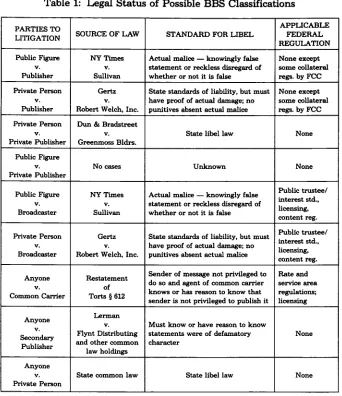
Table 1 summarizes the laws and regulations that apply to each possible classification for an electronic bulletin board. As already dis-cussed, the standard for libel varies not only with the type of defendant but also with the nature of the plaintiff.
113. See State Regulation to MFJ," Audiotext Standards Pose Complex Problems, COM.
DAILY, July 26, 1988, at 2 (strong argument that the telephone companies should not take responsibility for dial-a-porn content).
Table 1: Legal Status of Possible BBS Classifications
PARTIES TO SOURCE OF LAW APPLICABLE
STANDARD FOR LIBEL FEDERAL
LITIGATION REGULATION
Public Figure NY Times Actual malice - knowingly false None except
v. v. statement or reckless disregard of some collateral Publisher Sullivan whether or not it is false regs. by FCC Private Person Gertz State standards of liability, but must None except
v. v. have proof of actual damage; no some collateral Publisher Robert Welch, Inc. punitives absent actual malice regs. by FCC
Private Person Dun & Bradstreet
v. v. State libel law None
Private Publisher Greenmoss Bldrs. Public Figure
v. No cases Unknown None
Private Publisher
Public trustee/ Public Figure NY Times Actual malice - knowingly false interest std.,
v. v. statement or reckless disregard of
Broadcaster Sullivan whether or not it is false cening content reg.
Public trustee/ Private Person Gertz State standards of liability, but must interest std.,
v. v. have proof of actual damage; no licensing,
Broadcaster Robert Welch, Inc. punitives absent actual malice
content reg.
Sender of message not privileged to Rate and A n R e do so and agent of common carrier service area o Co knows or has reason to know that regulations;
sender is not privileged to publish it licensing
Anyone Lerman
v. Must know or have reason to know
V. Flynt Distributing statements were of defamatory None Secondary and other common character
Publisher law holdings
Anyone
v. State common law State libel law None Private Person
With this information as background, it is interesting to look at the federal court's decision in Cubby, Inc. v. Compuserve, Inc. ,115 a case that
represents the first time the judiciary was asked to determine the legal identity of a computer information service.
VII. CUBBY, INC. V. COMPUSERVE, INC.
In October, 1991, United States District Judge Peter Leisure of the Southern District of New York granted CompuServe's motion for
mary judgment in the first libel case against a nationwide computer ser-vice to reach district court.16 This holding received national attention not only in the computer community but in the public press as well."i 7 The court's reasoning in reaching its decision and the precedential value of the holding are worth close examination.
CompuServe Information Service, the defendant in the litigation, is a subsidiary of H & R Block, Inc. and is headquartered in Columbus, Ohio.1 1 8 CompuServe was one of the first nationwide computer services
and now claims over 868,000 subscribers.1 9 Included in CompuServe's service are over one hundred and fifty special interest forums, com-posed of electronic bulletin boards, interactive on-line conferences, and topical data bases.120 These forums are provided by independent con-tractors who agreed to control their contents in accordance with edito-rial and technical standards set by CompuServe.121 This particular business arrangement is relatively unique among computer bulletin board systems.
The Journalism Forum is provided to CompuServe by Cameron Communications Inc., a company based in Darien, Connecticut.122
To add to its forum, Cameron buys a daily computer newsletter called
"Rumorville, U.S.A.", produced in San Francisco, by Don Fitzpatrick Associates.123 Rumorville carries reports about broadcast journalism
and journalists.124
In 1990 the plaintiffs in this action, Cubby Inc. and Robert Blanchard, jointly developed "Skuttlebut," a computer data base designed to carry news of the journalism industry, with the intent to compete directly with Rumorville for subscribers.125 On several occa-sions in April, 1990, Rumorville published items about the plaintiffs that were carried on the CompuServe service nationwide.'2 6 Claiming
116. Cubby, Inc. v. CompuServe, Inc., 776 F. Supp. 135 (S.D.N.Y. 1991).
117. See Charles, Libel Law Comes On-Line, RECORDER, Jan. 17, 1992, at 8; Feder,
To-ward Defining Free Speech in the Computer Age, N.Y. TIMES, Nov. 3, 1991, § 4, at 5, col. 1;
Jackson, CompuServe Picked It's Fight in Libel Case, UMI DATA COURIER, Nov. 18, 1991, § 1, at 4; Picarille, BBS Not Liable for Libel, Court Says, INFOWORLD, Nov. 11, 1991, 130;
Provider of On-Line Information Service Wins Dismissal of Unfair Competition Claim
ANTITRUST & TRADE REG. REP., Nov. 14, 1991 [hereinafter Provider].
118. Jackson, supra note 117. 119. Feder, supra note 117.
120. Provider, supra note 117. 121. Id.
122. Charles, supra note 117.
123. Id.
124. 776 F. Supp. at 137.
125. Provider, supra note 117.
126. Rumorville carried a statement saying that Skuttlebut "gained access to