Dr. Abbas Taher
Dept of OMF Surgery, Faculty of Dentistry, University of Kufa, Iraq
E-mail: [email protected]
Address for correspondence
Access this article online www.japer.in
Valsartan modulates the inflammatory response and apoptosis
and protects from cerebral ischemia Reperfusion injury
Introduction
The term ischemia reperfusion injury (IRI) describes the experimentally and clinically prevalent finding of tissue ischemia with inadequate oxygen supply followed by successful reperfusion initiates a wide and complex array of inflammatory responses that may both aggravate local injury as well as induce impairment of remote organ function 1. Ischemia-reperfusion injury contributes to the pathophysiology of many conditions, include the different forms of acute vascular occlusions such as stroke, myocardial infarction, peripheral vascular insufficiency and hypovolemic shock With the relevant reperfusion strategies like thrombolytic therapy, coronary
angioplasty, cardiopulmonary bypass and operative revascularization 2. Cerebral ischemia leads to energy depletion and cell death, which can stimulate immune responses, leading to inflammatory cells activation and infiltration. Reperfusion of the occluded vessel, either spontaneously or by the collateral circulation or by therapeutic recanalization, leads to the generation of reactive oxygen species (ROS) that are delivered with the reperfused oxygenated blood or produced within brain and immune cells. ROS can then stimulate ischemic cells, even ischemic neurons, to secrete inflammatory chemokines and cytokines that enhance the biosynthesis of adhesion molecule in the cerebral vasculature and also lead to peripheral leukocyte recruitment 3. As inflammatory cells become activated, they can release a variety of cytotoxic molecules including more cytokines, matrix metalloproteinases (MMPs), nitric oxide (NO) and more ROS. These molecules may provoke more cell damage as well as disruption of the extracellular matrix and blood-brain Research
ResearchResearch
Research ArticleArticleArticleArticle
Objectives: The objective of this study is to investigate the possible cerebroprotective potential of valsartan in brain ischemia reperfusion injury via interfering with inflammation and oxidative pathway and apoptosis.
Materials and Methods: Adult albino rats were randomized into four groups as follow: Group (1) sham group: the rats were subjected to the same surgical procedures as other groups but the common carotid arteries were not occluded; Group (2) control (ischemic-reperfused) group: the rats were subjected to the same surgical procedures as other groups with bilateral common carotid artery occlusion (BCCAO) for 30 min. followed by reperfusion for 1 hr but without drug; Group (3) control vehicle group: ten days before surgery, rats received daily the vehicle of valsartan drug, normal saline (0.9% Nacl) (1 ml/kg/day) intraperitoneally, then anesthesia and surgery with BCCAO for 30 min. followed by reperfusion for 1 hr were done and Group (4) valsartan treated group: rats received daily valsartan intraperitoneally. The dose of valsartan was (3 mg/kg /day) for ten days before the surgery, then anesthesia and surgery with BCCAO for 30 min. followed by reperfusion for 1 hr.
Results: At the end of the experiment, the levels of cerebral TNF-α, IL-6, IL-10,Caspase-3,Bax,MDA,CD4 and MPO significantly (p < 0.05) increased in control group as compared with the sham group and the level of cerebral GSH significantly (p < 0.05) decreased in control group as compared with the sham group, while there was insignificant difference in cerebral levels of CD8 between the four experimental groups. Histopothological analysis showed that rats in control group showed significant cerebral injury. Treatment with valsartan significantly counteracted the increase in the cerebral levels of TNF-α, IL-6, IL-10,Caspase-3,Bax,MDA,CD4 and MPO and the decrease of GSH .Histopathological analysis revealed that valsartan significantly (P < 0.05) reduced the severity of cerebral injury in the rats underwent BCCAO.
Conclusions: The results of the study revealed that inflammatory cytokines, apoptosis pathways and oxidative stress mediators are involved in global cerebral ischemia induced by bilateral common carotid artery occlusion. Cerebral ischemia reperfusion injury can be modified by valsartan via its anti-inflammatory, anti-apoptosis and anti-oxidant effects.
Keywords: Cerebral ischemia reperfusion injury, inflammation, apoptosis , oxidative stress, valsartan
ABSTRACT ABSTRACT ABSTRACT ABSTRACT
Najah R Hadi*, Hashim T. Raheem1, Karrar J Kareem2,
Kahlaa A Kadhim3
Abbas Taher4
*Najah R Hadi, Dept of Pharmacology and Therapeutics, Faculty of Medicine, University of Kufa, Iraq
1Hashim R Taresh Raheem Dept of
Microbiology Faculty of Medicine, University of Kufa, Iraq
2Khalaa Kadim, Dept of
Microbiology Faculty of Medicine, University of Kufa, Iraq
3Karrar K Dept of Pharmacology
and Therapeutics, Faculty of Medicine, University of Kufa, Iraq
4Abbas Taher, Dept of OMF
Surgery, Faculty of Dentistry, University of Kufa, Iraq
barrier (BBB) 4,5. Secondary ischemic brain damage occurs as a consequence of brain edema and post-ischemic microvascular stasis leading to hypoperfusion and post-ischemic inflammation 6,7. The recruitment of peripheral circulating leukocytes into the brain parenchyma can produce an augmentation of inflammatory signal cascades, which will enhance the damage. These processes are mainly prominent during reperfusion which is often associated with microvascular injury, particularly due to increased permeability of capillaries and arterioles that lead to an increase of fluid filtration across the tissues. These activated endothelial cells produce more ROS following reperfusion, and results in a subsequent inflammatory response. White blood cells, carried to the area by the newly returning blood, release a mass of inflammatory factors such as interleukins (ILs) as well as free radicals in response to tissue damage. The restored blood flow reintroduces oxygen within cells that damages cellular proteins, DNA, and the plasma membrane. Damage to the cell's membrane may in turn causes the release of more free radicals. ROS may also act indirectly in redox signaling to turn on apoptosis. White blood cells may also bind to the endothelium of small capillaries, obstructing them and leading to more ischemia 8,9. Early restoration of blood flow remains the treatment of choice for limiting brain injury following ischemic stroke. Improved educational efforts that emphasize the early signs and symptoms of stroke, coupled with the widespread application of thrombolytic therapy to patients with acute ischemic stroke have increased the number of patients benefiting from reperfusion 10. While reperfusion of the ischemic brain is desirable, tissue damage may result from reperfusion only. Reperfusion appears to enhance the inflammatory response and causes additional injury to adjacent brain tissue 11. From experimental stroke, blocking various aspects of the inflammatory cascade has shown to improve injury 8.valsartan is an angiotensin II receptor antagonist (ARB) with particularly high affinity for the angiotensin type I (AT1) receptor.
valsartan has shown helpful effects on vasoconstriction, proliferation, endothelial function, remodeling and thrombogenesis, inflammation and atherosclerosis 12.
Materials and methods
Animals
The study was performed using 24 Adult albino rats weighting (200-250 g), provided by the animal house of high institute of infertility diagnosis and assisted reproductive technologies / Al-nahrain University. The rats were housed in the animal house of College of pharmacy/ Kufa University, in a room in which lighting was controlled (12 hr on, 12 hr off), temperature was kept at (25±1°C) and humidity was kept at (60–65%) with unlimited access to food and water until the start of experiments. The Animal Investigation Committee(AIC) office of Kufa university approved the experimental protocol.
Preparation of valsartan
Valsartan was supplied by (Pioneer co. Sulaymanieyah/Kurdistan Iraq), and was prepared immediately before use by dissolving it in normal saline.
Experimental groups
After one week of acclimatization, the rats were divided randomly into four groups (6 rats in each group) as follow: Group(1) sham group: The rats were subjected to the same surgical procedures as other groups but the common carotid arteries were not occluded ; Group(2)control (ischemic-reperfused) group: The rats were subjected to the same surgical procedures as other groups with bilateral common carotid artery occlusion (BCCAO) for 30 min. followed by reperfusion for 1 hr but without drug; Group(3)control vehicle group:
intraperitoneally (iP). The dose of valsartan was (3 mg/kg /day) for te days before the surgery 14, then anesthesia and surgery with BCCAO for 30 min. followed by reperfusion for 1 hr were done.
Induction of global brain ischemia
Each rat was anesthetized by intraperitoneal (iP) injection of 100 mg/kg of ketamine and 5 mg/kg of xylazine 15. Within few min, the rat became unconscious, then placed in supine position and exposed to light source to keep it worm. After that a midline ventral small skin incision in the neck was made and the paratracheal muscles and fascia were splitted and pulled by stay sutures to expose the trachea, carotid arteries and vagal nerves. Both common carotid arteries were exposed, with special attention paid to separate and preserve the vagus nerve fibers and global cerebral ischemia was induced by BCCAO 16 by using vascular clamps for 30 min. After 30 min of global cerebral ischemia, the clamps were removed to allow the reflow of blood through carotid arteries (reperfusion) for 1 hr 17.
Preparation of samples
Tissue preparation for TNF-α, IL-6, IL-10, Caspase-3
,Bax ,CD4,CD8, MPO-ANCA IgG, ,MDA and GSH
measurement
After decapitation, the brain was removed and washed in cold normal saline (0.9% Nacl) to remove any blood or debris and subsequently blotted on filter paper. Afterward, brain tissues were homogenized in ice-cold 1:10 (w/v) 0.1 M phosphate-buffered saline (PBS) (pH 7.4), containing 1× protease inhibitor cocktail and 0.2% Triton X-100 for 30 seconds, using a high intensity ultrasonic liquid processor. The resulting homogenates were centrifuged at 15,000 g
for 30 min, at 4°C, and supernatants were stored at −80°C until analysis was done18.
Tissue preparation for histopathological analysis
and Scoring of brain damage
After 30 min. ischemia and 60 min. reperfusion, decapitation was done and the brain was removed and fixed with 10% formalin and embedded in
paraffin wax and cut into coronal sections of 4-8μm thickness. The sections were stained with haematoxylin and eosin (H&E) dye for histopathological examination that was done by pathologist. The scoring system for the pathological changes in ischemia reperfusion injury isas follows19 : 0:(normal) = no morphological signs of damage; 1:(slight) = edema or eosinophilic or dark neurons (pyknotic) or dark/ shrunk cerebellar Purkinje cells; 2:(moderate)= at least two small hemorrhages; 3:(severe) = clearly infarctive foci (local necrosis).
Statistical analysis
All data are expressed as mean ± SEM. The difference between various groups were analyzed by one-way analysis of variance (ANOVA) followed by multiple comparison tests as Post Hoc. LSD. Non- parametric tests were used to assess the statistical significance of histopathological parameter. Cerebral lesions is a non-normally distributed variable. The Fisher exact test is used when members of two independent groups can fall into one of two mutually exclusive categories. The test is used to determine whether the proportions of those falling into each category differ by group. In all tests P< 0.05 was considered to be statistically significant.
Results
Effect on inflammatory markers (TNF-α, IL-6, IL-10)
Figure (1): Error bar chart shows the difference in mean± SEM values of cerebral TNF-α level (pg/mg)
in the four experimental groups at the end of the experiment (No. of animals = 6 in each group). * P <
0.05 vs. sham group, ** P < 0.05 vs. control-vehicle group.
Figure (2): Error bar chart shows the difference in mean± SEM values of cerebral IL-6 level (pg/mg) in
the four experimental groups at the end of the experiment (No. of animals = 6 in each group). * P <
0.05 vs. sham group, ** P < 0.05 vs. control-vehicle group.
Figure (3): Error bar chart shows the difference in mean± SEM values of cerebral IL-10 level (pg/mg) in
the four experimental groups at the end of the experiment (No. of animals = 6 in each group). * P <
0.05 vs. sham group, ** P < 0.05 vs. control-vehicle group.
Effect on apoptptic markers (caspase-3 and Bax)
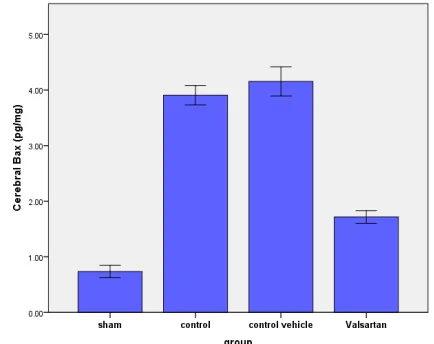
At the end of the experiment, the levels of cerebral caspase-3 and Bax significantly (P<0.05) increased in control group as compared with sham group. The levels of cerebral caspase-3 and Bax of valsartan treated group were significantly (p<0.05) lower than that of control-vehicle group. The values of cerebral caspase-3 and Bax are shown in figures (4 and 5).
Figure (4): Error bar chart shows the difference in mean± SEM values of cerebral caspase-3 level (pg/mg) in the four experimental groups at the end of the experiment (No. of animals = 6 in each group). * P < 0.05 vs. sham group, ** P < 0.05 vs. control-vehicle group.
Effect on oxidative stress markers (MDA and GSH)
At the end of the experiment, the level of cerebral MDA significantly (P<0.05) increased in control group as compared with sham group, while the level of cerebral GSH significantly (P<0.05) decreased in control group as compared with sham group. The level of cerebral MDA of valsartan treated group was significantly (p<0.05) lower than that of control-vehicle group, while the level of cerebral GSH of valsartan treated group was significantly (p<0.05) higher than that of control-vehicle group. The values of cerebral MDA and GSH are shown in figures (6 and 7).
Figure (6): Error bar chart shows the difference in mean± SEM values of cerebral MDA level (pg/mg) in
the four experimental groups at the end of the experiment (No. of animals = 6 in each group). * P <
0.05 vs. sham group, ** P < 0.05 vs. control-vehicle group.
Figure (7): Error bar chart shows the difference in mean± SEM values of cerebral GSH level (pg/mg) in
the four experimental groups at the end of the experiment (No. of animals = 6 in each group). * P <
0.05 vs. sham group, ** P < 0.05 vs. control-vehicle group.
Effect on CD4+T-Lymphocytes
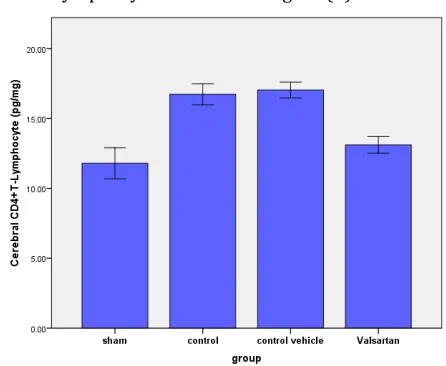
At the end of the experiment, the level of cerebral CD4+T-Lymphocytes significantly (P<0.05) increased
in control group as compared with sham group. The level of cerebral CD4+T-Lymphocytes of valsartan
treated group was significantly (p<0.05) lower than that of control-vehicle group. The value of cerebral CD4+T-Lymphocytes is shown in figure (8).
Figure (8): Error bar chart shows the difference in
mean± SEM values of cerebral CD4+T-Lymphocytes
level (pg/mg) in the four experimental groups at the end of the experiment (No. of animals = 6 in each
group). * P < 0.05 vs. sham group, ** P < 0.05 vs. control-vehicle group.
Effect on CD8+T-Lymphocytes
At the end of the experiment, there was insignificant
difference in cerebral level of CD8+T-Lymphocytes
between the four experimental groups. The value of
cerebral CD8+T-Lymphocytes is shown in figure (9).
Figure (9): Error bar chart shows the difference in
level (pg/mg) in the four experimental groups at the end of the experiment (No. of animals = 6 in each
group).
Effect on Myeloperoxidas-Antineutrophil
Cytoplasmic Antibody IgG ( MPO -ANCA IgG)
At the end of the experiment, the level of cerebral
MPO significantly (P<0.05) increased in control group
as compared with sham group. The level of cerebral
MPO of valsartan treated group was significantly
(p<0.05) lower than that of control-vehicle group. The
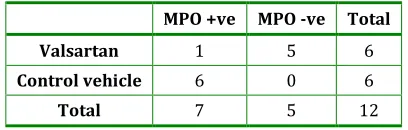
changes in cerebral MPO is shown in table (1).
Table 1: Relation between valsartan and control vehicle groups regarding MPO.
MPO +ve MPO -ve Total
Valsartan 1 5 6
Control vehicle 6 0 6
Total 7 5 12
The fisher exact statistic value is significant at p<0.05.
Histopathological findings
The cerebral injury was assessed in the rat's brain
of the four experimental groups according to 19 and
the results were as follow: In the sham group, a cross
sections of rat's brain showed normal appearance
(100%) as shown in table (2) and figure (10).
Statistically, there was significant difference between
control group and sham group, and the score of the
control group showed that (66.6%) of the group had
severe cerebral injury , (16.7%) had moderate
cerebral injury and (16.7%) had slight cerebral injury
as shown in table (2) and figure (10). Statistically,
there was insignificant difference between control
group and vehicle control group , and the score of the control vehicle group showed that (33.3%) had severe
cerebral injury, (50%) had moderate cerebral injury
and (16.7%) had slight cerebral injury as shown in
table (2) and figure (10). pretreatment of rats with
valsartan improved cerebral injury score significantly
as compared with control vehicle group and the score
of this group showed that (16.7%) had normal
histopathological appearance, (66.6%) had slight
cerebral injury and (16.7%) had moderate injury as
shown in table (2) and figure (10 and 11). The
histopathological cerebral changes are shown in
figures (11-16).
Table 2: The differences in histopathological grading of abnormal cerebral changes among the four
experimental groups. Histopathologicl Score Groups Sham Control Control vehicle Valsartan N % N % N % N % Score 0(normal) 6 100 0 0 0 0 1 16.7 Score 1(slight) 0 0 1 16.7 1 16.7 4 66.6 Score2(moderate) 0 0 1 16.7 3 50 1 16.7 Score 3(sever) 0 0 4 66.6 2 33.3 0 0 Total 6 100 6 100 6 100 6 100
Figure 10: Component bar chart shows the relative frequency of different histopathological grading of
abnormal cerebral changes among the four experimental groups.
Figure 11: A Photomicrograph of normal rat's brain section shows normal tissue and the histopathological
score =0. The section stained with H&E (X 40).
Figure 12: Photomicrograph of rat's brain section after global cerebral ischemia shows edema(black
0% 10% 20% 30% 40% 50% 60% 70% 80% 90% 100%
Sham Control Control vehicle Valsartan
H is to p a th o lo g ic a l D a m a g e sc o re
Total severity score
severe
moderate
arrow) and the histopathological score = 1 (Slight injury). The section stained with H&E (X 40).
Figure 13: Photomicrograph of rat's brain section after global cerebral ischemia shows edema(black
arrow) and hemorrhage(red arrow). The histopathological score = 2 (Moderate injury). The
section stained with H&E (X 40).
Figure 14: Photomicrograph of rat's brain section after global cerebral ischemia shows edema(black arrow) and neutrophil infiltration(blue arrow). The
histopathological score = 2 (Moderate injury). The section stained with H&E (X 40).
Figure 15: Photomicrograph of rat's brain section after global cerebral ischemia shows edema(black arrow), hemorrhage(red arrow) and area of necrosis
and destructed neuron(green arrow). The histopathological score = 3 (Moderate injury). The
section stained with H&E (X 40).
Figure 16:Photomicrograph for brain tissue of rats treated with valsartan drug shows mild edema (slight
injury). The histopathological score =1 .The section stained with H&E (X 40).
Discussion
Effect of global cerebral ischemia reperfusion
injury on inflammatory mediators (TNF-α, 6,
IL-10)
In the present study, a significant increase (P< 0.05) in
the inflammatory cytokine (TNF-α , IL-6 and IL-10)
level was found in the control group as compared
with the sham group. Chu et al. (2012) 20 showed that
transient global cerebral IRI resulted in a substantial
increase in the mRNA expression levels of TNF-α and
IL-6 in the rat hippocampus. Jing et al. (2012) 21 data
indicate that inflammatory response was initiated
after transient cerebral ischemia and the release of
inflammatory cytokines such as IL-6 and TNF-α
occurred in the brain. Higher IL-6 levels have been
detected in the peripheral blood of patients with acute
cerebral ischemia than in control subjects 22,23.
Increased plasma and cerebrospinal fluid IL-6 levels
are correlated with a larger infarct size 22.Zingarelli et
al.(2001) 24 established that the anti-inflammatory
properties of endogenous IL-10 include negative
modulation of secretion of proinflammatory TNF-α
and IL-6, endothelial expression of P-selectin and
ICAM-1, with consequent reduction of neutrophil
infiltration and related oxidative and nitrosative
stress. Zhai et al.(1997) 25 demonstrated that IL-10
and TNF-α gene expression is induced early following
MCAO, where TNF-α induces 10, subsequently
Effect of global cerebral ischemia reperfusion
injury onapoptotic markers (caspase-3 and Bax)
In the present study, a significant increase (P< 0.05) in
cerebral levels of Caspase-3 and Bax were found in the
control group as compared with the sham group.
Caspase-3 has been identified as a key mediator of
apoptosis in animal models of ischemic stroke. Asahi
et al.(1997) 26 demonstrated upregulation of
caspase-3 mRNA in rat brain 1 hr after the onset of focal
ischemia. In addition, Namura et al.(1998) 27 detected
caspase-3 and its cleavage products in mouse brain
during early reperfusion after 2 hr MCAO.
Importantly, comparable observations have been
extended to ischemic human brain tissue in that
caspase-3 was upregulated after ischemia 28. Liu et
al.(2013) 29 concluded that cerebral IRI may cause
neurological impairment and causes neuron apoptosis
that may be associated with the activation of
caspase-3 and Bax and the down regulation of Bcl-2. Bax has
been demonstrated to promote apoptosis, whereas
Bcl-2 is important for cell survival and antiapoptotic
effects 30.Liu and Yang. (2004)31 established that the
expression of Bax mRNA in ischemic group was
increased significantly as compared with sham group.
Yin et al.(2013) 32 showed that the pro-apoptotic
protein Bax content in brain tissues of ischemic
reperfused group was markedly elevated as compared
with sham-operated animals.
Effect of global cerebral ischemia reperfusion
injury onoxidative stress markers (MDA and GSH)
In the current study, a significant increase (P< 0.05)
in cerebral level of MDA was found in the control
group as compared with the sham group; while there
is a significant decrease (P< 0.05) in cerebral level of
GSH for the control group as compared with sham
group. It is well documented that transient global
cerebral ischemia results in neurological abnormality
and BCCAO for 30 min followed by 45 min of
reperfusion was associated with increase generation
of ROS and free radicals (Raghvendra et al., 2009) 33.
In agreement with our observation, Vekaria et
al.(2012) 34 found that BCCAO for 30 min, followed by
reperfusion for 45 min showed increase in MDA in
brain affected by ischemic-reperfusion injury in
controlled group which suggested enhanced lipid
peroxidation. Cosar et al.(2014) 35 demonstrated that
when cerebral ischemia was performed via the
occlusion of bilateral internal carotid artery for 45
minutes and continued with reperfusion process ,the
MDA levels increased from sham group to IR group
and the GSH levels decreased from sham to IR group.
In the study of Vekaria et al.(2012)34, they observed
that GSH levels decreased in hippocampus of ischemic
rats (BCCAO control group) as compared to sham
operated group. It has been shown that depletion in
GSH levels in IRI can be attributed to several factors
such as cleavage GSH levels to cysteine, decrease in
synthesis of GSH and formation of mixed disulfides,
causing their cellular stores to be depleted 36. Also
Mukherjee et al.(2007) 37 and Cosar et al.(2014) 35
observed that the GSH levels decrease due to cerebral
IRI.
Effect of global cerebral ischemia reperfusion
injuryon T-Lymphocytes
In the current study, a significant increase (P< 0.05) in
cerebral level of CD4+ T- lymphocyte was found in the
control group as compared with the sham group, but
there was insignificant changes in cerebral level of
CD8+ T- lymphocyte in the control group as
compared with the sham group. T lymphocytes are
central to the development of a sustained
inflammatory response and there is now good
evidence that these cells accumulate in the post
ischemic brain within a few hr of reperfusion 38. Liesz
et al. (2011b) 39 also reported significant reduced
infarct volumes in mice depleted of T helper and T
cytotoxic cells following permanent ischemia. Thus,
these findings suggest that both T helper and T
cytotoxic cells contribute to the development of brain
injury following stroke. Alison .(2006) 40 study
strongly implicated both T lymphocytes and IFN-γ as
key participants in the microvascular dysfunction and
tissue injury that result from transient focal ischemia
Winerdal et al.(2012)42 demonstrated that the initial
influx of T-lymphocytes was dominated by CD4+
T-helper cells, followed one week later by CD8+ cytotoxic
T-cells. These are mainly in agreement with our
results, where a significant increase in cerebral level
of CD4+ T- lymphocyte was found in the control
group, but there was insignificant changes in cerebral
level of CD8+T- lymphocyte. The differences seen
could be explained by the time of ischemia and
reperfusion, where in our experiment, the time of
ischemia was 30 min and the time of reperfusion was
1 hr.
Effect of global cerebral ischemia reperfusion
injury on MPO-ANCA IgG
In the current study, a significant increase (P< 0.05) in
cerebral level of MPO-ANCA IgG was found in the
control group as compared with the sham group. MPO
activity, which is an essential enzyme for normal
neutrophil function that is released as a response to
various stimulations 43, was evaluated by Cosar et
al.(2014)35who found that cerebral ischemia via the
occlusion of bilateral internal carotid artery for 45
minutes and followed by reperfusion process, caused
the MPO levels to increase from sham group to
ischemic reperfused group. After MCAO for 2 hr, Chen
et al.(2012) 44 measured MPO activity at 6 and 24 hr
of reperfusion, and found that neutrophil infiltration
was significantly higher in the ischemic reperfused
group than in the sham group.Annapurna et al.(2013)
45 demonstrated that MPO activity was increased
significantly in control vehicle group when compared
to sham group and was correlated positively with
infarct size.
Effect of global cerebral ischemia reperfusion
injury on cerebral histopathology
There was a statistically significant difference
between control group and sham group. The score of
the control group shows slight and moderate cerebral
injury. From the histopathological study of Prakash et
al.(2011) 46, it was observed that sections of brain
tissue showed swollen neurons, dilated blood vessels
with neuronal loss occurred in brain regions of
ischemic reperfused rats induced by BCCAO for 30
min followed by 1 hr and 4 hr reperfusion in ischemic
control group . While no apparent morphological
changes in sham and brain section showing normal
structure. Chandrashekhar et al.(2010) 17
demonstrated that global cerebral ischemia on rats by
BCCAO for 30 min followed by 1 hr reperfusion caused
marked congestion of blood vessels and neutrophil
infiltration and neuronal necrosis. Shah et al . (2005)
47 found that in BCCAO for 30 min, caused marked
congestion of blood vessels and these effects were
further augmented following reperfusion for 1hr i.e.
lymphocytic proliferation and neuronal necrosis.
Effect of valsartan on study parameters
Effect of valsartan on inflammatory markers (TNF
α , IL-6 and IL-10)
The present study showed that valsartan
administration before the induction of cerebral
ischemia caused a significant lowering (P<0.05) in
cerebral level of TNF-α, IL-6 and a significant increase
(P<0.05) in IL-10 as compared with control and
control vehicle group. So our results indicated that
valsartan, an ARB, can prevent cerebral inflammation
and decrease ischemic brain damage. This finding is in
consent with Saavedra et al. (2006) 48 who strongly
suggested that inhibition of AT(1) receptors
considered as a preventive therapeutic measure to
protect the brain from ischemia, and as a possible
novel therapy of inflammatory conditions of the brain.
Wu et al(2001) 49 showed that valsartan attenuated
the expression of MCP-1, TNF-α, IL-6, IL-1β, and
infiltration of leukocytes and macrophages in the
injured arteries; these results suggested that the
stimulation of the AT(2) receptor after AT(1) blockade
is important in the improvement of the inflammatory
vascular injury. Kikuchi et al.(2012) 50 stated that
cerebral inflammation was also prevented by
valsartan, and this was associated with suppression of
inflammatory cytokines such as MCP-1 and TNF-α by
valsartan.Peeters et al.(1998)51 found that the AT(1)
receptors antagonist , valsartan, has potent inhibitory
production of inflammatory cytokines, TNF-α and IL-6
in vitro. Santiago et al.(2008) 52 suggested a possible
anti-inflammatory effect for valsartan in colitis via
modulation of the immune system. In their study
valsartan treatment caused an upregulation in the
gene expression of IL-10, a cytokine which is known to
be therapeutic in colitis, confirmed by an increase in
IL-10 positive cells staining by immunohistochemistry
in the valsartan treated animals. To the best of our
knowledge, there is no data available about the effect
of valsartan on IL-10 in global cerebral IRI.
Effect of valsartan on apoptotic markers (caspase-3
and Bax)
The current study showed that valsartan
administration before the induction of cerebral
ischemia caused a significant decrease (P<0.05) in
cerebral level of Caspase-3and Bax as compared with
control and control vehicle group . So our results
indicated that valsartan can reduce cerebral apoptosis
and decrease ischemic brain injury. Kikuchi et
al.(2012)50stated that valsartan prevented neuronal
apoptosis, and this was associated with the
suppression of apoptosis signal-regulating kinase 1
activation by valsartan. Tang et al.(2013) 53 found that
in the primary cultured neurons, in which the in vitro
ischemic reperfused model was established, Ang II
increased the ratio of bcl2/bax in mRNA expression
and valsartan was shown to inhibit cell apoptosis.
Experimental and clinical studies have revealed that
ARB has protective effects against ischemic brain
injury, but the mechanism is still obscure. ARB may
also have effects on neurogenesis through the
activation of unblocked AT II type 2 receptors54.
Wakai et al.(2011) 54 showed that Val significantly
suppressed superoxide production and cytochrome C
release into the cytosol after transient forebrain
ischemia and consequently attenuated ischemic
neuronal damage without affecting the blood pressure
in rats. Their results suggest that valsarta has
neuroprotective effects on ischemic injury through the
suppression of oxidative stress and mitochondrial
injury.
Effect of valsartan on oxidative stress markers
(MDA and GSH)
The current study showed that valsartan
administration before the induction of cerebral
ischemia caused a significant lowering (P<0.05) in
cerebral level of MDA and a significant increase
(P<0.05) in GSH as compared with control and
control vehicle group. So our results indicated that
valsartan can attenuate oxidative damage of the brain.
This finding is in agreement withYang et al.(2014)55
who showed that valsartan significantly restored SOD
and GSH activities and reduced MDA level in cortex
and hippocampus indicating attenuation of oxidative
stress and attenuate oxidative damage.Li et al.(2008)
56 established that MCAO increased superoxide
production in the ischemic area of the brain, and
temporary treatment with valsartan attenuated
superoxide production, where as continuous
treatment with valsartan decreased oxidative stress.
Jiao et al.(2011) 57 revealed that valsartan exhibited
renoprotective effects through restoring the levels of
oxidative stress relevant molecules (GSH,SOD and
MDA), results suggested that the renoprotective
effects of valsartan may be related to its potential in
decreasing oxidative stress . Qin et al.(2011) 58
showed that in rats with vascular dementia induced
by BCCAO, valsartan increased the activities of SOD
and GSH and decreased MDA activities in hippocampal
tissues. The damages in structure, number and volume
of hippocampal neuron cells were reduced by
valsartan.
Effect of valsartan on T-Lymphocytes
The current study showed that valsartan
administration before the induction of cerebral
ischemia caused a significant changes (P<0.05) in
cerebral level of CD4+ T-Lymphocytes and
insignificant changes in cerebral level of CD8+
T-Lymphocytes as compared with control and control
vehicle group. This effect of valsartan on
T-lymphocyte could be due to its pleotropic effect as
anti-inflammatory, anti-oxidant and anti-apoptotic
available about the effect of valsartan on CD4+ and
CD8+ T-Lymphocytes in global cerebral IRI.
Effect of valsartan on MPO-ANCA IgG
The current study showed that valsartan
administration before the induction of cerebral
ischemia caused a significant lowering (P<0.05) in
cerebral level of MPO as compared with control and
control vehicle group. This could be due to its
anti-inflammatory effect via suppression of anti-inflammatory
cytokines such as MCP-1 andTNF-α 59,50. To the best of
our knowledge, there is no data available about effect
of Val on MPO on global cerebral IRI .
Effect of valsartan on brain histopathology
In the current study, pretreatment with valsartan for
10 days before cerebral ischemia ameliorated the
brain injury significantly as compared with control
group. Li and Zhou. (2010) 60 found that the cerebral
neuron damage of spontaneously hypertensive rats
whose ultrastructure showed cell-pyknosis, chromatin
margination and typical apoptotic body formation
were alleviated after the intervention of valsartan.Qin
et al.(2011) 58 showed that the damages in structure,
number and volume of hippocampal neuron cells were
reduced by valsartan.
Acknowledgement
We are grateful for everyone help us in our work.
References
1. Neary P, Redmond HP. (1999) Ischaemia–
reperfusion injury and the systemic inflammatory
response syndrome. Ischaemia–Reperfusion Injury,
Oxford: Blackwell Science; 123–136.
2. Bernard SA, Gray TW, Buist MD, et al. (2002)
Treatment of comatose survivors of out-of hospital
cardiac arrest with induced hypothermia. N Engl J
Med; 346: 557–63.
3. Carden DL and Granger DN. (2000) Pathophysiology
of ischemia-reperfusion injury. Louisiana State
University Health Sciences Center; 190(3):255-66.
4. Danton GH & Dietrich WD (2003) Inflammatory
mechanisms after ischemia and stroke. J
Neuropathol Exp Neurol 62, 127–136.
5. Emsley HC, Tyrrell PJ.(2002) Inflammation and
infection in clinical stroke. J Cereb Blood Flow
Metab; 22 :1399–1419.
6. Dirnagl U, Iadecola C, Moskowitz MA.(1999)
Pathobiology of ischaemic stroke: an integrated
view. Trends Neurosci; 22 : 391–397.
7. Siesjo BK, Siesjo P. (1996) Mechanisms of secondary
brain injury. Eur J Anaesthesiol; 13:247–268.
8. Han HS, Yenari MA.(2003) Cellular targets of brain
inflammation in stroke. Curr Opin Investig Drugs; 4:
522–529.
9. Adhiyaman V, Alexander S.(2007) Cerebral
hyperperfusion syndrome following carotid
endarterectomy. QJM; 100(4):239-44.
10. Davis SM, Hand PJ, Donnan GA.(2007) Tissue
plasminogen activator for ischaemic stroke: highly
effective, reasonably safe and grossly underused.
Med J Aust; 187 :548–549.
11. Schaller B, Graf R. (2004) Cerebral ischemia and
reperfusion: the pathophysiologic concept as a basis
for clinical therapy. J Cereb Blood Flow Metab; 24:
351–371.
12. De Gasparo M.(2000) New basic science initiatives
with the angiotensin II receptor blocker valsartan. J
Renin Angiotensin Aldosterone Syst;1(2) :3-5.
13. Imanishi T, Kobayashi K, Kuroi A, Mochizuki S, Goto
M, Yoshida K, Akasaka T.(2006) Effects of
angiotensin II on NO bioavailability evaluated using a
catheter-type NO sensor. 48(6) :1058-65.
14. Iwai M, Liu HW, Chen R, Ide A, Okamoto S, Hata R,
Sakanaka M, Shiuchi T, Horiuchi M.(2004) Possible
inhibition of focal cerebral ischemia by angiotensin II
type 2 receptor stimulation. Circulation; 110: 843–
848.
15. Terao S, Yilmaz G, Stokes KY, Russell J, Ishikawa M,
Kawase T, Granger DN: Blood cell-derived RANTES
mediates cerebral microvascular dysfunction,
inflammation, and tissue injury after focal
ischemia-reperfusion. Stroke 2008, 39:2560-70.
16. Tang H, Tang Y, Li N, Shi Q, Guo J, Shang E, Duan JA.
(2014) Neuroprotective effects of scutellarin and
scutellarein on repeatedly cerebral
ischemia-reperfusion in rats. Pharmacol Biochem Behav; 118
:51-9.
17. Chandrashekhar VM, Ranpariya VL, Ganapaty S,
Parashar A, Muchandi AA. (2010) Neuroprotective
model of ischemia in rats. J Ethnopharmacol; 127(3)
:645-51.
18. Famakin B, Mou Y, Spatz M, Lawal M, Hallenbeck J.
(2012) Downstream Toll-like receptor signaling
mediates adaptor-specific cytokine expression
following focal cerebral ischemia. J
Neuroinflammation; 9 :174.
19. Pokela.M. (2003) Predictors of brain injury after
experimental hypothermic circulatory arrest .An
experimental study using a chronic porcine
model.Department of Surgery, University of Oulu
:47-49.
20. Chu K , Yin B,Wang J ,Peng G ,Liang H ,Xu Z,Du Y,
Fang M,Xia Q and Luo B.(2012) Inhibition of P2X7
receptor ameliorates transient global cerebral
ischemia/ reperfusion injury via modulating
inflammatory responses in the rat hippocampus.
Journal of Neuroinflammation;9:69.
21. Jing YH, Hou YP, Song YF and Yin J.(2012)
Methylprednisolone improves the survival of new
neurons following transient cerebral ischemia in
rats. Acta Neurobiol Exp ; 72: 240–252.
22. Tarkowski E, Rosengren L, Blomstrand C, Wikkelsö
C, Jensen C,Ekholm S, Tarkowski A. (1997)
Intrathecal release of pro- and anti-inflammatory
cytokines during stroke. Clin Exp Immunol ; 110
:492-499.
23. Kim, Y.H., Kim, E.Y., Gwag, B.J., Sohn, S., and Koh,
J.Y.(1999) Zincinducedcortical neuronal death with
features of apoptosis and necrosis:mediation by free
radicals. Neuroscience; 89 :175–182.
24. Zingarelli B, Yang Z, Hake P W, Denenberg A, Wong H
R. (2001) Absence of endogenous interleukin 10
enhances early stress response during
post-ischaemic injury in mice intestine Gut; 48 :610–622.
25. Zhai QH, Futrell N, Chen FJ. (1997) Gene expression
of IL-10 in relationship to TNF-alpha, IL-1beta and
IL-2 in the rat brain following middle cerebral artery
occlusion. J Neurol Sci; 152 :119 –124.
26. Asahi M, Hoshimaru M, Uemura Y, Tokime T, Kojima
M, Ohtsuka T, Matsuura N, Aoki T, Shibahara K,
Kikuchi H. (1997) Expression of interleukin-1 beta
converting enzyme gene family and bcl-2 gene family
in the rat brain following permanent occlusion of the
middle cerebral artery. J Cereb Blood Flow Metab;
17: 11–18.
27. Namura S, Zhu J, Fink K, Endres M, Srinivasan A,
Tomaselli KJ, YuanJ, Moskowitz MA.(1998)
Activation and cleavage of caspase-3 in apoptosis
induced by experimental cerebral ischemia. J
Neurosci1; 8 :3659–3668.
28. Rami A, Sims J, Botez G, Winckler J. (2003) Spatial
resolution of phospholipid scramblase 1 (PLSCR1),
caspase-3 activation and DNA-fragmentation in the
human hippocampus after cerebral ischemia.
Neurochem Int; 43 : 79–87.
29. Liu G, Wang T, Wang T, Song J, Zhou Z. (2013) Effects
of apoptosis-related proteins caspase-3, Bax and
Bcl-2 on cerebral ischemia rats. Biomedical Reports;(6)
:861-867.
30. Wang P, Fang H, Chen J, Lin S, Liu Y, Xiong X,
Wang Y, Xiong R, lv F, Wang
Jhttp://www.jimmunol.org/content/192/10/4783.f
ull - aff-6 and Yang Q. (2014)
Polyinosinic-Polycytidylic Acid Has Therapeutic Effects against
Cerebral Ischemia/Reperfusion Injury through the
Downregulation of TLR4 Signaling via TLR3. The
Journal of Immunology; 192 : 4783-4794.
31. Liu B, Yang G.(2004) Effects of
L-tetrahydropalmatine on the expressions of bcl-2 and
bax in rat after acute global cerebral ischemia and
reperfusion. J Huazhong Univ Sci Technolog Med Sci;
5 :445-8.
32. Yin J, Tu C, Zhao J, Ou D, Chen G, Liu Y, Xiao X. (2013).
Exogenous hydrogen sulfide protects against global
cerebral ischemia/reperfusion injury via its
anti-oxidative, anti-inflammatory and anti-apoptotic
effects in rats.Central South University; 1491
:188-96.
33. Raghavendra M, Maiti R, Kumar S, Trigunayat A,
Mitra S, Acharya SB. (2009) Role of Centella asiatica
on cerebral post-ischemic reperfusion and long-term
hypoperfusion in rats. Int J Green Pharm; 3 : 88-96.
34. Vekaria RH, Patel MN, Bhalodiya PN, Patel V, Desai
TR,Tirgar PR. (2012) Evaluation of neuroprotective
effect of coriandrum sativum linn. against
ischemic-reperfusion insult in brain. International Journal of
Phytopharmacology; 2:186-193.
35. Cosar M, Kaner T, Sahin O, Topaloglu N, Guven M,
Aras AB, Akman T, Ozkan A, Sen HM, Memi G, Deniz
M .(2014) The neuroprotective effect of Sulindac
after ischemia-reperfusion injury in rats. Acta Cir
36. Nagini, Subapriya.(2003) Antioxidant approach to
disease management and the role of 'Rasayana'
herbs of Ayurveda. J Ethnopharmacology; 99:
165-78.
37. Mukherjee PK, Ahamed KF, Kumar V, Mukherjee K,
Houghton PJ.(2007) Protective effect of biflavones
from Araucaria bidwillii Hook in rat cerebral
ischemia/reperfusion induced oxidative stress.
Behav Brain Res;178 :221-8.
38. Brait VH, Jackman KA, Walduck AK, Selemidis S, Diep
H, Mast AE, Guida E, Broughton BRS, Drummond GR,
Sobey CG.(2010)Mechanisms contributing to
cerebral infarct size after stroke: gender,
reperfusion, T lymphocytes, and Nox2-derived
superoxide. J Cereb Blood Flow Metab; 30 :1306–
1317.
39. Liesz A, Zhou W, Mracsko E, Karcher S, Bauer H,
Schwarting S, Sun L, Bruder D, Stegemann S,
Cerwenka A, Sommer C, Dalpke AH, Veltkamp R.
Inhibition of lymphocyte trafficking shields the brain
against deleterious neuroinflammation after stroke.
Brain. 2011b; 134: 704–720.
40. Alison E B.( 2006) The Forgotten Lymphocyte:
Immunity and Stroke. American Heart Association;
113:2035-2036.
41. Lai LW, Yong KC, Igarashi S, Lien YH. (2007) A
sphingosine-1 phosphate type 1 receptor agonist
inhibits the early T-cell transient following renal
ischemia-reperfusion injury; 71(12):1223-31.
42. Winerdal M, Winerdal ME, Kinn J, Urmaliya V,
Winqvist O, et al. (2012) Long Lasting Local and
Systemic Inflammation after Cerebral Hypoxic
ischemia in Newborn Mice . PLoS ONE; 7(5) : 36422.
43. Winterbourn CC, Kettle AJ. (1988) Reactions of
myeloperoxidase with superoxide and hydrogen
peroxide: significance for its function in the
neutrophil. Basic Life Sci; 49 :823-7.
44. Chen Y, Wu X, Yu S, Lin X, Wu J, Li L, Zhao J, Zhao
Y.(2012) Neuroprotection of tanshinone IIA against
cerebral ischemia/reperfusion injury through
inhibition of macrophage migration inhibitory factor
in rats. PLoS One ; 7(6) :40165.
45. Annapurna A, Ansari MA, Manjunath PM. (2013)
Partial role of multiple pathways in infarct size
limiting effect of quercetin and rutin against cerebral
ischemia-reperfusion injury in rats. European
Review for Medical and Pharmacological Sciences;
17: 491-500.
46. Prakash T, Kotresha D, and Nedendla R R. (2011)
Neuroprotective activity of Wedelia calendulacea
on cerebral ischemia/reperfusion induced oxidative
stress in rats. Indian J Pharmacol; 2011; 43(6) : 676–
682.
47. Shah ZA, Gilani RA, Sharma P, Vohora SB. (2005)
Cerebroprotective effect of Korean ginseng tea
against global and focal models of ischemia in rats. J
Ethnopharmacol; 101(1-3) :299-307.
48. Saavedra JM, Benicky J, Zhou J. (2006) Mechanisms
of the Anti-Ischemic Effect of Angiotensin II AT( 1 )
Receptor Antagonists in the Brain. Cell Mol
Neurobiol; 26 :1099-111.
49. Wu L, Iwai M, Nakagami H, Li Z, Chen R, Suzuki J,
Akishita M, de Gasparo M, Horiuchi M. (2001) Roles
of angiotensin II type 2 receptor stimulation
associated with selective angiotensin II type 1
receptor blockade with valsartan in the
improvement of inflammation-induced vascular
injury. Circulation ;104(22) :2716-21.
50. Kikuchi K, Uchikado H, Morioka M, Murai Y, and
Tanaka E.(2012) Clinical Neuroprotective Drugs for
Treatment and Prevention of Stroke. Int J Mol Sci;
13(6): 7739–7761.
51. Peeters AC, Netea MG, Kullberg BJ,Thien T and
Vander M. (1998) The effect of renin-angiotensin
system inhibitors on pro- and anti-inflammatory
cytokine production. Immunology; 94 :376-379.
52. Santiago OI, Rivera E, Ferder L, Appleyard CB. (2008)
An angiotensin II receptor antagonist reduces
inflammatory parameters in two models of colitis.
Regul Pept ; 146(1-3) :250-259.
53. Tang M, Zhao L, Chen Y, Wang L, Zhang X. (2013)
Angiotensin II protects cortical neurons against
oxygen-glucose deprivation-induced injury in vitro.
DOI ;182 :112-116.
54. Wakai T, Yoshioka H, Yagi T, Kato T, Kinouchi H.
(2011) Effects of valsartan on neuroprotection and
neurogenesis after ischemia. Neuroreport; 22(8) :3
85-90.
55. Yang WN, Hu XD, Han H, Shi LL, Feng GF, Liu Y, Qian
YH. (2014) The effects of valsartan on cognitive
deficits induced by aluminum trichloride and
56. Li JM, Mogi M, Iwanami J, Min LJ, Tsukuda K, Sakata
A, Fujita T, Iwai M, Horiuchi M.(2008) Temporary
pretreatment with the angiotensin II type 1 receptor
blocker, valsartan, prevents ischemic brain damage
through an increase in capillary density. Stroke ;
39(7):2029-36.
57. Jiao B, Wang YS, Cheng YN, Gao JJ, Zhang QZ.(2011)
Valsartan attenuated oxidative stress, decreased
MCP-1 and TGF-β1 expression in glomerular
mesangial and epithelial cells induced by
high-glucose levels. Biosci Trends; 5(4):173-81.
58. Qin DL, Deng S, Zhang Z, Zhou M, Li H.( 2011)
Protective effect of valsartan or/and ligustrazine on
hippocampal neuronal loss in rats with vascular
dementia. Sichuan Da Xue Xue Bao Yi Xue Ban;
42(1):56-60.
59. Yamamoto E, Tamamaki N, Nakamura T, Kataoka K,
Tokutomi Y, Dong YF, Fukuda M, Matsuba S, Ogawa
H, Kim-Mitsuyama S. (2008) Excess salt causes
cerebral neuronal apoptosis and inflammation in
stroke-prone hypertensive rats through angiotensin
II-induced NADPH oxidase activation. Stroke; 39(11)
:3049-56.
60. Li X, Zhou Q.(2010) Effect of valsartan on
ultrastructure in the brain tissue and expression of
Klotho gene in spontaneously hypertensive rats.
Zhong Nan Da Xue Xue Bao Yi Xue Ban; 35(3)
:254-61.
How to cite this article: Najah R Hadi*, Hashim T. Raheem1, Karrar J Kareem2, Kahlaa A Kadhim3, Abbas
Taher4; Valsartan modulates the inflammatory response
and apoptosis and protects from cerebral ischemia Reperfusion injury; J. Adv. Pharm. Edu. & Res. 2015: 5(1): 1-14.