Emilia Mikołajewska
Associations between Results of Post-Stroke
NDT-Bobath Rehabilitation in Gait Parameters,
ADL and Hand Functions
Korelacje między wynikami rehabilitacji metodą NDT-Bobath
z zakresu reedukacji chodu, czynności życia codziennego
oraz funkcji ręki
Rehabilitation Clinic, Military Clinical Hospital No. 10 and Polyclinic, Bydgoszcz, Poland
Abstract
Background. In patients after a stroke there are variable disorders. These patients often need rehabilitation in more than one area beceause of multiple limitations of the ability to perform everyday activities.
Objectives. The aim of the study was to assess correlations – statistical relationships between observed gait param-eters, ADL and hand functions – results of rehabilitation of patients after ischaemic stroke according to the NDT-Bobath method for adults.
Material and Methods. The investigated group consisted of 60 patients after ischaemic stroke, who participated in the rehabilitation programme. 10 sessions of the NDT-Bobath therapy were provided in 2 weeks (10 days of the therapy). The calculation of correlations was made based on changes of parameters: Bobath Scale (to assess hand functions), Barthel Index (to assess ADL), gait velocity, cadence and stride lenght. Measurements were performed in every patient twice: on admission (before the therapy) and after last session of the therapy to assess rehabilita-tion effects.
Results. The main statistically relevant corellations observed in the study were as follows: in the whole group of patients: poor and moderate (negative) correlation between changes of gait parameters and Bobath Scale and Barthel Index, moderate and severe (negative) correlation between changes of gait parameters and Bobath Scale and Barthel Index in the group of women, correlation between changes in Bobath Scale and Barthel Index in the group of patients with left side of paresis, (negative) correlation between changes of gait parameters and Bobath Scale in group of patients younger than 68 years, moderate, high and very high correlations between changes in gait parameters in groups of women, men, younger than 68 years and older than 68 years.
Conclusions. There have been observed statistically significant and favourable changes in the health status of patients, described by gait parameters, changes in hand functions and ADL. Based on the presented correlations there is an assumption that it is hard to achieve simultaneous recovery in all areas: gait parameters, hand functions and ADLs in two weeks of rehabilitation (Adv Clin Exp Med 2013, 22, 5, 731–738).
Key words: ischaemic stroke, NDT-Bobath, corellations, activities of daily living, hand functions, gait assessment.
Streszczenie
Wprowadzenie. U pacjentów po udarze często dochodzi do różnorodnych zaburzeń, co powoduje konieczność
zapewnienia rehabilitacji jednocześnie w obszarze wielu deficytów w celu zapewnienia zdolności do wykonywania czynności życia codziennego.
Cel pracy. Celem badania była ocena korelacji – powiązań statystycznych – między wynikami rehabilitacji pro-wadzonej metodą NDT-Bobath dla dorosłych z zakresu wskaźników chodu, czynności życia codziennego i funkcji ręki.
Materiał i metody. Badaną grupę stanowiło 60 pacjentów po udarze niedokrwiennym objętych rehabilitacją przez 2 tygodnie (10 sesji rehabilitacji). Korelacje były obliczane na podstawie zmian wskaźników z zakresu funkcji ręki (mierzonej skalą Bobath), czynności życia codziennego (mierzonej wskaźnikiem Barthel) oraz parametrów chodu (prędkości, tempa i długości dwukroku). Pomiary te były wykonywane 2-krotnie: przy przyjęciu na rehabilitację oraz po 2 tyg. rehabilitacji w celu oceny jej wyników.
Adv Clin Exp Med 2013, 22, 5, 731–738 ISSN 1899–5276
oRIgINAL PAPERS
Stroke is a big medical, social and financial problem. The number of people suffering from strokes is estimated worldwide to be 15 m, includ-ing 5 m deaths each year. Ischaemic stroke con-stitutes 80–85% of all stroke cases [1–6]. It is esti-mated that 60% of patients after stroke suffer from motor deficits, and 50% of them suffer from lim-ited independence, need personal help/care in dai-ly living or are unable to work and/or participate in community life [6, 7]. The aim of post-stroke rehabilitation is to restore the patient’s best possi-ble functioning, so there is a great interest in look-ing for more effective ways to do this. The aim of the study was to assess corellations – statistical re-lationships between observed gait parameters, ac-tivities of daily living (abbr. ADLs) and hand func-tions – results of rehabilitation of patients after ischaemic stroke according to the NeuroDevelop-mental Treatment – Bobath (abbr. NDT-Bobath) for adults method. Corelations have been made based on changes of parameters: Bobath Scale (to assess hand functions), Barthel Index (to assess ADLs), gait velocity, cadence and stride lenght. Correlations analysis in the presented area can be very useful, because it can indicate predictive rela-tionships exploited later in clinical practice.
NDT-Bobath method for adults is one of the leading methods in post-stroke rehabilitation [8– 14], percived as not a set of exercises, but as a whole concept [15]. The main advantages of NDT-Bo-bath method are as follows:
– holistic, comprehensive, patient-oriented approach, used both in rehabilitation of children and adults, both in neurologic patients and in the other cases,
– continously developing approach, offered both as classic “pure” Bobath approach and eclec-tic (i.e. joined with other methods),
– painless techniques,
– high requirements for certified therapists’ knowledge and experience ensures highest quality of the therapy [15].
Main disadvantages of NDT-Bobath method, wide discussed, are as follows:
– long-lasting and rather expensive therapy certification training causes a shortage of experi-enced NDT-Bobath therapists, especially in devel-oping countries,
– widely discussed effectivity – despite the wide use of NDT-Bobath, there is a lack of stud-ies in the area of outcomes for post-stroke rehabi-litiation using NDT-Bobath method [16–20]. A re-view of 15 trials of NDT-Bobath treatment in adult patients with post-stroke hemiplegia performed by Paci [16] shows a lack of evidence proving sig-nificant positive differences between therapy us-ing NDT-Bobath method and therapy usus-ing oth-er methods. According to this review, it is hard to find NDT-Bobath method as the optimal type of treatment in adult patients with post-stroke hemi-plegia. But simulaneously this paper describes both general methodological problems in evaluating ef-fectiveness of physiotherapy for adults with hemi-plegia and other, specific aspects of the NDT-Bo-bath method (therapy of tone anomalies, lack of standarized therapy protocols, various content of treatment sessions, various therapists’ knowledge and experience, need for dedicated clinimetric tools, etc.) [16].
Material and Methods
The study involved 60 post ischaemic stroke patients. Study groups were established on the ba-sis of the criteria described. Inclusion criteria were as follows: age above 18 years, time were each time confirmed by medical records. The patients’ pro-files are presented in Table 1.
The calculation of corelations has been made based on a change of parameters: Bobath Scale (to assess hand functions), Barthel Index (to as-sess ADL), gait velocity, cadence and stride length. Measurements were performed in every patient
Wyniki. główne zaobserwowane statystycznie istotne korelacje były następujące: w całej grupie pacjentów: słaba i umiarkowana korelacja ujemna między zmianami z zakresu wskaźników chodu, wyników skali Bobath i wskaź-nika Barthel, umiarkowana i wysoka korelacja ujemna między zmianami w zakresie parametrów chodu, wyników skali Bobath i wskaźnika Barthel w grupie kobiet, korelacja między zmianami wyników skali Bobath i wskaźnika Barthel w grupie pacjentów z porażeniem lewostronnym, korelacja ujemna między zmianami z zakresu wskaźników chodu i wyników skali Bobath w grupie pacjentów poniżej 68. r. ż., umiarkowana, wysoka i bardzo wysoka korelacja między poszczególnymi parametrami chodu w grupach: kobiet i mężczyzn oraz bez względu na wiek.
Wnioski. Zaobserwowano statystycznieistotne korzystne zmiany w stanie zdrowia pacjentów, odzwierciedlane w parametrach chodu, zmianach w wynikach testów oceniających funkcje ręki i czynności życia codziennego. W wyniku analizowanych korelacji można stwierdzić, że podczas 2 tygodni rehabilitacji trudno osiągnąć jednocze-sną poprawę we wszystkich badanych obszarach: parametrach chodu, funkcjach ręki i czynnościach życia codzien-nego (Adv Clin Exp Med 2013, 22, 5, 731–738).
twice: on admission (before the therapy) and after the last session of the therapy to assess rehabilita-tion effects.
Patients were treated according to the rules of the method by experienced therapists of NDT-Bobath method for adults with international certificates:
– IBITA recognized Basic Course “Assess-ment and Treat“Assess-ment of Adults with Hemiplegia – The Bobath Concept”,
– IBITA recognized Advanced Course “As-sessment and Treatment of Adults with Neurolog-ical Conditions – The Bobath Concept”,
– additionally (earlier) EBTA recognized NDT-Bobath Basic Course.
10 sessions of the NDT-Bobath therapy were provided during the course of 2 weeks (10 days of the therapy – the therapy was performed ev-ery day through 5 days a week). Each session last-ed 30 min.
The results of measurements were given as mean, median, maximal value, minimal value and SD. Changes between 1st and 2nd mesurements were calculated as a result of the substraction. To assess correlations and their strength, Spearman’s rank correlation coeficients (Spearman’s rhos) were calculated. Increasing rank correlation coef-ficient implies an increasing relationship between rankings. Value of Spearman’ rank correlation Table 1. Patients’ overall profile
Number and percentage Side of paresis:
Left
Right 30 (50%)30 (50%) Sex:
Females
Males 30 (50%)30 (50%) Age (years):
Min Max SD Mean Median
42 86 10,3 65,7 68 Age brackets (years): 38–47
48–57 58–67 68–77 78–87
2 (3,33%) 13 (21,67%) 13 (21,67%) 27 (45%) 5 (8,33%) Time after
cerebrovas-cular accident (CVA): 6 weeks – 6 months > 6 months – 1 year > 1 year – 2 years > 2 years – 3 years
20 (33, 33%) 13 (21,67%) 14 (23, 33%) 13 (21, 67%)
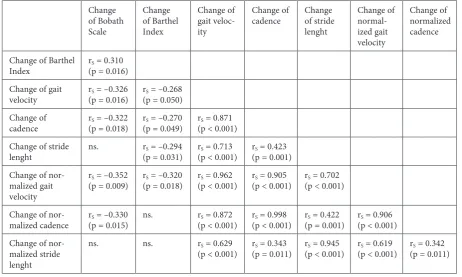
Table 2. Corellations between gait parameters. ADL and hand functions for whole group pf patients Change
of Bobath Scale
Change of Barthel Index
Change of gait veloc-ity
Change of
cadence Change of stride lenght
Change of normal-ized gait velocity
Change of normalized cadence
Change of Barthel
Index r(p = 0.016)S = 0.310 Change of gait
velocity r(p = 0.016)S = –0.326 r(p = 0.050)S = –0.268 Change of
cadence r(p = 0.018)S = –0.322 r(p = 0.049)S = –0.270 r(p < 0.001)S = 0.871 Change of stride
lenght ns. r(p = 0.031)S = –0.294 r(p < 0.001)S = 0.713 r(p = 0.001)S = 0.423 Change of
nor-malized gait velocity
rS = –0.352
(p = 0.009) r(p = 0.018)S = –0.320 (p < 0.001)rS = 0.962 r(p < 0.001)S = 0.905 r(p < 0.001)S = 0.702
Change of
nor-malized cadence (p = 0.015)rS = –0.330 ns. r(p < 0.001)S = 0.872 (p < 0.001)rS = 0.998 r(p = 0.001)S = 0.422 r(p < 0.001)S = 0.906 Change of
nor-malized stride lenght
ns. ns. rS = 0.629
(p < 0.001) r(p = 0.011)S = 0.343 (p < 0.001)rS = 0.945 r(p < 0.001)S = 0.619 r(p = 0.011)S = 0.342
coeficient is inside the interval [−1, 1] and assumes the value: 1: the two rankings are the same – (posi-tive) correlation, 0: rankings are (completely) inde-pendent, 1: one ranking is the reverse of the other – (negative) correlation.
Values of the corellation were perceived as: poor: < 0.3, moderate: 0.3–0.5, severe: 0.5–0.7, high: 0.7–0.9, very high: > 0.9. The level of statis-tical significance was set at p < 0.05. The data was analyzed with Statistica 9.0 Software.
The study was accepted by the appropriate Bioethical Committee. The subjects gave written informed consent before entering the study, in ac-cordance with the recommendations of the Bio-ethical Committee, acting on the rules of good Clinical Practice and the Helsinki Declaration after CVA – from 6 weeks to 3 years and diagnosis: ischaemic stroke.
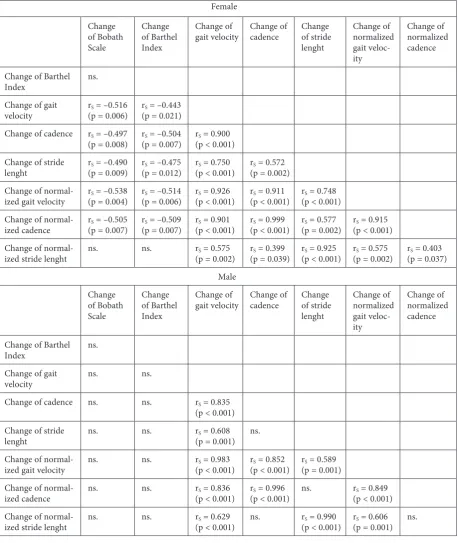
Table 3. Corellations between gait parameters. ADL and hand functions depends on sex Female
Change of Bobath Scale
Change of Barthel Index
Change of
gait velocity Change of cadence Change of stride lenght
Change of normalized gait veloc-ity
Change of normalized cadence
Change of Barthel Index ns. Change of gait
velocity r(p = 0.006)S = –0.516 r(p = 0.021)S = –0.443 Change of cadence rS = –0.497
(p = 0.008) r(p = 0.007)S = –0.504 r(p < 0.001)S = 0.900 Change of stride
lenght r(p = 0.009)S = –0.490 (p = 0.012)rS = –0.475 r(p < 0.001)S = 0.750 r(p = 0.002)S = 0.572 Change of
normal-ized gait velocity (p = 0.004)rS = –0.538 r(p = 0.006)S = –0.514 (p < 0.001)rS = 0.926 r(p < 0.001)S = 0.911 r(p < 0.001)S = 0.748 Change of
normal-ized cadence r(p = 0.007)S = –0.505 r(p = 0.007)S = –0.509 (p < 0.001)rS = 0.901 r(p < 0.001)S = 0.999 r(p = 0.002)S = 0.577 r(p < 0.001)S = 0.915 Change of
normal-ized stride lenght ns. ns. r(p = 0.002)S = 0.575 r(p = 0.039)S = 0.399 (p < 0.001)rS = 0.925 r(p = 0.002)S = 0.575 r(p = 0.037)S = 0.403 Male
Change of Bobath Scale
Change of Barthel Index
Change of
gait velocity Change of cadence Change of stride lenght
Change of normalized gait veloc-ity
Change of normalized cadence
Change of Barthel Index ns. Change of gait
velocity ns. ns.
Change of cadence ns. ns. rS = 0.835
(p < 0.001) Change of stride
lenght ns. ns. r(p = 0.001)S = 0.608 ns. Change of
normal-ized gait velocity ns. ns. r(p < 0.001)S = 0.983 r(p < 0.001)S = 0.852 r(p = 0.001)S = 0.589 Change of
normal-ized cadence ns. ns. r(p < 0.001)S = 0.836 r(p < 0.001)S = 0.996 ns. r(p < 0.001)S = 0.849 Change of
Results
The study focused on determining the corre-lations observed as a result of therapy conduct-ed according to the NDT-Bobath method rules in a group of patients after ischaemic stroke in the area of selected parameters, so there is no control group.
A statistically relevant poor and moderate cor-relation between changes of gait parameters and Bobath Scale and Barthel Index was observed in the whole group of patients (Table 2).
A statistically relevant moderate and severe correlation between changes of gait parameters and Bobath Scale and Barthel Index was observed in the group of women (Table 3).
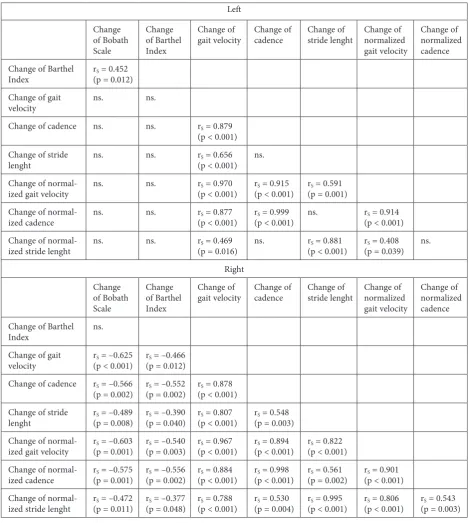
A statistically relevant correlation between changes in Bobath Scale and Barthel Index was ob-served in the group of patients with left side of pa-resis (Table 4).
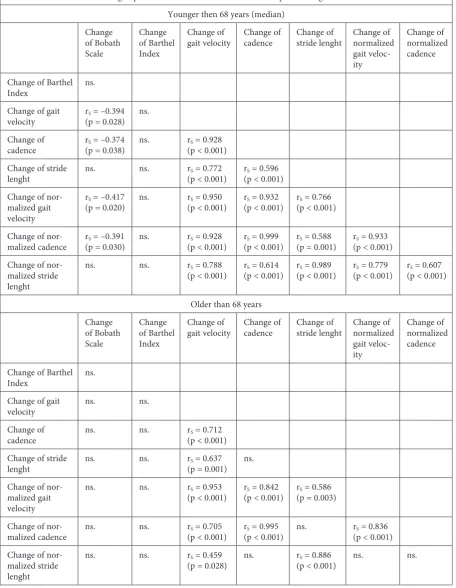
A statistically relevant correlation between changes of gait parameters and Bobath Scale was observed in the group of patients younger than 68 years (Table 5).
Table 4. Corellations between gait parameters. ADL and hand functions depends on a side of paresis Left
Change of Bobath Scale
Change of Barthel Index
Change of
gait velocity Change of cadence Change of stride lenght Change of normalized gait velocity
Change of normalized cadence Change of Barthel
Index r(p = 0.012)S = 0.452 Change of gait
velocity ns. ns.
Change of cadence ns. ns. rS = 0.879
(p < 0.001) Change of stride
lenght ns. ns. r(p < 0.001)S = 0.656 ns. Change of
normal-ized gait velocity ns. ns. r(p < 0.001)S = 0.970 r(p < 0.001)S = 0.915 r(p = 0.001)S = 0.591 Change of
normal-ized cadence ns. ns. r(p < 0.001)S = 0.877 r(p < 0.001)S = 0.999 ns. r(p < 0.001)S = 0.914 Change of
normal-ized stride lenght ns. ns. r(p = 0.016)S = 0.469 ns. (p < 0.001)rS = 0.881 r(p = 0.039)S = 0.408 ns. Right
Change of Bobath Scale
Change of Barthel Index
Change of
gait velocity Change of cadence Change of stride lenght Change of normalized gait velocity
Change of normalized cadence Change of Barthel
Index ns. Change of gait
velocity r(p < 0.001)S = –0.625 r(p = 0.012)S = –0.466 Change of cadence rS = –0.566
(p = 0.002) r(p = 0.002)S = –0.552 r(p < 0.001)S = 0.878 Change of stride
lenght r(p = 0.008)S = –0.489 (p = 0.040)rS = –0.390 r(p < 0.001)S = 0.807 r(p = 0.003)S = 0.548 Change of
normal-ized gait velocity (p = 0.001)rS = –0.603 r(p = 0.003)S = –0.540 (p < 0.001)rS = 0.967 r(p < 0.001)S = 0.894 r(p < 0.001)S = 0.822 Change of
normal-ized cadence r(p = 0.001)S = –0.575 r(p = 0.002)S = –0.556 (p < 0.001)rS = 0.884 r(p < 0.001)S = 0.998 r(p = 0.002)S = 0.561 r(p < 0.001)S = 0.901 Change of
A statistically relevant moderate, high and very high correlations between changes in gait parameters were observed in groups of women, men, younger than 68 years and older than 68 years (Table 3, 5).
There was not observed statistically rele-vant correlations depends on the time following CVA.
Table 5. Corellations between gait parameters, ADL and hand functions depends on age bracket Younger then 68 years (median)
Change of Bobath Scale
Change of Barthel Index
Change of
gait velocity Change of cadence Change of stride lenght Change of normalized gait veloc-ity
Change of normalized cadence
Change of Barthel Index ns. Change of gait
velocity r(p = 0.028)S = –0.394 ns. Change of
cadence r(p = 0.038)S = –0.374 ns. r(p < 0.001)S = 0.928 Change of stride
lenght ns. ns. r(p < 0.001)S = 0.772 r(p < 0.001)S = 0.596 Change of
nor-malized gait velocity
rS = –0.417
(p = 0.020) ns. r(p < 0.001)S = 0.950 r(p < 0.001)S = 0.932 r(p < 0.001)S = 0.766
Change of
nor-malized cadence (p = 0.030)rS = –0.391 ns. r(p < 0.001)S = 0.928 (p < 0.001)rS = 0.999 r(p = 0.001)S = 0.588 r(p < 0.001)S = 0.933 Change of
nor-malized stride lenght
ns. ns. rS = 0.788
(p < 0.001) r(p < 0.001)S = 0.614 (p < 0.001)rS = 0.989 r(p < 0.001)S = 0.779 r(p < 0.001)S = 0.607
older than 68 years Change
of Bobath Scale
Change of Barthel Index
Change of
gait velocity Change of cadence Change of stride lenght Change of normalized gait veloc-ity
Change of normalized cadence
Change of Barthel Index ns. Change of gait
velocity ns. ns. Change of
cadence ns. ns. r(p < 0.001)S = 0.712 Change of stride
lenght ns. ns. r(p = 0.001)S = 0.637 ns. Change of
nor-malized gait velocity
ns. ns. rS = 0.953
(p < 0.001) r(p < 0.001)S = 0.842 r(p = 0.003)S = 0.586
Change of
nor-malized cadence ns. ns. r(p < 0.001)S = 0.705 r(p < 0.001)S = 0.995 ns. r(p < 0.001)S = 0.836 Change of
nor-malized stride lenght
ns. ns. rS = 0.459
(p = 0.028) ns. r(p < 0.001)S = 0.886 ns. ns.
Discussion
The achieved results of rehabilitation, ob-served as changes of gait parameters, Bobath Scale and Barthel Index, were statistically relevant and reflected the recovery (change was > 0).
The observed poor and moderate statistically relevant (negative) correlation between changes of gait parameters and Bobath Scale and Barthel Index in the whole group of patients can suggest that dur-ing the 2 weeks of the therapy, it is hard to achieve simultaneous recovery in all areas: gait parameters, hand functions and ADLs. This is very significant, but cannot exclude that with a longer period of re-habilitation this correlation could change, because recovery of hand function can be, in selected cases, more complicated than gait re-education.
This (negative) correlation was moderate and severe in the group of women, but did not exist in the group of men. In both groups, moderate, high and very high correlations between changes in gait parameters were observed.
A statistically relevant correlation between changes in Bobath Scale and Barthel Index was observed in the group of patients with left side of paresis. Recovery of hand function can influence ADL abilities, but the same correlation was not ob-served in patients with right side of paresis. In this group of patients, (negative) correlation between changes of gait parameters and Bobath Scale and Barthel Index were observed. This confirms the as-sumption that it is hard to achieve simultaneous recovery in all areas: gait parameters, hand func-tions and ADLs.
In the group of patients younger than 68 years statistically relevant (negative) correlation between changes of gait parameters and Bobath Scale was observed. In both groups of age moderate, high and very high correlations between changes in gait parameters were observed.
The results of the study inspire me to provide further evidence in the area of post-stroke rehabil-itation based on the NDT-Bobath approach. The analysis of differences among results in tables 1, 2, and 3 allow us to formulate the general hyposthe-ses as follows:
– both patients’ functional status on admis-sion (before the therapy) and quick achievment of recovery in ADLs can determine the effectivity of further therapy in the area of gait quality, gait pa-rameters and hand functions,
– cortical neuroplasticity can be limited and can depend on the patient’s age – short period of rehabilitation (two weeks) reduces the possibility of simultaneous significant recovery in ADLs, gait parameters and hand functions.
I hope to verify the aforementioned hyposthe-ses during my further research.
Unfortunately, there is a lack of studies using NDT-Bobath method for adults to compare the outcomes of this study. Widely discussed system-atic literature review of Paci [16] demonstrated fi-teen clinical trials, but its results show no evidence proving the effectiveness of NDT-Bobath method. Paci perceived as necessary further investigations to develop outcome measures concerning the goals of the Bobath approach (motor performance, etc.). As one of criteria in the study should be the ther-apists’ extensive knowledge about NDT-Bobath method for adults, confirmed by international cer-tificates and several years of experience [15, 17]. To sum up, only their outcomes of the therapy can be compared.
There is a need to provide further studies in the area of independent sources of knowledge nec-essary to estimate the correlations between re-sults of the rehabiltiation conducted according to the NDT-Bobath method for adults in post-stroke patients, capable of detecting even more general dependencies.
The author conclude that the findings confirm that NDT-Bobath method for adults can be an ef-fective therapy in adult patients after ischaemic stroke. There have been observed statistically sig-nificant and favourable changes in the function-al status of patients, described by gait parameters, changes in hand functions and ADL. Based on the presented correlations, there is an assumption that it is hard to achieve simultaneous recovery in all areas: gait parameters, hand functions and ADLs in two weeks of rehabilitation.
References
[1] Błaszczyk B, Czernecki R, Prędota-Panecka H: Profilaktyka pierwotna i wtórna udarów mózgu. Studia Medyczne 2008, 9, 71–75.
[2] Członkowska A: Udar mózgu – perspektywy leczenia w Polsce w świetle osiągnięć światowych. Polski Przegląd Neurologiczny 2005, 1, 1–7.
[3] Członkowska A: osiągnięcia w zakresie udaru mózgu. Medycyna po Dyplomie 2005, Supl. 17, 5–11.
[4] Palasik W: Nowe tendencje w terapii udaru niedokrwiennego. Terapia 2006, 1, 4–8.
[6] Muren MA, Hütler M, Hooper J: Functional capacity and health-related quality of life in individuals post stroke. Top Stroke Rehabil 2008, 15, 51–58.
[7] Murtezani A, Hundozi H, Gashi S et al.: Factors associated with reintegration to normal living after stroke. Med Arh 2009, 63, 216–219.
[8] Bromley I: Tetraplegia and paraplegia: a guide for physiotherapists. 6th edition. Churchill Livingstone, London 2006.
[9] Davies PM: Steps to follow: the comprehensive treatment of adult hemiplegia. 2nd edition. Springer, New York 2000.
[10] Howle JM: Neuro-Developmental Treatment Approach. Theoretical foundations and principles of clinical prac-tice. Neuro-Developmental Treatment Association, Tampa 2003.
[11] Mayston MJ: Problem solving in neurological physiotherapy – setting the scene. In: Edwards S – Neurological physiotherapy 2nd ed. A problem solving approach. Churchill Livingstone, London 2001, 4–16.
[12] Lennon S, Ashburn A: The Bobath concept in stroke rehabilitation: a focus group study of the experienced phys-iotherapists’ perspective. Disabil Rehabil 2000, 15, 665–674.
[13] Lennon S, Baxter D, Ashburn A: Physiotherapy based on the Bobath concept in stroke rehabilitation: a survey within the UK. Disabil Rehabil 2001, 6, 254–262.
[14] Bobath B: Adult hemiplegia: evaluation and treatment. 3rd edition. Heinemann Medical Books, London 1990.
[15] Mikołajewska E: Metoda NDT-Bobath w neurorehabilitacji osób dorosłych. Wydawnictwo Lekarskie PZWL, Warszawa 2011.
[16] Paci M: Physiotherapy based on the Bobath Concept for adults with post-stroke hemiplegia: a review of effective-ness studies. J Rehabil Med 2003, 1, 2–7.
[17] Mikołajewska E: Przykład terapii chodu metodą NDT-Bobath u pacjenta z hemiplegią. Praktyczna Fizjoterapia i Rehabilitacja, 2010, 11, 16–20.
[18] Mikołajewska E: Metoda NDT-Bobath w praktyce klinicznej. Prakt Fizjoter Rehabil 2010, 11, 14–15.
[19] Mikołajewska E: Metoda NDT-Bobath w usprawnianiu osób dorosłych: wprowadzenie do metody. Prakt Fizjoter Rehabil 2010, 11, 8–13.
[20] Mikołajewska E, Radziszewski K.: Metoda NDT-Bobath w rehabilitacji pacjentów dorosłych. Valetudinaria 2007, 1, 51–53.
Address for correspondence:
Emilia Mikołajewska Rehabilitation Clinic
Military Clinical Hospital No. 10 and Polyclinic Powstańców Warszawy 5
85-681 Bydgoszcz Poland
E-mail: [email protected]
Conflict of interest: None declared