Development of Automobile Power Seat Motor
Controller Having Soft-Start and Soft-Stop Function
Sang-Yeon Hwang
1and Myung-Jin Chung
2*Abstract – Seat of automobile is required to support the
comfort to driver and passenger during the driving. The control method of the seat position is changed from manual type to power type, which means using the motor to increase the comfort of the driver. By using the motor, several problems, such as vibration, noise, and overcurrent, appeared. These problems can be resolved through the control of seat motor. In this study, a control method profiling motor start and stop current is proposed. The soft-start and soft-stop current profile can be achieved by controlling the voltage applied to the DC motor. With the soft-start and soft-stop current profile, the slow-start and slow-stop motion of seat is possible. The driver can feel comfortable by smooth motion of seat, which can be acquired through DC motor control. An automobile power seat motor controller having the soft-start and soft-stop function is developed. The experimental test shows that the motor controller having the proposed control function reduced the reflection sound pressure by 73.3% and the shock acceleration by 68.4%, respectively.
Keywords – Automobile Power Seat Motor, Controller,
Current Profile, Soft-start and Soft-stop.
I.
INTRODUCTION
Seat of automobile is required to support the comfort to driver and passenger while driving [1]. The control method of the seat position is changed from manual type to power type, which means using the motor to increase the comfort of the driver as proposed by Lahiry [2] and Kovener [3]. Lahiry and Kovener used the motor to move the seat from one position to the other position. The seat using the motor is called power seat and that is classified as two-way or four-way power seat according to a number of control direction. By using the motor, several problems, such as vibration, noise, and overcurrent, appeared. Researches for the evaluation of these problems are conducted [4-9]. Cho [4] visualized the automotive power seat slide motor noise, Han [5] suggested the method for automatic measurement of noise and vibration for power seat DC motor in the vehicle, and Seo [8] evaluated the vibration and sound quality according to battery voltage change while moving a power seat in an automobile forward or backward. Those researches suggested the method for measurement and analysis of the noise and vibration generated by the power seat DC motor, which is controlled by step voltage to move the seat. Chung [10] proposed the motor start current control method using the non-step voltage.
In this study, a control method profiling motor start and stop current is proposed and an automobile power seat motor controller having the proposed control function is developed. The driver can feel comfortable by smooth motion of seat, which can be acquired through DC motor
control. In Section 2, configuration of the power seat is presented. Then, the control method of the motor for generation of the current profile, such as soft-start and soft-stop, is proposed in Section 3. An automobile power seat motor controller having the proposed control function is developed and experimental test is conducted with the DC motor and the power seat. Also the comfort level of driver is evaluated when the developed motor controller is applied to an automobile in Section 4.
II.
CONFIGURATION OF POWER SEAT
The power seat is classified as two-way power seat or four-way power seat according to the number of control direction. The power seat consists of seat body, motor, motor controller, and actuating mechanism. The motor used in the power seat is classified as recline motor conducting the rotating function of seat back, tilt motor conducting the tilting function of seat base, slide motor conducting the moving function of seat base horizontally, and height motor conducting the moving function of seat base vertically according to function as shown in Figure 1. The DC motor, having properties such as high starting torques, good output efficiency for input current, and easy rotating control, is used for the power seat. The motor controller adopts the electric driving type using the electric switching device.
III.
CONTROL METHOD
The driver can feel comfortable by smooth motion of seat, which can be acquired through DC motor control having soft-start and soft-stop current profile as shown in Figure 2. In this figure, current profile by proposed control method is smooth compared to current profile due to step input voltage. By the adoption of soft-start and soft-stop current profile to DC motor control, the power seat can be moved smoothly.
Fig. 1. Configuration of power seat having recline motor, tilt motor, slide motor, and height motor
Fig. 2. DC motor control method having soft-start and soft-stop current profile
Fig. 3. Applying voltages to DC motor for generation of soft-start and soft-stop current profile
The shape of the soft-start and soft-stop current profile can be controlled according to initial voltage (Vi), increasing time (Ti), drop voltage (Vd), and decreasing time (Td), which are changed according to the friction force of guide rail in the power seat.
The control block diagram of DC motor controller, which is using the electric switching device, is shown in Figure 4. The gate signal is generated by controller according to current flowing to the DC motor. The soft-start and soft-stop current profile is controlled by the gate signal. The initial voltage (Vi) and increasing time (Ti) for soft-start and drop voltage (Vd) and decreasing time (Td) for soft-stop can be controlled in the microprocessor.
IV.
DEVELOPMENT AND EXPERIMENTAL
RESULTS
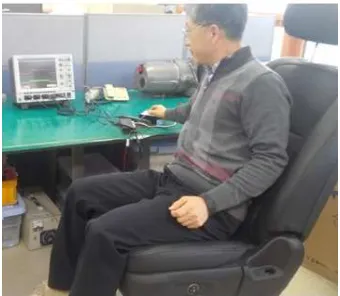
DC motor controller having functions shown in Figure 4 is developed as shown in Figure 5. The developed motor controller circuit consisted of control circuit for control of motor by microprocessor and power circuit for generating the current. Figure 6 shows the experimental setup for the performance test of developed DC motor controller.
Fig. 5. Developed DC motor controller having functions of soft-start and soft-stop
Fig. 6. Experimental setups for performance test of developed DC motor controller
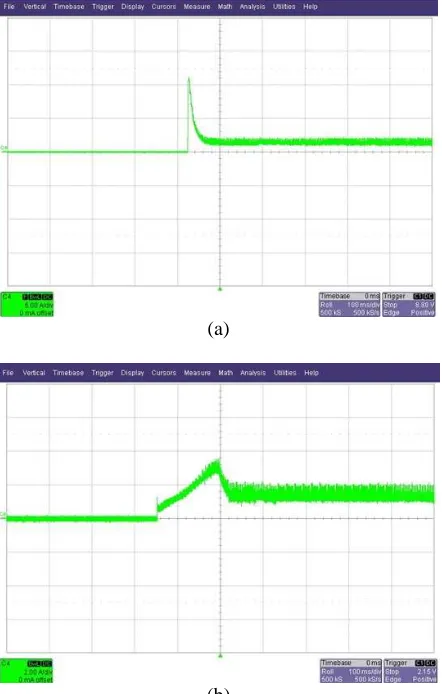
In this setup, power supply, current probe, and digital oscilloscope are used to measure the driving voltage, current, soft-start time, and soft-stop time.
Fig. 4. Control block diagram of DC motor controller
(a)
(b)
Fig. 7. Measured motor current profile; (a) without control of applying voltage and (b) with control of applying
voltage to DC motor
Table I lists the specifications of the developed motor controller. The initial and drop voltage can be controlled from 0volt to 16volt and the increasing and decreasing time can be controlled from 0.02sec to 2sec. These voltage and time duration are determined according to properties such as friction force between guide rails of seat.
Table 1. Specifications of the developed motor controller
Parameters Value Unit
Driving voltage 6-24 V
Max. driving current 20 A
Initial voltage 0-16 Volt
Drop voltage 0-16 Volt
Increasing time 0.02-2 sec
Decreasing time 0.02-2 sec
Figure 9 shows the experimental setup for the performance test of power seat using the developed motor controller in the dead sound chamber. Pressure meter is used to measure the reflection sound pressure and the accelerometer is used to measure the shock acceleration.
Figure 10 shows the measured reflection sound pressure and shock acceleration according to the absence and presence of soft-start and soft-stop function. In Figure 10 (a), the reflection sound pressure of power seat using previous motor controller is measured as 150mPa and the reflection sound pressure of power seat using developed motor controller is measured as 40mPa. In Figure 10 (b), the shock acceleration of power seat using previous motor controller is measured as 3.8m/sec2 and the shock acceleration of power seat using developed motor controller is measured as 1.2m/sec2. From the performance test, the reflection sound pressure is reduced by 73.3% and the shock acceleration is reduced by 68.4% by using the developed motor controller.
Fig. 8. Measured motor control signal and current profile generated by control of applying voltage to DC motor with the developed motor controller
Fig. 9. Experimental setup for the performance test of power seat using the developed motor controller in the
dead sound chamber Fig. 10. Measured results; (a) reflection sound pressure
and (b) shock acceleration
V.
CONCLUSION
In this study, the control method of the motor for the generation of current profile, such as start and soft-stop, is proposed. The soft-start and soft-stop current profiles are achieved through the voltage control applied to the DC motor. DC motor controller is developed, and experimental test using the developed motor controller is conducted to verify the proposed control method. From the verification test, the reflection sound pressure is reduced by 73.3% and the shock acceleration is reduced by 68.4% by using the developed motor controller. In the evaluation test of comfort level, we confirmed that the measured comfort level is high when the soft-start and soft-stop function is activated. From the study, we concluded that the driver can feel comfortable by using the developed motor controller having soft-start and soft-stop function
.
ACKNOWLEDGMENT
Following are results of a study on the “Leaders Industry-university Cooperation” Project, supported by the Ministry of Education (ME)
REFERENCES
[1] M. J. Chung, “Development of actuator system for automobile massage seat,” Proc. of the 29th Institute of Control, Robtics and Systems Annual Conference, 2014, pp. 273-274.
[2] A. Lahiry, S. Chanana, and S. Kwnwar, “Automation in automobiles: power seat,” Proc. of the 2nd International Conference on Machine Vision, 2009, pp. 158-160.
[3] R. W. Kovener, “Power seat with memory,” International Journal of Vehicle Design, 1981, pp. 111-117.
[4] Y. T. Cho and J. S. Bolton, “Visualization of automotive power seat slide motor noise,” Proc. of the National Conference on Noise Control Engineering, 2014, pp. 181-188.
[5] H. S. Han, B. W. Jeong, G. H. Kim, and D. H. Song, “Automatic measurement of noise and vibration for power seat DC motor in the vehicle,” Proc. of the Spring Conference on The Korean Society for Noise and Vibration Engineering, 2002, pp. 1142 - 1147.
[6] P. Scheibner, A. Zeitler, A. Wendemuth, “Sound Quality Evaluation of Power Seat Adjusters,” International Conference on Acoustics, 2009, pp.1547 – 1549.
[7] S. Y. Kim, Evaluation of noise and vibration characteristic related to slide mechanism at power seat of vehicle, a master's thesis of Kongju University, ch3, 2016.
[8] K. S. Seo, D. S. Choi, and K. S. Kim, “Evaluation of vibration and sound quality according to battery voltage change while moving a power seat in an automobile forward or backward,” Journal of Central South University, 2014, pp. 3844 – 3849.
[9] Y. Shi, I. T. Lee, A. M. Afsar, J. I. Song, “Development and performance analysis of an automotive powr seat for disabled persons,” International journal of automotive technology, v.10, no.4, 2009, pp.481 – 488.
[10] M. J. Chung, S. Y. Hwang, “Control method of power seat motor for comfort of automobile driver,” The 8th International Conference on Advances in Human-oriented and Personalized Mechanisms, Technologies, and Services, 2015, pp. 1 - 4.
AUTHORS' PROFILES
Sang-Yeon Hwang received his B.S. (1990) and M.S.
(1993) in electrical engineering from Hanyang University (Seoul, Korea).
He is a chief engineer in the research center of the TSA Co. Ltd. (Korea).
Myung-Jin Chung received his B.S. in mechanical
engineering (1989) from Hanyang University (Seoul, Korea), M.S. in production engineering (1991) and a PhD in mechanical engineering (2002) from the Korea Advanced Institute of Science and Technology (Daejeon, Korea).