Commun
ficat
fion
D
fistr
fibut
fion
and
hab
fitat
use
of
the
endangered
Dhole
Cuon
alp
finus
(Pallas
,
1811
)
(Mammal
fia
:
Can
fidae
)
fin
J
figme
Dor
j
fi
Nat
fional
Park
,
western
Bhutan
Chh
fim
fi
Namgya
l
&
Phuntsho
Th
fin
ley
26 September 2017 | Vol. 9| No. 9 | Pp.10649–10655 10.11609/jot.3091.9.9.10649-10655
Threatened Taxa TheJournal of Threatened Taxafis dedficatedto bufildfing evfidencefor conservafion globally by publfishfing peer-revfiewed arficles onlfine every month at a reasonably rapfid rate at www.threatenedtaxa.org.All arficles publfishedfin JoTT are regfistered under Creafive Commons Atrfibufion 4.0InternafionalLficense unless otherwfise menfioned.JoTT allows unrestrficted use of arficles finany medfium, reproducfion, and dfistrfibufion by provfidfing adequate credfit to the authors and the source of publficafion.
OPEN
ACCESS
Partner
www
.
threa
tenedtaxa
.org
ISSN 0974-7907(Onlfine) |ISSN 0974-7893(Prfint) Bufildfing evfidencefor conservafion globally
Journa
l
o
f
Threatened
Taxa
Pub
l
fisher/Host
For Focus, Scope, Afims, Polficfies and Gufidelfines vfisfit htp://threatenedtaxa.org/About_JoTTFor Arficle Submfissfion Gufidelfines vfisfit htp://threatenedtaxa.org/Submfissfion_Gufidelfines
10649
Communica
tion
DOI: http://doi.org/10.11609/jott.3091.9.9.10649-10655 | ZooBank: urn:lsid:zoobank.org:pub:1FF94BDB-4E7A-4032-9A84-8FDAD6205DAF
Editor: L.A.K. Singh, Bhubaneswar, Odisha, India. Date of publication: 26 September 2017 (online & print)
Manuscript details: Ms # 3091 | Received 07 October 2016 | Final received 18 August 2017 | Finally accepted 27 August 2017
Citation: Namgyal, C. & P. Thinley (2017). Distribution and habitat use of the endangered Dhole Cuon alpinus (Pallas, 1811) (Mammalia: Canidae) in Jigme Dorji National Park, western Bhutan. Journal of Threatened Taxa 9(9): 10649–10655 ; http://doi.org/10.11609/jott.3091.9.9.10649-10655
Copyright: © Namgyal & Thinley 2017. Creative Commons Attribution 4.0 International License. JoTT allows unrestricted use of this article in any medium, repro-duction and distribution by providing adequate credit to the authors and the source of publication.
Funding: The Rufford Foundation (18751-1).
Competing interests: The authors declare no competing interests.
Author Details: Chhimi Namgyal has been working as a Senior Park Range Officer at Soe Range under Jigme Dorji National Park since 2011. Prior to his transfer to the park, he has worked as a Forestry Extension Agent in Paro District. He completed his Bachelor’s degree in Forestry from the College of Natural Resources, Bhutan, in June 2016. Phuntsho Thinley (PhD) is a Principal Forestry Research Officer at the Ugyen Wangchuck Institute for Conservation and Environment Research in Bhutan. He is primarily interested in wildlife ecology and human-wildlife interactions. Formerly the Park Manager of Jigme Dorji National Park (2009–2012), he also teaches at the College of Natural Resources in Bhutan as an adjunct lecturer.
Author Contribution: Both the authors have equally contributed in field data collection, data analysis, and drafting of the manuscript.
Acknowledgements: We are truly grateful and indebted to the Rufford Foundation for the generous funding support. We thank the Department of Forests and Park Services for kindly permitting us to undertake the study. We also express gratitude to Mr. Lhendup Tharchen, the former Park Manager, and his dedicated field staff of Jigme Dorji National Park for their kind assistance during our field visits and for sharing camera trap images. Last, but certainly not the least, we owe our appreciation to Dr. Om Katel of the College of Natural Resources, Bhutan, for his valuable comments and input on our research proposal. Likewise, Dr. Rajanathan Rajaratnam from the University of New England in Australia provided some critical comments and edits on this manuscript. Lastly, the anonymous reviewers and the JoTT’s subject editor are thanked for their rigorous reviews and edits.
Distribution and habitat use of the endangered Dhole
Cuon alpinus (Pallas, 1811) (Mammalia: Canidae) in
Jigme Dorji National Park, western Bhutan
Chhimi Namgyal 1& Phuntsho Thinley 2
1 Jigme Dorji National Park, Department of Forests and Park Services, Damji, Gasa, Bhutan
2 Ugyen Wangchuck Institute for Conservation and Environment Research, Department of Forests and Park Services,
Lamoigoenpa, Bumthang, Bhutan
1 [email protected], 2 [email protected]; [email protected] (corresponding author)
ISSN 0974-7907 (Online) ISSN 0974-7893 (Print)
OPEN ACCESS
Journal of Threatened Taxa | www.threatenedtaxa.org | 26 September 2017 | 9(9): 10649–10655
Abstract: The Dhole is a little-studied wild canid with decreasing populations throughout its global range. We conducted this study in Bhutan’s Jigme Dorji National Park (JDNP) to establish baseline records of Dhole distribution and habitat use. We used trail transects and recorded animal presence via tracks, scats, direct sightings and camera traps. Ancillary habitat characteristics such as elevation, slope and vegetation cover were recorded to characterise habitat use. We used MaxEnt model to estimate distribution within JDNP. We recorded 609 indicators of Dhole presence over a 60-day survey period. The model estimated almost one-fourth of JDNP as having a high probability of Dhole occurrence, which closely corresponds to the distribution of cool broadleaved forests (CBLF) and areas close to human settlements. The highest number of indicators was obtained from CBLF, between slope ranges of 2 – 38 degree and elevation ranges of 1,468 m – 4,620 m above sea level, indicating a new record upper altitude limit for Dhole distribution across its global range. We highlight JDNP as an important Dhole conservation area in the Eastern Himalayas, and recommend drafting a pragmatic conservation plan that will strive to minimize conflicts with livestock owners and include key components such as farmer education and livestock insurance to cover Dhole kills.
Journal of Threatened Taxa | www.threatenedtaxa.org | 26 September 2017 | 9(9): 10649–10655 10650
Distribution and habitat use of Dhole in western Bhutan Namgyal & Thinley
INTRODUCTION
The Dhole Cuon alpninus (Pallas, 1811) is commonly known as the Asiatic Wild Dog, Indian Wild Dog, or Red Dog. Depending on the regions where it is found in Bhutan the Dhole is referred to as ‘phaw’ (in Dzongkha, the national language), ‘rom’ (in Tshangla, the eastern Bhutan dialect), ‘tsawaring’ (in Khengkha, the central Bhutan dialect), and ‘ban-kukur’ (in Lhotshamkha, the southern Bhutan dialect). It is considered ‘Endangered’ by the IUCN Red List (Kamler et al. 2015).
The Dhole is native to Asia, and it is currently found in Bangladesh, Bhutan, Cambodia, China, India, Indonesia, Lao PDR, Malaysia, Myanmar, Nepal, and Thailand. It is thought to have been extirpated from Central and East Asia, the Korean Peninsula, Singapore and possibly Vietnam. At present this threatened wild dog is facing a decreasing population trend across its entire distributional range, primarily due to retaliatory killings and a decrease in prey base (Durbin et al. 2004; Kamler et al. 2015).
Dholes are post-Pleistocene in origin and are more closely related to jackals than wolves according to Thenius (1954), as cited by Johnsingh & Acharya (2013). The species was first described in 1794 by Pesteref during his travels in far eastern Russia (Heptner et al. 1998), and was given the scientific name Canis alpinus by a German Zoologist Peter Simon Pallas in 1811 (Pallas 1831). The number of Dhole subspecies is debatable, but 11 have been identified based on differences in coat length and colour (Durbin et al. 2004). According to Wangchuk et al. (2004), the subspecies C. a. primaevus is found in Bhutan. Like its other sympatric carnivores in the Indian subcontinent such as the tiger Panthera tigris and the common leopard Panthera pardus (Karanth & Sunquist 1995), the Dhole is an important predator. In Bhutan, the Dhole regulates populations of wild ungulates such as Sambar Rusa unicolor, Muntjac Muntiacus muntjac, Gaur
Bos gaurus, Himalayan Serow Capricornis thar, Goral Naemorhedus goral, Wild Pig Sus scrofa and primates
such as the gray langur Semnopithecus schistaceus and Assamese Macaque Macaca assamensis (Wangchuk 2004; Wang & Macdonald 2009; Thinley et al. 2011).
Despite its ecological significance as one of the apex predators with an ‘Endangered’ status, the Dhole has received little attention from conservationists and researchers. Thus, it is one of the least studied and most neglected among the wild carnivores (Srivathsa et al. 2014) and there is very little information on Dhole distribution. This information gap is largely attributed to its persistent predation on domestic livestock. For
instance, it was once almost extirpated from Bhutan in the 1980s in a massive poisoning campaign (Wangchuk 2004; Thinley et al. 2011) because of its excessive predation on domestic livestock. In a recent questionnaire survey on livestock loss in western Bhutan Katel et al. (2015) observed that Dholes killed more livestock compared to common leopards and tigers.
There is currently no reliable information on Dhole distribution and habitat use in Bhutan, although cases of livestock depredation by Dholes are periodically documented. In the absence of such basic ecological information, there is no realistic conservation plan for the Dhole in Bhutan. Now that this endangered dog has fairly re-established its population in the country, contrary to the popular local belief of having been introduced by the government (Wangchuk 2004), there is an urgent need to understand its distribution pattern and habitat use to monitor and detect any massive disruptions to populations and distributions. Therefore, with the goal of enhancing ecological information on the Dhole we studied the species’ distribution and habitat use in western Bhutan. We have also modelled its distributional extent using the latest prescribed species distribution model.
MATERIALS AND METHODS
Study area descriptions
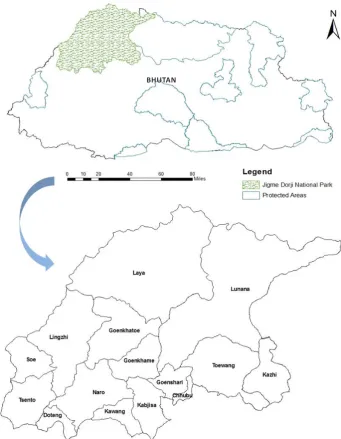
We conducted the study in Jigme Dorji National Park (JDNP), which is located in the northwestern part of Bhutan between the geographical coordinates of 27o33’ N to 28o15’ N and 89o16’ E to 90o16’ E. Covering
an area of approximately 4,317km2, JDNP is the second
largest protected area in Bhutan (Fig. 1). The park shares an international border with the Tibetan Autonomous Region of China in the north. The elevation ranges from 1,200m in the south to 7,314m in the north. The areas above 6,000m are mostly covered with snow (Thinley et al. 2015b).
JDNP is one of the richest parks in Bhutan in terms of biological diversity and a hotspot for canid and felid diversity. So far, seven cat species – including the Tiger and Snow Leopard Panthera uncia, and four canid species – including the Gray Wolf Canis lupus, Red Fox
Vulpes vulpes, and Asiatic Jackal Canis aureus, have
Journal of Threatened Taxa | www.threatenedtaxa.org | 26 September 2017 | 9(9): 10649–10655 10651
Distribution and habitat use of Dhole in western Bhutan Namgyal & Thinley
chrysogaster. Floristically, the park has 1,434 recorded
species of vascular plants of which 300 are medicinal. Annually, the highest quantities of the expensive Chinese Caterpillar Ophiocordyceps sinensis are collected from the park (Thinley et al. 2014, 2015a,b).
Field data collection
Initially, a preliminary presence-absence questionnaire survey was conducted among park staff and villagers within the park in order to get a sense of whether Dholes were present in their locality. This rapid assessment helped in careful planning of our survey.
In order to investigate Dhole distribution, we adopted the trail transect method used by Thinley et al. (2011), because Dholes are known to use regular trails. We
surveyed all major human and animal paths for 60 days from 1 February to 1 April 2016 and looked for Dhole presence, namely, sightings, tracts or foot prints, and scats or faeces. The Field Guide to Mammals of Bhutan (Wangchuk et al. 2004) was used to identify Dhole scats and tracks. Recognizing the potential confusion between Dhole tracts and scats and those of sympatric canids and felids, we only considered numerous scats and tracts observed in a straight line along a tract which could be unmistakably attributed to a Dhole pack. We also made use of 108 camera traps stationed in the park for zoning purpose. We recorded additional habitat characteristics where Dhole signs were observed: a) location – recorded in geographical coordinates using a hand-held GPS (Global Positioning System) unit; b) elevation
Journal of Threatened Taxa | www.threatenedtaxa.org | 26 September 2017 | 9(9): 10649–10655 10652
Distribution and habitat use of Dhole in western Bhutan Namgyal & Thinley
– in meters measured using an altimeter; c) slope – in degrees measured using a clinometer; d) aspect – in cardinal directions determined using a compass; and e) vegetation characteristics or forest type – characterised by dominant tree species. Location, elevation, and slope were recorded at the centre of a scat or track group. We also recorded the presence of various prey species, including domestic livestock in the vicinity of Dhole signs to check what type of prey species are followed by Dholes.
Data analysis
For modelling Dhole distribution we used MaxEnt (version 3.3.3k), a computer programme for modelling species distribution in ecology. The model uses presence-only data of the target species – basically a set of occurrence data – and some environmental variables or covariates to produce a surface of the probability of occurrence (Phillips et al. 2006; Elith et al. 2010). In the model, the influence of each environmental variable on the species’ distribution is assessed, and the mean values of the variables are used for the whole landscape of interest. Ultimately, a surface corresponding to the maximum entropy probability of distribution is produced to best reflect the probability of distribution of the target species (Phillips et al. 2006; Papeş & Gaubert 2007).
In MaxEnt, we used five environmental variables that were deemed to affect Dhole distribution. These are elevation, slope, aspect, land cover, and distance from human settlement. We collected the spatial layers for these variables which were then processed in GIS (Geographic Information System) environment using ArcGISTM (version 10.3). All the layers were converted to
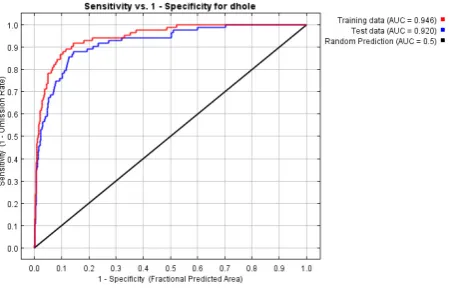
raster format with a standardized cell size of 30 m, in line with the standard projection and coordinate system for Bhutan (i.e., PCS_DRUKREF_03_TM), and the geographic extent of JDNP boundary. As with Jenks et al. (2012), we used the default setting in MaxEnt model of 500 iterations with convergence threshold of 0.00001, a regularization multiplier of 1, and a maximum background point of 10,000, but with 50 random test percentage using JDNP boundary as the mask. We assessed the model’s performance using the AUC (Area under the Receiver Operating Curve). The AUC values range from 0.5 to 1.0 such that values closer to or equal to 0.5 indicate very poor fit whereas those closer to or equal to 1 indicate perfect fit (Fielding & Bell 1997).
Dhole occurrences in different habitat parameters – slope, elevation, aspect, and habitat types– were assessed using the statistical programme R (R Core Team 2015). A non-parametric Kruskal-Wallis test was
performed to check the relationship between the habitat parameters and the number of Dhole evidences. Post-hoc analyses were performed using the package “pgirmess” (Giraudoux 2014) and function “kruskalmc” (for Kruskal-Wallis one-way analysis of variance) in R to check which pair of factors showed significant differences.
RESULTS AND DISCUSSION
Dhole evidences
We encountered 41 Dhole tracks and 522 Dhole scats during the sampling period of 60 days, which covered 256km of trails. This translated to a sign encounter rate of 2.2 signs per km of trail walked. As a comparison, a study conducted by Ramesh et al. (2012) in Kalakad-Mundanthurai Tiger Reserve in India’s Western Ghats observed sign encounter rate of 0.67 signs per km (from 353.2km of transect length and 237 signs). We also obtained 46 Dhole images from 46 camera trap stations (Image 1). In summary, a total of 609 Dhole evidence were obtained from 170 locations inside the park (Fig. 2). Most of the evidences were observed in areas situated closer to human settlement. This could be because we saw more evidence of Dhole prey, such as wild pig and sambar, near human settlements than in areas further away into the deep jungle. Such a high relative abundance of wild ungulates near human settlements was also observed by Thinley et al. (2017) in the same park, which further explains the current pattern of Dhole occurrences near human settlements.
Dhole distribution
Judging from the geographical locations of evidence,
Image 1. A Dhole pack captured by one of the camera traps stationed in Jigme Dorji National Park for zoning purpose.
Journal of Threatened Taxa | www.threatenedtaxa.org | 26 September 2017 | 9(9): 10649–10655 10653
Distribution and habitat use of Dhole in western Bhutan Namgyal & Thinley
Dholes were distributed in settlement areas with high livestock populations (Fig. 1), specifically in proper Laya, Tsharijathang and Lungo villages of Laya ‘geog’ (a Dzongkha term for a sub-district or an administrative block); Ramina, Wachey, Threga, Lheydi and Tenchoe villages of Lunana goeg; all villages of Khatoe, Khamoe, and Goenshari geogs; Kewana and Neptengkha villages of Tewang geog; Gangyul and Chebisa villages of Lingzhi geog; Zhomthang, Waza, Zhodue, and Barshong villages of Naro geog; all villages of Soe geog; Yaktsa, Shana, and Chuyuel villages of Tsento geog; Dodeyna, Begana, and Kuzhuchen villages of Kawang geog; and Girigang, upper Tongshina, and upper Tsheteyna villages of Kabji geog. Coincidentally, these areas were also the livestock depredation hotspots for Dholes, as many cases of livestock losses and damages by Dholes have been reported to the park management from these areas (Leki, pers. comm. JDNP 22 July 2016).
The MaxEnt program predicted almost one-fourth of the park’s total surface area as having a high probability of Dhole occurrence (indicated by red areas in Fig. 3). These high probability areas are situated close to human settlements, and correspond to CBLF (cool broadleaved forest) and mostly lower elevations. The model performed very well with AUC values of 0.946 for training data and 0.922 for test data (Fig. 4). Our model was heavily influenced by the variable “distance from human settlement”, as it contributed 61% of the model gain (Table 1). This is realistic because most of the Dhole evidences were gathered from areas close to human settlements. The variable “slope” contributed the least to model gain with only 1.9%, indicating that slope is not an important factor for Dhole distribution. Likewise, the variable “Land cover” (implicit of vegetation cover) also contributed merely 2.7%. This could be because Dholes
are found in wide range of land cover types (Jenks et al. 2012).
For a dataset like ours, MaxEnt is currently the only viable choice of species distribution model as the data on occurrence of Dholes were collected as “presence only” from certain locations, without systematic and true absence data (Phillips et al. 2004; Elith et al. 2010). The other models such as the Generalized Linear Model and Generalized Additive Models require true absences which are difficult to prove within a short study period as ours (Phillips et al. 2004). The MaxEnt model could provide good distribution data from even a limited number of occurrence data points (Phillips et al. 2004, 2006). In fact, the model has already been successfully applied to predict Dhole distribution in Thailand by Jenks et al. (2012). Therefore, we believe that the MaxEnt model of Dhole distribution in JDNP is highly reliable considering the appropriateness of the model used and its high predictability indicated by high AUC values.
Dhole habitat use
We found Dhole evidence in seven different vegetation types in JDNP: CBLF, MCF (mixed coniferous forest), BPF (blue pine forest), CF (chirpine forest), FF (fir forest), HF (hemlock forest), and AM (alpine meadows). The highest number of Dhole evidence (n = 426) were recorded from CBLF and the least from CF (n = 2). A similar pattern was also observed by Thinley et al. (2015a) in the same park during a camera trap survey in 2012. There was a highly significant difference in the number of Dhole evidence among the vegetation types (Kruskal-Wallis chi-squared = 33.8249, df = 6, p < 0.005). Post-hoc analysis showed significant differences in the number of evidences between the CBLF and AM, CBLF and FF, and AM and HF.
Figure 2. Dhole occurrences in Jigme Dorji National Park based on
Journal of Threatened Taxa | www.threatenedtaxa.org | 26 September 2017 | 9(9): 10649–10655 10654
Distribution and habitat use of Dhole in western Bhutan Namgyal & Thinley
The Dhole, however, is indeed a habitat generalist; it can be found in a wide array of forest or vegetation cover types from dense forest in Thailand to alpine areas in Russia (Kamler et al. 2015). Particularly in southern India, Dholes are seen mostly in forests and thick jungle (Krishnan 1972) as cited by Johnsingh & Acharya (2013). At any rate, Dhole distribution may be largely influenced by availability of appropriately sized prey, dense cover, and high tree densities (Karanth & Sunquist 2000).
Dhole evidences were observed in JDNP between an elevation range of 1,468m to 4,620m. This upper limit of 4,620m is the highest elevation record of Dhole occurrence throughout its entire distributional range. Elevation as a habitat characteristic correlated significantly negative to the number of Dhole evidences (β = - 0.001, SE = 0.0002, t = -4.632, and p < 0.05), indicating the Dholes’ general preference for lower elevations where prey populations, including livestock, are usually higher. Comparing the result to studies in the region, Aryal et al. (2015) in Nepal’s Dhorpatan Hunting Reserve encountered Dhole signs mostly at elevations higher than 2,500m. In a camera trap survey of Dholes in Sikkim’s Khanchendzongkha Biospehere Reserve by Bashir et al. (2014), Dhole images were obtained from sub-alpine forests between the elevations of 3,100 to 3,900 and in alpine zone at 4,100m.
With regard to slope utilization, Dhole evidences were observed between 2 to 38 degrees (with µ = 17.7 degree and SD = 6.2 degree); this shows the Dholes’ preference of gentle slopes. There was negative correlation between slope and Dhole evidence, but the relationship was not significant (β = - 0.0173, SE = 0.03, t = -0.664, and p = 0.508). This is plausible, because Dholes are also known to select sloped land in Nepal (Aryal et al. 2015) which has a similar geographical feature as in Bhutan.
When it comes to aspect utilization, we observed Dhole evidences mostly in north-east (n = 236) and north-west (n = 203) aspects. It is not known how aspect determines Dhole distribution, but the variable has
contributed only 7.2% to model gain in MaxEnt (Table 1).
Scat size
Judging from the number of fresh and moderately fresh scats of same age and content deposited along the trails, we have determined the scat size ranging from 2 to 12 which is similar to 2 to 13 observed by Thinley et al. (2011) in the same park in 2009. This suggests that Dholes in JDNP have been stable since 2009.
CONSERVATION IMPLICATIONS
Our study provides the first information on Dhole distribution in a protected area in Bhutan. We have predicted Dhole occurrence in space as well as across various habitat variables. Through this study we have established a baseline for Dhole distribution in JDNP, which could be used for future monitoring, and detecting changes in distribution patterns. Despite the global decline in Dhole populations, JDNP holds promise as an important Dhole conservation area in the eastern Himalaya.
We have seen a new record of Dhole occurrence at a very high elevation (4,620m) overlapping with the Snow Leopard, which occurs between 3,800m and 5,200m (Thinley et al. 2014). An in-depth study is warranted to investigate the potential existence of dietary overlap between these two predators. In addition, we also observed that Dholes are mostly located near human settlements, thereby increasing the human-Dhole interface. This situation needs to be studied in detail to predict any ecological and/or social implications.
Now that Dholes have become well-established in JDNP, the park management needs to develop a conservation plan to minimize their predation on
Table 1. Relative contributions of the environmental variables to the MaxEnt model of Dhole distribution in Jigme Dorji National Park, Western Bhutan.
Variable Percent contribution Dhole evidenceRelation with Variable
Distance from human
settlement 61 More evidence closer to human settlement Elevation 27.1 Significant, Negative
Aspect 7.2 Not clear
Land cover 2.7 Wide range of land covers are associated
Slope 1.9 Appear insignificant
Journal of Threatened Taxa | www.threatenedtaxa.org | 26 September 2017 | 9(9): 10649–10655 10655
Distribution and habitat use of Dhole in western Bhutan Namgyal & Thinley
domestic livestock. The park staff could educate the livestock owners on the ecological roles and benefits of Dhole conservation with respect to their control on wild herbivores, some of which are also crop depredators. Concurrently, recently piloted reconciliatory conservation initiatives, such as a livestock insurance scheme which has proven successful in the park, should be up-scaled with increased premiums, endowment and coverage extending to incidents caused by Dholes, in order to dissuade retaliatory killings similar to those of the 1980s.
REFERENCES
Aryal, A., S. Panthi, R.K. Barraclough, R. Bencini, B. Adhikari, W. Ji & D. Raubenheimer (2015). Habitat selection and feeding ecology of
Dhole (Cuon alpinus) in the Himalayas. Journal of Mammalogy 96(1): 47–53; https://doi.org/10.1093/jmammal/gyu001
Bashir, T., T. Bhattacharya, K. Poudyal, M. Roy & S. Sathyakumar (2014). Precarious status of the Endangered Dhole Cuon alpinus in
the high elevation Eastern Himalayan habitats of Khangchendzonga Biosphere Reserve, Sikkim, India. Oryx 48(1): 125–132; https://doi. org/10.1017/S003060531200049X
Durbin, L.S., A. Venkataraman, S. Hedges & W. Duckworth (2004).
Dhole (Cuon alpinus), pp. 210–219. In: Sillero-Zubiri, C., M. Hoffmann & D.W. Macdonald (eds.). Candids: Foxes, Wolves, Jackals and Dogs. Status Survey and Conservation Action Plan. IUCN/SSC Canid Specialist Group, Gland, Switzerland and Cambridge, UK, 430pp.
Elith, J., S.J. Phillips, T. Hastie, M. Dudı´k, Y. En Chee & C. Yates (2010). A statistical explanation of MaxEnt for ecologists. Diversity
and Distributions 17(1): 43–57; http://doi.org/10.1111/j.1472-4642.2010.00725.x
Fielding, A.H. & J.F. Bell (1997). A review of methods for the assessment
of prediction errors in conservation presence/absence models. Environmental Conservation 24(1): 38–49.
Giraudoux, P. (2014). Pgirmess: Data analysis in ecology. R package
version 1.5.9. http://CRAN.R-project.org/package=pgirmess. Downloaded on 06 August 2014.
Heptner, V.G., A.A. Nasimovich & A.G. Bannikov (1998). Sirenia and
Carnivora (Sea Cowes, Wolves, and Bears). In: Heptner, V.G. & N.P. Naumov (eds.). Mammals of the Soviet Union. Smithsonian Institution Libraries and National Science Foundation, Washington, D.C., U.S.A.
Jenks, K.E., S. Kitamura, A.J. Lynam, D. Ngoprasert, W. Chutipong, R. Steinmetz, R. Sukmasuang, L.I. Grassman Jr., P. Cutter & N. Tantipisanuh (2012). Mapping the distribution of Dholes, Cuon
alpinus (Canidae, Carnivora), in Thailand. Mammalia 76(2): 175–184;
http://doi.org/10.1515/mammalia-2011-0063
Johnsingh, A.J.T. & B. Acharya (2013). Asiatic Wild Dog (Cuon alpinus),
pp. 392–415. In: Johnsingh, A.J.T. & N. Manjrekar (eds.). Mammals of South Asia (Volume 1). Universities Press (India) Private Ltd., Noida, New Delhi, India, 614pp.
Kamler, J.F., N. Songasen, K. Jenks, A. Srivathsa, L. Sheng & K.E. Kunkel (2015). Cuon alpinus. In: The IUCN Red List of Threatened Species.
Version 2015: e.T5953A72477893. Downloaded on 18 March 2016;
http://doi.org/10.2305/IUCN.UK.2015-4.RLTS.T5953A72477893.en
Karanth, K.U. & M.E. Sunquist (1995). Prey selection by Tiger, Leopard
and Dhole in tropical forests. Journal of Animal Ecology 64(4): 439– 450.
Karanth, K.U. & M.E. Sunquist (2000). Behavioural correlates of
predation by Tiger (Panthera tigris), Leopard (Panthera pardus) and Dhole (Cuon alpinus) in Nagarahole, India. Journal of Zoology 250(2): 255–265.
Katel, O.N., S. Pradhan & D. Schmidt-Vogt (2015). A survey of livestock
losses caused by Asiatic Wild Dogs, Leopards and Tigers, and of the impact of predation on the livelihood of farmers in Bhutan. Wildlife Research 41(4): 300–310; http://doi.org/10.1071/WR14013
Krishnan, M. (1972). An ecological survey of the larger mammals of
peninsular India. The Journal of the Bombay Natural History Society 68: 42–47.
Pallas, P.S. (1831). Zoographia Rosso-Asiatica: sistens omnium
animalium in extenso Imperio Rossico et adiacentibus maribus observatorum recensionem, domicilia, mores et descriptiones anatomen atque icones plurimorum, 1. Caes.
Papeş, M. & P. Gaubert (2007). Modelling ecological niches from low
numbers of occurrences: assessment of the conservation status of poorly known viverrids (Mammalia, Carnivora) across two continents. Diversity and Distributions 13(6): 890–902; http://doi. org/10.1111/j.1472-4642.2007.00392.x
Phillips, S.J., R.P. Anderson & R.E. Schapire (2006). Maximum entropy
modeling of species geographic distributions. Ecological Modelling 190(3): 231–259; http://doi.org/10.1016/j.ecolmodel.2005.03.026
Phillips, S.J., M. Dudík & R.E. Schapire (2004). A maximum entropy
approach to species distribution modeling. In: Proceedings of the 21st
international Conference on Machine Learning. ACM, 83pp.
R Core Team (2015). R: A language and environment for statistical
computing. R Foundation for Statistical Computing, Vienna, Austria. http://www.R-project.org/ Accessed 25 June 2015.
Ramesh, T., N. Sridharan, K. Sankar, Q. Qureshi, K.M. Selvan, N. Gokulakkannan, P. Francis, K. Narasimmarajan, Y.V. Jhala & R. Gopal (2012). Status of large carnivores and their prey in tropical rainforests
of south-western Ghats, India. Tropical Ecology 53(2): 137–148.
Srivathsa, A., K.K. Karanth, D. Jathanna, N.S. Kumar & K.U. Karanth (2014). On a dhole trail: examining ecological and anthropogenic
correlates of Dhole habitat occupancy in the Western Ghats of India. PloS ONE 9(6): e98803; http://doi.org/10.1371/journal. pone.0098803
Thenius, E. (1954). On the origins of the Dhole. Osterr Zoological
Zeitsch 5: 377–388.
Thinley, P., D. Leki, P. Dorji, C. Namgyel, S. Yoenten, Phuntsho & T. Dorji (2014). Estimating Snow Leopard (Panthera uncia) Abundance
and Distribution in Jigme Dorji National Park using Camera Ttraps: A Technical Report. Jigme Dorji National Park, Thimphu, Bhutan, 45pp.
Thinley, P., J.F. Kamler, S.W. Wang, K. Lham, U. Stenkewitz & D.W. Macdonald (2011). Seasonal diet of dholes (Cuon alpinus) in
northwestern Bhutan. Mammalian Biology 76(4): 518–520; http:// doi.org/10.1016/j.mambio.2011.02.003
Thinley, P., J.P. Lassoie, S.J. Morreale, P.D. Curtis, R. Rajaratnam, K. Vernes, L. Leki, S. Phuntsho & T. Dorji (2017). High relative abundance
of wild ungulates near agricultural croplands in a livestock-dominated landscape in Western Bhutan: Implications for crop damage and protection. Agriculture, Ecosystems and Environment 248: 88–95;
http://doi.org/10.1016/j.agee.2017.07.036
Thinley, P., S.J. Morreale, P.D. Curtis, J.P. Lassoie, T. Dorji, Leki, S. Phuntsho & N. Dorji (2015a). Diversity, occupancy, and
spatio-temporal occurrences of mammalian predators in Bhutan’s Jigme Dorji National Park. Bhutan Journal of Natural Resources and Development 2(1): 19–27; http://doi.org/10.17102/cnr.2015.03
Thinley, P., L. Tharchen & R. Dorji (2015b). Conservation management
plan of Jigme Dorji National Park for the period January 2015 – December 2019: Biodiveristy conservation in pursuit of Gross National Happiness. Department of Forests and Park Services, Kuensel Corporation Ltd., Thimphu, Bhutan, 110pp.
Wang, S.W. & D.W. Macdonald (2009). Feeding habits and niche
partitioning in a predator guild composed of Tigers, Leopards and Dholes in a temperate ecosystem in central Bhutan. Journal of Zoology 277(4): 275–283; http://doi.org/10.1111/j.1469-7998.2008.00537.x
Wangchuk, T. (2004). Predator-prey dynamics: The role of predators in
the control of problem species. Journal of Bhutan Studies 10: 68–89.
Wangchuk, T., P. Thinley, K. Tshering, C. Tshering, D. Yonten, B. Pema & S. Wangchuk (2004). A Field Guide to the Mammals of Bhutan. Royal
Government of Bhutan, Thimphu, Bhutan, 180pp.
The Journal of Threatened Taxa is dedicated to building evidence for conservation globally by publishing
peer-reviewed articles online every month at a reasonably rapid rate at www.threatenedtaxa.org. All articles
published in JoTT are registered under Creative Commons Attribution 4.0 International License unless
otherwise mentioned. JoTT allows unrestricted use of articles in any medium, reproduction, and distribution by providing adequate credit to the authors and the source of publication.
ISSN 0974-7907 (Online); ISSN 0974-7893 (Print)
OPEN ACCESS
Threatened Taxa
ArticlesThe ecology of Harwood’s Francolin Pternistis harwoodi (Aves: Galliformes: Phasianidae) at Merhabete District, central highlands of Ethiopia: implications for conservation -- Abadi Mehari Abrha & Habtu Kiros Nigus, Pp. 10633–10641
Effects of the invasive Tilapia on the Common Spiny Loach (Cypriniformes: Cobitidae: Lepidocephalichthys thermalis) - implications for conservation
-- Sandip D. Tapkir, Sanjay S. Kharat, Pradeep Kumkar &
Sachin M. Gosavi, Pp. 10642–10648
Communications
Distribution and habitat use of the endangered Dhole
Cuon alpinus (Pallas, 1811) (Mammalia: Canidae) in
Jigme Dorji National Park, western Bhutan
-- Chhimi Namgyal & Phuntsho Thinley, Pp. 10649–10655
Winter food habits of the Golden Jackal Canis aureus (Mammalia: Carnivora: Canidae) in Patna Bird Sanctuary, Uttar Pradesh, India
-- Khursid A. Khan, Jamal A. Khan & Narendra Mohan, Pp. 10656–
10661
On the poorly-known White-spotted Skink Lygosoma
albopunctatum (Gray, 1846) (Reptilia: Scincidae) with further
topotypical records and notes on the type locality -- S.R. Ganesh, Pp. 10662–10668
A study on the density, population structure and regeneration of Red Sanders Pterocarpus santalinus (Fabales: Fabaceae)
in a protected natural habitat - Sri Lankamalleswara Wildlife Sanctuary, Andhra Pradesh, India
-- Chenchu Ankalaiah, Thondaladinne Mastan & Mullangi Sridhar Reddy, Pp. 10669–10674
Short Communications
First record and genetic affiliation of the Balkan Snow Vole
Dinaromys bogdanovi (Rodentia: Cricetidae) in Albania
-- Ivan Stolarik & Daniel Jablonski, Pp. 10675–10678
Avifaunal diversity in the scrub forest of Sri Lankamalleswara Wildlife Sanctuary, Andhra Pradesh, India
-- Sumant Mali, Chelmala Srinivasulu & Asad R. Rahmani,
Pp. 10679–10691
A second record of the Eastern Spadefoot Toad
(Amphibia: Anura: Megophryidae: Leptobrachium bompu Sondhi & Ohler, 2011) with a note on its morphological variations and natural history
-- Bhaskar Saikia, Bikramjit Sinha & Ilona J. Kharkongor,
Pp. 10692–10696
Spiders of Gujarat: a preliminary checklist
-- Archana Yadav, Reshma Solanki, Manju Siliwal & Dolly Kumar, Pp. 10697–10716
An ethnomycological survey of Jaunsar, Chakrata, Dehradun, India
-- Manoj Kumar, N.S.K. Harsh, Rajendra Prasad &
Vijay Vardhan Pandey, Pp. 10717–10725
Notes
First record of Rufous-tailed Scrub Robin Cercotrichas galactotes
(Aves: Passeriformes: Muscicapidae) from Jammu & Kashmir, India
-- Neeraj Sharma, Pp. 10726–10728
Sightings of the Great White Pelican Pelecanus onocrotalus (Linn. 1758) (Aves: Pelicaniformes: Pelicanidae) in Pallikaranai Marshlands, Tamil Nadu, India
-- Kannan Thirunaranan, Samidurai Jayakumar, Sankaranathan
Sivaraman & Santhanakrishnan Babu, Pp. 10729–10732
A note on three interesting Heteroptera from Kolhapur, Maharashtra, India
-- S.M. Gaikwad, Y.J. Koli & G.P. Bhawane, Pp. 10733–10737
Response & Reply
Response to article on Adventitious rooting of mature Cycas
micronesica
-- S. Suresh Ramanan, P. 10738
Best protocols for cycad propagation require more research -- Thomas Edward Marler & Gil Naputi Cruz, Pp. 10738–10740