A Routing Algorithm for Resource Constrained
Wireless Self-organized Networks
https://doi.org/10.3991/ijoe.v13i11.7750
Dan Han!!", Lingmei Fu
Sanya Polytechnica Vacational College, Sanya, China [email protected]
Abstract—To explore the algorithms for wireless self-organized networks, through the NS-2 network simulation platform, the simulation analysis is made on the performances of multi hop data transmission of the existing four typical Ad hoc network routing protocols. And the energy saving strategy of Ad hoc network routing protocol SFR (Selection Forwarding Routing) based on net-work average node connection degree is discussed and analyzed, which is suit-able for intensive Ad hoc network. The simulation data showed that, SFR pro-tocol can, under the premise of ensuring the network coverage rate the same as that of flooding algorithm, reduce more than 56.1% redundant information in the network, and reduce the energy consumption of network by more than 30.2%. Finally, it is concluded that the selection forwarding routing has quite good performance.
Keywords—NS-2 network simulation platform; Ad hoc network routing proto-col; routing algorithm
1
Introduction
look-up message. After the destination node received the routing look-look-up message, the destination node is not directly back to the link message along the original direction for the source node. Instead, it first of all launched a routing shortcut look-up pro-cessing, to get the closer shortcut routing with little amount of messages, and then the link message of routing shortcut is returned to the source node. Compared with the traditional Internet routing protocols, the main design goal of Ad hoc network routing protocol is to node mobility and maintain high performance in different mobile envi-ronment. As a result, in the simulation, we mainly study the impact of node mobility and network size on the performance of the routing protocol. This paper uses the simulation platform to study the energy saving performance of routing protocols in Ad hoc networks, and then analyzes the situations of reducing routing energy con-sumption.
2
Literature review
Singla and other scholars have simulated and compared the performance of table driven routing protocol DSDV and demand driven routing protocol AODV and TORA in different message traffic environments [2]. Morshed and his partners used the delay and shaking as the evaluation indexes to simulate the performance of DSDV and AODV. However, none of them evaluated the energy consumption of multi hop packet data transmission under protocol control. Pascoe-Chalke [4] put forward sev-eral models that can simulate the movement of nodes in Ad hoc networks, but they did not use these models to simulate the performance of routing protocols. Khan and others have simulated the performance of on-demand routing protocol AODV and table driven routing protocol OLSR in vehicular Ad hoc networks (VANETs). During the simulation, they introduced several mobility models to simulate the VANETs. Unlike this paper, the models they used are limited to simulations of VANETs, unable to really simulate the Ad hoc networks. The network scale model and the node mo-bility model are used to simulate the actual Ad hoc network, and the performance of the routing protocol is simulated and analyzed. Because the number of nodes in Ad hoc network is large, and the price of each node in the actual condition is more expen-sive, we use NS-2 network simulation platform to simulate the Ad hoc network.
3
Method
3.1 Energy consumption evaluation method Bec for Wireless Ad Hoc
Networks
) * ) * ) ( ( ) * ) ( ( ) ) ( ( 0 0 z 0 Size N hops MAC E hops RTR E hops AGT E B x i y
j j j k k k
i i ec
!
!
!
= = = + + " = (1) In the above formula, i represents the i-th business layer data packet transmitted at the service layer, and E(AGT) refers to the energy needed for each node to send the i-th business layer data packet, whose value is related to i-the size of i-the data packet. hops is the number of hops required for the i-th business layer data packet from the source node to the destination node. E(AGT) *hops indicates the total amount of energy consumed by the i-th business layer data packet after a multi hop transmission from the source node to the destination node. Similarly, j represents the j-th routing protocol packet transmitted at the routing layer and the MAC layer, and k suggests the k-th MAC layer data packet transmitted at the MAC layer, respectively. E(RTR) and E(MAC) refer to the energy consumed for each node to send the j-th routing layer protocol packet and the k-th MAC layer packet. E(RTR) *hops and E(MAC) k*hops represent the total energy consumed for the j-th routing protocol packet and the k-th MAC layer data transmitted in the MAC layer, after the multi-hop transmission, from the source node to the destination node. x and y indicate the number of packets of the business layer, routing layer, and MAC layer. The sum of energy consumption value of all the packets of business layer, routing layer, and MAC layer is the energy con-sumption value for the whole network to make message transmission.3.2 Static model
In the static model, we set that the node is distributed according to the matrix form, the spacing between node is 150 meters, and the number of nodes were 6, 12, 20, 30, 42, 56, 72, 90, 100, 121, and 144, respectively. The data stream is transmitted accord-ing to the diagonal direction. In the static model, we compare the performance of AODV and DSR two protocols mainly from the routing discovery time delay, the number of hops of routing link redundancy, and network energy consumption 3 as-pects.
3.3 Performance comparison of various kinds of Ad hoc routing protocol In order to analyze the applicability of Ad hoc routing protocol in different types in complex wireless networks environment, in this part, we establish two models of analog simulation of complex wireless Ad hoc network environment: the network scale model and node mobility model. In addition, the performance of Ad hoc routing protocol in different types is studied from the applicability of networks in different scales, the applicability of different node moving speeds, and the applicability of pause time of different nodes. This part, based on the network scale model and node mobility model, makes use of end-to-end delay, end-to-end delivery rate and network energy consumption three parameters. In addition, the applicability of AODV, DSR, DSDV and TORA four routing protocols in complex wireless ad hoc network envi-ronment is compared and analyzed in detail.
We will make the performance simulation and comparison of 4 protocols in 3 models according to the network scale model, the node moving speed model and the node static time model.
The network scale model: in the network scale model, in order to simulate all kinds of large-scale Ad hoc networks, the number of nodes is set to 16, 36, 64 and 100, and the network topology range is dynamically adjusted according to the number of nodes. The model with 16 nodes is to simulate the small scale wireless ad hoc work, the model with 36 and 64 nodes is designed to simulate the medium scale net-work, and the model with 100 nodes is used to simulate large networks. All nodes in the network move at the same fixed speed (15m/s), and the static time of all nodes is set to 0. That is to say, all nodes are moving constantly.
The node mobile speed model: we consider the mobility problem of Ad hoc net-work respectively from two angles of node mobile speed and node static time. In the node mobile speed model, the applicability of the performance of routing protocols in different node mobile speed environment is analyzed. In this model, the network size is taken the medium size (49 nodes). The moving speed of nodes is 0m/s, 5m/s, 20m/s, 45m/s and 80m/s, respectively. When the node speed is 0m/s, the network is a completely static environment, and the simulation parameters can show the mance of the routing protocol in the static wireless sensor network, and the perfor-mance of four routing protocols under node moving speed model.
times than that of completely static. In the static time model, the end-to-end delivery rate of the DSR protocol has been maintained at over 96%, the AODV protocol has been maintained at over 93%, and the TORA protocol has been maintained at over 90%. The end-to-end delivery rate of DSR protocol in node time static model is slightly better than that of AODV and TORA. The change of node static time has little influence on the performance of the above 3 protocols, but it has a great impact on the DSDV protocol.
4
Results and discussion
4.1 Performance changes of AODV under mobile model
The number of nodes in the mobile model is set to 16, 36, 64, and 100, and each scene is simulated under four moving speeds (5m/s, 20m/s, 45m/s, and 80m/s), a total of 16 mobile environments. In order to verify the relationship between protocol per-formance and node mobility, the dwell time of nodes is set to 0 seconds, that is, all nodes move at constant speed. In order to prevent the node distance too far for the communication, the range of network topology is set to a dynamic values, which is defined as follows: Simulation topo=150!nx150!n where n is the number of node. In this paper, we mainly focus on vertical comparison of three indicators, the AODV end-to-end delivery rate, end-to-end delay and energy consumption ec. The objective is to analyze the performance and difference of wireless ad hoc network under the control of AODV protocol in different mobile environment.
From the above analysis, it is known that, when the network scale is smaller, the impact of node moving speed on AODV's packet transmission performance and net-work energy consumption is little. While in the large scale netnet-work situation, the performance of protocol multi hop data transmission and the performance of energy consumption decrease with the increase of the node move speed.
4.2 Performance change of DSR protocol under mobile model
above 94.3% regardless of the speed of movement. When the 100 node is at speed 45m/s, the delivery rate drops to 39.9%. The analysis shows that the more the number of nodes is, the greater the effect of speed on end-to-end delivery rate of DSR is. The simulation result shows that the multi hop data transmission and energy consumption performance of DSR protocol are slightly affected by moving speed when the net-work scale is small. While when the netnet-work scale is large, the protocol performance significantly decreased with the increase of node speed.
4.3 SFR performance simulation
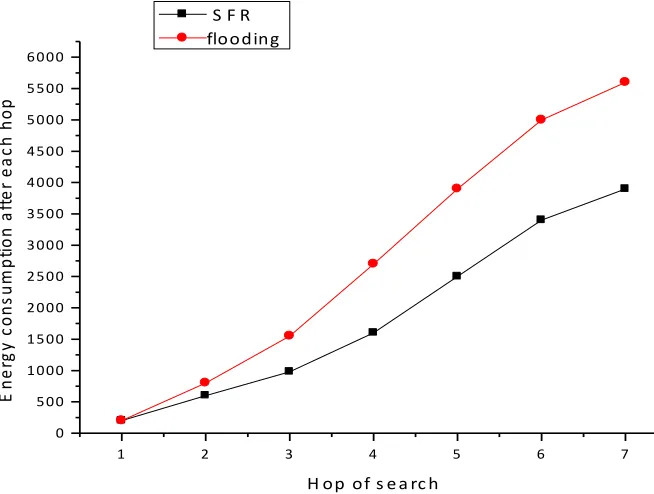
Figure 1 shows that the total energy consumption of each hop network of the SFR protocol is obviously lower than that of flooding mode. When the routing discovery process is completed, the total energy consumption of flooding is 5633, which is 1.43 times of that of SFR protocol. At the completion of the third hop, the total network energy consumption of flooding is 1.71 times that of SFR. The SFR protocol can save 30.2% of the total energy of the network, while ensuring the same coverage as flood-ing.
! " # $ % & '
( %(( !((( !%(( "((( "%(( #((( #%(( $((( $%(( %((( %%(( &(((
)
*+
,-./
01
*2
34
56
71
*/
89
6+
,/+
80
:/
:1
5
; 15/19/2 +8 ,0 : /< = >
9?11@7*- /
! " # $ % & ' ( ) !
&!! "!!! "&!! #!!! #&!! $!!! $&!! %!!!
*
+,-.,/
.0
12
+.+
34
12
05
.6
-7
89
:5
.2
/;
9+
32
+/
0<2
<5
8
= 5825;26 +/ 30< 2> ? *
2;@55,:.4
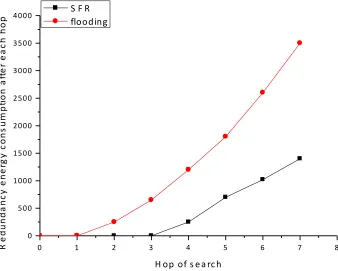
Fig. 2. The redundant energy consumption of each hop network of the SFR protocol
As shown in figure 2, it is the redundant energy consumption per jump network. It clearly shows that the amount of redundant energy consumed by flooding increases rapidly as the number of hops increases, especially between the third to sixth hops. The SFR protocol does not have any redundant messages in the first few hops, and only there are only a small amount of redundant messages at the beginning of the fourth hop. The total redundancy energy consumption of flooding is 2.27 times that of SFR routing protocol. Compared with flooding algorithm, SFR routing protocol can reduce more than 56.1% redundant messages.
5
Conclusion
compare the network coverage after each hop; the total energy consumption after each hop; and the energy redundancy rate after each hop.
It is believed that a routing protocol using segmentation search strategy in the rout-ing discovery phase can be proposed. Accordrout-ing to the average node network connec-tivity, forwarding rules are made. The forwarding of routing request messages, at the first several hops, tends to node with high node connection degree, so as to rapidly expand the network coverage range. At the latter several hops, the forwarding of rout-ing request messages tends to nodes with low node connection degree, so as to ensure that the network can cover the areas with sparse distribution of nodes.
6
References
[1]Kontik, M., & Ergen, S. C. (2017). Distributed Medium Access Control Protocol for Suc-cessive Interference Cancellation-Based Wireless Ad Hoc Networks. IEEE Communica-tions Letters, 21(2), 354-357. https://doi.org/10.1109/lcomm.2016.2619702.
[2]Varshney, P. K., Agrawal, G. S., & Sharma, S. K. (2016). Relative Performance Analysis of Proactive Routing Protocols in Wireless Ad hoc Networks using Varying Node Density. Invertis Journal of Science & Technology, 9(3), 161-169. https://doi.org/10.5958/2454-762x.2016.00015.9.
[3]Varshney, P. K., Agrawal, G. S., & Sharma, S. K. (2016). Energy Consumption Analysis of Wireless Ad hoc Networks Routing Protocols under Different Energy Models. INROADS-An International Journal of Jaipur National University, 5(1s), 250-253. https://doi.org/10.5958/2277-4912.2016.00048.5.
[4]Yadav, A. K., Das, S. K., & Tripathi, S. (2017). EFMMRP: Design of efficient fuzzy based multi-constraint multicast routing protocol for wireless ad-hoc network. Computer Networks, 118, 15-23. https://doi.org/10.1016/j.comnet.2017.03.001.
[5]Prusty, A. R., Sethi, S., & Nayak, A. K. (2016). A hybrid multi-hop mobility assisted het-erogeneous energy efficient cluster routing protocol for Wireless Ad hoc Sensor Networks. Journal of High Speed Networks, 22(4), 265-280. https://doi.org/10.3233/jhs-160548. [6]Biagioni, E., Giordano, S., Luo, X., Camp, T., & Tian, T. (2016). Social and mobile
solu-tions in ad hoc and sensor networking [Series Editorial]. IEEE Communicasolu-tions Magazine, 54(7), 100-101. https://doi.org/10.1109/mcom.2016.7509385.
7
Authors
Dan Han#and Lingmei Fu are with Sanya Polytechnica Vacational College, Sanya, China.