A Novel Wireless Sensor Network Architecture
Based on Cloud Computing and Big Data
https://doi.org/10.3991/ijoe.v13i12.7890
Changtong Song Zhenjiang College, Zhenjiang, China
Abstract—To explore big data processing and its application in wireless sensor network (WSN), this paper studies structural construction of the WSN based on big data processing, and numerically simulates SVC4WSN and MDF4LWSN architectures. Moreover, the relationship between the optimal network layer and node communication radius was verified at different node densities. The results indicate that the proposed model achieved better lifecycle and loading balancing effect than the other network.
Keywords—Big Data, Cloud Computing, Wireless Sensor Network (WSN)
1
Introduction
The wireless sensor network (WSN) and its application have become hotspots in in the academic circle. Typical information strategies for the WSN include Wisdom of the Earth (US), U-Japan, U-Korea, the Digital Agenda for Europe, and Perception of China. With the proliferation of the network, the information technology has been extensively applied in various fields, exerting a profound impact on all aspects of the national economy and social life. If the current trend continues, the information indus-try is bound to transcend to the fields of overall perception and intelligent application. Nevertheless, the research on the management and processing of WSN data is still far from enough. There are many problems demanding prompt solutions and an ample space for further development. In this paper, the WSN management software is com-bined with the cloud storage platform of big data to explore WSN data management and processing.
2
Literature Review
structured data, Amazon provided a simple user interface service called the Sim-pleDB. The user data is organized into a series of domains, each of which corresponds to a set of items composed of attribute-value pairs. The SimpleDB provides the even-tual consistency through availability and partitioning tolerance [3].
In general, the existing plans neither efficiently tackle the heterogeneity of WSN data, nor support the processing of large data volume in the current sensor network. To overcome the shortcomings, this paper probes into a new architecture technology combining the WSN and cloud computing. First, the big data processing was intro-duced based on cloud computing, aiming to support the data processing of large-scale WSN; then, an innovative structure of the large-scale WSN was presented for better integration of big data processing with cloud computing.
3
Network Structure Design
The Service Oriented Architecture and Virtualization Cloud for WSN (SVC4WSN) mainly covers four layers: a large-scale WSN, the gateway, the cloud centre and the users.
The first layer is a large-scale WSN, consisting of numerous sensor nodes at the bottom and the sink node. This layer is mainly responsible for acquiring the data of sensor nodes, and passing the data to the local sink node.
The second layer is the gateway, which is subdivided into a data abstraction layer, a local storage and management layer and an SOA communication layer. The data abstraction layer shields the data difference at the bottom and interacts with the WSN in the first layer; the local storage and management layer stores data and backs up task management services; the SOA communication layer offers the data in the form of services to the cloud access.
The third layer is the cloud centre, which includes such four parts as the virtual cloud, the cloud processing and storage, the web application and the cloud manage-ment. Among them, the virtual cloud part implements the gateway and cloud services; the cloud processing and storage part runs Map Reduce and persistent storage of data in the cloud; the web application part provides access to business based on the data to the user; the cloud management part manages cloud services and infrastructure, moni-tors work implementation, and supports business logic and query processing.
The fourth layer is the users. The users are classified into three groups, namely de-velopment users, cloud management users and ordinary users.
3.1 Architecture design
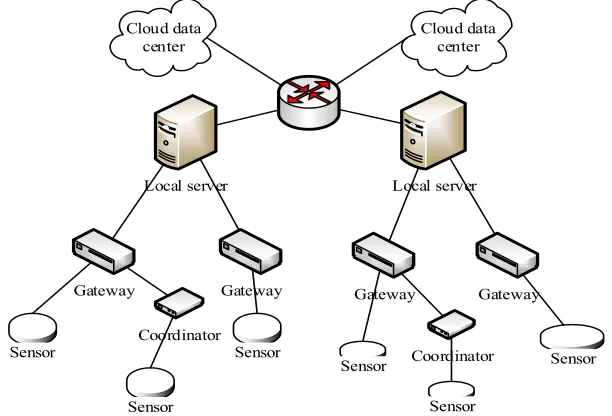
still some stones left unturned. One of the problems lies in the storage of sensor data. If all the data were transferred to the cloud data centre in the sampling time, the entire network will be congested by the big data. Another problem is the processing method for these data. If all sensor data are processed in the cloud, the communication latency will be intolerable for applications with time delay requirements [4]. To solve these problems, it is necessary to conceive and design a flexible and multi-layer data pro-cessing and storage model based on cloud computing (Figure 1).
Grounded on the cloud data model, the SVC4WSN was designed to enhance the performance and virtualization of services. In the SVC4WSN, the Service Oriented Architecture (SOA) has the following three functions [5]. First is the distributed ser-vice registration and discovery function of the WSN. The sensor network serser-vice is described in the service registration end with the SDL file. All sensor services register their own service in the form of URL, creating a unified and efficient access mode of sensor network services. Second is the collaborative access and interaction between different WSN data. The data are expressed in the unified format of XML file. Last is the provision of convenient services based on the cloud, so that the end user can use the ubiquitous service in the web.
Local server Local server
Gateway Gateway Gateway Gateway
Coordinator
Coordinator Cloud data
center Cloud data center
Sensor Sensor
Sensor
Sensor
Sensor
Sensor
Fig. 1. Flexible and multi-layer data processing and storage model based on cloud compu-ting
Large-scale WSN Gateway !"#$%&'()*(+ !",()* Transport
layer Storage layer
Sense layer
Milti Sinks
-./&012(+
0-30 41*1& /56*+1'*
Web Application
Cloud Management
Virtual Cloud
Developer
Manager
User
SVC4SN Architecture
Fig. 2. SVC4WSN architecture
According to the above figure, the Map phase, ranging from the cloud centre, the gateway, to the WSN, is divided into three processes. First, the cloud receives a job, and maps it to the corresponding gateway according to the nature and purpose of the job. Then, the gateway analyses and processes the job, divides it into several tasks based on the actual situation of the connected WSN, and maps the tasks to the work-ing area of the sensor network. In the end, the regional sink node assigns the tasks to the underlying sensor nodes, which start working upon receiving the tasks during the internal mapping process.
3.2 Gateway, cloud centre and users
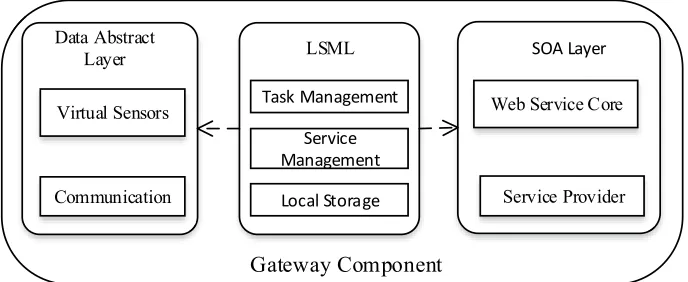
As mentioned above, the gateway is subdivided into a data abstraction layer, a lo-cal storage and management layer and an SOA communication layer. The structure of each layer is given in Figure 3.
Data Abstract
Layer LSML !"#$%&'()
Virtual Sensors
Communication
*&+,$-&.&/(0(.1
!()234($ -&.&/(0(.1
%54&6$!15)&/(
Web Service Core
Service Provider
Gateway Component
As shown in Figure 3, the data abstraction includes a communication layer and a virtual sensor layer associated with the sink node. The local storage and management layer (LSML) covers local storage, service management, and task management mod-ules. The SOA communication layer encompasses a web service core and a service provider.
The cloud centre, as the core of the SVC4WSN, manages the WSN in the bottom layer through the gateway, acquires and releases sensor network services, and cooper-ates with the sensor networks in the cloud. It is also responsible for preserving all the data collected by the sensor network nodes [7], and transferring the data to web appli-cations by their business logics, so as to ensure the intelligent access of the users. The cloud centre is mainly made up of four parts: virtual cloud, cloud processing and storage, web application and cloud management.
The users layer contains various users of the WSN cloud computing platform. They fall into the groups of developers, managers, and ordinary users. Using plat-form-supplied API and development tools, the developers create applications as per platform standards, and publish them to the cloud. The managers manipulate JSP pages with the browser, seeking to facilitate the management and use of the platform.
4
Simulation and Discussion
This chapter simulates the SVC4WSN based on the theoretical analysis in the pre-ceding chapters, and discusses the sink mechanism, cloud centre, service QoS, and Map Reduce of the proposed model. Moreover, the SVC4WSN was compared with Multi-Hop Direct Forwarding for Local Wireless Sensor Network (MDF4LWSN) in terms of energy efficiency, transmission delay and data storage. The simulation was implemented in Matlab8.0, and the program design of sensor node was carried out in TinyOS2.1 [8, 9].
4.1 Simulation and discussion of SVC4WSN architecture
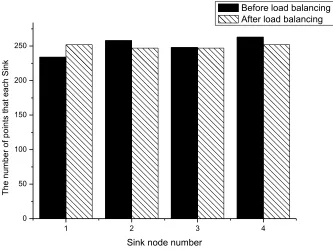
This section first analyses the multi-sink mechanism of the WSNs being simulated. Through the analysis, it is known that two modes of sink node load balancing existed in sensor network area: the interregional load balancing and the intraregional load balancing [10]. The two algorithms correspond to Interregional Load Balancing and Intraregional Load Balancing, respectively. Figure 4 depicts the scenario of interre-gional load balancing of sink nodes.
Fig. 4. Results of load balancing simulation on the sink nodes in the SVC4WSN
4.2 Simulation and discussion of MDF4LWSN architecture
In the Map phase of the MDF4LWSN, the primary purpose of design is to mini-mize the total energy consumption of the entire network, and optimini-mize the network layers and the radius of inter-node communication.
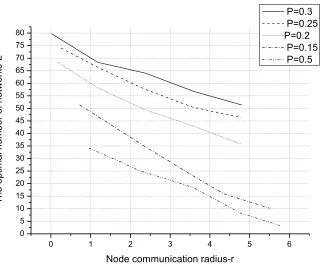
Figure 5 shows the relationship between the optimal number of layers (L) and the node communication radius (r_com) at different node densities P (the number of nodes per square meter; P [1, 0.3]) in the circle with radius R=l00m. It can be seen from Figure 5 that the inter-node communication radius gradually increased but the corresponding optimal number of layers declined with the decrease in the node densi-ty P. The relationship reveals that, the nodes are more likely to communicate with each other if there are lots of nodes, that is, the neighbouring nodes are closer to each other [12, 13]. In this case, the communication radius r_com of nodes gets shorter, while the optimal number of layers L grows. The optimal value of L should be taken at the minimum value of ESUM. Furthermore, the dotted line with high P value re-mained above the dotted line with low P value, indicating that more layers are needed to lower the energy consumption of the entire network without changing the commu-nication radius.
1 2 3 4
0 50 100 150 200 250
The
number
of
point
s t
hat
eac
h
Si
nk
Sink node number
Fig. 5. Relationship between the network optimum layer (L) and node communication radius (r_com)
5
Conclusions
Based on cloud computing and big data processing, this paper studies large-scale WSN architecture and simulates the structure of the proposed model. Then, the effects of multi-sink mechanism on node load balancing were explored, and the results were compared before and after the load balancing.
The integration of cloud computing and the WSN is an innovative perspective of research. With the emergence of new solutions, more and more technologies will be introduced to improve the data sensing ability and life cycle of WSNs, and to create a truly ubiquitous network.
6
References
[1] Jo, M., Maksymyuk, T., Strykhalyuk, B., & Cho, C. H. (2015). Device-to-device-based heterogeneous radio access network architecture for mobile cloud computing. IEEE Wire-less Communications, 22(3): 50-58. https://doi.org/10.1109/mwc.2015.7143326.
[2] Kehoe, B., Patil, S., Abbeel, P., & Goldberg, K. (2015). A survey of research on cloud ro-botics and automation. IEEE Transactions on automation science and engineering, 12(2): 398-409. https://doi.org/10.1109/tase.2014.2376492.
0 1 2 3 4 5 6
0 5 10 15 20 25 30 35 40 45 50 55 60 65 70 75 80
The opt
im
al
n
um
ber
of
net
wor
ks
-L
Node communication radius-r
[3] Quwaider, M., & Jararweh, Y. (2015). Cloudlet-based efficient data collection in wireless body area networks. Simulation Modelling Practice and Theory, 50: 57-71. https://doi.org/10.1016/j.simpat.2014.06.015.
[4] Sivakumar, M., Sadagopan, C., & Baskaran, M. (2016). Wireless Sensor Network to Cyber Physical Systems: Addressing Mobility Challenges for Energy Efficient Data Aggregation Using Dynamic Nodes. Sensor Letters, 14(8): 852-857. https://doi.org/10.1166/sl. 2016.3624
[5] Yaqoob, I., Ahmed, E., Hashem, I. A. T., Ahmed, A. I. A., Gani, A., Imran, M., & Gui-zani, M. (2017). Internet of Things Architecture: Recent Advances, Taxonomy, Require-ments, and Open Challenges. IEEE Wireless Communications, 24(3): 10-16. https://doi.org/10.1109/MWC.2017.1600421
[6] Keskin, M. E. (2017). A column generation heuristic for optimal wireless sensor network design with mobile sinks. European Journal of Operational Research, 260(1): 291-304. https://doi.org/10.1016/j.ejor.2016.12.006
[7] El-Basioni, B. M. M., Moustafa, A. I., El-Kader, S. M. A., & Konber, H. A. (2016). Tim-ing Structure Mechanism of Wireless Sensor Network MAC layer for MonitorTim-ing Applica-tions. International Journal of Distributed Systems and Technologies (IJDST), 7(3): 1-20. https://doi.org/10.4018/IJDST.2016070101
[8] Jang, W. S., Kim, D. Y., & Skibniewski, M. J. (2016). Reliability performance of wireless sensor network for civil infrastructure–part I: experimental analysis. Journal of Civil Engi-neering and Management, 22(1), 105-117. https://doi.org/10.3846/13923730.2014.895410. https://doi.org/10.3846/13923730.2014.895410
[9] Guo, K. (2016). Empirical Study on Factors of Student Satisfaction in Higher Education. Revista Iberica de Sistemas e Tecnologias de Informacao, E11: 344-355.
[10] Yoon, I., Yi, J. M., Jeong, S., Jeon, J., & Noh, D. K. (2016). Dynamic Sensing-Rate Con-trol Plan Using a Selective Data-Compression for Energy-Harvesting Wireless Sensor Networks. IEMEK Journal of Embedded Systems and Applications, 11(2): 79-86. https://doi.org/10.14372/IEMEK.2016.11.2.79
[11] Rajasoundaran, S., Narayanasamy, P., & Riasudheen, H. (2016). A Hybrid Secure Routing and Monitoring Mechanism Using Authorized and Concealed Arbitrary Watchdogs in Wireless Sensor Network. Intelligent Systems And Communication (NCISC-2016), 177. https://doi.org/10.5958/2249-7315.2016.00664.X
[12] Tan, X., Zhang, F., Shi, M., Gao, D., & Liu, Y. (2016). A Survey on Organization and Po-sitioning of Nodes in Wireless Sensor Network. International Journal of Future Generation Communication and Networking, 9(11), 113-124. https://doi.org/10.14257/ijfgcn.2016. 9.11.11
[13] Duan, H.Y. (2016). Research on Collaboration in Innovative Methods of Manufacturing Innovation Chain. Revista Iberica de Sistemas e Tecnologias de Informacao, E11: 292-303.
7
Author
Changtong Song is with the Electrical and information Engineering Department, Zhenjiang College, Zhenjiang 212028, China.