University of Trento University of Bergamo University of Brescia University of Padova University of Trieste University of Udine University IUAV of Venezia
Md. Rashedul Hasan
Semantic Aware Representing and Intelligent
Processing of Information in an Experimental domain:
the Seismic Engineering Research Case
Tutor: Prof. Oreste S. Bursi
Co-Tutor: Feroz Farazi
UNIVERSITY OF TRENTO
Ph. D. in Engineering of Civil, Environmental and Mechanical
Cycle: XXVII
Head of Department: Prof. Marco Tubino
Head of the Doctoral School: Prof. Paolo Scardi
Final Examination: 24 / 04 / 2015
Board of Examiners
Prof. Claudio Di Prisco (Politecnico di Milano)
Prof. Ernesto D’Avanzo (Università di Salerno)
Abstract
Seismic Engineering research projects’ experiments generate an enormous amount of data that would benefit researchers and experimentalists of the community if could be shared with their semantics. Semantics is the meaning of a data element and a term alike. For example, the semantics of the term experiment is a scientific research performed to conduct a controlled test or investigation. Ontology is a key technique by which one can annotate semantics and provide a common, comprehensible foundation for the resources on the Semantic Web. The development of the domain ontology requires expertise both in the domain to model as well as in the ontology development. This means that people from very different backgrounds, such as Seismic Engineering and Computer Science should be involved in the process of creating ontology. With the invention of the Semantic Web, computing paradigm is experiencing a shift from databases to Knowledge Bases (KBs), in which ontologies play a major role in enabling reasoning power that can make implicit facts explicit to produce better results for users. To enable an ontology and a dataset automatically exploring the relevant ontology and datasets from the external sources, these can be linked to the Linked Open Data (LOD) cloud, which is an online repository of a large amount of interconnected datasets published in RDF. Throughout the past few decades, database technologies have been advancing continuously and showing their potential in dealing with large collection of data, but they were not originally designed to deal with the semantics of data. Managing data with the Semantic Web tools offers a number of advantages over database tools, including classifying, matching, mapping and querying data. Hence we translate our database based system that was managing the data of Seismic Engineering research projects and experiments into KB-based system. In addition, we also link our ontology and datasets to the LOD cloud.
In this thesis, we have been working to address the following issues. To the best of knowledge the Semantic Web still lacks the ontology that can be used for representing information related to Seismic Engineering research projects and experiments. Publishing vocabulary in this domain has largely been overlooked and no suitable vocabulary is yet developed in this very domain to model data in RDF. The vocabulary is an essential component that can provide logistics to a data engineer when modeling data in RDF to include them in the LOD cloud. Ontology integration is another challenge that we had to tackle. To manage the data of a specific field of interest, domain specific ontologies provide essential support. However, they alone can hardly be sufficient to assign meaning also to the generic terms that often appear in a data source. That necessitates the use of the integrated knowledge of the generic ontology and the domain specific one.
ACKNOWLEDGEMENTS
In the first place I would like to record my gratitude to Professor Oreste S. Bursi for his supervision, advice, and guidance from the very early stage of this research as well for giving me extraordinary experiences throughout the work. Above all and the most needed, he provided me unflinching encouragement and support in various ways.
Special thanks go to my co-supervisor, Dr. Feroz Farazi, for his guidance, insightful discussion, and encouragement throughout the development of this thesis.
I am also thankful to The University of Trento for granting me the Ph.D. fellowship to commence this thesis and to carry out the necessary research work.
I would also like to thank all my friends, in particular, Dr. Md. Shahin Reza, for his encouragement during this challenging time and my PhD.
CONTRIBUTIONS and PUBLICATIONS
The main contributions of this thesis are summarized as follows:
An ontology based system for the Seismic Engineering domain is introduced to provide a mechanism to manage information and semantics thereof that can make systems semantically interoperable, and as such can exchange and share data.
It develops faceted ontology in the Seismic Engineering domain.
It provides an overview of the Semantic Web languages in order to identify a suitable language for representing faceted ontologies.
Representing SEPREMO as an RDF graph that can help understanding the relationship between different concepts.
The integration of the SEPREMO ontology with WordNet.
To realize the theoretical concepts into practical systems and to make the results of this thesis accessible to the user, a number of tools have been implemented: an ontology browser with the possible support for searching, editing and visualizing both the ontology and experimental data.
It provides an overview of how to deal volume, velocity and high-variety of information.
It developed an ontology matching algorithm that potentially contributes to resolve the data integration and interoperability issue. The proposed algorithm is implemented so that users can select an RDF file to find the correspondences on the LOD cloud.
An analysis of the computational complexity of the matching algorithm is also provided.
As a result of the work conducted in this thesis, the following publications have been produced:
Journal Publication:
Hasan, M.R., Farazi, F., BURSI, O.S., Reza, M.S., D’Avanzo E. “A semantic-aware data management system for seismic engineering research projects and experiments”, International Journal for Advanced Research in Artificial Intelligence, 2015, (in print).
Conferences:
Hasan M. R., Farazi F, Bursi OS, Reza M.S. Towards Publishing Earthquake Engineering Experimental Data As Part Of Linked Open Data Cloud. The 8th INSPIRE Conference, Aalborg, Denmark, 16-20 June 2014.
Hasan M. R., Farazi F., Bursi O. S., Reza M. S. A faceted lightweight ontology for earthquake engineering research projects and experiments. SERIES Concluding Workshop - Joint with US-NEES, Earthquake Engineering Research Infrastructures, JRC-Ispra, May 28-30, 2013.
Hasan M. R., Farazi F., Bursi O. S., Reza M. S. A Semantic Technology-Based Information Management System for Earthquake Engineering Projects and Experiments. 5th International Conference on Advances in Experimental Structural Engineering, Taipei, Taiwan, November 8-9, 2013.
C
ONTENTS1 INTRODUCTION 1
1.1 The Context . . . 1
1.2 The Problem . . . 3
1.3 Solution . . . 5
1.4 Structure of the Thesis . . . 6
2 Background Studies 9 2.1 Introduction . . . 9
2.2 Exchange Data Format . . . 10
2.3 System Architecture . . . 14
2.3.1 Local site management of RELUIS Database . . . 14
2.4 Distributed Database Architecture . . . 15
2.5 Conclusion . . . 18
3 State of the Art 19 3.1 Introduction . . . 19
3.2 Ontology . . . 20
3.2.1 Ontology Design and development . . . 24
3.2.2 Ontology Representation . . . 27
3.2.3 Ontology Matching Techniques . . . 30
3.2.4 Query Formulation and Answering . . . 34
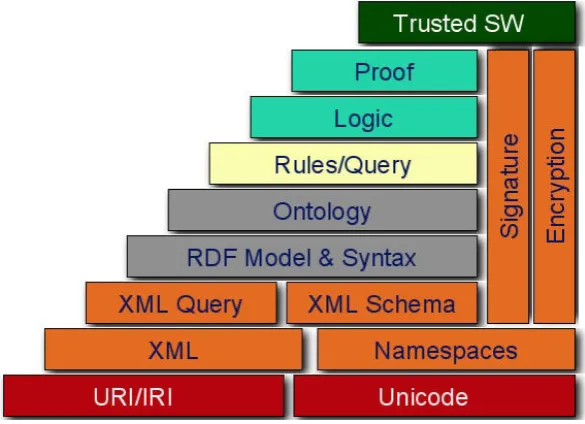
3.3 The Semantic Web . . . 35
3.4 Data Science . . . 38
3.4.1 R Statistical Tools . . . 39
3.4.3 Hadoop . . . 40
3.4.4 Open Refine . . . 42
3.4.5 Apache Spark . . . 43
3.5 Conclusion . . . 44
4 Ontology Development 47 4.1 Introduction . . . 47
4.2 Ontology Development Methodology . . . 48
4.3 Ontology Representation . . . 51
4.4 Ontology Integration . . . 52
4.5 Ontology Mapping . . . 54
4.6 Ontology Alignment . . . 56
4.7 Ontology Evolution . . . 59
4.8 Conclusion . . . 62
5 Ontology Publishing 63 5.1 Introduction . . . 63
5.2 Vocabularies . . . 63
5.3 Web Ontology Languages . . . 67
5.3.1 Resource Description Language (RDF) . . . 67
5.3.2 RDF Schema . . . 70
5.3.3 Web Ontology Language (OWL) . . . 72
5.4 Conclusion . . . 77
6 Linking RDF Datasets 79 6.1 Introduction . . . 79
6.2 Linked data background and sources . . . 81
6.3 Ontologies alignment using Linked Data . . . 83
6.4 Ontologies alignment using Linked Data . . . 84
6.4.1 Algorithm . . . 84
6.4.2 System Design . . . 87
6.5 Evaluation . . . 87
7 Intelligent Query Answering 91
7.1 Introduction . . . 91
7.2 Document Collection . . . 92
7.3 Indexing and Searching . . . 92
7.3.1 Apache Lucene . . . 92
7.3.2 Apache Solr . . . 97
7.4 Output . . . 100
7.5 Conclusion . . . 100
8 Result 101 8.1 Introduction . . . 101
8.2 Ontology Development . . . 102
8.2.1 Approach . . . 102
8.2.2 Experimental Data Collection . . . 103
8.2.3 Experimental Setup . . . 104
8.2.4 Controlled Experiment . . . 106
8.2.5 RDF Liking Datasets . . . 112
8.2.6 Intelligent Query System . . . 113
8.3 RELUIS Database . . . 115
8.4 Conclusion . . . 122
9 Conclusions 125 9.1 Thesis Summary . . . 125
9.2 Limitations . . . 128
9.3 Future Work . . . 128
9.4 Conclusions . . . 129
Appendix A Seismic Engineering Research Projects and Experiments
L
IST OFF
IGURES2.1 Data hierarchy . . . 11
2.2 Example of Signal Table . . . 12
2.3 Project, Sensor level in MySQL . . . 15
2.4 RELUIS distributed database . . . 15
3.1 RDF Triple . . . 28
3.2 Matching algorithm . . . 33
3.3 Semantic Web Architecture (Berners-Lee et al., 2001) . . . 36
4.1 The Device and Experiment Facets . . . 50
4.2 SEPREMO RDF graph . . . 52
4.3 NEES Thesaurus . . . 53
4.4 After applying the removal of the concept Vibrate. . . 60
4.5 Inclusion of the shaker-based test and hammer-based test in the ex-periment facet . . . 61
5.1 A subset of the entity class concepts of the SEPREMO . . . 65
5.2 A partial list of attribute concepts added to the SEPREMO . . . 66
5.3 Excel view of SEPREMO . . . 68
5.4 RDF describes the Resources . . . 69
5.5 A snippet of the experimental data represented in RDF . . . 70
5.6 Modeling Components of RDF schema from (Brickley et al. , 2004) . . 71
5.7 RDFS describes the Resources ”Hammer” and ”Damper” . . . 71
5.8 Attribute presents in RDF . . . 72
5.9 A fragment of OWL ontology. . . 74
6.1 Linked open Data Cloud (Tim Berners-Lee , 2006) . . . 80
6.2 The basic structure of a Semantic matcher algorithm. . . 85
6.3 System Architecture . . . 87
7.1 Apache Lucene System Architecture . . . 95
7.2 Intelligent query answering system architecture . . . 96
7.3 The architecture of Solr (Yonik , 2006) . . . 98
7.4 Figure: Solr Admin Panel . . . 99
8.1 Ontology based development Approach . . . 102
8.2 Experimental set-up of a piping system tested under earthquake load-ing (Reza et al. , 2013). . . 103
8.3 Ontology Integration and Population to KB . . . 104
8.4 KB-based System Architecture . . . 105
8.5 Synonymus relationship of Test. . . 107
8.6 Transitive Relationship of Device . . . 108
8.7 Sparql Endpoint . . . 108
8.8 Circle pack layout for ontology visualization . . . 110
8.9 A snippet of the experimental data represented in RDF . . . 111
8.10 Load-displacement characteristics curve drawn with the data provided in Figure 8.9 . . . 111
8.11 Web Interface for RDF Data sets Linking . . . 112
8.12 WordNet RDF dataset interlink with DBpedia . . . 113
8.13 SEPREMO RDF datasets interlink with DBpedia. . . 113
8.14 Intelligent Query System . . . 114
8.15 The organization of the views of RELUIS application . . . 115
8.16 Login Page . . . 116
8.17 Add New Project . . . 117
8.18 List of Projects . . . 118
8.19 Navigation at the Central Site: project level . . . 118
8.20 Specimen level: expanded view of specimen characteristics . . . 119
8.22 Signal level: each signal is delivered together with data regarding its
units, the nature of the signal . . . 120
8.23 List of Users . . . 120
8.24 Search User Page . . . 121
L
IST OFT
ABLES3.1 The Hadoop Family . . . 41
5.1 A partial list of relation concepts added to the SEPREMO . . . 67
6.1 Performance of Semantic matcher . . . 88
CHAPTER
1
INTRODUCTION
1.1 The Context
The Semantic Web was designed to be the ground of meaning-wise
intercon-nected, logically consistent, immediately updateable and machine processable data
elements. These data elements can come from the original Web as well as from other
sources ranging from universities and research centers to private and public organi-zations. Until the middle of the last decade people were barely publishing data on the
Semantic Web because of the lack of skill for generating data and the deficiency of
the easy to use tools for converting data into required logical formalisms. Moreover,
tools which were already in place could hardly show their potential in dealing with
large amount of data.
Since the advent of the Linked Open Data (LOD) cloud, a myriad of data elements
sprung up and that revolutionized the growth of the Semantic Web both in terms of
content and tools. As of now data in many domains including life science, geography,
media and government became part of the LOD cloud. The proliferation of LOD cloud
has been the inspiration of developing new tools and customizing the existing ones in
order to effectively deal with the Semantic Web Data. Some examples of such tools
are D2R server1 , OWLIM2 and Virtuoso3 . In the LOD realm, a dataset is usually published by establishing links with other existing relevant datasets. This linking is the
powerful mechanism that allows easy exploration of the interesting datasets and facts
codified in them. These links can help develop applications which can take advantage
of the knowledge originating from external sources.
Seismic Engineering research projects experiments generate an enormous amount
of data that would benefit researchers and experimentalists working elsewhere if
could be shared with their semantics. Semantics is the meaning of something, e.g.,
the semantics of the term experiment is a scientific research performed to conduct a
controlled test or investigation. There has been an increase in the number of search
on the web relevant to seismic engineering experiments and projects (Bosi et al.,
2013). A couple of resources have been developed in this area to share experimental
findings and outcomes, for example, Reluis4database. To the best of our knowledge, unfortunately, no significant effort has been devoted yet to promote access to and to
integrate seismic engineering projects experimental information.
Semantic Web community has been working in order to solve data integration issue
since the beginning of the last decade by employing a novel approach that incorpo-rates the use of ontology and the Semantic Web languages, i.e., RDF and OWL.
Ontology is an artifact used to model the real world facts and entities. RDF is an
acronym for Resource Description Framework used to represent ontologies which do
not consist of complex logical formulas. OWL, which is an acronym for Web Ontology
Language, was designed to make possible the representation of comparatively
com-plex logical formulas. Ontologies are intended to be stored in the Knowledge Base
(KB), which can offer better user experience by supporting reasoning over ontological
data and semantics. As KB systems can also manage the semantics of the data, they
have the potential to tackle the semantic interoperability issue.
In fact, ontology is a key technique by which one can annotate semantics and
provide a common, comprehensible foundation for resources on the Semantic Web.
However, the development of the domain ontology requires expertise both in the
do-main to model as well as in the ontology development. This means that people
from very different backgrounds, such as Seismic Engineering and Computer
Sci-ence should be involved in the process of creating ontology.
Several methodologies have been developed to build ontologies (Denicola et al.,
2009; Sure et al., 2003). DERA methodology (Giunchiglia and Dutta, 2011), which
was developed at the University of Trento is gaining popularity because of its ease
of use. As like as knowledge, ontologies also evolve as new facts can emerge at
any time. This demands the continuous update of the ontology. Fulfilling this very
demand is challenging in either ways, be it manual or automatic. It is hardly affordable for a research group to employ an ontology developer for a long period, though this
approach would give us required accuracy. On the other hand, automatic approach
is error prone. However, the latter approach is the most widely used technique in
such a situation. Supervised machine learning approach can be used for keeping the
knowledge updated.
The Semantic Web technologies are fostering to accept a new computing paradigm
that entails a shift from databases to Knowledge Bases. There the core is the
ontol-ogy that plays a main role in enabling reasoning power that can make implicit facts
explicit; in order to produce better results for users. In addition, KB-based systems
provide mechanisms to manage information and semantics thereof, that can make
systems semantically interoperable and as such can exchange and share data
be-tween them. In order to exploit the benefits offered by state of the art technologies, we
moved to KB-based system in managing data of the Seismic Engineering Research
Projects and Experiments domain. To enable our system automatically exploring the relevant new datasets from the external sources, we connected the projects and
ex-perimental data to the LOD cloud.
1.2 The Problem
Employing Semantic Web tools for developing applications and Publishing data on
the LOD cloud in the field of Seismic Engineering experience the following research
issues.
1.2.1 Deficiency of domain ontology for categorizing information of Seismic
Engineering projects and experiments: In the last couple of decades, database
deal-ing with large collection of data, but they were not originally designed to deal with
the semantics of data. Managing data with the Semantic Web tools offers a number
of advantages over Database tools in classifying, matching, mapping and querying
data. While Semantic Web tools play the role of catalyst, domain specific ontologies
are the key elements to perform these operations effectively. Unfortunately, it still
lacks such ontology that can be used for representing information related to Seismic Engineering projects and experiments.
1.2.2 Lack of suitable vocabulary for publishing Seismic Engineering
experi-mental data on the LOD cloud: The vocabulary is an essential component that can
guide a data engineer when modeling data in RDF to publish them as part of the LOD cloud. Use of standard domain specific vocabularies is recommended as it leads to
an easier consumption of the data by LOD applications and users. Despite the fact
that the seismic engineering community is nontrivially contributing to the cloud,
find-ing datasets for experiments such as dynamic tests, pseudo-dynamic tests and cyclic
tests is a far cry from what has been expected. As a matter of fact, publishing such
experimental data has largely been overlooked and, as such, to the best of our
knowl-edge no vocabulary is yet developed in this field, to model data in RDF.
1.2.3 Ontology integration and linking data elements to the LOD cloud: to
manage the data of a specific field of interest, domain specific ontologies provide
es-sential support. However, they alone can hardly be sufficient to assign meaning also
to the generic terms that often appear in a data source. That necessitates the use of
both the generic ontology and the domain specific one. To provide seamless access
to these ontologies, it is crucial to integrate them and put them in the same knowledge base. Through integration we can also avoid having duplicate concepts in the
knowl-edge base. Because of the polysemous nature of the natural language terms finding
the right correspondences between ontologies appears as a challenge. Polysemous
nature of the terms in the integrated ontology pause further challenge when we try
to match them with the existing datasets, e.g., DBPedia, on the LOD cloud. Usually
1.3 Solution
To address the issues described in Section 1.2, in this thesis we have proposed
the development of a domain ontology that can cover the specificity of the Seismic
Engineering research projects and experiments (solution to the problem 1.2.1), the
specification of a vocabulary taking into account the reuse of the existing terms
when-ever possible (solution to the problem 1.2.2) and the application of semantic similarity
measure while matching the ontological concepts and terms to the datasets of the
LOD cloud (solution to the problem 1.2.3).
This thesis presents the development of a Seismic Engineering Research Projects
and Experiments Ontology (SEPREMO) with a focus on research project
manage-ment and experimanage-ments. The developed ontology was validated by domain experts,
published in RDF and integrated into WordNet. Data originating from scientific
ex-periments such as cyclic and pseudodynamic tests were also published in RDF. We exploited the power of Semantic Web technologies, namely Jena, Virtuoso and
Virt-Graph tools in order to publish, storage and manage RDF data, respectively. Finally,
a system was developed with the full integration of ontology, experimental data and
tools, to evaluate the effectiveness of the KB-based approach; it yielded favorable
outcomes.
Linked Open Data Cloud opened up the opportunity for researchers,
experimen-talists, data scientists, data practitioners and many others from government, public
and private sectors for unlimited share, use and reuse of datasets. This global
ini-tiative fosters data accessibility, availability and interoperability. In a few years the
LOD Cloud proliferated from some hundred datasets to a very large collection; as of
March 2014, it consists of around 9k datasets covering almost all possible top level
domains such as space, time, science, engineering, medicine, sports and
entertain-ment. However, publishing Seismic Engineering research projects and experiments
data has largely been overlooked and, as such, no vocabulary is yet developed in this
field, to the best of our knowledge, to model data in RDF. In this thesis, we present an approach for publishing them into the LOD Cloud. In order to model the concepts
complementing the vocabulary that we need for the experimental data representation,
Moreover, we have developed a matching algorithm that takes into account the
tex-tual description of the terms and the context in which the terms are found both in the
source and target datasets. In addition to these features, in measuring the similarity
we also check the existence of the semantically equivalent terms.
1.4 Structure of the Thesis
The remainder of this thesis is structured as follows.
Chapter 2 discusses an Italian national project (RELUIS) database, based on
which we got some concepts and entities for the SEPREMO ontology.
Chapter 3presents an overview of ontology and semantic web, sets out the
def-initions, structure and some methodologies of ontology development. In addition, it
also gives definitions of ontology mapping and other operations, such as ontology
alignment and how it can be used. It then offers a clear description and comparison
of ontology languages such as RDF, RDF(S), OWL and SKOS. Finally, we conclude
this chapter with an overview of big data that is a popular term used to describe
the exponential growth and availability of data, both structured and unstructured, and
overview of some tools that manage big data.
In Chapter 4, the DERA methodology is described, which is used for building
domain specific ontologies. Then, it describes the Knowledge Representation
Lan-guages RDF and OWL in terms of their capacity in representing ontologies of various
kind. Afterwards, the process of integrating the developed ontology with Wordnet is
explained. Basically, we applied the semi-automatic ontology integration algorithm
proposed in (Farazi et al., 2011). Also the ontology matching algorithms is discussed, which will help in obtaining a high quality results. It also provides approaches to
map between ontologies. Finally, evolution of methodology shows that the proposed
methodology is capable of dealing sufficiently with different real word scenarios.
Chapter 5 contains the formalization of seismic engineering terminologies using
the Semantic web languages. The schema is defined in such a way that it can be combined with vocabularies as produced by the developed methods. An overview of
In Chapter 6, overviews of the implementation of the semantic web matcher
in-cludes algorithm and system design is provided; the proposed approach elaborates
how to construct dynamic semantic data linking by taking advantage of DERI pipe (?)
features.
Chapter 7includes reviews related to the significance of annotations in the field of
information retrieval and recent research enhancements with a special focus on those
that take advantage of semantic web technologies in the Seismic engineering field.
The annotation and search modules of the proposed framework are implemented
using Apache Lucene.
The implementation of the developed system is described inChapter 8. The full
implementation is presented with some case studies, to provide a full picture of the
present approach and show its ability to produce high quality results. The
implemen-tation process, where the features of ontology alignments are integrated with
Word-Net in order to empower the search module to take advantage of the knowledge, is
presented via an ontology. Besides, the RELUIS project outcome is also commented in this chapter.
Chapter 9concludes the thesis with a summary of the work presented, its
CHAPTER
2
BACKGROUND
STUDIES
2.1 Introduction
At present, different laboratories of Italian Universities store and manage
experi-mental data in various fashions. Each laboratory deals with data with a unique local
data model and user interface, language and scheme. Therefore, the dissemination
and use of these experimental results outside the laboratory where they are produced can be problematic. To address the issue, there is an urgent need of creating a unique
platform for Italian Universities Laboratories capable of sharing seismic
experimen-tal data and knowledge. Therefore, a central database where centralized access to
database nodes that are distributed over the network is needed. This database will
be able to connect with a central portal in a uniform manner.
The most important components of the RELUIS database given below:
• Data Access Portal. It provides a centralized access to all the projects the
RELUIS laboratories make public. The Data Access Portal presents the infor-mation of the available projects, by following the structure of the Exchange Data
Format. Each individual laboratory can select which projects or project results
to make public.
• Exchange Data Format. This is the format in which the data and other
• Local database. It is the local repository where data is stored.
• Web Services. Allow the exchange of content and configuration between the
Data Access Portal and the local data-bases.
Section 2.2 describes the data format that is used in the communication between
every RELUIS partner and the central site containing the Data Access Portal.
Sec-tion 2.3 explains the RELUIS database from the perspective of external users and
how they can take advantage of this RELUIS infrastructure. Section 2.4 presents
distributed database architecture and Finally, Section 2.5 presents conclusions.
2.2 Exchange Data Format
The Exchange Data Format (EDF) is the format in which data are presented through
the Data Access Portal (DAP) as well as the format in which data are stored locally at
individual sites. The EDF has been designed to:
i. Be suitable for any experimental data type: data produced by centrifuges,
reac-tion walls, shaking tables and so on.
ii. Allow storing data along with all other types of information (documents, image
and so on.) which are useful to describe, repeat or simulate the experiments under
the same conditions.
iii. Allow for data accessibility restrictions: projects can be public, restricted only
to partners or, completely private (accessible only to the laboratory where have been
produced).
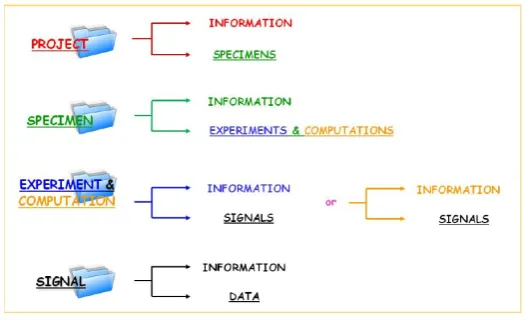
Figure 2.1: Data hierarchy
Project level includes infrastructures and persons involved and scope of the project.
For the sake of uniformity, most of the fields have a fixed list of possible entries from
which the user can chose. This allows for avoiding typos or using different naming for
same objects, while simplifying retrieval of data and information through the search
functionality. The main focus of the research project is indicated, a list of keywords
to define the research areas will be provided. Moreover, it is important to have a
template to fully define a report: title, author, abstract, date of publication, and link to the effective report in pdf and to the report in its original format.
A project usually includes testing of more than one physical (or numerical)
struc-ture (a short bridge pier and a tall one, several masonry strucstruc-tures made by different
kinds of clay) identified as Specimen. It is also possible to test the same structure
but in different states for example the structure in its original state and then after different types of retrofitting. While it may be argued that, in this case, all tests are
performed on the same specimen, the hierarchical structure of the database demands
that retrofitted specimens are included as new specimen. At this level, the physical
and mechanical characteristics of the specimen are specified. Each structure is
sub-divided into structural elements (as for example beam, column). Nominal mechanical
properties and, when experimentally measured, also actual ones can be specified.
Furthermore, maximum dimensions of the specimen are specified. A comprehensive
all the necessary information for external users to adequately model the specimen;
these documents show also the geometry of the facility and the location of the
speci-men in the facility.
In the case of a physical experiment, the same specimen is usually subjected to
several types of tests that differ by the type of load imposed (quasi-static test,
pseudo-dynamic test, shake table test, hammer test, etc. with or without sub-structuring,
in-situ or in laboratory), by the location of the loading and/or by the configuration of the
sensors. The original load time-histories and the effective inputs used on the
differ-ent experimdiffer-ents must be explicitly iddiffer-entified. For example, in case of seismic
experi-ments, the same accelerogram can be used several times by changing its intensity, or
a different one may be used for each test. The original signals are preserved by pro-viding some information on their nature (natural for accelerogram, natural-normalized
for natural accelerogram normalized in the intensity, natural-modified for natural
ac-celerogram modified according to Eurocode, etc.) and the peak excitation. A key
issue is the link between experiment, sensors and signals: signals are the product
of sensors during an experiment. Therefore, signals are defined by two variables:
experiment and sensors.
• If a signal is issued from a direct measurement, the relationship with the sensor
is obvious and should be maintained.
• If the signal results from data processing (for instance modal frequency, target
displacement for a PsD algorithm, inter-story drift, etc.), the link with sensors is
complex and cannot be expressed by means of a one-to-one relationship.
Figure 2.2: Example of Signal Table
data). In order to validate the aforementioned database interface, the experimental
data collected during the INDUSE experimental program was uploaded to the
RE-LUIS database (see Figure 2.2). The Location is a physical descriptor of where the
sensor is actually located in the specimen (e.g., first floor left bay, second floor
cen-tral bay), and provides an immediate way of locating the sensor in the specimen. The
coordinates of the sensor provide useful information when used in the context of a numerical model or a drawing produced by a CAD software.
The original load signal can then be scaled in intensity or applied in different
direc-tion this represents the effective input that has also to be provided. The results of all
the experiments performed on a specimen are often collected in a specific specimen
report.
The laboratory database located at each site adopts the very same Exchange Data
Format, with the addition of some extra fields which allow the description of the
char-acteristics and configuration of devices and sensors employed in testing. As this
information is considered meaningful to (and in some cases, understandable by) only the laboratory personnel that performed the experiment, it is not made available to
external users.
In the case of numerical simulation results being introduced in the database, the
computer system and software used must be specified, along with detailed
informa-tion on issues regarding modelling the structure (models, assumpinforma-tions and so on).
At the bottom of the hierarchy is the Signal level presented in Figure 2.1. Each
signal is delivered together with data regarding its units, the nature of the signal
(force, acceleration), the location and the associated time sequence. In the local
site database each measured signal is reported along with the associated sensor.
Signals resulting from data processing or computation (for instance modal frequency, target displacement for a pseudo dynamic algorithm, etc.) are stored as computed
ones.
The design of the Exchange Data Format allows for additional documentation,
2.3 System Architecture
The main idea in structuring the database was to store the basic data, provided by
the researchers (in papers, reports, etc.), but also to be able to provide the derived
data, which may assist researchers in their analyses (i.e. developing seismic
perfor-mance models for different RC load bearing elements). Extracted and post-processed
data may be used for various statistical studies in a user-friendly way, and for
devel-oping databases for using in a research and for develdevel-oping performance/capacity
models of structural elements.
2.3.1 Local site management of RELUIS Database
The standardization of the Exchange Data Format has been an iterative process
involving all laboratories, especially for the part concerning the definition of a com-mon naming which could accommodate the heterogeneity of the data encountered
in the different laboratories. Once the Exchange Data Format has been defined, it
was implemented in a MySQL database and tested with real experimental data.
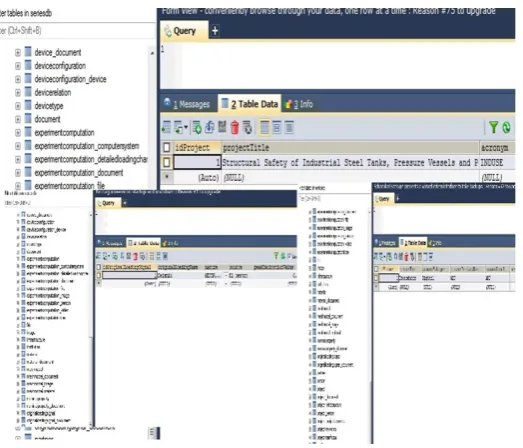
Fig-ure 2.3 presents screenshot of the interface to the RELUIS database with laboratory
data, corresponding to the Project level and the signal level. For each project, the
relevant information is specified, together with the privacy restriction. MySQL
Work-bench or SQLyog was initially used to input information into the database, although
using this generalized user interface for data manipulation appeared to be tedious and
error prone, considering that just one complete experiment consists interconnected
records comprising signals, sensors, configurations, materials and other metadata. Therefore, a formal process definition for the automatic conversion of laboratory data
into the common format and specialized tools for its implementation have been
de-veloped, consisting of two main logical layers.
• An intermediate portable experiment format enabling the expression and
stor-age of proprietary experimental structures in a common specification.
Figure 2.3: Project, Sensor level in MySQL
2.4 Distributed Database Architecture
A schematic of the distributed database in depicted in Figure 2.4, it is presented
like a centralized database to external users through the Data Access Portal, it is
ac-tually a time-evolving aggregated collection of experimental data, which are regularly
retrieved and updated from local distributed repositories. The aggregation of publicly
shared data is performed by the Web Services installed at each local node and their
communication with the Central Site.
Data flow from the RELUIS database to the external user is given below:
• A laboratory produces experimental data and stores them in its local database.
At this stage only the local users can access the data.
• The Web Services implemented at the local site automatically make available
for the central site the experimental data which have been flagged as public in
the local database.
• The Data Access Portal Central Site communicates regularly with individual
nodes to retrieve updated information or new data.
• The information retrieved is then made publicly available in the Data Access
Portal.
• External users may access, explore and finally download the published local
experimental data, through the Data Access Portal.
RELUIS targeted at creating an Italian platform for wide sharing of experimental data
and knowledge amongst different university, research and industry, which could be
maintained and enhanced over time. The interface of the RELUIS presented in the
Results chapter. This interface is designed to enable:
• Database access: functionalities to interact with the whole database internal
structures in a user friendly way. Users just need to use a visually appealing
interface to create, edit or delete elements in the database without knowing
how the database is actually implemented. They can also conduct other tasks
such as visualize data.
• Management of local users: UI allows different local users to access the database.
Every user has a role assigned (administrator, contributor or guest) that enables
them to use different functionalities within the interface. For instance, guest
users can only visualize data, but they cannot modify any information.
etc.
A key role is played by Web Services (WS). Within distributed systems, such as the one we find in RELUIS, SOA (Service Oriented Architecture) is an architectural
paradigm that focuses in connecting heterogeneous systems under the control of
different owners. This methodology allows interoperability between different systems.
The table Server could also allow future services. For example, imagine a service that
provides communication partner-to-partner, via the Central Site, in order to exchange
information or a service that puts two or more partners in contact to configure a
distributed test before conducting it (in the configuration stage, time is not critical).
Basically, this service would be useful to locate other partners and authenticate them,
in a centralized way.
The Web Service in the Central Site is in charge of connecting with all partners in
order to get the information that feeds the Distributed Database. It translates all the
received information, coming in a common agreed format to the data for the Central
Database. As long as partners implement a Web Service consumer that complies
with the WS specification, the platform and programming language that are employed
are of no consequence. One of the benefits of Web Services is this freedom to choose. One of the typical issues about Web Services is whether it is better to create
the code first or the contract first. In a typical situation, the steps involved in a Web
Service creation are:
• Server creates and implements a Web service interface for an existing
applica-tion.
• Server distributes a WSDL contract to use the Web Service.
• Finally, Client obtains the WSDL contract to access the Web Service.
This way of developing a Web Service is far easier than creating the WSDL directly.
of their own Web Service. For example, most of the input data will come from the
Central Website. This input, the Central Web Service might need to communicate
with some partners Web Services. If the Central Site does not filter the input received
from the Central Website, it can propagate a security risk to the partners Web Sites.
The communication between Central Site and partners should be safe and reliable.
If the Central Site just transmits user requests without checking them, neither safety nor reliability will be achieved.
2.5 Conclusion
The chapter describes the principle and associated elements which constitute RE-LUIS database. An Exchange Data Format that could host heterogeneous
experi-mental data and provide all the information needed to reproduce a test, has been
de-veloped and agreed. Data stored at local sites is made accessible to external users
by means of the Data Access Portal hosted at the University of Trento. In this way
a centralized access to database nodes that are distributed over a network and are
able to dialog with a central portal in a uniform manner, is provided. Moreover,
RE-LUIS database enables a wider sharing of data and knowledge and ultimately, offers
an unprecedented service to the earthquake engineering community. RELUIS users
will be able to have access to a wide database of experimental data and information,
CHAPTER
3
STATE OF THE
ART
3.1 Introduction
Starting with the history and definitions of ontology, this chapter discusses the state
of the art methodologies for developing ontologies. In this chapter, we also provide
a detailed description of the formalisms for representing ontologies. The discussion
about ontology matching techniques is followed by the query formulation and answer-ing in the ontology based systems. We also describe the layered architecture of the
Semantic Web. Finally, we discuss data science that deals with the technologies and
tools for managing large amount of data.
Section 3.2 describes what an ontology is from the perspective of Computer Sci-ence and Philosophy. Section 3.2.1 deals with the methodologies normally used to
define ontologies. Section 3.2.2 focuses on ontology languages that allow the
en-coding of knowledge about specific domain and the main differences and similarities
between the most relevant ontology languages. Section 3.2.3 presents a literature
survey of ontology matching techniques. Query formulation for user query mainly
presented in Section 3.2.4. Section 3.3 briefly introduces the semantic web and
se-mantic web tools for ontology development. Section 3.4 provides a literature review
challenges to management in big data science. Finally, we conclude Section 3.5 with
a summary of the ontology development methodologies and semantic web tools in
3.2 Ontology
Ontology can be seen as an artifact used for managing semantics of the natural
language terms, which are often dubbed as concepts, and the relations between
the terms in the scope of a domain. The term ontology originated from the branch
of Philosophy known as Metaphysics, in which Aristotle first proposed ontology as
the science in the Metaphysics(Warrington, John , 1956) that the study of being and
reality for the classification of entities within a hierarchy to be capable to answer the
question whether something exists. The word ontology comes from two Greek words
namely: onto which means existence or being and logia which means science or study. Some essential ontological pairs are: universals and particulars, substance
and accident, abstract and concrete objects, essence and existence, determinism
and indeterminism. Greek Eleatic philosopher Parmendies was first introduce an
ontological characterization of the fundamental type of existence where he describes
two views of existence one initially and another one nothing comes from nothing.
Moreover, Plato a philosopher as well as mathematician, develop a method where he
distinction between true reality and illusion and he also assume that all nouns specify
entities. A.N. Whitehead stated that ontology is useful to distinguish the terms ”reality”
and ”actuality”. Philosophers classified ontologies in various ways for example:
• Upper ontology: Each group of ontology engineer would need to perform the
task of making its terms and concepts compatible with those of other such
groups only once.
• Domain ontology: Concepts relevant to a particular topic or area of interest. For
example, Seismic engineering.
• Interface ontology: concepts relevant to a particular point in events of two
disci-plines.
• Process ontology: inputs, outputs, constraints, sequencing information involved
In the 18th century Scottish philosopher introduces Bundle theory where an object consists of only a collection properties, relation or tropes. Hence, there cannot be an
object without properties nor can one even conceive of such an object. For example,
a car is really a collection of the properties color, model, and capacity and so on. In
particular, there is no substance in which the properties inhere. These all factors are
considered in ontology development.
Dialectics is the Socratic method of reasoning which aims to understand things
correctly in all movements, changes and interconnections. Its origins in ancient
soci-ety, both among the Chinese and the Greeks, where thinkers sought to understand
Nature as a whole, and saw that everything is fluid, constantly changing, coming into
being and passing away. The key notion in dialectics is that changes occurring in
a system are a result of the relationship between subsystems of the system. The
correctness of dialectical reasoning is guaranteed by its ontological foundation and
also deals with the categories and their sub categories into species. German
philoso-pher Hegel identified dialectic as the tendency of a notion to pass over into its own negation as the result of conflict between its inherent contradictory forms. Afterwards,
Karl Marx and Friedrich Engels adopted Hegels definition and applied it to social and
economic a process that is classified as modern philosophy. Dialectic is useful to
ontology development in two respects.
(i) with a view to seeing whether a claim or its contradictory is true or false.
(ii) the correctness of dialectical reasoning is guaranteed by its ontological
founda-tion
A Conceptual metaphor in which one idea is understood in terms of another. In
Metaphors We Live By (1980), George Lakoff and Mark Johnson identify three
over-lapping categories of conceptual metaphors:
• Orientational metaphor
• Ontological metaphor and
In cognitive science, the conceptual domain from which we draw metaphorical
expressions to understand another conceptual domain is known as the source
do-main. The source domain consists of a set of literal entities, attributes, processes
and relationships, linked semantically and apparently stored together in the mind.
The conceptual domain that is understood in this way is the target domain. Thus the
source domain is commonly used to explain the target domain. To know a conceptual metaphor is to know the set of mappings that applies to a given source-target pairing.
For example, the theory was not intended to account for language in use. Conceptual
metaphor also helps to generalize the concept for example polysemy generalization,
semantic change and inferential generalization. Moreover, metaphoric concepts are
expressed through terms that express explicitly the two concepts that play a part in
a metaphor, and are represented in unique formats. The conceptual metaphor
ap-proach is for identifying underlying meaning of concept of the given domain.
Moreover, the Values Theory defines values as desirable, trans-situational goals,
varying in importance, which serves as guiding principles in ontology development.
The crucial content aspect that distinguishes among values is the type of motivational
goal they express. In general, values theory differentiates between moral and natural
concepts. For example the statement John is good person represents a very different
sense of the word good than the statement That was some good food.
Whereas during the 1990s, this word became relevant for the knowledge
engineer-ing community.
Recently, ontology became a popular research topic in many areas, including
e-commerce (Hepp , 2008), knowledge management (Davies and Weeks , 2004),
earth-quake engineering (Hasan et al., 2013), and natural language processing (Fensel ,
2001). In this context, ontology is an explicit specification of a conceptualization
(Gruber , 1993); this implies that the modeling provided by ontology should specify
a systematic correlation between reality and its representation. Conceptualization is
an abstract, simplified view of the world that present for some purpose. Ontologies
aim at overcoming the problem of implicit and hidden knowledge by making the
which the concept is normally used. Moreover, everything (i.e., any knowledge-based
system or any knowledge-level agent) is liable to some conceptualization, explicitly
or implicitly. Therefore, since there is consensus of terms, it is a shared
conceptual-ization. More formally, an ontology defines the vocabulary of a problem domain and
a set of constraints (axioms or rules) on how terms can be combined to model
spe-cific domains. It is typically structured as a set of concept definitions and relations between them. Hence, Ontologies are machine process able models that provide
the semantic context, enabling natural language processing, reasoning capabilities,
domain enrichment and domain validation.
Guarino and Giaretta (Guarino and Giaretta, 1995) collected the following seven
definitions:
• Ontology as a Philosophical discipline
• Ontology as an informal conceptual system
• Ontology as a formal semantic account
• Ontology as specification of a conceptualization
• Ontology as representation of a conceptual system via logical theory
• Characterized by specific formal properties
• Characterized only by its specific purpose
• Ontology as the vocabulary use by a logical theory
• Ontology as specification of a logical theory
The invention of the Semantic Web provide a set of standards where ontologies
are the principal resource to integrate and deal with information. Over the past years,
many representation languages have been developed for ontologies, some of which
are highly efficient, standardized, and relevant to the present research are in fact
operational knowledge and the reuse of domain and operational knowledge
sepa-rately (e.g., configuration based on constraints), and can manage combinatorial
ex-plosion and enable automated reasoning.
The purpose of an ontology is not to model the whole world, but rather a part of
domain. A domain is just a specific subject area or area of knowledge, like medicine,
earthquake engineering, realestate,geo names, financial management and so on.
3.2.1 Ontology Design and development
Ontology building is a complex process and challenging task. Furthermore there
are no standard methodologies for building ontology therefore, finding an adequate
methodology was not easy. To address this point, Gruber has listed a number of
prin-ciples for the design of ontologies such as clarity, coherence, extensibility, minimal
encoding bias and minimal ontological commitment (Gruber , 1993).The
develop-ment of domain ontology is known as Ontological Engineering, which is a continu-ous process incorporating the complete life-cycle of an ontology; an ontological
en-gineering process typically comprises activities such as: Purpose Identification and
Requirements Specification, Knowledge acquisition, Conceptualization, Reuse and
Integration, Evaluation and Documentation (Falbo et al. , 2002; Perez et al. , 2004).
Each support activity is carried out during a specific part of the complete
develop-ment process, but they are all essential to the developdevelop-ment process. In the following
subsections, we will present several types of ontology engineering methodologies.
METHONTOLOGY
The METHONTOLOGY methodology is presented by (Fernandez et al. , 1994).It is one of the earlier attempts to develop a method specifically for ontology
engineer-ing processes (prior methods often include ontology engineerengineer-ing as a sub-discipline
within knowledge management). An ontology lifecycle consisting of a number of
fol-lowing sequential work phases or stages:
(ii)Knowledge Acquisition: Once the domain or scope of an ontology has been
decided, the process of acquiring domain knowledge from specialists (in our domain
earthquake engineer and mechanical engineer); database metadata; standard text
books; research papers and other ontologies.
(iii)Conceptualization: The main activities in conceptualization are:
• identification of concepts and their properties
• classification of groups of concepts in classification trees
• description of properties
• identification of instances
• description of instances.
(iv)Integration: Use or combine available data from existing ontologies for example
WordNet, DBpedia to obtain a consistent ontology.
(v)Evaluation: By assessing the competency of the ontology to satisfy the
require-ments of its application, including determining the consistency, completeness and
conciseness of an ontology (Perez , 1994). We evaluate ontologies for
complete-ness, consistence and avoidance of redundancy
(vi)Documentation: An ontology that cannot be understood cannot be reused.
Informal and formal complete definitions, assumptions and examples are essential to
promote the appropriate use and reuse of ontology.
On-To-Knowledge
The On-To-Knowledge Methodology (OTKM) (Sure et al. , 2003) is, similarly to
METHONTOLOGY, a methodology for ontology engineering that covers the big steps,
but leaves out the detailed specifics. OTKM is framed as covering both ontology
en-gineering and a larger perspective on knowledge management and knowledge
Application and Evolution.
DERA
To gain satisfactory result for ontology development we found DERA methodology.
This methodology allows for building domain specific ontologies. Domain is an area of knowledge in which users are interested in. For example, earthquake engineering,
oceanography, mathematics and computer science can be considered as domains.
In DERA, a domain is represented as a 3-tuple D = <E, R, A >, where E is a set
of entity-classes that consists of concepts and entities; R is a set of relations that
can be held between concepts and entities and A is a set of attributes of the entities.
Moreover, DERA accepts fully automated reasoning by direct encoding in Description
Logics (DL) (Baader et al. , 2003).
In this three basic components concepts, relations and attributes are organized into
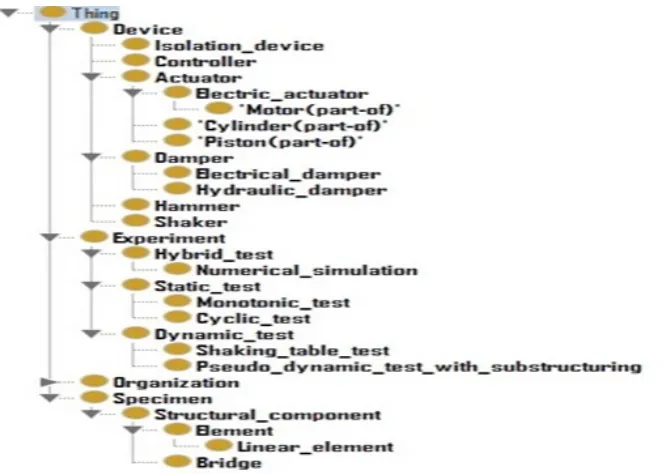
facets; hence, the ontology is based on faceted methodology. Facet is a hierarchy of
homogeneous concepts describing an aspect of a domain. S. R. Ranganathan, who
was an Indian mathematician-librarian, was the first to introduced faceted approach
capable of categorizing books in the libraries (Ranganathan , 1967).
The mapping above 3-tuple to DL should be obvious. IS-A, part-of and value-of
relations form the backbone of facets, are assumed to be transitive and
asymmet-ric, and hence are said to be hierarchical. Other relations, defined, not having such
properties are said to be associative and connect terms in different facets. All
to-gether facets constitute the TBox of a descriptive ontology. The main steps in the
methodology are as follows:
• Identification of the atomic concepts
• Analysis
• Synthesis
• Standardization
• Formalization
During the early stage of ontology development research, Gruber provides five
design principles (Gruber , 1993):
• Clarity: communicate effectively the intended meaning of defined terms.
Defi-nitions should be objective, complete and documented with natural language.
• Coherence: inferences that are consistent with the definitions. If a sentence
inferred from the axioms contradicts a definition then the ontology is incoherent.
• Extendibility: enable the definition of new terms for special uses based on the
existing vocabulary and that avoids the revision of the existing vocabulary.
• Minimal encoding bias: Specified at the knowledge level without depending
on a particular symbol level encoding.
• Minimal ontological commitment: specify the weakest theory and define only
those terms those are essential to the communication of knowledge consistent
with the theory.
In this thesis the focus is mainly on the development activities; providing
semi-automatic support for some of the activities during development. Several of the
sup-port activities are also highly relevant, such as knowledge acquisition, integration,
and evaluation. To conclude, we use theDERAmethodology for our ontology
devel-opment.
3.2.2 Ontology Representation
The ontology must be specified and encoded, that is, delivered using some
con-crete representation. There are a variety of languages which can be used for
on types of ontology representation such as RDF, RDFS, OWL and SKOS is
pre-sented.
3.2.2.1 RDF
The Resource Description Framework (RDF) is a data model used to represent
information about resources in the World Wide Web (WWW) and can be used to
describe the relationships between concepts and entities. It is a framework to
de-scribe metadata on the web. Three types of things are in RDF: resources (entities
or concepts) that exist in the real world, global names for resources (i.e. URIs) that
identify entire web sites as well as web pages, and RDF statements (triples, or rows in a table) (Klyne and Carroll , 2004). Each triple includes a subject, an object and a
predicate(see Figure 3.1). RDF is designed to represent knowledge in a distributed
way particularly concerned with meaning.
Figure 3.1: RDF Triple
From this basic structure, schemas can be built, placed on top of the RDF structure
and used to build complex ontologies to help in the structuring and organization of
data. Moreover, text form of RDF is called RDF serialization. It can have more forms.
Among these forms is RDF/XML, N3 notation, N-triples, RDFa. Serialization called
RDF/XML is the mostly used type of serialization. It is based on the XML language.
RDF can be used in several applications, one of the most important being resource
discovery, used to enhance search engine capabilities. It is also used to facilitate
knowledge sharing and exchange in intelligent software agents to describe the
3.2.2.2 RDFS
RDF schema is a semantic extension of RDF which provides mechanisms to
de-scribe groups of related resources and the relationships between these resources in
a RDF document (Miller and Brickley , 2002). To define the semantics of resource,
RDF schema utilize superclass, class and subclass concepts which are very similar
to the concept used in object oriented programming like Java. Particularly, a class
contains a set of resources. Relation between classes a domain specific hierarchy is
formed; the resulting hierarchy is able to restrict the interpretation of the resources
to their intended semantics in a RDF document. To ensure consistency of semantic interpretation, RDF schema allows property to define its RDF and RDF schema are
only capable of representing semantics.
3.2.2.3 OWL
Web Ontology Language is designed to represent comparatively complex
ontolog-ical relationships and to overcome some of the limitations of RDF such as
repre-sentation of specific cardinality values and disjointness relationship between classes
(Giunchiglia et al. , 2010). The language is characterized by formal semantics and
RDF/XML based serializations for the web. As an ontology representation language,
OWL is essentially concerned with defining terms that can be used in RDF
docu-ments, i.e., classes, properties and instances. It serves two purposes: first, it
iden-tified current document as an ontology and second it serves as a container
meta-data regarding the ontology. This language focuses on reasoning techniques, formal foundations and language extensions. OWL uses URI references as names and
con-structs these URI references in the same manner as that used by RDF. The W3C
allows OWL specification includes the definition of three variants of OWL, with
differ-ent levels of expressiveness. These are OWL Lite, OWL DL and OWL Full ordered
3.2.2.4 SKOS
Simple Knowledge Organization System (SKOS) is a model for expressing
knowl-edge organization systems in a machine-understandable way, within the framework
of the Semantic Web. The SKOS Core vocabulary is an RDF application. Using RDF
allows data to be linked and merged with other RDF data by Semantic Web
applica-tions. SKOS Core provides a model for expressing the basic structure and content
of concept schemes, including thesauri, classification schemes, subject heading lists,
taxonomies, terminologies, and other types of controlled vocabulary used for
repre-senting semantic Knowledge Organization Systems. It’s being widely used beyond the librarian’s world, partly because of its better labelling features (prefLabel,
altLa-bel) that can be used with any kind of real-world data.
3.2.3 Ontology Matching Techniques
Information and communication systems are facing unprecedented levels of
distri-bution and heterogeneity due to the advent of new technological and socio-organizational
paradigms. Hence, many applications/scenarios see the ontology matching process
as an appropriate approach to overcome such heterogeneity since it is able to
de-fine an alignment between two ontologies at the conceptual level, which support to
enhance interoperability between applications and/or systems.
Ontology matching has been defined as finding correspondences between
seman-tically related entities of different ontologies (Euzenat and Shvaiko , 2007). These
correspondences are called alignments, and represent not only equivalence, but also
other kinds of relations, such as sub-sumption, or disjointness. Ontology Matching
is seen as the process of semi automatically the correspondences between
semanti-cally related ontological entities of the ontologies adopted by the organizations
wish-ing to interoperate.
Precisely, as stated (Euzenat and Shvaiko , 2007), the matching operation
deter-mines as a function f which, from a pair of ontologies to match O1 and O2, a set of
A” between the matched ontologies.
A”= f (O1, O2, p, res, A)
There are some other parameters that can extend the definition of matching:
• the use of an input alignment A, which is to be extended;
• the matching parameters, for instance, weights, or thresholds; and
• external resources, such as common knowledge and domain specific thesauri
An alignment is a set of correspondences between entities belonging to the matched ontologies. Alignments can be of various cardinalities: 1:1 to-one), 1:m
(one-to-many), n:1 (many-to-one) or n: m (many to-many). Moreover, alignment also
ex-pressed as a set of relations that is used to represent the relation holding between
the entities (e.g. equivalence, subsumption, disjoint).
In order to align entities from ontologies in different description languages (e.g. OWL, RDF) or in the same language; alignment technique use all the features of
on-tologies (concept, attributes, relations, structure, etc.) to get efficiency and high
qual-ity results. For this purpose, several matching techniques have been used such as
string, structure, heuristic and linguistic matching techniques with thesaurus support,
as well as human intervention in certain cases, to obtain high quality results. This
technique integrates some important features in matching in order to achieve high
quality results, which will help when searching and exchanging information between
ontologies. Moreover, an ontology alignment system illustrates the solving of the key
issues related to heterogeneous ontologies, which uses combination-matching
strate-gies to execute the ontology-matching task. Therefore, it can be used to discover the matching between ontologies.
Matchers can be classified based on many independent classifications. From the
definition of the matching process introduced, the algorithms could be classified
1. Pre-processing
The first step entails obtaining useful information from the ontologies that are to
be matched, beginning by loading two ontologies and extracting useful ontological
features such as class names and properties. In that respect, algorithms may support
the relational, object-oriented and entity-relationship models e.g. Artemis (Castano
et al. , 2000), XML and relational models (e.g. Cupid (Madhavan et al. , 2001)) or
RDF and OWL models for example NOM (Ehrig and Sure, 2005), FOAM (Ehrig and
Sure, 2005), FALCON-AO (Jian et al. 2005), OLA (Euzenat , 2004), oMap (Straccia
and Troncy , 2005).
2. Process Dimensions
In general, the similarity between entities needs to be calculated in order to find
the correspondence between ontology entities. For that reason, different strategies
used (e.g. string similarity, synonyms, structural similarity and similarity based on
instances) for achieving similarity between entities.
The first context concerns the granularity and the way algorithms interpret the input. In terms of granularity, algorithms are classified as (i) Element-level, which are those
that compute correspondences by analyzing each entity individually, ignoring the
ex-isting relationships with other entities and (ii) Structure-level, which are those that
compute correspondences by analyzing how entities appear together in a structure,
through existing relationships between entities. With respect to the way algorithms
interpret the input data, they are classified as:
• Syntactic, which are those that interpret the input regarding its sole structure
through some clearly defined method;
• External, which are those that interpret the input in the light of some external
resources of a domain or of common knowledge;
• Semantic, which are those that interpret the input using some formal semantics.
In this case, the outputs are also justified based on the adopted formal
The second perspective is based on the type of data used as input. At a first level, it
is distinguished by algorithms working on:
(i) Terminological data (i.e. strings). Terminological matchers can be classified
further either as string-based (those that consider strings as sequences of characters)
or as linguistic (those that consider strings as terms of natural language);
(ii) Structure (structural). The structural matchers can be classified either as
inter-nal (those that consider the interinter-nal structure such as attributes and the data types) or
as relational (or external, when considering the relations an entity has with the other
entities);
(iii) Models (or semantics). These matchers require a semantic interpretation of the ontologies;
(iv) Extensional (data instances). These matchers exploit the current population