The Remote Experimentation as the Practical-Oriented
Basis of Inclusive Engineering Education
https://doi.org/10.3991/ijoe.v15i05.9752
Heinz-Dietrich Wuttke(*)
Ilmenau University of Technology, Ilmenau, Germany [email protected] Anzhelika Parkhomenko, Artem Tulenkov, Galyna Tabunshchyk, Andriy Parkhomenko Zaporizhzhia National Technical University, Zaporizhzhia, Ukraine
Karsten Henke
Ilmenau University of Technology, Ilmenau, Germany
Abstract—The challenges and solutions for inclusive engineering education are discussed in this paper. We propose remote experimentation as the practical-oriented basis to train engineers with disabilities in the fields of Computer Sci-ence and Information Technologies. The structure and the functionality of in-ternational GOLDi network that unites partner universities from Germany, Aus-tralia, Ukraine, Armenia and Georgia is given. The possibilities of REIoT com-plex for studying the features of embedded systems design and Internet of Things technologies as well as an overview of ISRT laboratory for embedded software development and testing are given. The presented Remote Laborato-ries are successfully used to improve educational services quality and accessi-bility as well as to strengthen the practical component of the learning process.
Keywords—People with disabilities, remote laboratory, electromechanical physical system, control unit, embedded system, Internet of Things, Smart House.
1
Introduction
educa-tion. Therefore, the materials of this paper were recently discussed at the international conference in Ukraine and should be disseminated [2].
According to the statistics, among the 2.5 million students of Ukrainian HEIs of I-IV levels of accreditation there are just over 10 thousand - students with special needs. In practice, this is less than 1% of the total number of people with disabilities of working age (up to 40 years) [1]. The reason for this is that, unfortunately, the conditions and infrastructure for the education of such categories of students do not exist. In recent years, this problem has worsened due the events in the zone of conflict in the east of Ukraine and on the occupied territory of the Crimea. Thus, the number of people with special needs is permanently growing. They are refugees, internally displaced persons, and disabled people (civilians as well as participants in anti-terrorist operations) injured in conflict zones [3].
Therefore, in parallel with traditional tasks of the educational process, it is neces-sary to regulate the issues of the organizing of studies for people with special educa-tional needs. Certainly, these tasks are new for educaeduca-tional system in Ukraine, but the Ministry of Education and Science, university administrations, the international com-munity, organizations and authorities from different countries must solve them to-gether [4].
The physical presence in the auditorium, taking into account the state of physical health, the psychological aspects of communication and the working conditions asso-ciated with checkpoints and transport in conflict zones are the key issues in organiz-ing the educational process for these specific categories of students.
Thus, the implementation of modern technologies of distance learning that would allow reducing the face-to-face communication between the teacher and the student without worsening the final academic results, will contribute to the increase of the amount of students with special educational needs.
The fields of study Computer Science and Information Technology are the most popular among the entrants to the HEIs from such special categories of young people. According to market requirements, engineers in these specialties must be able to de-sign, implement and verify advanced embedded electronic systems, cyber physical systems, to realize Internet of Things technologies (IoT), etc. Therefore, the applica-tion of new teaching approaches and modern tools for educaapplica-tional process of these specialties is very important.
Today there are many various distance-learning systems, which are developed and successfully implemented in the world for remote access to the theoretical compo-nents of courses and tests. The most well-known are: web Tutor LMS, Moodle, ATu-tor, Eliademy, Forma LMS, Dokeos, ILIAS, Opigno, and OLAT.
The International Association of Line Engineering (IAOE) and the Global On-Line Laboratory Consortium (GOLC) promote the development, dissemination and application of on-line technologies and their impact on society [5].
Nowadays, the Remote and Virtual Labs (R&VL) are successfully developed and implemented worldwide, but for Ukraine, such experience is new and it requires in-vestigation and implementation. Nevertheless, the development and practical applica-tion of novel educaapplica-tional resources based on remote access experiments and installa-tions is an urgent task, as they can offer qualitatively new technologies and methods of vocational training [6-9].
The most popular R&VL for engineering education laboratories in the fields of control engineering, robotics and electronics are iLab, WebLab Deusto, VISIR, GOLDi, RELLE, WEBENCH, Labshare and others [10-11]. They provide plenty of opportunities for working with unique equipment and for safety performing of differ-ent experimdiffer-ents. As investigation [12] has shown, its main problems are the limited number of users that can work with the equipment simultaneously, as well as the lack of a common infrastructure. Therefore, today in the world experience of R&VL the clear trends are information aggregation of existing Internet resources with access to laboratory experiments as well as unification of labs architecture and hard-ware/software solutions [13-16]. On this basis, we can recommend the usage of GOLDi (Grid of Online Lab Devices), which offers a worldwide network of laborato-ries and thus more opportunities for the effective work of students [17].
2
GOLDi as Effective Platform for Practical-Oriented
Engineering Education
The Integrated Communication Systems Group at the Technische Universität Il-menau, Germany, developed hardware and software of GOLDi. Today, the GOLDi network of laboratories brings together the partner universities of Germany, Ukraine, Georgia, Armenia and Australia. Students can use any equipment available on-line at any of these universities. They can observe that the students from other countries have the same learning tasks, the same equipment and the same training base and it serves as a strong motivation for them.
GOLDi servers and GOLDi infrastructures were installed at Ukrainian HEIs (Za-porizhzhia National Technical University (ZNTU, Za(Za-porizhzhia), Boris Grinchenko Kiev University (BGKU, Kiev), Donbass State Engineering Academy (DSEA, Kra-matorsk)) in the frame of the international educational TEMPUS projects ICo-op and DESIRE [18-19] and are organized as a cloud-solution (Fig. 1).
The features of this cloud architecture are as follows [20-21]:
• Maintenance of the whole system on one central location: goldi-labs.net. • All partner universities have the same GOLDi version.
• The user can determine which lab has the lowest delay (best reaction time) regard-ing his current geographic position and internet connection.
• Overview about all running experiments in all partner labs worldwide with the possibility to observe these experiments.
Each GOLDi client communicates with the GOLDi cloud for the central user man-agement, experiment management and the booking management.
• All privacy-relevant data of the cloud are located in the computing department of the Ilmenau University of Technology following the GDPR [22].
• Each client application exchanges only the sensor/actuator signals directly with the local GOLDi infrastructure.
Fig. 1. GOLDi architecture
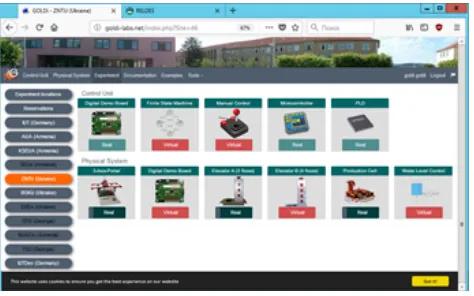
The use of GOLDi was implemented at ZNTU for such specialties as Computer Science, Engineering of Software and others. Several GOLDi physical (electrome-chanical) systems successfully function at the Laboratory of Embedded Systems and Remote Engineering of the Software Tools Department of ZNTU (Fig. 2).
The great variety of experiments results from the grid structure of the connections between control units (CU) and control objects (CO, electromechanical physical sys-tems), in which any combination of real or virtual control units and control objects is possible [23-24]. To teach the development of control algorithms, different experi-ment configurations can be realized:
• Finite State Machines (FSM) based experiment configuration (for an abstract ap-proach, independent of the implementation by using an FSM-interpreter),
• Microcontroller based experiment configuration (for a software-oriented imple-mentation using microcontrollers or programmable systems on chip (PSOCs), • Programmable Logic Devices (PLD) based experiment configuration (for a
hard-ware-oriented design using CPLDs or FPGAs) and
• Programmable Logic Controller (PLC) based experiment configuration (for an industry-oriented approach using industrial control units).
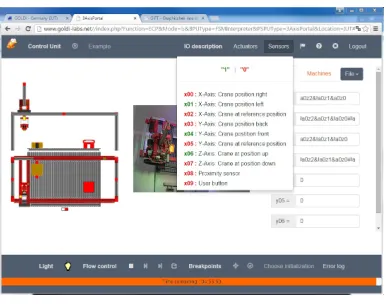
After the configuration of the experiment, the students see the Experiment Control Panel (ECP) and have access to the actuators and sensors (Fig.3).
Fig. 3. GOLDI Experiment Control Panel
Via the ECP they are able to:
• Upload the synthesized/compiled designs to the CU of the experiment configura-tion in the laboratory.
• Handle the experiment (e.g., start, stop, reset).
• Use the interactive debug features (break at sensor/actuator changes or special conditions), single step processing, or by pausing the execution at every sen-sor/actuator change.
• If necessary, change environmental variables and watch the experiment by manipu-lating environmental variables using an I/O monitor or by observing the control of the physical system directly via a webcam.
The Graphical Interactive FSM Toolset (GIFT) сan be used directly within the GOLDi infrastructure and provides methods for:
• General FSM administration.
• Input the FSM as automaton graph or transition table. • Editing edge weights, output functions and node coding. • Simulation of single and parallel machines.
• Generation of the next-state (z) and output (y) equations. • Generation of equations for D and JK flip-flops.
• Export of z/y equations via the ECP to the FSM-interpreter of the GOLDi system. Fig. 4 shows the graphical FSM-input mode of the GIFT user interface.
Fig. 4. GOLDI FSM-input mode of the GIFT user interface
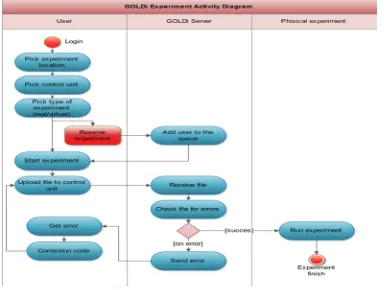
The use case diagram in Fig. 5 shows the main steps and activities of the user, GOLDi server and experiment execution.
Any user, who wants to access a remote experiment, must be registered in GOLDi user management system. Registered users can select an experiment location (at any university) and then configure an experiment by selecting the control unit and physi-cal system, required for the work. If certain experiment configurations are not current-ly available, the user can reserve them for a later date using the GOLDi booking sys-tem.
The input data for the experiments can be prepared using different specification techniques and development tools support (GIFT and FSM-interpreter for FSM de-signs, microcontroller IDE (Atmel), Altera development environment (Quartus II, ModelSim) or Siemens LOGO! Software).
The input file for the control unit can be created using different languages (Assem-bler, C, VHDL (Very high-speed integrated circuits Hardware Description Language), AHDL (Altera Hardware Description Language), Verilog HDL or LOGO!). It is pos-sible to use text based (enter the design by means of logical equations, truth tables) or graphically based design methods (enter the design by using block diagrams and/or schematic diagrams). Simulation of the design can be done by using different simula-tion tools (e.g. Qsim or ModelSim).
3
The Features and Possibilities of Integrated Complex with
Remote Control REIoT for Engineers Training
R&D group of Software Tools Department of Zaporizhzhia National Technical University, Ukraine, developed REIoT-complex for Embedded Systems design and IoT technologies study.
It is based on Arduino, Raspberry Pi and OpenHAB platforms and unites two sub-systems: RELDES (REmote Laboratory for Development of Embedded Systems) and the Remote Laboratory Smart House&IoT [25-26].
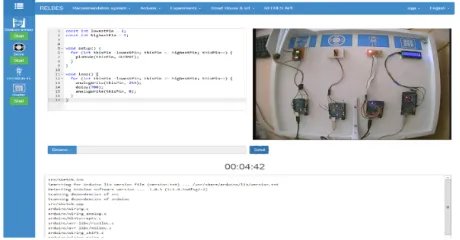
The use of the RELDES remote lab (Fig.6) allows students to acquire knowledge and practical skills in the area of embedded systems (ES) design. Several remote ex-periments in the field of ES for controlling mobile objects using Arduino, LED traffic light, servomotors, LCD and TFT displays, ultrasonic sensors are proposed for users [27-29].
They can obtain and analyze information about finished hardware/software plat-forms, get recommendation about platforms to be used for their projects (Fig. 7), develop program code, and verify the hardware and software compatibility and per-formance of embedded systems. Remote testing of components allows a quick as-sessment of their appropriateness for use and the decision to integrate them into the project to reduce risks and development time.
Fig. 7. RELDES recommendation system web-interface
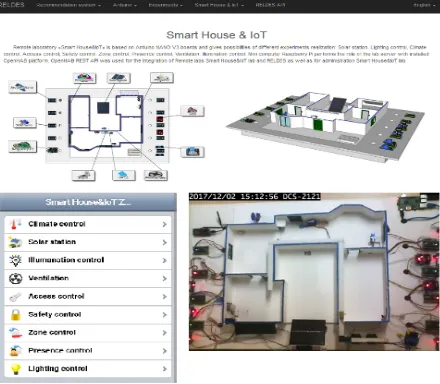
The Remote Lab (RL) Smart House & IoT (Fig.8) is the software/hardware plat-form for investigation the features of the development Smart House Systems (SHS) and the practical study of various platforms, sensors, actuators, protocols and interfac-es for implementation of IoT technologiinterfac-es. It combininterfac-es several subsystems to create a true Internet of Things for the SHS: Solar Energy Subsystem, Climate Control Sub-system, Lighting SubSub-system, Access Control SubSub-system, Ventilation Subsystem and others.
An investigation has shown that similar Smart home laboratories were established by Intel Corporation and Cornell University (Itaka, USA) [30-31]. However, Intel lab is based on only Intel equipment with the aim of its promotion and Cornell lab is controllable via voice, which is not convenient for people with voice disorders. This justifies the development of RL Smart House & IoT based on widespread inexpensive components and acceptable control options.
The RL Smart House & IoT provides the possibility to define the rules and the log-ic of operation and monitoring of the entire SHS processes or to perform remote ex-periments with each subsystem separately. The proposed remote exex-periments fit typi-cal home automation tasks and subsystems. Based on our open information about schemas, software solutions and component suggestions, users will be able to create their own Smart House systems.
The RL Smart House&IoT can be effectively used as a prototype of real SHS for issues of such systems as power efficiency, safety and cybersecurity investigation [32].
One set of experiments is proposed for studying the issues of resource saving and energy efficiency. They allow controlling the parameters of lighting, heating, air con-ditioning, ventilation and recuperation systems as well as solar energy production. • Lighting and illumination control – studying of various lighting systems usage
and control of the level of illumination in different zones.
• Climate control – control of temperature, humidity and air quality in different areas of sensors installation.
• Ventilation – principles of operation of the air ventilation system with heating and control of the flow rate parameters, temperature and humidity.
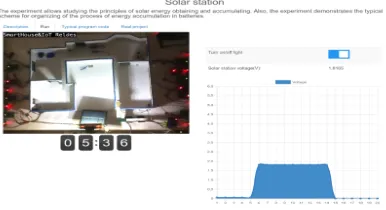
• Solar Station – the basis of obtaining and accumulating renewable energy from solar panels (Fig.9).
Fig. 9. Experiment Solar station web-page
Another set of experiments can be carried out for the study of safety issues, allow-ing monitorallow-ing the access to controlled zones and objects.
• Presence control – control of presence in the zone for effective lighting control. • Zone control – proposes for studying the principles of security control of the
• Access control - proposes for studying the principles of authorization and access control systems.
• Safety control – proposes for studying the basics of security systems with motion sensors and intrusion detection systems (Fig.10).
Fig. 10.Experiment Safety Control web page
The third set of experiments can be used for the study of cyber security issues that enable the use of wireless, cloud and mobile technologies for system monitoring and control, as well as for data collection and visualization.
• Wi-Fi security - principles of connecting devices via Wi-Fi protocol, checking the stability and security of the connection, as well as the demonstration of exceptional situations.
• OpenHAB control – additional features of the OpenHAB platform (my.openhab, MailControl and Telegram), which allow to control SHS through the Internet, col-lect device statistics, receive notifications on users mobile devices.
C++ and Python for manipulating and testing of the connected hardware [33-34]. The aim is to prepare students for IoT software development as students have the possibil-ity to study and experiment on different aspects of embedded systems and communi-cation tools over the Internet.
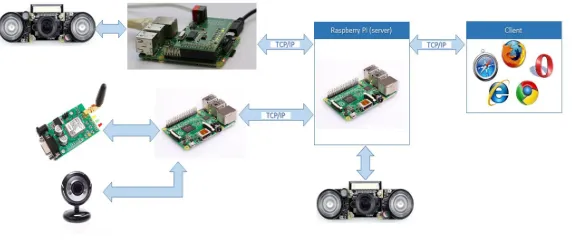
It has an adaptive architecture based on three Raspberry Pi devices [35], which have connected hardware for the laboratory experiments. The software architecture is based on client-server approach that allows easily increase the number of connected Raspberry Pi devices and consequently expand number of the experiments (Fig. 11).
Fig. 11.Basic architecture of the ISRT
Possibilities for the remote users’ access to the ISRT infrastructure were imple-mented by usage of web-browsers at the client machine. The interface functionality includes the administrative panel for specifying the functional units for an architecture adaptation.
Scenarios for the remote software development include manipulation with LEDs on the expansion board, manipulation with a light sensor, face detection or with the Raspberry Pi Professional Infrared Camera OV5647 (internal) or with a standard Web-camera (external), GSM module manipulation, and detection BLE devices [36].
The other set of remote experiments include developing test suits as for web-oriented software as for the connected hardware. Such experiments allow students to get skills in developing unit-tests and knowledge in black box and grey box testing.
The common approach for ISRT is to use it for training purposes and as a step-by-step build-up of competences for the own project.
5
Conclusion
edu-cation as well. New knowledge and skills can be obtained by a student confined to a bed or a wheelchair, or by a student, which cannot get to the place of study.
Based on GOLDi, REIoT and ISRT laboratories it is possible to develop different learning scenarios for the educational process in different areas: embedded electronic systems, cyber physical systems, IoT technologies, embedded software development and testing, and others.
These laboratories are constantly expanding and improving. It is planned in nearest feature to supplement the set of GOLDi experiments with Smart House set of equip-ment. The future work for REIoT complex will be related with an integration of rec-ommendation system for Remote and Virtual Labs selection and effective application in the educational process. A further improvement of the ISRT is concentrated on implementing a module for data analysis.
6
Acknowledgement
We acknowledge support for the Article Processing Charge by the German Re-search Foundation (DFG) and the Open Access Publication Fund of the Technische Universität Ilmenau.
7
References
[1]D. Kornienko, “Inclusive education in Ukraine: It's mooring, it destroys...” [Online]. Available: https://gazeta.ua/articles/life/_inklyuzivna-osvita-v-ukrayini-toj-muruye-toj-rujnuye/818388
[2]A. Parkhomenko, A. Parkhomenko, G. Tabunshchyk, K. Henke, and H.- D. Wuttke. “The remote labs as an effective tool of inclusive engineering education. 12th International
Conference on Perspective Technologies and Methods in MEMS Design, 2018, pp.209-214. https://doi.org/10.1109/MEMSTECH.2018.8365735
[3]Report on the human rights situation in Ukraine. [Online]. Available: http://www.ohchr.org/Documents/Countries/UA/UAReport18th_EN.pdf
[4]Education for ATO veterans: overview of the best programs. [Online]. Available: https://hromadskeradio.org/ru/programs/ tochky-opory/osvita-dlya-veteraniv-ato-oglyad-naykrashchyh-program
[5]The International Association of Online Engineering. The Global Online Laboratory Con-sortium. [Online]. Available: http://www.online-lab.org/
[6]P. Arras, K. Henke, G. Tabunshchyk, and D. Van Merode. “Iterative pattern for the em-bedding of remote laboratories in the educational process”. International Conference on Remote Engineering and Virtual Instrumentation, 2015, pp.52-55
[7]M. Poliakov, T. Larionova, G. Tabunshchyk, A. Parkhomenko, and K. Henke. “Hybrid models of studied objects using remote laboratories for teaching design of control sys-tems”. iJOE12: 7-13, 2016
[8]M. Poliakov, T. Larionova, G. Tabunshchyk, A. Parkhomenko, and K. Henke. “Remote laboratory for teaching of control systems design as an integrated system”. International Conference on Remote Engineering and Virtual Instrumentation, 2016, pp. 333-340. https://doi.org/10.1109/REV.2016.7444497
[10]LabsLand network for remote experimentation. [Online]. Available: https://labsland.com [11]Go-Lab repository for online labs, apps and inquiry spaces. [Online]. Available:
https://www.golabz.eu/
[12]A. Parkhomenko, A. Sokolyanskii, O. Gladkova, and S. Kurson. “Investigation of remote lab design technologies”. XI International Conference on Perspective Technologies and Methods in MEMS Design, 2015, pp. 92–95.
[13]M. Tawfik, C. Salzmann, D. Gillet, D. Lowe, H. Saliah-Hassane, E. Sancristobal, and M. Castro. “Laboratory as a service (LaaS): a novel paradigm for developing and implement-ing modular remote laboratories”. iJOE10: 13-21, 2014
[14]D.G. Zutin, M. Auer, P. Orduna, and Ch. Kreiter. “Online lab infrastructure as a service: a new paradigm to simplify the development and deployment of online labs”. International Conference on Remote Engineering and Virtual Instrumentation, 2016, pp.202-208.
https://doi.org/10.1109/REV.2016.7444467
[15]P. Orduna, L. Rodriguez-Gil, I. Angulo, and O. Dziabenko. “Towards a microRLMS ap-proach for shared development of remote laboratories”. International Conference on Re-mote Engineering and Virtual Instrumentation, 2014, pp.375-381
[16]M. Niederstaetter, Th. Klinger, and D.G. Zutin. “An image processing online laboratory within the iLab shared architecture”. iJOE 6: 37-40, 2010
[17]GOLDi. [Online]. Available: www.goldi-labs.net
[18]TEMPUS project ICo-op. [Online]. Available: www.ico-op.eu [19]TEMPUS project DESIRE. [Online]. Available: http://tempus-desire.eu
[20]K. Henke, T. Vietzke, R. Hutschenreuter, and H.-D. Wuttke. “The remote lab cloud “goldi-labs.net”. International Conference on Remote Engineering and Virtual Instrumen-tation, 2016, pp. 31-36. https://doi.org/10.1109/REV.2016.7444437
[21]K. Henke, St. Ostendorff, St. Vogel, and H.-D. Wuttke. “A Grid concept for reliable, flex-ible and robust remote engineering laboratories”. iJOE8: 42–49, 2012
[22]General Data Protection Regulation. [Online]. Available: https://gdpr-info.eu/
[23]K. Henke, St. Ostendorff, H.-D. Wuttke, T. Vietzke, and C. Lutze. “Fields of applications for hybrid online labs”. iJOE 9: 20-30, 2013
[24]K. Henke, G. Tabunshchyk, H.-D. Wuttke, T. Vietzke, and St. Ostendorff. “Using interac-tive hybrid online labs for rapid prototyping of digital systems”. iJOE 6: 57-62 2014 [25]REIoT. [Online]. Available: http://swed.zntu.edu.ua /
[26]A. Parkhomenko, A. Tulenkov, A. Sokolyanskii, Y. Zalyubovskiy, and A. Parkhomenko. “Integrated complex for IoT technologies study”. Online Engineering & Internet of Things. Lecture Notes in Network and Systems, vol. 22, pp.322-330, 2017.
https://doi.org/10.1007/978-3-319-64352-6_31
[27]A. Parkhomenko, O. Gladkova, E. Ivanov, A. Sokolyanskii, and S. Kurson. “Development and application of remote laboratory for embedded systems design”. iJOE11: 27-31, 2015 [28]A. Parkhomenko, O.Gladkova, A. Sokolyanskii, V. Shepelenko, and Y. Zalyubovskiy. “Implementation of reusable solutions for remote laboratory development”. iJOE12: 24-29, 2016
[29]A. Parkhomenko, O.Gladkova, A.Sokolyanskii, V. Shepelenko, and Y. Zalyubovskiy. “Reusable solutions for embedded systems design”. International Conference on Remote Engineering and Virtual Instrumentation, 2016, pp.313-317. https://doi.org/10.1
109/REV.2016.7444491
[30]IoT reference implementation: how to build the Smart Home prototype. [Online]. Availa-ble: https://software.intel.com/en-us/articles/iot-reference-implementation-how-to-build-the-smart-home-prototype
[31]Smart Home system. A wireless, voice-controllable, household system. [Online]. Availa-ble:
[32]A. Parkhomenko, A. Tulenkov, A. Sokolyanskii, Y. Zalyubovskiy, A. Parkhomenko, A. Stepanenko. “The application of the remote lab for studying the issues of Smart House systems power efficiency, safety and cybersecurity”. Smart Industry & Smart Education. Lecture Notes in Network and Systems, vol. 47, pp.395-403, 2018. https://doi.org/10.1 007/978-3-319-95678-7_44
[33]G. Tabunshchyk, D. Van Merode, P. Arras, and K. Henke. “Remote experiments for reli-ability studies of embedded systems”. International Conference on Remote Engineering and Virtual Instrumentation, pp. 68-71, 2016
[34]G. Tabunshchyk, D. Van Merode, P. Arras, K. Henke, and V. Okhmak. “Interactive plat-form for embedded software development study”. Online Engineering & Internet of Things Lecture Notes in Network and Systems, vol. 22. pp. 3122.1, 2017. https://doi.org/10.1007/978-3-319-64352-6_30
[35]P. Arras, D. Van Merode, G. Tabunshchyk. “Project oriented teaching approaches for e-learning environment”. IEEE 9th International Conference on Intelligent Data Acquisition and Advanced Computing Systems, 2017, pp.317-320.
https://doi.org/10.1109/IDAACS.2017.8095097
[36]G. Tabunshchyk, P. Arras, T. Kapliienko. “Sustainability of the remote laboratories based on systems with limited resources”. Smart Industry & Smart Education. Lecture Notes in Network and Systems, vol. 47, pp. 197-206, 2018. https://doi.org/10.1007/978-3-319-95678-7_22
8
Authors
Heinz- Dietrich Wuttke is a senior researcher in the Integrated Communication Systems Group of the Faculty of Computer Science and Automation at the Technische Universität Ilmenau, Germany. He is a member of the International Association of Online Engineering (IAOE). E-mail: [email protected]
Anzhelika Parkhomenko is PhD, Associate professor of Software Tools Depart-ment of Faculty of Computer Science and Technologies at Zaporizhzhia National Technical University, Ukraine. E-mail: [email protected]
Artem Tulenkov is PhD student of Software Tools Department of Faculty of Computer Science and Technologies at Zaporizhzhia National Technical University, Ukraine. E-mail: [email protected]
Galyna Tabunshchyk is PhD, Professor of Software Tools Department of Faculty of Computer Science and Technologies at Zaporizhzhia National Technical Universi-ty, Ukraine. E-mail: [email protected]
Andriy Parkhomenko is PhD, Head of Educational-Methodical Department of Zaporizhzhia National Technical University, Ukraine. E-mail: [email protected]
Karsten Henke is research associate in the Integrated Communication Systems Group of the Faculty of Computer Science and Automation at the Technische Univer-sität Ilmenau, Germany. He is a member of the International Association of Online Engineering (IAOE). E-mail: [email protected]