Volume 2, Issue 3, March 2013
Page 474
ABSTRACT
This paper presents model of Lake Tana reservoir. River head flow was estimated by Soil and Water Assessment Tool (SWAT) was. SWAT model was calibrated and validated over the gauged upper reaches of major catchments of Gilgel Abay, Gumera, Rib and Megech. The model was calibrated for the period from 1996-2002 and validated for the period from 2003-2005. The performance of the model was evaluated on the basis of performance rating criteria, coefficient of determination, and Nash & Sutcliff efficiency. The overall performance of the model appears satisfactory. The R2 for all catchments vary between 0.7 to 0.91 during calibration and 0.84 to 0.93 during validation. However the level of sensitivity of flow parameters differ from catchment to catchment, the curve number (CN) has been found the most sensitive parameters in all catchments. The calibrated parameters were transferred to un-gauged catchments to estimate the ungauged flow contribution based on similarity of the hydrologic response unit (HRUs). From the model result total inflow from major gauged catchments was found 2850.727MCM, 3595.137MCM, and 3311.873MCM for time period (1991-2000), (2031-2040), and (2091-2100) respectively. Total inflow from ungauged catchments was found 3759.228MCM, 5382.034MCM, and 5006.76MCM for time periods of (1991-2000), (2031-2040), and (2091-2100) respectively.
Keywords:SWAT, Lake Tana, Gilgel Abay, Gumera, Rib, Megech.
1.
INTRODUCTION
The increased demand of water for agriculture, industries, domestic, and power generation in Lake Tana sub-basin requires proper planning and management of water resources in the basin. The basin has more than 40 rivers inflow in to Lake Tana and about 93% of the inflow is coming from the four major rivers Gilgel Abbay, Gummera, Rib and Megech [3].
The purpose of this study is therefore applying a physically based semi distributed model called Soil and water assessment tool (SWAT), to understand the hydrology of the basin, to know the water resource potential as a whole from gauged and un-gauged catchments as well as water evaluation and planning (WEAP) model[6] were used to asses upstream catchment development and climate change impact on Lake Tana water level and to assess the sustainability of Tana –belles Hydropower plant on the basis of adjusting the operation rule of Lake Tana reservoir.
The analysis presented in this paper is the first of its kind which was done using actual data in Lake Tana sub-basin. The study addresses; The assessment of water resources potential of Lake Tana basin, Assessment of Impact of upstream irrigation development on Lake Tana water level and Tana-belles Hydropower plant, Assessment of impact of climate change on Lake Tana and Beles hydro power plant with and without emerging upstream irrigation project, and assessment of the sustainability of Tana-Beles development on the basis of adjusting the operation rule of the Lake. The output of this study can be used as an input for decision support for water resources planning, development, and management of water resources in the basin.
2.
STUDY
AREA
DESCRIPTION
Lake Tana Basin is part of the Blue Nile basin, which lies in a natural drainage basin of about 15114 Km2 as per this research work using SWAT delineation. Among which about 20.47% is covered by the Lake Tana. Lake Tana basin is found in North West part of Ethiopia and it extends between 10.950N to 12.78oN latitude and from 36.89oE to 38.25oE longitude (highlighted in fig.1).
Topography is generally uniform and quite well adapted to irrigation development surrounding Lake Tana [5, 9]. The elevation ranges between 914 m to 4096 m +MSL, which is extracted from DEM (90*90m) resolution. There are two seasons rainy and dry. The rainy season has two periods, the little rains, during April and May, and the big rains, which last from mid- June to mid-September. The rainfall distribution in the basin is found to be a mono-modal pattern i.e. one peak value observed during rainy season especially in July, and August.
Lake Tana Reservoir Water Balance Model
Getachew Tegegne1, Dereje Hailu2 and Prof.Dr.S.Moses Aranganathan3
1
Volume 2, Issue 3, March 2013
Page 475
Considering the rainfall stations in the basin for a period of 1996-2006 the mean annual rainfall amount ranges between 813 mm in Yifag and 2328 mm in Enjibara. Similarly the mean annual minimum and maximum temperature ranges between 9.3 oC in Dangila and 29.6 oC in Gorgora respectively.
Land use of study area was classified based on Abay river master plan study conducted by BCEOM, in 1996-1999[2], about 51.37 % of the watershed area was covered by Agriculture, 21.94 % by Agro-pastoral, 20.41 % by Lake Tana, 0.39 % by Agro-Sylvicultural, 0.13 % by wetland, 5.47 % by Pastoral, 0.15 % by Sylvicultural, 0.03 % by sylvo-pastoral and 0.11 % by Urban.
The soil classification for the study area is also adopted from Abay river master plan study in 1996-1999 conducted by BCEOM [2]. Based on the classification Halpic luvisol which covers about 20.68 % of the watershed area is considered to be the major dominant soil in the study area.
Figure 11: Location Map of Lake Tana Basin
3.
METHODOLOGY
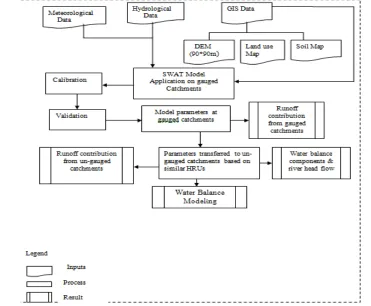
The following flow chart indicates the overall framework of the methodology to be followed throughout the study.
Volume 2, Issue 3, March 2013
Page 476
4.
RESULTS AND DISCUSION
4.1 Evaporation and rainfall over the lake
From the Thissen polygon analysis, the annual average areal rainfall over the Lake for the simulation periods of (1991-2000), (2031-2040), and (2091-2100) found to be 1291mm/year, 1737.693mm/year, and 1690.104 mm/year respectively. From CROPWAT model the average annual evaporation over the Lake for the simulation periods of (1991-2000), (2031-2040), and (2091-2100) found to be 1618 mm/year, 1767mm/year, and1909mm/year respectively
Figure 5: Monthly average rainfall and evaporation over Lake Tana. 4.2 Modeling of Gauged Catchments
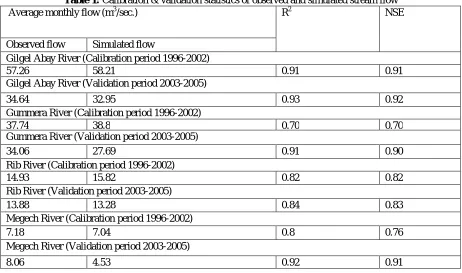
Historical observed stream flow of Gilgel Abay at Merawi, Gummera at Bahirdar, Rib at Addiszemen and Megech at Azezo were calibrated from a period of 1996-2002 and validated from a period of 2003- 2005 .
Table 1: Calibration & validation statistics of observed and simulated stream flow Average monthly flow (m3/sec.) R2 NSE
Observed flow Simulated flow
Gilgel Abay River (Calibration period 1996-2002)
57.26 58.21 0.91 0.91
Gilgel Abay River (Validation period 2003-2005)
34.64 32.95 0.93 0.92
Gummera River (Calibration period 1996-2002)
37.74 38.8 0.70 0.70
Gummera River (Validation period 2003-2005)
34.06 27.69 0.91 0.90
Rib River (Calibration period 1996-2002)
14.93 15.82 0.82 0.82
Rib River (Validation period 2003-2005)
13.88 13.28 0.84 0.83
Megech River (Calibration period 1996-2002)
7.18 7.04 0.8 0.76
Megech River (Validation period 2003-2005)
8.06 4.53 0.92 0.91
4.3 The inflow hydrograph from gauged and ungauged catchments
Once the model is calibrated and verified at the gauged location the model output during that period were quantified and taken as simulated inflow series. Later this inflow series will be used for water balance analysis.
Similarly, the inflow series for ungauged catchments were done by transferring calibrated parameters having the same HRUs as gauged catchments. The total inflow in to the Lake mouth was determined after having the inflow from gauged catchments and inflow from ungauged catchments separately and later the total inflow was taken as the aggregate of inflow series from gauged and ungauged catchments.
Volume 2, Issue 3, March 2013
Page 477
Figure 6: Total Inflow Hydrograph from gauged and ungauged catchment for all scenarios 4.4 Elevation Area Volume Relation ship
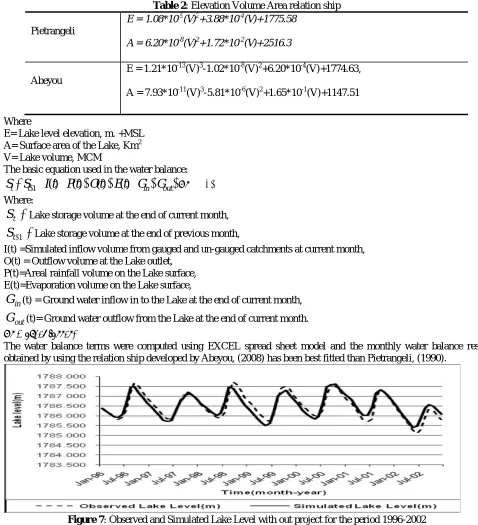
The elevation Area Volume relation ship of Lake Tana reservoir was calculated for the calibration period (1996-2002).The polynomial fitted bathymetry by Pietrangeli and Abeyou [1, 8] used in this research work is as follows: Elevation-Volume-Area relation ship as per Pietrangeli and Abeyou.
Table 2: Elevation Volume Area relation ship
Pietrangeli
E = 1.08*10-9(V)2+3.88*10-4(V)+1775.58
A = 6.20*10-8(V)2+1.72*10-2(V)+2516.3
Abeyou
E = 1.21*10-13(V)3-1.02*10-8(V)2+6.20*10-4(V)+1774.63,
A = 7.93*10-11(V)3-5.81*10-6(V)2+1.65*10-1(V)+1147.51
Where
E= Lake level elevation, m. +MSL A= Surface area of the Lake, Km2 V= Lake volume, MCM
The basic equation used in the water balance:
t in outt
S
I
t
P
t
O
t
E
t
G
G
S
1(
)
(
)
(
)
(
)
∆s (1)Where:
t
S
Lake storage volume at the end of current month,
1 t
S
Lake storage volume at the end of previous month,I(t) =Simulated inflow volume from gauged and un-gauged catchments at current month, O(t) = Outflow volume at the Lake outlet,
P(t)=Areal rainfall volume on the Lake surface, E(t)=Evaporation volume on the Lake surface,
in
G
(t) = Ground water inflow in to the Lake at the end of current month,out
G
(t)= Ground water outflow from the Lake at the end of current month.∆s = other losses.
The water balance terms were computed using EXCEL spread sheet model and the monthly water balance result obtained by using the relation ship developed by Abeyou, (2008) has been best fitted than Pietrangeli, (1990).
Volume 2, Issue 3, March 2013
Page 478
Table 3: Lake Tana Annual water balance components simulated from 1996-2002
5.
SUMMARY
AND
CONCLUSION
The SWAT model was setup from January 1985 - December 2006.Calibration and validation was done for seven years monthly time step (1996-2002) and three years monthly time step (2003-2005) respectively. After modeling the gauged watershed, calibrated parameters were transferred to ungauged watershed by lumping the parameters having the same hydrologic response unit (HRUs). The model output indicates that, the total annual inflow volume from gauged and ungauged catchments estimated to be 6229.115 MCM for calibration period. From the Thissen polygon analysis, the annual average areal rainfall over the Lake for the simulation periods of (1991-2000), (2031-2040), and (2091-2100) found to be 1291mm/year, 1737.693mm/year, and 1690.104 mm/year respectively. From CROPWAT model the average annual evaporation over the Lake for the simulation periods of (1991-2000), (2031-2040), and (2091-2100) found to be 1618 mm/year, 1767 mm/year, and 1909 mm/year respectively.
R
EFERENCES[1] Abeyou W., (2008). Hydrological balance of Lake Tana, Upper Blue Nile Basin, Ethiopia, a M.Sc. thesis, International Institute for Geo-information science and Earth observation, Netherlands.
[2] BCEOM (1999): Abbay River Basin Integrated Development Master Plan Project and Associates (1999).
[3] Kebede, S.; Travi, Y.; Alemayehu, T.; Marc, V (2006). Water Balance of Lake Tana and its Sensitivity to fluctuations in rainfall, Blue Nile Basin, Ethiopia. Journal of hydrology 316: 233-247.
[4] McCartney; Alemayehu; Shiferaw; Awulachew, S.B. (2010). Evaluation of Current and Future Water Resources Development in the Lake Tana basin, Ethiopia. Colombo, Srilanka: International Water Management Institute.39p. (IWMI Research Report 134).
[5] MoWR (Ministry of Water Resources) (1998). Abbay River Basin Integrated Development Mater Plan Project: Phase 2, vol. VI, Water Resources Development, part 2, Large Irrigation and Hydropower Dams. Report, Addis Ababa, Ethiopia.
[6] SEI (Stockholm Environment Institute). (2007). WEAP: Water Evaluation and Planning System User guide. Boston, Stockholm Environment Institute.
[7] SMEC (Snowy Mountains Engineering Corporation). (2008): Hydrological Study of the Tana – Beles Sub-basins, main report. Addis Ababa, Ethiopia: Ministry of Water Resources.
[8] Studio Pietrangeli, (1990). Tana Beles Project studies document.
[9] WWDSE (Water Works Design and Supervision Enterprise) and TAHAL Consulting Engineer Ltd. (2008). Lake Tana Sub-basin four dams project, final feasibility report for Megech Irrigation Project, Vol. III: hydrological report. Addis Ababa, Ethiopia
Water balance components mm/year
Lake areal rainfall +1291 Gauged River inflow +822 Un-gauged river inflow +1297 Lake Evaporation -1618
River outflow -1725