The Thirty-Third AAAI Conference on Artificial Intelligence (AAAI-19)
Amalgamating Knowledge towards Comprehensive Classification
Chengchao Shen,
1Xinchao Wang,
2Jie Song,
1Li Sun,
1Mingli Song
11Zhejiang University,2Stevens Institute of Technology
{chengchaoshen,sjie,lsun,brooksong}@zju.edu.cn, [email protected]
Abstract
With the rapid development of deep learning, there have been an unprecedentedly large number of trained deep network models available online. Reusing such trained models can significantly reduce the cost of training the new models from scratch, if not infeasible at all as the annotations used for the training original networks are often unavailable to public. We propose in this paper to study a new model-reusing task, which we term asknowledge amalgamation. Given multiple trained teacher networks, each of which specializes in a dif-ferent classification problem, the goal of knowledge amalga-mation is to learn a lightweight student model capable of han-dling the comprehensive classification. We assume no other annotations except the outputs from the teacher models are available, and thus focus on extracting and amalgamating knowledge from the multiple teachers. To this end, we pro-pose a pilot two-step strategy to tackle the knowledge amal-gamation task, by learning first the compact feature represen-tations from teachers and then the network parameters in a layer-wise manner so as to build the student model. We ap-ply this approach to four public datasets and obtain very en-couraging results: even without any human annotation, the obtained student model is competent to handle the compre-hensive classification task and in most cases outperforms the teachers in individual sub-tasks.
Introduction
Recent years have witnessed the unprecedented
progress of deep learning. Many deep models, such as AlexNet (Krizhevsky, Sutskever, and Hinton 2012), VGG (Simonyan and Zisserman 2014), GoogLeNet (Szegedy et al. 2015), and ResNet (He et al. 2016), have been pro-posed and applied to almost every single computer vision task, yielding state-of-the-art performances. However, the promising results come with the costs of the huge amount of annotations required and the resource-consuming training process, which may take up to weeks on multiple GPUs.
Yet encouragingly, many researchers have published on-line their trained models, tailored for various tasks like classification, detection, and segmentation. Reusing these trained models, either for the primary task or novel ones, can significantly reduce the effort to retrain the new models from scratch, which is in many cases not feasible at all as Copyright c2019, Association for the Advancement of Artificial Intelligence (www.aaai.org). All rights reserved.
the annotations used to train the original models may not be publicly available.
To this end, researchers have started to look at prospec-tive approaches to reuse trained deep models. For example, (Buciluˇa, Caruana, and Niculescu-Mizil 2006) proposes a model compression approach that trains a neural network using the predictions of an ensemble of heterogeneous mod-els trained a priori. (Hinton, Vinyals, and Dean 2015) intro-duces the concept of Knowledge Distillation (KD), whose goal is to derive a compact student model that imitates the teacher by learning from the teacher’s outputs. (Romero et al. 2014) makes one step further by learning a student model that is deeper and thinner than the teacher so as to improve the performance. These model-reusing approaches, despite their very promising results, focus on tackling the same task as the trained teacher models.
In this paper, we propose to investigate a new
model-reusing task, which we term as knowledge amalgamation.
Given multiple trained teacher models, each of which spe-cializes in a different classification problem, knowledge amalgamation aims to learn a compact student model ca-pable of handling the comprehensive classification problem. In other words, the classification problem addressed by the student is the superset of those by all the teachers. For exam-ple, say we have two teacher classifiers, the first one classi-fies sedan cars and SUVs while the second classiclassi-fies pickups and vans. The student model is expected to be able to clas-sify all the four types of cars simultaneously. Note that, here
we assumeno human annotationsand only the predictions
from the teacher models are available.
The proposed knowledge amalgamation task is, to our best knowledge, both novel and valuable. It is novel be-cause, in contrast to prior model-reusing tasks that restrict the student model to handle the same problem as the teachers do, knowledge amalgamation learns the “super knowledge” covering the specialties from all the teachers. It is valuable because, it allows reusing the trained models, without any human annotation, to learn a compact student model that ap-proximates or even outperforms the teacher models.
teach-ers, and then compresses the stacked features into a compact and discriminative set. The obtained set of features are then used as the supervision information for learning the network parameters in a layer-wise manner in the parameter learning step. This strategy turns out to effective, as the learned com-pact student model, without any human-labeled annotations, is capable of handling the comprehensive classification task and achieves performances superior to those of the teachers on individual sub-tasks.
Our contribution is thus introducing the knowledge amal-gamation task and a simple yet competent approach to-wards solving it, as demonstrated on several datasets. We would like to promote, via the introduction of the knowledge amalgamation task, that researchers should look at reusing trained models to novel tasks, in which way the annotation-, training-, and running-cost can be dramatically reduced.
Related Work
Knowledge Distillation Hinton et al. (Hinton, Vinyals, and Dean 2015) proposes a teacher-student paradigm where a smaller student network imitates the soft prediction of the large teacher ones. This method introduces a temperature concept to highlight the similarities among categories, ben-efiting the learning of student network.
Following (Hinton, Vinyals, and Dean 2015), Fit-Net (Romero et al. 2014) adopts a deeper but thinner stu-dent network to learn the knowledge of a teacher. To im-prove the optimization of deep student network, not only the soft prediction but also the intermediate representation are taken into consideration to supervise the training of the stu-dent network. Specifically, the intermediate representation includes both the feature maps from the convolutional lay-ers and the feature vectors from the intermediate fully con-nected layers.
DK2PNet (Wang, Deng, and Wang 2016) introduces a
dominant convolutional kernel method to compress convo-lutional layers. AT (Zagoruyko and Komodakis 2017) ex-ploits two types of spatial attention maps, activation-based and gradient-based from teacher network, to guide the learn-ing of student network. NST (Huang and Wang 2017) re-gards the knowledge distillation as a distribution matching problem, where the student network is trained to match the distribution of intermediate representation with that of the teacher network.
The knowledge distillation task, despite its solid motiva-tion and proven significance, has a major goal-wise limi-tation. It aims at learning a student model only from one teacher and thus expects the student to master only the specialization from that teacher. By contrast, the proposed knowledge amalgamation task enables the student to learn from multiple teacher models and amalgamates all of their knowledge so as to handle the “super” task.
In addition, the work of (Huang and Wang 2017) demon-strates that when the number of classes is large, the variants of knowledge distillation approaches (Romero et al. 2014; Wang, Deng, and Wang 2016; Zagoruyko and Komodakis 2017; Huang and Wang 2017) yield worse classification per-formances than the original version of (Hinton, Vinyals, and Dean 2015). Such variants thus do not fit our purpose, as we
aim to amalgamate from multiple teachers with potentially large number of classes shown in our experiments.
Transfer Learning Transfer learning is proposed to trans-fer knowledge from source domain to target domain so as to reduce the demand for labeled data on the target do-main (Pan, Yang, and others 2010). It can be roughly cate-gorized into cross-domain (Long et al. 2013; Huang, Huang, and Kr¨ahenb¨uhl 2018; Hu, Lu, and Tan 2015; Ding et al. 2018) and cross-task transfer learning (Hong et al. 2016; Cui et al. 2018; Gholami, Rudovic, and Pavlovic 2017). More specifically, cross-domain transfer learning aims to transfer knowledge among datasets with different data dis-tributions but the same categories. And cross-task transfer learning tries to alleviate the deficit of data for categories on the target task by transferring knowledge from other cate-gories on the source task. However, knowledge amalgama-tion focuses on amalgamating the existing models with un-labeled data to obtain a versatile neural network.
Cross-modal transfer learning (Huang, Peng, and Yuan 2017; Gupta, Hoffman, and Malik 2015; Xu et al. 2018) transfers knowledge among different modalities to improve the performance on the target modality with the same cat-egories, which is different from knowledge amalgamation. FMR (Yang et al. 2017) is proposed to introduce extra fea-tures into Convolutional Neural Network (CNN) to improve the performance on the original classification task. It is dif-ferent from knowledge amalgamation, which amalgamates multiple teachers for the comprehensive classification task instead of the original one.
Knowledge Amalgamation Task
We give the definition of the knowledge amalgamation task
as follows. Assume that we are given N teacher models
{ti}Ni=1 trained a priori, each of which implements a spe-cific classification problem. LetDidenote the set of classes handled by modelti. Without loss of generality, we assume
Di 6=Dj,∀i6=j. In other words, for any pair of modelsti andtj, we assume they classify different sets of classes. The goal of knowledge amalgamation is to derive a compact stu-dent model that is able to conduct the comprehensive clas-sification task, in other words, to be able to simultaneously classify all the classes inD=∪N
i=1Di.
The student model is thus expected to be more powerful as it handles the “super” classification problem, and meanwhile more portable as it is smaller and more resource-efficient than the ensemble of the teacher models.
The Proposed Method
Towards solving the proposed knowledge amalgamation task, a simple yet effective pilot approach is introduced. In what follows, we first give an overview of the method, then detail the two steps, and finally show the training objective.
Overview
Amalgamation Module
Teacher Network 1
Teacher Network 2
Student Network (Parameter Learning) Feature Amalgamation Amalgamation
Module Amalgamation Module Amalgamation Module
Prediction softmax
softmax
softmax
Concatenate
Figure 1: The overall workflow of the proposed approach in the two-teacher case. It consists of two steps, feature amalgamation and parameter learning. The feature amalgamation step, as depicted by the black block, computes the features of the student model from those of the teachers. For example, the feature mapsFl
1andF2lfrom the teachers are fed into the feature amalga-mation module to obtain the compact feature mapFl
aof the student. The parameter learning step, as depicted by the red arrows, computes the network parameters of the student network, given the features amalgamated from the first step.
many cases especially on large-scale datasets, where multi-ple models are trained on subsets of the classes. We hope this proposed approach could serve as a baseline method towards solving the knowledge amalgamation, based on which fur-ther research could improve. Specifically, the proposed ap-proach follows a two-step procedure: feature amalgamation and parameter learning. In the feature amalgamation step, we derive a set of learned features for each layer of each teacher model, obtained by feeding input samples to each such teacher. The features from the same layer across differ-ent teachers are then concatenated and further compressed into a compact set, which is treated as the corresponding feature map for the student. In the parameter learning step, we treat the obtained feature sets as the supervision informa-tion for learning the parameters of the student network. This is achieved by looking at the feature sets from two consec-utive layers and then computing the corresponding network parameters between them.
The overall process of the knowledge amalgamation, in the case of two teacher models, is shown in Figure 1. The details of the feature amalgamation step and the parameter learning step are given as follows.
Feature Amalgamation
We start by discussing first the feature amalgamation from two teacher models, and then two possible solutions for multi-teacher feature amalgamation, followed by the score-vector amalgamation.
Amalgamation from Two Teacher Models We first con-sider the case of feature amalgamation from two teacher models. A straightforward amalgamation approach would be to directly concatenate the feature sets, obtained by feeding inputs to the teacher models, on the same layer of the two teachers. In this way, however, the obtained student model would be very cumbersome: the student would be four times
Concatenation operation
Identical connection 1×1 convolution
operation C
C
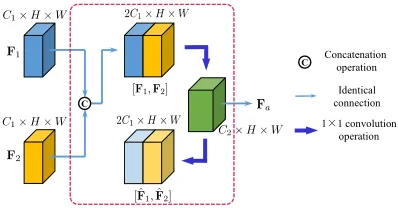
Figure 2: Feature amalgamation from two teacher models.
F1andF2respectively denote the features from two teacher
models, each of which has C1 channels. They are further
encoded to a compact feature mapFaofC2channels, where C1 < C2 < 2C1. The whole module is trained using an auto-encoder architecture that enforces Fa to preserve the information of input features.
as large as the teachers, as between the two layers we will have twice as many the inputs and twice the outputs.
Recall that the goal of amalgamation is to obtain a com-pact model that is more resource-efficient and thus handy to deploy. To this end, we apply an auto-encoder architec-ture that compresses the concatenated feaarchitec-tures from the two teachers, as depicted in Figure 2. We choose auto-encoder because it reduces the size of the feature maps and mean-while preserves the critical information, as the compact fea-tures approximately reconstruct the original concatenated one.
num-ber of feature maps and the computation load, and mean-while preserves the size of the receptive field. We write
Fa,c= Cin X
c0=1
wc,c0·Fc0, (1)
wherewc,c0 denotes thec0-th channel weight of the1×1 convolution kernel,c∈ {1, . . . , Cout},Fc0denotes thec0-th channel of the input feature map F,Fa,c denotes the c-th channel of the output feature mapFa,CinandCoutdenote the channel numbers of input feature mapFand output fea-ture mapFa, respectively. Note that, we haveCout < Cin due to the feature compression.
Amalgamation from Multiple Teacher Models Two ways to amalgamate features from more than two teacher models are proposed as follows.
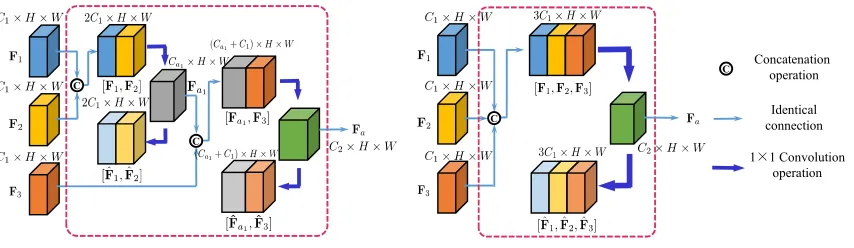
• Incremental Feature Amalgamation (IFA): we con-duct amalgamation in a progressive manner, by each time amalgamating two sets of feature maps, as depicted in Figure 3 (a).
• Direct Feature Amalgamation (DFA): we directly amal-gamate feature maps from multiple teachers, as depicted in Figure 3 (b). Similar to the two-teacher case, the feature sets are concatenated into one and then passed through an auto-encoder to obtain a compressed feature set.
Although the architecture of DFA is more intuitively straightforward, IFA is in fact easier to generalize as the same auto-encoder can be repetitively adopted and thus ex-tended to arbitrary number of teachers, while DFA needs to retrain the whole auto-encoder when a new teacher is added.
Amalgamation of Score Vectors The score vector can be regarded as the response scores of the categories to be classified. For disjoint teacher models that handle non-overlapping classes, we directly concatenate their score vec-tors as the amalgamated one, and use the amalgamated score vector as the target for the student, as shown in Figure 1. In fact, the same strategy can also be used for teachers with overlapping classes, in which case we treat the multiple en-tries of the overlapping categories in the concatenate score vector as different classes during training but as the same one at test time. We also test the results of preserving only one entry and removing the rest entries of each overlapping category, which can be found in our supplementary material.
Parameter Learning
In the parameter learning stage, the obtained compact fea-ture maps in consecutive layers are treated as the supervision information to learn the weights in between. Specifically, this is achieved by first learning the weights in a layer-wise manner and then fine-tuning all the layers jointly. To facil-itate the layer-wise training, a feature adaptation strategy is adopted.
Layer-wise Parameter Learning Let Fl
a and Fal−1 re-spectively denote the compact features of thel-th and(l−1) -th layer in -the student network obtained by feature amalga-mation. In the layer-wise parameter learning step,Fal−1 is
Algorithm 1 Knowledge Amalgamation from Multiple Teachers
Input: N trained teacher models T = {ti}Ni=1, and unla-beled samplesD={xk}Kk=1.
Output: The parameters of the student modelS:{Θl}L l=1 1: forl= 1toL−1do
2: Obtain{Fl
i}Ni=1from{ti}Ni=1withD;
3: Amalgamate feature maps{Fl
i}Ni=1to obtainFal; 4: Compute the output ofSfroml-th layer:Fˆal;
5: Compute the lossLl
PLaccording to Eq. 5;
6: Update the parametersΘlusing SGD;
7: end for
8: ObtainL-th layer score vectors{FL
i }Ni=1from{ti}Ni=1; 9: Obtain score vector forS:FL
a ←concat({FiL}Ni=1); 10: Compute the output ofSfromL-th layer:FˆL
a; 11: Compute the lossLL
PLaccording to Eq. 5;
12: Jointly update the parameters{Θl}Ll=1using SGD.
fed as input and goes through a series of operations includ-ing poolinclud-ing, activation and convolution to approximateFal. We write
ˆ
Fal= conv(pool(activation(Fal−1))), (2)
whereFˆal corresponds to the estimated features in thel-th layer. Since the pooling layer and activation layer have no parameters, pool(activation(Fal−1)) is deterministic for a givenFl−1
a . Therefore, the goal of the layer-wise learning stage is to obtain the weights of the convolutional layer. This leads to a linear optimization problem, which is much easier to be solved than optimizing all the parameters of the net-work jointly.
Feature Adaption A straightforward way to compute the weights of the convolutional layers is to solve directly the linear transformation that mapspool(activation(Fal−1))to Fl
a. This however turns out to be sub-optimal, as Fal−1 is obtained directly from feature amalgamation and is fixed, meaning thatFl−1
a is not adjustable to the non-parametric
operations like pooling and activation. As such, the non-parametric layers may remove some discriminant informa-tion fromFl−1
a , making the parameter learning troublesome.
For example, the ReLU layer will suppress all the non-positive values from the feature mapFl−1
a , which might be
the critical information to be passed toFl a.
To facilitate the learning, we introduce a Feature Adaption Module (FAM) to the layer-wise parameter learning stage, and transform the features into a form that can be well adap-tive to other non-parametric layers. Specifically, a1×1 con-volution operation is adopted to implement FAM. We write
ˆ
Fal = conv(pool(activation(FAM(Fal−1)))). (3)
(a) Incremental Feature Amalgamation (IFA) (b) Direct Feature Amalgamation (DFA) C
C
C
Concatenation operation
Identical connection
1×1 Convolution
operation C
Figure 3: Feature amalgamation from multiple teacher models. (a) IFA amalgamates features progressively by each time looking at two teachers, while (b) DFA amalgamates features from multiple teachers in one shot. More specifically, IFA first amalga-mates the featuresF1andF2to obtain featuresFa1, which is then amalgamated withF3to obtain final feature setFa; DFA, on
the other hand, simultaneously amalgamatesF1,F2andF3.
Loss Functions
Loss of Feature Amalgamation Recall that the target of feature amalgamation step is to remove redundant informa-tion of the concatenated features and obtain a compact fea-ture map that preserves the critical information of the multi-ple teachers. Our objective is therefore set to be theL2loss to reconstruct the origin feature maps ofl-th layer, as fol-lows:
Ll FA=
1 2k[ ˆF
l 1, . . . ,Fˆ
l N]−[F
l 1, . . . , F
l N]k
2. (4)
Loss of Parameter Learning The loss function of the pa-rameter learning stage, including both layer-wise learning and joint learning, is taken to be
LlPL= 1 2k
ˆ
Fal−Falk2, (5)
whereFˆl
aandFalcorrespond to the compact feature maps for layer-wise learning and to the score vector for joint learn-ing. The complete algorithm for knowledge amalgamation from multiple teacher models is summarized in Algorithm 1, where SGD stands for Stochastic Gradient Descent.
Experiments
To evaluate the effectiveness of our proposed method, we conduct experiments on several publicly available bench-marks. More experimental results can be found in the sup-plementary material.
Experimental Setup
Dataset The first two datasets we adopt, CUB-200-2011 (Wah et al. CUB-200-2011) and Stanford Dogs (Khosla et al. 2011), are related to animals and the last two, FGVC-Aircraft (Maji et al. 2013) and Cars (Krause et al. 2013), are related to vehicles. CUB-200-2011 consists of 11,788 im-ages from 200 bird species, Stanford Dogs contains 12,000 images about 120 different kinds of dogs, FGVC-Aircraft
consists of 10,000 images of 100 aircraft variants, and Cars comprises 16,185 images of 196 classes of cars.
For each dataset, we randomly split their categories, which are considerably correlated, into parts of equal size to train two networks. These networks are regarded as teach-ers to guide the learning of student network that recognizes all categories. In our supplementary material, we also show the amalgamation results across different datasets where the categories are uncorrelated.
Implementation The proposed method is implemented using PyTorch (Paszke et al. 2017) on a Quadro P5000 16G GPU. In our experiment, all the teacher models adopt the same AlexNet architecture (Krizhevsky, Sutskever, and Hin-ton 2012), obtained by finetuning the ImageNet pretrained models1. The student model has a very similar network
ar-chitecture as teachers. The only difference is that the student model has in each layer a different number of kernels, i.e., a different number of feature map channels. Intuitively, the number of kernels within the student model should be larger than that of the teachers, as the student is more “knowledge-able” than the teachers due to its capability of handling the whole set of classes, and meanwhile be smaller than the sum of all teachers, as it is assumed that the features from teach-ers share redundancies. Please refer to the supplementary material for the detailed configuration of the network archi-tecture.
Experimental Results
Knowledge Amalgamation from Two Teachers To ver-ify the effectiveness of our approach, we evaluate the per-formance of our learned student model that amalgamates knowledge from two teacher models and implements clas-sification task of both teachers. The following four methods are compared.
1
Table 1: Performance of knowledge amalgamation from two teachers on comprehensive classification task. The best accuracy is marked inboldfont.
Stanford Dogs CUB-200-2011 FGVC-Aircraft Cars
Method Params Accuracy Params Accuracy Params Accuracy Params Accuracy
Ensemble ∼114.4M 43.5% ∼114.8M 41.4% ∼114.4M 47.1% ∼114.8M 37.8%
Baseline ∼69.9M 10.4% ∼70.2M 30.0% ∼69.8M 39.9% ∼70.2M 17.0%
Layer-wise Learning ∼69.9M 38.4% ∼70.2M 31.8% ∼69.8M 39.8% ∼70.2M 33.6%
Joint Learning ∼69.9M 45.3% ∼70.2M 42.6% ∼69.8M 49.4% ∼70.2M 40.6%
Table 2: Comparing the results of the teacher models and the learned student models on Stanford Dogs and
CUB-200-2011 dataset.Layer denotes layer-wise parameter learning
strategy, andJointdenotes joint learning strategy .
Stanford Dogs CUB-200-2011 Method whole part1 part2 whole part1 part2
Teacher1 - 60.8% - - 53.8% -Teacher2 - - 58.5% - - 49.7%
Layer 38.4% 54.1% 54.3% 31.8% 44.8% 41.2% Joint 45.3% 61.5% 59.6% 42.3% 53.2% 50.3%
• Ensemble:We concatenate the score vectors from the two teacher models and classify the input sampling by assign-ing the class of the highest score in the concatenated score vector as the label of the input.
• Baseline: We learn a student model by applying Hin-ton’s knowledge distillation method (Hinton, Vinyals, and Dean 2015), which has proven a superior performance to its variants on large number (≥100) of classes. Specifi-cally, we stack the score vectors from the teachers and use the concatenated vector as the target to train the student. • Layer-wise Learning: After the feature amalgamation
step, we conduct only layer-wise parameter learning to obtain the student network parameters.
• Joint Learning: Our complete model, with parameters first layer-wise learned and then jointly learned.
The comparative results are shown in Table 1. On all
benchmark datasets, our complete method Joint Learning
achieves the highest performance among the four methods, and demands significantly fewer parameters thanEnsemble. We also compare the performance of the learned student
model with those of the teachers. Letpart1 andpart2
de-note the categories handled by the two teachers models,
teacher1 and teacher2, respectively, and letwhole denote
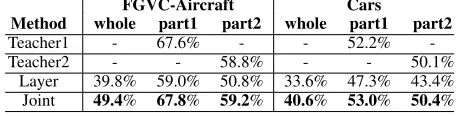
the complete set of categories. As shown in Table 2 and Ta-ble 3, our complete student model, joint learning, in fact outperforms the teacher models on the corresponding sub-tasks. For example, on the Stanford Dogs dataset, the stu-dent model achieves apart1accuracy of 61.5% and apart2 one of 59.6%, while those forteacher1andteacher2, which specialize in handlingpart1andpart2, are 60.8% and 58.5% respectively. These interesting and encouraging results show that our approach is indeed able to learn the amalgamated knowledge from both teachers, and the knowledge learned from one teacher benefits the classification task of the other.
Table 3: Comparing the results of the teacher models and the learned student models on FGVC-Aircraft and Cars dataset.
Layer denotes layer-wise parameter learning strategy, and
Jointdenotes joint learning strategy .
FGVC-Aircraft Cars
Method whole part1 part2 whole part1 part2
Teacher1 - 67.6% - - 52.2%
-Teacher2 - - 58.8% - - 50.1%
Layer 39.8% 59.0% 50.8% 33.6% 47.3% 43.4%
Joint 49.4% 67.8% 59.2% 40.6% 53.0% 50.4%
Knowledge Amalgamation from Multiple Teachers We also test the performance of multi-teacher amalgamation. We first conduct experiments on amalgamating different numbers of teacher models. We split the Stanford Dogs dataset comprising 120 classes into four even parts, each of which contains 30 classes, and then test the classifica-tion performances on these parts by amalgamating knowl-edge from two, three and all four teachers using the DFA model. We show the results in Table 4. Interestingly, the more teachers used for amalgamation, the higher the clas-sification performance is. For example, the performance on
part1increases from 68.7% to 69.9% and further to 70.3%
for two, three and four teachers. This again indicates that the potentially complementary knowledge from multiple classi-fication tasks indeed benefits each other.
We then compare the two schemes for multi-teacher amal-gamation, DFA and IFA. Note that the performances of DFA and IFA differ only when amalgamating from more than two teachers, and thus we compare their performances us-ing three and four teachers. We show the results in Table 5. The performances of the two strategies are in general much the same where DFA yields slightly better results on one part while IFA on the others. In our supplementary material, we also provide experimental results of IFA with different amalgamating orders.
Ablation Study
We also conduct ablation studies to validate the proposed method as follows.
Table 4: Classification performances of the student models, whose knowledge is amalgamated from different numbers of teachers using DFA.
Stanford Dogs
Method part1 part2 part3 part4
From 2 teachers 68.7% 66.1% -
-From 3 teachers 69.9% 67.7% 63.8%
-From 4 teachers 70.3% 68.0% 65.4% 67.3%
Table 5: Classification performances of the student models, whose knowledge is amalgamated from different numbers of teachers using DFA and IFA.
Stanford Dogs
Method part1 part2 part3 part4
DFA from 3 teachers 69.9% 67.7% 63.8% -IFA from 3 teachers 69.6% 69.1% 64.7% -DFA from 4 teachers 70.3% 68.0% 65.4% 67.3%
IFA from 4 teachers 69.9% 68.8% 65.5% 67.9%
amalgamated features into a form that better adapts to non-parametric layers in the network, and meanwhile preserves and passes the critical information to the next layer.
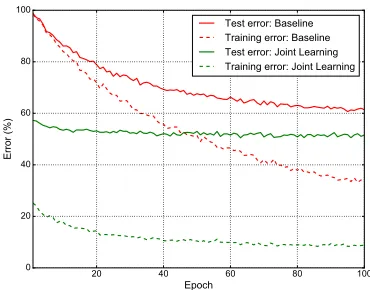
Layer-wise Parameter Learning We also investigate the power of the layer-wise learning strategy, by comparing the student model with and without the layer-wise learning, which correspond to thejoint learningmethod and the base-linedescribed in the previous section. We show their training and testing errors versus the epochs in Figure 4. The test er-ror ofjoint learningwith layer-wise learning is significantly lower than that of thebaselinewithout layer-wise learning. In fact, despite not shown here, without layer-wise learning the test error at 300 epochs remains to be 60.1%, as indicated by thebaselinein Table 1. We may thus safely conclude that layer-wise learning indeed facilitates the training compared to learning from scratch as done forbaseline.
Joint Parameter Learning We compare in Table 2 and Table 3 the results of layer-wise learning only and joint learning, where the latter one outperforms the former on all the four datasets. This validates in part our hypothesis that thelayer-wise learningaccumulates errors across layers dur-ing traindur-ing, which can be alleviated byjoint learning.
Table 6: Classification performances of the student model with and without FAM. For simplicity, “Dogs” denotes “Stanford Dogs”, “CUB” denotes “CUB-200-2011” and “Aircraft” denotes “FGVC-Aircraft”.
Method Dogs CUB Aircraft Cars
W/O FAM 25.3% 33.9% 39.7% 30.7%
W/ FAM 45.3% 42.6% 49.4% 40.6%
(SRFK
(UURU
7HVWHUURU%DVHOLQH 7UDLQLQJHUURU%DVHOLQH 7HVWHUURU-RLQW/HDUQLQJ 7UDLQLQJHUURU-RLQW/HDUQLQJ
Figure 4: Training and test errors ofbaselineandjoint
learn-ing versus the number of epochs on Stanford Dogs.Joint
learningconverges to much lower errors.
Conclusion and Future Work
In this paper, we propose a new model-reusing task, termed
knowledge amalgamation, which aims at learning a
com-pact student model capable of handing the “super” task from multiple teachers, each of which specializes in a dif-ferent task. This task is in our opinion a research-worthy topic in the sense that it allows amalgamating well-trained models, many of which are learned using large-scale or private datasets that are not publicly available, to derive a lightweight student model that approximates or even outper-forms the teachers.
To this end, we propose a pilot approach towards solving this task. The proposed approach follows a two-step strat-egy by first conducting feature amalgamation from the mul-tiple teachers and then treating the obtained features as guid-ance to learn the parameters of the student network. We con-duct experiments on four datasets to validate the proposed approach, which yields very promising results: the learned student model can in fact perform better than the teach-ers at their specializations, at a model scale that is much smaller than the ensemble of the teachers. We also justify the validness of several components by conducting the abla-tion study.
Admittedly, this pilot approach in the current form, de-spite its very encouraging results, indeed has some limita-tions. We assume that the teacher models and the student one share the same network architecture, which might be a strong assumption in some real-world scenarios. In our near-future work, we will therefore investigate amalgamat-ing knowledge from teachers of different network architec-tures, which truly allows us to reuse the knowledge of mas-sive well-trained neural networks in the wild.
In the longer term, we will explore how to bridge the semantic gap among different network architectures and reuse the amalgamated knowledge to new tasks, enabling the
amalgamated knowledge transfer.
of China (61572428, U1509206), Fundamental Research Funds for the Central Universities (2017FZA5014), and Key Research and Development Program of Zhejiang Province (2018C01004).
References
Buciluˇa, C.; Caruana, R.; and Niculescu-Mizil, A. 2006.
Model compression. In ACM SIGKDD Conference on
Knowledge Discovery and Data Mining (KDD), 535–541.
Cui, Y.; Song, Y.; Sun, C.; Howard, A.; and Belongie, S. 2018. Large scale fine-grained categorization and domain-specific transfer learning. InThe IEEE Conference on
Com-puter Vision and Pattern Recognition (CVPR), 4109–4118.
Ding, Z.; Li, S.; Shao, M.; and Fu, Y. 2018. Graph adaptive knowledge transfer for unsupervised domain adaptation. In
European Conference on Computer Vision (ECCV), 37–52.
Gholami, B.; Rudovic, O.; and Pavlovic, V. 2017. Punda: Probabilistic unsupervised domain adaptation for knowl-edge transfer across visual categories. InThe IEEE
Interna-tional Conference on Computer Vision (ICCV), 3601–3610.
Gupta, S.; Hoffman, J.; and Malik, J. 2015. Cross
modal distillation for supervision transfer. arXiv preprint
arXiv:1507.00448.
He, K.; Zhang, X.; Ren, S.; and Sun, J. 2016. Deep residual
learning for image recognition. In The IEEE Conference
on Computer Vision and Pattern Recognition (CVPR), 770–
778.
Hinton, G.; Vinyals, O.; and Dean, J. 2015. Distilling the
knowledge in a neural network. Advances in Neural
Infor-mation Processing Systems (NIPS).
Hong, S.; Oh, J.; Lee, H.; and Han, B. 2016. Learning trans-ferrable knowledge for semantic segmentation with deep
convolutional neural network. InThe IEEE Conference on
Computer Vision and Pattern Recognition (CVPR), 3204–
3212.
Hu, J.; Lu, J.; and Tan, Y.-P. 2015. Deep transfer metric
learning. InThe IEEE Conference on Computer Vision and
Pattern Recognition (CVPR), 325–333.
Huang, Z., and Wang, N. 2017. Like what you like: Knowl-edge distill via neuron selectivity transfer. arXiv preprint
arXiv:1707.01219.
Huang, H.; Huang, Q.; and Kr¨ahenb¨uhl, P. 2018. Domain
transfer through deep activation matching. In European
Conference on Computer Vision (ECCV), 611–626.
Huang, X.; Peng, Y.; and Yuan, M. 2017. Cross-modal com-mon representation learning by hybrid transfer network. In International Joint Conference on Artificial Intelligence (IJ-CAI), 1893–1900.
Khosla, A.; Jayadevaprakash, N.; Yao, B.; and Fei-Fei, L. 2011. Novel dataset for fine-grained image categorization.
In First Workshop on Fine-Grained Visual Categorization,
IEEE Conference on Computer Vision and Pattern Recogni-tion (CVPR).
Krause, J.; Stark, M.; Deng, J.; and Fei-Fei, L. 2013. 3d ob-ject representations for fine-grained categorization. In
Inter-national IEEE Workshop on 3D Representation and Recog-nition (3dRR).
Krizhevsky, A.; Sutskever, I.; and Hinton, G. E. 2012.
Imagenet classification with deep convolutional neural
net-works. InAdvances in Neural Information Processing
Sys-tems (NIPS), 1097–1105.
Long, M.; Wang, J.; Ding, G.; Sun, J.; and Philip, S. Y. 2013. Transfer feature learning with joint distribution adaptation.
InThe IEEE International Conference on Computer Vision
(ICCV), 2200–2207.
Maji, S.; Kannala, J.; Rahtu, E.; Blaschko, M.; and Vedaldi, A. 2013. Fine-grained visual classification of aircraft.arXiv
preprint arXiv:1306.5151.
Pan, S. J.; Yang, Q.; et al. 2010. A survey on transfer
learn-ing. IEEE Transactions on Knowledge and Data
Engineer-ing (TKDE)22(10):1345–1359.
Paszke, A.; Gross, S.; Chintala, S.; Chanan, G.; Yang, E.; DeVito, Z.; Lin, Z.; Desmaison, A.; Antiga, L.; and Lerer, A. 2017. Automatic differentiation in pytorch. InAdvances
in Neural Information Processing Systems (NIPS).
Romero, A.; Ballas, N.; Kahou, S. E.; Chassang, A.; Gatta,
C.; and Bengio, Y. 2014. Fitnets: Hints for thin deep
nets.International Conference on Learning Representations (ICLR).
Simonyan, K., and Zisserman, A. 2014. Very deep convo-lutional networks for large-scale image recognition. arXiv
preprint arXiv:1409.1556.
Szegedy, C.; Liu, W.; Jia, Y.; Sermanet, P.; Reed, S.; Anguelov, D.; Erhan, D.; Vanhoucke, V.; and Rabinovich, A.
2015. Going deeper with convolutions. InThe IEEE
Confer-ence on Computer Vision and Pattern Recognition (CVPR),
1–9.
Wah, C.; Branson, S.; Welinder, P.; Perona, P.; and Belongie, S. 2011. The Caltech-UCSD Birds-200-2011 Dataset. Tech-nical report.
Wang, Z.; Deng, Z.; and Wang, S. 2016. Accelerating convo-lutional neural networks with dominant convoconvo-lutional kernel
and knowledge pre-regression. InEuropean Conference on
Computer Vision (ECCV), 533–548.
Xu, D.; Ouyang, W.; Wang, X.; and Sebe, N. 2018. Pad-net: Multi-tasks guided prediction-and-distillation network for simultaneous depth estimation and scene parsing. InThe IEEE Conference on Computer Vision and Pattern Recogni-tion (CVPR).
Yang, Y.; Zhan, D.; Fan, Y.; Jiang, Y.; and Zhou, Z. 2017.
Deep learning for fixed model reuse. InAAAI Conference
on Artificial Intelligence (AAAI), 2831–2837.
Zagoruyko, S., and Komodakis, N. 2017. Paying more at-tention to atat-tention: Improving the performance of convolu-tional neural networks via attention transfer. InInternational