The Thirty-Third AAAI Conference on Artificial Intelligence (AAAI-19)
Neural Machine Translation with Adequacy-Oriented Learning
Xiang Kong
Carnegie Mellon UniversityZhaopeng Tu
∗ Tencent AI Lab [email protected]Shuming Shi
Tencent AI Lab [email protected]Eduard Hovy
Carnegie Mellon UniversityTong Zhang
Tencent AI Lab [email protected]Abstract
Although Neural Machine Translation (NMT) models have advanced state-of-the-art performance in machine translation, they face problems like the inadequate translation. We at-tribute this to that the standard Maximum Likelihood Esti-mation (MLE) cannot judge the real translation quality due to its several limitations. In this work, we propose an adequacy-oriented learning mechanism for NMT by casting transla-tion as a stochastic policy in Reinforcement Learning (RL), where the reward is estimated by explicitly measuring trans-lation adequacy. Benefiting from the sequence-level training of RL strategy and a more accurate reward designed specif-ically for translation, our model outperforms multiple strong baselines, including (1) standard and coverage-augmented at-tention models with MLE-based training, and (2) advanced reinforcement and adversarial training strategies with rewards based on both word-level BLEU and character-levelCHRF3. Quantitative and qualitative analyses on different language pairs and NMT architectures demonstrate the effectiveness and universality of the proposed approach.
Introduction
During the past several years, rapid progress has been made in the field of Neural Machine Translation (NMT) (Kalch-brenner and Blunsom 2013; Sutskever, Vinyals, and Le 2014; Bahdanau, Cho, and Bengio 2015; Gehring et al. 2017; Wu et al. 2016; Vaswani et al. 2017).
Although NMT models have advanced the community, they still face inadequate translation problems: one or mul-tiple parts of the input sentence are not translated (Tu et al. 2016). We attribute this problem to the lack of the mech-anism to guarantee the generated translation being as suf-ficient as human translation. NMT models are generally trained in an end-to-end manner to maximize the likelihood of the output sentence. Maximum Likelihood Estimation (MLE), however, could not judge the real quality of gen-erated translation due to its several limitations
1. Exposure bias (Ranzato et al. 2016): The models are trained on the groundtruth data distribution, but at test time are used to generate target words based on previous model predictions, which can be erroneous;
∗
Zhaopeng Tu is the corresponding author. Work was mainly done when Xiang Kong was interning at Tencent AI Lab.
Copyright c2019, Association for the Advancement of Artificial Intelligence (www.aaai.org). All rights reserved.
2. Word-level loss(Shen et al. 2016): Likelihood is defined at word-level, which might hardly correlate well with sequence-level evaluation metrics like BLEU.
3. Focusing more on fluency than adequacy(Tu et al. 2017): Likelihood does not measure how well the complete source information is transformed to the target side, thus does not correlate well with translation adequacy. Ade-quacy metric is regularly employed to assess the transla-tion quality in practice.
Some recent work partially alleviates one or two of the above problems with advanced training strategies. For ex-ample, the first two problems are tackled by sequence level training using the REINFORCE algorithm (Ranzato et al. 2016; Bahdanau et al. 2017), minimum risk train-ing (Shen et al. 2016), beam search optimization (Wiseman and Rush 2016) or adversarial learning (Wu et al. 2017; Yang et al. 2018). The last problem can be alleviated by in-troducing an auxiliary reconstruction-based training objec-tive to measure translation adequacy (Tu et al. 2017).
In this work, we aim to fully solve all the three problems in a unified framework. Specifically, we model the transla-tion as a stochastic policy in Reinforcement Learning (RL) and directly perform gradient policy update. The RL re-ward is estimated on a complete sequence produced by the NMT model, which is able to correlate well with a sequence-level task-specific metric. To explicitly measure translation adequacy, we propose a novel metric called Coverage Dif-ference Ratio (CDR) which is calculated by counting how many source words are under-translated via directly com-paring generated translation with human translation. Bene-fiting from the sequence-level training of RL strategy and a more accurate reward designed specifically for translation, the proposed approach is able to alleviate all the aforemen-tioned limitations of MLE-based training.
also over a coverage-augmented attention model (Tu et al. 2016) that alleviates the inadequate translation prob-lem at the word-level. In addition, the proposed metric – CDR score, consistently outperforms the commonly-used word-level BLEU (Papineni et al. 2002) and character-level
CHRF3 (Popovi´c 2015) scores in both the reinforcement learning and adversarial learning frameworks, indicating the superiority and necessity of an adequacy-oriented metric in training effective NMT models.
Background
Neural Machine Translation (NMT) is an end-to-end struc-ture which could directly model the translation probability between a source sentencex =x1, x2, . . . , xJ and a target
sentencey=y1, y2, . . . , yIword by word:
P(y|x) =
I
Y
i=1
P(yi|y<i,x;θ) (1)
wherey<iis the partial translation before decoding step i
andθis parameters of the NMT. The probability of generat-ing thei-th wordP(yi|y<i,x;θ)is calculated by
P(yi|y<i,x;θ)∝exp{f(yi−1,si,ci;θ)} (2)
where si is the i-th hidden state of the decoder and f(·)
is a non-linear activation function of the decoder state. ci is a distinct source representation for time i,
calcu-lated as a weighted sum of the source annotations: ci =
PJ
j=1αi,j·hj, wherehj is the annotation ofxjfrom a
en-coder, and its weightαi,jis computed by
αi,j=
exp(ei,j)
PJ
j0=1exp(ei,j0)
with ei,j=a(si−1,hj) (3)
where a(·) is an attention modelthat scores how well yi
and hj (i.e., xj) match. The encoder and decoder can be
implemented as Recurrent Neural Network (RNN) (Bah-danau, Cho, and Bengio 2015), Convolutional Neural work (CNN) (Gehring et al. 2017), or Self-Attention Net-work (SAN) (Vaswani et al. 2017).
The parameters of the NMTθare trained to maximize the likelihood of training instances{[xn, yn]}N
n=1:
L(θ) = arg max
θ N
X
n=1
logP(yn|xn;θ) (4)
Although likelihood is a widely-used training objective for its simpleness and effectiveness, it has several afore-mentioned limitations includingexposure bias (Ranzato et al. 2016; Wiseman and Rush 2016), word-level estima-tion(Shen et al. 2016), andfocusing more on fluency than adequacy(Tu et al. 2017).
Approach
Intuition
In this work, we try to solve the three problems mentioned above in a unified framework. Our objective is three-fold:
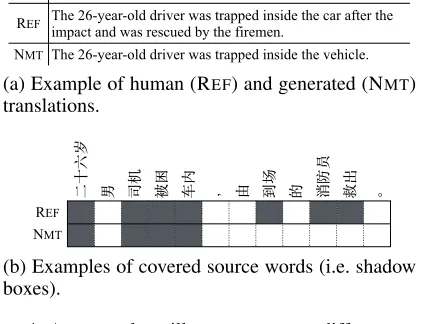
Input ⼆⼗六岁男司机被困车内,由到场的消防员救出。
REF The 26-year-old driver was trapped inside the car after the impact and was rescued by the firemen.
NMT The 26-year-old driver was trapped inside the vehicle.
(a) Example of human (REF) and generated (NMT) translations.
REF NMT
11
REF NMT
Input
REF The 26-year-old driver was trapped inside the car after the impact and was rescued by the firemen.
NMT The 26-year-old driver was trapped inside the vehicle.
(b) Examples of covered source words (i.e. shadow boxes).
Figure 1: An example to illustrate coverage difference ratio.
1. We solve the exposure bias problem by modeling the translation as a stochastic policy in reinforcement learn-ing (RL) and directly performlearn-ing policy gradient update.
2. The RL reward is estimated on a complete sequence, which correlates well with either sequence-level BLEU or a more adequacy-oriented metric, as described below.
3. We design a sequence-level metric –Coverage Differ-ence Ratio(CDR) – to explicitly measure translation ade-quacy which focuses on the commonly-cited weaknesses of NMT models: producing fluent yet inadequate transla-tions. We expect that the model can benefit from linguis-tic insights that correlate well with human intuitions.
Coverage Difference Ratio (CDR) We measure transla-tion adequacy by the number of under-translated words via comparing generated translation with human translation. We take an example to illustrate how to measure translation ad-equacy in terms of coverage difference ratio. Figure 1(a) shows one inadequate translation. Following (Luong, Pham, and Manning 2015; Tu et al. 2016), we extract only one-to-one alignments (hard alignments) by selecting the source word with the highest alignment for each target word from the word alignments produced by NMT models.1 A source word is considered to be translated when it is covered by the hard alignments, as shown in Figure 1(b). Comparing source words covered by generated translation with those covered by human translation, we can find that the two sets are very different for inadequate translation. Specifically, the differ-ence generally lies in the untranslated source words that cause inadequate translation problem, indicating that cover-age difference ratio is a good way to measure the adequacy of generated translation.
1
NMT Model G
ŷ2 ŷ1
Hyp: ŷ ŷI’
x2 x1
Source:x xJ
Discriminator D
Orientator O CDR Score
Translate Force Decode
y2
y1 yI
Ref: y
Coverages estimated reward
Figure 2: Architecture of adequacy-oriented NMT. The newly added orientatorOreads coverages of generated and human translations to generate a CDRscore for each gener-ated translation, which guides the discriminatorDto differ-entiate good generated translations from bad ones.
Formally, we calculate the CDRscore of a given generated translationˆyby
CDR(yˆ|y,x) = 1−|Cref \Cgen| |Cref|
(5)
whereCref and Cgen is the set of source words covered
by human translation and generated translation, respectively. Cref \Cgendenotes the covered source words inCref but
not inCgen. We useCref as the reference coverage to
elim-inate the effect of null-aligned source words which are not aligned to any target word. As seen, CDR(ˆy|y,x)is a num-ber between 0 and 1, where 1 means “completely adequate translation” and 0 means “completely inadequate transla-tion”. Taking Figure 1(b) as an example, the CDRscore is 1−(7−4)/7 = 0.57.
Architecture
As shown in Figure 2, the proposed model consists of a gen-erator, adiscriminator, and anorientator.
Generator The generator G generates the translation yˆ conditioned on the input sentencex. Because we need word alignments to calculate adequacy scores in terms of CDR, an attention-based NMT model is employed as the generator.
Orientator The orientator O reads the word alignments produced by NMT attention model when generating (or force decoding) the two translations and outputs an ade-quacy score for the generated translation in terms of the aforementioned CDR score. Then, the orientator is used to guide the discriminator to distinguish adequate translation from inadequate ones. Accordingly, adequate translations with higher CDRscores would contribute more to parameter tuning, as described in the following section.
Discriminator We employ a RNN-based discriminator to differentiate generated translation from human translation, given the input sentence. The discriminator reads the in-put sentence xand its translation (eithery or ˆy), and use two RNNs to summarize the two sentences individually. The concatenation of the two summarized representation vectors is fed into a fully-connected neural network.
Adequacy-Oriented Training
In order to train the system efficiently and effectively, we employ a periodical training strategy, which is commonly used in adversarial training (Goodfellow et al. 2014; Wu et al. 2017). Specifically, we optimize two networks with two objective functions and periodically freeze the parameters of each network during training.
Train Generator and Freeze Discriminator Follow-ing Wu et al. (2017), we use the REINFORCE algo-rithm (Williams 1992) to back-propagate the error signals fromDtoG, given the discretely generatedˆyfromG. The objective of the generator is to maximize the expected re-ward:
L=E(x,ˆy)∈Gθ[D(x,ˆy)] (6)
whose gradient is
Oθ=E(x,ˆy)∈Gθ[D(x,yˆ)OθlogGθ(ˆy|x)] (7)
The gradient is approximated by a sample fromGusing the REINFORCE algorithm (Williams 1992):
Oθ≈Oˆθ=D(x,ˆy)OθlogGθ(yˆ|x) (8)
whereOθlogG(yˆ|x)is the standard NMT gradient which
is calculated by the maximum likelihood estimation. There-fore, the final update function for the generator is:
θ=θ−ηOˆθ (9)
where theη is the learning rate. Based on the update func-tion, when theD(x,ˆy)is large (i.e.,ideally, the generated translationˆyhas a high adequacy score) , the larger reward the NMT model will get, and thus parameters are updated more based on the adequate training instance(x,yˆ).
Train Discriminator Oriented by Adequacy and Freeze Generator Ideally, a good translation ˆy should be as-signed a high adequacy scoreD(x,ˆy)and thus contribute more to updating the generator. Therefore, we expect the discriminator to not only differentiate generated translations from human translations but also distinguish bad generated translations from good ones. Therefore, a new objective of discriminator is to assign a precise score for each generated translation, which is consistent with their adequacy score:
min
D |CDR(ˆy|x,y)−D(x,ˆy)|
2 (10)
Related Work
This work is related to modeling translation as policy gra-dient and adequacy modeling. For the former, we take min-imum risk training, reinforcement learning and adversarial learning as representative strategies.
Minimum Risk Training In response to the exposure bias and word-level loss problems of MLE training, Shen et al. (2016) minimize the expected loss in terms of evaluation metrics on the training data. Our simplified model is anal-ogous to their MRT model, if we directly use CDR as the reward to update parameters:
ˆ
Oθ=CDR(ˆy|x,y))OθlogGθ(ˆy|x) (11)
The simplified model differs in that (1) we use adequacy-oriented metric (i.e., CDR) while they use sequence-level BLEU, and (2) we only need to sample one candidate to calculate reinforcement reward while they generate multiple samples to calculate the expected risk. In addition, our dis-criminator gives a smoother and dynamically-updated ob-jective compared with directly using the adequacy-oriented metric, because the latter is highly sensitive to the slight cov-erage difference (Koehn and Knowles 2017).
Reinforcement Learning Recent work shows that max-imum likelihood training could be sub-optimal due to the different conditions between training and test modes (Ben-gio et al. 2015; Ranzato et al. 2016). In order to address the exposure bias and the loss which does not operate at the se-quence level, Ranzato et al. (2016) employ the REINFORCE algorithm (Williams 1992) to decide whether or not tokens from a sampled prediction could contribute to a high task-specific score (e.g.,BLEU). Bahdanau et al. (2017) use the actor-critic method from reinforcement learning to directly optimize a task-specific score.
Adversarial Learning Recently, adversarial learn-ing (Goodfellow et al. 2014) has been successfully applied to neural machine translation (Wu et al. 2017; Yang et al. 2018; Cheng et al. 2018). In the adversarial framework, NMT models generally serve as the generator which defines the policy to generate the target sentence
y given the source sentence x. A discriminator tries to distinguish the translation result yˆ = G(x) from the human-generated oney, given the source sentencex.
If we remove the orientatorO, our model is roll-backed to the adversarial NMT, and the training objective of the dis-criminatorDis rewritten as
max
D {logD(x,y) + log(1−D(x,ˆy))} (12)
The goal of the discriminator is try to maximize the likeli-hood of human translationD(x,y)to 1 and minimize that of generated translationD(x,yˆ)to 0.
As seen, the discriminator uses a binary classification by uniformly treating all generated translations as negative ex-amples (i.e.,labeling “0”) and all human translations as posi-tive examples (i.e.,labeling “1”), regardless of the quality of
the generated translations. However, intuitively, high-quality translations and low-quality translations should be treated differently by the discriminator, otherwise, inaccurate re-ward signals would be propagated back to the generator. In our proposed architecture, this problem can be alleviated by replacing the simple binary outputs with the more informa-tive adequacy-oriented metric CDR, which is calculated by directly comparing generated and human translations.
Adequacy Modeling Inadequate translation problem is a commonly-cited weakness of NMT models (Tu et al. 2016). A number of recent efforts have explored ways to allevi-ate this problem. For example, Tu et al. (2016) and Mi et al. (2016) employ coverage vector as a lexical-level in-dicator to indicate whether a source word is translated or not. Zheng et al. (2018) and Meng et al. (2018) move one step further and directly model translated and untranslated source contents by operating on the attention context vec-tor. He et al. (2017) use a prediction network to estimate the future cost of translating the uncovered source words. Our approach is complementary to theirs since they model the adequacy learning at the word-level inside the genera-tor (i.e., NMT models), while we model it at the sequence-level outside the generator. We take the representative cover-age mechanism (Tu et al. 2016) as another stronger baseline model for its simplicity and efficiency, and experimental re-sults show that our model can further improve performance. In the context of adequacy-oriented training, Tu et al. (2017) introduce an auxiliary objective to measure the adequacy of translation candidates, which is calculated by reconstructing generated translations back to the original in-puts. Benefiting from the flexible framework of reinforce-ment training, we are able to directly compare generated translations with human translations and define a more straightforward metric, i.e., CDR to measure adequacy of generated sentences.
Experiments
Setup
We conduct experiments on the widely-used Chinese (Zh)
⇒English (En) and German (De) ⇔English (En) trans-lation tasks. For Zh⇒En translation, the training corpus contains 1.25M sentence pairs extracted from LDC cor-pora. NIST 2002 (MT02) dataset is the validation set and the test data consists of NIST 2003 (MT03), NIST2004 (MT04), NIST 2005 (MT05) and NIST 2006(MT06). For De⇔En translation, to compare with the results reported by previous work (Shen et al. 2016; Bahdanau et al. 2017; Wu et al. 2017; Vaswani et al. 2017), we use both the IWSLT 2014 and WMT 2014 data. The former contains 153K sen-tence pairs and the latter consists of 4.56M sensen-tence pairs. The 4-gram NIST BLEU score (Papineni et al. 2002) is used as the evaluation metric and sign-test (Collins, Koehn, and Kuˇcerov´a 2005) is employed to test statistical significance.
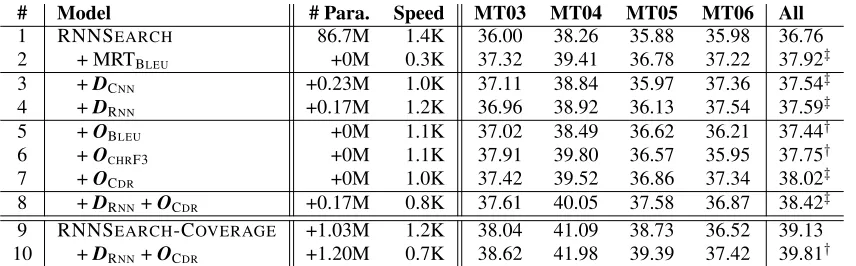
# Model # Para. Speed MT03 MT04 MT05 MT06 All
1 RNNSEARCH 86.7M 1.4K 36.00 38.26 35.88 35.98 36.76
2 + MRTBLEU +0M 0.3K 37.32 39.41 36.78 37.22 37.92‡
3 +DCNN +0.23M 1.0K 37.11 38.84 35.97 37.36 37.54‡
4 +DRNN +0.17M 1.2K 36.96 38.92 36.13 37.54 37.59‡
5 +OBLEU +0M 1.1K 37.02 38.49 36.62 36.21 37.44†
6 +OCHRF3 +0M 1.1K 37.91 39.80 36.57 35.95 37.75†
7 +OCDR +0M 1.0K 37.42 39.52 36.86 37.34 38.02‡
8 +DRNN+OCDR +0.17M 0.8K 37.61 40.05 37.58 36.87 38.42‡
9 RNNSEARCH-COVERAGE +1.03M 1.2K 38.04 41.09 38.73 36.52 39.13 10 +DRNN+OCDR +1.20M 0.7K 38.62 41.98 39.39 37.42 39.81†
Table 1: Evaluation of translation performance on Zh⇒En translation. “D” denotes discriminator and “O” denotes orientator. “MRT” indicates minimum risk training (Shen et al. 2016), and “DCNN” indicates adversarial training with a CNN-based
dis-criminator (Wu et al. 2017). “# Para.” denotes the number of parameters, and “Speed” denotes the training speed (words/second). “†” and “‡” indicate statistically significant difference (p <0.05andp <0.01respectively) from the corresponding baseline.
and for WMT 2014 En⇒De, preprocessing method de-scribed in Vaswani et al. (2017) is borrowed. We pre-train the discriminator on translation samples produced by the pre-trained generator. After that, the discriminator and the generator are trained together, and the generator is updated by the REINFORCE algorithm mentioned above. We also follow the training tips mentioned in Shen et al. (2016) and Wu et al. (2017). The hyper-parameterαwhich could con-trol the sharpness of the generator distribution in our system is 1e-4, which could also be regarded as a baseline to re-duce the variance of the REINFORCE algorithm. We also randomly choose 50% minibatches trained with our objec-tive function and the other with the MLE principle. In MRT training strategy (Shen et al. 2016), the sample size is 25, the hyper-parameterαis5e-3and the loss function is negative smoothed sentence-level BLEU.
We validate our models on two representative model architectures, namely RNNSEARCH and TRANSFORMER. For the RNNSEARCH model, mini-batch size is 80, the word-embedding dimension is 620, and the hidden layer size is 1000. We use a neural coverage model for RNNSEARCH -COVERAGE and the dimensionality of coverage vector is 100. The baseline models are trained for 15 epochs, which are used as the initial generator in the proposed framework. For the TRANSFORMERmodel, we implement our proposed approach on top of an open source toolkit THMUT (Zhang et al. 2017). Configurations in Vaswani et al. (2017) are used to train the baseline models.
Chinese-English Translation Task
Table 1 lists the results of various translation models on Zh⇒En corpus. As seen, all advanced systems significantly outperform the baseline system (i.e., RNNSEARCH), al-though there are still considerable differences among differ-ent variants.
Architectures of Discriminator (Rows 3-4) We evaluate two architectures for the discriminator. The CNN-based dis-criminator is composed of two convolution layers with3×3 window, two max-pooling layers with2 ×2 window and
one softmax layer. The feature map size is 10 and the feed-forward hidden size is 20. The RNN-based discriminator consists of two two-layer RNN encoders with 32 LSTM units and a fully-connected neural network with 32 units. We find that the RNN discriminator achieves similar perfor-mance with its CNN counterpart (37.59 vs. 37.54), while has a faster training speed (1.2K vs. 1.0K words/second). The main reason is that the CNN-based discriminator requires high computation and space cost to utilize multiple layers with convolution and pooling from a large input matrix.
Adequacy Metrics for Orientator (Rows 5-7) As afore-mentioned, the CDR score can be directly used as a re-ward to update the parameters, which is in analogy to the MRT (Shen et al. 2016) except that we use 1-best sam-ple while they use n-best samsam-ples. For comparison, we also used the word-level BLEU score (Row 5) and character-level
CHRF3 score (Popovi´c 2015) (Row 6) as the rewards. As seen, this strategy consistently improves translation performance, without introducing any new parameters. The extra computation cost is mainly from generating translation sentence and force decoding the human translation with the NMT model. We find that CDRnot only outperforms its 1-best counterpart “OBLEU” and “OCHRF3”, but also surpasses “MRTBLEU” using 25 samples. We attribute this to the fact
that CDR can better estimate the adequacy of the transla-tion, which is the key problem of NMT models, and go be-yond the the simple low-level n-gram matching measured by BLEU andCHRF3.
Combining Them Together (Row 8) By combining ad-vantages of both reinforcement learning and adequacy-oriented objective, our model achieves the best perfor-mance, which is 1.66 BLEU points better than the baseline “RNNSEARCH”, up to 0.98 BLEU points better than us-ing sus-ingle component and significantly improve the perfor-mance of “MRTBLEU” model. One more observation can be
System Model De⇒En
Existing end-to-end NMT systems
(Ranzato et al. 2016) CNN encoder + Sequence level objective 20.73 (Bahdanau et al. 2017) CNN encoder + Actor-critic 22.45 (Wiseman and Rush 2016) RNNSEARCH+ Beam search optimization 25.48 (Wu et al. 2017) RNNSEARCH+ Adversarial objective 26.98
Our end-to-end NMT systems
this work
RNNSEARCH 26.51
+ MRTBLEU 27.29†
+DCNN 27.24†
+OCDR 27.31†
+DRNN+OCDR 27.79‡
Table 2: Comparing with previous works of applying reinforcement learning for NMT on IWSLT 2014 De⇒En translation task. “†” and “‡” indicate statistically significant difference (p <0.05andp <0.01respectively) from the RNNSEARCHmodel.
Model BLEU
GNMT + RL (Wu et al. 2016) 26.30 ConvS2S (Gehring et al. 2017) 26.43 Transformer (Base) (Vaswani et al. 2017) 27.3 Transformer (Big) (Vaswani et al. 2017) 28.4 TRANSFORMER-BASE 27.30
+OCDR 27.80
+DRNN+OCDR 28.01†
TRANSFORMER-BIG 28.35
+OCDR 28.63
+DRNN+OCDR 28.99†
Table 3: BLEU scores on WMT 2014 En⇒De testset us-ing the state-of-the-art TRANSFORMERmodel. ‘†” indicates statistically significant difference (p <0.05) from the corre-sponding TRANSFORMERbaseline model.
smoother and dynamically-updated score than directly using the calculated one.
Working with Coverage Model (Rows 11-12) Tu et al. (2016) propose a coverage model to indicate whether a source word is translated or not, which alleviates the inad-equate translation problem of NMT models. We argue that our model is complementary to theirs, because we model the adequacy learning outside the generator by using an addi-tional adequacy-oriented discriminator, while they model it inside the generator. Experimental results validate our hy-pothesis: the proposed approach further improves perfor-mance by 0.58 BLEU points over the coverage-augmented model RNNSEARCH-COVERAGE.
English-German Translation Tasks
To compare with previous work of applying reinforcement learning for NMT (Ranzato et al. 2016; Bahdanau et al. 2017; Wiseman and Rush 2016; Wu et al. 2017), we first conduct experiments on IWSLT 2014 De⇒En translation task. As listed in Table 2, we reproduce the results of adver-sarial training reported by Wu et al. (2017) (27.24 vs. 26.98). Furthermore, the proposed approach consistently
outper-Model MAN 4 CDR 4
RNNSEARCH 3.31±0.70 – 0.68 –
+D 3.57±0.61 7.9% 0.71 4.4%
+O 3.69±0.48 11.5% 0.75 10.3%
+D+O 3.79±0.47 14.5% 0.80 17.6%
Table 4: Adequacy scores on randomly selected 100 sen-tences on Zh⇒En task, which are measured by CDR and human evaluation (“MAN”).
forms previous works, demonstrating the effectiveness of our models.
We also evaluate our model on the recently proposed TRANSFORMERmodel (Vaswani et al. 2017) on WMT 2014 En⇒De corpus. As shown in Table 3, our models signifi-cantly improve performances in all cases. Combining with previous results, our model consistently improve translation performance across various language pairs and NMT archi-tectures, demonstrating the effectiveness and universality of the proposed approach.
Analysis
To better understand our models, we conduct extensive anal-yses on the Zh⇒En translation task.
Adequacy Evaluation To better evaluate the adequacy, we randomly choose 100 sentences from the test set, and ask two human evaluators to judge the quality of generated translations. Five scales have been set up, i.e.,{1,2,3,4,5}, where “1” means that it is irrelevant between the source sen-tence and the translation sensen-tence, and “5” means that from semantic and syntactic aspect, the translation sentence and the source sentence is completely equivalent.
Figure 3: BLEU and CDRscores of the translations with re-spect to the input lengths.
between CDRand manual evaluation score is 0.64, indicat-ing that the proposed CDRis a reasonable metric to measure translation adequacy.
Length Analysis We group sentences of similar lengths and compute both the BLEU score and CDRscore for each group, as shown in Figure 3. The four length spans contain 1386, 2284, 1285, and 498 sentences, respectively. From the perspective of the BLEU score, the proposed model (i.e., “+D+O”) outperforms RNNSEARCHin all length segments. In contrast, using discriminator only (i.e., “+D”) outper-forms RNNSEARCH in most cases, except long sentences (i.e.,>45). One possible reason is that it is difficult for the discriminator to differentiate generated translations from hu-man translations for long source sentences, thus the genera-tor cannot learn well about these instances due to the “mis-taken” rewards from the discriminator. Accordingly, using the CDR score (i.e., “+O”) alleviates this problem by pro-viding a sequence-level score, which better estimates the adequacy of the translations. The final model combines the advantages of both a smoother and dynamically-updated ob-jective from the discriminator (“+D”), and a more accurate objective specifically designed for the translation task from the orientator (“+O”).
The CDRscores for all models degrade when the length of source sentence increases. This is mainly due to that inadequate translation problem is more serious on longer sentences for NMT models (Tu et al. 2016). The adver-sarial model (i.e., “+D”) improves CDR scores while the improvement degrades faster with the increase of sentence length. However, our proposed approach consistently im-proves CDRperformance in all length segments.
Input 美国线上时代华纳董事长凯斯今晚宣布他将在五
⽉辞职 , 他说 , 此举「对公司⽽⾔是最好的」。
REF
Steve case chairman of AOL time warner announced tonight that he will resign in May, he said that his move is the best interest of the company.
BASE
The chairman of the board of time warner of the united
states announced tonight that he will resign in May. (CDR: 0.56; BLEU: 36.18)
OURS
Chairman of AOL time warner announced tonight that he will resign in May, he said this is the best thing for the company. (CDR: 0.88; BLEU: 58.82)
Figure 4: Example translations on Zh⇒En test set.
Effect of the Discriminator Koehn and Knowles (2017) point out that the attention model does not always corre-spond to word alignment and may considerably diverge. Ac-cordingly, the attention matrix-based CDRscore may not al-ways correctly reflect the adequacy of generation sentences. However, our discriminator is able to give a smoother and dynamically-updated objective, and thus could provide more accurate adequacy scores of generation sentences. From the above quantitative and qualitative results, the discriminator indeed leads to better performance (i.e.,“+D+O” vs. “+O”).
Case Study To better understand the advantage of our pro-posed model, we show a translation case in Figure 4. Spe-cially, we provide a Zh⇒En example with two translation results from the RNNSearch and Adequacy-NMT models respectively, as well as the corresponding CDRand BLEU scores. We emphasize on their different parts with bold fonts which lead to different translation quality. As seen, the latter part of the source sentence is not translated by the RNNSearch model while our proposed model correct this mistake. Accordingly, our model improves both CDR and BLEU scores.
Conclusion
In this work, we propose a novel learning approach for RL-based NMT models, which integrates into the policy gradi-ent with an adequacy-origradi-ented reward designed specifically for translation. The proposed approach combines the advan-tages of both sequence-level training of reinforcement learn-ing, as well as a more accurately estimated reward by con-sidering the translation adequacy in terms of coverage dif-ference ratio (CDR). Experimental results on different lan-guage pairs show that our proposed approach not only sig-nificantly outperforms standard NMT models, but also fur-ther improves performance over those using the policy gra-dient and the adequacy-oriented reward individually. In ad-dition, the proposed approach is also complementary to the coverage models (Tu et al. 2016), because the two models aim to alleviate the inadequate translation problem from two different perspectives (i.e.,sequence-level vs. word-level).
learning and adversarial learning (Bahdanau et al. 2017; Yu et al. 2017; Yang et al. 2018).
References
Bahdanau, D.; Brakel, P.; Xu, K.; Goyal, A.; Lowe, R.; Pineau, J.; Courville, A.; and Bengio, Y. 2017. An actor-critic algorithm for sequence prediction. InICLR.
Bahdanau, D.; Cho, K.; and Bengio, Y. 2015. Neural ma-chine translation by jointly learning to align and translate. In ICLR.
Bengio, S.; Vinyals, O.; Jaitly, N.; and Shazeer, N. 2015. Scheduled sampling for sequence prediction with recurrent neural networks. InNIPS.
Cheng, Y.; Tu, Z.; Meng, F.; Zhai, J.; and Liu, Y. 2018. Towards robust neural machine translation. InACL. Collins, M.; Koehn, P.; and Kuˇcerov´a, I. 2005. Clause re-structuring for statistical machine translation. InACL. Gehring, J.; Auli, M.; Grangier, D.; Yarats, D.; and Dauphin, Y. N. 2017. Convolutional sequence to sequence learning. InICML.
Goodfellow, I.; Pouget-Abadie, J.; Mirza, M.; Xu, B.; Warde-Farley, D.; Ozair, S.; Courville, A.; and Bengio, Y. 2014. Generative adversarial nets. InNIPS.
He, D.; Lu, H.; Xia, Y.; Qin, T.; Wang, L.; and Liu, T. 2017. Decoding with value networks for neural machine transla-tion. InNIPS.
Kalchbrenner, N., and Blunsom, P. 2013. Recurrent contin-uous translation models. InEMNLP.
Koehn, P., and Knowles, R. 2017. Six challenges for neural machine translation. InProceedings of the First Workshop on Neural Machine Translation, 28–39.
Luong, M.-T.; Pham, H.; and Manning, C. D. 2015. Effec-tive approaches to attention-based neural machine transla-tion. InEMNLP.
Meng, F.; Tu, Z.; Cheng, Y.; Wu, H.; Zhai, J.; Yang, Y.; and Wang, D. 2018. Neural machine translation with key-value memory-augmented attention. InIJCAI.
Mi, H.; Sankaran, B.; Wang, Z.; and Ittycheriah, A. 2016. Coverage embedding models for neural machine translation. InEMNLP.
Papineni, K.; Roukos, S.; Ward, T.; and Zhu, W.-J. 2002. BLEU: a method for automatic evaluation of machine trans-lation. InACL.
Popovi´c, M. 2015. chrf: character n-gram f-score for auto-matic mt evaluation. InProceedings of the Tenth Workshop on Statistical Machine Translation, 392–395.
Ranzato, M.; Chopra, S.; Auli, M.; and Zaremba, W. 2016. Sequence level training with recurrent neural networks. In ICLR.
Shaw, P.; Uszkoreit, J.; and Vaswani, A. 2018. Self-Attention with Relative Position Representations. In NAACL.
Shen, S.; Cheng, Y.; He, Z.; He, W.; Wu, H.; Sun, M.; and Liu, Y. 2016. Minimum risk training for neural machine translation. InACL.
Shen, T.; Zhou, T.; Long, G.; Jiang, J.; Pan, S.; and Zhang, C. 2018. DiSAN: directional self-attention network for RNN/CNN-free language understanding. InAAAI.
Sutskever, I.; Vinyals, O.; and Le, Q. V. 2014. Sequence to sequence learning with neural networks. InNIPS.
Tu, Z.; Lu, Z.; Liu, Y.; Liu, X.; and Li, H. 2016. Modeling coverage for neural machine translation. InACL.
Tu, Z.; Liu, Y.; Shang, L.; Liu, X.; and Li, H. 2017. Neural machine translation with reconstruction. InAAAI.
Vaswani, A.; Shazeer, N.; Parmar, N.; Uszkoreit, J.; Jones, L.; Gomez, A. N.; Kaiser, Ł.; and Polosukhin, I. 2017. At-tention is all you need. InNIPS.
Williams, R. J. 1992. Simple statistical gradient-following algorithms for connectionist reinforcement learning. Ma-chine Learning8(3-4):229–256.
Wiseman, S., and Rush, A. M. 2016. Sequence-to-sequence learning as beam-search optimization. InEMNLP.
Wu, Y.; Schuster, M.; Che, Z.; and Le, Q. V. e. a. 2016. Google’s neural machine translation system: Bridging the gap between human and machine translation.arXiv. Wu, L.; Xia, Y.; Zhao, L.; Tian, F.; Qin, T.; Lai, J.; and Liu, T.-Y. 2017. Adversarial neural machine translation. arXiv. Yang, Z.; Chen, W.; Wang, F.; and Xu, B. 2018. Improving neural machine translation with conditional sequence gener-ative adversarial nets. InNAACL.
Yu, L.; Zhang, W.; Wang, J.; and Yu, Y. 2017. SeqGAN: sequence generative adversarial nets with policy gradient. InAAAI.