Volume 3, Issue 5, May 2014
Page 41
agreement with those obtained using the same modeling.Key words: Eclipsing binaries, Spectroscopic, PHOEBE package, Binary Maker 3 and spectroscopic binary solver.
1.
INTRODUCTION
The study of binary stars is vitally important in astronomy because it is only by carefully measuring the interactions between stars that we can accurately determine their absolute characteristics such as mass, luminosity, and radius. In this paper, we will be discussed three computer modeling PHOEBE, Binary Maker 3(BM3) and spectroscopic binary solver (SBS) for analysis the radial velocity of eclipsing binaries systems ER Vul and BX And of the short period group RS CVn binaries.
ER Vulpeculae (HD 200391, BD+27° 3952, HIP 103833, V = 7. 36ᵐ, P = ) is a double-lined spectroscopic binary, its orbit was first determined by Northcott and Bakos (1956,1967)[1]. The spectroscopic orbit of the ER Vul was determined by McLean (1982) and several other radial velocity studies have been performed in recent years e.g. Hall et al. 1990; Gunn et al. 1996 [2]. Hall (1976) classified ER Vul as a member of the short-period group of RS CVn systems, with main sequence components in a detached configuration. The RV of both components of ER Vul has been the subject of intense studies over many decades by several researchers. The first radial velocity curves of both components of ER Vul, based on an average of a dozen lines, which are taken between1949–1951 at David Dunlap Observatory, were published by Northcott and Bakos (1956). They found a systemic velocity of -25.2 km⁄sec and derived RV curve
semi-amplitudes of 138.5 and 149.3 for the primary and secondary component, respectively. Alexandru and Călin detected a periodicity in the O–C curve of ER Vul and proved its detectability. They investigated the standard mechanisms for orbital period modulation and they emphasized a statistically significant increase of the orbital period of ER Vul. They proposed a methodology for estimating the detectability of periodic signals [3]. The orbital phases have been calculated with the following ephemeris:
HJD (MinI) = 2 449 564.31173+ × E
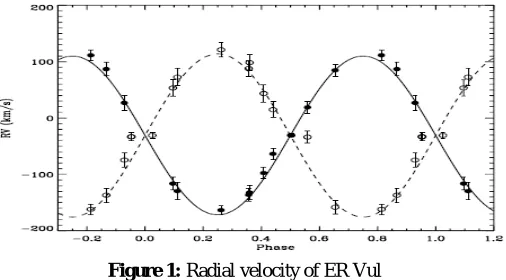
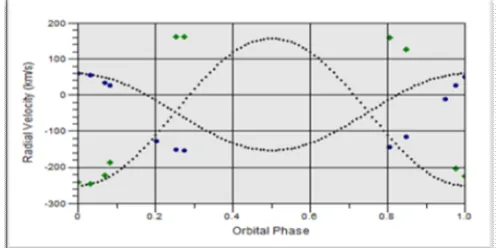
In this paper, we used this observation for analysis the radial velocity. Figure 1 shows the radial velocity of this binary [2].
Figure 1: Radial velocity of ER Vul
Ronald et.al observed the short-period eclipsing binary system BX And on five nights in 1976 at the Morgan Monroe station of the Goethe link Observatory of Indiana University. They found that BX And binary system consists of an F type primary component and a K secondary component [4]. The first radial velocity data and absolute dimensions of the system were obtained by Bell et. al. [5], where the data were phased according to the ephemeris:
HJD (MinI) = 2446705.49310 0.00012 + E.0.61011258
Volume 3, Issue 5, May 2014
Page 42
Figure 2: Radial velocity of BX AndThis paper is organized as follows. We analyzed spectroscopic data in section 2. Section 2 .1 analyzed the radial velocities using PHOEBE and the physical parameters for the systems are calculated. Section 2 .2 analyzed the radial velocities using Binary maker 3 .Section 2 .3 analyzed the radial velocities using Spectroscopic Binary Solver (SBS). Section 3 is devoted to conclusions.
2.
DATA ANALYSIS
In order to modeling the radial velocities of eclipsing binaries ER Vul and BX And, we applied three different models: the first is PHOEBE (Prša and Zwitter 2005)[6] which is released under the GNU public license., it is modeling software for eclipsing binaries which uses the Wilson- Devinney code. The second is Binary maker 3 (BM3) and the third is Spectroscopic binary solver (SBS).
2.1 ANALYSIS with PHOEBE
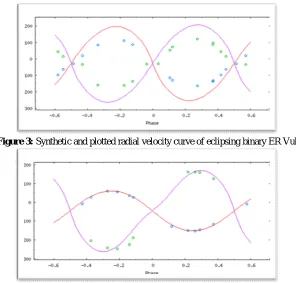
In order to analysis the radial velocities of these eclipsing binaries using PHOEBE, we added the experimental data in arrange consists of two columns the first column represents the independent variables, in this cause is phase, Then we plotted the synthetic and the experimental radial velocities of ER Vul and BX And as shown in figure 3 and figure 4, respectively.
Figure 3: Synthetic and plotted radial velocity curve of eclipsing binary ER Vul
Volume 3, Issue 5, May 2014
Page 43
Ω Non-dimensional surface potential K1 Semi amplitude of the primary component K2 Semi amplitude of the secondary component
Systematic velocity
In order to obtain the physical and geometric parameters of the binary components, we adjusted a numerical eclipsing binary model to the observations; the mass-ratio of ER Vul and BX And were fixed at the values of 0.96 and 0.49, respectively and we fixed the values of the effective temperature of the primary component (T1) ;these values are 6050 and 6600 for ER Vul and BX And binaries, respectively . This model and for a given q has the following adjustable parameters: the orbital inclination (i), the non-dimensional potentials (
1and
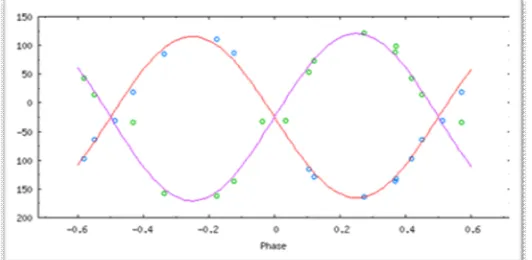
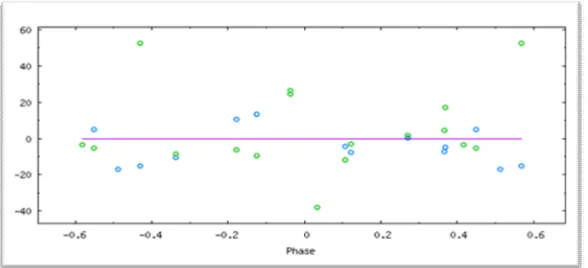
2), the effective temperature of the secondary component (T2).After some iteration we get the best match between the synthetic and the experimental radial velocity curve of the eclipsing binaries ER Vul and BX And as shown in the figure 5 and figure 6, respectively. The radial velocity curves residuals windows plot the difference between experimental and synthetic radial velocity curves verses the phase; Figure 7 and figure 8 show the residuals of both binaries. Table 2 presents the physical and orbital parameters of ER Vul and BX And from using PHOEBE model.
Figure: 5 The best match between the synthetic and the experimental radial velocity curve of binary ER Vul
Volume 3, Issue 5, May 2014
Page 44
Figure 7: Residuals obtained from fitting routine of eclipsing binary ER VulFigure 8: Residuals obtained from fitting routine of eclipsing binary BX And
Table 2: Thephysical and orbital parameters of ER Vul and BX And Using PHOEBE parameters ER Vul Cakırli et.al. [2] BX And Bell et.al.[5]
Mass1 1.11 1.09 1.63 1.52
0.05Mass 2 1.06 1.06 0.81 0.75
0.03TAVH 6050 6010 6600 6800
200TAVC 6016 5883 5362 4500
200R1 1.05 1.16 1.78 1.78
0.03R2 0.88 1.18 1.40 1.30
0.03Ω(L1) 3.68 - 2.87 -
Ω(L2) 3.16 - 2.57 -
Mbol 1 4.87 4.28 4.36 2.79
0.13Mbol 2 4.47 4.31 3.98 5.26
0.20Inclination 67.138 ° 66.32° 76.35° 75.50°
PHSV 5.06 - 2.95 -
PCSV 5.69 - 2.81 -
SMA 4.29 4.27 4.21 4.32
VGA -24.95 −25.2 -45.36 -45.11
2.2 ANALYSIS with BINARY MAKER 3
Volume 3, Issue 5, May 2014
Page 45
Figure 9: : The synthetic and the experimental radial velocity curves of binary ER VulFigure 10: The synthetic and the experimental radial velocity curves of binary BX And
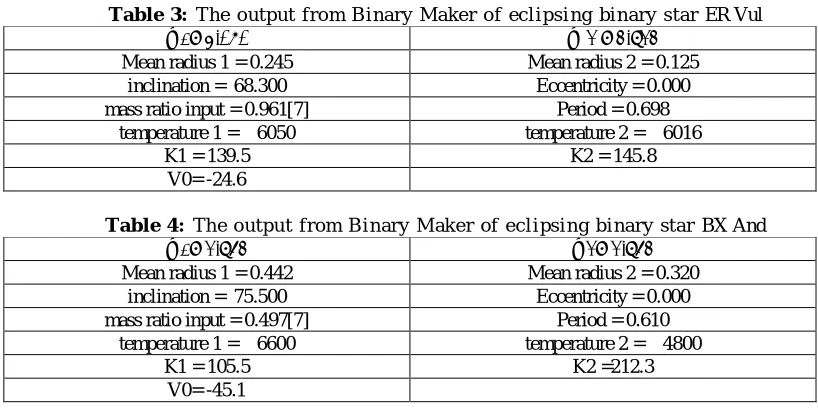
T abl e 3: The out put fr om B i nar y Maker of ecl i ps i ng bi n ary s t ar ER Vul
Ω1= 5.070 Ω 2 = 4.824
Mean radius 1 = 0.245 Mean radius 2 = 0.125 inclination = 68.300 Eccentricity = 0.000 mass ratio input = 0.961[7] Period = 0.698
temperature 1 = 6050 temperature 2 = 6016
K1 = 139.5 K2 = 145.8
V0= -24.6
T abl e 4 : Th e out pu t fr om B i n ar y M aker of ecl i ps i n g bi nar y st ar BX And
Ω1= 2.864 Ω2= 2.864
Mean radius 1 = 0.442 Mean radius 2 = 0.320 inclination = 75.500 Eccentricity = 0.000 mass ratio input = 0.497[7] Period = 0.610
temperature 1 = 6600 temperature 2 = 4800
K1 = 105.5 K2 =212.3
V0= -45.1
2.3 Analysis with Spectroscopic Binary Solver (SBS)
The radial velocity of star in a binary system is defined as follows [8]:
V=
K
cos(
)ecos
………..(1)where
is the systematic velocity,K
is the semi-amplitude of the velocity curve and
,
,
e
are the angular polar coordinate (true anomaly), the longitude of periastron and the eccentricity, respectively . The quantities θ and ω are measured from the periastron point and the spectroscopic reference line (plane of sky), respectively. The mass-ratio q can be determined from the ratio of the semi-amplitudes q = K2/K1. Also the semi-amplitude of the velocity curve may also be determined by2
e -1 P
sin 2 a i
Volume 3, Issue 5, May 2014
Page 46
where a is the semi axis of the orbit around the center of mass, P is the period of motion, and inclination i is the angle between the line of sight and the normal of the orbital plane. Thus, since we know P, e and K, we can determine a sin i– but we cannot determine a or i separately. According to definition of the center of mass, the mass ratio in the system is obtained as:i
a
i
a
M
M
sin
sin
2 1 1 2
………(3)According to Kepler’s third law and equation 3 , the following relation is obtained 2 2 1 2 3 1
sin
sin
sin
sin
P
i
a
i
a
i
a
i
M
………..(4)A similar relation is obtained for the secondary component only by replacing 1 with 2 and vice versa, in the equation 4. We adopted the mass ratio q = M2/M1 = 0.96 for ER Vul and 0.49 for BX And from our radial velocity orbits.
The Root Mean Square (RMS) can be calculated from the following equation [8]:
RMS
=
………....(5)Where
V
obs represents observed radial velocity,V
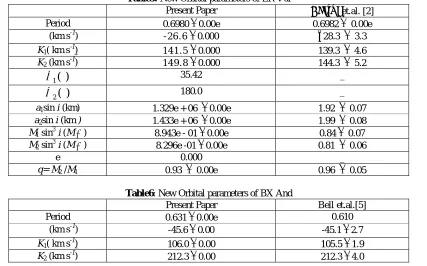
calc represents numerical calculated velocity, and N represents the number of iterations where a few iterations often produce a reasonably good fit to the observed radial velocity data. We note that the best fit is achieved when the calculated RMS value is minimized. In this work, we used Spectroscopic Binary Solver software (SBS) [9] to calculate the orbital parameters of a binary star system based on observed radial velocities relevant to equation 1.For spectroscopic binaries where both components radial velocities are measurable, it is possible to determine the spectroscopic orbital solution. After providing experimental radial velocity curve data to the (SBS), we added input parameters to construct meaningful binary models, then we begin the analysis by clicking on the Read File button to select data file containing radial velocity observations per star. Each line of data must consist of an observation time (in decimal days) and a measured radial velocity (in km/s or m/s) separated by either spaces or tabs. After providing experimental radial velocity curve data to the SBS, we make some iteration by clicking on solve button till we get the less value of Root Mean Square. Figures 11 and 12 show the Synthetic and observation data radial velocity curves for both binaries while figures 13 and 14 show orbital parameters fitted to the observation data radial velocity curves for ER Vul and BX And, respectively. The orbital parameters and a comparison are given in tables 5 and 6 for both binaries.Figure 11: Synthetic and observation data radial velocity curves of eclipsing binary ER Vul.
Volume 3, Issue 5, May 2014
Page 47
Figure13: The best match between the synthetic and the experimental radial velocity curve of eclipsingbinary ER Vul
Figure 14: The best match between the synthetic and the experimental radial velocity curve of eclipsing binary BX And
Table5: New Orbital parameters of ER Vul
Present Paper Cakırli et.al. [2]
Period 0.6980
0.00e 0.6982
0.00e
(km s-1) -26 . 6
0.000 −28.3
3.3K1( km s
-1
) 14 1. 5
0.000 139.3
4.6K2 (km s-1) 14 9. 8
0.000 144.3
5.2)
(
1
35.42 _)
(
2
180.0 _a1sin i (km) 1.329e + 06
0.00e 1.92
0.07a2sin i (km ) 1.433e + 06
0.00e 1.99
0.08M1 sin 3
i (M) 8.943e - 01
0.00e 0.84
0.07M2 sin3i (M) 8.296e -01
0.00e 0.81
0.06e 0.000 _
q= M2 /M1 0.93
0.00e 0.96
0.05Table6: New Orbital parameters of BX And
Present Paper Bell et.al.[5]
Period 0.631
0.00e 0.610
(km s-1) -45.6
0.00 -45.1
2.7K1( km s-1) 106.0
0.00 105.5
1.9K2 (km s
-1
Volume 3, Issue 5, May 2014
Page 48
)
(
1
0.0
0.0 _)
(
2
180.0
0.0 _a1sin i (km) 8.893e+05
0.00 1.272
0.022a2sin i (km ) 1.7811e+06
0.00 2.559
0.048M1 sin3i (M) 1.359e
0.00 1.358
0.045M2 sin3i (M) 6.788e-01
0.00 0.675
0.022e 0.0 0.0
q= M2 /M1 0.497
0.00 0.497
0.0133. CONCLUSIONS
In this paper, the results from a radial velocity analysis of the eclipsing binaries ER Vul and BX And are presented and discussed. The analysis of spectroscopic data of both eclipsing binaries using PHOEBE, BM3 and SBS models has allowed us to determine the orbital parameters of the component stars. By iterative adjustment parameters best fitting to experimental data are established. PHOEBE, BM3 and SBS programs plotted the radial velocity curves for each system. New orbital parameters such as systematic velocity, semi amplitude, a1sin i, a2sin i, M1 sin
3
i, and M2 sin 3
i are determined. Our numerical calculations show that the results obtained for the orbital parameters
are in good agreement with those obtainedby other researchers.
References
[1] K. Olah, E. Budding, H. I. Kim, and P.B. Etzel, “The active close binary system ER Vulpeculae”, Astronomy and Astrophysics Journal 8 June 1994.
[2] O. Cakırli, C. Ibanoglu, A. Frasca, and S. Catalano, “Hα variations of the RS CVn type binary ER Vulpeculae”, Astronomy & Astrophysics Journal, 17 December 2002
[3] Alexandru, P. and Călin V."Orbital period modulation of the eclipsing binary system ER Vulpeculae: Real or not?", New Astronomy Journal, Vol. 23, October 2013
[4] G. Ronald , Fuller R. E., and R.H. Kaitchuck, ” BX Andromedae : A shallow contact system with a large temperature difference”, The Astronomical Journal, Vol 97, no. 4 ,April 1989
[5] S. A. Bell, P.P. Rainger, G. Hill and R.W. Hilditich, “ A Photometric and Spectroscopic study of BX Andromedea”, University Observatory, 23 October 1989
[6] A. Prša ,"PHOEBE Scientific Reference", villanova university, college of arts and sciences, dept. of astronomy and astrophysics, PHOEBE version 0.30,2011.
[7] G. Dryomova, E. Perevozkina and M. Svechnikov," Catalogue of the orbital elements, masses, and luminosities for short-periodic RS CVn-type eclipsing systems" A&A 437, 375–381,2005.
[8] K. Karami and R. Mohebi1" Velocity Curve Analysis of the Spectroscopic Binary Stars PV Pup, HD 141929, EE Cet and V921 Her by Nonlinear Regression" J. Astrophys. Astr. 28, 217–230, 2007.
[9] D.O. Johnson,” Spectroscopy Binary Solver”,The Astronomical Journal, Data 10, 2004
Authors
Bushra Q. Al-Abudi received Ph.D. degree in Astronomy in 2002 from University of Baghdad, College of Science, Astronomy and Space Department. Currently she is professor in Astronomy and Space department and her research interests include spectroscopy and photometry analysis of binary stars.