I
nvestor
B
riefing
Content developed from
State of the Apes:
Infrastructure Development and Ape Conservation
State of the Apes
The Impact of Infrastructure Development
on Biodiversity
State of the Apes
The Impact of Infrastructure Development
on Biodiversity
Acknowledgements
ShareAction gratefully acknowledges the generous financial support of the Arcus Foundation. This foundation kindly supported this project, but the views expressed are those of ShareAction. More information is available on request.
The information contained in this briefing draws extensively on the third book of the State of the Apes series (Arcus Foundation, 2018). This volume explores the impact of infrastructure development on the conservation of African great apes and Asian great apes and gibbons.
We would further like to thank the panel of experts who gave their time to provide guidance to inform this research project, including Motoko Aizawa, Tania Inowlocki, Annette Lanjouw, Kate Newman, Helga Rainer and Alison White.
About the author
Report written and produced by Jo Alexander. Jo is a Chartered Geologist who spent 11 years working as an Exploration Geoscientist for BP and now engages with investors about climate change, forests and biodiversity. The report was edited by Toby Belsom (Head of Research & Analytics).
About ShareAction
ShareAction (Fairshare Educational Foundation) is a registered charity that promotes responsible investment practices. ShareAction believes that responsible investment helps to safeguard investments as well as securing environmental and social benefits.
For more information, please contact:
Jo Alexander – Research and Engagement Manager [email protected]
Helen Wiggs – Engagement Manager [email protected]
+44 (0)20 7403 7800 www.shareaction.org
About the Arcus Foundation
The Arcus Foundation is a private grant making foundation that advances social justice and conservation goals. The Foundation works globally and has offices in New York City, USA and Cambridge, UK.
Executive Summary
T
his investor briefing paper examines the impact of infrastructure projects on biodiversity. We use the apes of Africa and Asia to illustrate how investors can play an important role in biodiversity protection. Apes are particularly important because they are an indicator species for the broader health of these sensitive regions.Biodiversity has been in free-fall over recent decades; put-ting us in the midst of the Earth’s sixth mass extinction event. Alongside climate change, biodiversity loss poses an existential threat to the ecosystems which underpin our economic and social wellbeing.
Biodiversity conservation has come to increasing promi-nence with investors committed to the Sustainable Development Goals (SDGs) and responsible investment (RI). It is likely to come into sharper focus ahead of the UN’s 15th meeting on the Convention on Biological Diversity (Beijing: October 2020) where the parties are expected to adopt an ambitious global biodiversity framework.
Global sustainability concerns, including the importance of biodiversity and species protection, are growing in the pub-lic awareness, and will also take on a higher profile with savers, civil society and international and national policy makers. As the world looks to fill the gap in global infra-structure investment, responsible investors and banks com-mitted to the SDGs urgently need to review biodiversity pol-icies and practices in relation to these types of projects.
This briefing paper is organised into 5 sections:
Section 1 summarises how infrastructure projects represent a significant opportunity for investors to contribute to the UN’s SDGs through conservation and economic develop-ment in emerging economies.
Section 2 outlines the potential impact of infrastructure pro-jects on biodiversity with specific reference to apes. Drawing from the Arcus Foundation's State of the Apes publication, we discuss why a sustainable approach to infrastructure development is needed to meet growing demands whilst avoiding negative impacts on biodiversity, local communities and the ecosystems that support them.
Section 3 & 4 describes the risks that are relevant to institu-tional investors. Poorly managing infrastructure projects has material, reputational and financial risks. We outline the steps that can to mitigate these risks. These include prioritising conservation during the early stages of project planning and adopting international standards such as the Equator Principles and the mitigation hierarchy.
Section 5 lists a series of recommendations and questions that investors should pose to businesses involved in the financing, planning, development, construction and opera-tion of large infrastructure projects in regions of high biodi-versity value. These recommendations are designed to ensure that the risks described in Section 3 are being miti-gated and the good practice described in Section 4 is being implemented.
Table of Contents
Executive Summary...
Section 1: Investing in Sustainable Infrastructure...
Infrastructure Investment Underpins the SDGs
Strong Infrastructure Demand
The Role of Investors in Conservation
Section 2: Biodiversity Protection...
Protection of Biodiversity
Protection of Species
Protection of Habitats
Focus on Apes
Direct Impact
Indirect and Secondary Impacts
Protection of Indigenous People
Section 3: Identifying Investor Risks...
Financial Risk
Reputational Risk
Section 4: Mitigation of Risks and Good Practice Principles...
Co-Investing Alongside Institutions with High Standards
International Finance Corporation Performance Standards
The Equator Principles
Investing in Companies with High Standards
Mitigation Hierarchy
Hydropower Good Practice
Section 5: Recommendations for Banks, Investors and Savers...
1
2
2
3
4
5
5
5
5
6
6
6
7
8
8
9
10
10
10
10
11
11
13
Section 1: Investing in Sustainable
Infrastructure
This section describes the opportunity for investors to con-tribute to the UN’s SDGs through their investments in infra-structure development.
Infrastructure Investment Underpins the
SDGs
The scope of this briefing is to review the impact of physi-cal infrastructure projects. We define these as large, diverse structures that are built to enable the provision of services for households, industries and governments. Infrastructure can either be categorised as linear, such as roads, rail-ways, power lines and pipelines, or non-linear installations such as mines, hydropower dams, hydrothermal power plants or ports. In this briefing, we focus on infrastructure assets and networks across the transport, energy and extractive sectors. With respect to biodiversity in general
and ape conservation in particular, roads and dams have an especially large impact.
'Infrastructure is widely considered to have a positive social impact. Infrastructure forms the backbone of every economy, enabling economic and social development. Increased infrastructure spending is widely considered to generate an economic multiplier effect' (PRI, 2018). New infrastructure is considered essential to achieve economic development and represents a unique opportunity to con-tribute to the achievement of the SDGs (Mercer, 2018; PRI, 2018). However, not all infrastructure is equal in its benefits and impacts. Projects should be assessed to ensure that the social and economic benefit to the local community is maximised. Too often infrastructure projects are developed to service large-scale economic development, such as mining activities, and overlook the needs of the local com-munity. In addition, infrastructure is often built without regard for the negative impacts on the environment and the people who rely on forests for their livelihoods and wellbeing. In cases where impacts on biodiversity are
unacceptably high and outweigh the positive impacts, abandonment should be considered. In these cases, inves-tors and developers are taking significant financial and reputational risks. To minimise risks to all parties, investors and developers need to take a balanced approach to incor-porating all parties’ interests in the project development.
This will become increasingly important as institutional investors continue to adopt the UN’s SDGs as a framework for making investments which have a positive impact on society and the environment (United Nations, n.d.). Abandoning infrastructure projects that cause harm is con-sistent with fiduciary duty. '57% of direct infrastructure investor reports stated that ESG issues led to the abandon-ment of potential investabandon-ments' (PRI, 2018).
Allianz and APG are two of the world’s largest private inves-tors in infrastructure and who use the SDGs as a guide to their investment and a framework for reporting (IPE, 2017).
In their 2017 Responsible Investment Report, APG quantify the investment they have made in each of the SDGs. ‘As a long-term responsible investor APG uses the United Nations Sustainable Development Goals as a guideline for invest-ments with a positive influence on people and the environ-ment or a more sustainable economy. For each of the invest-able SDGs we have developed taxonomies that we use to assess and identify investments that contribute to the SDGs’ (APG, 2018).
Allianz have chosen four SDGs to which they contribute and impact the most. ‘Next to managing ESG risks related to megatrends such as climate change, food security, poverty, and loss of biodiversity, we actively look for investment opportunities that offer solutions to such challenges. Through selected ESG-themed investments, we can gener-ate stable returns and cregener-ate long-term value for society' (Allianz, 2018, p.37).
The Principles for Responsible Investment (PRI) have put forward The SDG Investment Case (PRI, 2017), highlighting that the returns of institutional investors are dependent on
the continuing good health of the overall economy and envi-ronment, that the SDGs will drive global GDP growth and also that investment opportunities contribute to providing solutions to sustainability challenges.
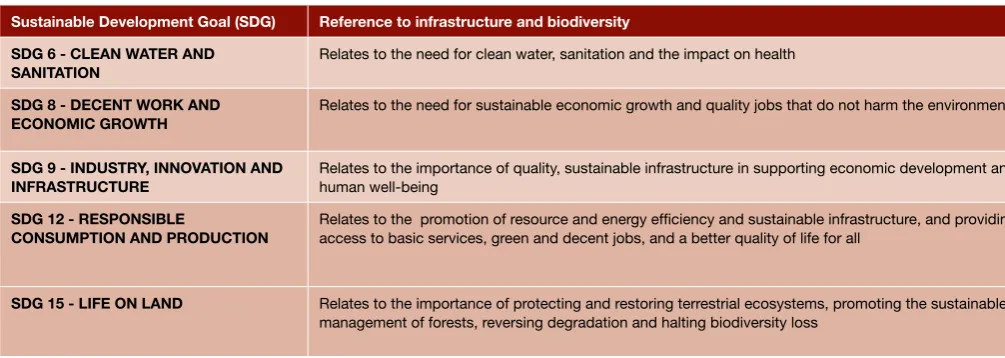
Figure 1 summarises the three SDGs that explicitly mention infrastructure as well as the two SDGs that refer to biodiver-sity. All 17 SDGs are inter-related, an improvement in one will impact on the others. For example, sustainable infra-structure (SDG 9) will support all of the SDGs, but SDG 6, 8, 12 and 15 in particular.
Although ‘responsible investment is particularly compatible with infrastructure investing because of the long-term nature of this asset class and its focus on essential services’ (PRI, 2018), infrastructure developments also have the potential to cause significant negative impacts on biodiversity. For those investors who have outlined approaches to RI and are using, or considering using, the SDGs as a framework, the impact on biodiversity needs careful consideration.
Strong Infrastructure Demand
The unmet demand for infrastructure represents an opportunity for investors to contribute to sustainable development whilst generating a return on investment. It is estimated that to meet the ambitions of the UN SDGs and the Paris Agreement, US$90 trillion in infrastructure invest-ment will be needed (Global Commission, 2016). US$6.9 trillion a year is required up to 2030 to meet climate and development objectives, however current spending on infra-structure is only around US$3.4-4.4 trillion a year (OECD, 2018). Chronic underinvestment has opened up an ‘infra-structure gap’ in both developed and developing econo-mies, hindering economic development and supressing GDP growth rates. However, recent GDP growth rates in Africa are starting to close this gap. Sub-Saharan Africa’s GDP has increased by more than four times since the begin-ning of the century, from US$392 billion in 2000 to US$1.67 trillion (US) in 2017 (World Bank, 2019) and Africa’s annual investment in infrastructure has doubled to around $80 bil-lion a year (Brookings, 2019, p.80).
FIGURE 1
SDGs that Reference Infrastructure and Biodiversity
Sustainable Development Goal (SDG) Reference to infrastructure and biodiversity
SDG 6 - CLEAN WATER AND SANITATION
Relates to the need for clean water, sanitation and the impact on health
SDG 8 - DECENT WORK AND ECONOMIC GROWTH
Relates to the need for sustainable economic growth and quality jobs that do not harm the environment
SDG 9 - INDUSTRY, INNOVATION AND INFRASTRUCTURE
Relates to the importance of quality, sustainable infrastructure in supporting economic development and human well-being
SDG 12 - RESPONSIBLE
CONSUMPTION AND PRODUCTION
Relates to the promotion of resource and energy efficiency and sustainable infrastructure, and providing access to basic services, green and decent jobs, and a better quality of life for all
As the planet’s population and consumption levels grow, the demand for resources is ever increasing. To meet these demands, people and industries are expanding farther and farther into locations that were once remote. Companies are intensifying their prospecting in previously unexplored areas, many of which are protected or have high conserva-tion value (McNeely, 2005). At least 25 million kilometres of new roads are expected worldwide by 2050 (Dulac, 2013)— enough to circle the Earth over 600 times—and 90% of these are in developing nations, including many regions that deliver vital ecosystem services and harbour excep-tional biodiversity.
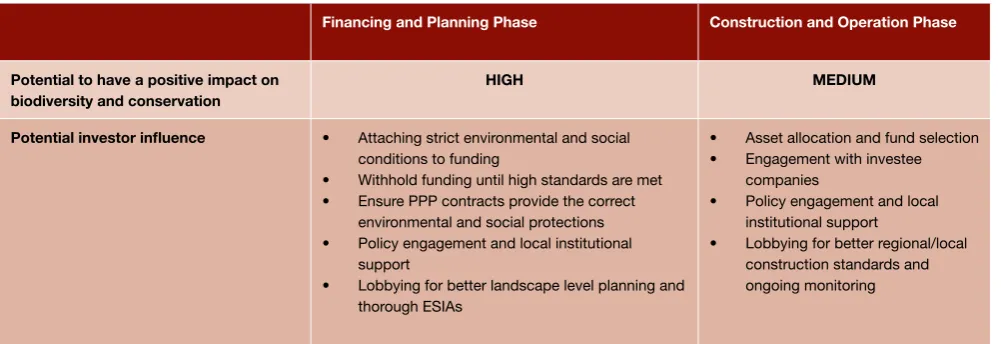
Figure 2 outlines some of the potential routes institutional investors’ capital can be involved in infrastructure projects in developing markets (Inderst and Stewart, 2014) and areas of high biodiversity value. As an example, Public Private Partnership (PPP) contracts between governments and private firms have grown in popularity as a way to attract the private capital needed to initiate infrastructure projects in emerging economies. PPPs have been common place in the OECD (Organization for Economic Cooperation and Development) economies since the 2000s, and have been used more recently by developing economies.
Designing and implementing a successful PPP is challeng-ing. PPP agreements may have potentially serious implica-tions for biodiversity and local communities. The structure of the PPP should be balanced so that risks and rewards, as well as rights and responsibilities, are shared fairly and equitably between the private partner and the contracting authority. Governments and investors should also ensure the contract provides the correct environmental and social protections for the local context.
The Role of Investors in Conservation
Most of the negative impacts on biodiversity occur during the construction phase. Infrastructure investors are able to make the greatest impact on conservation and biodiversity during the early planning stages, during the environmental
and social impact assessment (ESIA) and at the point that the infrastructure location or route is selected.
Traditionally, asset owners have invested later in the project cycle, either during construction or operation, so have not had an influence during the crucial planning phase. However, innovations in finance and investment are start-ing to encourage private capital to fill this ‘infrastructure gap’. This will enable investors to have a much greater influence on conservation (see Figure 2).
Therefore, investors who become involved in infrastructure projects during this early planning phase should use their leverage to protect biodiversity, by attaching strict environ-mental and social conditions to funding or even withhold-ing fundwithhold-ing until high standards are met. In Section 3 we outline the good practice that investors should expect, including what makes a good ESIA.
FIGURE 2
Infrastructure Project Phases and Investor Involvement
Financing and Planning Phase Construction and Operation Phase
Potential to have a positive impact on biodiversity and conservation
HIGH MEDIUM
Potential investor influence • Attaching strict environmental and social conditions to funding
• Withhold funding until high standards are met • Ensure PPP contracts provide the correct
environmental and social protections • Policy engagement and local institutional
support
• Lobbying for better landscape level planning and thorough ESIAs
• Asset allocation and fund selection • Engagement with investee
companies
• Policy engagement and local institutional support
• Lobbying for better regional/local construction standards and ongoing monitoring
SECTION 1: KEY MESSAGES
Infrastructure investments in emerging economies are an opportunity to contribute to the UN’s SDGs.. Stakeholders in infrastructure projects are able to make the greatest positive impact on conservation, biodiversity, and local communities during project financing and planning stages.
Section 2: Biodiversity Protection
This section summarises the international agreements that protect biodiversity, threatened species and their habitats. We also illustrate how an understanding of species behaviour is needed to predict the direct and indirect impacts of infrastructure projects on that spe-cies, focussing on apes as a key example.
Protection of Biodiversity
Global attention to climate change and environmental issues, including biodiversity, is on the rise. Politicians, sav-ers and civil society are all important stakeholdsav-ers in the financial system. They are pressing companies and institu-tional investors to exceed minimum expected standards and introduce better practice, to behave in a way that both reduces impact on the environment and restores and regen-erates the natural world. These pressures are only likely to increase.
The enormous growth in infrastructure, anticipated over the coming decades, has the potential to dramatically and irreparably damage biodiversity and put species at risk of extinction, unless the impact of projects is carefully managed. Protecting biodiversity and maintaining the eco-system services that we rely on is important to the future economy. Without these ecosystem services we will strug-gle to provide food, water, soft commodities, shelter, medi-cines and climate change mitigation for the world’s growing population. Failure of key environmental services can have significant economic costs, which need to be incorporated into national economic plans.
The Convention on Biological Diversity (CBD) is a multi-lateral treaty signed by 168 nations. The Convention has set out a vision that ‘by 2050, biodiversity is valued, conserved, restored and wisely used, maintaining ecosystem services, sustaining a healthy planet and delivering benefits essential for all people’ (CBD, 2010). In cases where there is a signifi-cant threat of biodiversity loss, the CBD refers to the 'pre-cautionary approach', which says that a lack of full scientific certainty should not be used as a reason for postponing measures to avoid or minimise such a threat.
Critical to achieving the objectives of the CBD and the SDGs is the management of protected species' habitats, the defi-nitions of which are described in the following section.
Protection of Species
The International Union for Conservation of Nature (IUCN) Species Survival Commission assesses the conser-vation status of each species. All great apes and most gib-bons are classified on the IUCN Red List as endangered or critically endangered. There are a few examples of gibbons that are classified as vulnerable.
Vulnerable species are at high risk of extinction, with less than 10,000 individuals in the wild and/or more than 50% of the population lost over the past 10 years or 3 generations e.g. the eastern hoolock (Hoolockleuconedys).
Endangered species are at very high risk of extinction, with less than 2,500 individuals in the wild and/or more than 50% of the population lost over the past 10 years or 3 generations e.g. bonobos, chimpanzees, western hoolock (Hoolock hoolock).
Critically endangered species are at extremely high risk of extinction, with less than 250 individuals in the wild and/or more than 80% of the population lost over the past 10 years or 3 generations e.g. gorillas, orang utans and all Nomascus gibbons.
The Convention on International Trade in Endangered Species of Wild Fauna and Flora (CITES) includes lists of species afforded different levels or types of protection from overexploitation. As all non-human ape species are threat-ened with extinction, CITES prohibits international trade in specimens of these species, with some exceptions, such as for scientific research.
Protection of Habitats
A protected area is a clearly defined geographical space, recognised, dedicated and managed, through legal or other effective means, to achieve the long-term conservation of nature with associated ecosystem services and cultural val-ues (IUCN, 2013). A critical habitat is an area of high biodi-versity. It has significant importance to critically endangered, endemic or restricted range species; habitat that supports globally significant concentrations of migratory or congre-gatory species; a highly threatened and unique ecosystem; or an area associated with critical evolutionary processes (IFC, 2012).
The IUCN helps countries and communities designate and manage systems of protected areas on land and in the oceans.
• IUCN categories I-IV cover Strict Nature Reserves, Wilderness Areas, National Parks and Habitat/Species Management Areas, which protect species under threat and maintain and restore habitats.
• Key Biodiversity Areas (KBAs) are currently identified using the Global Standard for the Identification of Key Biodiversity Areas set out by the IUCN in 2016. They are 'sites that contribute significantly to the global persis-tence of biodiversity'; to date, more than 18,000 KBAs have been identified worldwide.
The United Nations Educational, Scientific and Cultural Organisation (UNESCO) also designates areas that are legally protected under international treaties, such as the Geneva Convention.
Direct Impacts
Deforestation associated with the construction of infrastruc-ture contributes to the loss and fragmentation of ape habitats. This reduces the area that apes have available for food and shelter which leads to malnutrition, illness and reduced reproductive success, resulting in declining ape populations. Compressing apes into smaller areas also changes their behaviour as competition for food and resources increases stress and conflict. The construction phase of a project can be particularly stressful for apes, and temporarily reduce ape ranges, as they keep away from loud noise and vibrations.
Over 10% of ape range was lost between 2000 and 2014, with deforestation rates in Asia being much higher than for Africa (21% compared to 4%). The habitats of some species have been disproportionately affected, for example, the Cross River gorilla of Nigeria has lost 60% of their habitat (Junker et al., 2012). Of the remaining forests where apes and other primates are found, 65% are fragments smaller than 1 km2, which are insufficient to support apes (Harcourt and Doherty, 2005).
All apes require a level of tree cover in order to move around their territories. Those apes that are entirely arboreal, mean-ing that they spend all of their time in trees, require a continuous canopy for movement. These apes, including all gibbon species, are therefore particularly affected by linear infrastructure, such as roads, which break the forest canopy, permanently separating and isolating populations. Power transmission cables also present a threat, as apes cannot distinguish between branches and man-made cables. Apes that use these cables to move around are at risk of serious injury and death from electrocution.
Those apes that can move around on the ground (partially arboreal) are particularly vulnerable to road traffic accidents. The density of roads, width, design, and traffic intensity will affect the severity of impact. All species are reluctant to cross large, open spaces and no non-human ape is capable of swimming. Therefore, large areas of deforestation or bod-ies of water, such as hydropower dam reservoirs or wide drains create significant barriers to movement and can result in drowning.
Indirect and Secondary Impacts
The direct impacts described above are related to the foot-print of the infrastructure itself. Indirect or secondary impacts of infrastructure are related to humans moving into once remote areas and encroaching on ape habitats. These indirect impacts are often much greater than direct impacts.
Forest loss is highly contagious. Once infrastructure brings people into an area to live and work, additional deforestation should be expected. For example, satellite data has been used in Aceh, Sumatra to show that deforestation increased six-fold, in a zone 5 to 10 km away from a road improvement project (Global Forest Watch, n.d). A range of economic activities contributes to deforestation, including to small-UNESCO Man and Biosphere Reserves are any of the 686
sites (as of December 2018) around the world that are inter-nationally recognised for the simultaneous conservation and sustainable use of their ecosystems. This programme aims to establish a scientific basis for improving the relationship between people and their environments and promote inno-vative approaches to economic development that are socially and culturally appropriate and environmentally sus-tainable.
Focus on Apes
Apes are indicator species for the broader health of the biodiverse, tropical forests they inhabit. As all apes are endangered or critically endangered, it is illegal to kill, cap-ture or harm them. By protecting apes, we are also taking the necessary steps to protect the multitude of other species, which are found in these forest ecosystems. Forests are particularly important because of the ecosystem services they provide, such as mitigating climate change through their storage of carbon. The loss of ape populations damages the health of these ecosystems and the extent and nature of this impact is uncertain.
Predicting the impact of infrastructure on any species requires an understanding of all aspects of that species’ behaviour, throughout the year’s seasons. The following section describes the type of knowledge that is needed, using apes as an example. Incorporating these considera-tions into project design is an important part of early stage planning critical to minimising impacts on biodiversity.
The great apes of Africa are comprised of bonobos, chim-panzees and gorillas, whereas Asia is home to orangutans and gibbons (small apes). Ape habitat is predominantly lowland tropical forest, although chimpanzees, gorillas and orangutans can also live at higher elevations and chimpan-zees and bonobos can also be found in savannah-woodland mosaic landscapes. All species require a large area of forest for their survival, either as large intact forest blocks or having reliable connectivity between smaller isolated blocks. They are dependent on large areas to source sufficient quantity and quality of food, nest and reproduce.
scale subsistence agriculture, livestock grazing, logging for firewood or charcoal and artisanal mining.
Direct contact between ape and human populations presents a threat of injury, illness and death, particularly to apes but also to humans. The genetic similarity between apes and humans means that infectious disease can be spread between species causing illness and death. In addi-tion, conflict can arise from apes raiding crops. People living near forests also frequently hunt apes for food (wildmeat) and capture them for live animal trade. Hunting is the sec-ond largest threat to apes, after deforestation.
A compounding factor is that ape populations take a long time to recover from losses, because their reproductive rates are slow. Births are widely spaced, occurring every 4-7 years in African apes, every 6-8 years in Bornean orangu-tans and every 9 years in Sumatran oranguorangu-tans. These birth rates are slowed further if apes are not in good health. In addition, ape populations can only increase at slow rates because a mother usually gives birth to a single offspring.
Protection of Indigenous People
Impacts on apes and indigenous peoples often occur together. The UN Declaration on the Rights of Indigenous Peoples (2007) affirms the right of potentially impacted peoples to give or withhold their free, prior and informed consent (FPIC) to proposed actions that may affect the lands they customarily own, occupy or otherwise use. A state must seek the consent of indigenous peoples as a precondition to allowing or engaging in activities that could significantly affect the communities’ substantive rights.
More complex dilemmas can arise when the interests of humans and those of apes appear in conflict. In the case of the Chad Cameroon pipeline project, rerouting linear infrastructure to avoid ape habitat would have meant reset-tlement of communities that occupy the area of the new routing. Technology allows us to compare multiple routing options and identify those that avoid impacts to humans and apes.
overruns (Morris and Hough, 1987). Causes of such delays can include poor quality ESIAs or lack of baseline informa-tion of sufficient detail. If ESIAs do not meet the required standard then they can be rejected and delay the construc-tion phase until the ESIA is improved and approved.
Infrastructure projects located in protected areas and critical habitats often require additional permits, complex biodiver-sity management plans and offsetting measures. Therefore, there is a financial risk if the associated costs are underesti-mated in project budgets. If the correct permits are not secured or legislation that projects biodiversity is violated, this may result in fines and other penalties, including the possibility of licences being revoked (CDC, 2018).
SECTION 2: KEY MESSAGES
At a minimum, investors should not directly or indi-rectly invest in or finance projects that impact endangered species (IUCN Red List - endangered or critically endangered) or critical habitats as defined by the IUCN and UNESCO.
Indirect or secondary impacts can be greater than direct impacts.
Protection of biodiversity is often aligned with the rights of indigenous people. Investors should ensure that potentially impacted peoples have giv-en their FPIC.
Section 3: Identifying Investor Risks
This section outlines the financial and reputational risks to investors of infrastructure projects that impact biodiversity and the good practice that should be followed to mitigate these risks.
Financial Risk
Due to the size of some infrastructure projects, financial commitments can be significant. Risks associated with this capital investment are often related to poor planning leading to delays, unforeseen costs or fines. This type of risk is par-ticularly relevant to companies involved in the construction of infrastructure projects in developing countries. This will include lead contractors, sub-contractors and suppliers, as well as groups providing or facilitating finance.
Infrastructure projects commonly experience delays and go over budget: 63% of 1,778 projects funded by the World Bank between 1974 and 1988 experienced significant cost
CASE STUDY: FINANCIAL RISK
Significant delays and cost over-runs on the
Bakun Dam, in Sarawak, Malaysian Borneo
The Bakun Dam was expected to cost US$564 mil-lion, but research from the National University of Singapore puts the final cost at 6 times the original estimate. Construction also took almost twice as long as expected; it began in 1994, was due to be operational in 2003, but was not completed until 2011.
CASE STUDY: FINANCIAL RISK
Lack of appropriate environmental planning
threatens gorillas, chimpanzees and local
populations in Nigeria and causes years of
delays to the Cross River Superhighway
A 260 km long, 6-lane highway was planned to pass through the Cross River National Park in Nigeria, cut-ting off critical corridors that connect gorilla and chimpanzee habitat areas. There were also plans to deforest a 20 km wide corridor along the highway, sell the trees for timber, and convert the land to palm oil plantations.
Preparation for construction started for the Cross River Superhighway before the ESIA had been final-ised. In 2016, the government published a notice of revocation of rights of occupancy and, despite opposition, seized a land area of 5,200 km2, displac-ing 185 communities. Once communities had been removed, a number of bulldozers started clearing and felling trees along the proposed route.
CASE STUDY: MITIGATING
REPUTATIONAL RISK
Investor engagement led to Wilmar
intro-ducing a policy of ‘no deforestation, no
peat, no exploitation’
Wilmar International is Asia’s largest agribusiness and controls 45% of global palm oil trade. Wilmar was found to be the least sustainable of 500 compa-nies ranked by Newsweek in 2012. This was, in part, due to its reputation for clearing hundreds of thou-sands of acres of forest across Indonesia and Malaysia, home to orangutans and gibbons. In 2012 Kellogg’s launched a joint venture with Wilmar. During a quarterly earnings phone call, one investor in Kellogg’s questioned why they had made the alliance and pointed out the threat it posed to their brand values. This highlighted the issue to Kellogg’s CEO and all of their investors.
A few months later Wilmar launched its ‘no defor-estation, no peat, no exploitation’ policy, which took them from a laggard in sustainability to having a leading industry policy. Because of Wilmar’s large size, this policy had positive knock-on effects, rais-ing standards in their supply chain and with com-petitors. It gave Wilmar a strong incentive to per-suade governments to regulate the industry, to make sure that their competitors cannot undermine their business by continuing to engage in deforestation. The influence of Wilmar’s policy even spread to Africa, where the Liberian government now requires any such commodity company to adhere to Wilmar’s policy.
However, despite these policy changes, Greenpeace has gathered evidence that unsustainable palm oil continues to be used by Kellogg's and 'exposes the total failure of Wilmar International... to break its links to rainforest destruction' (Greenpeace, 2018). This demonstrates that changing policies are not enough to guarantee that sustainable practices are imple-mented. Investors should continue to engage with companies to raise standards where there are gaps between sustainability policies and practices.
SECTION 3: KEY MESSAGES
As institutional investors increasingly embrace responsible investment and some utilise the SDGs as a framework for engagement and investment policy, the reputational and financial risks of not recognising the potential impact of investments on biodiversity and local communities increases. Risks associated with capital investment are often related to poor planning leading to delays, unfore-seen costs or fines.
Investor engagement with large companies can have a systemic impact, improving standards of whole industries and countries.
Reputational Risk
In cases where a project has negative impacts on particular vulnerable species or sensitive ecosystems, the images can be very emotive, especially when apes, who are our closest genetic relatives, are affected. These can become high pro-file leading to reputational damage to the companies, but also to the investors and lenders involved in such projects.
Poor planning and lack of local consultation can result in local opposition. If local communities are not consulted for their free, prior and informed consent or are not satisfied with the outcome of the consultation, the project can face strong local opposition. With the spread of digital communi-cations, local issues can quickly become global PR issues for international investors.
Where reputational risk of a company is at stake, investor engagement can have a powerful influence on company policy (State of the Apes, 2016).
CASE STUDY: REPUTATIONAL AND
FINANCIAL RISK
The impact of dam building on local
com-munities in Malaysian Borneo
The indigenous people of the Baram River, in Sarawak state, Malaysian Borneo, depend on healthy rivers and forests for their livelihoods. Since the 1980s, when agriculture and forestry started to change the landscape, the people of Baram have resisted deforestation, through protests and block-ades.
In 2006, the federal government of Malaysia embarked on a programme of dam building. In order to make way for the Bakun and Murum dams, a total of 11,500 people were relocated, severely impacting their quality of life. Communities no longer have access to forests and pollution from the dams has decimated fish stocks. The land that people were relocated to was much smaller than promised, with large portions of it being infertile or threatened by logging from palm oil and timber companies. Construction of the Baram Dam, by the state owned Sarawak Energy Berhad (SEB), was met with exten-sive community resistance from indigenous commu-nities. The Native Customary Rights (NCR) of indig-enous groups over their ancestral land are enshrined in the Sarawak Land Code and protected under the Malaysian Constitution (Colchester et al, 2007). After several years of resistance the state government legally withdrew its claim over the land.
Section 4: Mitigation of Risks and
Good Practice Principles
This section suggests how investors can mitigate risk by co-investing with organisations that have high standards in upstream planning processes and follow the good practise principles described.
Co-investing Alongside Institutions with
High Standards
It is important that investors assess the standards of the institutions that they invest alongside, to ensure that biodi-versity is protected. The robustness of environmental and social standards attached to financing and the level of pro-ject diligence varies greatly, depending on the group of financial institutions involved. The standards of the project proponents who are leading the project's development are particularly important, as they are responsible for complet-ing the ESIA.
Private investors in infrastructure typically co-invest along-side governments and development finance institutions (DFIs) such as multilateral development banks (MDBs), emerging-market development banks, bilateral aid agen-cies, as well as private companies. Generally, traditional MDBs were established with high environmental standards. They have developed expertise and rigorous processes in dealing with complex infrastructure projects. The World Bank, and other traditional MDBs such as the European Bank for Reconstruction and Development (EBRD) and Inter-American Development Bank (IDB), adopted ‘environ-mental and social safeguards’ in the 1980s. This made it more difficult for national governments to borrow for projects that were likely to harm the environment. MDBs often co-finance projects and this has led to the standards of MDBs becoming aligned over time.
In recent years, emerging-market development banks, such as the Asian Infrastructure Investment Bank (AIIB), Brazilian Development Bank, China Development Bank, Development Bank of Southern Africa and New Development Bank, have increasingly replaced the traditional MDBs. These banks are less concerned about environmental and social considera-tions and less susceptible to pressure from NGOs. This has made it easier for governments to obtain funds for contro-versial projects and contributed to a lowering of standards overall as traditional MDBs try to compete..
Standards across MDBs are therefore changing and need to be monitored by institutional investors. Some commenta-tors consider that the World Bank has started to weaken its policies, some believe this is so that they can stay competi-tive with the emerging-market development banks (BIC, 2016). The World Bank’s updated Environmental and Social Framework has been criticised as a serious dilution of previ-ous policy (The World Bank, 2018). Their existing safeguards on forests and natural habitats have been collapsed into one standard that fails to consider or protect environmental
val-ues other than biodiversity, and introduces the possibility of offsets in critical habitats. This has resulted in the Bank having given a green light to industrial logging and other projects in protected forests. At the same time, it has stripped away protections and rights from forest communi-ties, leaving them and the forests they depend upon highly vulnerable (Sinani, 2017).
The following section outlines the standards and practices that investors and co-investors should adhere to in their policies. However, it is important to appreciate that no standards, no matter how comprehensive, can be fully prescriptive because so much depends on the local context of the project. Therefore, we also provide additional guid-ance, at the end of this section, on how ESIAs should be planned to avoid some of the common pitfalls.
International Finance Corporation (IFC)
Performance Standards
The IFC is an international financial institution that is a mem-ber of the World Bank Group. They offer investment, advi-sory and asset management services to encourage private-sector development in developing countries. The IFC’s eight Performance Standards define their clients’ responsibilities for managing environmental and social risks, which should be applied to project locations in critical habitats. All of the African and Asian countries containing ape habitats are expected to comply with the IFC Performance Standards.
Performance Standard 6 relates to biodiversity. It specifies that the client should avoid negative impacts on biodiversity and ecosystem services and should also retain external experts with appropriate regional experience. Experts should assist in the development of a mitigation hierarchy and verify the implementation of those measures for those projects that are suitable to proceed.
The Equator Principles (EPs)
The Equator Principles risk management framework draws heavily on the IFC Performance Standards (EP, n.d.). It pro-vides banks with a structured approach for determining, assessing and managing environmental and social risk in development projects and supports responsible risk deci-sion-making. As of 2016, the Equators Principles Financial Institutions (EPFIs) represented more than 70% of interna-tional project finance debt in emerging markets (BankTrack, 2018). The requirements of the EPs are summarised below.
The EPs also require engagement with affected communi-ties, through an informed consultation and participation process, which should be tailored to the local risks and lan-guage and free from intimidation. Projects with adverse impacts on indigenous people will require their free, prior and informed consen. Affected communities should also be informed about the process to communicate and resolve concerns and grievances about the project’s environmental and social impact (required by the IFC Performance Standards).
An Independent Environmental and Social Consultant is required to assess compliance with the EPs where projects have high risk impacts on indigenous peoples, critical habi-tat, cultural heritage or require large scale resettling. This consultant is expected to stay involved, with on-going moni-toring and reporting.
Investing in Companies with High
Standards
Infrastructure projects that impact endangered species require an ESIA under the IFC and Equator Principles. Whilst investors are not responsible for producing these assess-ments, they need to ensure that the correct standards of due diligence are being applied. The following section describes best practice for ESIAs.
Direct and indirect impacts: ESIAs should assess both direct and indirect impacts of infrastructure projects not only at the geographical location of the project itself but also across the wider landscape. These assessments should use the mitigation hierarchy to avoid, minimise, restore and offset these impacts (described in the next section). These mitiga-tion measures should be described in a Biodiversity Acmitiga-tion Plan (BAP).
Sufficient time: When done properly, an ESIA allows suffi-cient timeto complete comprehensive baseline assessments to collect observations about species behaviour. At least 12 months of data collection is needed in order to document seasonal observations.
Information and data: The ESIA should be informed by all relevant existing information and data. Geospatial data should be gathered using available satellite imagery available from the A.P.E.S. portal, Digital Observatory for Protected Areas, Integrated Biodiversity Assessment Tool and Global Forest Watch. Any new data gathered, such as the baseline assessment and monitoring data, should be made public to assist with other projects.
Local collaboration: Assessments should be conducted in collaboration with all relevant stakeholders. Relevant exper-tise in ecological services should be brought in. Local and international conservation NGOs, academic institutions and state agencies often have local specialist knowledge and inclusion of their valuable knowledge can bring credibility to the project. Meaningful and effective inclusion of indigenous forest communities in development planning is also impor-tant, although disappointingly rare.
Strategic policy approach: Strategic, landscape level ESIAs are needed in addition to project level ESIAs to assess cumu-lative impacts. These require a high degree of collaboration across projects, which are often run by multiple organisa-tions in the private and public sector. MDBs should offer technical support to governments to enable long-term sys-tem level planning, which will in turn boost investor confi-dence and attract more capital.
Mitigation Hierarchy
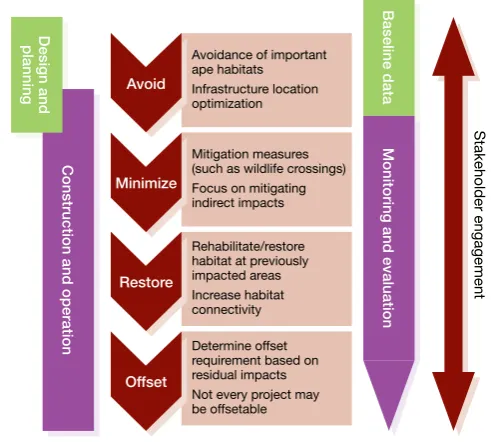
The mitigation hierarchy provides a framework for best or better practice approach to managing biodiversity risk (Quintero et al., 2010). These fall into four categories: avoid, minimise, restore and offset.
Avoid
Avoidance is most effective when applied as early in the development process as possible. This approach will require data collection, analysis and mapping to allow selection of the optimal location for infrastructure that avoids critical habitats. The area of forest affected should be kept to a minimum. For example, road projects should be carefully planned to reduce their number, length and width, therefore minimising the related destruction. It might even be possible to avoid the building of access roads. For example, in Kalimantan, Borneo, a gold exploration company uses heli-copters instead of roads to transport materials and person-nel, thereby reducing deforestation (White and Fa, 2014). It should be noted that avoidance of one risk may create new risks, which also need to be addressed using the mitigation hierarchy.
FIGURE 3
The Mitigation Hierarchy Applied to Infrastructure
Projects within Ape Habitats
Source: © TBC, 2017
Avoidance of important ape habitats
Infrastructure location optimization
Mitigation measures (such as wildlife crossings) Focus on mitigating indirect impacts
Rehabilitate/restore habitat at previously impacted areas Increase habitat connectivity
Determine offset requirement based on residual impacts Not every project may be offsetable
Construction and operation
Design and
planning
Baseline data
Monitoring and evaluation
Avoid
Minimize
Restore
Offset
Stakeholder engagement
Minimise
Avoidance and minimisation of biodiversity impacts should be prioritised in the ESIA as it is more effective than restora-tion and offsets. Direct impacts can be avoided in different ways depending on the type of infrastructure.
Industrial activities - Appropriate buffer zones should be established to keep a safe distance from core ape habitat areas and locations with high densities of fruiting trees, par-ticularly where industrial activities are within protected areas.
Road projects - To reduce the risk of collisions between apes and vehicles, wildlife crossings and canopy bridges should be constructed and paired with speed bumps and precautionary signage. Advanced computer modelling can be used to optimise the location of such road crossings, as was demonstrated for the Dawai road link (Tang and Kelly, 2016). Crossings should also be maintained and patrolled to prevent poaching.
Power transmission – Power lines and transformers should be insulated to prevent electrocution and canopy bridges can again be used to provide apes with safe passage.
Indirect or secondary impacts can also be avoided in the fol-lowing ways:
Hunting should be minimised by providing basic food pro-visions for workers. Tight controls that ban the hunting, sale or possession of live animals or wild meat from endangered species should be enforced at road checkpoints and site access points.
Providing sanitation facilities and waste management can help control the spread of disease.
Environmental education, social and behaviour change programmes are useful in raising awareness and creating positive action amongst local communities.
Remote monitoring is incredibly powerful in collecting real time data. The Global Forest Watch mobile app can be used to monitor deforestation in ape habitats, this satellite data is freely available for most ape ranges and is updated weekly.
Gibbons rarely come to the ground, so the construction of a road dissects their habitat. © Markl Ancrenaz/HUTAN-Kinabatangan Orang-utan Conservation Project.
CASE STUDY: POOR OUTCOME
Upstream planning is not enough to ensure
mitigation measures are implemented
The Pro-Routes project is a major road rehabilitation undertaken in the Democratic Republic of Congo. The project triggered the World Bank’s strictest envi-ronmental safeguards due to its proximity to a critical chimpanzee conservation area, known as Bili–Uélé Protected Area Complex (BUPAC). BUPAC harbours an estimated 20,000 endangered eastern chimpan-zees, which are under threat from hunting and poaching.
Restore
Once construction activities are completed, impacts that cannot be avoided or minimised should be restored following decommissioning of the project. This should include disman-tling or removal of all temporary infrastructure and unneces-sary human access should be restricted. Native vegetation should be re-established on degraded and deforested land, especially to restore migration corridors that can reconnect ape habitat that had been fragmented.
Offset
Conservation of offset areas, that are sited away from a pro-ject's location, are used to compensate for all social and environmental damage that could not be avoided or fully rehabilitated, repaired or restored. The ultimate goal should be a net increase or at least no net loss of biodiversity. Offsets should be seen as a last resort and in some cases are not considered possible. IFC Guidance Note 6 states that most project related impacts in Tier 1 critical habitat for critically endangered or endangered species are not considered ‘off-setable’.
Engaging with experts is particularly important to make sure suitable offset locations are selected. Larger, aggregate off-set sites are more appropriate for apes than smaller, discon-nected sites. Therefore collaboration between projects to consolidate the offset is considered best practice and can be facilitated by the establishment of National Offset Strategies (Kormos et al., 2014).
Hydropower Good Practice
The Nature Conservancy has developed ‘Hydropower by Design’, which uses the same framework as the mitigation hierarchy but is adapted for dams (TNC, WWF and UoM, 2016).
• Avoid: building dams in particularly damaging sites
• Minimise: impacts by using best practices
• Restore: key processes, such as fish passage and envi-ronmental flows
• Offset: or compensate, to achieve no net loss of biodi-versity
Investors and lenders to infrastructure projects should also use the World Commission on Dams Framework, which was created with support from the World Bank and IUCN (WCD, 2000). One of their ten guidelines specifies that the project should be selected based on a basin-wide assessment of the river ecosystem and an attempt to avoid significant impacts on threatened and endangered species. A useful tool to eval-uate the sustainability profile of a dam and identify areas for improvement is the Hydropower Sustainability Assessment Protocol (IHA, 2010).
CASE STUDY: POSITIVE OUTCOME
Mitigation Hierarchy used to minimise
impact on western chimpanzees in Guinea
The Guinea Bauxite Company and the Guinea Alumina Corporation (GAC) both mine bauxite, gold and iron ores in the Republic of Guinea, West Africa. The bauxite reserves overlap with the habitats of the critically endangered western chimpanzee. These neighbouring companies are working together to establish international best practice standards and address cumulative impacts, using the mitigation hierarchy. Mitigation measures, which were devel-oped to minimise both direct and indirect impacts, are outlined in each companies’ Biodiversity Action Plan.
Avoid: Both companies are considering setting aside a portion of their concession to avoid sensitive chimpanzee habitat. Also, by sharing a railway to transport ore 140 km to the seaport for export, they reduce their impact.
Restore: GAC established a nursery for native tree species, used by chimpanzees for feeding and nest-ing, which will be used to rehabilitate degraded areas impacted by operations or cleared by the local popu-lation.
Offsets: Despite the above measures, preliminary assessments show that both companies will have residual impacts on chimpanzees and therefore off-sets will be required. GAC has supported a nation-wide survey of chimpanzee habitat to identify the most appropriate offset sites.
SECTION 4: KEY MESSAGES
Utilising existing international standards, such as the Equator Principles, IFC Performance Standards and the mitigation hierarchy, should be seen as a minimum requirement.
Avoiding harm should be prioritised, whereas off-sets should be seen as the last resort.
Section 5: Recommendations for
Banks, Investors and Savers
This section proposes biodiversity policies for banks and insti-tutional investors involved in infrastructure projects. We also recommend questions that institutional investors should use when engaging with operators of infrastructure assets.
INVESTOR ENGAGEMENT
The following questions are intended to assist inves-tors’ engagement, by either asset owners or asset managers, with companies that manage the infra-structure assets. They are based on the biodiversity sections of CDC’s Environmental and Social Checklist (CDC, 2015) and the GRESB Infrastructure assessment (GRESB, 2017) and are relevant through several phases of the project: planning, design, monitoring and operation.
Policy:
• Does the lead contractor have a policy or policies on biodiversity, habitat protection and addressing social impacts?
• How are these policies independently monitored and progress verified?
• Are policies on specific projects aligned with national or international lobbying by investee companies?
Risk assessment:
• Does or could the asset (directly or indirectly) adversely impact endangered or critically endangered species, indigenous communities and/or legally protected and/or internationally recognised areas?
• Has the asset/operator been targeted by NGO programmes or campaigns in relation to biodi-versity? How have they responded?
Project planning and design:
• What is the operator doing to prevent or mini-mise impacts on biodiversity?
• Has the ESIA been independently reviewed and is it current?
• Is there a Biodiversity Management Plan (BMP) or Biodiversity Action Plan (BAP)? Does it utilise the mitigation hierarchy to deliver net biodiversity gain?
• Have experts been consulted or specialist consultants been hired when appropriate? • Is there a Stakeholder Engagement Plan?
Monitoring and operation:
• Has a monitoring protocol been established? • What data is collected? This may include wildlife
fatalities (annual count), habitat removal (area per annum), area of habitat enhanced/
restored, and area of habitat protected on-site and off-site.
ASSET OWNER ENGAGEMENT
The following questions are intended for Asset Owners’ engagement with their Asset Managers, to ensure that they are undertaking due diligence in relation to biodiversity. They are also suitable for individual savers to ask of their pension funds. These questions broadly draw from the PRI’s case studies of APG Asset Management (PRI, 2012a) and AMP Capital Investors (PRI, 2012b).
Policy:
• Do they have a specific policy on biodiversity and/ or the SDGs?
• Does this policy specifically refer to international benchmarks such as the IFC Performance Standards?
• Does the asset manager have any exclusions such as not investing in infrastructure within Key Biodiversity Areas or UNESCO Man and Biosphere Reserves?
• Are they a signatory to the PRI?
Process:
• How are biodiversity policies integrated into the investment process for infrastructure?
• How does the asset manager identify infrastruc-ture projects that have high biodiversity risks or impacts?
• How does the asset manager report and monitor on engagement with investee companies and finance providers to infrastructure develop-ments?
• What escalation strategy does the asset manager employ if engagement fails?
POLICIES OF BANKS AND INVESTORS
We make the following recommendations for banks and investors to adopt a biodiversity policy which:
Covers a range of industrial sectors (including energy, mining and soft commodities). We recom-mend adopting a cross-sector biodiversity policy as is often done for Human Rights (Société Générale, 2014).
Refers to international standards: the IUCN Red List of Threatened Species, CITES, IUCN categories I-IV, Key Biodiversity Areas, the Equator Principles, The IPC Performance Standards, the Mitigation Hierarchy and the World Commission on Dams.
Introduces internal processes for assessing co-investors to deliver infrastructure projects that minimise environmental and social impacts.
Abbreviations and Acronyms
AIIB Asian Infrastructure Investment Bank
BAP Biodiversity Action Plan
BMP Biodiversity Management Plan
BUPAC Bili–Uélé Protected Area Complex
CBD Convention on Biological Diversity
CITES Convention on International Trade in Endangered Species of Wild Fauna and Flora
DFI development finance institutions
EBRD European Bank for Reconbstruction and Development
EPs Equator Principles
EPFIs Equator Principles Financial Institutions
ESIA environmental and social impact assessment
FPIC free, prior and informed consent
GAC Guinea Alumina Corporation
IDB Inter-American Development Bank
IFC International Finance Corporation
IUCN International Union for Conservation of Nature
KBA Key Biodiversity Area(s)
MDB multilateral development bank(s)
NGO non-governmental organisations(s)
SDGs United Nations Sustainable Development Goals
UN United Nations
UNESCO United Nations Educational, Scientific and Cultural Organisation
References
Allianz, 2018. Allianz Group Sustainability Report 2017. Available at: https://www.allianz.com/content/dam/onemarketing/ azcom/Allianz_com/sustainability/documents/Allianz_Group_ Sustainability_Report_2017-web.pdf [Accessed: 15 March 2019].
APG, 2018. Responsible investment & Stewardship policy. Available at: https://www.apg.nl/pdfs/APG%20 Responsible%20Investment%20-%20Stewardship%20 Policy%20FINAL_ENG.pdf [Accessed: 15 March 2019]. Arcus Foundation, 2018. State of the Apes; Infrastructure
Development and Ape Conservation, ed. Arcus Foundation. Cambridge, UK: Cambridge University Press. Available at: htt- ps://www.stateoftheapes.com/volume-3-infrastructure-devel-opment/ [Accessed: 4 February 2019].
BankTrack (2018). The Equator Principles Track and Chase Project. Nijmegen, Netherlands: BankTrack. Available at: https://www. banktrack.org/show/pages/equator_principles.
BIC (2016). World Bank’s Updated Safeguards a Missed
Opportunity to Raise the Bar for Development Policy. Banking Information Center (BIC). Available at: http://www.bankinfor- mationcenter.org/world-banks-updatedsafeguards-a-missed-opportunity-to-raise-the-bar-for-development-policy/. Brookings, 2019. Foresight Africa: Top priorities for the continent
in 2019. Available at: https://www.brookings.edu/multi-chap- ter-report/foresight-africa-top-priorities-for-the-continent-in-2019/ [Accessed: 21 March 2019].
CDC, 2015. CDC’s environmental and social checklist. Available at: https://toolkit.cdcgroup.com/reference-materials/ [Accessed: 20 March 2019].
CDC, 2018. E&S topics: Biodiversity conservation. Available at: https://toolkit.cdcgroup.com/es-topics/biodiversity-conserva-tion/ [Accessed: 15 March 2019].
Convention on Biological Diversity, 2010. Key Elements of the Strategic Plan 2011-202, including Aichi Biodiversity Targets. Available at: https://www.cbd.int/sp/elements/ [Accessed: 19 March 2019].
Dulac, J. (2013). Global Land Transport Infrastructure Requirements to 2050. Paris, France: International Energy Agency. Available at: https://www.iea.org/publications/ freepublications/publication/TransportInfrastructureInsights_ FINAL_WEB.pdf [Accessed: 3 April 2019].
Edwards, D. P., Sloan, S., Weng, L., et al. (2014). Mining and the African environment. Conservation Letters, 7, 302-11. DOI: 10.1111/conl.12076. Available at: https://onlinelibrary.wiley. com/doi/full/10.1111/conl.12076 [Accessed: 3 April 2019]. Equator Principles (n.d.). The Equator Principles. Poole, United
Kingdom: Equator Principles Association. Available at: http:// equator-principles.com/about.
Global Commission on the Economy and Climate, 2016. The Sustainable Infrastructure Imperative: Financing for Better Growth and Development. The 2016 New Climate Economy Report. Available at: http://newclimateeconomy.report/2016/ wp-content/uploads/sites/4/2014/08/NCE_2016Report.pdf [Accessed: 21 March 2019].
Global Forest Watch, n.d. Available at: https://www.globalforest-watch.org/ [Accessed: 3 April 2019].
GRESB, 2017. GRESB Infrastructure Asset Assessment. Available at: https://gresb.com/gresb-infrastructure/ [Accessed: 20 March 2019].
Greenpeace, 2018. World's biggest brands still linked to rainforest destruction in Indonesia. Available at: https://www.green- peace.org/international/press-release/18485/greenpeace-investigation-wilmar-brands-palm-oil-deforestation-indonesia/ [Accessed: 24 April 2019].
Harcourt, A. H., and Doherty, D. A. (2005). Species-area relation-ships of primates in tropical forest fragments: a global analy-sis. Journal of Applied Ecology, 42, 630-7. Available at: https:// besjournals.onlinelibrary.wiley.com/
doi/10.1111/j.1365-2664.2005.01037.x [Accessed: 3 April 2019].
IHA (2010). Hydropower Sustainability Assessment Protocol. London, UK: International Hydropower Association (IHA). Available at: http://www.hydrosustainability.org/Protocol/ Protocol.aspx.
Inderst, G. and Stewart, F. (2014). Institutional Investment in Infrastructure in Developing Countries. Available at: http://doc-uments.worldbank.org/curated/en/238121468325297049/pdf/ WPS6780.pdf [Accessed: 18 March 2019].
International Finance Corporation, 2012. Performance Standard 6: Biodiversity Conservation and Sustainable Management of Living Natural Resources. Available at: https://www.ifc.org/ wps/wcm/connect/bff0a28049a790d6b835faa8c6a8312a/ PS6_English_2012.pdf?MOD=AJPERES [Accessed: 11 March 2019].
IPE, 2017. Top 100 Global Infrastructure Investors. Available at: https://realassets.ipe.com/top-100-global-infrastructure-inves- tors/realassets.ipe.com/top-100-global-infrastructure-inves-tors/10020822.fullarticle [Accessed: 14 March 2019]. IUCN, 2013. Guidelines for Applying Protected Area Management
Categories. Available at: https://portals.iucn.org/library/sites/ library/files/documents/PAG-021.pdf [Accessed: 11 March 2019].
Kormos, R., Kormos, C.F., Humle, T., et al. (2014). Great apes and biodiversity offset projects in Africa: the case for national off-set strategies. PLoS One, 9, e111671. DOI: 10.1371/journal. pone.0111671. Available at: https://journals.plos.org/plosone/ article?id=10.1371/journal.pone.0111671. [Accessed: 3 April 2019].
McNeely, J.A. (2005). Friends for Life: New Partners in Support of Protected Areas. Gland, Switzerland and Cambridge, UK: IUCN. Available at: https://portals.iucn.org/library/node/8772 [Accessed: 11 March 2019].
Mercer, 2018. Investment in African Infrastructure: Challenges and Opportunities. Available at: https://www.mercer.com/news- room/new-mercer-research-highlights-challenges-and-oppor-tunities.html [Accessed: 14 March 2019].
Morris, P. and Hough, G. (1987). The Anatomy of Major Projects – A Study of the Reality of Project Management. John Wiley & Sons Ltd., Chichester.
OECD, 2018. Financing Climate Futures: Rethinking Infrastructure. Available at: https://read.oecd-ilibrary.org/environment/financ-ing-climate-futures_9789264308114-en#page1 [Accessed: 21 March 2019].
PRI, 2012a. Requiring ESG input into the investment decision-making process. Available at: https://www.unpri.org/infrastruc- ture/requiring-esg-input-into-the-investment-decision-making-process/135.article [Accessed: 15 March 2019].
PRI, 2012b. Developing an infrastructure ESG toolbox. Available at: https://www.unpri.org/infrastructure/developing-an-infra-structure-esg-toolbox/131.article [Accessed: 15 March 2019]. PRI, 2017. The SDG investment case. Available at: https://www.
unpri.org/sdgs/the-sdg-investment-case/303.article [Accessed: on 19 March 2019].
PRI, 2018. Primer on Responsible Investment in Infrastructure. Available at: https://www.unpri.org/infrastructure/primer-on-responsible-investment-in-infrastructure-/2700.article [Accessed: 13 March 2019].
Quintero, J.D., Roca, R., Morgan, A.J., Mathur, A. and Xiaoxin, S. (2010). Smart Green Infrastructure in Tiger Range Countries: A Multi-Level Approach. Global Tiger Initiative, GTISGI Working Group, Technical Paper. Discussion Papers. Washington DC: World Bank.
Sinani, N., 2017. World Bank’s Updated Safeguards a Missed Opportunity to Raise the Bar for Development Policy. Available at: https://www.huffpost.com/entry/world-banks-updated-safeg_b_11110340 [Accessed: 12 March 2019].
Société Générale, 2014. Cross-Sectorial Policy: Biodiversity. Available at: https://www.societegenerale.com/sites/default/ files/2018/biodiversity_cross-sectorial_policy.pdf [Accessed: 13 March 2019].
State of the Apes, 2016. Videos: Glenn Hurowitz interview. Available at: https://www.stateoftheapes.com/videos/ [Accessed: 11 March 2019].
Tang, D. and Kelly, A.S. (2016). Design Manual: Building a Sustainable Road to Dawei: Enhancing Ecosystem Services and Wildlife Connectivity. Yangon, Myanmar: World Wide Fund for Nature (WWF).
TNC, WWF and UoM (2016). Improving Hydropower Outcomes through System-Scale Planning: An Example from Myanmar. United Kingdom, Department for International Development (DFID). The Nature Conservancy (TNC), World Wide Fund for Nature (WWF) and the University of Manchester (UoM). United Nations, (2018) Sustainable Development Goals
Knowledge Platform. Available at: https://sustainabledevelop-ment.un.org/?menu=1300 [Accessed: 21 March 2019]. WCD (2000). Dams and Development: A New Framework for
Decision-making. World Commission on Dams (WCD). London, UK: Earthscan Publications. Available at: https:// www.internationalrivers.org/resources/dams-and-develop-ment-a-new-framework-for-decision-making-3939.
White, A. and Fa, J.E. (2014). The bigger picture: indirect impacts of extractive industries on apes and ape habitat. In State of the Apes: Extractive Industries and Ape Conservation, ed. Arcus Foundation. Cambridge, UK: Cambridge University Press, pp. 197–225. Wich, S. A., Gaveau, D., Abram, N., et al. (2012). Understanding the
impacts of land-use policies on a threatened species: is there a future for the Bornean orang-utan? PLoS One, 7, e49142. DOI: 10.1371/ journal.pone.0049142. Available at: https://journals.plos.org/plosone/ article?id=10.1371/journal.pone.0049142 [Accessed: 3 April 2019]. World Bank, 2018. Environmental and Social Framework. Available at:
http://www.worldbank.org/en/projects-operations/environmental-and-social-framework [Accessed: 3 April 2019].
not constitute financial or investment advice. ShareAction makes no representation regarding the advisability or suitability of investing in any particular company, investment fund or other vehicle or of using the services of any particular entity pension provider or other service provider for the provision of investment services. A decision to use the services of any pension provider, or other entity should not be made in reliance on any of the statements set forth in this publication. While every effort has been made to ensure the information in this publication is correct, ShareAction and its agents cannot guarantee its accuracy and they shall not be liable for any claims or losses of any nature in connection with information contained in this document, including (but not limited to) lost profits or punitive or consequential damages or claims in negligence. ShareAction did not assess asset owners according to financial performance or metrics. The research in this report was carried out between January and April 2018. During the period of analysis, the entities surveyed were given the opportunity to comment on or ask questions on relevant sections to make additional disclosures or to provide clarification. Any notifications of changes, information or clarifi-cation not drawn to ShareAction’s attention prior to the deadlines are not included in the report.
The opinions expressed in this publication are based on the documents specified. We encourage readers to read those documents. Online links accessed between 4 February and 8 April 2019.