LAPPEENRANTA UNIVERSITY OF TECHNOLOGY DEPARTMENT OF INFORMATION TECHNOLOGY
BAYESIAN CLASSIFICATION USING GAUSSIAN
MIXTURE MODEL AND EM ESTIMATION:
IMPLEMENTATIONS AND COMPARISONS
Information Technology Project Examiner: Professor Pekka Toivanen
Supervisors: Researcher, Dr.Tech. Joni Kämäräinen, Professor Heikki Kälviäinen Lappeenranta, June 23, 2004 Pekka Paalanen Leirikatu 2 G 10 53600 Lappeenranta Tel. 050 321 0527 [email protected] http://www.iki.fi/pq/
ABSTRACT
Lappeenranta University of Technology Department of Information Technology Pekka Paalanen
Bayesian Classification Using Gaussian Mixture Model and EM Estimation: Implementations and Comparisons
Information Technology Project 2004
35 pages, 10 figures, 1 table and 2 appendices.
Supervisors: Researcher, Dr.Tech. Joni Kämäräinen, Professor Heikki Kälviäinen
Keywords: Bayesian classification, Gaussian mixture, overfitting, expectation maximiza-tion, maximum likelihood, gmmbayes toolbox
The main purpose of this project was to develop a Bayesian classification toolbox with Gaussian mixture probability densities for Matlab. The toolbox has two parts: the training part estimates Gaussian mixture parameters from training samples and the classifier part classifies new samples according to the estimated parameters. Three different expectation maximization algorithms for Gaussian mixture estimation were implemented: the basic expectation maximization algorithm, an algorithm proposed by Figueiredo and Jain, and the greedy expectation maximization algorithm by Verbeek, Vlassis and Kröse.
The toolbox was tested with neighbor-bank transformed forest spectral color data, wave-forms and noise data, and letter image recognition data. The basic expectation maximiza-tion algorithm produces the best classificamaximiza-tion accuracy, but requires tuning parameters by hand and is failure prone. Figueiredo-Jain algorithm produces better accuracy than the greedy algorithm, but requires a certain number of training data before it works at all. The greedy algorithm has much lower requirement for the amount of training data.
Contents
1 INTRODUCTION 3
1.1 Background . . . 3
1.2 Objectives and Restrictions . . . 4
1.3 Structure of the Report . . . 4
2 FUNDAMENTALS 6 2.1 Classifier . . . 6
2.2 Bayesian Classification . . . 6
2.3 Gaussian Mixture Probability Density Function . . . 8
2.4 Complex Valued Features . . . 10
3 GAUSSIAN MIXTURE DENSITY ESTIMATION 12 3.1 Maximum Likelihood Estimation . . . 12
3.2 Basic EM Estimation . . . 13
3.3 Figueiredo-Jain Algorithm . . . 16
3.4 Greedy EM Algorithm . . . 17
4 GMMBAYES TOOLBOX 20 4.1 GMMBayes Matlab Toolbox Interface . . . 20
4.2 Avoiding Covariance Matrix Singularities . . . 21
4.3 Algorithm Implementation Details . . . 21
5 EXPERIMENTS 23 5.1 Forest Spectral Colors . . . 24
5.2 Waveforms and Noise . . . 28
5.3 Letter Image Recognition Data . . . 30
6 CONCLUSIONS 32
REFERENCES 34
APPENDIX 1. Derivation of the FJ Cost Function
ABBREVIATIONS AND SYMBOLS
CEM Component-wise EM algorithm
EM Expectation Maximization
FJ Figueiredo-Jain algorithm
GEM Greedy Expectation Maximization algorithm
GMM Gaussian Mixture Model
ML Maximum Likelihood
PDF Probability Density Function
SCC Sub-Cluster Classifier
c (algorithmic) component index in a mixture C number of components in a mixture
Cnz number of non-zero component weights in a mixture
D number of data dimensions
EY[·] expectation of a function withYas the random variable k (algorithmic) index of a class
K number of classes
n (algorithmic) index of a sample N number of samples
p(·) probability density function P(·) probability (mass) function
V number of parameters of a mixture distribution component x a sample, data vector
X a set of vectors
A∗ Adjoint matrix, complex conjugate matrix:A= (aij)⇔A∗ = (aji)
ℵ(·) the size of a set (cardinal number)
αc weight of thecth component in a mixture
µ mean vector of a Gaussian distribution ωk kth class
Σ (variance-)covariance matrix of a Gaussian distribution
|Σ| determinant of a covariance matrix θ full set of mixture distribution parameters
1
INTRODUCTION
1.1
Background
When something is measured a piece of data is acquired. Naturally measurements are never exact, and at least some kind of noise is always present in the data. Getting the data itself is not in the focus but the problem is to understand what does the data mean. That is, we need to classify the data. For example, if the vibration of an electric motor is measured, how can one tell from the results if the bearings have gone bad? The data is usually so vague or complex that we cannot just say ”If it is like this, then the case is that.” We need to develop a classifier that takes the data, examines it and gives a meaning to it according to experience and knowledge of the phenomena.
Classification is a very common task in information processing, and it is not generally easy. Some of the application areas are industrial quality control, object recognition from a visual image, and separating different voices from hum of voices. While these tasks might be easy for human beings they are very hard for machines. Even with the simplest cases there are noise and distortions affecting the measurement results and making the classification task nontrivial.
Classifier algorithms do not usually work well with raw data, such as a huge array of numbers representing a digital image. Data have to be preprocessed to extract few pieces of valuable information, called features. Features are represented as a feature vector where the dimension of a vector is the number of scalar components of different features. Feature extraction is very important for achieving good classification results and it is typically application specific. Usually each known sample, i.e., feature vector, is labeled to belong to a known class.
Feature vectors with class labels can be used to estimate a model describing a class, pro-vided that there are enough good samples available. Some assumptions have to be made about the structure of the estimating model because totally arbitrary models are difficult to handle. For example in the Bayesian classification it can be assumed that a class can be represented in feature space with a Gaussian probability density function (PDF). The classification of unknown samples is based on estimated class representations in a feature space. [1]
1.2
Objectives and Restrictions
The purpose of this study is to familiarize with Bayesian classifier, Gaussian mixture probability density function models, and several maximum likelihood parameter estima-tion methods. Gaussian mixture model is a weighted sum of Gaussian probability density functions which are referred to as Gaussian components of the mixture model describing a class. The goal is to implement a Bayesian classifier that can handle any feasible number of variables (data dimensions), classes and Gaussian components of a mixture model. Feature extraction is a crucial part of recognition systems, but it is not considered here. Data used in classification are assumed to come from a proper feature extraction, to be real valued, and not to have any missing values in samples. Data used in a classifier construction are assumed to contain class labels. Now training of a classifier is actually supervised learning.
The project was supposed to be started by an implemention of a simple classifier system of two classes for one-dimensional data and a single Gaussian component. The classifier system should have contained two main components: a training function and a classi-fication function, both implemented in Matlab. Additionally it may have been made to work with complex valued data. Purpose was to implement more than one expectation maximization (EM) algorithms in the training functionality.
The training methods should be evaluated by testing how well they learn artificially gen-erated and real world data. Purpose was to integrate the classification system into the facial evidence detection system [2, 3] developed by Kämäräinen et al. where it should challenge the Mahalanobis-distance-based sub-cluster classifier (SCC) method.
The director of the project is professor Heikki Kälviäinen and the project was supervised by researcher Joni Kämäräinen. The work supports research areas of Laboratory of Infor-mation Processing, Department of InforInfor-mation Technology, Lappeenranta University of Technology.
1.3
Structure of the Report
This report is organized as follows: In Section 2 the classifier overfitting scenario and the Bayesian classification are presented. Also Gaussian mixture models are introduced and
complex valued data are discussed with respect to Gaussian mixtures. Section 3 presents the maximum likelihood principle and the basic EM algorithm, and describes the other two variations of the EM algorithm. In Section 4 some implementation details concerning the GMMBayes Matlab toolbox are revealed. Experiments and results are presented in Section 5, and the report is concluded in Section 6.
2
FUNDAMENTALS
2.1
Classifier
Classifier is an algorithm with features as input and concludes what it means based on information that is encoded into the classifier algorithm and its parameters. The output is usually a label, but it can contain also confidence values.
Knowledge of a classification task can be incorporated into a classifier by selecting an appropriate classifier type, for example a neural network, a distance transform or the Bayesian classifier. Knowledge is also required to determine a suitable inner structure for the classifier, for example the number of neurons and layers in a neural network classi-fier. For the Bayesian classifier the probability density models, or functions, need to be selected. The complexity of a classifier is determined mostly by these choices.
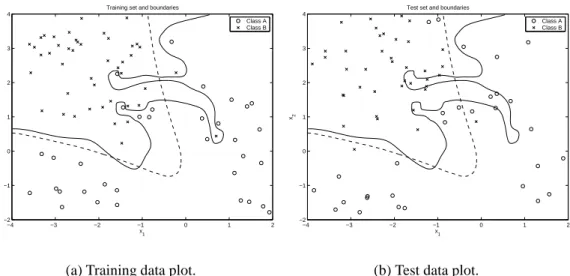
Classifier complexity is a tradeoff between representational power and generality for a task. A simple classifier may not be able to learn or represent classes well which yields poor accuracy. An overly complex classifier can lead to a situation shown in Figure 1: an overfitted classifier can classify the training data 100% correct, but when a different data set from the same task is presented, the accuracy can be poor. Therefore the training data is usually divided into two disjoint sets: an actual training set and a test set, so that the classifier performance can be estimated objectively.
A classifier can have numerous parameters that have to be adjusted according to the task. This is called training or learning. In supervised learning the training samples are labeled, and the training algorithm tries to minimize the classification error of the training set. In unsupervised learning or clustering the training samples are not labeled but the training algorithm tries to find clusters and form classes. In reinforcement learning the training samples are also not labeled, but the training algorithm uses feedback saying if it classifies a sample correctly or not. [1]
2.2
Bayesian Classification
Bayesian classification and decision making is based on probability theory and the prin-ciple of choosing the most probable or the lowest risk (expected cost) option [4].
−4 −3 −2 −1 0 1 2 −2 −1 0 1 2 3 4 x 1 x2
Training set and boundaries
Class A Class B
(a) Training data plot.
−4 −3 −2 −1 0 1 2 −2 −1 0 1 2 3 4 x 1 x2
Test set and boundaries
Class A Class B
(b) Test data plot.
Figure 1: Too complex decision boundary (solid line) can separate the training set without any errors (Fig. (a)), but it can make many mistakes with another data set (Fig. (b)). Dashed line is a more general boundary that leads to lower average classification error. Assume that there is a classification task to classify feature vectors (samples) to K dif-ferent classes. A feature vector is denoted as x = [x1, x2, . . . , xD]T where D is the
dimension of a vector. The probability that a feature vector x belongs to class ωk is
P(ωk|x), and it is often referred to as a posteriori probability. The classification of the
vector is done according to posterior probabilities or decision risks calculated from the probabilities.
The posterior probabilities can be computed with the Bayes formula P(ωk|x) =
p(x|ωk)P(ωk)
p(x) (1)
where p(x|ωk) is the probability density function of class ωk in the feature space and
P(ωk)is the a priori probability, which tells the probability of the class before measuring any features. If prior probabilities are not actually known, they can be estimated by the class proportions in the training set. The divisor
p(x) =
K X
i=1
p(x|ωi)P(ωi) (2)
is merely a scaling factor to assure that posterior probabilities are really probabilities, i.e., their sum is one.
minimum error probability [1, 4]. However, if the cost of making different kinds of errors is not uniform, the decision can be made with a risk function that computes the expected cost using the posterior probabilities, and choose the class with minimum risk.
The major problem in the Bayesian classifier is the class-conditional probability density functionp(x|ωk). The function tells the distribution of feature vectors in the feature space
inside a particular class, i.e., it describes the class model. In practice it is always unknown, except in some artificial classification tasks. The distribution can be estimated from the training set with a range of methods.
2.3
Gaussian Mixture Probability Density Function
The Gaussian probability density function in one dimension is a bell shaped curve defined by two parameters, meanµand varianceσ2. In theD-dimensional space it is defined in a
matrix form as N(x;µ,Σ) = 1 (2π)D/2|Σ|1/2exp −1 2(x−µ) TΣ−1 (x−µ) (3) whereµis the mean vector andΣthe covariance matrix. In Figure 2 is shown an example of 2-dimensional Gaussian PDF. Equiprobability surfaces of a Gaussian are µ-centered hyperellipsoids. −5 −4 −3 −2 −1 0 1 2 3 4 5 −5 0 5 −0.15 −0.1 −0.05 0 0.05 0.1 x2 x1 p
Figure 2: An example surface of two-dimensional Gaussian PDF with µ = [0; 0] and Σ = [1.56,−0.97;−0.97,2.68]and contour plots (equiprobability surfaces) to emphasize the shape.
The Gaussian distribution is usually quite good approximation for a class model shape in a suitably selected feature space. It is a mathematically sound function and extends
easily to multiple dimensions. In the Gaussian distribution lies an assumption that the class model is truly a model of one basic class. If the actual model, the actual probability density function, is multimodal, it fails. For example, if we are searching for different face parts from a picture and there are several basic types of eyes, because of people from different races perhaps, the single Gaussian approximation would describe a wide mixture of all eye types, including patterns that might not look like an eye at all.
Gaussian mixture model (GMM) is a mixture of several Gaussian distributions and can therefore represent different subclasses inside one class. The probability density function is defined as a weighted sum of Gaussians
p(x;θ) =
C X
c=1
αcN(x;µc,Σc) (4)
where αc is the weight of the component c, 0 < αc < 1 for all components, and PC
c=1αc= 1. The parameter list
θ ={α1,µ1,Σ1, . . . , αC,µC,ΣC} (5)
defines a particular Gaussian mixture probability density function. An example of Gaus-sian mixture model is shown in Figure 3. [5]
−5 −4 −3 −2 −1 0 1 2 3 4 5 −5 0 5 −0.1 −0.08 −0.06 −0.04 −0.02 0 0.02 0.04 0.06 x2 x1 p
Figure 3: An example surface of a two-dimensional Gaussian mixture PDF with three components: α1 = 0.40, µ1 = [−2.5;−2], Σ1 = [0.81,0; 0,1.44], α2 = 0.25,
µ2 = [0.5; 1.5], Σ2 = [1.30,−0.66;−0.66,1.30] and α3 = 0.35, µ3 = [2.0;−0.5],
Σ3 = [0.69,0.61; 0.61,2.36].
Estimation of the Gaussian mixture parameters for one class can be considered as un-supervised learning of the case where samples are generated by individual components of the mixture distribution and without the knowledge of which sample was generated by
which component. Clustering usually tries to identify the exact components, but Gaussian mixtures can also be used as an approximation of an arbitrary distribution.
2.4
Complex Valued Features
Some applications utilize complex valued features, for example describing the amplitude and phase of a sinusoidal signal. These features can be handled in three different ways. First, a single real value can be calculated from each complex attribute, by probably losing some information. Second, the complex value can be divided to two real values, which means that the length of feature vectors is doubled. Third, it might be possible to use the complex arithmetics directly.
The first approach is good in the sense that it reduces the dimensionality of a problem, which can lead to better performance even with small number of training data. If this is the case, it should have been done already in the feature extraction phase. On the other hand, combining two values into one can cause a loss of valuable information and the performance may degrade.
Dividing complex values into two parts, real and imaginary or modulus and argument, preserves all information, but increases the dimensionality of the problem. This can be a real problem with high dimensional complex valued data since the amount of training data may become insufficient or computation time increases too much.
Using the complex values directly is something between the two previous cases. It intro-duces a constraint to the Gaussian distribution model and requires little modifications in classifier training algorithms and the Gaussian PDF. If the transpose operation in Eq. 3 is changed to conjugate transpose, the resulting formula
N(x;µ,Σ) = 1 (2π)D/2|Σ|1/2 exp −1 2(x−µ) ∗Σ−1 (x−µ) (6) works also with complex valuedµandΣ, assuming the covariance matrix is still positive definite. Changes in the training algorithms are explained later.
The constraint affects the shape of the distribution. It forces the shape of the density function to be spherical on each complex plane, eliminating the covariance between the real and imaginary part of a variable and making the variances equal.
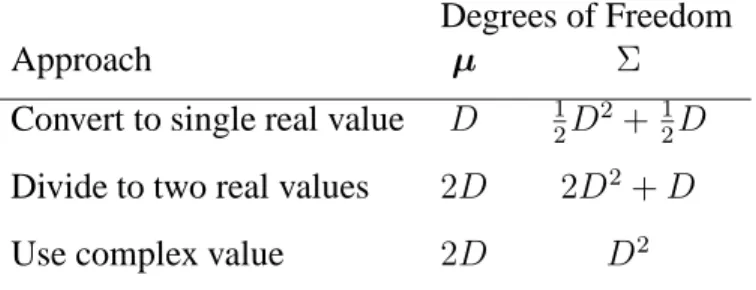
The differences between approaches for using complex valued data in the Gaussian PDF are presented in Table 1. The degree of freedom here refers to an unknown value and the number of such values in the D-dimensional case are shown in the table. With the covariance matrix Σ the symmetry and real valued diagonal constraints are taken into account.
Table 1: Comparison of degrees of freedom in a single multivariate Gaussian density function with different approaches for using complex data.
Degrees of Freedom
Approach µ Σ
Convert to single real value D 1 2D
2
+1 2D
Divide to two real values 2D 2D2+D
3
GAUSSIAN MIXTURE DENSITY ESTIMATION
3.1
Maximum Likelihood Estimation
In construction of a Bayesian classifier the class-conditional probability density functions need to be determined. The initial model selection can be done for example by visualizing the training data, but the adjustment of the model parameters requires some measure of goodness, i.e., how well the distribution fits the observed data. Data likelihood is a such goodness value.
Assume that there is a set of independent samples X = {x1, . . . ,xN} drawn from a
single distribution described by a probability density functionp(x;θ)whereθis the PDF parameter list. The likelihood function
L(X;θ) =
N Y
n=1
p(xn;θ) (7)
tells the likelihood of the data X given the distribution or, more specifically, given the distribution parametersθ. The goal is to find θˆthat maximizes the likelihood:
ˆ
θ= arg max
θ L(X;θ). (8)
Usually this function is not maximized directly but the logarithm L(X;θ) = lnL(X;θ) =
N X
n=1
lnp(xn;θ), (9)
called the log-likelihood function which is analytically easier to handle. Because of the monotonicity of the logarithm function the solution to Eq. 8 is the same usingL(X;θ)or L(X;θ). [4]
Depending on p(x;θ) it might be possible to find the maximum analytically by setting the derivatives of the log-likelihood function to zero and solving θ. It can be done for a Gaussian PDF, which leads to the intuitive estimates for a mean and variance [1], but usually the analytical approach is intractable. In practice an iterative method such as the expectation maximization (EM) algorithm is used. Maximizing the likelihood may in some cases lead to singular estimates, which is the fundamental problem of maximum likelihood methods with Gaussian mixture models [5].
Recall the task of classifying vectors into K classes. If different classes can be seen as independent, i.e., training samples belonging to one class tell nothing about other classes, the estimation problem ofKclass-conditional PDFs can be divided intoK separate esti-mation problems.
3.2
Basic EM Estimation
The expectation maximization (EM) algorithm is an iterative method for calculating max-imum likelihood distribution parameter estimates from incomplete data (some elements missing in some feature vectors). It can also be used to handle cases where an analyti-cal approach for maximum likelihood estimation is infeasible, such as Gaussian mixtures with unknown and unrestricted covariance matrices and means.
Assume that each training sample contains known features and missing or unknown fea-tures. Mark all good features of all samples withXand all unknown features of all samples withY. The expectation step (E-step) for the EM algorithm is to form the function
Q(θ;θi)≡EY[ lnL(X,Y;θ)|X; θi] (10) whereθi is the previous estimate for the distribution parameters andθis the variable for a new estimate describing the (full) distribution.Lis the likelihood function (Eq. 7). The function calculates the likelihood of the data, including the unknown featureY marginal-ized with respect to the current estimate of the distribution described by θi. The maxi-mization step (M-step) is to maximizeQ(θ;θi)with respect toθand set
θi+1 ←arg max
θ Q(θ;θ i).
(11) The steps are repeated until a convergence criterion is met. [1]
For the convergence criterion it is suggested in [1] that
Q(θi+1;θi)−Q(θi;θi−1)≤T (12) with a suitably selectedT and in [4] that
for an appropriately chosen vector norm and. Common for both of these criteria is that iterations are stopped when the change in the values falls below a threshold. A more sophisticated criterion can be derived from Eq. 12 by using a relative rather than absolute rate of change.
The EM algorithm starts from an initial guessθ0 for the distribution parameters and the log-likelihood is guaranteed to increase on each iteration until it converges. The conver-gence leads to a local or global maximum, but it can also lead to singular estimates, which is true particularly for Gaussian mixture distributions with arbitrary covariance matrices. The description of the general EM algorithm and also its application for the Gaussian mixture model can be found in [6, 1, 4].
The initialization is one of the problems of the EM algorithm. The selection ofθ0(partly) determines where the algorithm converges or hits the boundary of the parameter space producing singular, meaningless results. Some solutions use multiple random starts or a clustering algorithm for initialization. [7]
The application of the EM algorithm to Gaussian mixtures according to [7] goes as fol-lows. The known data X is interpreted as incomplete data. The missing part Y is the knowledge of which component produced each sample xn. For each xn there is a
bi-nary vector yn = {yn,1, . . . , yn,C}, where yn,c = 1, if the sample was produced by the
componentc, or zero otherwise. The complete data log-likelihood is lnL(X,Y;θ) = N X n=1 C X c=1 yn,cln (αcp(xn|c;θ)). (14)
The E-step is to compute the conditional expectation of the complete data log-likelihood, theQ-function, givenXand the current estimateθiof the parameters. Since the complete data log-likelihoodlnL(X,Y;θ)is linear with respect to the missing Y, the conditional expectation W ≡ E[Y|X,θ] has simply to be computed and put it into lnL(X,Y;θ). Therefore
Q(θ,θi)≡E
lnL(X,Y;θ)|X,θi
= lnL(X,W;θ) (15) where the elements ofWare defined as
wn,c≡E yn,c|X,θi = Pr yn,c= 1|xn,θi . (16)
The probability can be calculated with the Bayes law wn,c= α i cp(xn|c;θi) PC j=1αijp(xn|j;θi) (17)
whereαci is the a priori probability (of estimateθi) andwn,cis the a posteriori probability that yn,c = 1 after observing xn. In other words, wn,c is the probability that xn was produced by componentc. [7]
Applying the M-step to the problem of estimating the distribution parameters for C-component Gaussian mixture with arbitrary covariance matrices, the resulting iteration formulas are as follows:
αic+1 = 1 N N X n=1 wn,c (18) µic+1 = PN n=1xnwn,c PN n=1wn,c (19) Σi+1 c = PN n=1wn,c(xn−µi +1 c )(xn−µic+1)T PN n=1wn,c . (20)
The new estimates are gathered toθi+1(Eq. 5). If the convergence criterion (Eqs. 12 or 13) is not satisfied,i←i+ 1and Eqs. 17–20 are evaluated again with new estimates. [1] The interpretation of the Eqs. 18–20 is actually quite intuitive. The weightαcof a com-ponent is the portion of samples belonging to that comcom-ponent. It is computed by approxi-mating the component-conditional PDF with the previous parameter estimates and taking the posterior probability of each sample point belonging to the component c (Eq. 17). The component mean µcand covariance matrixΣc are estimated in the same way. The
samples are weighted with their probabilities of belonging to the component, and then the sample mean and sample covariance matrix are computed.
It is worthwhile to note that so far the number of components C was assumed to be known. Clustering techniques try to find the true clusters and components from a training set, but our task of training a classifier only needs a good enough approximation of the distribution of each class. Therefore, C does not need to be guessed accurately, it is just a parameter defining the complexity of the approximating distribution. Too smallC prevents the classifier from learning the sample distributions well enough and too largeC may lead to an overfitted classifier. More importantly, too largeC will definitely lead to singularities when the amount of training data becomes insufficient.
3.3
Figueiredo-Jain Algorithm
The Figueiredo-Jain (FJ) algorithm tries to overcome three major weaknesses of the ba-sic EM algorithm. The EM algorithm presented in Section 3.2 requires the user to set the number of components and the number will be fixed during the estimation process. The FJ algorithm adjusts the number of components during estimation by annihilating components that are not supported by the data. This leads to the other EM failure point, the boundary of the parameter space. FJ avoids the boundary when it annihilates compo-nents that are becoming singular. FJ also allows to start with an arbitrarily large number of components, which tackles the initialization issue with the EM algorithm. The initial guesses for component means can be distributed into the whole space occupied by training samples, even setting one component for every single training sample. [7]
The classical way to select the number of mixture components is to adopt the ”model-class/model” hierarchy, where some candidate models (mixture PDFs) are computed for each model-class (number of components), and then select the ”best” model. The idea behind the FJ algorithm is to abandon such hierarchy and to find the ”best” overall model directly. Using the minimum message length criterion and applying it to mixture models leads to the objective function
Λ(θ,X) = V 2 X c:αc>0 ln(N αc 12 ) + Cnz 2 ln N 12 + Cnz(V + 1) 2 −lnL(X,θ) (21) whereN is the number of training points,V is the number of free parameters specifying a component, andCnzis the number of components with nonzero weight in the mixture
(αc > 0). θ in the case of Gaussian mixture is the same as in Eq. 5. The last term
lnL(X,θ) is the log-likelihood of the training data given the distribution parameters θ (Eq. 9). [7]
The EM algorithm can be used to minimize Eq. 21 with a fixed Cnz [7]. It leads to the
M-step with component weight updating formula
αic+1= max 0, N P n=1 wn,c −V 2 C P j=1 max 0, N P n=1 wn,j − V 2 . (22)
This formula contains an explicit rule of annihilating components by setting their weights to zero. Other distribution parameters are updated as in Eqs. 19 and 20. [7]
The above M-steps are not suitable for the basic EM algorithm though. When initial C is high, it can happen that all weights become zero because none of the components have enough support from the data. Therefore a component-wise EM algorithm (CEM) is adopted. CEM updates the components one by one, computing the E-step (updatingW) after each component update, where the basic EM updates all components ”simultane-ously”. When a component is annihilated its probability mass is immediately redistributed strengthening the remaining components. [7]
When CEM converges, it is not guaranteed that the minimum ofΛ(θ,X)is found, because the annihilation rule (Eq. 22) does not take into account the decrease caused by decreasing Cnz. After convergence the component with the smallest weight is removed and the CEM
is run again, repeating until Cnz = 1. Then the estimate with the smallest Λ(θ,X) is
chosen. [7]
The implementation of the FJ algorithm uses a modified cost function instead ofΛ(θ,X). The derivation of the modified cost function is presented in Appendix 1.
Hitherto the only things assumed for the mixture distribution are that an EM algorithm can be written for it and all components are parameterized the same way (number of parametersV for a component). With Gaussian mixture model the number of parameters per componentV =D+1
2D 2+1
2Din the case of real valued data and arbitrary covariance
matrices. With complex valued data the number of real free parameters V = 2D+D2
where D is the dimensionality of the (complex) data. It would seem logical to choose this value for V instead of the previous one defined with real valued data. As seen in Eq. 22 this amplifies the annihilation which makes sense because there are more degrees of freedom in a component. On the other hand there are more training data with the same number of training points, because the data is complex (two values in one variable as opposed to one value). The nature of complex data with Gaussian PDF has been discussed in Section 2.4.
3.4
Greedy EM Algorithm
The greedy algorithm starts with a single component and then adds components into the mixture one by one. The optimal starting component for a Gaussian mixture is trivially computed, optimal meaning the highest training data likelihood. The algorithm repeats two steps: insert a component into the mixture, and run EM until convergence. Inserting
a component that increases the likelihood the most is thought to be an easier problem than initializing a whole near-optimal distribution. Component insertion involves searching for the parameters for only one component at a time. Recall that EM finds a local opti-mum for the distribution parameters, not necessarily the global optiopti-mum which makes it initialization dependent method.
LetpCdenote aC-component mixture with parametersθC. The general greedy algorithm
for Gaussian mixture is as follows [8]:
1. Compute the optimal (in the ML sense) one-component mixturep1and setC ←1.
2. Find a new componentN(x;µ0,Σ0)and corresponding mixing weightα0 that
in-crease the likelihood the most:
{µ0,Σ0, α0}= arg max {µ,Σ,α} N X n=1 ln[(1−α)pC(xn) +αN(xn;µ,Σ)] (23)
while keepingpC fixed.
3. SetpC+1(x)←(1−α0)pC(x) +α0N(x;µ0,Σ0)and thenC ←C+ 1.
4. UpdatepC using EM (or some other method) until convergence. [optional]
5. Evaluate some stopping criterion; go to Step 2 or quit.
The stopping criterion in Step 5 can be for example any kind of model selection criterion, wanted number of components, or a minimum message length criterion.
The crucial point is of course Step 2. Finding the optimal new component requires a global search, which is performed by creatingCNcand candidate components. The
num-ber of candidates will increase linearly with the numnum-ber of componentsC, havingNcand
candidates per each existing component. The candidate resulting in the highest likelihood when inserted into the (previous) mixture is selected. The parameters and weight of the best candidate are then used in Step 3 instead of the truly optimal values. [8].
The candidates for executing Step 2 are initialized as follows: the training data setXis partitioned intoC disjoint data sets{Ac}, c = 1. . . C, according to the posterior
proba-bilities of individual components; the data set is Bayesian classified by the mixture com-ponents. From eachAcnumber ofNcand candidates are initialized by picking uniformly
smallest distance selection with respect toxl andxr. The mean and covariance of these
two new subsets are the parameters for two new candidates. The candidate weights are set to half of the weight of the component that produced the setAc. Then newxl andxr
are drawn untilNcandcandidates are initialized withAc. The partial EM algorithm is then
used on each of the fresh set of candidates. The partial EM differs from the EM and CEM algorithms by optimizing (updating) only one component of a mixture, it does not change any other components. In order to reduce the time complexity of the algorithm a lower bound on the log-likelihood is used instead of the true log-likelihood. The lower-bound log-likelihood is calculated with only the points in the respective setAc. The partial EM
update equations are as follows: wn,C+1= αN(xn;µ,Σ) (1−α)pC(x) +αN(x;µ,Σ) (24) α= 1 ℵ(Ac) X n∈Ac wn,C+1 (25) µ= P n∈Acwn,C+1xn P n∈Acwn,C+1 (26) Σ = P n∈Acwn,C+1(xn−µ)(xn−µ) T P n∈Acwn,C+1 (27) whereℵ(Ac)is the number of training samples in the set Ac. These equations are much
like the basic EM update Eqs. 18–20. The partial EM iterations are stopped when the relative change in log-likelihood of the resulting C + 1 -component mixture drops be-low threshold or maximum number of iterations is reached. When the partial EM has converged the candidate is ready to be evaluated. [8]
4
GMMBAYES TOOLBOX
4.1
GMMBayes Matlab Toolbox Interface
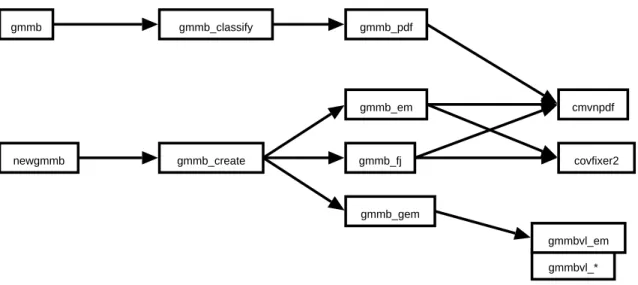
The developed Matlab functions for different algorithms and the Bayesian classifier were wrapped into a common function interface and packaged as the GMMBayes Matlab Tool-box which is available from the web site [9]. The basic interface consists of the functions gmmb_create(create and train GMM) andgmmb_classify(classify samples with the Bayesian or Mahalanobis distance classifier). There is also a higher level interface of the functionsgmmbandnewgmmb, but it is just a simple wrapper for the basic interface functions that provides an abstraction layer to allow the use of other classification tools in a portable way. The function (or m-file) call graph is shown in Figure 4.
newgmmb gmmb gmmb_create gmmb_classify gmmb_em gmmb_fj gmmb_gem cmvnpdf covfixer2 gmmbvl_* gmmbvl_em gmmb_pdf
Figure 4: Function call graph of the GMMBayes Matlab Toolbox.
Under the gmmb_create interface there are the implementations of three introduced algorithms. Each one of them uses different parameters, so the parameter list should be built individually consulting the desired function. All function m-files contain usage documentation and parameter descriptions.
Allgmmbvl_*functions have been downloaded from the home page of Dr. Nikos Vlassis (link provided in [9]).
4.2
Avoiding Covariance Matrix Singularities
The EM algorithm tends to converge to a singular solution, especially when training data is (nearly) insufficient. The FJ algorithm does not suffer from this, but still the training data may sometimes lead to an invalid covariance matrix.
Functioncovfixer2takes a candidate covariance matrix and returns a slightly modified matrix that fulfills the requirements for a valid covariance matrix (semipositive definite, complex conjugate symmetric). If the input matrix is already valid, it is returned as is. In the function the matrix is forced to complex conjugate symmetric as follows:
Σ←Σ− Σ−Σ
∗
2 . (28)
Possible imaginary components are removed from the diagonal, which results in a Her-mitian matrix. Then it is tested for positive definiteness (Cholesky factorization), and while the test fails one of two things is done: i) If there is a negative element in the diag-onal, then one percent of the maximum element in the diagonal is added to all diagonal elements; ii) Otherwise all the diagonal elements are increased by one percent.
By growing the covariance matrix diagonal we try to get rid of singular matrices. The iterative algorithm, which called thecovfixer2function, is supposed to fix the possible ill effects of the matrix modifications on next iterations, but it may also lead again to a singular covariance matrix; algorithm starts to oscillate and may jam.
4.3
Algorithm Implementation Details
The Gaussian probability density function is evaluated incmvnpdffunction, which is a modified version of the Matlab R13mvnpdffunction, since it does not handle complex valued data correctly.
The gmmb_classify function can additionally classify samples according to Maha-lanobis distance, where the distance is computed to each component of each trained class. This method ignores all a priori and component weight information. When using the function to classify using the Bayesian rule, the function can output either only a class label or all posterior probabilities for each sample.
The EM implementation uses fuzzy c-means clustering for initializing the component means. Component covariance matrices are initialized to diagonal part of the whole data covariance matrix. Weights are set to equal. Thecovfixer2function is used on every iteration. The algorithms stops when relative change1 of the log-likelihood of the data
falls below a threshold. The implementation can compute with complex data directly. In the Figueiredo-Jain algorithm implementation component mean vectors are initialized to random data points. Covariance matrices are initialized toσ2I, whereI is the unitary matrix andσ2 is one tenth of the maximum of the diagonal of the whole data covariance matrix. Initial component weights are equal. Thecovfixer2function is used on every iteration of the wise EM algorithm. The stopping criteria for the component-wise EM is a threshold in the relative change of the data log-likelihood, and the whole algorithm stops when the minimum number of components is reached and CEM has con-verged. The FJ implementation also computes with complex data.
The greedy EM implementation contains a trivial initialization step, because it starts from a single Gaussian component; the standard mean and covariance of the data. The stopping condition for the partial EM when creating candidates is the relative change in data log-likelihood falling below 0.01 or number of iterations reaching 20. After all candidates are created one of the candidate components is selected and then it is updated again with partial EM with relative log-likelihood change threshold 10−5
. The change in the log-likelihood when inserting the new component is checked and the component is inserted if the log-likelihood increases. Otherwise the algorithm stops. The whole mixture updating EM is stopped when the relative change in log-likelihood falls below10−5
.
5
EXPERIMENTS
Three different data sets were used in the experiments: forest spectral colors, artificial waveforms and noise, and letter image recognition data. The tests were run with the following parameters:
EM
relative log-likelihood change threshold: 10−5
number of mixture components: 1 to 8 Figueiredo-Jain
relative log-likelihood change threshold: 10−5
maximum number of mixture components: 4, 8, 16, 32, 64 Greedy EM
maximum number of mixture components: 4, 8, 16, 32, 64 number of candidates per existing component: 8
For each algorithm the number of components was varied.
In a test round a data set was randomly divided into three: the test data, the training data and unused data. The test data was always 30% of the data set and the training data was varied from 20% to 70% with ten percent unit steps. The division algorithm assures that the training and test data sets are non-overlapping and the class proportions remain the same in the three subsets and the data set.
A test round produced an accuracy ratio (correctly classified samples in the test data set), the estimated Gaussian mixture model and miscellaneous data about the used algorithm. One test round was repeated three times with the same parameters and data sets. For each set of parameters the training and test sets were randomly created five times. This method totals to 15 test rounds per a test run with each fixed parameters, algorithm and data set. Description of the result file format is in Appendix 2.
Because the FJ and GEM can produce different number of components for different classes within a single test round, the maximum number of components of class mod-els is used to describe the result of a round. The crashed runs are taken into account as zero accuracy.
An algorithm crash is a situation where the algorithm did not produce a final mixture estimate and cannot continue. For example in the EM algorithm a covariance matrix becomes undefined, or in the FJ algorithm all mixture components get annihilated. Test runs were executed for every combination of data set, parameter and algorithm men-tioned in this section.
5.1
Forest Spectral Colors
The forest colors set contains samples of reflectance spectra of pine, spruce and birch. The spectra is recorded in wavelength interval 390 nm – 850 nm with 5 nm resolution which leads to 93-element sample vectors. There are 349 samples from spruce, 337 from birch and 370 from pine. [10]
The data is too high-dimensional to be used directly, and it was thus transformed with neighbor-bank projection [11] to 23, 15 and 10-dimensional data sets with cos2
bank shape. The 23-dimensional case was near the classification accuracy optimum in [11], and 15 and 10-dimensional cases were created in case 23 dimensions would be too much for the algorithms considering the amount of training data.
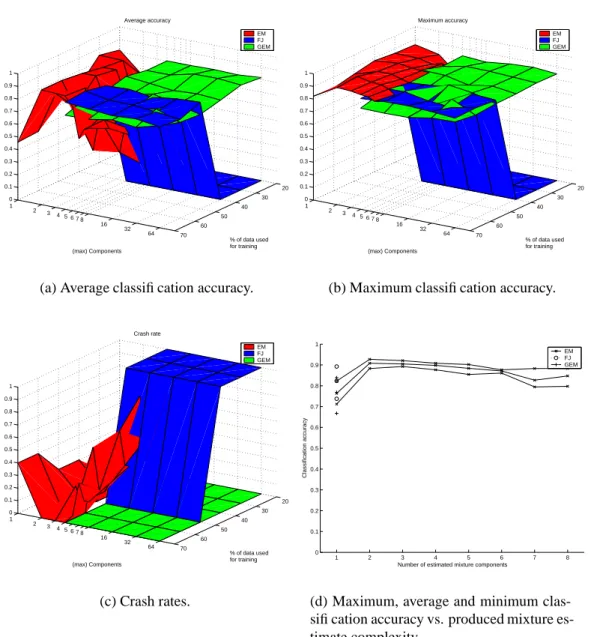
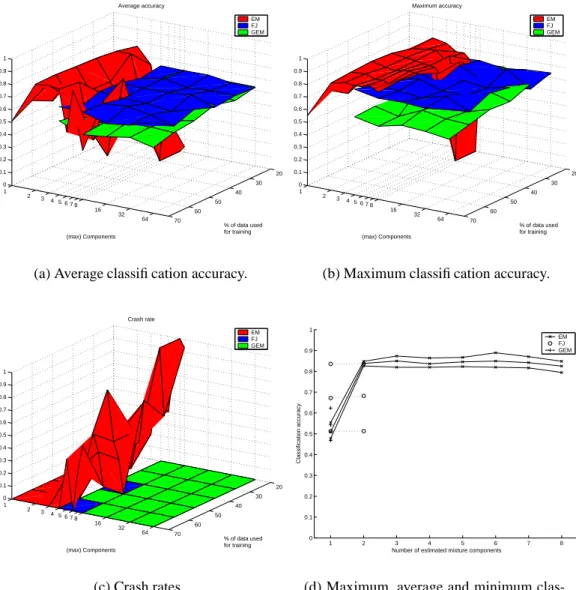
The results are presented as follows: Figure 5 with the 23-dimensional forest colors data, Figure 6 with the 15-dimensional data and Figure 7 with the 10-dimensional data. With these data sets the EM algorithm provides the best classification accuracy with two com-ponents though in Figure 7(d) the performance remains steady up to seven comcom-ponents. The FJ and GEM algorithms perform comparably with the 23-d and 15-d sets, GEM little worse with the 10-d set. GEM chose always only one component so its stable performance is not a surprise. FJ also chose only one component with the 23-d data, but produced also two-component estimates with 15-d and 10-d data (Figs. 6(d), 7(d)). The two-component estimates of FJ were not better than the one-component estimates.
In Figures 5(c), 6(c) and 7(c) it is shown that the EM algorithm is quite unstable and crashes more often with higher a number of mixture components. Why it crashes with one component (Fig. 5(c)) is a mystery. The FJ algorithm has a clear limit of how much training data is required before it works at all, and it depends on the data dimension. This can be traced back to the annihilation step in Eq. 22. Below this limit all mixture components are annihilated and the FJ algorithm crashes. The GEM algorithm did not
crash at all. 20 30 40 50 60 70 1 2 3 4 5 6 78 16 32 64 0 0.1 0.2 0.3 0.4 0.5 0.6 0.7 0.8 0.9 1 % of data used for training Average accuracy (max) Components EM FJ GEM
(a) Average classification accuracy.
20 30 40 50 60 70 1 2 3 4 5 6 78 16 32 64 0 0.1 0.2 0.3 0.4 0.5 0.6 0.7 0.8 0.9 1 % of data used for training Maximum accuracy (max) Components EM FJ GEM
(b) Maximum classification accuracy.
20 30 40 50 60 70 1 2 3 4 5 6 78 16 32 64 0 0.1 0.2 0.3 0.4 0.5 0.6 0.7 0.8 0.9 1 % of data used for training Crash rate (max) Components EM FJ GEM (c) Crash rates. 1 2 3 4 5 6 7 8 0 0.1 0.2 0.3 0.4 0.5 0.6 0.7 0.8 0.9 1
Number of estimated mixture components
Classification accuracy
EM FJ GEM
(d) Maximum, average and minimum clas-sification accuracy vs. produced mixture es-timate complexity.
Figure 5: Results for the 23-dimensional forest colors data. In (a)–(c) each point is a statistic of 15 test rounds. Plot (d) is made with 70% of data used for training.
20 30 40 50 60 70 1 2 3 4 5 6 78 16 32 64 0 0.1 0.2 0.3 0.4 0.5 0.6 0.7 0.8 0.9 1 % of data used for training Average accuracy (max) Components EM FJ GEM
(a) Average classification accuracy.
20 30 40 50 60 70 1 2 3 4 5 6 78 16 32 64 0 0.1 0.2 0.3 0.4 0.5 0.6 0.7 0.8 0.9 1 % of data used for training Maximum accuracy (max) Components EM FJ GEM
(b) Maximum classification accuracy.
20 30 40 50 60 70 1 2 3 4 5 6 78 16 32 64 0 0.1 0.2 0.3 0.4 0.5 0.6 0.7 0.8 0.9 1 % of data used for training Crash rate (max) Components EM FJ GEM (c) Crash rates. 1 2 3 4 5 6 7 8 0 0.1 0.2 0.3 0.4 0.5 0.6 0.7 0.8 0.9 1
Number of estimated mixture components
Classification accuracy
EM FJ GEM
(d) Maximum, average and minimum clas-sification accuracy vs. produced mixture es-timate complexity.
Figure 6: Results for the 15-dimensional forest colors data. In (a)–(c) each point is a statistic of 15 test rounds. Plot (d) is made with 70% of data used for training.
20 30 40 50 60 70 1 2 3 4 5 6 78 16 32 64 0 0.1 0.2 0.3 0.4 0.5 0.6 0.7 0.8 0.9 1 % of data used for training Average accuracy (max) Components EM FJ GEM
(a) Average classification accuracy.
20 30 40 50 60 70 1 2 3 4 5 6 78 16 32 64 0 0.1 0.2 0.3 0.4 0.5 0.6 0.7 0.8 0.9 1 % of data used for training Maximum accuracy (max) Components EM FJ GEM
(b) Maximum classification accuracy.
20 30 40 50 60 70 1 2 3 4 5 6 78 16 32 64 0 0.1 0.2 0.3 0.4 0.5 0.6 0.7 0.8 0.9 1 % of data used for training Crash rate (max) Components EM FJ GEM (c) Crash rates. 1 2 3 4 5 6 7 8 0 0.1 0.2 0.3 0.4 0.5 0.6 0.7 0.8 0.9 1
Number of estimated mixture components
Classification accuracy
EM FJ GEM
(d) Maximum, average and minimum clas-sification accuracy vs. produced mixture es-timate complexity.
Figure 7: Results for the 10-dimensional forest colors data. In (a)–(c) each point is a statistic of 15 test rounds. Plot (d) is made with 70% of data used for training.
5.2
Waveforms and Noise
Waveforms and noise data is an artificial data set from three classes of waves [12]. The data set was retrieved from the UCI Machine Learning Repository [13] and it contained 5000 samples with equal class distributions. A sample is a 40-element vector, where the first 21 elements are real attributes with added noise (zero mean, unity variance) and the last 19 elements are pure noise. All vector elements are real valued. The optimal Bayes classification accuracy is 86% [12].
The results with the waveforms and noise data set are in Figure 8.
20 30 40 50 60 70 1 2 3 4 5 6 78 16 32 64 0 0.1 0.2 0.3 0.4 0.5 0.6 0.7 0.8 0.9 1 % of data used for training Average accuracy (max) Components EM FJ GEM
(a) Average classification accuracy.
20 30 40 50 60 70 1 2 3 4 5 6 78 16 32 64 0 0.1 0.2 0.3 0.4 0.5 0.6 0.7 0.8 0.9 1 % of data used for training Maximum accuracy (max) Components EM FJ GEM
(b) Maximum classification accuracy.
20 30 40 50 60 70 1 2 3 4 5 6 78 16 32 64 0 0.1 0.2 0.3 0.4 0.5 0.6 0.7 0.8 0.9 1 % of data used for training Crash rate (max) Components EM FJ GEM (c) Crash rates. 2 4 6 8 10 12 0 0.1 0.2 0.3 0.4 0.5 0.6 0.7 0.8 0.9 1
Number of estimated mixture components
Classification accuracy
EM FJ GEM
(d) Maximum, average and minimum clas-sification accuracy vs. produced mixture es-timate complexity.
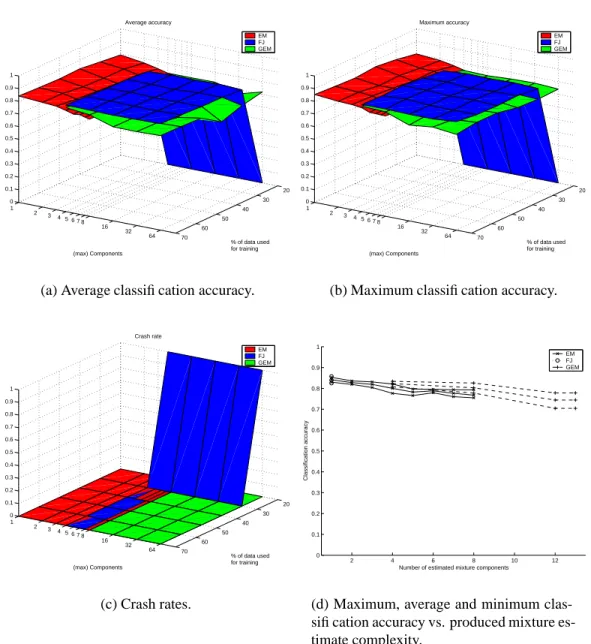
Figure 8: Results for the waveforms and noise data. In (a)–(c) each point is a statistic of 15 test rounds. Plot (d) is made with 70% of data used for training.
Another test was executed with the pure noise components excluded, using only the first 21 elements of the sample vectors. The results with that data set are in Figure 9.
20 30 40 50 60 70 1 2 3 4 5 6 78 16 32 64 0 0.1 0.2 0.3 0.4 0.5 0.6 0.7 0.8 0.9 1 % of data used for training Average accuracy (max) Components EM FJ GEM
(a) Average classification accuracy.
20 30 40 50 60 70 1 2 3 4 5 6 78 16 32 64 0 0.1 0.2 0.3 0.4 0.5 0.6 0.7 0.8 0.9 1 % of data used for training Maximum accuracy (max) Components EM FJ GEM
(b) Maximum classification accuracy.
20 30 40 50 60 70 1 2 3 4 5 6 78 16 32 64 0 0.1 0.2 0.3 0.4 0.5 0.6 0.7 0.8 0.9 1 (max) Components % of data used for training Crash rate EM FJ GEM (c) Crash rates. 5 10 15 20 0 0.1 0.2 0.3 0.4 0.5 0.6 0.7 0.8 0.9 1
Number of estimated mixture components
Classification accuracy
EM FJ GEM
(d) Maximum, average and minimum clas-sification accuracy vs. produced mixture es-timate complexity.
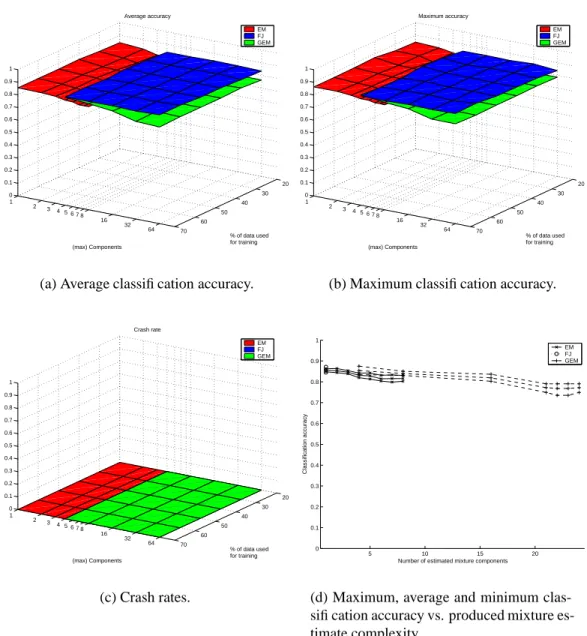
Figure 9: Results for the waveforms data without pure noise components. In (a)–(c) each point is a statistic of 15 test rounds. Plot (d) is made with 70% of data used for training. The performance of all algorithms is quite near the reported optimum with these data sets and only FJ crashes for too little training data in the 20% case with the 40-dimensional data. The FJ algorithm always chooses just one component into mixtures which makes it the best and most stable algorithm for these data sets. GEM produces too complex esti-mates with the 40-dimensional data set and overfitting shows as degrading performance as the complexity grows. The EM algorithm shows also the effect of overfitting. Sur-prisingly GEM estimates with four components per mixture manage to reach the same accuracy as FJ with the 21-dimensional data.
5.3
Letter Image Recognition Data
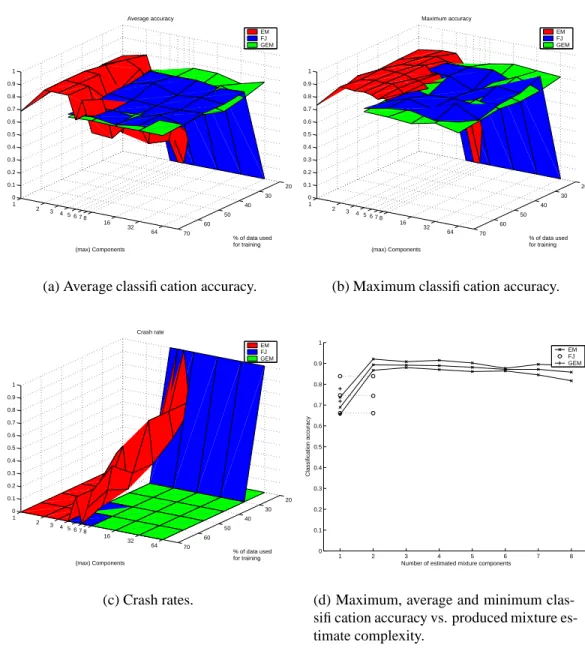
The letter image recognition data is an artificial data set containing 20,000 16-element sample vectors. The black-and-white letter images were generated from 20 different fonts using 26 different uppercase letters and adding random distortions. The sample vectors were calculated from those images, and include attributes such as mean x and y variance of pixels. [14]
The data set was retrieved from the UCI Machine Learning Repository [13]. All attributes were already transformed to integers in the range [0,15] which makes this data set diffi-cult, because the algorithms were coded for real valued, not integer, data. The class distribution of the 26 classes (letters) ranged from 734 to 813 samples per class. The best classification accuracy obtained in [14] was a little over 80%.
The results with the letter image recognition data set are shown in Figure 10.
The data set proved to be very difficult indeed, only the EM implementation produced results. FJ did not finish a single test round within reasonable time and thus there are no results from FJ, and only in few test rounds GEM did not crash (Fig. 10(c)). The EM implementation is quite reliable with one, two and even three components for mixtures and produces classification accuracies near 90% (Fig. 10(d)).
20 30 40 50 60 70 1 2 3 4 5 6 78 16 32 64 0 0.1 0.2 0.3 0.4 0.5 0.6 0.7 0.8 0.9 1 % of data used for training Average accuracy (max) Components EM FJ GEM
(a) Average classification accuracy.
20 30 40 50 60 70 1 2 3 4 5 6 78 16 32 64 0 0.1 0.2 0.3 0.4 0.5 0.6 0.7 0.8 0.9 1 % of data used for training Maximum accuracy (max) Components EM FJ GEM
(b) Maximum classification accuracy.
20 30 40 50 60 70 1 2 3 4 5 6 78 16 32 64 0 0.1 0.2 0.3 0.4 0.5 0.6 0.7 0.8 0.9 1 % of data used for training Crash rate (max) Components EM FJ GEM (c) Crash rates. 1 2 3 4 5 6 7 8 0 0.1 0.2 0.3 0.4 0.5 0.6 0.7 0.8 0.9 1
Number of estimated mixture components
Classification accuracy
EM
(d) Maximum, average and minimum clas-sification accuracy vs. produced mixture es-timate complexity.
Figure 10: Results for the letter recognition data. In (a)–(c) each point is a statistic of 15 test rounds. Plot (d) is made with 70% of data used for training. The FJ algorithm did not produce any results.
6
CONCLUSIONS
The goal for this project is well achieved, although it took over a year to complete. The Bayesian classifier using Gaussian mixtures is functional and the three different Gaussian mixture estimation algorithms are available in the developed GMMBayes Matlab Tool-box. The experiments show that the toolbox is working well and that there are differences in the behavior of the three implemented estimation algorithms.
There are some projection errors in the 3-dimensional graphs due to the way Matlab and PostScript handle the vector graphics, but they should not obscure the results. Corretly projected bitmap images can found at [9].
The EM implementation requires the user to set the number of components a priori for each mixture, but seems to outperform the other algorithms if a good number is found. Another downside of EM is its crash rate, but as the letter image recognition data experi-ments proved, it can work in situations where the other algorithms fail.
The FJ implementation determines the number of components by itself, going down from the user defined maximum. FJ also produced better classification accuracies than the GEM implementation, but FJ has a failure mode too: its minimum requirement for the number of training samples is higher than with the other algorithms. For some reason FJ could not produce a single mixture estimate with the letter image recognition data, although in preliminary tests during the development FJ did produce results.
The GEM implementation also determines the number of components by itself, inserting components one by one. GEM was the most stable implementation on average, looking at the crash rates, but produced generally a little worse classification accuracies than FJ. GEM produced results where the FJ implementation failed, except with the letter image recognition data, where they both failed.
The EM and FJ implementations work also with complex valued data, using complex arithmetics. The effects of the different approaches to using complex valued data de-scribed in Section 2.4 were not tested, but it would be an interesting topic, though the behavior might be application dependent.
The GMMBayes Toolbox was incorporated in the facial evidence detection system [2, 3] developed by Kämäräinen et al. where it outperformed the SCC method. The results can
be found in [15].
The GMMBayes Matlab Toolbox is already in use or to be used in several other projects at the Laboratory of Information Processing in Lappeenranta university of Technology.
REFERENCES
[1] R.O. Duda, P.E. Hart, and D.G. Stork. Pattern Classification. John Wiley & Sons, Inc., 2nd edition, 2001.
[2] J.-K. Kämäräinen, V. Kyrki, M. Hamouz, J. Kittler, and H. Kälviäinen. Invariant Gabor features for face evidence extraction. In Proceedings of the IAPR Workshop
on Machine Vision Applications, pages 228–231, Nara, Japan, 2002.
[3] J.-K. Kämäräinen. Face evidence extraction using Gabor features. Website. [Re-trieved 30.10.2003]
From:http://www.it.lut.fi/project/facedetect/.
[4] S. Theodoridis and K. Koutroumbas. Pattern Recognition. Academic Press, 1999. ISBN 0-12-686140-4.
[5] B.S. Everitt and D.J. Hand. Finite Mixture Distributions. Monographs on Applied Probability and Statistics. Chapman and Hall, 1981.
[6] J. Bilmes. A gentle tutorial on the EM algorithm and its application to parameter estimation for Gaussian mixture and hidden Markov models, 1997.
[7] M.A.T. Figueiredo and A.K. Jain. Unsupervised learning of finite mixture models.
IEEE Transactions on Pattern Analysis and Machine Intelligence, 24(3):381–396,
Mar 2002.
[8] J. J. Verbeek, N. Vlassis, and B. Kröse. Efficient greedy learning of Gaussian mix-ture models. Neural Computation, 5(2):469–485, Feb 2003.
[9] http://www.it.lut.fi/project/gmmbayes/.
[10] T. Jaaskelainen, R. Silvennoinen, J. Hiltunen, and J. P. S. Parkkinen. Classification of the reflectance spectra of pine, spruce, and birch. Applied Optics, 33(12):2356– 2362, April 1994.
[11] J.-K. Kamarainen, V. Kyrki, J. Ilonen, and H. Kälviäinen. Improving similar-ity measures of histograms using smoothing projections. Pattern Recogn. Lett., 24(12):2009–2019, 2003.
[12] L. Breiman, J.H. Friedman, R.A. Olshen, and C.J. Stone. Classification and
Re-gression Trees, pages 43–49. Wadsworth International Group, Belmont, California,
[13] C.L. Blake and C.J. Merz. UCI repository of machine learning databases, 1998. [14] P.W. Frey and D.J. Slate. Letter recognition using Holland-style adaptive classifiers.
Machine Learning, 6(2):161–182, March 1991.
[15] M. Hamouz, J. Kittler, J.-K. Kamarainen, P. Paalanen, and H. Kälviäinen. Affine-invariant face detection and localization using GMM-based feature detector and en-hanced appearance model. In Proceedings of the Sixth IEEE International
APPENDIX 1. Derivation of the FJ Cost Function
The objective function was defined in Eq. 21 as Λ(θ,X) = V 2 X c:αc>0 ln N αc 12 + Cnz 2 ln N 12+ Cnz(V + 1) 2 −lnL(X,θ).
The log-likelihood is not of interest here and it is discarded during the deriving. By decomposing the logarithms of products into sums of logarithms we get
V 2 X c:αc>0 (lnN + lnαc−ln 12) +Cnz 2 (lnN −ln 12) + Cnz(V + 1) 2 .
The only thing dependent oncinside the sum islnαcso the other terms can be taken out. Cnzis defined as the number of summables.
V 2 X c:αc>0 lnαc+V Cnz 2 (lnN −ln 12) + Cnz 2 (lnN −ln 12) + Cnz(V + 1) 2 Rearranging the terms and adding the log-likelihood back we get
V 2 X c:αc>0 lnαc+Cnz(V + 1) 2 lnN + (V + 1)(1−ln 12)−lnL(X,θ).
Recalling the message length interpretation of Eq. 21 the term (V + 1)(1−ln 12) can be discarded because it is an irrelevant additive constant which does not depend on the data or component weights of the mixture (V is the parameter count for one component). Therefore the final cost function to be minimized is
Λ0(θ,X) = V 2 X c:αc>0 lnαc+Cnz(V + 1) 2 lnN −lnL(X,θ).
APPENDIX 2. Experiment Save File Format
The result save file is a MAT-file with two variables:descandresults. It is produced by thetestrunfunction which takes thedescas argument.
Thedescis a structure with fields:
datafile the input data file name method EM, FJ or GEM
params cell array of algorithm specific parameters trainsizes vector of relative training set sizes
redivs number of division repetitions iters number of test run repetitions savefile the result save file name
Theresultsvariable is alength(trainsizes)long cell array of structures: sets{redivs} cell array of data division label vectors
rounds{redivs} cell array of arrays of theroundstructures trainsize the training set size used
Theround[iters]array of structures:
bayesS structure describing the estimated Gaussian mixture model stats miscellaneous information about the test run
accuracy the test set classification accuracy
Thestatsfield is a number of classes long cell array of structures with fields depending on the used algorithm and logging level:
iterations algorithm iterations, all algorithms
covfixer2 covariance fixer running counts, EM and FJ loglikes history of the log-likelihood, all algorithms initialmix the initial guess, EM and FJ, extra logging
mixtures history of the mixture model, EM and FJ, extra logging costs development of the FJ cost function
![Figure 2: An example surface of two-dimensional Gaussian PDF with µ = [0; 0] and Σ = [1.56, −0.97; −0.97, 2.68] and contour plots (equiprobability surfaces) to emphasize the shape.](https://thumb-us.123doks.com/thumbv2/123dok_us/9411720.2423057/10.918.336.646.666.897/figure-example-surface-dimensional-gaussian-equiprobability-surfaces-emphasize.webp)
![Figure 3: An example surface of a two-dimensional Gaussian mixture PDF with three components: α 1 = 0.40, µ 1 = [−2.5; −2], Σ 1 = [0.81, 0; 0, 1.44], α 2 = 0.25, µ 2 = [0.5; 1.5], Σ 2 = [1.30, −0.66; −0.66, 1.30] and α 3 = 0.35, µ 3 = [2.0; −0.5], Σ 3 = [0](https://thumb-us.123doks.com/thumbv2/123dok_us/9411720.2423057/11.918.335.640.604.842/figure-example-surface-dimensional-gaussian-mixture-pdf-components.webp)