• No results found

Routing Algorithm for Vehicular Ad Hoc Network Based on Dynamic Ant Colony Optimization

N/A
N/A
Protected

Academic year: 2020

Share "Routing Algorithm for Vehicular Ad Hoc Network Based on Dynamic Ant Colony Optimization"

Copied!
5
0
0

Loading.... (view fulltext now)

Full text

(1)

Routing Algorithm for Vehicular Ad Hoc

Network Based on Dynamic Ant Colony

Optimization

A. M. Oranj

Department of Basic Sciences, Faculty of Medicine, Ardabil University of Medical Sciences (ArUMS), Ardabil, Iran Email: [email protected]

R. M. Alguliev and Farhad Yusifov

Institute of Information Technology, Azerbaijan National Academy of Sciences, Baku, Azerbaijan

Shahram Jamali

Department of Computer Engineering, Faculty of Engineering, University of Mohaghegh Ardabili, Ardabil, Iran

Abstract—Increasing interests in Vehicular Ad hoc networks over the last decade have led to huge investments. VANET (Vehicular Ad-hoc Network) is a new field of technology which has been widely used in autonomous systems. Due to rapid topology changing and frequent disconnection makes it difficult to design an efficient routing protocol. Various routing protocols for VANETs have been recently proposed. Most approaches ignored parameters which effect performance of real VANET applications like environmental changes. Environmental changes can affect both performance and throughput in VANET. In this paper, we proposed a routing algorithm based on ant colony optimization and DYMO (Dynamic MANET On-demand) protocol which copes with changes in environment. Ant colony optimization algorithm is a probabilistic technique which has been widely used in finding routes through graphs. Two parameters were considered to evaluate discovered paths in this paper: (i) delay time, (ii) path reliability. Ns-2 was used to implement the proposed algorithm and monitor its performance through different amount of modifications in environment. Results proved that the proposed ant colony routing algorithm can achieve better performance in compare of other well-known methods like Ad Hoc on Demand Distance Vector (AODV).

Index Terms—VANET, ant colony optimization, routing algorithm, DYMO

I. INTRODUCTION

VANET is a special type of mobile ad hoc networks (MANETs). It has some characteristics similar to those of MANETs, such as self-organization, self-management and short-range radio transmission. In addition to these similar characteristics, a VANET also has some unique characteristics, such as highly dynamic topology, sufficient energy capacity and predictable mobility model. The network architecture of VANET can be classified into three categories:

Manuscript received January 20, 2015; revised April 21, 2015.

 Pure cellular/WLAN

 Pure ad hoc

 Hybrid [1].

There are many research projects around the world which are related with VANET such as COMCAR [2], PRE-DRIVE C2X [3], FleetNet [4] and NoW (Network on Wheels) [5], CarTALK 2000 [6], CarNet [7]. There are several VANET applications such as Vehicle collision warning, Security distance warning, Driver assistance, Cooperative driving.

In a VANET, communication occurs from vehicle to vehicle (V2V) or from vehicle to infrastructure (V2I). A vehicle needs to transmit its data to other vehicles or roadside units to provide a variety of applications, such as traffic control, environment monitoring, and inter-vehicle communication. For this purpose, a path needs to be established between a source and its destination or roadside unit before data transmission, and routing therefore becomes a critical issue in the design of a VANET.

Routing problem is one of major issues in VANETs. Routing is in conjunction with the admission, flow and congestion control components, determines the overall network performance in terms of both quality and quantity of delivered service.

A variety of routing algorithms have been proposed in the literature, which can be classified into five categories:

 Ad hoc routing

 Position-Based routing

 Cluster-Based routing

 Broadcasting

 Geocast routing [8]

(2)

II. RELATED WORKS

A variety of routing protocols have recently been proposed for different network scenarios, such as AODV (Ad-hoc On-demand Distance Vector) [9] and DSR (Dynamic Source Routing) [10], which were originally proposed for MANETs but can also be used for VANETs with lower throughput [11]. Moreover, GPSR (Greedy Perimeter Stateless Routing) [12] is a well-known routing protocol proposed particularly for VANETs, which can achieve a better performance than AODV and DSR in a suburban scenario. GPCR (Greedy Perimeter Coordinator Routing) [13] is another routing protocol proposed particularly for VANETs, which is based on GPSR and does not use any street map. Although these routing protocols have been proposed for VANETs, all of them have this or that limitation in achieving network performance or addressing different network scenarios.

Temporally Ordered Routing Protocol [14] is based on the link reversal algorithm that creates a direct acyclic graph towards the destination where source node acts as a root of the tree. In TORA packet is broadcasted by sending node, by receiving the packet neighbor nodes rebroadcast the packet based on the DAG if it is the sending node’s downward link.

Vehicle-Assisted Data Delivery [15] focused on multihop data delivery through vehicular ad hoc networks which is a complicated problem. The method is based on the idea of carry & forward approach by using predicable vehicle mobility.

Huang, et al. [16] studied movement characteristics of vehicle nodes in VANET and proposed a GPSR based routing algorithm. Also this paper considered circle changing trends angle in vehicle speed fluctuation curve and the movement domain

MEDAL [17] is a routing algorithm for both vehicle to vehicle (V2V) and vehicle to infrastructure (V2I) communications in VANETs. MEDAL takes advantage of both the moving directions of vehicles and the destination location to select a neighbor vehicle as the next hop for forwarding data.

Metaheuristic algorithms are another approach which has been widely used in routing problem. Ant colony optimization [18] is a metaheuristic algorithm which is inspired by the behavior of a real ant colony.

AntNet [19] is a novel approach to the adaptive learning of routing tables in communications networks. AntNet is a distributed, mobile agents based on Monte Carlo systems.

Correia, et al. [20] proposed Ant Colony Optimization (ACO) algorithm which uses information available in vehicular networks such as the vehicles’ position and speed in order to design an ant based algorithm that performs well in the dynamics of such networks. The authors have also adapted the Dynamic MANET On-demand (DYMO) routing protocol [21] to make use of the ACO procedures.

III. ANT COLONY OPTIMIZATION ALGORITHM Bio inspired computing is a major part of natural computation. It takes bottom-up and decentralized

approach. Bio-inspired techniques involve the methods of specifying a set of simple rules, a set of simple organisms which follows those rules, and an iterative method applies to those rules [22]. Bio-Inspired Algorithms can be divided into two classes, namely, Evolutionary Algorithms and Swarm based Algorithms which are inspired by the natural evolution and collective behavior in animals respectively.

Swarm Intelligence appears in biological swarms of certain insect species. It gives rise to complex and often intelligent behavior through complex interaction of thousands of autonomous swarm members. Interaction is based on primitive instincts with no supervision. The end result is accomplishment of very complex forms of social behavior and fulfillment of a number of optimization and other tasks. The main principle behind these interactions is called stigmergy, or communication through the environment. An example is pheromone laying on trails followed by ants in ant colony optimization algorithm. Ant colony optimization algorithm is a metaheuristic [18] algorithm which is inspired by foraging behavior of ants. Pheromone is a potent form of hormone that can be sensed by ants as they travel along trails. It attracts ants and therefore ants tend to follow trails that have high pheromone concentrations. Ants attracted by the pheromone will lay more pheromone on the same trail, causing even more ants to be attracted.

Ant colony optimization algorithm has advantages like:

 Scalability: Population of the agents can be adapted according to the network size. Scalability is also promoted by local and distributed agent interactions

 Fault tolerance: Ant colony optimization processes do not rely on a centralized control mechanism. Therefore the loss of a few nodes or links does not result in catastrophic failure, but rather leads to graceful, scalable degradation

 Adaptation: Agents can change, die or reproduce, according to network changes

 Modularity: Agents act independently of other network layers

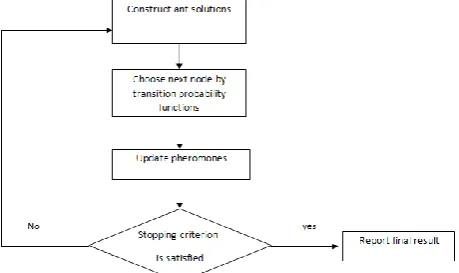
Fig. 1 shows flowchart of ant colony optimization algorithm.

Figure 1. Flowchart of ant colony optimization algorithm

IV. PROPOSED ALGORITHM

(3)

Vehicular ad hoc networks based on DYMO routing protocol and ant colony optimization algorithm in which it can work efficiently through changeable environments. Environmental changes can cause Modifications in routes, damages in infrastructures and disconnection between nodes (vehicle to vehicle or vehicle to infrastructure).

DYMO [21] is a reactive and unicast routing protocol for multihop wireless networks and is considered a successor of the popular AODV. It consists of two basic operations:

 Route discovery

 Route maintenance

The route discovery procedure is performed when a node in the network wants to send data to another node for which it does not know a route for. At this point, the first node creates a route request (RREQ) message and floods the network with it. The RREQ messages keep a list of visited nodes, so that a node, upon receiving a RREQ message, can update its routing table with a route to the source of this message. After receiving an RREQ message, the node checks whether it has a route to its destination, and if it does, it sends a route reply (RREP) message back to the source of the RREQ, telling it about this route. An RREP is also sent if the receiving node is the actual destination of the RREQ message.

The route maintenance procedure takes care of eliminating invalid routes from routing tables, attributing to each route a duration time. When a route is successfully used in the forwarding of data packets, the lifetime associated with that route is extended. When the route lifetime expires, its associated route is removed from the routing table. In This way, DYMO only keeps routes that are being used frequently.

With considering process of DYMO protocol and iterative procedure of ant colony optimization algorithm, we proposed a new ant based routing algorithm.

Two types of ants are considered in proposed algorithm:

 Explorer ant: responsible for creating routes to its source

 Search ant: responsible for searching for a specific destination

Explorer ants carry the information on the destination node and create pheromone trails along the way. Also they carry the address of the source node and also a list containing every intermediate node it has passed by. The processing of an ant can be divided in two phase:

 If TTL>0 (TIME TO LIVE) and reliability> β then add the new node address and broadcast explorer ant to neighbors

 Otherwise discard the explorer ant

RREQ format in proposed algorithm is based on DYMO’s RREQ which is improved with a probabilistic search mechanism that takes into account the level of pheromones on the paths. The transition probability of the ant located at the node (m) to the node (n) as the next hop is defined by (1).

( , ) ( , )

0 ( , )

i s Ni

m n

if s N m s

otherwise P m n

 

 

      

(1)

In (1), Ni is the set of 1-hop neighbors of node (m) and φ(m, n) is the pheromone level on the link e(m, n). Following equations are considered for pheromone update:

( , )m n ( , )m n ( , )m n

    (2)

1

2

( , ) ( )

( , ) v

c

m n c etx

Distance m n

    (3)

Two parameters were considered for pheromone update:

 Distance between two nodes which effects delay time

 Path reliability (etxv): For reliability metric, we used ETX [23] for calculating the path reliability. ETX is defined as the expected number of transmissions (including retransmission) for a successful end-to-end data forwarding and hop-by-hop acknowledgment. The following expression shows how to compute the ETX metric for a path:

1 v

v v

etx

fd rd

 (4)

fdv: the forward delivery ratio is the measured probability that a data packet successfully arrives at the recipient

rdv: the reverse delivery ratio is the probability that the ACK packet is successfully received c1 and c2 are adjustable parameters that represent the influence of the distance and reliability of a path.

Equation (5) models the pheromone evaporation scheme, similar to the real ants, where the pheromone level reduces with time (α is evaporation factor):

( , )m n (1 ). ( , )m n

    (5)

V. EXPERIMENTAL RESULTS

The simulation environment chosen for evaluating proposed algorithm was the ns-2 network simulator [24] in its version 2,34.

DYMOUM [25] was used as basis for implementation of proposed algorithm in ns-2. For more accurate implementation The Nakagami radio propagation model was used as well.

The vehicular traffic was generated by VanetMobiSim [26]. The Vehicular Ad Hoc Networks Mobility Simulator (VanetMobiSim) is an open source, java-based generator of realistic vehicular mobility traces. VanetMobiSim consists of following modules:

 Traffic generator

 Obstacle generator

 Incident Extension: specifies an incident class, its location and its duration in environment

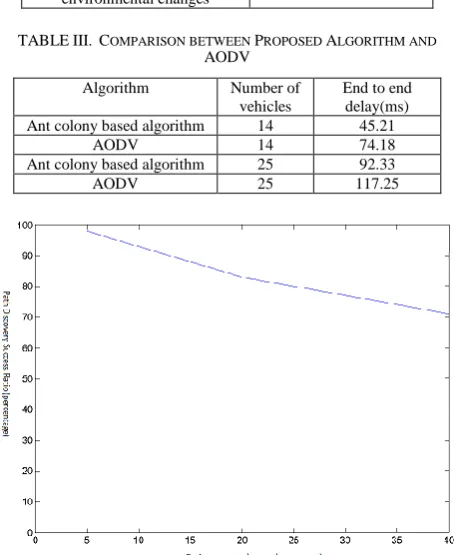
The simulation parameters are summarized in Table I. Table II shows parameters which were used for implementation of proposed algorithm.

(4)

TABLEI. SUMMARY OF SIMULATION PARAMETERS

Simulation Parameters

Scenario Area 500m*500m

Communication range 80m

Propagation model Nakagami

Transport UDP

Simulation Time 100 sec

Size of RREQ 176

MAC and PHY IEEE 802.11

TABLEII. VALUE OF PARAMETERS IN ANT COLONY BASED ROUTING ALGORITHM

Implementation parameters

Number of Ants 100

Maximum number of iteration 10

Default TTL 7

Receiving signal threshold 30db Noises caused by

environmental changes 40-60db

TABLEIII. COMPARISON BETWEEN PROPOSED ALGORITHM AND AODV

Algorithm Number of

vehicles

End to end delay(ms)

Ant colony based algorithm 14 45.21

AODV 14 74.18

Ant colony based algorithm 25 92.33

AODV 25 117.25

Figure 2. Path discovery success ratio based on environmental changes

Figure 3. Delivery ratio

Fig. 2 shows path discovery success ratio value according to environmental changes.

Fig. 3 shows delivery ratio according to number of vehicles in proposed ant colony based routing algorithm.

VI. CONCLUSION

In this paper, we studied routing problem in VANET through changeable environments. The proposed routing algorithm is based on ant colony optimization and DYMO protocol. Our goal was proposing a novel algorithm which can cope with noises, disconnection between nodes and damages in infrastructures. Two parameters were considered to evaluate discovered paths in this paper: (i) delay time, (ii) path reliability. The simulation environment chosen for evaluating proposed algorithm was the ns-2 network simulator. The vehicular traffic was generated by VanetMobiSim. A comparison was made between ant colony based routing algorithm and Ad Hoc on Demand Distance Vector (AODV). Following results were observed within experimental analysis:

 Increasing accuracy of path finding with considering changes in environment

 Decreasing Delay time in network

 In compare to AODV, less number of lost and dropt packets was observed

REFERENCES

[1] K. C. Lee, U. Lee, and M. Gerla, “Survey of routing protocols in vehicular ad hoc networks,” in Advances in Vehicular Ad-Hoc Networks: Developments and Challenges, M. Watfa, Ed., IGI Global, Oct. 2009, ch. 8, pp. 149-170.

[2] Ericson. (2002). Communication and mobility by cellular advanced radio, ComCar project. [Online]. Available: www.comcar.de

[3] Pre-Drive c2x. [Online]. Available: http://www.pre-drive-c2x.eu/ [4] W. Franz, H. Hartenstein, and M. Mauve,

Inter-Vehicle-Communications Based on Ad Hoc Networking Principles - The Fleet Net Project, Karlshue, Germany: Universitatverlag Karlsuhe, Nov. 2005

[5] A. Festag, et al., “NoW-Network on wheels: Project objectives,

technology and achievements,” in Proc. 6th International Workshop on Intelligent Transportations (WIT), Hamburg, Germany, Mar. 2008.

[6] D. Reichardt, M. Miglietta, L. Moretti, P. Morsink, and W. Schulz, “CarTALK 2000 – Safe and comfortable driving based upon inter-vehicle-communication,” in Proc. IEEE Intelligent Vehicle Symposium, 2000, pp. 545-550.

[7] R. Morris, J. Jannotti, F. Kaashoek, J. Li, and D. Decouto, “CarNet: A scalable ad hoc wireless network system,” in Proc. 9th ACM SIGOPS European Workshop, Kolding, Denmark, Sept. 2000.

[8] F. Li and Y. Wang, “Routing in vehicular ad hoc networks: A survey,” IEEE Vehicular Technology Magazine, vol. 2, no. 2, pp. 12-22, Jun. 2007.

[9] C. Perkins, E. Belding-Royer, and S. Das, “RFC3561: Ad hoc on-demand distance vector (AODV) routing,” Internet RFCs, 2003.

[10] D. Johnson, Y. Hu, and D. Maltz, “RFC4728: The dynamic source routing protocol (DSR) for mobile ad hoc networks for IPv4,” 2007.

[11] S. Y. Wang, C. C. Lin, Y. W. Hwang, K. C. Tao, and C. L. Chou, “A practical routing protocol for vehicle-formed mobile ad hoc networks on the roads,” in Proc. 8th IEEE International Conference on Intelligent Transportation Systems, Vienna, Austria, Sep. 2005, pp. 161-165.

(5)

International Conference on Mobile Computing and Networking (MobiCom’20), Boston, MA, Aug. 2000, pp. 260-272.

[13] C. Lochert, M. Mauve, H. Füßler, and H. Hartenstein, “Geographic routing in city scenarios,” ACM SIGMOBILE Mobile Computing and Communications Review (MC2R), vol. 9, no. 1, pp. 69-72, Jan. 2005.

[14] S. Debajit and K. Majumder, “An efficient ant based qos aware intelligent temporally ordered routing algorithm for manets,” barXiv preprint arXiv:1308.2762, 2013.

[15] J. Zhao and G. H. Cao, “VADD: Vehicle-Assisted data delivery in vehicular ad hoc networks,” IEEE Transactions on Vehicular Technology, vol. 57, no. 3, pp. 1910-1922, 2008.

[16] H. J. Huang and S. K. Zhang, “A routing algorithm based on dynamic forecast of vehicle speed and position in VANET,”

International Journal of Distributed Sensor Networks, vol. 12, no. 8, pp. 761-764, 2013.

[17] X. Wu, et al., “MEDAL: A moving direction and destination location based routing algorithm for vehicular ad hoc networks,”

IEEE International Conference on Communications (ICC), 2013, pp. 6412-6416.

[18] M. Dorigo and B. Mauro, “Ant colony optimization,” in

Encyclopedia of Machine Learning, Springer US, 2010, pp. 36-39.

[19] G. D. Caro and M. Dorigo, “AntNet: Distributed stigmergetic control for communications networks,” J. Artif. Intell. Res. (JAIR), vol. 9, pp. 317-365, 1998.

[20] S. L. Correia, C. Joaquim, and C. Omar, “Mobility-Aware ant colony optimization routing for vehicular ad hoc networks,” in

Proc. 2011 IEEE Wireless Communications and Networking Conference (WCNC),2011, pp. 1125-1130.

[21] I. Chakeres and P. Charles, “Dynamic MANET on-demand (DYMO) routing,” draft-ietf-manet-dymo-14, 2008.

[22] S. Binitha and S. S. Sathya, “A survey of bio inspired optimization algorithms,” International Journal of Soft Computing and Engineering, vol. 2, no. 2, May 2012.

[23] D. S. J. D. Couto, D. Aguayo, J. Bicket, and R. Morris, “A high-throughput path metric for multi-hop wireless routing,” Wireless Networks, vol. 11, no. 4, pp. 419-434, 2005.

[24] N. Simulator. (2005). 2 (NS2). [Online]. Available: http://www.isi.edu/nsnam

[25] F. J. Ros, “DYMOUM-DYMO implementation for real world and simulation,” 2009.

[26] J. Härri, et al., “VanetMobiSim: Generating realistic mobility patterns for VANETs,” in Proc. 3rd International Workshop on Vehicular Ad Hoc Networks, 2006.

Mr. Alireza Mohammadnia Oranj is

Academic Staff in IAU-Ardabil since 2001 to 2009 and Academic Staff in Ardabil University of Medical Science (ArUMS) since 2009, He obtained B.Sc. Degree in Computer Engineering Hardware From IAU-Arak and M.Sc. Degree in Computer Architecture Engineering from IAU- Science and Research Tehran Branch, He is Ph.D. Candidate in Computer Network Engineering in Azarbaycan

National Academy of Sciences (ANAS). His research interests are Hardware Technology, Robotic, Computer Networks, Sensor Networks, VLSI. He is the author of more than 10 journal and conference papers. He has more than 10 patent Innovation.

Rasim M. Alguliyev graduated in 1979 from

the Automation and Computing Machinery Faculty, Azerbaijan Technical University, Azerbaijan. He received his PhD in 1995 and his Dr.Sc. in 2003 from Supreme Attestation Commission under the President of the Republic of Azerbaijan. Since 2001, he is the Director of the Institute of Information Technology of Azerbaijan National Academy of Sciences (ANAS). In 2014, he was elected as academician of ANAS. He is the Editor-in-Chief of journals Problems of Information Technologies and Problems of Information Society. He is the author of more than 300 papers.

Dr. Shahram Jamali is an assistant professor

leading the Autonomic Networking Group at the Department of Engineering, University of Mohaghegh Ardabili. Dr. Jamali received his M.Sc. and Ph.D. degree from the Dept. of Computer Engineering, Iran University of Science and Technology in 2001 and 2007, respectively. Since 2008, he is with Department of Computer Engineering, University of Mohaghegh Ardabili and has published more than 50 conference and journal papers. His research interests are Bio-Inspired Networking, Distributed Systems, Computer Network Security, Self-Managing Computer Systems, Network Performance Evaluation. He is the author of more than 30 journal and conference papers

Farhad Yusifov received his Master’s degree

Figure

Fig. 1 shows flowchart of ant colony optimization algorithm.
TABLE III.  COMPARISON BETWEEN PROPOSED ALGORITHM AND AODV

References

Related documents

In general, series that tended to use more than one name to label or describe their documents were also less consistent in the way the document was structured or the type of content

the principal difference between a selected and a ran- drawn from simulated base populations in which the dom sample is in the frequency and spatial arrangement sample fraction,

Norlaila Binti Mok, ” Photocatalytic degradation of oily wastewater: effect of catalyst concentration load, irradiation time and temperature”, Chemical &

Mydul Islam in 2012 examined that Suitability of sea water on curing and compressive strength of structural concrete as a part of durability study, this paper describes the

Then we give the solution of the FBSDEs with two (but decoupled) Riccati equations, and derive the respective optimal feedback law for both determin- istic and random controllers,

With majority of cases being treated initially or completely in the home and community, the level of awareness of diarrhoea and simple home management practices

In the two-dimensional code, (0) expresses white, and (1) expresses black. The advantage of the two-dimensional code is the ability to express a variety of information as