Vol.7 (2017) No. 1
ISSN: 2088-5334
Cheapest Insertion Constructive Heuristic based on Two Combination
Seed Customer Criterion for the Capacitated Vehicle Routing Problem
Mansour Alssager
#, Zulaiha Ali Othman
#, Masri Ayob
# #Data mining and Optimization Group, Centre of artificial intelligence, Faculty of Information Sciences and Technology, University Kebangsaan Malaysia, Selangor, Malaysia
E-mail: [email protected], [email protected]
Abstract— The heuristic method is a well-known constructive method for initialize trail quality solutions in capacitated vehicle
routing problem. Cheapest insertion heuristic is a popular construction heuristic known for being fast, producing decent solutions, simple to implement and easy to extend handling complicated constraints. However, in previous work, there was less focus on diverse initial quality solutions. Therefore, this study proposed an extension to the cheapest insertion heuristic which consider various combinations of seed customer criteria (the first customer inserted on a route) to preserve solutions diversification. Three seed customer criteria proposed which based on the combination of two criteria based on (farthest, nearest and random criteria). The best performing criteria selected and tested on benchmark dataset, later compared with Clarke and Wright saving heuristic. The results shown that the combination of (farthest and random) criteria obtained the best initial solution which preserve balance between the quality and diversity, with less time when compared to Clarke and wright saving heuristic. This approach is for generating diverse and quality starting solutions for the capacitated vehicle routing problem.
Keywords— insertion heuristic; capacitated vehicle; routing problem; initial solution construction.
I. INTRODUCTION
The vehicle routing problem (VRP) and its extensions is one of the most widely studied optimization combinatorial problems (COPs) in the transportation domain. One of its basic variant is the Capacitated VRP (CVRP), which may be stated as follows: generate a sequence of deliveries for each vehicle in a homogeneous fleet based on a single depot so that all customers are serviced and the total distance travelled by the fleet is minimised. Each vehicle has a fixed capacity and must leave from and return to the depot. Each customer has a known demand serviced by exactly one visit of a single vehicle [1]. Up to date, many efforts made to construct the initial quality solutions for the CVRP. Generally, these solution methods are either randomly constructed or by a classical heuristics often name as (greedy methods). The aim of the constructive heuristics is to obtain fast quality solutions, not necessarily the best one [2]. However, when the solution is not final and need to be further improved by other methods such as the upper level heuristic (metaheuristic). The need for a diverse solutions pool is become critical [3]. Diversity is referred to as the key to preventing stagnation in local optima (The diversity in this context means that each solution properties are different from each other). Mainly, the constructive heuristics for
proposed CIH heuristic and how it applied to CVRP demonstrated. In (Section 3) an experimental setup and result presented. Finally, (Section 4) concluded the study.
II. MATERIAL AND METHOD
Literature reviews have shown that the use of SCC has significantly influenced the behaviour of various CIH extensions [9]. The most popular SCC for CVRP is known as the nearest, farthest, biggest demand and random [10], classified as the fixed criteria. However, the most popular one among them would be the cheapest. The use of the cheapest SCC classified the CIH as a deterministic, which always obtains the same quality solution. On the other hand, the use of random SCC classified as a non-deterministic, which has less quality solutions but preserve high solution diversifications [11]. Solution diversity is referred to as a key in preventing premature convergence and stagnation in local optima [3]. It is generally believed that diversity is beneficial in heuristic and metaheuristic to efficiently explore the given search space [12]. In the iterative stage, which usually tackled using metaheuristics, the diversification defines the amount of variety in the population pool. The diverse of initial solutions and how to maintain it is considered as one of the fundamental issues in iterative stage. Latest literature indirectly addressed the importance of solution diversify by adopting a non-deterministic two-phase construction heuristic (construction of the initial solution, followed by an improvement phase using other heuristic such as 2-opt), it is identified as always produces a different solution in each execution [6, 11, 13, 14]. Moreover, the simple deterministic CIH were enhanced by the two-phase heuristics such as in [6, 9, 15]. How-ever, the limitation of this mechanism is that incur additional configuration of adding extra computationally cost heuristics. The diversity of the solutions according to the literature can be categorised into two categories: Burke, Gustafson [3], some diversity measurement methods are intended to quantify the variety in a population (behavioural diversity), such as the common approach to measure diversity based on fitness values without measure the structural of the solutions [16]. On other hand, other methods used to measure the difference between individuals (structural diversity) which is attempting to maintain high diversity during a run by compare the solution characteristic. In this study, a structural diversity measurement is used which is presented by Maquera, Laguna [17].
A. review of the basic insertion heuristic
The cheapest insertion heuristic was defined by Solomon [7]. It begins by initialising the route under consideration with a seed customer (the first customer inserted on a route) this process named as the (initialization criteria). After initialization of each route by the selected initial criteria is finished, other customers then selected for addition to the current route, if they satisfy the problem constraint (capacity constraint in this study). However, this process is known as (insertion criterion) which is fixed in this study to (cheapest to previous customer). When no more un-routed customers can be ‘feasibly’ inserted in the current route, and as long as adding this customer does not exceed the capacity of this route, the process is repeated for a new route until either all
the routes are full or all customers have been served. However, different variants of CIH rise as result of how the two key decisions that are made at every iteration are selected: Firstly, which un-routed customer to insert as stated before (initialization criteria), secondly, where to insert it in the partial solution (insertion criteria).
B. Initialization Criteria
The basic initial criteria can be identified as follow: for each SCC (whether it is farthest, nearest or random), the distance between the depot d and the seed customer k in the customer list (CL) is computed and evaluated. This SCC selection can obtained by the function g in Eq. 1.
g (k) = cdk (1) The selection associated with the nearest k to d is performed as:
min {g(k)| k ∈ CL} (2)
while the farthest is performed as:
max {g(k)| k ∈ CL} (3)
and random customers are performed as:
k ~U([1, n]) {g(k)| k ∈ CL} (4)
where n is the number of customers.
C. Insertion Criteria
A simple insertion ‘greedy’ approach used in the proposed CIH, known as Cheapest Insertion Criterion (CIC). CIC directly computes the distance between a customer k in available CL and every customer i that has been already included into the partial solution; as can be observed by function g in Eq. 5. It assumed that the insertion of k is always performed after i.
g (k) = cik (5)
The insertion associated with the cheapest-cost (the minimum distance between the current previous inserted customer and newly suggested customer) is performed as the one presented in Eq. 2.
D. CIH Drawbacks
E. diversity measurement method
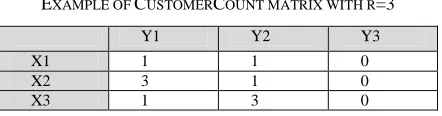
In order to calculate the diversity of the solutions, this study employs a structural diversity, which presented by Maquera, Laguna [17]. This structural diversity measurement considers the differences in properties between the compared solutions. This method works as follows: The difference value between the two solutions x and y is calculated by creating a two-dimensional matrix CustomerCount of size r x r, where r is the maximum number of routes in either x or y (in this case, the number of routes in the solution was fixed). Then, the matrix will be filled up in such a way that CustomerCount (xi,yj) include the number of customers that match route (ith) in solution x with route (jth) in solution y. After the above process is complete, either the total number of customers is computed in the solution, x or y, then the largest CustomerCount value is found. This value is then summed and the corresponding column and row is thus eliminated. The process will finish when CustomerCount becomes empty. The sum value will be subtracted from the total number of customers and the difference between two solutions x and y is obtained. Here, an example demonstrated the above-mentioned technique to obtain the diversity between solutions x and y:
X= (3, 7) (4, 5, 8, 6) (10, 2, 9, 1) Y= (7, 9, 6, 8, 5) (1, 2, 3, 4, 10)
TABLE I
EXAMPLE OF CUSTOMERCOUNT MATRIX WITH R=3
Y1 Y2 Y3
X1 1 1 0
X2 3 1 0
X3 1 3 0
The CustomerCount matrix is filled as in Error!
Reference source not found., where the value of r is 3.
However, the first value (x1, y1) in the matrix in table, the number of customers that are mutual between route x1 and route y1. This operation is repeated until the entire CustomerCount matrix is filled. The maximum number in the matrix will saved, and then all values in the same column and row will deleted. This operation repeated until there are no more values in the matrix. Next, the sum of all saved values is calculated to detect the average number of customers in both solutions. For example, after filling up CustomerCount matrix with the number of customers that are mutual between routes, the values (x2, y1) selected as maximum value 3 in the matrix; then, the corresponding column and row will deleted. The same procedure repeated for the values (x3, y2). Therefore, the sum of the maximum values in CustomerCount matrix is 6. After that, the average of the total customers in both solutions are found by dividing it by 2, (20/2=10). Finally, the difference value between solution x and y is given by 10-6=4. The difference value (diversity) is calculated for each solution x in population P, with the remaining solution in P; next, the average is found for each solution corresponding to other solutions in P.
F. The proposed cheapest insertion heuristic based on two-seed customer criteria
The proposed CIH is similar to the basic previously presented CIH in insertion criteria but differ in terms of the initialisation criteria of the seed customer. The basic CIH uses one type of SCC; either nearest, farthest or random [18]. On other hand, the proposed CIH uses a combination of two types of SCC from the three types shown in Table 2. Which named as CIH based Two-Seed Customer Criteria (Two-CIH). This combination aims to make a balance between the solution quality and diversity. Since the proposed criterion is a combination of two criteria, only one type of SCC selected during the assignment of the seed customer. Therefore, a random selection used to select the type of SCC in each route SCC assignment.
TABLE II
THE BASIC AND TWO-SEED CUSTOMER CRITERIA
Abbreviation Seed customer criteria Category Type Distance measure
N Single Nearest
Deterministic F Single Farthest
R Single Random
Non-deterministic NF Combined nearest or farthest
NR Combined nearest or random FR Combined Farthest or random
The proposed Two-CIH was based on the heuristic presented by [18]. The pseudo code of the proposed CIH presented in Error! Reference source not found..
Fig. 1. The CIH pseudo code
1 Procedure GenerateInitialSolution( s, MaxIter, seedCustomerCriteria);
2 ConsecutiveTrials ← 0;
3 Initialize the CL;
4 Initialize s by v empty routes 5 for v’ = 1 . . . v do
6 Evaluate the value of each k ∈ CL based on seedCustomerCriteria 7 s v’← k
8 Update CL; {CL ← CL - {k}} 9 InsertionCriterion ← CIC as in Eq. 2. 10
while CL ∅ and at least one customer k ∈ CL can be added to s do 11
for v’ = v0 . . . v and CL ∅ do
12 if at least one customer k ∈ CL can be inserted into the vehicle v’
then
13 Evaluate the value of each cost g(k) for k ∈ CL; 14 g Min.← InsertionCriterion
15 k’ ← customer k associated to g Min.;
16 if capacity of k’ + demand of v’ ≤ vehicle demand do 17 s v’← s v’∪ {k’};
18 Update CL; 19 Update v’;
20 End while
21
if s is infeasible and ConsecutiveTrials MaxIter then 22 ConsecutiveTrials ← ConsecutiveTrials + 1;
23 Go to line 3;
24 if ConsecutiveTrials = MaxIter then
25 report unable to construct feasible solution
26 return s
The heuristic began by randomly selecting one criteria from the proposed SCC (line 4) which differed from Subramanian [18] original pseudocode. An initial costumer list and empty solution was generated (line 3-4). Each route filled with a seed customer k from the Customer List (CL); it selected based on the proposed combined criteria (lines 5-8), this step illustrated as in Error! Reference source not
found.. (a). An insertion criterion was fixed as cheapest
insertion criteria (CIC) in line 9. Iteratively, each remaining customer assigned to its respective routes (lines 10-20). Only a single route considered for insertion in each iteration these steps are illustrated as in Error! Reference source not
found.. (b, c, and d). While the CL is not empty and there
was at least one customer k ∈ CL that can be added to the current partial solution without violating any constraints (lines 11-19), each route was filled with a selected customer using CIC (lines 13-15) these steps is illustrated as in Error!
Reference source not found.. (f). If an infeasible solution
has been found, the procedure restarts from line 3 (line 23). In this case, an infeasible solution necessarily corresponded to an incomplete solution, which meant that the selected insertion procedure was not capable of including all customers using v vehicles. However, the returned solution may not have visited all customers because of the earlier stated problem of high tightness value.
(a) (b) (c)
(d) (e) (f)
Fig. 2. The CIH steps.
III. RESULTS AND DISCUSSION
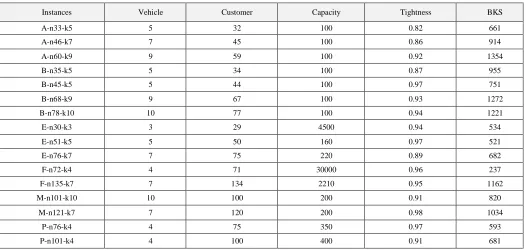
Experiments were conducted to test the performance of the proposed CIH on the benchmark datasets of Augerat, Belenguer [19]. There were 16 CVRP instances; the total number of clients varied from 30 to 135 clients, and the total number of vehicles varied from 3 to 10 vehicles. Details of these instances were presented in Error! Reference source
not found. and obtained from [20] .
TABLE III
CVRP INSTANCES CHARASTRASTICS.
Instances Vehicle Customer Capacity Tightness BKS
A-n33-k5 5 32 100 0.82 661
A-n46-k7 7 45 100 0.86 914
A-n60-k9 9 59 100 0.92 1354
B-n35-k5 5 34 100 0.87 955
B-n45-k5 5 44 100 0.97 751
B-n68-k9 9 67 100 0.93 1272
B-n78-k10 10 77 100 0.94 1221
E-n30-k3 3 29 4500 0.94 534
E-n51-k5 5 50 160 0.97 521
E-n76-k7 7 75 220 0.89 682
F-n72-k4 4 71 30000 0.96 237
F-n135-k7 7 134 2210 0.95 1162
M-n101-k10 10 100 200 0.91 820
M-n121-k7 7 120 200 0.98 1034
P-n76-k4 4 75 350 0.97 593
P-n101-k4 4 100 400 0.91 681
All experiments performed on a 2.4 GHz Intel core i5 laptop computer, 4 gigabyte of ram; and the heuristics coded using C++. The mini-mum (Min.), maximum (Max.), average (Avg.), standard deviation (Std.) and average result of all instances (Avg. All) computed over 31 independent runs with 30 solutions on each problem instances and the results were summarised in the following subsection. The best results showed in bold. The following subsection also displayed two experiments, which conducted based on two
A. The Proposed CIH Based on Solution Quality
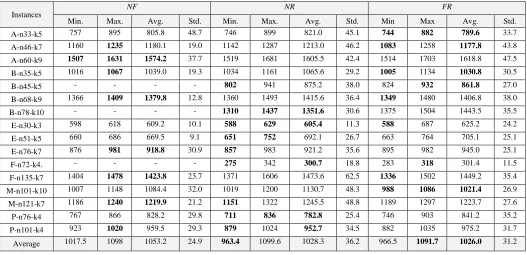
In order to estimate the benefit of using the CIH with different SCCs in terms of solution quality, three extensions of CIH heuristics applied to the basic CIH. The results
showed in Error! Reference source not found.. The table presented the min, max, average and standard deviation for various type Two-SCC-CIHs such as NF-SCC-CIH, NR-SCC-CIH and FR-NR-SCC-CIH.
TABLE IV
SOLUTION QUALITY COMPARISON RESULT BASED ON THE TWO-SCC-CIH TYPES
In Table 4, the ‘‘NR” SCC performed slightly better than the “FR” criteria, and much better than “NF” criteria when tested on capacitated vehicle routing problem. This comparison was based on the Min value, where 9 out of 16 instances were better when using “NR” than other criteria. In addition, it was slightly bigger in the overall Average when compared to its competitor “FR” SCC. However, the overall Average result of all instances was better when using the “FR” where the results showed that the best result of overall Average of (Max and Avg.) obtained by “FR”. Furthermore, it is worth mentioning that the “NF” criteria were unable to construct initial solutions for some instances (n45-k5, B-n78-k10, and F-n72-k4, F-n135-k7). This was mainly due to the tightness of the instances being very high (0.97, 0.94, 0.96 and 0.95, respectively). Moreover, the results also demonstrated that the two combination criteria with random criteria, “FR” and “NR”, performed better solution quality and were able to construct initial solutions for all instances compared to “FN”. The results illustrated that “FN” was unable to construct initial solutions for some instances, which was marked as a dashed line in the table. It clearly indicated that the CIH is able to overcome one of the known drawbacks of fixed criteria when random SCC criteria are combined with fixed criteria.
B. The Proposed CIH Based on Solution Quality
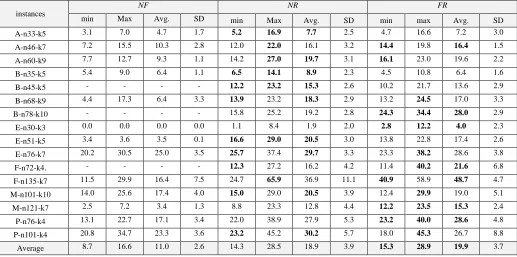
Table 5 displayed the results of solution diversity for the three CIH extensions. The Min and Max values described the similarity of solutions. The Min value indicated how far the solutions are similar to each other; while the Max value indicated how far the solutions are diversified or different. The Avg. described the average diversifying value for current instance, while the SD indicated the standard deviation for Min and Max. The solution diversity of the proposed CIH evaluated based on the max value. Table 5 also presented the diversity values of the three criteria. The “FR” criterion obtained the best Max value for 9 out of 16, which indicated that the solution was much diversified in those 9 instances, followed by “NR” with 7 out of 16 and, lastly, NF with zero instances. Moreover, the overall Average of the Min, Max and Avg. values for all instances was better when using the “FR” criteria. One may say that when the quality is compared to the diversity in the initial stage of the combinatorial problem, then clearly one can choose the diversifying solutions rather than the quality ones since the solutions are not final and the differences in quality is not that much. The solutions, for now, are in a preliminary stage of whole methodology of designing a better solution, and the quality of both “NR” and “FR” SCC criteria is slightly different. Therefore, the diversifying solution using the “FR” SCC selected to carry out next experiments. Instances
NF NR FR
Min. Max. Avg. Std. Min. Max. Avg. Std. Min Max Avg. Std.
A-n33-k5 757 895 805.8 48.7 746 899 821.0 45.1 744 882 789.6 33.7
A-n46-k7 1160 1235 1180.1 19.0 1142 1287 1213.0 46.2 1083 1258 1177.8 43.8
A-n60-k9 1507 1631 1574.2 37.7 1519 1681 1605.5 42.4 1514 1703 1618.8 47.5
B-n35-k5 1016 1067 1039.0 19.3 1034 1161 1065.6 29.2 1005 1134 1030.8 30.5
B-n45-k5 - - - - 802 941 875.2 38.0 824 932 861.8 27.0
B-n68-k9 1366 1409 1379.8 12.8 1360 1493 1415.6 36.4 1349 1480 1406.8 38.0
B-n78-k10 - - - - 1310 1437 1351.6 30.6 1375 1504 1443.5 35.5
E-n30-k3 598 618 609.2 10.1 588 629 605.4 11.3 588 687 625.2 24.2
E-n51-k5 660 686 669.5 9.1 651 752 692.1 26.7 663 764 705.1 25.1
E-n76-k7 876 981 918.8 30.9 857 983 921.2 35.6 895 982 945.0 25.1
F-n72-k4. - - - - 275 342 300.7 18.8 283 318 301.4 11.5
F-n135-k7 1404 1478 1423.8 23.7 1371 1606 1473.6 62.5 1336 1502 1449.2 35.4
M-n101-k10 1007 1148 1084.4 32.0 1019 1200 1130.7 48.3 988 1086 1021.4 26.9
M-n121-k7 1186 1240 1219.9 21.2 1151 1322 1245.5 48.8 1189 1297 1223.7 27.6
P-n76-k4 767 866 828.2 29.8 711 836 782.8 25.4 746 903 841.2 35.2
P-n101-k4 923 1020 959.5 29.3 879 1024 952.7 34.5 882 1035 975.2 31.7
TABLE V
SOLUTION DIVERSITY COMPARISON RESULT OF THE THREE CIH TYPES
The results revealed that the best criteria used for constructing the initial solution for the CVRP was “FR”. Furthermore, the results also showed that “FR” is different from the other criteria employed for the CVRP; thus, a statistical t-test among the “FR” with other Two-SCCs executed. Table 6 displayed the p-value results. The p-value results that showed (p<0.05) were a significant difference between “FR” compared to the used “NF” and “NR”.
TABLE VI
P-VALUE RESULTS FOR THE “FR” PAIRED WITH OTHER CRITERIA
Instances p-Value
FR & NF FR & NR
A-n33-k5 0.0 0.0
A-n46-k7 0.0 0.0
A-n60-k9 0.0 0.0
B-n35-k5 0.0 0.0
B-n45-k5 - 0.0
B-n68-k9 0.0 0.0
B-n78-k10 - 0.0
E-n30-k3 0.047 0.006
E-n51-k5 0.0 0.0
E-n76-k7 0.470 0.0
F-n72-k4. - 0.001
F-n135-k7 0.073 0.0
M-n101-k10 0.006 0.0
M-n121-k7 0.0 0.0
P-n76-k4 0.0 0.027
P-n101-k4 0.110 0.170
Table 6 presented the p-values for the best criteria paired with two other criteria for all instances. With such results, it can be concluded that a CIH with different SCC criterion has
different impact, where the criteria used in the CVRP are different from each other.
C. Performance of the FR-SCC-CIH Compared to Other Fixed CIH Criteria
Table 7 demonstrated the difference between the “FR” CIH, the fixed “N” CIH and the fixed “F” SCC-CIH from the solution quality prospective. It can be seen that the N and F based CIH were unable to construct feasible solutions for some instances, representing 37% and 43% of the overall instances, respectively. While the proposed combined, “FR” SCC was able to overcome this drawback and successfully construct solutions for all instances. Moreover, the fixed “N” and “F” SCC were always constructing the exact solutions. Therefore, they drove the solutions to the same area in the problem search space which affected the solution diversity in later stages.
D. Performance of the FR-SCC-CIH with CW Heuristic
Furthermore, a comparison made between the “FR” and CW to demonstrate the difference, with different prospective, regarding the solution quality and computational time presented in Error! Reference source not found.. The CW heuristic was able to obtain the best solution for all instances, but with high computational cost ranging from 5 seconds for small instances and up to 15 minutes for larger ones. Whilst using the “FR” based CIH, the solution quality was acceptable since the diversity was the important factor in this study. This solution quality of the proposed method came with small computational costs compared to CW with less than 5 seconds for even larger instances.
instances
NF NR FR
min Max Avg. SD min Max Avg. SD min max Avg. SD
A-n33-k5 3.1 7.0 4.7 1.7 5.2 16.9 7.7 2.5 4.7 16.6 7.2 3.0
A-n46-k7 7.2 15.5 10.3 2.8 12.0 22.0 16.1 3.2 14.4 19.8 16.4 1.5
A-n60-k9 7.7 12.7 9.3 1.1 14.2 27.0 19.7 3.1 16.1 23.0 19.6 2.2
B-n35-k5 5.4 9.0 6.4 1.1 6.5 14.1 8.9 2.3 4.5 10.8 6.4 1.6
B-n45-k5 - - - - 12.2 23.2 15.3 2.6 10.2 21.7 13.6 2.9
B-n68-k9 4.4 17.3 6.4 3.3 13.9 23.2 18.3 2.9 13.2 24.5 17.0 3.3
B-n78-k10 - - - - 15.8 25.2 19.2 2.8 24.3 34.4 28.0 2.9
E-n30-k3 0.0 0.0 0.0 0.0 1.1 8.4 1.9 2.0 2.8 12.2 4.0 2.3
E-n51-k5 3.4 3.6 3.5 0.1 16.6 29.0 20.5 3.0 13.8 22.8 17.4 2.6
E-n76-k7 20.2 30.5 25.0 3.5 25.7 37.4 29.7 3.3 23.3 38.2 28.6 3.8
F-n72-k4. - - - - 12.3 27.2 16.2 4.2 11.4 40.2 21.6 6.8
F-n135-k7 11.5 29.9 16.4 7.5 24.7 65.9 36.9 11.1 40.9 58.9 48.7 4.7
M-n101-k10 14.0 25.6 17.4 4.0 15.0 29.0 20.5 3.9 12.4 29.9 19.0 5.1
M-n121-k7 2.5 7.2 3.4 1.3 8.8 23.3 12.8 4.4 12.2 23.5 15.3 2.4
P-n76-k4 13.1 22.7 17.1 3.4 22.0 38.9 27.9 5.3 23.2 40.0 28.6 4.8
P-n101-k4 20.8 34.7 23.3 3.6 23.2 45.2 30.2 5.7 18.0 45.3 26.7 8.8
TABLE VII
DIFFERENCE BETWEEN RANDOM GENERATION METHOD AND CIH BASED METHOD
instances N F FR
min Max Avg. SD T(s) min Max Avg. SD T(s) min Max Avg. SD T(s)
A-n33-k5 829 829 829 0 0.10 - - - 744 882 789.6 33.7 0.14
A-n46-k7 1201 1201 1201 0 0.18 1161 1161 1161 0 0.2 1083 1258 1177.8 43.8 0.16
A-n60-k9 - - - 1590 1590 1590 0 0.24 1514 1703 1618.8 47.5 0.25
B-n35-k5 1024 1024 1024 0 0.06 1016 1016 1016 0 0.1 1005 1134 1030.8 30.5 0.09
B-n45-k5 - - - 824 932 861.8 27.0 3.98
B-n68-k9 1360 1360 1360 0 0.1 1371 1371 1371 0 0.37 1349 1480 1406.8 38.0 0.30
B-n78-k10 - - - 1375 1504 1443.5 35.5 2.09
E-n30-k3 598 598.0 598.0 0 1.11 - - - 588 687 625.2 24.2 1.47
E-n51-k5 - - - 663 764 705.1 25.1 0.31
E-n76-k7 869 869 869 0 0.30 943 943 943 0 0.1 895 982 945.0 25.1 0.25
F-n72-k4. - - - 283 318 301.4 11.5 4.79
F-n135-k7 1477 1477 1477 0 1.76 - - - 1336 1502 1449.2 35.4 1.51
M-n101-k10 1147 1147 1147 0 0.44 995 995 995 0 0.29 988 1086 1021.4 26.9 0.37
M-n121-k7 - - - 1205 1205 1205 0 1.5 1189 1297 1223.7 27.6 1.06
P-n76-k4 797 797 797 0 0.67 849 849 849 0 0.55 746 903 841.2 35.2 0.34
P-n101-k4 944 944 944 0 0.32 984 984 984 0 0.41 882 1035 975.2 31.7 0.44
TABLE VIII
COMPARISON BETWEEN “FN” BASED CIH WITH CW HEURISTIC
Instances CW FR
Min max Avg. SD T(s) min max Avg. SD T(s)
A-n33-k5 691 691 691 0.0 7.3 744 882 789.6 33.7 0.14
A-n46-k7 939 939 939 0.0 24.6 1083 1258 1177.8 43.8 0.16
A-n60-k9 1428 1428 1428 0.0 70.6 1514 1703 1618.8 47.5 0.25
B-n35-k5 978 978 978 0.0 10.3 1005 1134 1030.8 30.5 0.09
B-n45-k5 758 758 758 0.0 21.4 824 932 861.8 27.0 3.98
B-n68-k9 1322 1322 1322 0.0 92.1 1349 1480 1406.8 38.0 0.30
B-n78-k10 1268 1268 1268 0.0 165.6 1375 1504 1443.5 35.5 2.09
E-n30-k3 538 538 538 0.0 5.7 588 687 625.2 24.2 1.47
E-n51-k5 588 588 588 0.0 29.9 663 764 705.1 25.1 0.31
E-n76-k7 738 738 738 0.0 116.3 895 982 945.0 25.1 0.25
F-n72-k4. 256 256 256 0.0 106.5 283 318 301.4 11.5 4.79
F-n135-k7 1214 1214 1214 0.0 935.5 1336 1502 1449.2 35.4 1.51
M-n101-k10 830 830 830 0.0 245.2 988 1086 1021.4 26.9 0.37
M-n121-k7 1076 1076 1076 0.0 804.3 1189 1297 1223.7 27.6 1.06
P-n76-k4 655 655 655 0.0 119 746 903 841.2 35.2 0.34
P-n101-k4 766 766 766 0.0 295.5 882 1035 975.2 31.7 0.44
IV. CONCLUSION
This study proposed two combinations of seed customer criterion to improve CIH for CVRP solution quality (Two-SCC-CIH) as FR, NR and NF. The proposed methods had proven their ability to establish diversification of the solution method for the CIH as they presented better results in com-parison to the basic CIH. The used random combination SCC (FR and NR) obtained better solutions compared to the fixed combination (NF). However, the farthest and random (FR) to depot as seed customer criteria obtained better performance based on the balance between quality and di-versity. The use of FR seed customer criterion for CIH also obtained better solution quality compared to the fixed SCC,
along with better time com-pared to the CW heuristic. The proposed Two-SCC-CIH was developed based on the one-phase approach, as the quality solution can be improved using the 2-phase approach.
REFERENCES
[1] Gendreau, M., et al., Metaheuristics for the Vehicle Routing Problem and Its Extensions: A Categorized Bibliography, in The Vehicle Routing Problem: Latest Advances and New Challenges, B. Golden, S. Raghavan, and E. Wasil, Editors. 2008, Springer US. p. 143-169.J. Breckling, Ed., The Analysis of Directional Time Series: Applications to Wind Speed and Direction, ser. Lecture Notes in Statistics. Berlin, Germany: Springer, 1989, vol. 61.
[3] Burke, R., S.M. Gustafson, and G. Kendall. A Survey And Analysis Of Diversity Measures In Genetic Programming. in GECCO. 2002. [4] Clarke, G. and J.W. Wright, Scheduling of Vehicles from a Central
Depot to a Number of Delivery Points. Operations Research, 1964. 12(4): p. 568-581.
[5] Pichpibul, T. and R. Kawtummachai, New enhancement for Clarke-Wright savings algorithm to optimize the capacitated vehicle routing problem. 2012.
[6] Mester, D. and O. Bräysy, Active-guided evolution strategies for large-scale capacitated vehicle routing problems. Computers & Operations Research, 2007. 34(10): p. 2964-2975.
[7] Solomon, M.M., Algorithms for the vehicle routing and scheduling problems with time window constraints. Operations Research, 1987. 35(2): p. 254-265.
[8] Cordeau, J.F., et al., A guide to vehicle routing heuristics. Journal of the Operational Research society, 2002: p. 512-522.
[9] Hosny, M.I. and C.L. Mumford, Constructing initial solutions for the multiple vehicle pickup and delivery problem with time windows. Journal of King Saud University - Computer and Information Sciences, 2012. 24(1): p. 59-69.
[10] Carić, T., et al., A modelling and optimization framework for real-world vehicle routing problems. Vehicle Routing Problem, 2008. 15. [11] Campbell, A.M. and M. Savelsbergh, Efficient insertion heuristics
for vehicle routing and scheduling problems. Transportation science, 2004. 38(3): p. 369-378.
[12] Berg, H., Viewing the problem from different angles: a new diversity measure based on angular distances. Journal of Artificial Evolution and Applications, 2009. 2009: p. 3.
[13] Stålhane, M., et al., A construction and improvement heuristic for a liquefied natural gas inventory routing problem. Computers & Industrial Engineering, 2012. 62(1): p. 245-255.
[14] Csiszár, S., Two-Phase Heuristic for the Vehicle Routing Problem with Time Windows. Acta Polytechnica Hungarica, 2007. 4(2): p. 143-156.
[15] Joubert, J. and S. Claasen, A sequential insertion heuristic for the initial solution to a constrained vehicle routing problem. ORiON: The Journal of ORSSA, 2006. 22(1): p. 105-116.
[16] Rosca, J.P. Genetic Programming Exploratory Power and the Discovery of Functions. in Evolutionary Programming. 1995. Citeseer.
[17] Maquera, G., et al., Scatter Search Applied to the Vehicle Routing Problem with Simultaneous Delivery and Pickup. Int. J. Appl. Metaheuristic Comput., 2011. 2(2): p. 1-20.
[18] Subramanian, A., Heuristic, exact and hybrid approaches for vehicle routing problems. 2012, Ph. D. thesis, Universidade Federal Fluminense, Niterói, Brazil.
[19] Augerat, P., et al., Computational results with a branch and cut code for the capacitated vehicle routing problem. Rapport de recherche- IMAG, 1995.