Vol.6 (2016) No. 6
ISSN: 2088-5334
Towards MOOC for Technical Courses: A Blended Learning
Empirical Analysis
Siti Feirusz Ahmad Fesol
#1, Sazilah Salam
##
Faculty of Information and Communication Technology, Universiti Teknikal Malaysia Melaka, Hang Tuah Jaya, 76100 Durian Tunggal, Melaka, Malaysia
E-mail: [email protected]
Abstract— Massive Open Online Learning (MOOC) is one of the rapidly growing and the most trending online learning platform throughout the world. As reported by Class Central up until December 2015, there are more than a total of 4200 courses, which enrolled more than 35 million students and adopted by more than 500 universities all over the world. Thus, the objective of this study is to identify the students’ readiness towards MOOC technical courses based on blended learning approach. This study adapted quantitative based approach to analyse the data gathered. Descriptive analysis and factor analysis are used to empirically analyse a total of 39 items on student attitude towards blended learning. This study successfully in developing six dimensions of student attitude towards the implementation of MOOC learning. The attributes namely are attitude towards learning flexibility, online learning, study management, technology, online interaction, and classroom learning. The findings summarized that, when students had a positive attitude towards learning flexibility, online learning, study management, technology, and online interaction, the students were more likely to adapt to blended learning and highly ready towards MOOC learning. On the other hand, when students had a positive attitude towards classroom learning, they were less likely ready towards MOOC learning, as they would prefer to meet their lecturers and friends in a physical lecture class compared to on the web-based. Understanding of student’s readiness towards MOOC learning based on blended learning approach is one of the critical success factors for implementing successful MOOC by higher learning institutions.
Keywords—student readiness; student adaptability; MOOC; online learning; blended learning
I. INTRODUCTION
The influence of technology innovation continues expanding and impacting all industries as it evolves including in the education field. In education, the technology roles have directly and indirectly changed the design and delivery of teaching and learning process. Devices like smartphones and tablets are starting to replace conventional classroom teaching and learning system. This change has brought a paradigm shift especially in the field of higher learnings institution. This scenario affecting the teaching practices and the ways of students acquire knowledge. Thus, in order to be in line with the current technology change, it is a must for higher learning institutions to continuously figure out latest and innovative solutions to improve the current teaching and learning process [1].
A. Massive Open Online Course (MOOC)
One of the solutions is by adapting teaching and learning process with online learning. MOOC is one of the most rapidly growing online educational based learning. Basically, the main purpose of online learning is to offer its learners
with access to education materials at their own pace and time, as well as lowering the average educational learning cost [2]. MOOC is a tuition-free course taught over the internet which allows virtually anyone to attend the course [2]. As reported by Class Central up until December 2015, there are more than a total of 4200 courses being offered, which enrolled more than 35 million students and adopted by more than 500 universities all over the world and it is expected that the number to increase more than double in 2016 [3]. The courses offered cover all the fields which can be categorized into technical courses which are technical and business courses; and non-technical courses which are humanities and social science courses.
blended learning can be categorized into six broad aspects, namely: attitude towards learning flexibility (FL), attitude towards online learning (OL), attitude towards study management (SM), attitude towards technology (TE), attitude towards online interaction (OI) and attitude towards classroom learning (CL) [1]. The objective of this study is to identify the student’s readiness towards the implementation of MOOC technical courses based on blended learning approach.
B. Student Attitude Towards Blended Learning
In this research, the six learning aspect of student attitude is adapted from the study done by Tang and Chaw [1]. The study identified six learning aspects to measure the student’s readiness towards blended learning, which are learning flexibility, online learning, study management, technology, online interaction and classroom learning. The first learning aspect is learning flexibility. Blended learning provides location convenience and time saving to the learners. The learning process can be done anytime and anywhere at their convenience period. A student also has unlimited time to access to the learning materials through the web. The second learning aspect is online learning. Online learning aspect allows learners to reflect and express their ideas better and this suited with learners who reluctant to share their ideas in front of public [1]. Several studies also support that online learning discussion able to promote a high level of interactivity with peers, influence active collaborative learning, can increase student engagement and improve student performance [12].
The third learning feature is study management. Tang and Chaw [1] shared that study management aspect can be reflected as a self-regulated learning process in which learners make an intended effort to plan, manage and direct the learning process with the instructor. With proper study management, learners able to create high in self-discipline and can motivate themselves with the learning process. The fourth learning aspect is technology. Information technology is one of the major role plays towards successful blended learning. Technology allows the learners to engage more with the learning process at anytime and anyplace. Besides, through technology assistance, learners can build online community across borders and time zone, as well as more prevalent than traditional face-to-face communities.
The fifth learning feature is online interaction. Two-way interaction and group discussion must exist in order to engage the learners with the learning process. Thus, these elements should be incorporated into a blended learning environment. In addition, blended learning provides a seamless communication medium especially for group-based learning which allows the student to actively communicate with another student in the MOOC course. Moreover, online learning platform also can motivate and encourage learner-learner and learner-learner-instructor interaction boundlessly. The sixth learning feature is classroom learning. The authors [1] also shared that the classroom community offers a sense of real, meaningful interaction between learners and instructors, which cannot be replaced by online learning. The stronger the student’s dependence for classroom learning, the less prepared for the student to move towards fully MOOC implementations which require high self-independence.
However, with the assistance of interactive content and e-activities offers in MOOC these problems can be addressed [13], [14]. Therefore, the early hypothesis that can be drawn is a student who possesses a positive attitude towards learning flexibility, online learning, study management, technology, and online interaction reflect a high level of readiness to adapt towards MOOC learning. In contrast, the more negative of student attitude towards classroom learning, the more prepared the student will be towards MOOC learning.
C. Student Readiness Towards MOOC
Overall, each of the learning aspects highlighted above address the major advantages offered by blended learning through online learning and MOOC. This also reflects that online learning as one of the preferred learning platform options by generation Y (gen Y) learners [3]. Gen Y is a generation who was born between the 1980 and the year 2000 and is a generation that high with visual literacy; comfortable in an image-rich environment; equipped with latest technology and gadgets, and they are online and connected 24/7, 365 days a year [15]. While online learning offers flexibility in accessing the learning materials and conducting learning process as per prefer by the learners’ own pace and convenience time. Thus this platform becomes one of the preferable learning platforms among gen Y learners. Through this study, we can identify the readiness level of gen Y learners towards most highly technology online learning platform which is MOOC. As cited by [1] in their research, it is essential for IHLs generally, and higher management of each university specifically, to understand their students’ attitude in order to identify the level of readiness for blended learning.
II. MATERIAL AND METHOD
A quantitatively based method was chosen as the blueprint in this study which focuses on exploratory research. Questionnaire type is used as the main data collection method for this study. This section explains on the sample chosen, chosen survey instrument, data collection procedures and analysis methods used to analyze the gathered data.
A. Participants
how the survey being carried out and the important definitions of few terms used in the study. Among the participants, 536 (59.1%) of them were male while the rest were female. Table 1 shows the scattering number of participants based on their respective faculties.
TABLEI
THE NUMBER OF PARTICIPANTS BY FACULTY Faculty Frequency Percent
FKM 69 7.6
FKEKK 97 10.6
FKP 102 11.2
FPTT 109 12
FKE 127 14
FTMK 148 16.3
FTK 258 28.3
Total 909 100
B. Survey Instrument
Questionnaire data collection methods have been widely used in collecting information on student readiness for learning research [1], [16]-[18]. The questionnaire consists of three major sections part I, part II and part III. Part I gathered information on respondent’s demographic info and their understanding of blended learning and MOOC where the item is measured using a likert scale from 1 to 5 (1-Not all familiar; 2-Slightly familiar; 3-Somewhat familiar; 4-Moderately familiar; 5-Extremely familiar) options. While part II consists of 39 items to measure the student’s attitude towards six learning aspects where each of the 39 items is measured using a likert scale from 1 to 5 (1-Completely Disagree; 2-Somewhat Disagree; 3-Somewhat Agree; 4-Strongly Agree; 5-Completely Agree) options. Lastly, part III collected information on technology they used. This study adopted and enhanced a student readiness model from Tang and Chaw (2013). In addition, three items were added to identify the construct readiness towards MOOC learning.
The questionnaire consists of 39 items categorized into seven learning aspect instruments namely as Learning Flexibility (FL), Online Learning (OL), Study Management (SM), Technology(TE), Online Interaction (OI), Classroom Learning (CL), and Readiness Towards MOOC (RTM). From these seven instruments, six instruments categorized as independent variables (FL, OL, SM, TE, OI, CL) and one item as dependent variable (RTM). This model proposed that, when students had a positive attitude towards learning flexibility, online learning, study management, technology, and online interaction, the students were more likely to adapt to blended learning and highly ready towards MOOC learning. On the other hand, when students had a positive attitude towards classroom learning, they were less likely ready towards MOOC learning, as they would prefer to meet their lecturers and friends in a physical lecture class compared to on the web-based. Fig. 1 depicts graphically the research model adopted in this.
C. Data Collection Procedure and Analysis
A total of 1000 questionnaire distributed manually to the participants. Only 950 questionnaires successfully returned back and a total of 909 responses were identified as valid response being analyzed. In order to identify the reliability
each of the construct used, Cronbach-Alpha test was implemented.
III.RESULT AND DISCUSSION
This section presents the results of the study. Findings from the Cronbach's Alpha value for all the variables reflected as acceptable (above .70) and preferable (above .80) [19]. This reflects very good internal consistency reliability among the items for each of the construct. This mirrors that the constructs used to measure student’s readiness in this study are reliable. Table 2 presents the Cronbach-Alpha value and number of items for each of the construct.
A. Demographic Analysis
In order to capture the respondents’ background details on mobile devices and their understanding on blended learning and MOOC, an extra three items added to the questionnaire. When asked about the mobile devices that they used to access information, among 909 feedbacks, 86.8% own an android based phone, 15.3% own an iPhone, 11.4% have a tablet, 5.7% have an iPad, 2.6% own an eBook reader, 1.1% own iPod and remaining 2.2% of the participants that do not own any mobile devices. This reflects that majority of the respondents have technology facilities to access the learning materials anytime and anywhere.
Fig. 1 Research model to measure student readiness towards MOOC learning
TABLEII
CRONBACH-ALPHA VALUE FOR EACH OF THE INSTRUMENTS Component Cronbach Alpha Items
Flexible Learning .722 4
Online Learning .736 8
Study Management .718 6
Technology .806 6
Online Interaction .767 7
Classroom Learning .838 5
Readiness towards MOOC .878 3
(6.5 %) respondents are extremely familiar (M = 3.27; SD = .94).
Fig. 3 below illustrates the distribution of respondents’ understanding MOOC learning. The results showed that 52 (6.0 %) of the respondents are not familiar, 88 (10.1 %) respondents slightly familiar and the number of 315 (36.3 %) respondents were somewhat familiar. While a total of 325 (37.4 %) respondents were moderately familiar and 88 (10.1 %) respondents are extremely familiar with MOOC (M = 3.36; SD = 1.00).
Fig. 2 Result for ‘Please rate your understanding on blended learning’ item
Fig. 3 Result for ‘Please rate your understanding on MOOC learning’ item
B. Descriptive Analysis
To further understand the data gathered, this section analyzed based on the means and standard deviation values by each construct. In the statistical results of the flexible learning category, the results clearly reflect that the learners are strongly agreed to have flexible options in terms of an access to the lecture materials, learning time management and location to conduct the learning, with total average means of 4.00. Table 3 below summarize mean and standard deviation of the items for flexible learning dimension.
TABLEIII
DESCRIPTIVE RESULTS FOR FLEXIBLE LEARNING CATEGORY
Flexible Learning Means SD
FL1
I would like unlimited access to lecture
materials 4.20 0.87
FL2 I would like to decide where I want to study 3.98 0.89
FL3 I like to study at my own pace 3.93 0.93
FL4 I would like to decide when I want to study 3.87 1.00
Total 4.00 0.92
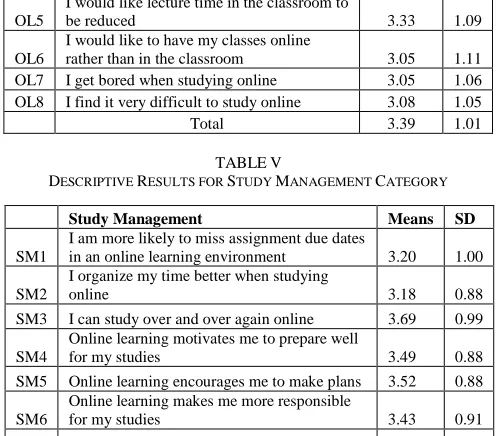
In terms of online learning category, the results uncover that majority of the learners do agree that online learning allows them to engage more with the lecture because they feel more comfortable with the learning and give them more flexibility in order to express their thoughts better. Table 4 illustrate mean and standard deviation of the items for online learning dimension. Further analysing from study management perspective, the majority of the respondents do once again agree that learning via MOOC can help them to better organize and manage their learning process more effectively. Besides, they do also agree that online learning makes them more responsible for their study. Table 5 show the mean and standard deviation of the items for study management dimension.
TABLEIV
DESCRIPTIVE RESULTS FOR ONLINE LEARNING CATEGORY
Online Learning Means SD
OL1
I believe face-to-face learning is more
effective than online learning 3.98 0.99 OL2 I am comfortable with self-directed learning 3.65 0.94 OL3 I do not resist having my lessons online 3.49 0.92
OL4
I like online learning as it provides richer
instructional content 3.51 0.95
OL5
I would like lecture time in the classroom to
be reduced 3.33 1.09
OL6
I would like to have my classes online
rather than in the classroom 3.05 1.11 OL7 I get bored when studying online 3.05 1.06 OL8 I find it very difficult to study online 3.08 1.05
Total 3.39 1.01
TABLEV
DESCRIPTIVE RESULTS FOR STUDY MANAGEMENT CATEGORY
In addition, statistical analysis from the technology dimension obtained an overall average of 3.77, with an acceptable standard deviation, as presented in Table 6. This reflects that majority of the students agree that learn through the web is easy to be used and is a very useful platform. Besides, they also agree that the used of iPad, tablet, smartphone, wearable technology and MOOC are another alternative in making the learning more fun and engaging.
Study Management Means SD
SM1
I am more likely to miss assignment due dates
in an online learning environment 3.20 1.00
SM2
I organize my time better when studying
online 3.18 0.88
SM3 I can study over and over again online 3.69 0.99
SM4
Online learning motivates me to prepare well
for my studies 3.49 0.88
SM5 Online learning encourages me to make plans 3.52 0.88
SM6
Online learning makes me more responsible
for my studies 3.43 0.91
TABLEVI
DESCRIPTIVE RESULTS FOR TECHNOLOGY CATEGORY
Likewise, the online interaction category obtained an overall mean of 3.56, with an acceptable standard deviation. The majority of the learners do agree that they feel more comfortable and easy to communicate, discuss and share their opinions via online. This reflects that via online learning it can increase the students’ motivation and confidence level to express their ideas boundless. Table 7 show the mean and standard deviation of the items for online interaction dimension. On the other hand, the classroom learning criteria obtained an overall mean of 3.56, with an acceptable standard deviation, as presented in Table 8. Particularly, CL2, CL3, and CL5 obtained high mean scores of 4.12, 4.0, and 4.21 respectively. These indicators highlight that although the students agree with the advantages offer by online learning as per discussed earlier, but they still possess strong dependence for classroom-based learning. This reflects that the students less prepared to move on with fully MOOC learning. However, as we mentioned earlier, with the assistance of interactivity of e-contents and e-activities, online forums and chats rooms between learner-learner and learner-learner-instructor offers by MOOCs platform, the issue of classroom dependency can be reduced.
TABLEVII
DESCRIPTIVE RESULTS FOR ONLINE INTERACTION CATEGORY
Online Interaction Means SD
OI1
I feel isolated in an online learning
environment 3.27 0.92
OI2
I am comfortable in using Web technologies
to exchange knowledge with others 3.61 0.82
OI3
I would like to interact with my lecturer
online 3.45 0.92
OI4
I would like to interact with other students
outside of the classroom 3.80 0.84
OI5
I find it easy to communicate with others
online 3.60 0.93
OI6 I appreciate easy online access to my lecturer 3.69 0.89
OI7
I can collaborate well with a virtual team in
doing assignments 3.53 0.92
Total 3.56 0.89
TABLEVIII
DESCRIPTIVE RESULTS FOR CLASSROOM LEARNING CATEGORY
C. Exploratory Factor Analysis
Statistical analysis based on factor analysis was used to further explore the data gathered. EFA is one of the analysis methods that can be used to identify the number of dimensions for a construct [1]. In EFA the number of factors is not specified before the analysis. The analysis attempts to examine individual items across factors, identifying items that load strongly on a particular factor [1]. Items that load strongly on one factor but not on others are grouped together to form a scale. Any item that cross-loads on more than one factor or loads weakly on any factor is considered for deletion. The most common extraction method is principal components analysis (PCA) [1]. An EFA is necessary to examine the dimensionality of the scale before a confirmatory factor analysis (CFA).
We first performed an item analysis on 36 items (excluding three items from Readiness towards MOOC construct) to eliminate any item that had an inter-item correlation below 0.3 [1] and an item-total correlation below 0.3 [1]. As a result, a total of ten items were deleted. Two items were removed from the attitude towards online learning construct (OL1: “I believe face-to-face learning is more effective than online learning” and OL8: “I find it very difficult to study online”) and one item was removed from attitude towards learning flexibility (FL1: “I would like unlimited access to lecture materials”). The remaining of seven items were then deleted from construct attitude towards online interaction because of the presence of multicollinearity, where the total tolerance value for the whole construct is less than .10 (0.049) and the VIF value is more than 10 (20.955).
We then further conducted a Principle Component Analysis (PCA) on the remaining 26 items. Assuming that there were correlations among the items, the Direct Oblimin rotation method was used. The Kaiser-Meyer-Oklin (KMO) value was 0.867, exceeding the recommended value of .60 [19] and Bartlett’s test reach statistical significance (p = 0.000), supporting the factorability of the correlation matrix and provided evidence that the dataset was appropriate to perform factor analysis. From the communality value, using PCA extraction method, we only interested with the extraction value more than 0.30 [19]. Low extraction values (below .30) indicate that the item does not fit well with the other items in its components [14], resulted in one item (SM1:” I am more likely to miss an assignment due dates in an online learning environment”) deleted. The reason to remove the item with low communality values is to increase the total variance explained.
Technology Means SD
T1
I believe the Web is a useful platform for
learning 3.95 0.89
T2 I am familiar with Web technologies 3.53 0.92 T3 I find Web technologies easy to use 3.66 0.87
T4
I think we should implement wearable
technologies in learning 3.75 0.85
T5
I think we should implement iPad/ tablets/
smart phones in learning 3.86 0.92
T6
I think we should use MOOC platform as one
of the alternatives in learning 3.85 0.84
Total 3.77 0.88
Flexible Learning Means SD
CL1
I have a sense of community when I meet
other students in the classroom 3.86 0.90
CL2
I like the fast feedback when I meet my
lecturer in person 4.12 0.81
CL3
I find learning through collaboration with
others face-to-face is more effective 4.00 0.82
CL4
I learn better through lecturer-directed
classroom-based activities 3.91 0.83
CL5
I learn better when someone guides me
personally 4.21 0.83
As explain earlier, there are several analysis methods that can be used to determine the number of factors to retain such as Kaiser’s criterion, scree test, and parallel analysis. However, in this research, we adopted only Kaiser’s criterion and parallel analysis techniques as factor analysis. Next, based on the result drawn from Kaiser’s criterion, we only interested with the constructs that have an eigenvalue more than 1. Here, there are only five factors (7.396, 2.982, 1.877, 1.566, 1.343) has been suggested for PCA to be retained. These five components explain a total of 57.13 percent of the variance, indicating that the five learning factor instruments able to reflect as much 57.13 per cent of the students’ readiness towards blended learning.
After that, we further conducted a parallel analysis to cross check the number of factors as per suggested by other research [1]. The parallel analysis suggested five factors. Items that loaded below .50 on any of the factors or cross-loaded above .50 must be deleted in order to produce better result analysis [1]. As the result, five item were deleted (SM2: “I organize my time better when studying online”, OL2: “I am comfortable with self-directed learning”, TE1: “I believe the Web is a useful platform for learning”, TE5: “I think we should implement iPad/ tablets/ smartphones in learning”, TE6: “I think we should use MOOC platform as one of the alternative in learning”).
After completed item analysis and PCA analysis, we had a total of 20 items were remain with five factors explained 61.23 percent of the total variance, indicating that based on these five learning factor instruments able to reflect the students’ readiness towards blended learning. Table 9 summarized the exploratory factor item loading for PCA with Obimin rotation of five-factor solution on 20 items.
Factor analysis also can be used to identify the critical factors in the overall research items [19]. Based on factor analysis, it can be found that study management is the most dominant factors that contributed 25.89 per cent from 61.23 per cent of the total variance with eigenvalues of 5.179. This factor consists of four items. The second factor is classroom learning. Eigenvalues are 2.775 with a variance contribution is 13.88 per cent. This factor contains five items. The third factor is flipped learning with three items that contribute 8.33 percent of the total variance with eigenvalue 1.666. The fourth factor is online learning. Eigenvalues are 1.353 with a variance contribution is 6.77 per cent. This factor contains five items. The fifth factor is a technology with four items that contribute 6.23 per cent of the total variance with eigenvalue 1.273.
TABLEIX
EXPLORATORY FACTOR ITEM LOADING BASED ON 20ITEMS
ITEMS FACTOR
1 2 3 4 5
SM4 .906
SM5 .832
SM6 .806
SM3 .571
CL3 .846
CL4 .820
CL2 .758
CL5 .706
CL1 .647
FL4 .823
FL3 .803
FL2 .742
OL5 -.771
OL6 -.743
OL7 -.731
OL3 -.716
OL4 -.574
TE2 -.896
TE3 -.861
TE4 -.603
Total Variance
Explained 5.179 2.775 1.666 1.353 1.273
Percentage Variance
Explained 25.89 13.88 8.33 6.77 6.360
IV.CONCLUSIONS
Understanding of students’ attitude towards blended learning based on different learning aspects is one of the critical success factors for implementing successful MOOC by higher learning institutions. The assessment results reveal a positive feedback on students’ adaptability and readiness towards successful blended learning and MOOC implementation. In this study, it shows that students who have a positive attitude towards learning flexibility, positive attitude towards online learning, positive feedback on study management, positive feedback towards technology, and positive attitude towards online interaction reflect a high level of readiness to adapt to MOOC learning. On the other hand, the findings also summarize that when students had a positive attitude towards classroom learning, they were less likely ready towards MOOC learning, as they would prefer to meet their lecturers and friends in a physical lecture class compared to on the web-based. The findings indicate that there is no reason to reject the hypothesis. These findings also being supported by some other studies in the same research area [1], [17]-[20]. The implementation of MOOC through blended learning able to prepare the students towards full implementation of MOOC platform for technical courses offered by universities. In MOOC environment, every individual student must possess strong self-determination spirit in order to fully engage with the learning process. This study also supports that self-determination able to motivate a learner towards online course completion [2].
MOOC able to foster active learning, able to create a meaningful connection with the learning process, allow lecturers to frequent monitoring of learning process, and can support active interaction among student with student and student with lecturer [2].
Overall, the result of this study offers some implications in the learning environment. Firstly, by identifying the students’ readiness for blended learning it provides an information to the university’s top management on their students’ adaptability and readiness for the future implementation of MOOC courses. As the output, educators can prepare suitable teaching and learning counter plans in order to support the students towards fully online learning. Secondly, this study also proved and shared six learning aspects to measure student’s readiness towards MOOC, which is one of the online learning platform used as blended learning aids. This empirical analysis also can be used by other educators to measure their students’ adaptability and readiness towards blended learning.
There are still a lot more works to do in this study. The researcher will further conduct a triangulation process in order to confirm findings from this study. In addition, acceptance analysis towards MOOC implementation and the effects of MOOC in enhancing learning experience among students will be other interesting aspects which can be explored further.
ACKNOWLEDGMENT
The authors would like to take this opportunity to highly appreciate the cooperation and the opportunity given by Universiti Teknikal Malaysia Melaka, the lecturers who gave their full support to this research and all the respective students. Not forgotten UTeM Research and Innovation Management and UTeM Zamalah Scheme for funding this research, PJP/2014/FTMK(12D)C-ACT2/S01373.
REFERENCES
[1] C. M. Tang and L. Y. Chaw, "Readiness for blended learning: understanding attitude of university students," International Journal of Cyber Society and Education, vol. 6, no. 2, pp. 79-100, 2013. [2] K. F. Hew, "Towards a model of engaging online students: lessons
from MOOCs and four policy documents," International Journal of Information and Education Technology 5, no. 6, pp. 425-431, 2015. [3] D. Shah, "By The Numbers: MOOCS in 2015," Class Central,
December 2015. [Online]. Available: https://www.class-central.com/report/moocs-2015-stats/. [Accessed April 2016]. [4] J. T. Flynn, "MOOCS: Disruptive innovation and the future of higher
education," Christian Education Journal, vol. 10, no. 1, pp. 149-155, 2013.
[5] C. Sandeen, "Integrating MOOCs into traditional higher education: The emerging “MOOC 3.0” era," Change: The magazine of higher learning, vol. 45, no. 6, pp. 34-39, 2013.
[6] R. Ferguson and M. Sharples, "Innovative pedagogy at massive scale: teaching and learning in MOOCs," Open Learning and Teaching in Educational Communities, no. Springer International Publishing, pp. 98-111, 2014.
[7] F. Garcia, G. Diaz, M. Tawfik, S. Martin, E. Sancristobal and M. Castro, " A practice-based MOOC for learning electronics," Global Engineering Education Conference (EDUCON), vol. 2014 IEEE, pp. 969-974, 2014.
[8] P. J. Guo, J. Kim and R. Rubin, "How video production affects student engagement: An empirical study of mooc videos," Proceedings of the first ACM conference on Learning@ scale conference, vol. ACM, pp. 41-50, 2014.
[9] G. G. Conole, "MOOCs as disruptive technologies: Strategies for enhancing the learner experience and quality of MOOCs," Revista de Educación a Distancia, vol. 39, 2015.
[10] M. A. Embi, N. Nordin and E. Panah, "Blended Learning Readiness in Malaysia," in Blended and Flipped Learning: Case Study in Malaysia HEIs, Universiti Kebangsaan Malaysia, 2014, pp. 37-55.
[11] Z. B. Razali and L. M. Kamarudin, "Experience on Blended Learning: Towards e-Laboratory," in Blended Learning & Flipped Learning: Case Study in Malaysiaan HEIs, Universiti Kebangsaan Malaysia, 2014, pp. 147-160.
[12] L. Blasco-Arcas, I. Buil, B. Hernández-Ortega and F. J. Sese, "Using clickers in class. The role of interactivity, active collaborative learning and engagement in learning performance," Computers & Education, vol. 62, pp. 102-110, 2013.
[13] N. Spyropoulou, C. Pierrakeas and A. Kameas, "Creating MOOC Guidelines based on best practices," Proc. of the 6th Annual International Conference on Education and New Learning Technologies (Edulearn14), pp. 6981-6990, 2014.
[14] D. Shah, J. French, J. Rankin and L. Breslow, "Using video to tie engineering themes to foundational concepts," Proceedings of the ASEE Annual Conference, Atlanta, GA, 2013.
[15] N. Waterworth, "Generation X, Generation Y, Generation Z and Baby Boomers," 2013. [Online]. Available: http://www.talentedheads.com/ 2013/04/09/generation-confused/. [Accessed April 2016].
[16] P. Harris, J. Connolly and L. Feeney, "Blended learning: overview and recommendations for successful implementation," Industrial and Commercial Training, vol. 41, no. 3, pp. 155-163, 2009.
[17] S. Iqbal and Z. A. Bhatti, "An Investigation of University Student Readiness towards M-learning using Technology Acceptance Model," The International Review of Research in Open and Distributed Learning, vol. 16, no. 4, 2015.
[18] N. F. W. M. Nasir and I. S. Ismail, "Student Readiness of a Newly-Designed Blended Learning English Language Proficiency Course in UiTM," In 7th International Conference on University Learning and Teaching (InCULT 2014) Proceedings, no. Springer Singapore, pp. 777-788, 2016.
[19] J. Pallant, SPSS survival manual: A step-by-step guide to data analysis using SPSS version 15, Nova Iorque: McGraw Hill, 2007.
[20] S. H. Muhamad and N. Nuwairi, "Management Students’ Readiness And Effectiveness In Adopting Blended Learning In English For Occupational Purposes Class At The Tertiary Level: A Concept Paper," Proceeding of the 2nd International Conference on