INTRODUCTION
Game performance in sport games is underlied by the perceptual-cognitive processes leading to decision making about movement response and senso-motor pro cesses responsible for skill execution. Thus, develop-ment of game performance is generally seen in learn-ing tactical and technical skills, and their integration into the game context (Mitchell, Oslin, & Griffi n, 2006; Gréhaigne, Richard, & Griffi n, 2005).
There has been considerable debate about how much emphasis should be placed on technical skills, and how much on players’ awareness of game tactics and their decision making skills to improve game perform-ance (Starkes, Ericsson, & Anders, 2003; Williams & Hodges, 2004). The tactical model of teaching was de-rived from ideas of the teaching games for understand-ing (TgfU) model (Mitchell, Oslin, & Griffin, 2006; Butler & Cahan, 2005) and presented a shift from an instructional approach emphasising learning technical
skills called the traditional or technical model (Rink, French, & Tjeerdsma, 1996), for the dominant style of teaching of decision making skills. In the tactical model, teaching technical skills is reduced and follows after the understanding and practice of particular tactical prin-ciples, so that movement execution skills are learned in closer connection with the particular tactical prob-lem (Mitchell, Oslin, & Griffi n, 2006; Rink, French, & Tjeerdsma, 1996). However, previous studies on the ef-fects of the tactical model in some sport games provided mixed or controversal results when this model did not demonstrate signifi cant benefi ts in the development of both the cognitive and motor components of game per-formance in comparison to the technical based instruc-tional models (Harrison, Blakemore, Richards, Oliver, Wilkinson, & Fellingham, 2004; French, Werner, Taylor, Hussey, & Jones, 1996; Turner & Martinek, 1995).
The skill oriented instructional models as models based on content development (Rink, 1998) or mastery learning (Bloom, 1976) showed similar eff ects on the
im-CHANGES IN DECISION MAKING SKILL AND SKILL EXECUTION
IN SOCCER PERFORMANCE: THE INTERVENTION STUDY
Rudolf Psotta, Andrew Martin*
Faculty of Physical Culture, Palacký University, Olomouc, Czech Republic * School of Management, Massey University, Palmerston North, New Zealand
Submitted in June, 2011
BACKGROUND:Previous studies have provided controversal results on the development of the skills of decision making skill and skill execution when tactical models of the teaching of a game were used.
OBJECTIVE: The purpose of the study was to examine the eff ects of two diff erent combined technical-tactical instructional models on the development of decision making skill and ball skill execution during a soccer match in female students.
METHODS:Two groups of female students aged 20.9 ± 0.7 years underwent the 5 week soccer training intervention, consisting of two 90 min. training units a week, based on the technical-tactical model with an emphasis on orientation to tactical and technical skills, respectively (CTA and CTE students, respectively). Before and after the intervention, studentsʼ decision making skill and ball skill execution in a match were assessed from videorecords of matches using the Soccer Performance Observation System (SPOS). In addition, the Soccer skill test battery (Mor & Christian, 1979) was used to assess the ball skills under control environment.
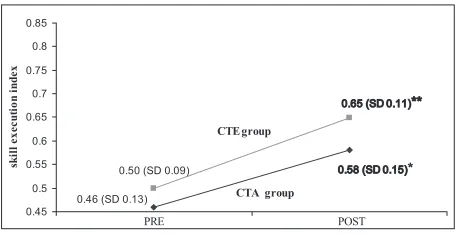
RESULTS: The Skill Execution Index (SEI) after intervention in both CTA and CTE students (0.58 ± 0.15 and 0.65 ± 0.11) found using SPOS were signifi cantly higher in comparison to SEI before the intervention (0.46 ± 0.13 and 0.50 ± 0.09; p < 0.05 and p < 0.01). Similarly, the Decision Making Index (DMI) was signifi cantly enhanced after intervention in the cases of both CTA students (from 0.70 ± 0.14 to 0.81 ± 0.12, p < 0.05) and CTE students (from 0.65 ± 0.11 to 0.75 ± 0.12, p < 0.05).
CONCLUSIONS: This study showed that instructional models with both dominant tactical tasks and dominant technical tasks can result in the signifi cant improvement of both decision making and skill execution performance in young adult subjects. The study suggested that both decision making in game situations and ball skill execution can be developed through implicit learning.
provement of decision making skills and skill execition in a match as a tactical model (Harrison, Blakemore, Richards, Oliver, Wilkinson, & Fellingham, 2004; Har-rison, Preece, Blakemore, Richards, Wilkinson, & Fell-ingham, 1999). Even, the instructional blocks focused on skill execution, applied in suffi cient frequency and time volume, could seem to provide an important condi-tion for the eff ective development of game performance, when decision making skills can be developed more easily than movement execution skills (McPherson, & French, 1991).
The evidence mentioned above suggests that integrat-ed teaching tactics and techniques could be benefi cial for the improvement of the game performance of play-ers. However, there are almost no studies on the eff ects of the combined technical and tactical models of teach-ing. Only three intervention studies which investigated the eff ects of the tactical model involving also blocks of teaching skill execution have been published (Harrison, Blakemore, Richards, Oliver, Wilkinson, & Felling ham, 2004; Turner & Martinek, 1992, 1995). Howe ver, in these studies, no information about the frequency and/or time volume of instruction devoted to skill execution and deci-sion making skills is available. Therefore, the purpose of the study was to examine the eff ects of two diff erently combined instructional models on the development of a playerʼs decision making skill and skill execution during a match in female students – soccer beginners.
METHODS
Participants
Two groups of female students of physical education (n = 2 × 12) aged 20.7 ± 0.8 years and 21.0 ± 0.7 years participated in this study. Students with experience in the systematic training of any team sport were not included into these groups. One university teacher of sport pedagogy with a specialisation in sport games in-struction/training and experienced in soccer coaching served as a teacher for the intervention study after his systematic preparation for the study.
Training intervention
Two 5 week training programs based on diff erently combined technical-tactical models were applied simul-taneously during the basic course of soccer in the two groups of students mentioned above. The content of the both programs was structured into fi ve two-lesson cycles, i.e. one cycle a week, with a 90 min. duration of each lesson.
In both training programs, teaching technical skills concerned off ensive skills – basic manipulative skills, various techniques of dribbling, passing, receiving a ball under control, overcoming an opponent in situa-tion 1 on/vs. 1 and shooting, further linking these skills
into chains as the serial skills and their application of various situations. Teaching off ensive tactical skills in-cluded principles for running without a ball (supporting a teammate, calling for a ball, timing runs to a goal), principles for acting after winning a ball in a defensive zone, after being in possession during the building up of the attack phase (through the middle zone) and after being in possession in an off ensive zone and close to the goal of the opponent team. As a supplement, defensive tactics were taught – principles for acting after losing a ball, building up the defence, covering space, mark-ing an opponent in possession, covermark-ing space behind a teammateʼs marking, pressing and shifting the block of players to the ball. Also, basic information related to both off ensive and defensive tactics for standard situa-tions such as the throw in, cornering and the free kick were provided to the students.
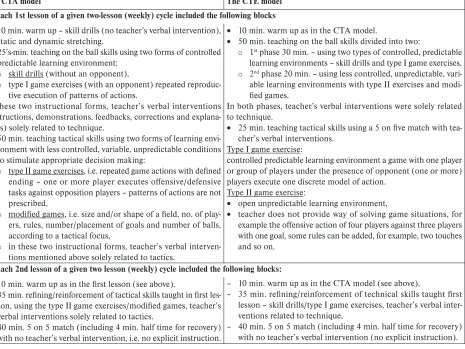
The diff erence between both models consisted in: a) The diff erent time needed for teaching tactical and
technical skills – in the CTA model 85 min. and 25 min. a week, respectively; in the CTE model 25 min. and 85 min. a week, respectively (TABLE 1). b) The diff erent time of students’ practice in a control-led predictable learning environment and an open unpredictable environment (TABLE 1). In the CTA model technical skills were taught under controlled conditions in a predictable learning environment, i.e. using skill drills and type 1 game exercises (the classifi cation of instructional forms according to Do-brý, 1988; for defi nitions see TABLE 1) for 25 min. a week while in the CTE model in a controlled en-vironment for 65 min. plus 20 min. per week using a variable, unpredictable environment, i.e. game ex-ercises of type 2 and training games (Dobrý, 1988; see the defi nitions in TABLE 1). In the CTA model, tactical skills were taught for 85 min. in an open, un-predictable environment, while, in the CTE model, 25 min. of a match were used, with a teacherʼs verbal instructions related to tactics. In addition, both mod-els involved a 40 min. match without any teacherʼs verbal instructions, each week (TABLE 1). For les-sons, one half of a grass fi eld with diameters in ac-cordance with the offi cial soccer laws was available.
Treatment validation
To check the type of instructions, all lessons were videorecorded by the two videorecorders, and audio-taped with the teacherʼs verbal intervention. From the video and audiorecords of each lesson, a description of each task was done to indicate: a) the focus in terms of the technical or tactical task; b) specifi c tactical or technical skills taught; c) the instructional form, i.e. type of learning environment; d) time spent on each task.
tech-TABLE 1
The CTA and CTE instructional models of soccer training intervention
The CTA model The CTE model
1. Each 1st lesson of a given two-lesson (weekly) cycle included the following blocks
• 10 min. warm up – skill drills (no teacherʼs verbal intervention),
static and dynamic stretching.
• 25ʼs-min. teaching on the ball skills using two forms of controlled
predictable learning environment: skill drills (without an opponent),
type I game exercises (with an opponent) repeated reproduc-tive execution of patterns of actions.
In these two instructional forms, teacherʼs verbal interventions (instructions, demonstrations, feedbacks, corrections and explana-tions) solely related to technique.
• 50 min. teaching tactical skills using two forms of learning
envi-ronment with less controlled, variable, unpredictable conditions to stimulate appropriate decision making:
type II game exercises, i.e. repeated game actions with defi ned ending – one or more player executes off ensive/defensive tasks against opposition players – patterns of actions are not prescribed,
modifi ed games, i.e. size and/or shape of a fi eld, no. of play-ers, rules, number/placement of goals and number of balls, according to a tactical focus,
in these two instructional forms, teacherʼs verbal interven-tions mentioned above solely related to tactics.
• 10 min. warm up as in the CTA model.
• 50 min. teaching on the ball skills divided into two:
1st phase 30 min. – using two types of controlled, predictable
learning environments – skill drills and type I game exercises, 2nd phase 20 min. – using less controlled, unpredictable,
vari-able learning environments with type II exercises and modi-fi ed games.
In both phases, teacherʼs verbal interventions were solely related to technique.
• 25 min. teaching tactical skills using a 5 on fi ve match with
tea-cherʼs verbal interventions. Type I game exercise:
controlled predictable learning environment a game with one player or group of players under the presence of opponent (one or more) players execute one discrete model of action.
Type II game exercise:
• open unpredictable learning environment,
• teacher does not provide way of solving game situations, for
exam ple the off ensive action of four players against three players with one goal, some rules can be added, for example, two touches and so on.
2. Each 2nd lesson of a given two lesson (weekly) cycle included the following blocks:
• 10 min. warm up as in the fi rst lesson (see above).
• 35 min. refi ning/reinforcement of tactical skills taught in fi rst
les-son, using the type II game exercises/modifi ed games, teacherʼs verbal interventions solely related to tactics.
• 40 min. 5 on 5 match (including 4 min. half time for recovery)
with no teacherʼs verbal intervention, i.e. no explicit instruction.
– 10 min. warm up as in the CTA model (see above),
– 35 min. refi ning/reinforcement of technical skills taught fi rst les son – skill drills/type I game exercises, teacherʼs verbal inter-ventions related to technique,
– 40 min. 5 on 5 match (including 4 min. half time for recovery) with no teacherʼs verbal intervention (no explicit instruction).
nical and tactical performance of students in particular tasks based on the observation of videorecords to modify appropriately the tasks planned for the next lesson.
The video and audio-analysis of tasks confirmed a diff erent total instructional time devoted to technical and tactical skills in the CTA and CTE model: the to-tal instructional time for technical tasks 95 min. vs. 309 min., i.e. forthe CTA students 30.7% of time of the CTE students; for tactical tasks 330 min. vs. 125 min., i.e. for the CTA students 264% of time of the CTE stu-dents, and a match without the teacherʼs verbal instruc-tion 169 min. vs. 176 min., i.e. for the CTA students 96% of time of CTE students.
In the case of the CTA students, the total instruc-tional time devoted to technical tasks involved 84% of the total practice time and 16% of the total teacherʼs ver bal intervention time; the total instructional time of tactical tasks involved 82% of the total practice time and 18% of the total teacherʼs verbal intervention time. In the CTE students, the total instructional time for both technical and tactical tasks was composed of the percentage of the total practice time (83%) and the total teacherʼs verbal intervention time (17%). These results
showed a similar relative proportion of the practice time and the teacherʼs verbal intervention time during both instruction sessions.
Testing procedures
With each group, technical skills, decision making and skill execution during a match were assessed in three sessions during the week before and after the train-ing intervention.
Soccer Skill Tests
The standardized Soccer Skill Test Battery (Mor & Christian, 1979) was used to assess the execution of the major soccer skills – dribbling, passing and shooting. The total time from two trials of dribling and a number of precise passes and shots were used as the test scores. The validity of the dribbling, passing and shooting tests in adolecent students was found to be r = 0.73, 0.78 and 0.91, respectively, the test-retest reliability was found to be r = 0.80, 0.96 and 0.98, respectively (Mor & Chris-tian, 1979).
the standardized instructions were provided for each stu dent. In a given test, each student performed a prac-tice trial in dribbling through half of the track, half of the number of passes and shots, respectively, followed immediately by a formal trial in the dribbling, passing and shooting tests, respectively.
Assessment of decison making skill and skill execution To assess decision making skill and skill execution during a student game while being in possession of the ball during a soccer match, the Soccer Performance Ob servation System (SPOS), based on the observation and coding of a playerʼs behaviour from videotape, was developed. The SPOS was constructed based on the metho dological principles of the Game Performance As-sessment Instrument GPAI (Mitchell, Oslin, & Griffi n, 2006; Griffi n, Mitchell, & Oslin, 1997) (TABLE 2).
Previous instruments for basketball (French & Tho-mas, 1987) and fi eld hockey (Turner & Martinek, 1995) serv ed as guides, too.
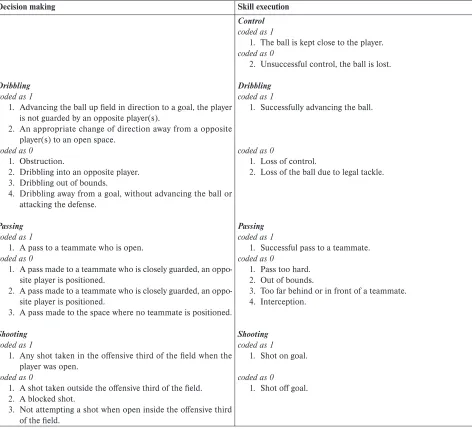
The decision making skill related to the selection of a studentʼs movement responses in possession involves three coded variables – dribbling, passing and shooting decision. Skill execution involves four variables – ball control (i.e. receiving a ball under control), dribbling, pass and shot execution. Decision making and skill ex-ecution performance were coded as 1 for an appropriate decision and successful execution, respectively, and 0 for an inappropriate decision and unsuccessful execution, respectively. Coding procedures for decision making and skill execution are showed in TABLE 2. The total varia-bles of decision-making and skill execution performance were counted in accordance with the GPAI (Mitchell et al., 2006) and the Decision Making Index (DMI) as the
TABLE 2
Coding procedures for decision making and skill execution in a match
Decision making Skill execution
Dribbling
coded as 1
1. Advancing the ball up fi eld in direction to a goal, the player is not guarded by an opposite player(s).
2. An appropriate change of direction away from a opposite player(s) to an open space.
coded as 0 1. Obstruction.
2. Dribbling into an opposite player. 3. Dribbling out of bounds.
4. Dribbling away from a goal, without advancing the ball or attacking the defense.
Passing
coded as 1
1. A pass to a teammate who is open. coded as 0
1. A pass made to a teammate who is closely guarded, an oppo-site player is positioned.
2. A pass made to a teammate who is closely guarded, an oppo-site player is positioned.
3. A pass made to the space where no teammate is positioned.
Shooting
coded as 1
1. Any shot taken in the off ensive third of the fi eld when the player was open.
coded as 0
1. A shot taken outside the off ensive third of the fi eld. 2. A blocked shot.
3. Not attempting a shot when open inside the off ensive third of the fi eld.
Control
coded as 1
1. The ball is kept close to the player. coded as 0
2. Unsuccessful control, the ball is lost.
Dribbling
coded as 1
1. Successfully advancing the ball.
coded as 0
1. Loss of control.
2. Loss of the ball due to legal tackle.
Passing
coded as 1
1. Successful pass to a teammate. coded as 0
1. Pass too hard. 2. Out of bounds.
3. Too far behind or in front of a teammate. 4. Interception.
Shooting
coded as 1
1. Shot on goal.
coded as 0
ratio of the number of all appropriate decisions made to all decisions made, and the Skill Execution Index (SEI) as the ratio of the number of all successful skill executions to all skill executions.
In the pilot study, inter-subject reliability (agree-ment) of the coding of decision making and skill execu-tion varia bles with the SPOS between two trained in dependent coders was 81% and 92%, respectively. The intra subject reliability (agreement) of the coding of deci-sion making and skill execution variables with the SPOS was conducted three times with 30 day brakes in two coders and was higher than 82% and 94%, respectively. The content validity of the SPOS is based on the conception of soccer game performance and the cur-riculum of the soccer course for preservice physical edu cation (PE) students (Author, 1999). The construct validity of the SPOS is determined by the criteria set for the coding of appropriate and inappropriate decision-making and successful and unsuccessful skill execution. These criteria were selected according to the principles for the correct execution of skills and tactical principles for the solving of game situations for players in posses-sion of the ball taught in a basic course for PE students. To assess the studentsʼ decision making skill and skill execution, a 5 vs. 5 match (plus one goalkeeper in each team) on a grass fi eld 45 × 30 m consisting of two 18 min. halves was organised for each treatment group. During a match, students rotated from the position of the goalkeeper to particular positions on a fi eld after each 3 minutes. So, each subject participated in a match in a total time of 30 min. as a fi elder.
Before the pre-treatment match, the 18 min. pilot match was conducted with the same format as the pre-treatment match to form two opposite teams with ba lanced performance. The rotation of the playersʼ posi-tions was changed every two minutes. During the pilot match, six observers/assessors – students in the last year of their PE master degree program with a specialisation in soccer coaching observed game performance and made written notation related to the assessment of their game performance according to the components of the
actions of each student in a match as determined before. On the basis of their observation, each assessor assessed each student using the fi ve rate scale. According to the sum of scale rates assigned by six assessors, the total rank of students was made up. Students placed on the odd and even places of the rank structure built up one and a second opposite team, respectively. The same pro-cedure of game performance assessment using a pilot match was used to build up opposite teams for the post-treatment game performance assessment using the SPOS. Each pre and post-treatment match was recorded by four video-camcorders S-VHS Panasonic NV-MS2B (Ja-pan), one on each side. Each video-camcorder was op-erated by one trained technician positioned at a perch. The focal distance of an object glass of moving video-camcorders was selected so that a suffi cient width of the space of a fi eld could be recorded with a player in possession in the centre of the picture.
Each game performance recorded was coded by two independent coders blind to group membership. Both coders with soccer playerʼs and coachʼs experience were trained for using the SPOS.
Statistical methods
Besides the mean and standard deviation, the Wilco-xon matched pairs signed ranks test (one tailed) and the Mann-Whitney U test (two tailed) were used to test the signifi cance of intra-group and inter group diff erences of dependent variables, respectively. For the statistical inference, a level of 0.05 signifi cance was selected.
RESULTS
Results of soccer skill tests
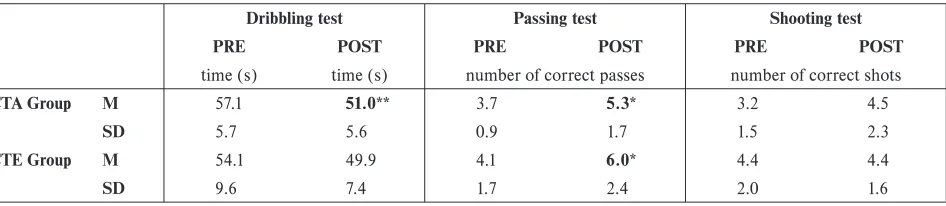
A signifi cant increase in performance level in the pas sing test in both treatment groups, but the signifi cant shortening of time in the dribbling test only in the CTA students were found after the training intervention. No signifi cant change to the results in the shooting test in both groups occurred (TABLE 3).
TABLE 3
Results of the soccer skill tests before and after the training intervention in the CTA and CTE students; the signifi cance of changes of the variables (Wilcoxon test: *p ≤ 0.05, **p ≤ 0.01)
Dribbling test Passing test Shooting test
PRE POST PRE POST PRE POST
time (s) time (s) number of correct passes number of correct shots
CTA Group M 57.1 51.0** 3.7 5.3* 3.2 4.5
SD 5.7 5.6 0.9 1.7 1.5 2.3
CTE Group M 54.1 49.9 4.1 6.0* 4.4 4.4
SD 9.6 7.4 1.7 2.4 2.0 1.6
The CTA students showed a signifi cant increase in the percentage of appropriate passing decisions but no signifi cant change to dribbling decisions after the inter-vention (TABLE 4). In the CTE students the opposite eff ect of the training intervention was found. However, the Decision Making Index (DMI) was signifi cantly enhanced after intervention in both groups of students (Fig. 1).
The percentage of successful execution of all ball ac-tions increased signifi cantly in both groups of students after the intervention, with the exception of no signifi -cant change in dribbling execution in CTA students (TABLE 4). The skill execution index (SEI) of both groups of students found from observation analysis of the gameʼs performance were signifi cantly higher in the post-matches in comparison to SEI in the pre-mat ches (Fig. 2). The percentage of appropriate shot decision and execution were not assessed due to a very low number of shot trials found during matches in most stu dents. TABLE 4
Selected variables of decision making skill and skill execution in a match before and after the training intervention in the CTA and CTE students; the signifi cance of changes of the variables (Wilcoxon test: *p ≤ 0.05, **p ≤ 0.01)
CTA Group CTE Group
PRE POST PRE POST
M SD M SD M SD M SD
(%) (%) (%) (%) (%) (%) (%) (%)
Dribbling Decision 72.3 16.4 78.4 20.7 69.8 18.5 84.1* 12.1
Passing Decisions 67.8 14.1 82.8* 17.2 69.5 16.3 75.2 13.1
Dribbling Execution 50.9 19.7 58.4 26.4 54.3 15.2 67.8** 10.2
Pass Execution 44.7 13.7 56.6* 19.6 42.5 14.9 56.9* 13.3
Control Execution 59.6 15.3 73.5* 20.9 64.1 15.6 78.8* 20.0
Legend: PRE and POST– values of the variables measured before and after the training intervention, M – mean, SD – standard deviation
DISCUSSION
Using the Mann-Whitney U-test, no diff erences in the variables of decision making and skill execution be-tween the CTA and CTE students were found neither before or after the intervention (p > 0.05). The results suggest that the signifi cant enhancement of decision making skill and skill execution found was not contri-buted from the potencial eff ect of an initial lower level of one of both studentsʼ groups in a given variable.
The CTE students achieved similar improvement of their decision making skills during a match as the CTA students, although the total time spent teaching tactical skills to CTA students represented 264% of that pro-vided to CTE students. In addition, the CTE students were taught tactical skills in one block of instruction per week only, in contrast to two blocks provided to CTA students.
Fig. 1
Decision-making index (DMI) before and after the train-ing intervention in the CTA and CTE students; the sig-nifi cance of change of DMI (Wilcoxon test: *p ≤ 0.05, **p ≤ 0.01)
0.70 (SD 0.14)
0.81 (SD 0.12)*
0.65 (SD 0.11)
0.75 (SD 0.12)*
0.45 0.5 0.55 0.6 0.65 0.7 0.75 0.8 0.85
d
e
c
is
io
n
-m
a
k
in
g
i
n
d
e
x
CTE group CTA group
POST PRE
Legend: PRE and POST– the values of DMI measured before and after the training intervention, M – mean, SD – standard de viation
Fig. 2
Skill execution index (SEI) before and after the train-ing intervention in the CTA and CTE students; the sig-nifi cance of change of SEI (Wilcoxon test: *p ≤ 0.05, **p≤ 0.01)
0.46 (SD 0.13)
0.58 (SD 0.15)*
0.50 (SD 0.09)
0.65 (SD 0.11)**
0.45 0.5 0.55 0.6 0.65 0.7 0.75 0.8 0.85
sk
il
l
e
x
e
c
u
ti
o
n
i
n
d
e
x
CTA group CTE group
POST PRE
A similar increase in decision-making skill in both studentsʼ groups could have more possible explanations. Firstly, fi ve training blocks focused on tactics with the mean time duration of 25 min. for each block provided to the CTE students this could be of suffi cient length to eff ect a positive change in decision making in any match in physically active young adult women. The in-tervention studies involving basketball and fi eld hockey instruction in children of an elementary school (Nevett, Rovegno, Babiarz, & McCaughtry, 2001; Turner & Mar-tinek 1992, 1995) and with volleyball and tennis instruc-tion in college students (Harrison, Blakemore, Richards, Oliver, Wilkinson, & Fellingham, 2004; McPherson & French, 1991) suggested that a signifi cant increase in decision making performance could be already achieved with a minimum amount of seven 35–45 min. lessons of instruction involving a major focus on tactics supple-mented with minor teaching techniques.
Secondly, signifi cant increase in the decision-making performance of the CTE students could be contributed to by implicit learning. Matches without the teacherʼs verbal intervention as a potencial source of implicit learn ing were provided to both studentsʼ groups at the same frequency and with almost the same mean time per each match, 34 min. and 35 min. Then, other stimuli for implicit learning tactics in the CTE students could be provided by their practicing 15 min. per week in instructional forms with an open unpredictable envi-ronment – type II game exercises and modifi ed games, although focused on technical skills. Improved deci-sion making was found in students who obtained the volleyball and fi eld hockey instructional units aimed at motor skill development without teaching tactics or with a very small portion of teaching tactics (Harrison, Blakemore, Richards, Oliver, Wilkinson, & Fellingham, 2004; Turner & Martinek, 1995).
Thirdly, decision making skill before intervention seemed to be of a high level in both studentsʼ groups, when the percentage of appropriate decisions on pass-ing and dribblpass-ing was 67–71%. Although the female stu dents in the study obtained no systematic soccer pro gram before the intervention, as physical educa-tion students they disposed of a signifi cant degree of sport experience. Then a probable cause, why a more signifi cant improvement in decision making skills in the CTA students was not achieved, could be the fact, that the next development in their decision making would requi re a longer and more frequent systematic training regime.
An improved degree of ball skill execution in any gi-ven match was found in both studentsʼ groups with the exception of dribbling execution in the CTA students. Improvement in the execution of a pass in a match in both studentsʼ groups was accompanied by signifi cantly improved performance in the test of the skill of passing.
On the other hand, the signifi cant and insignifi cant im-provement of dribbling execution in any given match in CTE students and CTA students, respectively, was not accompanied by the same change of performance in the dribbling test assessed after the intervention. One of the possible explanations could be the lower reliability and validity of the dribbling test in comparison to the test of the skill of passing used (see section on Methods).
What is an explanation of the similar improvement of the off ensive on a ball skills in the studentsʼ groups with the diff erent time and frequency of teaching tacti-cal and technitacti-cal skill?
A study with hockey field instruction suggested that 6 lesson course of instruction based on the techni-cal model need not be effi cient enough for the improve-ment of skill execution in a match (Turner & Martinek, 1992). However, the time, volume and duration of in-struction which would be suffi cient for the improvement of a technical skill, is dependent on its motoric diffi culty. Even a concentrated 17 lesson instructional program with a frequency of three lessons a week did not result in the signifi cant improvement of a tennis stroke in var-sity students (McPherson & French, 1991). One of the explanation, why improvement of the ball control and pass execution in the CTA students was similar to the CTE students, although they were provided with the to tal time for technical tasks of 95 min. only, in com-parison to 309 min. forthe CTE students, could be the contribution of the implicit learning of techniques. Im-plicit learning techniques in the CTA students could be stimulated by practising tactical tasks performed under the conditions of an open unpredictable environment and necessarily involving skill execution.
The shooting skill assessed by the shooting test did not signifi cantly change in either of the studentsʼ groups. In both the CTA and CTE program, the instruction on shooting was involved into one and two training blocks, respectively. Other implicit leasing of shooting was lim-ited, when some or all of the technical and tactical tasks provided were fi nished with a shot into a goal. In addi-tion, trials of shooting in modifi ed games and matches are generally of low frequency and random distribution.
CONCLUSIONS
ACKNOWLEDGEMENT
The study has b een supported by the research grant from the Ministry of Education, Youth and Sports of the Czech Republic (No. MSM 6198959221) “Physical Activity and Inactivity of the Inhabitants of the Czech Republic in the Context of Behavioral Changes”.
REFERENCES
Bloom, B. S. (1976). Human characteristics and school learning. New York: Graw-Hill.
Butler, J. I., & McCahan, B. J. (2005). Teaching ga mes for understanding as a curriculum model. In L. L. Grif-fi n & J. I. Butler (Eds.), Teaching games for under-standing: Theory, research and practice (pp. 33–54). Cham paign, IL: Human Kinetics.
Dobrý, L. (1988). Didaktika sportovních her. Praha: SPN. French, K. E., Werner, P. H., Taylor, K., Hussey, K., & Jones, J. (1996). The eff ects of a 6 week unit of tac-tical, skill, or combined tactical and skill instruc-tion on badminton performance of ninth grade students. Journal of Teaching in Physical Education, 15, 439–463.
French, K. E., & Thomas, J. (1987). The relationship of knowledge development to childrenʼs basketball performance. Journal of Sport Psychology,9, 15–32. Griffi n, L. L., Mitchell, S. A., & Oslin, J. L. (1997).
Teach ing sport concepts and skills: A tactical games approach. Auckland: Human Kinetics.
Gréhaigne, J. F, Richard, J. F., & Griffi n, L. L. (2005). Teaching and learning team sports and games. New York, London: RoutledgeFalmer.
Harrison, J. M., Blakemore, C. L., Richards, R. P., Oli-ver, J., Wilkinson, C., & Fellingham, G. (2004). The eff ects of two instructional models – tactical and skill teaching – on skill development and game play, knowledge, self effi cacy, and student perceptions in volleyball. Physical Educator, 61(4), 186–199. Harrison, J. M., Preece, L. A., Blakemore, C. L.,
Ri-chards, R. P., Wilkinson, C., & Fellingham, G. W. (1999). Eff ects of two instructional models – skill teaching and mastery learning – on skill develop-ment, knowledge, self effi cacy, and game play in vol-leyball. Journal of Teaching in Physical Education, 19, 34–57.
McPherson, S. L., & French, K. E. (1991). Changes in cognitive state and motor skill in tennis. Journal of Sport and Exercise Psychology,1, 26–41.
Mitchell, S. A., Oslin, J. L., & Griffi n, L. L. (2006). Teac hing sport concepts and skills. A tactical games ap-proach (2nd ed.). Champaign, IL: Human Kinetics.
Mor, D., & Christian, V. (1979). The development of a skill test battery to measure general soccer ability. N. C. J. Health Phys. Ed.,15, 30–39.
Nevett, M., Rovegno, I., Babiarz, M., & McCaughtry, N. (2001). Changes in basic tactics and motor skills in an invasion type game after a 12 lesson unit of instruction. Journal of Teaching in Physical Educa-tion, 20, 352–369.
Psotta, R. (1999). Fotbal. Základní program. Praha: NS Svoboda.
Rink, J. E. (1998). Teaching physical education for learn-ing (3rd ed.). Boston: WCB McGraw-Hill.
Rink, J. E., French, K. E., & Tjeerdsma, B. L. (1996). Foundations for the learning and instruction of sport and games. J. Teaching Phys. Educ., 15, 399–417. Starkes, J., Ericsson, K., & Anders, K. (2003). Expert
performance in sport: Advances in research on sport expertise. Champaign, IL: Human Kinetics.
Turner, A. P., & Martinek, J. (1992). A comparative ana lysis of two models for teaching games (techni-que approach and game centered tactical focus ap-proach). Int. J. Phys. Educ.,29, 15–31.
Turner, A. P., & Martinek, T. J. (1995). Teaching for under standing: A model for improving decision mak-ing durmak-ing game play. Quest, 47, 44–63.
Williams, A. M., & Hodges, N. J. (Eds.). (2004). Skill acquisition in sport: Research, theory and practice. Lon don: Routledge.
ZMĚNY DOVEDNOSTI V ROZHODOVÁNÍ A PROVEDENÍ ČINNOSTI VE FOTBALOVÉM
VÝKONU: INTERVENČNÍ STUDIE (Souhrn anglického textu)
VÝCHODISKA: Předchozí studie přinesly kon-tro verzní výsledky o vývoji dovednosti v rozhodování a do vednosti v provedení činností míčem při uplatnění taktického modelu vyučování sportovní hře.
CÍLE: Cílem studie bylo prozkoumat efekty dvou kom binovaných technicko-taktických modelů vyučování na rozvoj dovednosti v rozhodování a provedení činností s míčem v utkání u studentek.
utkání pomocí kategoriálního systému pozorování fotba-lového výkonu (SPOS). Dovednosti s míčem byly navíc hodnoceny mimo utkání testovou baterií fotbalových dovedností (Mor & Christian, 1979).
VÝSLEDKY: Index provedení činnosti (SEI) 0,58 ± 0,15 a 0,65 ± 0,11 zjištěný po intervenci u CTA, resp. u CTE metodou SPOS byl významně vyšší než před intervencí (0,46 ± 0,13, resp. 0,50 ± 0,09; p < 0,05, resp. p < 0,01). Podobně index rozhodování (DMI) se významně zvýšil po intervenci jak u CTA studentek (z 0,70 ± 0,14 na 0,81 ± 0,12, p < 0,05), tak u CTE stu-dentek (z 0,65 ± 0,11 na 0,75 ± 0,12, p < 0,05).
ZÁVĚRY: Studie ukázala, že vyučovací modely jak s pře vahou taktických úloh, tak s převahou technických úloh mohou u mladých dospělých jedinců vést k vý-znam ným změnám výkonu v rozhodování a provedení činností s míčem v utkání. Studie naznačila, že na vývoji jak dovednosti v rozhodování v herních situacích, tak dovednosti v provedení herní činnosti s míčem se může značně podílet mechanismus implicitního učení.
Klíčová slova: motorické učení, vyučování her, taktická do-vednost, implicitní učení, technická dodo-vednost, fotbal.
Doc. PaedDr. Rudolf Psotta, Ph.D.
Education and previous work experience
He has been affi liated with the Department of Natural Sciences in Kinanthropology at the Palacký University, Faculty of Physical Culture (Czech Republic) as an as-sociate professor. He received his Ph.D. in the kinan-thropology from the Charles University in Prague. His scientifi c interest is focused on the development and diag nostics of physical a motor performance in sports and other areas of human movement behavior. He is an author and coauthor of more than 140 publications, including several books.
First-line publications
Psotta, R., Bunc, V., Hendl, J., Tenney, D., & Heller, J. (2011). Is repeated sprint ability of soccer players predictable from fi eld based or laboratory physiologi-cal tests? Journal of Sports Medicine and Physical Fit-ness, 51, 18–25.
Psotta,R., Svěráková, D., Bunc, V., Šefl ová, I., & Hráský, P. (2009). Aerobic fi tness, running performance and body composition of Czech elite male summer biath-letes. International Journal of Fitness, 5, 41–49. Psotta, R., Blahuš, P., Cochrane, D., & Martin, A. J.
(2005). The assessment of an intermittent high in-tensity running test. Journal of Sports Medicine and Physical Fitness,45, 248–256.
Psotta, R., & Bunc, V. (2004). An intermittent anaero-bic running test: Reliability and factor validity in soc-cer players. Journal of Sport Sciences,22, 557–558. Psotta, R., Bunc, V., Tenney, D., Svěráková,D., Hráský, P., &
Šefl ová, I. (2007). Physiological profi le of Czech elite summer biathletes of both sexes. Gazetta Medica Ital-iana Archivio per le Science Mediche,166, 169–180.
Palacký University Faculty of Physical Culture tř. Míru 115