Wayamba Journal of Animal Science – ISSN: 2012-578X; P1787 - P1792, 2018 First Submitted November 12, 2018; Number 1540227534
COMPARISON OF SINGLE AND MULTI-STAGE INCUBATORS ON INCUBATION, CHICK QUALITY AND BROILER PERFORMANCE
1 Fathima Sufina, M. D., 1*Adikari, A. M. J. B., 2Gamlath, G. A. S. N.and 1Wijesundara, W.M.A.S.
1Department of Animal and Food Sciences, Faculty of Agriculture,
Rajarata University of Sri Lanka, Anuradhapura (50000), Sri Lanka. 2Bairaha Farms PLC., Pasyala, Sri Lanka.
*Corresponding author: - [email protected]
Commercial broiler hatcheries use two types of incubators to hatch eggs. This study was carried out to compare the effects of single and multi-stage incubators on incubation, chick quality parameters and broiler performances. One thousand two hundred eggs (57 – 64 g) from MX male x Cobb 500 female (35 - 40 wk) were collected and incubated in the single stage (SS) and multi stage (MS) incubators with four replicates and 150 eggs per each. At the end of incubation, moisture loss of eggs, hatchability and chick quality parameters such as chick weight, chick length and pasgar score, were measured. Chicks were reared in the open house for a period of 40 days to evaluate the performances. Data were analysed using two sample t-test in SAS. The initial egg weight and hatchability were not significantly (P > 0.05) different. Moisture loss of eggs in MS incubator was significantly (P < 0.05) higher than SS incubator. Chick quality parameters were not significantly (P > 0.05) different among chicks hatched from two different incubators. The highest average body weight and the lowest FCR were observed in birds hatched from MS (1.72 kg and 1.84) and the highest average carcass yield and dressing percentages were in SS (79.6% and 76.2%) incubator. The moisture loss during incubation is higher in the MS incubator. Both types of incubators do not affect the hatchability and chick quality traits. The SS incubated chicks result the better dressing percentage and carcass yield.
Keywords: Dressing percentage, FCR, Hatchability, Incubation
Poultry industry in Sri Lanka has shown a phenomenal growth over the past four decades and poultry products have become essential food items in Sri Lanka (DAPH, 2014). The regular supply of quality chicks on the demand is most challenging in the poultry industry. The ultimate goal of the modern day hatchery is to maximise its output of viable day-old chicks, as this is the critical factor, which determines its economic viability. All activities in the hatchery are aimed at maximising hatchability, chick quality and chick uniformity. The success of the hatchery depends on the quality of all preceding steps of the production chain (Verrees and Smet, 2010). The end product of the hatchery and the most important input for the poultry farms are day-old chicks (DOC) which is the crucial factor between the hatchery and the farm (Petek et al., 2010). Day-old chicks are the end product of the hatchery industry and an important input with good feed conversion efficiency and low mortality. The major objective of a hatchery is to obtain a high hatchability (large number of marketable chicks) while the farmers need chicks of high growth performance (Geidam
et al., 2007).
and both are used by the company in their hatchery. To meet the competition and demand of the current market, the company is targeting to establish an efficient incubator type in the incubation process. This study was aimed to compare the effects of single and multi-stage incubators on incubation, chick quality parameters and broiler performances.
MATERIALS AND METHODS
The experiment was conducted at the commercial hatchery and broiler farm under the supervision and guidance of Bairaha Farms PLC at Pasyala, Sri Lanka. A total of 1200 eggs (57 g – 64 g) were obtained from a commercial Cobb 500 broiler breeder parent stock (MX Male x Cobb 500 Female) at 35 - 40 weeks of age. In the experiment, two types of incubators were used with four replicates for each and each replicate consisted with 150 eggs. Eggs were incubated in SS and MS incubators, separately. The initial egg weight, egg weight at transfer, chick weight, chick length, pasgar scoring and breakout analysis data were collected at the hatchery. Weekly body weight and feed intake of birds were collected at the broiler farm. Feed conversion ratio (FCR) was calculated at the end of each week. At the slaughtering, live weight and carcass weight were measured and dressing percentage was calculated.
Production process of hatchery
One hundred and fifty hatching eggs were set in one setter tray. Eggs were numbered from 1 to 150 and initial egg weight of each egg was taken according to their respective numbers by using a balance. Setter trays of both incubators were tagged as S1, S2, S3 and S4 and M1, M2, M3 and M4, respectively. These trays were placed in SS and MS setter trolleys separately and eggs were stored for 3 - 5 days at 190C. Thereafter, setter trolleys were taken out from the cool room and eggs were fumigated for 20 minutes with formaldehyde gas before the incubation. Para-formaldehyde powder was used to fumigate the eggs. Fumigated trolleys were loaded into SS setter machine and MS setter machine, separately. Incubation conditions were provided
according to the incubator manufacturer’s recommendations.
Temperature and relative humidity were maintained at 37.2oC and 86% respectively. Temperature, relative humidity and turning were recorded in the check list once an hour. Turning was recorded as left and right. On the 10th day of incubation, eggs were individually candled in the transfer-room (around 240C and 60% relative humidity), using a hand held candling lamp. “Clear” eggs were removed and broken out for macroscopic examination, in order to determine early-dead embryos (< 7 day) and those that were infertile. On day 18 of incubation, eggs were transferred from setter to hatcher baskets separately. Incubation conditions were provided according to the incubator manufacturer’s recommendations. At day 18, individual egg was weighed according to their respective numbers and weight losses of eggs were calculated. Temperature and relative humidity were recorded in the checklist.
At the end of 21st day, the hatch was pulled out. Live hatched chicks were counted and recorded separately. All chicks were weighed individually by using a sensitive beam balance. A total of 30 chicks from each replicate were randomly sampled for chick length and pasgar score. Chick length was taken by measuring the length of stretched chick from tip of the beak to the middle toe using a measuring tape and recorded in centimetres (cm). Pasgar scoring method was followed to analyse the chick quality.
Management practices at the farm
Chicks were brooded separately as SS and MS incubated chicks in a closed house. All chicks were given similar environmental conditions. Automated feeding and watering systems were used during the brooding period. After the brooding period (at day 14), birds were transferred to open houses and reared for a period of 40 days. The birds were fed with a standard commercial pelleted diet (3,100 kcal metabolizable energy and 23% crude protein) for starters (1 to 14 day) and 3,150 kcal metabolizable energy and 19% crude protein for growers (15 to 40 day). All birds were given ad libitum access to feed and water. During the
rearing period, birds were individually weighed at 7, 14, 21, 28, 35 and 40 days.
Data analysis
The experiment was conducted as a Completely Randomized Design (CRD) and treatments were arranged with four replicates per each. Two types of incubators were used with four replicates for each and each replicate consisted with 150 eggs. Data were statistically analysed using two sample t-test in Statistical Software for Data Analysis (SAS, Ver 9.0) and significant was tested at P = 0.05 up to day old chick.
RESULTS AND DISCUSSION Incubation parameters
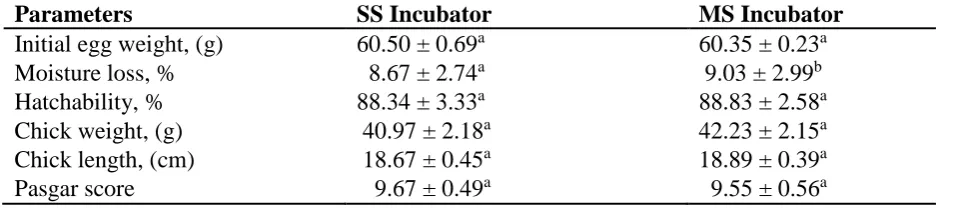
The initial egg weight and hatchability between two types of incubators were not significantly different (P > 0.05) (Table 1). However, the moisture loss % differed significantly (P < 0.05) between two different types of incubators. The highest moisture loss was reported in MS incubator. The amount of water and gases exchange depends on egg shell characteristics and a pressure difference between the egg and the surrounding (Walsberg, 1980; Molenaar et al., 2010). The average egg weight loss should be between 12 to 14% to obtain the highest hatchability of chicken eggs. Loss of egg weight must be between 6.5 and 14.0% of the initial egg weight, to obtain an adequate air cell size before the embryo internally pips (Molenaar et al., 2010). Hatchability and chick quality were affected by flock age (Petek et al., 2010). The SS incubator has reported the increased hatchability and better chick quality due to incubator temperature, humidity and
ventilation (Boerjan, 2006a).
Chick quality parameters
Chick quality parameters such as chick length, chick weight and pasgar score were not significantly (P > 0.05) different between two incubators (Table 1). However, highest chick weight and length were observed in MS incubator while SS incubator has the highest Pasgar score. Chick hatching weight is an indicator of chick quality and it depends on egg weight and egg weight loss during incubation (Sozcu and Ipek, 2013). Hatchling weight increased when the percentage of relative humidity during incubation was increased (Bruzual et al., 2000; Molenaar et al., 2010). Chick length (measured from tip of the beak to the middle toe) is considered as a better indicator than chick weight (Preez, 2007). The pasgar score was not significantly different between two incubators (P > 0.05) but SS incubator showed the highest pasgar score (9.67). The pasgar score is currently used to express the chick quality using a number and it has been developed by evaluating five morphological criteria such as reflex, navel, legs, beak and yolk sac volume of the chicks. A sample of at least 30 saleable chicks must be assessed to get a representative score for chick quality of a flock of chicks. Some studies reported that best quality chick have a pasgar score of 10 and one point is subtracted for each abnormality observed in morphological criteria stated above (Boerjan, 2002; Boerjan, 2006b). In the present study, though not significant, the highest pasgar score (9.67) was reported in the SS incubator.
Table 1: The effect of two different types of incubators on incubation and chick quality parameters
Parameters SS Incubator MS Incubator
Initial egg weight, (g) 60.50 ± 0.69a 60.35 ± 0.23a
Moisture loss, % 8.67 ± 2.74a 9.03 ± 2.99b
Hatchability, % 88.34 ± 3.33a 88.83 ± 2.58a
Chick weight, (g) 40.97 ± 2.18a 42.23 ± 2.15a
Chick length, (cm) 18.67 ± 0.45a 18.89 ± 0.39a
Pasgar score 9.67 ± 0.49a 9.55 ± 0.56a
Data are presented as mean ± SD
a,b Means within the same row with same superscript are not significantly different
Egg breakout analysis
As per the egg breakout analysis, it showed that membrane, blood ring, 3 - 7 day and 15 - 21 day development stages were higher in SS incubated eggs (Figure 1). Egg breakout analyses are useful hatchery management procedures that provide valuable information in isolating problems in the breeder and hatchery program. The hatch day breakout analysis involves sampling of unhatched eggs from breeder flocks, and classifying them into the various causes of reproductive failure (Mauldin, 2000). Egg breakout analysis is critical in pinpointing problems in setters and hatchers. High number of early dead of embryo indicates prolong storage or storage at elevated temperatures, or inadequate egg collection procedures (Abudabos, 2010). High temperature of embryo, nutritional deficiencies of breeder flocks and contamination are the reasons for high number of middle dead of embryo at the same time setter/ hatcher temperature and humidity problems, egg transfer damages, egg set upside down, insufficient water loss and nutritional deficiencies of breeder flocks are caused high number of late dead of embryo (Abudabos, 2010).
Figure 1: The results of the egg breakout analyses
Growth performances and carcass quality parameters
The growth performance of broilers at slaughter depends on egg quality and incubation conditions (Boerjan, 2006a). The day old chick quality has an important effect on the growth performance of the broiler (Christiensen, 2001; Meijerhof, 2005; Mendes et al., 2007; Wolanski et al., 2007; Petek et al., 2010).
Weekly body weight and feed conversion ratio (FCR)
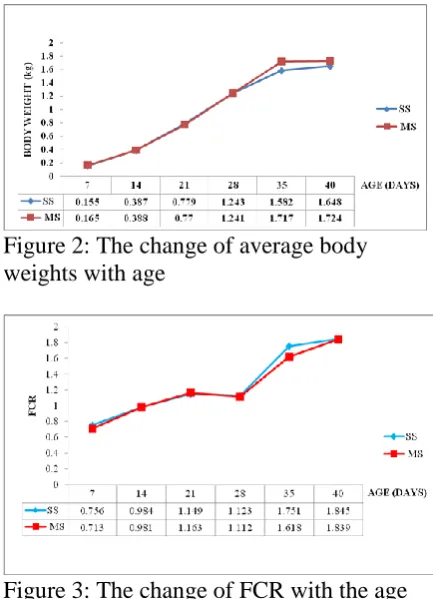
Highest average body weight (Figure 2) and lowest FCR (Figure 3) were observed in birds hatched from MS (1.72 kg and 1.84) compared to SS incubator (1.64 kg and 1.85). There was no much difference in the FCR values between SS and MS incubated chicks. According to a study, SS incubated chicks showed the better FCR than MS incubated chicks (Petek et al., 2010). However, in the present study, chicks incubated in MS showed the better FCR compared to SS incubated chicks.
Figure 2: The change of average body weights with age
Figure 3: The change of FCR with the age
Dressing and yield percentage
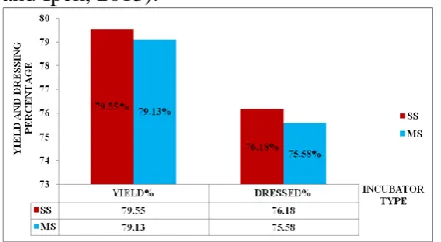
Average carcass yield and dressing percentage were higher in birds hatched in the SS (79.6% and 76.2%) than MS (79.1% and 75.6 %) incubator (Figure 4). One of the effects of SS incubation is more robust growth of the embryo and less egg weight loss during incubation. A 15% weight loss was desirable during incubation as a thumb rule. The weight loss in SS incubator is closer to 9-11% and result in heavier embryo at hatch which leads to less of a problem with dehydration and a quicker start. Relative humidity within an incubator can change egg weight loss. The relative
humidity during incubation may have an effect on later performance (Moleenar et al., 2010). There is a critical relationship between the DOC quality and post-hatch broiler performance. The chick quality is affected by incubation conditions during embryonic development stage and after hatching it reflects significantly subsequent performance during rearing period. Many studies have confirmed that variation of 1 g in broiler chick hatching weight reflects to slaughter weight as 50-100 g losses (Sozcu and Ipek, 2013).
Figure 4: The change of average carcass yield and dressing percentage
CONCLUSIONS
The moisture loss during incubation is higher in the Multi-stage incubator. Both types of incubators do not affect the hatchability and chick quality. The average body weight and the FCR are almost similar between SS and MS incubated chicks. The Single stage incubated chicks show the better dressing percentage and carcass yield
ACKNOWLEDGMENT
The authors would like to thank all the academic and non-academic staff members of the Faculty of Agriculture Rajarata University of Sri Lanka and to Bairaha Farms PLC. Pasyala, Sri Lanka for the valuable coordination and contribution given throughout the study period for the success of the experiment.
REFERENCES
1. Abudabos, A. (2010). The effect of broiler breeder strain and parent flock age on hatchability and fertile hatchability. Int. J. Poult. Sci.; 9: 231-235.
2. Boerjan, M. L. (2006a). Chick vitality and uniformity.
International Hatchery Practice, 20 (8): 7- 8.
3. Boerjan, M. L. (2002). Chick vitality and uniformity. Avian Poult. Biol. Rev.; 13: 237-238. 4. Boerjan, M. L. (2006b).
Incubation for uniformity.
Australian Poult. Sci. Symposium, 18: 174-181.
5. Bruzual, J. J., Peak, S. D., Brake, J. & Peebles, E. D. (2000). Effects of relative humidity during
incubation on hatchability and body weight of broiler chicks from young breeder flocks. Poult. Sci.; 79: 827-830.
6. Christensen, V. L. (2001). Development during the first seven days post-hatching Pages. In: Baggott GK et al.(ed)
Perspectives in fertilisation and embryonic development in poultry. Ratite Conference Book, Oxford, UK, 31-36.
7. DAPH (Department of Animal Product and Health) (2014). Poultry Sector Forecast-2014: Peradeniya, Sri Lanka.
8. Geidam, Y. A., Ibrahim, U. I., Bukar, M. M., Gambo, H. I. & Ojo, O. (2007). Quality assessment of broiler day-old chicks supplied to Maiduguri, North-Eastern Nigeria. Int. J. Poult. Sci.; 6 (2): 107-110. 9. Mouldin, J.M. (2000). Breakout
analyses guide for hatcheries. World Poultry Elsevier Special, 30-33.
10. Meijerhof, R. (2005). Defining and measuring quality in day old broilers. International Hatchery Practises, 19: 7.
11. Mendes, M., Dincer, E. & Arslan, E. (2007). Profile analysis and growth curve for body mass index of broiler chickens reared under different feed restrictions in early age. Arch Tierz.; 50: 403-411. 12. Molenaar, R., Reijrink, I. A. M.,
throughout incubation: A Review. Brazilian Journal of Poult. Sci.; 12 (3): 137-148.
13. Petek, M., Orman, A., Dikmen, S. & Alpay, F. (2010). Physical chick parameters and effects on growth performance in broiler. Arch Tierz.; 53(1): 108-115. 14. Preez, J. H. D. (2007). The effect
of different incubation temperature on chick quality. Department of Animal Sciences, Faculty of Agriculture Sciences, University of Stellenbosch. 15. Sozcu, A. & Ipek, A. (2013).
Incubation conditions affect chick quality and broiler performance. Journal of Agricultural Faculty of Uludag University, 27(2): 139-
146.
16. Verrees, R. & Smet, F. D. (2010). Maximising viable chick
production in the hatchery, International Hatchery Practice, 24(8): 15-17.
17. Walsberg, G. E. (1980). The gaseous microclimate of the avian nest during incubation. Am. Zool.; 20: 363-372.
18. Wolanski, N. J., Renema, R. A., Robinson, F. E., Carney, V. L. & Fancher, B. L. (2007)
Relationship among egg characteristics, chick
measurements and early growth traits in ten broiler breeder strains. Poult. Sci.; 86: 1784-1792.